Showing posts with label groundhog. Show all posts

Saturday, April 17, 2010

Mother Nature's Mistakes


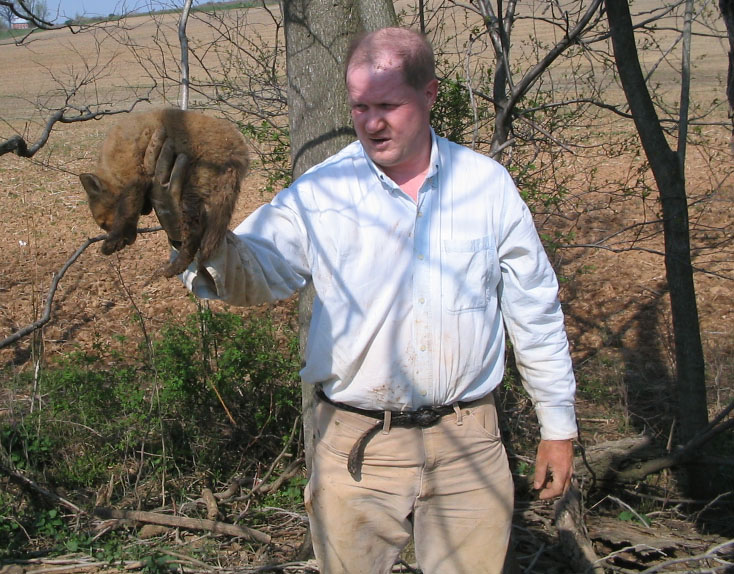
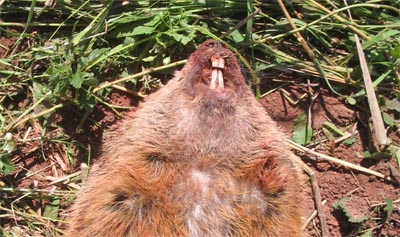
Teddy Moritz sent me this shocking photo of a tiny 5-pound groundhog with a terrible malocclusion of the jaw which resulted in the animal's teeth growing without end. As Teddy notes in her email: "Mother Nature is not always kind."

So why was I shocked by this photo? Well, I first saw it on my cell phone, and the picture was pretty tiny. What? Is that fingernail polish? When I got back to the computer, however, I saw it was just blood. Fine; all is right with the world again. Carry on.
.

Friday, April 16, 2010

Tarvag for Dinner Again?


A young Mongolian sharpshooter with Tarvags bound for the pot.

Two thousand years ago Herodotus told a tale of large furry ants that enriched the Persian empire by burrowing for gold.

According to Herodotus, the "ants were bigger than foxes, but smaller than dogs".

Herodotus's story inspired generations of treasure hunters and explorers going all the way back back to Alexander the Great.

Classical scholars assumed Herodotus was either a liar or a very gullible believer of fables. In fact, Herodotus was right -- it was the translators that were wrong.

It turns out that the "golden ants," were actually marmots that burrow into a gold-bearing stratum of sandy soil that lies just a few feet underground in much of Central Asia. The ancient Persian word for marmot, translates into "mountain ant".

The "Mountain Ant" of Pakistan is a close relative of the the North American Groundhog (Marmota Monax) and the Tarvag (Marmota sibirica).

The Tarvag and other Central Asia Marmots are hunted for food and for their fur, which -- if it is not used locally for fur coats -- is sheared, dyed and exported as "imitation marten."

It was fleas on the shipped hides of Mongolian Tarvag that first brought the Black Plague to Europe. The Tarvag is the natural home of Yersinia pestis -- the bacterium that inhabits the Xenopsylla cheopsis flea that thrives on Tarvag.

When dead Tarvag hides were shipped to Europe, Xenopsylla fleas leaped off the dead hides and reproduced on the Black Rat (Ratus ratus) which it found to be a suitable host.

The Bubonic Plague swept through Europe with the Black Rat until the Black Rat itself was driven out of Europe by another import -- the Norwegian Rat (Ratus norvegicus), which probably originated in the Middle East.

With the arrival of the larger and more aggressive Norwegian Rat, the smaller and more docile Black Rat was pushed out of Europe, and the era of Bubonic Plague infestations in Europe ended.

The bad news is that Tarvag fleas (Xenopsylla cheopis) managed to get to the West Coast of the U.S. around 1900 where they found a home on black rats living in San Francisco. Believe it or not, Norwegian rats did not arrive on the West Coast of the U.S. until around 1940.

The Black Rat and the Xenopsylla flea rode the train into the deserts of the American Southwest shortly after arriving in the U.S., and today the Bubonic Plague is a permanent feature of Prairie Dog towns and, to a lesser extent, Richardson's Ground Squirrel colonies, in the American West.

Could the Plague come East to take up residence on the common Groundhogs? For some reason this has not yet happened. It's hard to know what the barrier is, but the Xenopsylla flea may not find the Groundhog a suitable host -- fleas and lice are often host-species specific, and most will live on only one or two kinds of animals and no others.

Another problem may be that it is simply too wet and cold for the Xenopsylla flea to thrive in an eastern North American hedgerow. The Plague bacillus and its host flea generally thrive in desert or near-desert conditions.

Though Europe is as cold and wet as the Eastern U.S, the Black Rats of the Europeam Middle Ages tended to live under warm and dry roofs. The Xenopsylla flea apparently found this habitat quite suitable, while a wet and frozen hedgerow is the exact opposite of what the flea is looking for.

Another bit of good news is that today the Bubonic Plague to treatable with massive amounts of antibiotics, provided patients seek medical attention and doctors properly diagnose the problem.
This is a repost from January 15, 2005.
.
.

Thursday, June 25, 2009

Undiggable Earths


This groundhog sette ran more than 6 feet deep through broken slates mixed with thick tree roots. This is a diggable earth, but one you do not want to tackle solo, as I was this day in the field. This is when you want a dog that will come out rather than force you to dig down to it.


If you dig very much, your dog will eventually enter a sette that, for one reason or another, is undiggable. Perhaps it is a fine-looking earth that, when shovel is put to soil, turns out to be a heap of roofing tin covered over with dirt -- or worse, a mound of steel-belted radial tires! I have had dogs enter settes that ran under huge pieces of broken iron sewage pipe that had been dumped into a ravine, as well as rock settes and massive hay bale stacks that were not going to be shifted without a backhoe.

Sometimes a sette is theoretically diggable, but you really would prefer not to. A 10-foot solo dig for a groundhog? Not if you can avoid it!

What do you do when your dog enters an earth that could only be dug if you were forced to chainsaw down the tree and prize out the roots?

Simple.

Stand back, far away, and sit down. Do not smoke, do not talk, and do not stand up. Do not sit near the sette -- you want to be so far back from the hole that the dog cannot hear you breathe or smell you. Do not shift your weight or bang your tools -- just sit and wait and watch the hole.

How long do you wait? That depends. Most dogs will come out between a half hour and an hour after they enter. What happens if they don't? You wait some more. Do not go back to the sette and do not call the dog.

Waiting is hard, especially if it's a green dog, or you are a green digger. There's a natural desire to do something -- to start digging, to call the dog, to shove a mirror and light down the hole, to walk around topside boxing for location, etc.

If you have really ascertained that the earth is undiggable, resist temptation.

Two or three hours may go by with the dog not coming out. The good news is that most dogs will exit on their own before this amount of time has passed. Be patient.

It is in these undiggable earths that small vocal dogs prove their worth, because these dogs are less likely to get stuck, are more likely to be able to turn around underground, and are less likely to shove dirt behind them that might "bottle them up" from behind.

If the dog is vocal, and you are quiet, you should be able to hear it bay when you are close to the sette (provided it does not have a mouth full of fur).

When the dog does appear, do not walk up to it, but instead turn your back, walk slowly away, and quietly call its name -- the dog will most likely follow. If it does not follow, and instead dives back into the hole, simply sit down and wait some more -- the dog will be out again, soon enough. Now you are simply in a waiting and training game.

An experienced dog will understand, in time, that you are a team and that if you are digging it has to hold ground, but if you are not digging for a long period of time it may be a signal to come out.

Dogs learn, provided we are consistent and give them lots of experience. It is on the experience end that most terrier owners fall down.

Thursday, June 18, 2009

A Baby Groundhog Discovers Dirt Dens


Cson has been rehabbing an orphaned baby groundhog who seems to get the idea pretty quickly that holes in the ground are very good places to check out. Nice!

Groundhogs are actually members of the squirrel family, and when they are very small, they look quite a bit like regular tree squirrels.

By late Fall, if all goes well, this little fellow will be pushing about 10 pounds, and by the end of its second year, if it has had a good feed, it will weigh in at around 15 pounds.


.

Monday, April 6, 2009

Digging on the Dogs


Yesterday was a nice day in the field with perfect weather, and three kinds of quarry dug to -- raccoon, groundhog and possum.


Mountain located a raccoon
in a dirt den underneath a massive brush pile. I will spare you the details, but suffice it to say I managed to burrow down into the brush pile and sink a bore hole between mountain and the raccoon. I then twisted the post hole diggers so they blocked Mountain from reaching the raccoon, and she got the idea and finally came out. Good thing too, as there was no digging her out, and she was not coming off that raccoon any other way!

I leashed up Mountain and we drove to another farm a short way up the road, where we quickly located a groundhog and dispatched it at the farm manager's request.


I estimate I have taken 200 groundhog off of this particular farm, and there are not many left, though the farm manager says he has lost a few turkeys to a coyote, and the farm across the road took an enormous coyote last month -- the largest in the County so far.


The dogs checked a few more holes, and Mountain located a pretty tough-acting possum, which I pulled before Mountain decided to teach it respect. Possums are pretty harmless creatures, and though Dave the farm manager has chickens this fellow was toward the back of the farm, so I released him with nothing more than a stern warning.


This possum was released unharmed.

.

Monday, March 16, 2009

If You Come Across a Fox Sette This Time of Year


You can never be too careful this time of year, as fox can sometimes be found in groundhog settes that otherwise have little or no evidence of fox occupation.

While a fox in estrus will emit a stink, natal dens often barely smell at all -- a chemical change in the fox, and a natural protective defense after she whelps.

If you do come across a natal den, handle the kits as little as possible and put them back in the den. The mother fox will return very soon and move them, provided you clear out.

You can rest assured she has dug several dens close by, as fox will often move their litters two or three times even if undisturbed -- a way to lose flea and parasite infestations, and also to reduce run marks that might lead a dog, coyote, bobcat or human to the site of the den.

If a kit is harmed by a dog, humanely dispatch it and remove it from the area of the den after returning the unharmed kits to the den. Fox mortality is naturally higher than 50% in the first year, and the loss of one kit, while regrettable, will actually improve the odds of the remainder.

The kit, above, was an accidental run-in at a groundhog sette a few years back. There were five kits inside, and this one was removed unharmed by the dog. She was scooted back inside the sette without a mark on her, and she tumbled back down the pipe. The sette was carefully repaired with a bit of scrap rug found in the hedge, and the cubs were later spotted several weeks later and just one field over.
.

Friday, April 4, 2008

Groundhogs 101


This little video backgrounder comes from the Missouri Dept. of the Conservation.

On another page, the same Department notes that groundhogs "feed in hay or crop fields, home gardens, orchards and nurseries; and the burrows and mounds may be hazardous to farm equipment or to horses and riders. For these reasons, control measures may be necessary."

Right.

Instructions are given on how to shoot, use gas cartridges, and trap. Of course, nothing is as targetted or as humane as terrier work.
.

Thursday, March 13, 2008

Groundhog Teeth


Folks in Europe and elsewhere sometimes ask me to compare our quarry to fox. They seem especially curious about groundhog, our bread-and-butter quarry.

How do you compare apples and eggs?

Groundhog are simply different. For the dog, they can be tough to locate in a large sette with soft earth, as they can dig away quite rapidly.

If a larger dog tries to dig to a groundhog in tight pipe, the dog can easily bottle itself front and back with an earth plug behind and an earth plug in front. This does not happen too often, but suffocation can and, occassionally does, kill a dog.

Groundhogs have no necks and cannot be throttled underground and can only rarely be pulled by a dog -- and then only if they are very close to the entrance or you have broken away most of the pipe at the very end of a dig.

A groundhog's bites are mosly chisel-like rips, and they are very good at ripping through lips, and can easily slice up a nose or rip an eye. Again, most injuries are pretty superficial and will granulate on their own, but the injuries from a groundhog are a little different from those a dog might get from a fox.

A fox has canines and they tend to create puncture wounds top and bottom, and relatively light rips, as a general rule. Infection and eye damage are the main worry.

Groundhogs have chisels for teeth, and can remove a kerf of flesh from the face. They have shorter jaws than a fox, but they are more powerful and can crush if they get a dog right. Infection is less of a concern (though it occurs, of course). Eye injuries to a dog are about as common as from a fox -- rare, but a worry despite the shorter jaw.

I consider groundhogs tough for the totality of the package, racoons tough only if and when they want to stand and scrap, and fox third in line, with possum a distant fourth. Other folks would rank them differently (possum would always be fourth), and I would not argue.

Fox are most people's favorite animals because they are so wonderful to look at and because the season is pretty short -- about two months for the heart of it. The deal with groundhogs is that we dig so many of them that they are the animal most likely to get a dog wrecked.  Again, serioous damage to the dog is rare, but it can be serious on rare occassions.

Over here in the United States, the simple truth cannot horse everything you find in the hole and expect to dig weekend after weekend, which is the name of the game. In the States you have to have a dog that works different quarry in different ways. What works for a fox will not work for a groundhog, and what works for a possum will not work for a raccoon. The dog has to know what it's up against and change tactics, and above all it has to know butt from breath.
.
.

Monday, March 10, 2008

The Architecture of Burrows

A reprint from this blog of April 22, 2005.

The list of animals that hibernate in underground burrows, live in burrows or nest in burrows is astounding: fox, badger, turtles, some owls and parrots, ground squirrels and marmots, some penguins and puffins, European rabbits, bears, wolves and dogs, otter, some wild pigs, some wild cats, many snakes and lizards, possums, wombats, frogs and toads, moles, mice and rats, nutria, crayfish, armadillos, skunks, muskrats, meerkats, some large spiders, and several types of bees.

Many of these animals spend a fair amount of time constructing, maintaining, and modifying their den systems which, in turn, are structured in response to changing external circumstances and changing internal needs.

Anatomy, behavior, and distribution of wild animals are all greatly affected by the burrow environment, with temperature, humidity, oxygen, living space, availability of food, and protection from flooding and predation all being influenced by burrow architecture.

Despite this, the burrow structure of almost all subterranean mammals is barely known, and data and descriptions of den structures as they relate to soil composition, drainage, external defenses (rock, wire fences, farm buildings), proximity to food and water sources, is almost entirely non-existent.

All of this make understanding burrow architecture as an adaptive tool a difficult task, but it nonetheless clear, among humans digging to their terriers, that burrows are designed with a reason and that certain "tricks" keep popping up. A few I have noticed in the construction of groundhog and fox dens:

  • Water and the phreatic zone: Dens of fox and groundhogs are designed to keep the animals dry, yet fox in particular like to locate their dens very near water. Shallow dens are sometimes found carved into the sides of small humps or rises in marshy areas, but these are rarely natal dens. The deeper natal dens of fox are generally found on the rises above the flood plains -- on well-drained hillsides near a creek or pond or water-filled ditch. The ideal spot for a pipe is deep enough to be dry from surface water, but not so deep as to be encountering the water table -- the so-called "phreatic zone".

  • The "plumbers pipe" opening: In these settes the pipes run down for two or three feet before rising again and then dropping again. This creates an earthen "water stop" not so very different from the plumbers p-pipe you will find under your kitchen sink. This is a common feature in many animal burrows, from rat to fox.

  • Depth is determined by soil: This is near-truth. The softer the earth and the easier it drains, the deeper the den is likely to be. One of the chief functions of a den is to keep the animal dry, and in soils that are very light, dryness tends to be achieved with some depth. You may cut through very soft stuff for three or four feet, but below that will be the harder stuff -- a layer of hard sand below the soft, or a layer of hard dry clay below much softer friable soil. The pipe is likely to be in softer soil that lies below the vein of hard stuff. The hard vein works to structurally support the pipe and to keep out the last bits of water. The one exception that I would note is where a ridge is made almost entirely of small cherts, flints or flaked slate. Here digging by a fox or groundhog is so hard, and the drainage of water is so rapid, that the den pipe may be very shallow since water runs through the den as fast as it falls. These shallow and breezy loose-rock dens will not be used in winter, but are likely spots in summer.

  • Rocks, roots and barbed wire at the entrance: This is so common that it is clearly a planned design feature. It is not uncommon to find dens exiting inside a stump or hollow tree, or to have a strand or two of barbed wire running along the lip. Groundhog dens frequently start on one side of a barbed wire fence and exit out another. If there is an abandoned vehicle on the edge of a farm, a groundhog will invariably makes its home under the chassis -- a nice shelter from the rain, but also from predators who will have to slow down to a crawl to avoid beaning themselves on the I-beam and suspension. Hard structures not only make digging out more difficult, it makes a mad dash at the den hole a dangerous and maladaptive strategy for large predators. In addition to hard structures at den entrances and exits, you will frequently find "soft structures" such as thickets of multi-flora rose, bramble, poison ivy, and thick wild grape vines serving the same function.

  • The hard turn after the den entrance: This is a frequent feature of groundhog den entrances and serves two purposes: 1) it makes it difficult for predators to enter, and; 2) water entering the entrance will tend to follow the straight line of gravity and soak into the ground at the end of the pipe rather than run sideways with the turn of the pipe. I have encountered some rather incredible animals that took this "hard turn at the entrance" technique to absurd levels as they never stopped turning -- they corkscrewed their dens in full circles all the way down in a spiral that went four or five feet deep.

  • The pocket room close to the entrance: This is a common feature of groundhog dens, and I believe these serve as "loafing parlors" where the animal can tuck in out of danger between feeding forays. If you are quiet, and the dog is too, you can often bottle a groundhog in one of these little rooms before it goes deeper into the sette.

  • Right angle turns inside the den pipe: These are very frequent features of groundhog and fox dens and seem to serve two purposes. The first purpose is that they help keep the den dry, as water running down a pipe will tend to follow gravity rather than take a sudden turn to the left or right. The second purpose is clearly defensive; a groundhog or fox can take a stand at a corner and slash out at anything coming down the pipe, inflicting considerable damage if the corner is tight, as it invariably is. Often a sette will have several right-angle turns, each providing additional elements of security, like doors on a hallway. A human digging on a dog will often break into a pipe where the dog and quarry are at a standoff at one of these turns, at which point all hell will break loose as the animals grab each other, or else the fox or groundhog will manage to retreat to the next hard corner in the pipe system -- a kind of running battle that can be very frustrating to the digger!

  • Side pipes and stop-end branches: These are common feature of both groundhog pipes and fox dens. Some of these represent unfinished den digging, but for a fox they also provide a place into which one animal can scoot in order to let another pass by, where one animal can lay up without getting overheated from the warmth of its mate and where it can get a better supply of air. Earth dens are all about keeping dry, maintaining the right temperature, keeping the air flowing, and staying secure. Side passages increase the options on all counts.

  • Field settes are generally deeper and larger than hedgerow settes, and often harder for the human to dig up as a consequence: I believe this is due to a conflux of opportunity and necessity. The opportunity for larger and deeper settes is due to the lack of obstructions like roots and rocks. The necessity is that plowed fields with friable soils require deeper dens to remain dry, while larger more complex settes are an element of security, allowing a groundhog or fox to escape danger in one part of the sette by going to another -- or even bolting out of one entrance into another nearby sette.

  • Large "race track" settes are fairly common in fields. These large settes circle back on themselves several times and may have several layers of pipe. More commonly are simple four-, five-, or six-eyed settes with connecting pipes. A groundhog can run around in these large settes, shoveling dirt behind it to block the dog, and effectively preventing the dog from bottling it in a stop end. The solution I employ is to earth stop the den at two or three spots (generally at exits where the pipe goes left and right). If needed I will also allow two experienced dogs that know each other well to enter opposite sides of the settes and work the animal to the middle. This generally prevents the groundhog from digging in and gets the animal pinned against one of the newly-minted stop-ends in short order. Putting two dogs to ground should be left to people who know their dogs well and who are experienced diggers. It is better to lose quarry than a dog. Two very hard dogs to ground, or two dogs in a den occupied by a skunk, could be a disaster! Never enter two dogs on a fox -- it is simply not necessary, as the fox cannot dig away.

  • Winter "fox porches": A fox will often dig out the first three or four feet of a groundhog den and create a kind of "loafing porch" where it can tuck in out of the wind but still not be fully underground. Fox can easily overheat inside the earth, and this "porch" area allows for easy temperature regulation -- go a little deeper if it is very cold, stay right at the entrance if it is warm. The breezeway allows the fox two excellent avenues of escape if danger approaches -- into the nearby woods or thicket, or deeper underground.

  • An observation on what does not dig: Raccoons and possums do not dig earth dens -- they occupy holes made by other animals or find hollow trees, brush piles, rock crevices, hay bales, barns or crawlspaces. Neither animal is equipped to move dirt beyond a little scratching for worms and beetle grubs. Neither animal will modify a den in a significant way (though both will pull plastic bags and other debris into a den in order to improve insulation and provide bedding).

Tuesday, March 4, 2008

Groundhogs helping find a fix for Hepatitis B

White rats have done their bit in laboratory and psychology experiments going back more than 100 years. Now scientists have finally found a use for the groundhog, which seems to be VERY good news for chimps!


Drug Discovery and Development, April 1, 2004

Chronic hepatitis B is one of the 10 most common causes of death.

Worldwide, more than one million out of the 350 million chronic carriers of HBV die each year from complications of the disease. In the United States, approximately 1.25 million people are believed to have chronic HBV and an estimated 200,000 people become newly infected each year.

Approximately 4,000 to 5,000 people in the United States die each year from hepatitis-B-related chronic liver disease or liver cancer, and it is the leading cause of liver cancer.

Endeavors to contain the global pandemic of human HBV infection have been hindered by the virus's limited host range and the inability to propagate HBV in cell culture.

Then, in waddles the woodchuck (Marmota monax), more commonly known as the groundhog.

Woodchuck hepatitis virus (WHV) is closely related to HBV in its virus genetic organization and mechanism of replication. "The groundhog, the one who just saw his shadow, has its own hepatitis virus that develops into a progressive hepatitis and hepatocellular carcinoma that's very similar to the HBV-associated hepatocellular carcinomas in humans," says Leland. The predictable course of experimental WHV infection leading to liver disease in woodchucks makes them an ideal animal model in which to study the natural history of hepadenavirus and to develop effective antiviral strategies.

Research comparing the results of the effect of nucleoside analogs in woodchucks with their effect in humans demonstrates that it is an excellent model to test anti-HBV therapies. Studies show that without any treatment, more than 75% of infected woodchucks die by age 3 years, usually from primary liver cancer due to WHV. By age 4, more than 95% die due to WHV-related primary liver cancer, a sequela that is common in humans with HBV. "It's a reproducible model, found in the wild, with a much shorter time course and many similarities to the human disease," says Leland.

Historically, chimpanzees have been the cornerstone of all research on HBV infectivity, safety, and vaccine efficacy. The woodchuck model has a major advantage in that it can be adapted to the experimental laboratory and therefore eliminate many of the ethical and endangered status concerns associated with using chimpanzees.
.

Sunday, February 3, 2008

Cracking Tired Chestnuts About Form and Function


Red fox taxidermy mannequins. There is no red fox taxidermy mannequin anywhere in the world that has a chest span of greater than 14 inches.


At the side of every show ring, there is always some well-dressed individual talking about "the standard" and how "form follows function."

It all sounds good, of course -- wonderful rhetorical chestnuts -- but it's pretty much nonsense.

I mean think about it. A working dachshund is a great little animal in the field and does the same work as a terrier, but it does not look like a terrier, does it?

By the same token, a Patterdale Terrier does not look too much like a Jack Russell, which does not look too much like a Border Terrier. Smooth coats and rough do equally well in the field, as do coats of black or white, red or brown, or any combination in between. A folded ear is the same as a prick ear, a black nose the same as a liver-colored nose. Every working earth dog breed has a different head shape, and many have different tails as well. A perfect scissors bite is not necessary for work.

So when people say "form follows function," what the hell are they talking about?

Let us hope they are not talking about movement. Movement is one of those words show people toss around with a wink and a nod as if they have the secret knowledge of a wine connoisseur.

It is pure bunk. "Movement" may be important to a greyhound, a pulling dog, or even a border collie, but it is not much of a concern as it relates to a working terrier. So long as a dog can walk well, and has decent muscle mass, it can work fine. Hocks in or out hardly matters a whit.

Which is not to say that movement is irrelevant to terrier work. In fact, it is critical. But the important movement is .... wait for it .... an owner that will move off the couch, and move out of the car, and move into a hedgerow, and move a lot of dirt while digging down to a dog that is in full voice with rising adrenaline. That's the only important part of movement that matters. After you have done that a few dozen times, you will know a little more about movement, and terriers in particular.

We hear a great deal of nodding nonsense from folks who talk a good game about "protecting" their breed. But protect it from what? And by what right or qualification do these people think they are particularly well chosen to protect the bred? And what do they intend to protect it with?

In almost every case they are people who do not dig, and who seek to "protect" the terrier with nothing but a scrap of paper proclaiming a show dog "up to the standard."

And who do these people hope to protect the breed from? Why, show ring breeders, of course!

It is all laughable nonsense. And it becomes nonsense on stilts when people begin to talk about "the standard" as if it were a sacred text delivered to Moses on the Mount.

In fact, is there anything standard about "the standard?" I defy you to find a single canine standard that is more than 20 years old that has not been changed at least once.

And then there is the little matter that the standard is not the same from one country to another, or one registry to another. So what is so "standard" about the standard?

Ironically, what is NOT part of any standard in the UK or the US, is a requirement that the dog actually be a proven worker in the field. That, apparently is not "the standard." That function is not required for the rosette. A black nose, is a "Yes," but working a dozen fox, raccoon, badger, or groundhog in the field, is a "No."

The one issue of any importance in "the standard" as it relates to "form follows function," is chest size. Yet on this point, "the standard" is awfully vague, isn't it?

We are told a chest span is a man's hands. Yes, but whose hands? We do not measure a house in cubits, so why are we measuring dogs in "hand spans"? Who but the puppy peddler profits by keeping chest measurements this vague?

The Germans are not so coy and facile about chest size. A standard working dachshund (a "Teckel" in German) has a chest of just under 14 inches. The measurement is precise -- 35 cm -- and it reflects the chest size of the average red fox. The Germans are not ones to shave dice when it comes to working dogs.

It is interesing that the same 14" chest size is named not only by fox biologists, but also by such terriermen as Barry Jones, Ken James, and Eddie Chapman. In fact, if any one thing separates the digger from the rosette chaser, it's clarity on chest size.

The rosette chaser is always a bit vague about what a "span" actually means. A digger knows it means his fingers better well overlap, and if he is working fox in a natural fox-dug earth, it is best if his fingers overlap by more than one joint!

And so we come back to the real meaning of "form follows function" as used by academics in the dog world.

For these folks the "form" being refered to seems to be a paper form showing the pedigree of the animal being displayed. And "the function" is either the rosette from a show judge, or the cash to be gotten from a prospective dog-buyer.

Form follows function, indeed!

.

Thursday, January 3, 2008

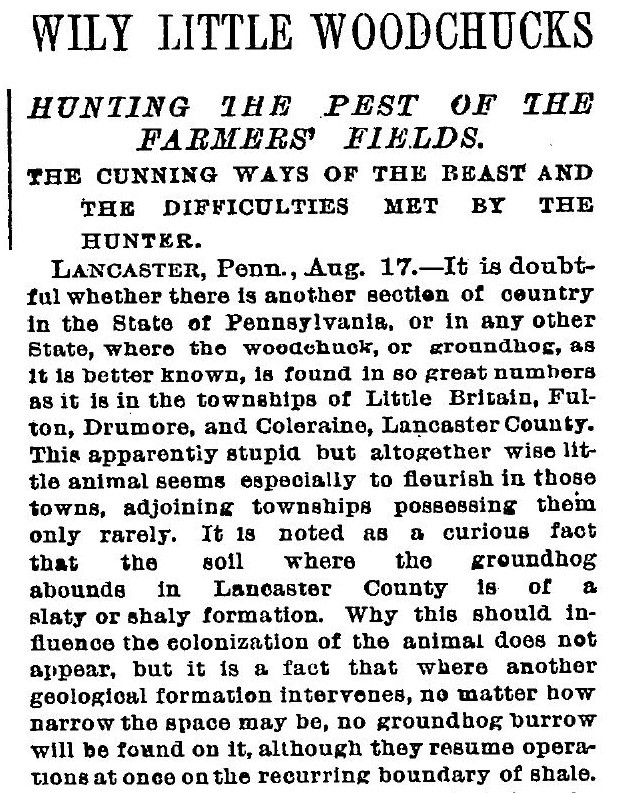
Groundhog Hunting Circa 1888

From the The New York Times of August 18, 1888. A hat tip to Teddy Moritz for this one!

Be sure to read the full article here.


Friday, November 23, 2007

Form for Function: Span Quarry, Not Just Dogs


Spanning a small-to-average groundhog. Notice how long a groundhog body can get when stretched under its own weight. These things are built like sacks of water.

This groundhog spans to the spot on my thumbs where I want a dog to span to. If my thumbs do not overlap all or most of the first joint, the dog is too big to easily get into most earths in the Eastern U.S.

I look for dogs with chests of 14 inches or less, and recommend that people who are serious about hunting their dogs do not compromise on this all-important point.

Remember that as a dog gets older, it's chest will generally spring out a bit and sometimes it gets less flexible too. A dog that is marginal for size at one year of age is only going to get bigger in the chest as time goes on. You want a dog that can hunt well past age six or seven, right? Then get a smaller dog.

But aren't fox bigger? Nope -- not really. It says quite a lot that the largest red fox taxidermy mannequin in the world has a 14" chest, while some are sold with chests as small as 11 inches.

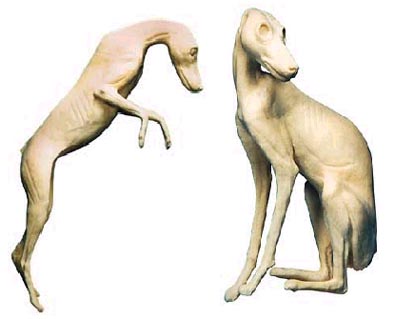
A fox is not built like a dog; it is built like a cat and underneath all that fur, it has the body shape of a small whippet.
.

Saturday, October 20, 2007

Digging on the Dogs


Char came down from Illinois to attend the JRTCA's 25th Annual Nationals trial, and I took the day off to go digging with her. The weather called for rain, but I told Char the weather reports did not mean too much around here, and that we'd probably get by with an overcast day before a good evening thunderstorm, which is exactly how it went.

We met up at Stups Market, and then headed a few hundred yards up the road to a little farm where I have been digging in recent months. Pearl is still knitting up from a dig two weeks ago, so I left her in the truck (Char bred her, and she's been a great dog for me), and we took Mountain and Char's Rue up a hedgerow to see what we could see.

Within the first five minutes Rue bolted a nice groundhog up a tree, and Char got a picture. Excellent!

We found the next groundhog where I thought we would -- in a trash-strewn hedgerow in the middle of two recently cut-over bean fields. The dogs bolted this one too (a very BIG groundhog!), and it dashed out and slid under a half dozen coils of old rusty barbed wire and into a cascade of steel and iron car parts, rotting fence posts, old tires, and broken bottles.

Mountain located this groundhog again, but after moving a couple of big rusty barbed wire coils, and seeing what was below that, we decided to give this groundhog best and move on. Why put a dog out of action working barbed wire, broken glass and trash when the day was still so young?

We rolled on across the top of the field, and down the middle. I swear, if we had a dollar for every piece of fox and raccoon crap we saw, Char and I both would have had gas money for a week.

The fox and raccoon are definitely marking every scrap of territory on this farm. And who can blame them with such nice fields of soy and corn bordering a narrow meadow with a stream running down the center? The soil here is pretty friable, and the drainage is very good. There are not too many trees, but the ones standing are often huge. This is about as good a farm as I have found for fox and raccoon. And the groundhogs are thick on the ground too.

We headed down to the edge of the soy field after banging around another recently occupied sette that had a slightly skunky smell to it.

Mountain located in another nice big sette along the fence line. She bayed it up and we downed tools, located, and dug to her. To make a long story short, this sette had two nice groundhogs in it, and both were accounted for, one by Rue and the other by Mountain. Rue did an excellent job of holding her hog while we finished up with Mountain's and could devote our full attention to her end of the pipe. Both dogs came away from this dig without so much as a nick for their efforts.

After the dig, I walked down field for a quick bathroom break, when I saw something white ambling my way -- a skunk. "Lace up the dogs Char," I yelled back to her "We have a skunk coming down the fence line. " The skunk hardly seemed to care about me. I ran back for the camera and took a few quick shots, as this skunk was almost completely white on top. A nice little freak of nature -- the kind of thing that awakes the raging 10-year old bug-collector inside of me.

We repaired the den we had dug up, and had just finished gathering up the tools, when Mountain began poking around a sette about 12 feet away. She slipped underground, and from the sound of it she began to dig on a bit.

No worries. We relaxed, waiting for her to find and open up if she did. In the interim, we took a few pictures of the two hogs, gabbed, and rested a bit.

It was then that Char noticed the white skunk coming back down the fence line, and so I grabbed a heavy board-like piece of bark with the idea of either changing the skunk's trajectory or its perspective on life. I was tossing the chunk of wood at the skunk's head (and missing by about three inches), when Char yelled back to me, "SKUNK in the ground with Mountain."

Oh crap!

I jogged back to the hole, and sure enough there was the faint smell of skunk coming out. Mountain was baying a bit, but then she fell silent.

Oh damn!

We boxed, but the collar seemed to be working intermittently, and so while Char cut away at the entrance hole which seemed to have the most sound coming out of it, I barred down to where I thought the den pipe was.

I think the bar had just popped into the den pipe, but I was not absolutely certain, and was about to bar again three inches over when Mountain began to bay a bit closer to the hole where Char had been cutting away.

Excellent. A baying dog is a living dog with some oyygen.

I ran over to where the sound had been coming out, and Char and I both cut back on the pipe entrance until Char said she could see the skunk, trying to exit, head out.

Mountain was baying a bit more now. I relaxed. No worries. If you can see the skunk and hear the dog, it's probably not going to end bad. This was going to be a bolt.

Char backed away from the hole, and I waited for the skunk to clear the pipe before I tried to nail it with the digging bar. I missed, and the skunk bolted for another pipe with Mountain chasing on after her. Char just managed to grab Mountain before she went to ground a second time, and we collared her up and checked her over for damage. She was stinky, but otherwise fine.

Mountain has been skunked a few times before, and does not seem to be overly sensitive as some dogs are. I checked her over, and she did not have the yellow spray marks on her chest or head that would suggest she got a full-on hit at very close range. I suspect the skunk was three feet ahead of her when it blew its load -- a good thing, I can tell you, as a full load to the skin is a lot of toxin (skunk spray is almost pure sulphuric acid) and stink. I collared her up and tied her to the fence twenty feet away, and in a few minutes she was rolling in the grass trying to get the stink off. She was going to be fine.

We filled in the skunk hole, checked Mountain again (no burning of the corneas), and decided to hit the trucks to swap out dogs and get a cold drink or two for ourselves.

At the truck we ran into the farm owners, and after a nice visit with all the dogs, we left them to hit the other side of the creek with Smudge and Sassy.

Smudge is an older dog that has had the good fortune of finding a home with Char, while Sassy is the one-year old full sister (out of a different litter) to my Pearl.

We walked down the creek bank, and there were a lot of holes over the space of 500 yards, but all of them were blank. I have taken about 30-35 groundhogs out of this creek bed over the last few months, and it seems I have made a some small dent in the population. Still, the stream bank is not completely blank, as I have bolted a few that got away as recently as last week, and the week before that.

From our side of the creek we could see some of the exit holes on the other bank, and so when we saw a really nice sette under a huge old elm tree on the other side, we decided to cross over and check it out.

Smudge waded over ahead of us and noodled up the bank through the thick maze of roots. Char followed directly behind, while I rounded and went up the bank a few yards upstream. By the time I got top side, Smudge was in the ground and baying up a storm.

When I say this was a big elm tree, I'm not kidding -- it was six or seven feet through the middle, with the top broken off about 25 feet up. Smudge sounded like he was inside the trunk . I circled the tree looking for a way in. There was a small soft-looking spot at the back base of the tree, and I started to pull away some matted leaves to see if I could find a hole when a large raccoon stuck its nose out. Yow!

I don't know which of us was more freaked out by what we found on the other side of that thick plug of leaves. The raccoon, of course, was not expecting to see a 200-pound human. On my end, I am hyper-aware that we have a lot of rabid raccoons in our area, so I try to stay away from the business end of raccoon with my bare hands. Yes, yes, any mammal can get rabies, but raccoon are positively dizzy with the stuff around here.

Anyway, the raccoon darted back in the tree, and I now knew what we had inside. I reached into the hollow with Char's scraper and pulled out some dirt and a chunk of rotted wood. The pipe did not appear to be very big and it seemed to jog to the left.

I boxed to locate the dog and the locator said Smudge was about two feet inside the trunk from the left side, but it sounded like he was also a foot or two down in the ground below that. Maybe more.

I barred on the left side of the tree, and cut through some smaller roots until hitting hard massive trunk wood. I tore off some pretty decent chunks of wood, but there did not seem to be any weakness to this side of the tree.

While I was slamming the posthole digger and bar into the roots and trunk with almost total futility (and doing some sawing too, it should be said), Char had stuck her spade into the hole where I had seen the coon nose, and pulled out quite a bit of dirt. After looking into the hollow of the hole, however, she decided she had probably blocked off the pipe as she could not tell which way it went. I checked it out and she was right. Where DID the pipe go? I could not tell either, and poking around inside the trunk, everything felt pretty solid. The coon had tried to exit from here, but where it had gone to was a complete mystery.

About an hour had gone by, and Smudge was still baying up a storm, especially when we banged on the trunk a lot. Smudge clearly had the raccoon cornered, he was not backing off, and the raccoon was business-end out. Air was apparently not a problem, and it sounded like Smudge had a good location to work from. What to do?

I suggested to Char that we pull off about 80 feet, sit down, and see if the dog would come out on his own if he didn't hear us banging about on top with our tools. Some dogs will exit after a while if they do not hear humans digging or talking.

Thirty minutes later, Smudge had not moved and he was still baying up a storm. Hmmmm. We seem to have a dedicated working dog here! A new plan of attack was clearly needed.

I went back to the original hole at the base of the tree, and moved a large trunk and branch that had been serving as a porch over the hole. With the branch and trunk out of the way, I had a better purchase on the hole, and I used Char's scrapper to pull out a big piece of old rotten wood and dirt. I dug a bit more, my arm all the way in, and banged out pieces of old rotten wood that were large enough to make an apple crate out of. I put in the shovel and brought out a lot more dirt too. I was digging and banging around inside the trunk blindly, but I was definitely removing material. If nothing else, I was creating more air space inside, and that could only be good. Plus, I was doing something.

Char got a light, and I shined it up into the pipe, and now I could finally see the top of Smudge's wagging tail peeking out over a piece of rotten timber. He was clearly doing fine.

I pulled out a little more dirt and wood, and shone the light about some more. Now I could see that there was a wall of rotten wood and dirt between the dog and us. I explained the situation to Char, who scooted in to take a look. While she sussed out the situation, I explained our plan of attack in my best Ronald Reagan voice: "Mr Gorbachev, tear down this wall."

And so we did.

More wood and dirt came out of the hole, and in the end it was clear Smudge had the raccoon, still unseen, pinned down in a hole somewhere near his feet.

I reached in with the snare pole to pull Smudge out (he was farther in than I could reach), and he got the idea that I was not happy with where he was ensconced, and so he bolted out of the pipe, very hard and very fast.

In truth, when Smudge exploded out of the trunk, I was not sure if it was the dog or the raccoon coming out. And believe me when I say it mattered to me quite a lot at that moment!

When my heart stopped skipping, we got Smudge leashed up, packed up the tools, and decided to leave the raccoon for another day's sport. As a general rule, raccoon and fox do no harm on our farms, and I find it best to let them go. A living fox and raccoon is the promise of another day.

Smudge looked fine coming out of the hole, but in fact he was ripped up a bit at the gum line, and he started to swell up on the walk back to the truck.

Char cleaned him up and loaded him up with Clavamox, but when I saw him at JRTCA Nationals the next day, he was still swollen and tender. None-the-less, he picked up his Bronze Medallion for all of his previous work in the field, and I will say that no one could question that he was a true working dog!

A permanent hat tip to Char who has beautiful small workers, and knows what to do with them! Come down when it's cold, lady, and we'll see if we can put something up.

.

Monday, October 8, 2007

Digging on the Dogs


First one of the day, quickly and humanely dispatched.


There was a fog out early this morning, and on the back roads I notice that both the Poison Ivy and the Sumac are starting to turn red. Fall in not quite here yet, but it's coming.

I do not expect this will be much of a year for leaf color -- the drought has been too fierce. When it gets this bad, the leaves just give up the ghost and come down in great brown drifts.

In drought, there is never much of a color guard to welcome in winter.

Things are beyond dry. The Potomac River is so low that the rocky gorge at Great Falls look like a foreign river. In the smaller creeks you can find dust on the stones where a pool should be. Not good.

The corn is all burned up, but still standing, while the soybeans have already come off, or are in the process.

I visited Nick's Farm last weekend, but the dogs found nothing in two hours of walking around. I have hunted this farm for a long time, and taken several hundred groundhogs off of this 250-acres, but I think Dave's aggressive plowing and ripping of dens has been what has really pushed things to a low level.

Dave has a number of free-range chickens, and he tells me he has just added a pen of turkeys. He says he lost 30 chickens to a raccoon which he trapped and shot, and I told him about two raccoons I had taken out of an old feed bunk some time back. Raccoons up near the house and the chicken pens will not last long with Dave's traps in action. He says he also took out a skunk with 6 babies. I tell him next time to drown them rather than shoot through the trap. Less stink that way. There are a few small things I know about.

Dave gave my name to a farm owner up the road (Call him, he'll get rid of your groundhogs), and I really like this new farm and appreciate the referral. I notice that the soybeans have already come off. A harvest transport truck is still in the fields, and it looks like there might still be some standing beans above the ridge, but with the fog we had, it's still too early for anyone to be cranking up the machine.

I tape up the locator collars really well, as the dogs will be in and out of water today. We check out a few dens in the bean fields, but the groundhogs have left. Who can blame them? There is not much left to eat in these fields. These dens might hold fox in a few months, however, and I will make their acquittance now.

The dogs and I go down to the creek, where it is still green, and the dogs are in and out of a den, but it's hard to tell if they are interested or just playing grab-ass, when -- BAM-- a groundhog bolts out of one of the holes and runs up a tree. Man that was a fast bolt! Smart groundhog. Good for him -- we'll be back later and see how he fares next time.

The dogs settle down and start working, and a bit later they locate again. It's a pretty shallow dig in a tough thicket of tree roots. After a bit of a saw job, we catch up to the groundhog who is not too enormous. He is quickly terminated and recycled for fox food. That's the deal on this farm -- clean out all the groundhogs along the creek where they are wrecking the stream banks. "Yes, ma'am right on it."

Mountain finds another occupied sette and bays it up good, and it sounds like a raccoon. I try to locate. From the sound, Mountain is staying and baying in one location, but the locator is a little shy about exactly where that location is. The box seems to read equally well in a four foot radius. Not good. I bar down to locate a pipe, and hit one, but after digging down to it, I realize it's the wrong one. Or the wrong bit of the right one. As it turns out, there are several den pipes here that are very close together thanks to the intersecting tree roots which keep the ground solid despite all the tunneling.

I eventually hit the right pipe, pull Mountain, and swap Pearl in. Pearl skits up the tube, digs through some dirt and starts to bay. The critter is making a noise that can best be described as "furniture-being-dragged-across-the-floor." I am pretty sure it is a raccoon, as this is the sound I expect from them. I posthole down between the roots for a foot or two, but hit an obstruction and cannot get in enough to figure out what it is. There's not enough room to cut it or remove it. Lots and lots of roots -- always a problem when digging alone.

I cut another hole in the wrong location, but at least I can get into the pipe here, and I reach in and grab Pearl who has a cut lip. I tie her up, and I am turning around to snare whatever's in the den pipe when a large, dark-colored groundhog crowns out of the den entrance. A groundhog? It tries to bolt, but it doesn't make it very far despite my considerable surprise. Damn if I have ever heard a groundhog make the sounds this one did!


Two down (and one bolted), but I am dead from the heat, and the dogs and I head back to the truck.

The day started off with a promise of Fall, but shook that off pretty quickly. Now it's 90 degrees in the shade -- not that we found any shade.

I am cooked, but we'll be back. Hopefully, it will be a little cooler.

.

Monday, September 10, 2007

Sailor, A Working Terrier, Has Gone to Earth

Sailor died one year ago today, and it still hurts to talk about it.

And yet, this was a good death by any measure -- standing up, boots on, doing what she loved best.

The post below was her obituary from this blog, one year ago. Words cannot express how much I loved this small, self-effacing little dog. We had a happy life together.

____________________________


Sailor, the love of my life, has gone to earth for the last time.

Her last day was a beautiful sunny morning in September.

She worked a groundhog at the first hole of the day, only 200 feet from the truck, and she then found again, 10 feet deep, in a rocky sette under an ancient and shattered oak at the edge of the farm.

We moved on, confident that she would exit in a bit, and she did, following us up a slope to a large field sette where she located again and bolted a large groundhog, which was nailed by Mountain as it tried to slip back to ground.

Two groundhogs down, and it was not yet 9:30. It was already a good day.

The dogs noodled around the edge of a steeply sloped and forested creek bed, and Sailor found again in a mess of old iron, discarded rugs, and wood that had been topped over with dirt. This earth was undiggable, and we moved on, confident that Sailor would sense the silence and realize we were not interested.

At the bottom of the slope, I began to pound the posthole digger into the ground like I was digging, and down came Sailor, trotting to where the action was.

Fooled you, I thought, but she did not seem to mind. She traipsed along behind me as we went up the wooded slope to the fields on the other side.

We worked the edge of the fields, looking for settes. All three of the dogs pinged on a rocky set of holes just 100 yards up the edge. Excellent!

Once again, Sailor was in the ground first, moving around and trying to locate. This sette was very tight, and after forty-five minutes of chasing around through rocks, roots and rumble, Sailor came out, walked off a little ways into the woods, and sat down. She was tired.

Sailor giving up in the middle of a dig is a very odd thing, but I reminded myself she was a little dog and she was no longer young. Plus she had worked four settes already. And then, of course, this sette was impossible. Maybe she had the right idea -- move on.

I let Sailor rest for a few minutes, and then picked her up and carried her to the creek for water. She was not interested, so back we went to the hole.

While I was in the creek, Chris had been digging up a storm, and his young dog, Moxie, had at last found a small groundhog squeezed in among the broken slates. I helped Chris move a little more dirt to get to it, and then we dispatched it and decided to call it a day.

I picked up Sailor and a full load of tools and carried her back to the truck in my arms. She looked fine, but she was very tired.

We were about 100 yards from the truck, when Sailor suddenly squirmed and jumped out of my arms.

She hit the ground running, flying down the fresh-mowed hay field like a six-month old puppy. What the hell? Had she seen a rat? A cat? A groundhog? A fox? There was no telling.

Sailor disappeared over a slight curve of the earth, headed straight for the trucks. I was sure she was headed for the vehicles.

When I arrived at the trucks a minute or two later, Sailor was nowhere to be seen. I assumed she had slid under the vehicles to get cool, and so I loaded up the tools and poured her some water.

I looked under the truck, but the grass was too high to see anything. I looked under Chris' vehicle, but she was not there.

Chris walked up with Moxie and the rest of the tools, and Dave, the farm manager pulled up in his truck at exactly the same time.

Chris and I showed Dave the three groundhogs on the hood of my vehicle, and we talked a bit about Dave's chickens and the terrific quality of the eggs you get from pasture-raised hens.

While Dave was still there, I rolled my truck forward, very slowly, looking for Sailor. She was nowhere to be seen, and I began to get worried. She never wandered off. Ever...

Chris and I said goodbye to Dave, and then we headed off with Moxie and Mountain to find Sailor.

We walked the length of the hayfield, which Dave had cut as smooth as a suburban lawn the day before. We saw nothing.

Then, just as we neared the very end of the hayfield, Chris saw something white on the ground in the distance. He began to walk to it and then, as he got closer, he started to run. That was when I knew something was terribly wrong. I did not run.

It was Sailor. She was dead in the field, her eyes open, rigor just starting to set in to her legs. There was nothing at all around her. It was as if someone had put a stuffed toy out onto the lawn. But, of course, it was not a stuffed animal. It was Sailor.

Sailor must have been dead within a minute of when I last saw her. She had continued running past the trucks, taking a sharp right up the hayfield and then straight on to where she had expired.

Chris left me alone with Sailor, and I sat in the field, craddling the greatest little dog I have ever known, completely heart broken and dumbfounded.

There is no explaining it. Perhaps Sailor died of a massive heart attack or a stroke or an embolism. Perhaps the Black Widow Spider bite that she survived in June weakened her heart or brain, and something finally ruptured within. Perhaps she got stung by a bee or a hornet while she was in my arms, and that's what made her jump off and run, with anaphylactic shock setting in a few hundred yards later. Perhaps a Black Widow Spider got her, but this time it caused a very different reaction from the one before.

It hardly matters what killed her. Either way she is dead and gone, and now I have a hole in my life that seems unfathomable. I loved this little dog.

Sailor was wonderful on every level. She was like a cat in the house -- curling up in her bed, and mugging for my wife who adored her. No other dog was allowed on the bed, but Sailor was. It is an unequal world, and Sailor was an unequaled dog, and everyone knew it. She was treated like a queen.

Sailor began her working career at nine months, and got her first working terrier certificate at 10 months, to a groundhog, only an hour or so after being skunked undergound. From Day One, there was no stopping this dog.

Larry Morrison once told me I would die of old age before I ever saw a dog the likes of Sailor again, and I am afraid -- very afraid -- that he might be right.

Over her life, Sailor worked it all -- groundhogs, red fox, raccoon, and possum. We mostly worked groundhogs of course -- they account for better than 90 percent of the terrier work in my area.

It's impossible for me to tally up all the critters Sailor worked, but the number is well over 400 -- a fairly impressive tally for a dog that weighed just 10 pounds with a full belly, and who stood only 11 inches tall.

Sailor was not a perfect dog in terms of conformation. She was a little short in the back, and had almost no coat at all on her belly. Winter fox hunting was hard on her. That said, I have never seen a dog that could equal her in the field. She had a great nose, and could get anywhere, and she never got hurt. Sailor not only knew butt from breath, she knew the power of voice and used it. She also knew when to put in her teeth. On more than one occassion people have gone out with me and exclaimed, after watching Sailor in action, "I thought you said she was a soft dog." Well she is. But mostly she's a smart dog.

Sailor did not know one way to work a critter in the hole, she knew a half dozen. And she changed tactics when needed, depending on the quarry and its temperament.

When Sailor was underground, I almost never worried about her. She was small enough to get anywhere and she was not foolish. She protected herself from real harm, and her only serious injury was caused by a freak accident when a falling piece of steel roofing nearly cut her in half. I scooped her up in my arms that day last winter, stuffed her intestines back in, and sped to an emergency vet who stapled her back together. Miraculously, she rallied and was back in the field again a few months later.

Sailor, you have gone to ground for the last time. I know you are happy down there, because it was your favorite place. Until we meet again.

REQUIEM

Under the wide and starry sky,
Dig the grave and let me lie.

Glad did I live and gladly die,
And I laid me down with a will.

This be the verse you grave for me:
Here he lies where he longed to be;

Home is the sailor, home from sea,
And the hunter home from the hill.

~ Robert Louis Stephenson ~


Sailor doing what she loved best.


Monday, September 3, 2007

The Real Jack Russell Terrier: A Complete History


Sawrey Gilpin, A Huntsman with Hounds Foxhunting


I got a call earlier this week from someone trying to assemble (or dissect) the history of how the U.K. Kennel Club (i.e. The Kennel Club) managed to add the "Parson Russell Terrier" to its roles approximately 100 years after the Reverend John Russell himself had died.

Good question!

Well, first of all, let's ground ourselves in a few basics (and reality) just a little bit.

The first point is that white fox-working terriers predate the Reverend John Russell. Remember that the young Russell bought Trump from a milkman who had her tied to a string tied to his cart. Or so the legend goes.

The picture, at top, is by painter Sawrey Gilpin, who was born in Cumbria in 1722, and died in 1803, some years before the Reverend John Russell ever acquired his famous first terrier, Trump. Gilpin was a painter that specialize in painting animals, particularly horses, cattle and dogs.

I bring this up, not only to show that riding hounds to fox was already being practiced before John Russell arrived on the scene, but to point out the little dog, to the right, that is featured in another Gilpin painting.

The dog in this picture is a terrier by the name of "Pitch," who was owned by Colonel Thornton.

The painting was done in 1790, and you will note that this is the very model of the (undocked) white fox-working terrier we know today as the Jack Russell Terrier, complete with spot above the tail, and split-head markings.

Let us also remember that not only did Russell buy the bitch without ever seeing her work, he seemed to have no trouble finding another suitable white-bodied fox-working terrier to mate her with.

In fact, this rather cavalier pickup of dogs seems to have been Russell's way of doing business his whole life. His financial fortunes were such that he had to sell off his hounds several times, and the notion that he kept a strain of line-bred terriers descended from Trump is nonsense -- he took dogs as offered, kept them if they worked, and moved them along as needed -- and money was certainly a pressing need throughout much of Russell's life.

No doubt Russell tried to breed the best dogs he could find, but in those early days of the mounted hunts, dogs were a practical matter. In the era before dog shows, telephones and the Internet, there was no fame or fortune in to be found in working terriers.

Most of what is said about Russell's dogs is pure nonsense. The famous picture of Trump, for example, was painted more than 40 year after the dog had died, and it was painted by someone that had never seen the original animal at all. Russell said the painting was “a good likeness” but in fact he may have been trying to be polite, as the painting was commissioned by Edward VII (then Prince of Wales) who befriended Russell in his old age, and had the painting done as an homage to the old man (it hangs today at Sandringham).

Russell's real claim to fame is that he had the good fortune of living his entire life during the period in which mounted fox hunting became popularized in the U.K. Though primarily a houndsman, Russell had a fondness for terriers, as did his wife Penelope (a picture of her with a terrier is at right), and his terriers were known to be generally good workers of the right sort.

Russell had been hunting with terriers for about 40 years when the first dog show in Great Britain was held in 1859. That same year, Charles Darwin's book "The Origin of Species" was published.

It should be said that Darwin's famous book and dogs shows themselves have a common root stock -- the agricultural stock shows that began with Robert Bakewell at the very end of the 18th Century.

Prior to Bakewell, animals were free to chose their own mates. Bakewell was the first person to show that by selecting and controlling for sires (through fencing, or enclosure) breeds of farm stock could be rapidly improved or even created.

It was Bakewell's work with sire selection and controlled breeding of farm stock which Erasmus Darwin -- Charles Darwin's father -- pointed out to his son as perhaps being a driving force in the shaping of the natural world.

With publication of The Origin of Species in 1859, Victorian England became besotted by natural history studies. Massive bird egg, butterfly and beetle collections were started, and keeping a small menagerie of exotic birds was far from uncommon.

Dogs, of course, were always the thing to own, and this natural trend was perhaps tweaked by Queen Victoria who herself was an avid dog collector, and whose approval of the Society to Prevent Cruelty to Animals transformed it from the SPCA to the RSPCA.

Darwin's work and theories were expanded upon by his cousin, Sir Francis Galton. Galton was the founder of the modern field of statistics, the inventor of fingerprint identification, and the creator of the first silent dog whistle. More importantly to this discussion, he was also the founder of study and experimentation we know as eugenics.

Galton's eugenics theories argued that species and breeds could be created and improved upon ad nauseum by selecting for defined characteristics.

To put it simply, this was Darwin' theory of evolution put into hyper-drive. The notion that overly close or tight breeding might result in a rise in inherited defects or seriously deficient animals was unimagined; evolution was thought to be a one-way street, and by breeding "best to the best," man would simply improve and speed up what Mother Nature had already started.

That was the theory.

It was a theory warmly embraced by The Kennel Club, which was founded in 1873, and which was deeply influenced by Galton's work.

The Kennel Club's thesis was a simple one: Create a visual standard for a breed, accept into a closed registry only those dogs that conformed to that standard, and then encourage the breeding of "the best to the best" of these "pure bred" dogs through a program of prize-awarding conformation shows.

Like most new organizations, The Kennel Club began on somewhat shaky legs, and sought to promote itself by trying to associate itself with "names" and money as quickly as possible. The Reverend John Russell had no money, but at age 78 he was one of the grand old men of mounted fox hunting, and well-loved by all. Who better than Russell to judge the fox terrier class at one of the first dogs shows?

Russell was no doubt flattered by The Kennel Club's solicitous offer, and he warmly agreed to judge the Crystal Palace show. Very old, and quite broken financially, Russell had been forced to give up his hounds two years earlier (1871). Perhaps here was a way to keep a hand in with the dogs? Apparently, however, Russell did not much like what he saw in The Kennel Club ring, for he never agreed to judge a Kennel Club show again, and he refused to let his own dogs be registered.

Later, Russell described the Kennel Club terriers he saw as being a bit like hot house roses: "True terriers [my own dogs] were, but differing from the present show dogs as the wild eglantine differs from a garden rose."


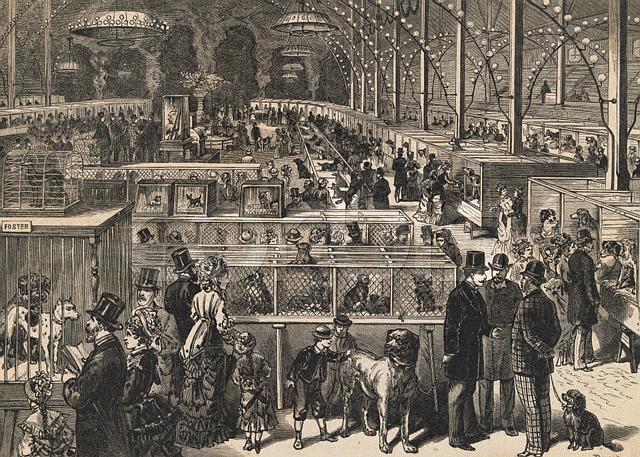
1877 dog show


In 1883, John Russell died at the age of 88. After his funeral, the few remaining dogs he had with him at Black Torrington (four very old terriers by the name of "Rags", "Sly", "Fuss" and "Tinker") were given away.

On the day of his funeral, his old sermons and other papers were found blowing around in the farm yard. Little or no self-authored record of Reverend John Russell survives to the present day.

In 1893, Rawdon Lee, Kennel Editor of "The Field" magazine, published Modern Dogs and noted the absence of Devon terriers on the show ring bench:


"There appears a semblance of strangeness that the wire-haired terriers from Devonshire have not been more used for show bench purposes, and by all accounts some of them were as good in looks as they had on many occasions proved in deeds. Those owned by the Rev. John Russell acquired a world-wide reputation, yet we look in vain for many remnants of the strain in the Stud Books, and the county of broad acres [the north] has once again distanced the southern one in the race for money. But, although the generous clerical sportsman occasionally consented to judge terriers at some of the local shows in the West, he was not much of a believer in such exhibitions. So far as dogs, and horses too, were concerned, with him it was 'handsome is that handsome does,' and so long as it did its work properly, one short leg and three long ones was no eye-sore in any terrier by the late Rev. John Russell."

Lee went on to note that the best working dogs, even in his day, were not found in the Kennel Club:


"As a matter of fact, those [terriers] best adapted for hard work either with foxhounds or otterhounds are cross-bred, hardy dogs, specially trained for the purpose, although many of the 'pedigree' animals will do similar duty to the best of their ability, but their 'pedigree' and no doubt inbreeding to a certain extent, has made them constitutionally and generally weaker than their less blue-blooded cousins."

Finally, to put a cap on it, Lee wrote:


"I have known a man act as a judge of fox terriers who had never bred one in his life, had never seen a fox in front of hounds, had never seen a terrier go to ground ... had not even seen a terrier chase a rabbit."

Only 20 years had passed since the founding of The Kennel Club, but already the death knell was being sounded for the fox terrier.

How was this possible? The short answer is that at the time Rawdon Lee was writing, The Kennel Club was undergoing a "terrier craze."

Why was this? One can only guess, but I would venture to say that terriers then, as now, fit both practical and psychological needs.

On the practical side, they are small, easy-to-keep dogs. On the psychological side, they are active dogs and not too "girly" for a man or active woman to own.

Fox terriers, in particular, have a pretension to field sports about them, and they particularly appealed to those that sought to associate themselves with the money, romance and aristocracy of the mounted hunts.

In fact, the first breed-specific publication was the Fox Terrier Chronicle, which tracked the comings and goings of Kennel Club shows as if they were High Society.

Special dog shows were started just to showcase terriers, and in 1886, a dog food salesman by the name of Charles Cruft took over the Allied Terrier Club Show at the Royal Aquarium at Westminster, with an eye towards making it a cash venture. This terrier show became the first formal Cruft's Show" when it was booked into the Royal Agricultural Hall, Islington in 1891.

In 1884, the American Kennel Club was started, and the terrier craze that had begun in the U.K. swept into the United States as well. Some small indication of this strength of this craze suggested by looking at the history of the Westminster Dog Show which awarded its first "best in show" award in 1907. The first winner was a fox terrier. A fox terrier won again in 1908, 1909, 1910, 1911, 1915, 1916, and 1917.

It was into this terrier-besotted world that Arthur Heinemann stepped -- a young man with an interest in badger digging. Heinemann was born in 1871, the year that John Russell gave up his hounds for the last time, and he was only 12 year old when the Reverend John Russell died.

Heinemann became interested in badger digging when he was in his 20s, and in 1894, he create the Devon and Somerset Badger Digging Club -- a small regional club composed of similar like-minded friends.

Where did Heinemann get his dogs? Not from John Russell.

As noted earlier, Russell gave up hunting the year Heinemann was born, and he died when Heinemann was only 12 years old. Heinemann and Russell never met.

Getting a working terrier was not much of a problem in any case. As noted earlier, white-bodied fox-working dogs were far from uncommon even in Russell's youth, and by the 1880s they were a fixture in the Kennel Club and cross-bred types were to be found all over the countryside.

As noted earlier, Russell himself did not keep a pure line of dogs, and was a bit of a dog dealer himself. By the time of Russell's death, almost anyone could have said they owned a dog descended from Russell's stock. Since Russell did not register his own dogs, and no pedigree charts survived his death (if they existed at all), who was to say otherwise? Anyone that wanted to make a claim that they had dogs descended from John Russell was free to do so -- and a few did so.

One of those people was Annie Rawl Harris, who was Kennelmaid to Squire Nicholas Snow of Oare and a relative of Will Rawl, John Russell's kennel man.

Did Annie Harris have direct descendants of John Russell's dogs? Of course. Who didn't?

As Dan Russell (the pen name of Exmoor hunt terrierman Gerald Jones) once observed in an interview with Eddie Chapman,


"John Russell was very much a dog dealer, as well as a breeder. He would buy or scrounge any terrier he thought looked like work, make it and sell it on. He always went each year to Scorrier House in Cornwall for a stay. They had their own strain of Fox Terrier there called the Scorrier terrier, which was reputed to be bred pure for over 200 years, and on leaving he would take on any terriers they didn't want."

And so we come to it: Not only were John Russell's type of dogs not unique to the Parson, he was not shy about selling them off and buying more terrier stock to breed back in. Any small white-bodied dog in the West Country could claim (perhaps legitimately) that it was descended from John Russell's own dogs.

Perhaps here is a good time to point out that Arthur Heinemann's terrier club was called the Devon and Somerset Badger Digging Club. His hound pack (acquired in 1902) was the Cheriton Otterhounds.

Badger. Otter.

The point here is that Heinemann was not chasing fox -- he was digging badger with terriers, and chasing otters with hounds and terriers. This is a point glossed over by some, but it is not insignificant, as chest size is far less of a concern when working badger and otter, than it is with fox.

In any case, in 1914 the Devon and Somerset Badger Digging Club changed its name to "The Parson Russell Terrier Club."

Why the name change? Well, to be blunt, and to use the words of his friend Dan Russell (aka Gerald Jones), Heinemann was a bit of a dog dealer who “sold a hell of a lot of dogs," both in the U.K. and overseas. He and his friend Annie Rawl Harris found that if they branded and sold their dogs as "Jack Russell Terriers" they sold better.

Why did they sell better? Well, to put it simply, no one wanted a Kennel Club Fox Terrier!

As Rawdon Lee had observed, the best working terriers were not Kennel Club dogs -- they were cross-bred dogs or dogs that were found far outside of the show ring. While the Reverend John Russell had called his own dogs fox terriers, and Rawdon Lee was still calling them fox terriers 10 years after Russell's death, by the turn of the Twentieth Century, a new name for working dogs was needed.

And that name was NOT the "Parson Russell" Terrier." It was the "Jack Russell" terrier. That was what Robert Leighton called them in his 1910 book, Dogs and All About Them, and it was the term increasingly being used in the working terrier community as well.

For evidence of this we need only turn to Jocelyn Lucas's Hunt and Working Terriers, written between 1927 and 1930, and published in 1931.

At the back of this book, Lucas lists more than 100 mounted hunts in the U.K. and details the types of terriers they themselves say they used in the field.

This was a period when the name of the dog was in transition. I say transition, because the word "fox terrier" is used in the list about as much as "Jack Russell," and other phrases appear as well, such as "white hunt terriers" and "Devonshire working terrier." In a listing of over 100 mounted hunts, however, not one claims to be working a "Parson Russell Terrier," and most of the time the word "fox terrier" is carefully proceeded by the words "cross," "cross bred," "non-pedigree," or even "mongrel."

In short, whatever a working terrier was been called in Heinemann's era, it was never called a "Parson Russell Terrier." The confusion arises, perhaps because Heinemann's badger digging Club was renamed, in 1912, the Parson Russell Terrier Badger Digging Club. The dog, however, was always called a Jack Russell Terrier. A club is not a dog.

Arthur Heinemann died in 1930 from pneumonia after coursing his lurchers in the rain (and falling through the ice on a pond), but Annie Rawl Harris continued selling Jack Russells and maintained the Parson Russell Terrier Club until it dissolved just before the Second World War.

Again, to quote Dan Russell from his own book Jack Russell and His Terriers:


"[Mrs. Harris] very quickly took the place of Heinemann as the arbiter of the Russell type terriers and she carried on breeding the type of terrier Heinemann had loved. In her heyday, she had some 50 puppies out to walk each year. She sent her stock all over the world. Her method of breeding was to use only dogs and bitches of proven gameness."

After War World War II, England seemed to get along perfectly fine without a Parson Russell Terrier Club. In fact, the 1950s, 60s and 70s were the Golden Age of terrier work in the U.K., as the weekend was invented (a product of the union movement), and it was now easier to get out to the countryside than ever before.


Add into the equation was the rise of distemper vaccines which prevented massive kennel loss, and the advent of antibiotics which helped prevent occassional gashes and wounds from getting infected, and it was truly the best of times.

Though myxomatosis arrived in the 1950s and devastated many ancient rabbit warrens throughout the U.K, the decline in rabbit populations was offset somewhat by a ban on the use of leghold traps (gins).

All through the 60s, 70s, and 80s, the fox population rose (see graph at left), and with it the chance of finding a bit of sport with the terriers in the countryside.

In 1974, the Jack Russell Terrier Club of Great Britain was founded "to promote and preserve the working terrier known as the Jack Russell".

In 1976, its U.S. analog was created -- the Jack Russell Terrier Club of America (JRTCA).

Both clubs have prospered and stuck to their original mission, and today the Jack Russell Terrier Club of America remains the largest Jack Russell terrier clubs in the world.

With an increase in the popularity of the Jack Russell terrier in Great Britain and the U.S., a push was initiated in 1983 to pull the Jack Russell into The Kennel Club. In 1990 this was finally done with representatives from several smaller Jack Russell Clubs meeting to draw up a conformation "standard" that called for a dog standing 12-15 inches at the withers.

It is claimed that this Kennel Club Standard was adopted from one originally written by Arthur Heinemann, but no evidence to support this claim has ever been presented so far as I know.

Dan Russell, who hunted with Heinemann and knew him well, says Heinemann did not value a large dog.


"As I remember it, and I am going back now sixty years or more, his main Badger dogs were about 12". He always said there was nothing a good fourteen inch terrier could do that a good eleven inch terrier couldn't do better. But it must be remembered he was referring to Badger digging in his own part of the West Country. His smaller terriers could manuever so much better in the large drawn out pipes of a badger set, they depended on their voice to keep the badger cornered for the diggers to hear, not brute force as some people seem to think. They were clever, game baying terriers, nothing more. Some of his best workers were no more than ten inches."

In his own book, "Jack Russell and His Terriers," written in 1979, before The Kennel Club controversty, Dan Russell quotes Heinemann directly:


"We are very much opposed to the modern show terrier and his type. Once you begin to breed it for show type, you lose the working qualities upon which you pride those terriers. I have been, I might say, the protagonist of the terrier bred for sport as against the terrier bred for show. I have no interest in cup hunting."

What Reverand John Russell or Arthur Heinemann wanted for the dogs, or what they actually used in the field, however, mattered not a whit to the Kennel Club.

In 1990 the Kennel Club admitted on to its roles a dog they called the "Parson Jack Russell Terrier," a name just invented for the occassion. In 1999 The Kennel Club changed the name to the "Parson Russell Terrier," another name invented wholecloth by Kennel Club theorists.

The American Kennel Club followed the U.K. Kennel Club in embracing both the 12-15 inch standard and in embracing the various inventeed names and name changes.

In 2005, The Kennel Club added a bit more confusion to the story by changing the standard for the dog they were now calling the Parson Russell Terrier, extending it to encompass dogs ranging from 10 to 15 inches tall at the shoulders.

The American Kennel Club has not followed the U.K Kennel Club in changing the standard, instead chosing to simply create another breed of dog (now in its Foundation Stock Service) called the "Russell Terrier."

The breed description of this dog claims it "originated" in the United Kingdom, but that it was "developed" in Australia -- a country which John Russell never so much as visited, which had no Jack Russells at all until the very late 1960s, and where the dog in question remains a pet and show dog that never sees a moment's work. The AKC "Russell terrier" standard calls for a dog standing 10-12 inches tall at the shoulder.

How to sort it all out then?

I think simplicity is best. In my opinion, there are only two types of terriers in the world: those that work, and those that don't. The white ones that work are called Jack Russell Terriers, and they are called that out of respect for the working standard that the Reverend John Russell himself honored throughout his life. Many of these white-bodied working terriers are not registered, but neither were any of the Reverend's own dogs.

What are we to make of the Kennel Club dogs? Simple: They are not Jack Russell terriers.

They are not Jack Russells in name, nor are they Jack Russell terriers in terms of performing regular honest work.

They are simply another white terrier being combed out, powdered, and fussed over by Kennel Club matrons.

So is there any place where the Parson Russell theorists and the practical working Jack Russell people might find common ground?

Oddly enough there is, though it is an area generally overlooked by the show ring crowd, and one they will no doubt surpress as time goes by.

The issue is chest size.

Barry Jones, a professional terrierman to the Cotswold Foxhounds in Andovers Ford, and a former Chairman and President of the Fell and Moorland Working Terrier Club, and the founding Chairman of the National Working Terrier Federation, was also a founding member of the Parson Russell Terrier Club. He warned the club to keep its eye on chest size, noting that:


"The chest is, without doubt, the determining factor as to whether a terrier may follow its intended quarry underground. Too large and he/she is of little use for underground work, for no matter how determined the terrier may be, this physical setback will not be overcome in the nearly-tight situations it will encounter in working foxes. It may be thought the fox is a large animal - to the casual observer it would appear so. However, the bone structure of the fox is finer than that of a terrier, plus it has a loose-fitting, profuse pelt which lends itself to flexibility.

I have not encountered a fox which could not be spanned at 14 inches circumference - this within a weight range of 10 lbs to 24 lbs, on average 300 foxes spanned a year. You may not wish to work your terrier. However, there is a Standard to be attained, and spannability is a must in the Parson Russell Terrier. "

Eddie Chapman, a working Devon hunt terrierman for more than 30 years, agrees that 14 inches is the maximum chest size for a fox. In The Working Jack Russell Terrier, he writes:


"I am a small man and have reasonably small hands, but in more than 20 years in which I have handled well over 1000 foxes, I have never handled a full grown fox which came anywhere near the span of my hands. The biggest I can remember was a South Hereford fox that was one and a half inches smaller than my hand span, and that without my squeezing him. It therefore follows that if I can pick up a dog and just span him with a squeeze, then the dog cannot get to the fox in a tight place and a dog that cannot get to a fox cannot be considered a Jack Russell. Either you are breeding a terrier suitable to work fox or, if he is too big to get to a fox, you are just breeding for looks. This is, of course, what happened to the pedigree Fox Terrier and look where that has got him!"

What is the future of the Jack Russell Terrier? The same as it has always been: as a working terrier in the hands of owners that will actually take it out to work it. Such people have always been rare. They were rare in John Russell's day, they were rare in Arthur Heinemann's day, and they are just as rare today.

As for the "Parson Russell" terrier and the "Russell" terrier they are completely interchangeable with every other terrier on the Kennel Club's roles. These dogs have no claim to history, and they have no future as honest workers. They stand as a complete rejection of every value ever held by John Russell and Arthur Heinemann, both of whom rejected Kennel Club registration and valued their own dogs based on performance in the field rather than Kennel Club points in the ring.

The good news is that with the name changes, no one will now confuse these Kennel Club dogs with the real Jack Russell Terrier.
.
_____________

Footnotes:


  • It should be said that Dan Russell (i.e. Gerald Jones) was himself terrierman for the Exmoor, Enfield Chace, and Old Berks hunts, and knew more than a bit about what was needed in a working dog.
  • Annie Rawl Harris was, for a time, housekeeper for Henry Williamson who wrote the book "Tarka the Otter."
  • The Scorrier terrier is associated with the Williams family and the Four Burrow Hunt.
  • The quotes in this piece come from the various books cited (and often pictured). For those that want a visual presentation of the history of working terriers, see A Pictorial History of Terriers; Their Politics & Their Place on the www.terrierman.com web site.
    .