Showing posts with label raccoon. Show all posts

Saturday, August 28, 2010

Gorring's Raccoons


A repost from January 2006


The Monterey Herald reports on Germany's "Unwanted Raccoon Harvest":

California has had its revenge on Germany, the source of wild boars that were stocked to provide game for hunters and have since overrun the state, plowing up fields, gobbling plants and animals, and endangering endangered species.

Germany has raccoons. Lots of them, according to the Times of London. Some studies put the estimate at a million.

Times reporter Roger Boyes reported last week that "Vineyard owners across Germany are hiring bounty hunters to kill furry animals with a taste for grapes.

"Hunters are being hired to prevent a plague of raccoons with Nazi-era ancestry from munching their way through the German wine harvest."

The German wine-growing region of Kassel has become "the raccoon capital of Europe ever since Baron Sittich Von Berlerpsch released two of the animals into the wild in February 1934.

"The move was encouraged by Hermann Goering," he wrote, "the Nazi leader who, apart from being the head of Hitler's air force, was the chief forester of the Third Reich."

The first raccoons were brought from North America in the 19th century, Boyes reported, and their population grew by leaps and bounds when an Allied bomb hit a raccoon farm in 1945, scattering the animals.

Friday, March 12, 2010

How to Train a Scent Hound


Gone to Earth by Thomas Woodward.


Over at Field & Stream's excellent Field Notes blog, Chad Love put up a post about South Carolina "fox pens" which are large multi-acre enclosures where fox and coyote are released in order to (supposedly) train hounds.

Chad is a little uneasy about fox pens, but he readily admits he is not a houndsman, and he wonders where to draw the line on using live critters for training purposes.

Where I’m stuck is this: Is it inherently more "cruel" to use live coyotes to train a coyote dog than it is to use live birds to train bird dogs? Rabbits for beagles? Coons for coon hounds? Where do you draw the line?


There was some palaver from people who do not hunt fox or coyotes with dogs, and who were trying to fit the fox pen question into some sort of "us versus them" hunters-versus-animal-rights-lunatics frame.

Then I weighed in, noting that while I hunted fox with dogs:

Surely we can say no to canned hunts of a predator in a fenced enclosure? Surely American sportsmen have not come down to this.

Has it ever been easier to hunt in the last 100 years? We have better cars and trucks, more free time, better weapons, and more game than our fathers, grandfathers or great grandfathers did. More public lands too, thanks to Pittman- Robertson.

And yet we still have folks who think we need PENS to "teach" a hound to hunt? We do not! They do not use such nonsense in the crowded U.K. or in France or anywhere else in the world where they hunt with hounds, and that includes most of America. And NO we do not need them here in Virginia, North Carolina or South Carolina.


Of course there was a bit more palaver.

Some folks did not seem to know that most of these "training" facilities operate as canned hunts at least some of the time.

Some folks too quickly embraced the notion that "a-pigeon is-a-rabbit-is-a-fox-is-a-coyote," seemingly unaware that this is the same "a chicken-is-a-pig-is-a-dog-is-a-child" line warmly embraced by Ingrid Newkirk of PeTA.

Mostly, however, folks seemed flummoxed. If you did not have a fox or a coyote in a pen, how would you train a dog?

And then it occurred to me: No one reading this fox pen story actually knew how to train a scent hound! They think this is how it is done.

No problem. I do know how to train a scent hound. And this is NOT how it's done. So let me set it right.

To start with, let me point out that working terriers operate as diminutive scent hounds.

In fact, the work of a terrier is indistinguishable in the field from that of a dachshund (a true scent hound).

Both dogs find their quarry by sniffing the air and the ground until they happen to cut across a "hot" trail leading to a hot hole.

Most folks who work terriers find they do not have to do too much to actually get their dogs operational.

The same is true for most scent hound hunters. Scent is a powerful stimulus for dogs, and they will naturally follow a "sweet" scent out of curiosity, or some small hope of food, sex, or excitement.

So how do you amplify and channel this natural trait?

For starters, get a bottle of fox, raccoon or coyote pee from a mail-order vendor like Bill Boatman Supply or Mark Junes' Lures & Trapping Supplies. Most hunting stores also carry fox, raccoon and coyote pee -- ask a salesman.

Next you need to make a drag out of an 18" inch square piece of heavy cloth or leather chamois (available at any auto-supply store).

Tie a 15-foot piece of cord to your scent drag, and slide a small stack of metal washers or fishing weights down the cord so the drag now has a small amount of weight attached to it.

Now load some of your store-bought critter pee into a cheap spray bottle, being sure not to get any on your hands.

Finally, obtain a package of hot dogs.

Got it all?

Good. Now we are almost ready to go train the dog!

Before we do that, however we want to get your dog well-motivated, and the secret here is to not feed the dog for a full 24 hours. You want that dog sharp! A hungry dog is a brilliant dog.

Now load everything into your truck or car and go out to a farm area where a grassy field or meadows borders a forest.

Leave your dog crated up in the car or truck while you walk down the edge. You should have the leather drag with you, along with the hot dogs, and the spray bottle with the critter pee in it.

About 200 feet from the vehicle, stop and spray the leather drag with critter pee, coating it well, but not getting any on yourself.

Now drop the drag in the middle of the trail (you can spritz the trail itself if you want) and walk perpendicular to the edge habitat, heading up into the grassy field.

As much as possible, you want to make an obvious trail in the grass, dragging the pee-scented leather or cloth behind you.

At the end of a straight 30-foot drag, stop and leave half a hot dog right in the middle, where it is quite clearly visible.

Pick up the drag and walk back the way you came to the exact spot where you took off perpendicular to the path.

From this spot, continue down the edge another 150 feet and then drop the drag and cut across the trail again, this time going 40 feet going into the woods side, dragging the pee-scented leather or cloth behind you as before.

Scuff logs and break a little brush as you go. An easily visible trail with a lot of scent is not a bad thing to have early on in the training process.


At the end of this straight 40-foot drag, leave the other half of the hot dog in plain site.

Continue down this math, making scent trails this until you have run out of hot dogs, each time making the distance to the hot dog a little longer, curving the trail, and perhaps making the trail a little less obvious.

Now take the dog out on a leash and walk down the path you started. You can slow down a little at the spot where the first "trail" goes off into the grass. Give the dog a chance to succeed, but do not shove the dog or make suggestions. Be calm and mellow. The scent is supposed to do the work, not you.

Once the dog starts down the path (you will wait at this spot until it does), quietly encourage the dog. When the hot dog has been found, and after it has been gobbled up, make a big happy production out of it with a little play and a scratch behind the ears. Good dog!

Now let's see if we can do that again another 150 feet down the hedge.

Repeat this process a dozen times an outing over the next few weeks, extending the trail, curving the trail and even cutting off at sharp angles.

Instead of a hot dog, you can also use a favorite toy, such as a ball, or even a piece of fur.

In only a few outings, your dog will quickly "get it." The smell of a critter means hot dogs and play! Critter smells are FUN to follow.

Now you have a dog that follows scent trails. Be aware, however, that your dog may not be too discerning and may end up following any type of animal scent they find in the woods. In fact that is not a problem for a working terrier, and most fox hounds are not trained beyond this point either. But they can be.

To do that you need to get the dog to follow fox and never follow raccoon. The instruction here is simple: one type of smell is "good" and the other type of smell is "bad".

How do you do that?

With several kinds of pee. After your dog is following fox pee well, start making some "false trails" with raccon pee. Make sure your dog never finds food when it follows a raccoon scent, but always finds food at the end of a fox scent.

Do that often enough, and your dog may stop responding to raccoon scent at all, choosing instead to only follow fox. This is what is called "extinguishing" a behavior in operant conditioning.

A note of caution here, however. Is a few rounds of extinguishing going to stop a dog from having all interest in the smell of raccoons?

No, probably not.

The reason for this is that animal scent reaches deep into the hidden recesses of the canine brain. Scent is one of the most powerful of canine stimuli.

Because scents are such a powerful stimulus for a dog, there is a very real chance that even if there is no known "payoff" at the end, your dog will still want to follow a raccoon scent at least some of the time. If your dog does that often enough, he or she will eventually find a live raccoon at the other end of the trail, and a live raccoon is a massive "jackpot" reward for any dog. It is the very definition of FUN on four legs. Big problem.

So what can you do, right at the start, to make sure your dog never follows raccoon scent?

The answer is that you get the dog to associate raccoon smell with a negative consequence -- a hard "whoa" on a check cord, or a small tap on an e-collar.

If either correction is used on a dog that has previously learned that raccoon scent never means food at the end of the trail, the dog is very likely to stay on the straight and narrow rather quickly, and you will end up with a dedicated fox hound.

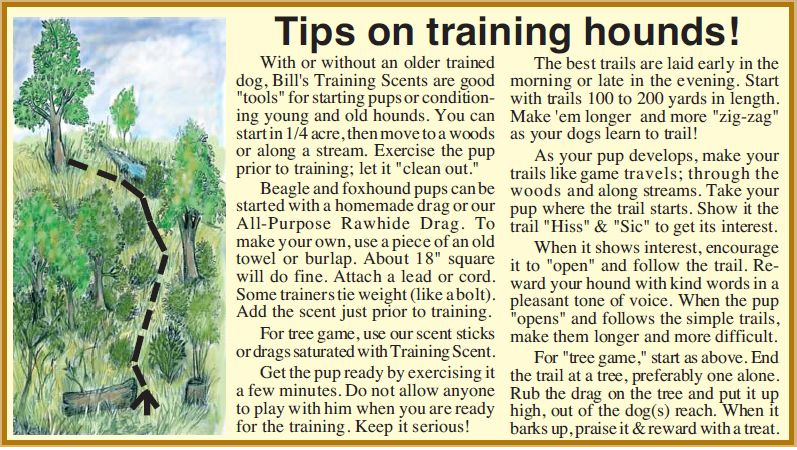
Now, are you looking for a simple summary of what I have presented here?

If so, the good news is that the 2010 Bill Boatman catalogue has a nice short training summary, which I have clipped out just for you. Enjoy!

Of course, none of this will stop the lazy and incompetent from wanting their fox pens. These are the guys with one or two dogs, who have no horse, and who have no access to land because they have never gone out and gone door to door at farms.

They have not trained their dogs at all -- they keep them in a kennel behind the house and pretty much ignore them 50 weeks out of the year.

In short these folks are just like the pay-and-shoot bird gunners who take their shotgun and barely trained birds dog out to some place where a fellow releases a few chickens pheasant out into a field to be blasted by the pay-to-shoot guy an hour or two later. We're hunting now! Look at my excellent bird dog.

Of course this is how they hunt birds in England, isn't it? If you are going to import a non-native tropical bird to hunt, like a pheasant, then you are going to have to stock them. You cannot release them into the wild to thrive on their own, any more than you can let a chicken "return to the wild".

But a fox? No, not even in England would they think to put a fox in a big pen with a hound and call it hunting. Or training. Or anything but a fat slob, without the proper tools, trying to do a job on the cheap that he should not have started to begin with.


.

Wednesday, July 1, 2009

Gentle on Dogs and Quarry

If you work your dogs regularly, you learn to value both the dogs and the quarry.

A smart digger learns to slip a spade between the dog and the quarry if it is at a stop end -- especially if it is a raccoon or a fox that cannot dig away. Why let the dog get injured when it has done its job, which is to locate, bolt, or bottle the animal in a stop end? The dog is valuable, and so too is the quarry.

Any fool can terminate quarry. There is no skill in killing. If it must be done (it is often a requirement for farm permissions when it comes to groundhogs), it should be done quickly with a gun or blow to the head.

Better yet is to let the animal go, especially if it is a fox or raccoon. If you hunt every weekend, it is too easy to bleed a farm white by killing off all the fox and raccoon in a matter of weeks.

If you must have a fox or raccoon on the mantle, buy a finished taxidermy piece -- it will be no more expensive, and you are guaranteed a good mount of a large specimen in prime coat.

Best of all, let your trophy be a picture. A shot down the hole is proof and memory enough of a dog that has done its job.

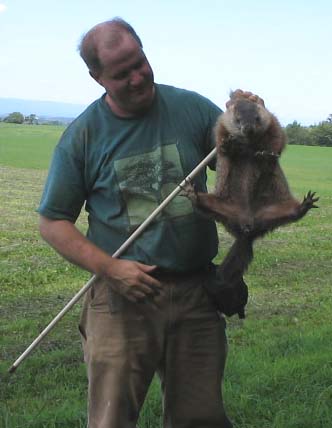
For those that prefer a picture of the complete animal in the full light of day, make a light-weight pole snare and learn how to use it. The design at the link is my own invention, and it works like new money.

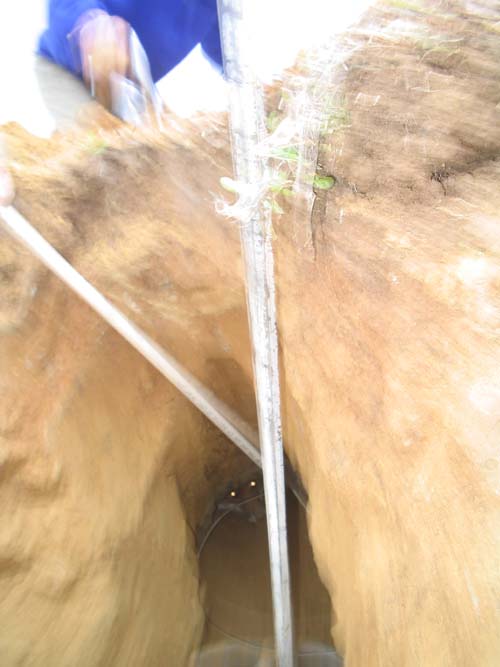
In the picture at top, the snare is set, with the digging bar placed vertically in the pipe to slow the fox down a bit and steer it into the snare.

A fox or raccoon can be snared around the neck, but a groundhog has no neck, and so at least one leg has to pass all the way through the loop before it is pulled tight. And, for the record, the little fellow at right was released unharmed.
. . . . .

This post is recycled from this blog circa Jan, 2005. And yes, I am still using the same snare and the same bar!

Monday, April 6, 2009

Digging on the Dogs


Yesterday was a nice day in the field with perfect weather, and three kinds of quarry dug to -- raccoon, groundhog and possum.


Mountain located a raccoon
in a dirt den underneath a massive brush pile. I will spare you the details, but suffice it to say I managed to burrow down into the brush pile and sink a bore hole between mountain and the raccoon. I then twisted the post hole diggers so they blocked Mountain from reaching the raccoon, and she got the idea and finally came out. Good thing too, as there was no digging her out, and she was not coming off that raccoon any other way!

I leashed up Mountain and we drove to another farm a short way up the road, where we quickly located a groundhog and dispatched it at the farm manager's request.


I estimate I have taken 200 groundhog off of this particular farm, and there are not many left, though the farm manager says he has lost a few turkeys to a coyote, and the farm across the road took an enormous coyote last month -- the largest in the County so far.


The dogs checked a few more holes, and Mountain located a pretty tough-acting possum, which I pulled before Mountain decided to teach it respect. Possums are pretty harmless creatures, and though Dave the farm manager has chickens this fellow was toward the back of the farm, so I released him with nothing more than a stern warning.


This possum was released unharmed.

.

Thursday, April 2, 2009

Largest Raccoons


A young raccoon exits a dirt den.

According to "Raccoons: A Natural History," by Samuel I. Zeveloff, the average weight for an adult raccoon is 8 to 20 pounds, but occasionally a very old, very well fed boar raccoon will top 30 pounds.

Dirt-dwelling raccoons rarely go over 15 pounds because a larger animal cannot fit down a groundhog hole. Raccoons cannot dig their own dens and have to take what they can find. Appropriately sized dirt holes of any kind are so rare in the American West that raccoons did not exist there at all until the 1950s when barns and other out structures provided denning habitat.

The heaviest raccoon ever recorded was a monster Wisconsin raccoon that weighed an amazing 62 pounds and 6 ounces! Zeveloff also notes an old and quite rotund Texas raccoon that tipped the scales at 56 pounds.
.

Sunday, March 1, 2009

Lie Down With Dogs, Get Up With Fleas


Some 17 months ago, I wrote a piece entitled Honey Pots and Trolls in the Land of Eire in which I noted that some gas bag in Ireland had gotten on the boards to bash a piece I had written two years earlier about the old Irish "strong dog" tests and the potted histories that you commonly find for all Kennel Club dogs, including the Glen of Imaal terrier.

This guy wanted to talk about badgers, and badger-bating trials, and what great badger dogs they had in Ireland.

Eh? I was a bit confused, as this fellow seemed detached from any logical mooring.

He had, of course, not so much as dropped me a line.

I suspected he did not want to provide a real name and a real email address.

As I wrote at the time:


A two-year old post? Did someone just get their first dog, or did they just get their first computer?

No mind.

Now here's the funny thing about this kerfuffle -- the "strong dog" tests once given by the Irish Kennel Club have not been done since 1968!

And when they were given, they weren't much of a test of a working dog were they? The Teastas Mor lasted for all of 5-minutes.

Five minutes? Five minutes.

In this Kennel Club test the dog was not required to find the quarry at all, and if the terrier bayed it was summarily disqualified.

Since the Kennel Club rules for this "test" were knitted up prior to the invention of locator collars, one has to wonder how the dog was supposed to be found underground. Telepathy? Dowsing rod?

But of course the dog did not need to be located, did it? The Teastas Mor was nothing more than a timed badger-baiting trial in a short artificial earth made to look "natural."


So what was this poster on about, I wondered?

I had an idea.


Well, it could be a simple matter of another Internet Troll on the boards. Such people are common enough, and I have written about them before.

But perhaps in this case it is something else. Think about it -- a person with an anonymous name shows up less than a year ago on a working terrier board, and now he wants to talk about badger baiting in a country where that practice is quite illegal?

Hmmmm. Sounds like a honey pot operation to me.

What's a honey pot? A honey pot is an old trick. You put down bait (preferably under cover of dark) and then stand back and shoot anything that comes in to feed on it.

I have written before about how these Internet bulletin boards might be a problem in this regard, and more people should probably be aware of how these honey pot schemes work if they want to stand clear of real trouble themselves, especially in the U.K.

In the old days, law enforcement "honey pots" were store-front fencing operations manned by the police, or a buy-and-bust drug corners where undercover cops replaced the local dealers which had been rounded up a half hour before.

Nowdays, thanks to the Internet, cops never have to leave their chair to make a bust -- they just go online to find the folks they want to arrest. Whether they are looking for wildlife poachers or illegal aliens, terrorists or pedophiles, neo-Nazis or stolen property, the Internet is the new hunting ground for law enforcement.

Are wildlife officials and animal rights lunatics using the Internet this way?

Believe it. It has been tried on me (though I do nothing illegal with my dogs), and it has been tried on others.

Right now the Roller Pigeon community is in a bit of a pinch and a bulletin board had to be closed down for a week so that it could be scrubbed of all mention of hawk and falcon killing. Falconers have similarly been nailed for illegal bird sales overseas.

Heads up and fair warning. Those in the U.K. who ignore this caution can go to page 30 of the June issue of Earth Dog-Running Dog magazine to find the telephone number of the Hunting Lawyer they may soon need. Those who want to see what the working terriers of Ireland actually look like, however, can go to page 29 of that same magazine. A little irony there, eh?


Well, of course, it turned out I was as right as rain.

Just six weeks later, a major bust went down in Ireland -- a fact I noted in a post entitled As Predicted: Fools Get Stung at Irish Honey Pot. And behind this bust was some bald-headed poseur showing up at the dog shows, and even trading dogs.

Of course, anyone with a brain and a sense of smell could have sensed this was coming.

You did not need to be a dyed-in-the-wool backwoodsman to see the sign. As I wrote:


The spoor was obvious to me, and so too was the scent. When you see such things, just sit down and keep quiet -- the game will reveal itself in time.

The funny thing is that genuine digging folks know the score, and have nothing to fear. We aren't going out to bait animals, we are going out to hunt.

And we sure as hell aren't using turnspit dogs or fighting dogs to get the job done, are we?

We are using terriers, yes, but the terriers used in Ireland to hunt are the same as those used all over -- Jack Russells, Patterdales, Fells and (perhaps) a few Borders. There is no shame or artifice in the world of true working terriers who are being worked by folks who actually know what they are doing.

And the job being done is not complex, is it? It's to locate and terminate the quarry, as quickly and painlessly as possible, and to shepherd the safety of the terrier so it can be used again next week.


So what's the latest news?

Well, it comes to me via way of an email which directed me back to the same before-mentioned bulletin-board where the folks there are all atwitter again because there have been more raids in Ireland. More are supposedly in the works for "known blood sports enthusiasts in Ireland, and as far afield as France and the USA."

Eh? Come again?

I am no expert on French law, but I am quit certain that hunting badger is legal in France, and I know for a fact that it is legal in most of the U.S.A. where badger are actually found.

So there will no arrests, as no laws have been broken -- that is just fanciful bunk cocked up by an ignorant press corps trying to sensationalize things as much as possible.

As for "baiting," I know no one who does that. Not a one.

But then, I do not claim to know everyone lurking on the margins of the world of working terriers, even in this country.

I have noted in the past that there are a few wanna-be pit-dog fighters about, but I will have nothing to do with them, and neither will anyone else with an ounce of brain or a real interest in working terriers.

These knuckle-draggers are to true working terriers what jack-lighting deer poachers are to real hunters -- an outrage and an embarrassment.

That said, I have always suspected that most of these loud mouths are nothing more than wannabe tough-guys who do not hunt very much, and who simply talk big to get attention.

I have written about these fools and fantasy diggers before, and I have noted that their rich fantasy life is every bit as detrimental to real terrier work as the nonsense spouted by Kennel Club matrons.


Does fantasy do any real harm?

Generally, no, but at times yes.

The fantasy digger who thinks a go-to-ground tunnel is the size of a real den pipe is spreading a lie forged in ignorance that allows the "big wink" of over-large dogs to continue unabated.

The preening pretender who prattles on about the glories of brain-dead "hard dogs" in order to compensate for his own male shortcomings glorifies a canine characteristic which, in excess, is too often a serious liability in the field.

The show ring breeder whose fantasy fox is as large as a coyote is what led to the Kennel Club fox terrier -- a dog whose chest is as deep as the keel of a war ship.

The young enthusiast who thinks a mute dog is a fine thing glorifies a serious nuisance and a potentially fatal liability in a working dog, while the "blue-blazer rosette chaser" who cares more about the color of a dog's nose than it's ability to scent does no better.

When push comes to shove, the thing that has killed working terriers over the course of the last 50 years is the creep of fantasy, and the slow but steady erosion of real diggers in the hedgerow.

The simple truth is that you cannot protect working dogs without working them.

And working a dog is not easy -- it is suspiciously like work for the human as well as the dog. There is equipment to be gotten -- spades, bars, posthole diggers, tie-outs, locator collars, machete, yo-ho, veterinary first aid equipment, and a decent pack in which to carry it all.

There are farm permissions to get, and there are the dogs which have to be raised up and given the experience -- experience which can only be gotten by driving out to the country and walking hedgerows and fields for many, many weekends.

This is to say nothing of the reality of digging in freezing cold, howling winds, sucking mud, pounding sun, and swarming bugs.


And so, I was not too surprised when I turned on the computer this morning to find someone had sent me another news article from The Sunday Times of London about the badger-baiting arrests in Ireland. Only in this article, two Americans were named -- the owner of Deadgame Kennels in West Virginia, and the owner of Barnburner Patterdales in Iowa. It seems these two gentlemen had imported dogs from Robert Booth, formerly of Ireland and now living in France.

Booth is a dog-dealer, and part of his business plan has been selling dogs to wanna-be tough guys in America who then go on Internet Bulletin Boards, list-servs, and web sites like "Bay Dogs Online" to claim that their dogs are descended from "Booth's So-and-So" and will "hunt anything."

Right. Hunted nothing is more likely.

As for badger baiting by either of the two named Americans, I seriously doubt it.

You see, neither of these gentlemen live in an area known for badger, and in fact it seems one of them even has to go out of state to hunt groundhog!

The other fellow seems to "hunt" only a few times a year, and this is generally done by shooting large numbers of raccoon that flee the treeless fields of Iowa in winter only to jungle up in barns and silos where their feces damage vast loads of hay and feed.

I do not consider this hunting; it is extermination.

And, let the record show, it is perfectly legal, even if it is not genuine terrier work in my book.

The United States, thank God, is not the U.K.

Not only are guns legal here, but so too are steep-jawed traps. In fact, there are more than 100,000 active trappers in the U.S., and these trappers are trapping (and mostly exporting) over 2,500,000 raccoons a year, along with many hundreds of thousands of wild fox and coyote pelts.

This trapping does no harm to wildlife numbers; raccoon, red fox, groundhog, and coyote numbers are at historical records.

As for North American badgers, which are not related to their European counter-parts in any way, they are not protected in most of the states where they occur in any appreciable number.

If you want to hunt badger in Idaho, Wyoming, Utah, or North Dakota, for example, go right ahead; it is an unprotected nongame species. The states of Nebraska, Wyoming and Missouri, very helpfully suggests using #3 traps. Kansas has a season that stretches from Nov. 12th to Feb. 15th, while Iowa's stretches from Nov. 3rd to Jan. 31st.

And so it goes. . . . .


Which is not to say that there is any excuse for stupidity or brutality.

The oldest adage in the world is both true and poignant: "Lie down with dogs, and get up with fleas."

If you rub up against dog dealers, dog-fighters, badger-baiters, and wanna-be-tough guys, do not be surprised if their mud ends up being splattered on you, whether it is deserved or nor.

And if, by chance, you are the kind of person who does not respect both the wildlife and the dogs, please get the hell out of terrier work all together.

Terrier work does not need thugs and numbskulls.

And, if you want my opinion, it does not need any of these Internet bulletin boards at all. As I wrote on this blog back in 2005:

When was the last time you read something useful or interesting or new about fox, raccoon, weasel, groundhog, badger or even ducks on one of these boards? When was the last time you got a bit of practical advice about shifting rocks, closing a wound, or finding permission? When was the last time someone even wrote a well-written story about their day in the field with the dogs?

Instead, what you find on the Boards are a great number of very young or immature people who seem to get most of their attention in this world by being combative, or otherwise wanting to work out their manhood issues (and yes there are some women doing that too!).

Most of these people seem to know very little about wildlife and not too much about dogs, either.

It is ironic, but true, that in the dog world the most common animal is the parrot -- people quick to repeat what others have said or scratched out. The parrot offers no new information or expanded point of view. They have little experience of their own. Think for themselves? Go their own way? Dig their own dog?

Parrots don't do that -- they are bird-brained and can only mimic. They do not own a library card and cannot hold a shovel.

Starting a bulletin board is certainly easy nowdays, isn't it? These things are now offered up as free services, the code is easy and can be set up in an hour or two, and the only trick is to get people to keep coming back.

No committment or investment is needed. Just erect an electronic wall and let the graffitti spraying begin.

And graffitti spraying is exactly what you get about 95 percent of the time. In fact, this is the chief product of the bulletin boards -- not information but fighting, not shared experience, but name-calling.

It is like a Drunken Night at O'Malleys, except that the drunks are a thousand miles apart and hiding behind fake names.

The folks that run bulletin boards are big on "free speech," but it is pure posture to hide true poverty. The sad truth is that if civility were maintained on these bulletin boards, the real truth would come out pretty quickly -- no one has very much to say.

In the end, bulletin boards have not created a working terrier community so much as destroyed it. The pictures on "anti" web sites are all culled from bulletin boards. Educated people who might educate, motivate and represent the best of working terriers soon turn away from these boards, leaving the loud, stupid, very young, and unemployed to dominate the boards and represent us all.

It is reverse Darwinism -- a devolution to the unfit and the unsound.

I think history has shown that nothing has harmed the world of working terriers more than weakly moderated bulletin boards. Mud and slander has been slung on established breeders, 30-year diggers, working judges, and respected authors.

At times I have wondered if these things were Animal Rights honey pots -- bait stations set out to poison the working dog community. Whether intended or not, that is what most of them have become.

What a sad thing the internet has done to working terriers!


Was I right? I think time has proven it so!
.


Thursday, May 1, 2008

Whither All Those Trapped Raccoons?


Raccoon harvests have gone up and down with the price of pelts, fads (for coats and hats) and population densities. The peak raccoon harvest was about 5.2 million pelts a year for the years 1980-83, but pelt prices have plumeted since then, and during the first half of the 1990s, only 1 to 2 million raccoon were trapped a year.

Unlike fox and mink, raccoons are never farm raised, as it's simply not economical. Only about 200,000 raccoons a year are harvested in Canada, reflecting their much smaller populations (most are taken in Ontario).

The majority of raccoon pelts are exported to Europe, especially West Germany, where they are sheared and dyed and sold as imitation otter, mink or seal.

The colloquial name for the raccoon in Mexico is the "tejon solitaria" which means solitary badger. Columbus called them the "perro tejon" or badger-like dog.
.

Sunday, April 13, 2008

Politicians Will Eat Anything


Another raccoon dinner -- this one in Mount Vernon, Ohio


Here in Virginia, we have the annual Shad Planking
-- a political meet-and-greet associated with a huge fish fry in mid-to-late April as the Shad begin to run up rivers in mind-numbing numbers (I once caught 60 in an hour with a dip net).

In other parts of the country they have other traditions -- pig roasts, walleye feats, and raccoon dinners.


Jan. 14, 2006

Raccoon dinner brings out Ark. politicians
by Andre DeMillo, Associated Press

GILLETT, Ark. - In most places, a politician has to kiss babies in order to succeed. Arkansas politicians have to eat raccoon.

The small east Arkansas town of Gillett doubles its population on the second weekend of every year as candidates and political junkies gather for its annual Coon Supper.

More than 60 years old, the event has become a required stop for anyone seeking or holding political office in Arkansas. Originally started as a fundraiser for high school athletics, it's now the ultimate meet-and-greet for the state's politicians.

"If anybody wants to be in the political scene in Arkansas, it's a must to attend the Coon Supper," said Phil English, the master of ceremonies.

Friday's supper was especially busy since it's an election year. Both announced candidates for Arkansas governor - Asa Hutchinson and Attorney General Mike Beebe - attended to shake hands, talk politics and, for those with the stomach for it, eat barbecued raccoon.

"Raccoon tastes like raccoon," English said. "I've never heard of any elected official or politician who didn't like 'coon."

Over the years, legends have developed about back-room deals made in Gillett, and political gossip is as plentiful as the several hundred pounds of raccoon served in the high school gymnasium.

U.S. Rep. Marion Berry, D-Ark., whose district includes Gillett, hosts a party at his farm before the annual dinner. He credits the gathering with his own political fortune and said he's witnessed far too many deals in his own living room before the supper.

"If it weren't for the Coon Supper, I probably wouldn't be in public life today," Berry said.

The gathering even earned a mention in former U.S. Sen. Dale Bumpers' speech defending Bill Clinton during impeachment proceedings in 1999.

Bumpers recalled a 1988 flight he and then-Governor Clinton took to DeWitt, on their way to the Coon Supper that year. The plane crashed on an icy runway, but neither were injured.

Bumpers called the supper "a political event that one misses at his own risk."

Tickets for the supper usually sell out weeks in advance, with candidates and parties buying blocks for supporters and colleagues.

Unofficially, the supper is a political shindig but organizers are careful to keep politics out of the evening's program. Only elected officials are allowed to speak at the gathering, so aspiring politicians don't have a chance to make any stump speeches - but go to be seen.

Organizers spent the last few days before the supper preparing between 600 and 800 pounds of raccoon meat for the supper. As the supply of the animal dwindles and as palates change, the amount served has dropped from the 1,800 pounds or so that has been served in past years.

Though the event has a rich history, some have raised questions about how much longer it will be able to continue. The Gillett schools were consolidated into another district two years ago, and some wonder if the 120-student high school can survive. Losing the high school would mean losing the dinner's host.

State Sen. Shane Broadway, D-Bryant, said he doesn't think Gillett will allow its school or the Coon Supper to disappear completely: "This is the one place where I don't see that happening. You have a community here that will fight to keep this school."

Linda Cover, who helps prepares sweet potatoes served with the raccoon, said the feast is considered an unofficial holiday for the Delta town.

"Around here, the holidays start with Thanksgiving and they're not really over until after the Coon Supper," said Cover.

.

Sunday, April 6, 2008

When Dogs Fly


Raccoons den in the ground and in hollow trees, and occasionally, a terrier will mark a hollow tree or stump . Now there are marks, and there are marks. The picture here is of one of the terriers leaping up INTO a hollow tree and shimmying up the trunk and down part of a branch. The raccoon was not home (it was very warm out), but he had not been gone very long.

Tuesday, March 4, 2008

Front Yard Raccoon Feeding Without the Fox


I spray painted a bit of old wicker in the front yard last night, which seems to have resulted in the fox staying away and the raccoon staying around a bit longer than usual.
.

Sunday, February 24, 2008

The Geography of American Working Terriers

.
This is a repost. Originally from August 2004.

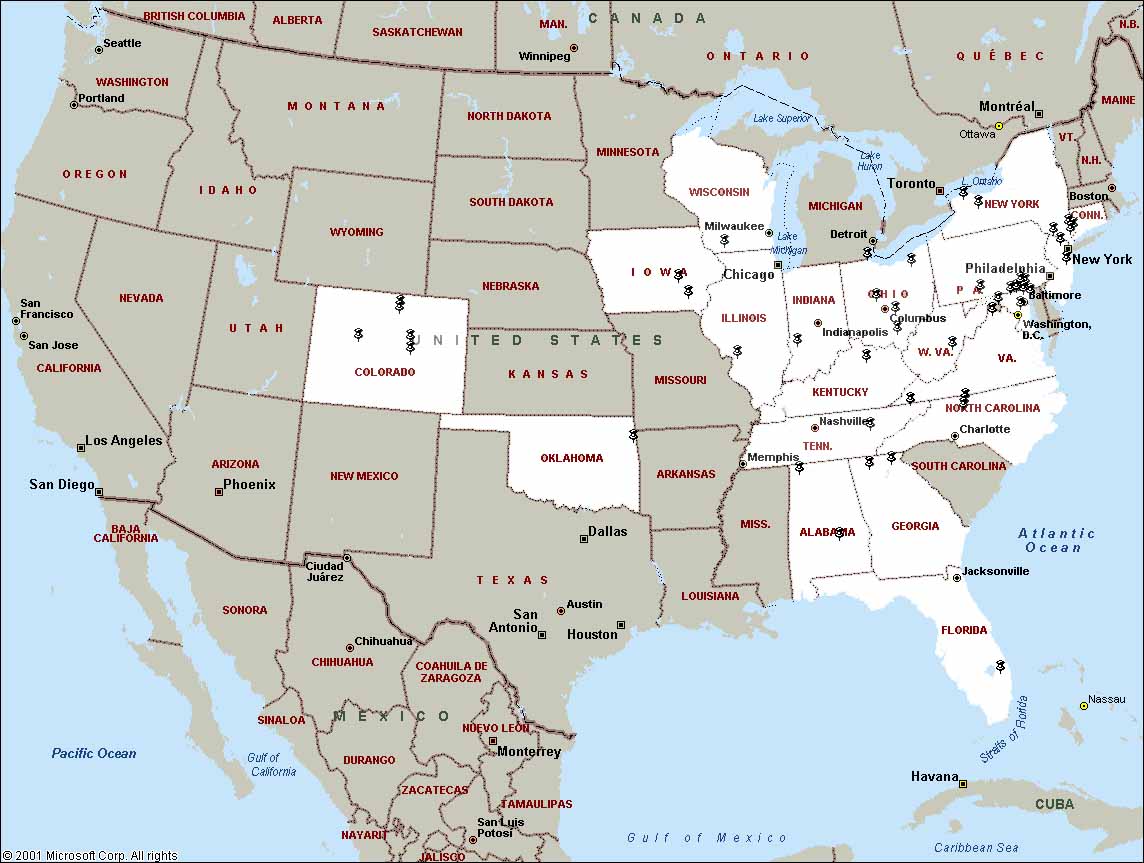
The map, above, is fairly illuminating, as it graphically represents where working judges sanctioned by the Jack Russell Terrier Club of America live.

The states in white are those that have any JRTCA working judges at all. The states that are muddy-grey colored have no JRTCA working judges. A pin (see a larger version of the map by clicking on it) represents the zip code of every JRTCA working judge in the U.S. in the current edition of True Grit magazine.

To get a "bronze medallion" for special merit in the field from the JRTCA, a dog has to work at least three types of quarry underground (fox, raccoon, groundhog, badger or an aggressive possum) operating as if it were out alone, and with the owner doing the digging, and a JRTCA judge has to be in attendance as witness the work. To get a certificate, a dog cannot work quarry in a barn, brush pile, artificial earth or man-made location (such as the crawlspace of an outbuilding).

Jack Russell Terriers are, far and away, the most commonly worked terrier in America. There are very few Fell Terriers in this country, and almost no working Border Terriers at all. Patterdale terriers in the U.S. are still relatively rare, and though some very good dogs are being bred by a handful of reputable breeders, too many over-large dogs are being produced -- many of them cross-bred in the not-too-distant past with small pit bulls in order to get a larger dog that can work game above-ground game -- barn raccoons and feral hogs in particular. There are some excellent Patterdales and a few good Fells in the US, but most of these seem to be owned by people that have had Jack Russell terriers at one time or another -- the dogs they started with before there were any Patterdales or Fells in the U.S.

In short, most working terriers in the U.S. are Jack Russell Terriers, and the map above tells a story.

Why does this JRTCA map look this way?

Some of it has to do with a population bias -- there are more people per square mile in the East and Midwest, and as a consequence associations are easier to maintain.

Another factor is that there are only about 50 pins on the map at all. This paucity of pins is partly a reflection of how few people actually work terriers in the U.S. beyond two-or-three time a year digs, and in part a reflection of the fact that being a working judge is truly a thankless task.

Of course there are more than 50 serious diggers in the U.S. Some of these diggers are ex-JRTCA working judges, some are people that dig a lot but have no desire to sign up for the thankless job of being a working judge, a very few diggers have Kennel Club registered dogs, some folks dig their dogs but have no club affiliation at all. And of course there are the patterdale-only owners, some of whom have joined the new UKC working terrier program or are members of the Patterdale Terrier Club of America.

That said, while this map is clearly not inclusive of everyone that digs their terriers, it is more-or-less geographically representative of the broad TREND of those that that do -- they tend to be in the East and in the Midwest, rather than in the Western United States. For example, of the 15 UKC working judges, as of August 2004, six are not in America, two are in California and come East to hunt, and the rest are in New Jersey, Kentucky, Virginia or Georgia -- states well-represented on the map above.

One of the reasons the map is skewed has to do with quarry availability. In the U.S., the bread-and-butter quarry of the working terrier is the groundhog. Raccoons cannot dig their own dens, and neither can possums. If dirt dens are not available, they will seek other alternatives -- hay lofts, brush piles, hollow trees, farm outbuildings, hay stacks, rock crevices, or old squirrel nests. With the exception of rock dens, these are not locations where a small dog follows quarry to ground and is then dug to. In short, it is not earthwork.

Red fox will dig dens on their own, of course, but in the American west they face real on-the-ground competition in the form of the coyote. A coyote will generally kill a red fox if given half a chance, and they directly compete with red fox for food.

In addition, the red fox is not native to most of the U.S., and its dispersal in the West is uneven as a consequence. While red fox are common in some areas (such as the prairie pothole region) they are quite rare in other areas (such as western Oklahoma).

Weather and time are another important reason fewer people hunt in the West. Fox will not den in warm weather unless they have kits, and in the U.S. we will not put a dog on a vixen with young. Without hounds to drive fox to ground, our fox-digging season is very short -- generally only 10 weeks long, and for most people with jobs this presents a very short period of time to get out into the field.

When people do get out into the field, of course, they have to find your fox! This is easier said than done, and is very hard job for a novice hunter with a novice dog. Red fox densities are variable, but settlement is generally much thinner in the West where there is less food than in the East, and where the fox faces direct competition with coyotes for food and den sites.

Raccoons are not native to the West, though they have spread with humans during the last 50 years, helped immeasurably by the creation of denning shelters in the form of barns, out buildings, road culverts, abandoned cars, and brush piles. A raccoon can expand a ground den a little bit, but it is not really made for digging. A skunk can and will dig its own hole, which is suitable for possum, but too small for anything but the smallest of adolescent raccoons.

Due to the absence of natural forage, raccoons are rarely found above 5,000 feet in the Rocky Mountain, unless they are living in close proximity to humans, though they have been reported at elevations as high as 10,000 feet if a steady food source is available.

Marmots and prairie dogs are found in some locations in the West, but the prairie dog is far too small for a dog to work, while the various species of rock marmots tend to gravitate towards areas with large boulders and talus slopes -- areas very hard to dig. Marmots are also absent from larger parts of the West outside of the Rockie Mountains. That said, if found in the right location, marmots are excellent quarry for working terriers in the Mountain States.

Some states -- notably California -- have very diverse geography and wildlife but also have very restrictive game laws which make working terriers difficult.

The American badger is common in some parts of the West, but more often than not its population is numerically thin on the ground. Badger are also hard to locate, as they will move every few days or so as they eat out, or chase out, a local rodent population (rats, mice, ground squirrels, and prairie dogs). Once the food is gone, so too is the badger. Unlike in Europe, the presence of a badger hole in the U.S. does not mean you have actually found a badger. More likely you have found a blank hole or, in some areas, worse -- a skunk, porcupine or snake.

Porcupines, rattlesnakes and skunks are fairly common in many parts of the West, and all three animals are a very serious threat to a dog. A dog sprayed underground by a skunk can be overpowered and die from anemia if not gotten out of the ground in pretty short order. A porcupine's defense system are barbed quills which can leave a dog wrecked in short order (and the owner's wallet drained after a visit to the vet). A dog bitten by a rattlesnake rarely lives, as the venom from even a small rattler is more than enough to kill a terrier.

In the South there are tens of millions of nutria, but they do not seem to be worked very often. In part this is due to the fact that in many Southern locations where nutria are numerous alligators also tend to be present. Another factor is that neither the American Working Terrier Association nor the JRTCA will give a working certificate to nutria as the holes are too big and shallow to qualify as real earth work. In addition the nutria, like the possum, is an animal whose primary defensive mechanism is bluffing. While AWTA will not give a certificate to possum, and the JRTCA will provided it is an "aggressive" possum, both seem to think the nutria is less than fomidable quarry for a working terrier.

A final obstacle to terrier work in the West is experienced people to show newcomers where to start. While the basics of terrier work are not overly complex, there are things to learn about locating quarry, digging, dispatch, and healthcare. To work any terrier in a safe manner requires several hundred dollars worth of equipment, as well as permissions from land owners. And then, of course, you have to have the desire to hunt, be in relatively sound physical shape, and be willing to devote the time to get out in the field in all kinds of wearther. It turns out all of this is a rare combination.

All of the factors above combine to create a "tipping effect" in much of the West where the chance of finding quarry is lower than in the East, and the chance of getting a dog injured is higher. When combined with a paucity of other working terrier owners, a very short working season, and the abundance of other kind of hunting opportunities, it is not surprising to find fewer working terriers in the Western United States than in the East and Midwest

Many of the western diggers that do exist actually come East to work their dogs, going to the trouble of loading themselves and their dogs into airplanes, trucks and cars for a week or two of hunting where quarry can be found on the ground.

This clearly takes a great deal of work and commitment, making these folks among the most dedicated working terrier enthusiasts in the U.S. A special hats off to them!
.

Monday, February 18, 2008

Banking Land for Wildlife

Example
On the map above, each green dot represents 1,000 acres of CRP land. The grey area is 95% federally-owned land, mostly U.S. Forest Service land, Bureau of Land Management land, Indian reservations, Wildlife Refuges, and National Parks.


A bit of good news on the environmental front: We are putting a lot of marginal farm land into the Conservation Reserve Program (CRP), which was started in 1982 as way of taking marginal land out of production in order to improve streams and wildlife habitat.

The General Agreement on Trade and Tariffs (GATT), has boosted this program a great deal, because it is now illegal, in this increasingly interconnected world, for the U.S. government to subsidize farmers in the manner they used to (we could do it, of course, but we would be nailed by import tariffs on our goods sold overseas).

Subsidies of course, rarely die -- they just morph into something new. In this case the "something new" is "land banking" through the Conservation Reserve Program. The CRP has become a new form of subsidy for marginal farms, especially in the Plains and Western states -- a win-win situation for wildlife and farmers.

More than 32 million acres of farmland have been voluntarily pulled out of production and put into the CRP in order to slow top soil loss and exhaustion, and to provide habitat for native plants and animals (including fox, raccoon, groundhogs, badger and possum). Farmers are paid a per-acre payment which is apparently worth the trouble of not plowing, not harvesting, and not worrying about the weather.

CRP lands now total more than 50,000 square miles of land across the United States (an area about the same size as England), and make up vast stretches of some prairie states. You can see the national map of CRP land >> here.
.

Saturday, December 29, 2007

Bill Boatman's Online Catalogue


Bill Boatman's is the semi-legendary catalogue
of stuff for the raccoon hunter, houndsman, beagler, and bird dog trainer, and it is now available on line (as a PDF).

Boatman's is a one-of-a kind business and if you are looking for a roll age, scent, or "coon tongs," this is the place to go!
. .

Sunday, December 9, 2007

Wildlfe In the Yard


It snowed!
Fox, raccoon, two colors of squirrel, and a cardinal that was feeding so early in the morning, that it was really night time. The color on the cardinal is off as I had to really lighten the picture and turn up the contrast to see what it was.

One more night with the camera in this location, and then I will move it to the goldfish pond and see what I can find there. Maybe nothing.

I'm a bit surprised I have not gotten a possum on the camera yet -- the fox might be driving them off.

I may put the camera on a bird feeder too, just to see what turns up. I know I have one feeder that is raided by raccoon pretty often. I would like to see how he gets past the squirrel baffles! Easily, apparently.

.

Monday, December 3, 2007

Camera Trap Wildlife in the Rain


It was raining yesterday, and again early this morning, but not enough to discourage a small parade of wildlife from coming to my front yard. The rain actually makes the pictures look kind of magical. I can hardly wait until it snows!


I am still having some operator error with the camera. I need to put the food back a little farther to avoid glare, and I also need to figure out how to turn off the date-time and I apparently have managed to get AM and PM confused. There is a learning curve!


I have already learned one thing with the camera trap -- blue jays like kibble dog food! This fellow was banging down a whole piece of Purina, never mind the sunflower seeds all around him. Blue Jays are very aggressive birds, but quite lovely I think.


Here's my friend, the raccoon. I have a small parade of raccoons that have come to the yard over the years, and I think they are less territorial than the fox are.

From display behavior on another photograph, I this raccoon may have met the fox at the feeder -- the clock times also suggests this was happening. The fox seems to have come, departed, and come back again, with the raccoon in the middle part of the visits.


.
Thanks to Chris for photoshopping the date out
of one of the fox pics, and making it clearer too!

.

Tuesday, November 27, 2007

Raccoon Biological History


The raccoon has had a tremendous reversal of fortune in the last 70 years both in terms of numbers and distribution.

By the late 1980s, the number of raccoons in the U.S. was estimated to be 15 to 20 times greater than the number that existed during the 1930s.

This reversal of fortune is partly due to the widespread regrowth of forests and revegetation of riparian areas, partly due to the rise of suburbia where they do so well, partly due to a decline in trapping and hunting, partly due to raccoons spreading out into new areas with the arrival of human-based food and denning structures (especially in the Plains states), and partly due to the stocking of raccoon in areas as far flung as California and Alaska (where islands were stocked with raccoons from Indiana).

Raccoons are not native to most of Canada, and in fact some tribes in northern Canada still do not have a name for the raccoon.

There are now raccoon populations in Germany (introduced in 1934) and they are spreading into France and the Netherlands. In 1936, raccoons were released into the former Soviet Union, and commercial trapping began in 1954. By 1964 the number had risen to over 40,000, but due to deep loose snow (which makes winter foraging very difficult) the raccoon seems to only thrive in the Caucus region and Byelorussia.

Most of a raccoon's diet is fruits, berries, nuts and seeds, and they strongly prefer to den near water (average distance 200-400 feet) which is why berry-rich and nut-rich hedgerows near water, corn and soy fields are the most likely location to find them.

In the spring, diet may be supplemented with birds eggs and hatchlings, and in the fall wounded wildlife may also be an important food source. In late fall acorns are important, and in the summer insects. Crustaceans are preferred all the time. Frogs are rarely eaten as they are hard to catch.

Raccoon population densities are extremely variable and depend almost entirely on food. Densities range from a low of 1-3 per square kilometer for North Dakota and Manitoba to 4-14 per square kilometer in Texas chaparral, to 15-20 in the tidewater and marshy areas of Virginia.

Numbers as high as 30 per square kilometer are reported in some swamps and waterfowl areas (where eggs, nestlings and wounded birds are important food supplements), and on the Swan Lake National Wildlife Refuge in Missouri (a marsh), 100 raccoons were removed from a 102 acre tract -- a density level of 250 per square kilometer.

Raccoon home ranges also depend on food density. A typical range is 100 to 250 acres, but they may be as small as five acres to as much as 12,000 acres depending on food availability. Male raccoons always have much larger ranges than females, and almost always leave the area they are born in.

Canine distemper and rabies appear to be the major population control agents for raccoons, with distemper capable of wiping out a raccoon population in an area.

The spread of rabies was greatly accelerated northward in the eastern U.S. in the 1970s due to several thousand raccoons from Florida being used to restock depleted hunting club lands in North Carolina, Virginia, and West Virginia.

Raccoons often move their young from tree dens to ground dens in the spring, when they are 45-65 days old, perhaps so they will not fall out, and perhaps to encourage them to start foraging on their own.

.

Monday, November 26, 2007

Predators and Duck Demographics


The October-November issue of National Wildlife magazine, the house organ of the National Wildlife Federation, has a piece on it about skunks which notes that a research project on Mephistus mephistus being conducted by Travis Quirk, and funded by Delta Waterfowl, is being done in a 30-square mile area of Manitoba "that once was one of the most productive duck-breeding regions in the province. '

However, as the article notes,

"Nest success has fallen well below the population maintenance levels in recent decades and the main culprits are the growing numbers of nest-raiding skunks, raccoons, foxes and mink. 'There are a lot of animals out there that eat duck eggs,' Quirk says, 'even white-tailed deer and ground squirrels.'


"Waterfowl managers estimate that predators typically destroy 90 percent of upland duck nests across the northern prairie breeding grounds, along with countless songbird nests. When predator numbers climb, nest success declines in lockstep. On a smaller research plot within Quirk's study area, only 1 percent of the mallard nests produced ducklings when his skunk population peaked at four per square mile, more than double the number when he began the study.'

.

Tuesday, October 30, 2007

New $5 Fur Bearer Permit Required in Maryland


Beginning in the 2006-2007 season, the Maryland Department of Natural Resources (DNR) has required that folks that "hunt, chase, trap, or pursue furbearers" have a new "Furbearer Permit". The cost is only $5 in addition to a hunting license, and it appears to be a way a way of keeping track of the number of fox and coon hunters in the state -- a necessary thing if wildlife populations are to be well-managed. Since Maryland has a surplus of both fox and raccoon, I think science is likely to result in an expanded season, not a more restricted one. Note that along with a Fur Bearer permit, you will also have to have a regular hunting license. >> For more information For the record, groundhog, are not considered furbearers, and are specifically exempt from all limits, Sunday hunting restrictions, and seasons. In short, they are treated as a pest and regulated as such.

.

Saturday, October 20, 2007

Digging on the Dogs


Char came down from Illinois to attend the JRTCA's 25th Annual Nationals trial, and I took the day off to go digging with her. The weather called for rain, but I told Char the weather reports did not mean too much around here, and that we'd probably get by with an overcast day before a good evening thunderstorm, which is exactly how it went.

We met up at Stups Market, and then headed a few hundred yards up the road to a little farm where I have been digging in recent months. Pearl is still knitting up from a dig two weeks ago, so I left her in the truck (Char bred her, and she's been a great dog for me), and we took Mountain and Char's Rue up a hedgerow to see what we could see.

Within the first five minutes Rue bolted a nice groundhog up a tree, and Char got a picture. Excellent!

We found the next groundhog where I thought we would -- in a trash-strewn hedgerow in the middle of two recently cut-over bean fields. The dogs bolted this one too (a very BIG groundhog!), and it dashed out and slid under a half dozen coils of old rusty barbed wire and into a cascade of steel and iron car parts, rotting fence posts, old tires, and broken bottles.

Mountain located this groundhog again, but after moving a couple of big rusty barbed wire coils, and seeing what was below that, we decided to give this groundhog best and move on. Why put a dog out of action working barbed wire, broken glass and trash when the day was still so young?

We rolled on across the top of the field, and down the middle. I swear, if we had a dollar for every piece of fox and raccoon crap we saw, Char and I both would have had gas money for a week.

The fox and raccoon are definitely marking every scrap of territory on this farm. And who can blame them with such nice fields of soy and corn bordering a narrow meadow with a stream running down the center? The soil here is pretty friable, and the drainage is very good. There are not too many trees, but the ones standing are often huge. This is about as good a farm as I have found for fox and raccoon. And the groundhogs are thick on the ground too.

We headed down to the edge of the soy field after banging around another recently occupied sette that had a slightly skunky smell to it.

Mountain located in another nice big sette along the fence line. She bayed it up and we downed tools, located, and dug to her. To make a long story short, this sette had two nice groundhogs in it, and both were accounted for, one by Rue and the other by Mountain. Rue did an excellent job of holding her hog while we finished up with Mountain's and could devote our full attention to her end of the pipe. Both dogs came away from this dig without so much as a nick for their efforts.

After the dig, I walked down field for a quick bathroom break, when I saw something white ambling my way -- a skunk. "Lace up the dogs Char," I yelled back to her "We have a skunk coming down the fence line. " The skunk hardly seemed to care about me. I ran back for the camera and took a few quick shots, as this skunk was almost completely white on top. A nice little freak of nature -- the kind of thing that awakes the raging 10-year old bug-collector inside of me.

We repaired the den we had dug up, and had just finished gathering up the tools, when Mountain began poking around a sette about 12 feet away. She slipped underground, and from the sound of it she began to dig on a bit.

No worries. We relaxed, waiting for her to find and open up if she did. In the interim, we took a few pictures of the two hogs, gabbed, and rested a bit.

It was then that Char noticed the white skunk coming back down the fence line, and so I grabbed a heavy board-like piece of bark with the idea of either changing the skunk's trajectory or its perspective on life. I was tossing the chunk of wood at the skunk's head (and missing by about three inches), when Char yelled back to me, "SKUNK in the ground with Mountain."

Oh crap!

I jogged back to the hole, and sure enough there was the faint smell of skunk coming out. Mountain was baying a bit, but then she fell silent.

Oh damn!

We boxed, but the collar seemed to be working intermittently, and so while Char cut away at the entrance hole which seemed to have the most sound coming out of it, I barred down to where I thought the den pipe was.

I think the bar had just popped into the den pipe, but I was not absolutely certain, and was about to bar again three inches over when Mountain began to bay a bit closer to the hole where Char had been cutting away.

Excellent. A baying dog is a living dog with some oyygen.

I ran over to where the sound had been coming out, and Char and I both cut back on the pipe entrance until Char said she could see the skunk, trying to exit, head out.

Mountain was baying a bit more now. I relaxed. No worries. If you can see the skunk and hear the dog, it's probably not going to end bad. This was going to be a bolt.

Char backed away from the hole, and I waited for the skunk to clear the pipe before I tried to nail it with the digging bar. I missed, and the skunk bolted for another pipe with Mountain chasing on after her. Char just managed to grab Mountain before she went to ground a second time, and we collared her up and checked her over for damage. She was stinky, but otherwise fine.

Mountain has been skunked a few times before, and does not seem to be overly sensitive as some dogs are. I checked her over, and she did not have the yellow spray marks on her chest or head that would suggest she got a full-on hit at very close range. I suspect the skunk was three feet ahead of her when it blew its load -- a good thing, I can tell you, as a full load to the skin is a lot of toxin (skunk spray is almost pure sulphuric acid) and stink. I collared her up and tied her to the fence twenty feet away, and in a few minutes she was rolling in the grass trying to get the stink off. She was going to be fine.

We filled in the skunk hole, checked Mountain again (no burning of the corneas), and decided to hit the trucks to swap out dogs and get a cold drink or two for ourselves.

At the truck we ran into the farm owners, and after a nice visit with all the dogs, we left them to hit the other side of the creek with Smudge and Sassy.

Smudge is an older dog that has had the good fortune of finding a home with Char, while Sassy is the one-year old full sister (out of a different litter) to my Pearl.

We walked down the creek bank, and there were a lot of holes over the space of 500 yards, but all of them were blank. I have taken about 30-35 groundhogs out of this creek bed over the last few months, and it seems I have made a some small dent in the population. Still, the stream bank is not completely blank, as I have bolted a few that got away as recently as last week, and the week before that.

From our side of the creek we could see some of the exit holes on the other bank, and so when we saw a really nice sette under a huge old elm tree on the other side, we decided to cross over and check it out.

Smudge waded over ahead of us and noodled up the bank through the thick maze of roots. Char followed directly behind, while I rounded and went up the bank a few yards upstream. By the time I got top side, Smudge was in the ground and baying up a storm.

When I say this was a big elm tree, I'm not kidding -- it was six or seven feet through the middle, with the top broken off about 25 feet up. Smudge sounded like he was inside the trunk . I circled the tree looking for a way in. There was a small soft-looking spot at the back base of the tree, and I started to pull away some matted leaves to see if I could find a hole when a large raccoon stuck its nose out. Yow!

I don't know which of us was more freaked out by what we found on the other side of that thick plug of leaves. The raccoon, of course, was not expecting to see a 200-pound human. On my end, I am hyper-aware that we have a lot of rabid raccoons in our area, so I try to stay away from the business end of raccoon with my bare hands. Yes, yes, any mammal can get rabies, but raccoon are positively dizzy with the stuff around here.

Anyway, the raccoon darted back in the tree, and I now knew what we had inside. I reached into the hollow with Char's scraper and pulled out some dirt and a chunk of rotted wood. The pipe did not appear to be very big and it seemed to jog to the left.

I boxed to locate the dog and the locator said Smudge was about two feet inside the trunk from the left side, but it sounded like he was also a foot or two down in the ground below that. Maybe more.

I barred on the left side of the tree, and cut through some smaller roots until hitting hard massive trunk wood. I tore off some pretty decent chunks of wood, but there did not seem to be any weakness to this side of the tree.

While I was slamming the posthole digger and bar into the roots and trunk with almost total futility (and doing some sawing too, it should be said), Char had stuck her spade into the hole where I had seen the coon nose, and pulled out quite a bit of dirt. After looking into the hollow of the hole, however, she decided she had probably blocked off the pipe as she could not tell which way it went. I checked it out and she was right. Where DID the pipe go? I could not tell either, and poking around inside the trunk, everything felt pretty solid. The coon had tried to exit from here, but where it had gone to was a complete mystery.

About an hour had gone by, and Smudge was still baying up a storm, especially when we banged on the trunk a lot. Smudge clearly had the raccoon cornered, he was not backing off, and the raccoon was business-end out. Air was apparently not a problem, and it sounded like Smudge had a good location to work from. What to do?

I suggested to Char that we pull off about 80 feet, sit down, and see if the dog would come out on his own if he didn't hear us banging about on top with our tools. Some dogs will exit after a while if they do not hear humans digging or talking.

Thirty minutes later, Smudge had not moved and he was still baying up a storm. Hmmmm. We seem to have a dedicated working dog here! A new plan of attack was clearly needed.

I went back to the original hole at the base of the tree, and moved a large trunk and branch that had been serving as a porch over the hole. With the branch and trunk out of the way, I had a better purchase on the hole, and I used Char's scrapper to pull out a big piece of old rotten wood and dirt. I dug a bit more, my arm all the way in, and banged out pieces of old rotten wood that were large enough to make an apple crate out of. I put in the shovel and brought out a lot more dirt too. I was digging and banging around inside the trunk blindly, but I was definitely removing material. If nothing else, I was creating more air space inside, and that could only be good. Plus, I was doing something.

Char got a light, and I shined it up into the pipe, and now I could finally see the top of Smudge's wagging tail peeking out over a piece of rotten timber. He was clearly doing fine.

I pulled out a little more dirt and wood, and shone the light about some more. Now I could see that there was a wall of rotten wood and dirt between the dog and us. I explained the situation to Char, who scooted in to take a look. While she sussed out the situation, I explained our plan of attack in my best Ronald Reagan voice: "Mr Gorbachev, tear down this wall."

And so we did.

More wood and dirt came out of the hole, and in the end it was clear Smudge had the raccoon, still unseen, pinned down in a hole somewhere near his feet.

I reached in with the snare pole to pull Smudge out (he was farther in than I could reach), and he got the idea that I was not happy with where he was ensconced, and so he bolted out of the pipe, very hard and very fast.

In truth, when Smudge exploded out of the trunk, I was not sure if it was the dog or the raccoon coming out. And believe me when I say it mattered to me quite a lot at that moment!

When my heart stopped skipping, we got Smudge leashed up, packed up the tools, and decided to leave the raccoon for another day's sport. As a general rule, raccoon and fox do no harm on our farms, and I find it best to let them go. A living fox and raccoon is the promise of another day.

Smudge looked fine coming out of the hole, but in fact he was ripped up a bit at the gum line, and he started to swell up on the walk back to the truck.

Char cleaned him up and loaded him up with Clavamox, but when I saw him at JRTCA Nationals the next day, he was still swollen and tender. None-the-less, he picked up his Bronze Medallion for all of his previous work in the field, and I will say that no one could question that he was a true working dog!

A permanent hat tip to Char who has beautiful small workers, and knows what to do with them! Come down when it's cold, lady, and we'll see if we can put something up.

.