.jpg)
In Hiding
This cute little creature popped his little head up out of the tall grass and clover
to get a better view of the world. He is alert and ready for anything.
6x6 oil on gallery wrapped canvas side are painted.
UNAVAILABLE

Where the Buffalo Roam -- Again
San Francisco Chronicle, April 22, 2001
________________
Brian Meirs first noticed it a few years ago. The game was coming back.
It was subtle in the beginning - a few more sharp-tailed grouse along the section roads than usual, more deer peering from the margins of the hayfields at night. Then people started noticing there were larger numbers of pronghorn antelope than had ever been seen, and they were hanging around closer to town.
"Even 10 years ago, you never heard of mountain lion or elk around here," said Meirs, a state game warden who works the vast plains and mesa country around Buffalo. "Now they're pretty common. There are even occasional wolf sightings. It's like the wildlife was back there in the shadows, waiting for a change."
The change has been building for decades. The western Great Plains contain the country's greatest demographic anomaly: Its human population is emptying out. The trend, the 2000 census shows, has really gained force over the past decade with the drying up of the ranching economy.
But as people move away, wildlife is starting to fill the vacuum. In an unexpected way, a vision of the Great Plains as a wild commons is taking hold.
"It's funny - Buffalo Commons is really happening," Meirs said, as he sat in his truck on the main drag of Buffalo, a thoroughfare framed by abandoned storefronts. "Not like people thought it would. But it's happening."
The concept of the Buffalo Commons was floated by New Jersey sociologists Frank and Deborah Popper in 1988. The Poppers observed that agriculture had failed miserably on the Great Plains, and noted that the region would probably be almost wholly depopulated save for a few cities by the mid-21st century.The highest and best use for the area, the Poppers argued, was in its pristine state: A restored prairie cleared of fences and abandoned ranches, reseeded with native bunchgrasses, teeming with wildlife. And foremost among these resurgent animals would be the emblematic beast of the Plains: the buffalo. Back by the tens, perhaps hundreds, of thousands. Plains residents, both white and Native American, would earn their money through ecotourism and franchise hunting, not punching cows and growing dryland wheat.
Because the Poppers' proposal was predicated in part on federal buyouts of private property, it kicked off a howling storm of protest from the Great Plains agricultural community. Ranchers saw it as the most sinister possible example of a federal land grab. Resistance was so great that the idea died aborning.But that didn't change the reality of Plains demographics - a reality best apprehended from the air.
Fly in a puddle jumper from Denver to Bismarck, N.D., and look down. There are great tracts of Badlands and rolling prairie, huge expanses of "pothole country" spangled with ponds and marshes, entire square miles of dryland wheat and irrigated alfalfa, serpentine brown rivers lined with cottonwoods, the occasional road. Very few ranches, and fewer towns. No cities. The West and East coasts, the intermountain West, the Southwest, the Gulf Coast and the Deep South - they're exploding with development. Even the industrial Northeast, long a laggard in population growth,
is gaining new people.
But not out here where the buffalo once roamed. Nearly three-quarters of Plains counties - 322 of 443 - have lost population since 1930. According to the 2000 census, 272 of 443 of the Plains counties have experienced population declines since 1990.Demographers estimate that rural counties of the Dakotas could lose an additional third of their population in the next 20 years. From eastern New Mexico through the Texas and Oklahoma panhandles, to large portions of Colorado, Kansas, Nebraska, the Dakotas and Montana, the story is the same.
The depopulation affecting the region is nothing more than the dying of a dream. Or a scheme, at least. At the turn of the century, the western Plains were considered the globe's most promising emerging breadbasket.
Cattle had thrived on the rich prairie bunchgrasses after the subjugation of the Plains Indians and the elimination of the buffalo.Now, decided the pols in Washington, D.C., the rich black earth beneath the virgin sod would grow the nation's wheat.
The late 19th century and early 20th century were fairly wet on the prairie, reinforcing a popular idea of the time that "rain followed the plow." But years of drought followed, and homesteaders began washing out. The ruins of their farms are all over the Plains, ranging from abandoned dugout hovels to derelict three-story houses that are home to nothing but bats and owls.
"Agriculture around here is changing so fast you won't even recognize it in 10 years," said game warden Meirs as he sat in his truck listening to the wind whistle down Buffalo's main street. "The cattle and sheep are going by the wayside."
Buffalo Commons, it seems, is destined to occur - no matter what it's called, no matter who loves or hates it. But the forging of the Commons isn't a completely passive process.
True, the great federal investment envisioned by the Poppers didn't happen, nor is that likely. Given general public sentiment against extravagant government spending programs, it's inconceivable that Congress would loosen up the purse strings to fund the purchase of tens of millions of acres of bankrupt rangeland.
Instead, Buffalo Commons is becoming a private enterprise. And leading the movement is media mogul Ted Turner, who appears to have made the North American bison his private totem. Turner owns about 1.7 million acres divided among several ranches scattered across the Plains, and that figure is growing.
"I heard tell that Ted Turner wants to be able to ride all the way from Canada to Mexico on his own land," drawled one Nebraska rancher. "And the way he's going, it isn't going to be too long before he can do that." Turner looks for a certain kind of property: One that's in grass rather than croplands, with natural contours intact. He wants good biodiversity - country that supports substantial populations of wildlife of numerous species. And when he buys properties, he more or less follows the same formula: Tear out all the cross fencing and replant pastures with bunchgrasses and other native vegetation. Bring in the buffalo.
Turner believes that ranching can be profitable on the Plains - but not necessarily by raising cattle. He's promoting the sale of buffalo breeding stock and meat, luxury big game and bird hunts and ecotourism tours as the economic saviors of the region.
Unlike many celebrity landowners, Turner isn't gate-happy, and doesn't seem to mind rubberneckers as long as they don't stop to shoot his buffalo. And there are plenty of buffalo to see. Under a sky crowded with lowering gray cumulus, a couple of hundred of the shaggy beasts grazed near a roadside. About a mile away, on the same vast tract of rolling prairie, a similar number fed.
A Lakota hunter could have witnessed precisely this scene in this same place 150 years ago.
And buffalo aren't the only animals thriving on Turner's property. Big coveys of sharp-tailed grouse fly unhurriedly out of the way at the approach of a truck. White-tailed deer bolt from every coulee. Stop to watch scores of blue-winged teal bank and swoop around a pothole, and you catch the eerie, wild yapping of two coyotes singing in antiphony in the distance. Although he is operating on the most ambitious scale, Turner is by no means the only New Age buffalo rancher on the Plains. Many of Turner's compeers don't necessarily share his wildlife habitat goals. But the wildlife is nevertheless reaping the benefits of their bison husbandry.
Kirk Budd, the proprietor of Freshwater Ranch in Nebraska's Sand Hills, has lived the quintessential hardscrabble Plains life. He raised cattle until "they just about starved me out." He was a bush pilot in Canada for years, and was a crop duster until a pesticide accident almost killed him. Things, in short, were looking pretty grim for Budd. He was in danger of busting out, losing his ranch.Then a few years ago, he bought some buffalo.
"They were cheap then," recalled Budd, crawling out from under an airplane he was repairing at his ranch. "About $400 for a cow. So I figured what the heck." Budd gradually expanded his herd, keeping the heifer calves, selling the bulls. He now owns several hundred buffalo on three ranches totaling 11,000 acres. Many are verging on coal black, and all are huge - much darker and far larger than Turner's brown-and-russet buffalo. His bred heifers sell for about $4,000.
Although Budd doesn't believe bison will utterly supplant cattle on the Plains, he feels buffalo ranching will continue to grow. "The National Buffalo Association says the country's herds are growing at 12 percent a year, but I know it's more than that. I know a lot of people in this business, and everyone is keeping all their heifers. I figure the real figure is more like 40 percent a year."
And compared with cattle, buffalo have been good to his land, Budd notes. Cattle like to wallow in water, tearing up creeks and ponds and trampling vegetation. But buffalo associate water with predators. They all go down at once to drink, then get out right away to higher ground. The creeks stay vegetated, and the water stays clean.
Indeed, the Freshwater Ranch looks markedly different from neighboring properties where cattle are grazed. The forage is in better condition, and the streams and ponds are far more vegetated. A creek that runs by the ranch house looks like prime trout water, and Budd confirms it is full of
large brown trout.
And the ranch burgeons with wildlife. "A lot of critters like being with buffalo," Budd said. "They evolved with them. Deer, elk, antelope, wild turkeys. We even have bighorn sheep on one of our ranches. You can ranch buffalo, maybe even tame some you raise from a bottle. But they're basically wildlife. And you can see that reflected in the condition of the range on any ranch where they're raised."
As bullish as he is on buffalo, Budd doesn't think much of Buffalo Commons. "That will never, never fly out here," he said. "As soon as you start talking big government involvement, people resist. Also, a lot of this land is still irrigated, particularly to the east of the Sand Hills. It's growing soybeans, wheat, corn and alfalfa. "As a general policy, I don't think you should take all that food land out of production for a wildlife park. That's just not good for the nation."
While Plains farmers resist government intervention, they do understand - and appreciate - government subsidies. Federal payouts have been part of America's ranching and farming culture for decades, and although they have diminished in recent years, they're still relied on to make ends meet. Since the mid-1980s, many of those subsidies have been paid to cattle ranchers to conserve wildlife habitat on their lands. In the Dakotas, almost 500,000 acres of upland and wetland habitat have been preserved under these conservation reserve programs, benefiting a variety of species, but particularly migratory waterfowl.
The coteau region - a vast, hilly stretch of glacially carved potholes and ponds in the Dakotas, eastern Montana, Saskatchewan and Alberta - is a duck factory, explained Scott McCleod, a biologist with the northern Plains regional office of Ducks Unlimited in Bismarck. Ducks Unlimited is a conservation organization composed of primarily hunters that preserve wetlands and grasslands prairie. So far, it has saved 8 million acres of habitat essential to waterfowl in the United States and Canada.
"Sixty to 70 percent of the continent's major duck species breed in the prairie pothole region," McCleod said. "During the winter and spring migrations, the potholes serve as critical resting and staging areas for the birds."
The historic temptation for farmers, McLeod said, has been to drain the potholes to increase tillable acreage and plow the grass for relatively profitable crops like wheat, corn and sunflowers. "That's why we like to work with cattle ranchers rather than farmers," said McCleod. "Ranchers are
interested in the same thing we are - preserving the grasslands."
The restoration under way is not necessarily a process that will proceed smoothly and steadily. Federal funds for conservation reserve programs could dry up; a prolonged recession could make the buying of megaranches by conservation-minded billionaires like Turner a thing of the past. But nothing, it seems, will change the bedrock reality of the western Plains: They are not well-suited for agriculture or year-round human habitation.
Native Americans knew how to live on them - by passing through, by following the buffalo that peregrinated from horizon to horizon. The record of permanent settlement on the Plains, on the other hand, has been dismal. One way or another, the Plains will devolve to their earlier condition: To a sea of grass, where people are the transient visitors, wildlife the enduring residents.
Bison are generally considered the emblematic animal of the Great Plains, and reintroduction efforts for the shaggy beasts are almost universally popular. But there's another keystone Plains species essential to grasslands restoration - and it's not nearly as esteemed as the buffalo. Prairie dogs were once the most common mammal in North America. In the late 19th century, about five billion prairie dogs of five species inhabited the Plains from Canada to Mexico. The vast majority were black-tailed prairie dogs, a stocky, buff-colored rodent that weighs between two to three pounds. Their vast towns comprised complete ecologies in their own right: One in Texas measured 100 miles wide, 250 miles long and contained an estimated 400 million dogs.
Prairie dogs shaped the Plains as much as the buffalo, and a considerable array of wild species depended on the rodents for shelter and food. The prairie dogs' various diggings provide
shelter for a great many animals: badgers, foxes, burrowing owls and a tremendous variety of reptiles, amphibians and insects.
The huge quantity of feces and urine produced by the dog towns was a gigantic fertilizing mechanism for the Plains. Today, prairie dogs only inhabit about 1 percent of their former range; the black-tailed prairie dog is a candidate for protection under the U.S. Endangered Species Act. Their decline began shortly after cattlemen moved to the Plains. Seen as competitors with cattle for forage, the dogs were poisoned and shot out.
A coalition of environmentalists is agitating for a return of the dog. "Prairie dogs are decreasing in numbers across their range," said Jonathan Proctor, a program associate with the Predator Coalition Alliance in Bozeman, Mont. Proctor's group was able to secure a temporary ban on poisoning on federal lands through a petition to list black-tailed prairie dogs under the U.S. Endangered Species Act.
But the dogs are still shot in large numbers, often for sport. Such activities are widely condoned by ranchers. "There's no shortage of prairie dogs," said South Dakota rancher Pat Clark, who said the animals compete with cattle for grass and endanger livestock with their burrows. "They're all over the place." But scattered families of prairie dogs are no indication of the general health of the five species, Proctor said. Despite the pressures facing prairie dogs, Proctor said he is guardedly optimistic about their future. Colorado recently banned sport hunting for black-tailed prairie dogs, and South Dakota and Montana are considering similar restrictions, said Proctor.
"Basically, they'll come back if we stop actively killing them," he said.


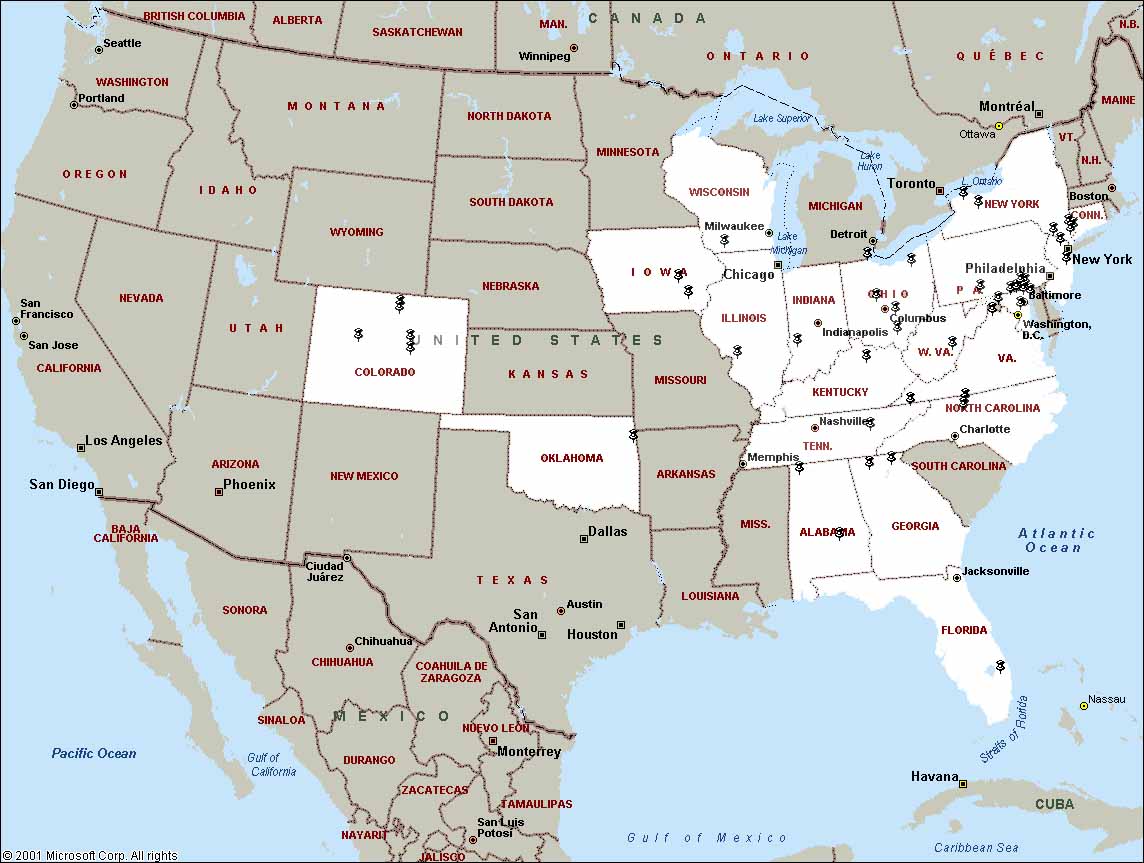
This is a repost. Originally from August 2004.
The map, above, is fairly illuminating, as it graphically represents where working judges sanctioned by the Jack Russell Terrier Club of America live.
The states in white are those that have any JRTCA working judges at all. The states that are muddy-grey colored have no JRTCA working judges. A pin (see a larger version of the map by clicking on it) represents the zip code of every JRTCA working judge in the U.S. in the current edition of True Grit magazine.
To get a "bronze medallion" for special merit in the field from the JRTCA, a dog has to work at least three types of quarry underground (fox, raccoon, groundhog, badger or an aggressive possum) operating as if it were out alone, and with the owner doing the digging, and a JRTCA judge has to be in attendance as witness the work. To get a certificate, a dog cannot work quarry in a barn, brush pile, artificial earth or man-made location (such as the crawlspace of an outbuilding).
Jack Russell Terriers are, far and away, the most commonly worked terrier in America. There are very few Fell Terriers in this country, and almost no working Border Terriers at all. Patterdale terriers in the U.S. are still relatively rare, and though some very good dogs are being bred by a handful of reputable breeders, too many over-large dogs are being produced -- many of them cross-bred in the not-too-distant past with small pit bulls in order to get a larger dog that can work game above-ground game -- barn raccoons and feral hogs in particular. There are some excellent Patterdales and a few good Fells in the US, but most of these seem to be owned by people that have had Jack Russell terriers at one time or another -- the dogs they started with before there were any Patterdales or Fells in the U.S.
In short, most working terriers in the U.S. are Jack Russell Terriers, and the map above tells a story.
Why does this JRTCA map look this way?
Some of it has to do with a population bias -- there are more people per square mile in the East and Midwest, and as a consequence associations are easier to maintain.
Another factor is that there are only about 50 pins on the map at all. This paucity of pins is partly a reflection of how few people actually work terriers in the U.S. beyond two-or-three time a year digs, and in part a reflection of the fact that being a working judge is truly a thankless task.
Of course there are more than 50 serious diggers in the U.S. Some of these diggers are ex-JRTCA working judges, some are people that dig a lot but have no desire to sign up for the thankless job of being a working judge, a very few diggers have Kennel Club registered dogs, some folks dig their dogs but have no club affiliation at all. And of course there are the patterdale-only owners, some of whom have joined the new UKC working terrier program or are members of the Patterdale Terrier Club of America.
That said, while this map is clearly not inclusive of everyone that digs their terriers, it is more-or-less geographically representative of the broad TREND of those that that do -- they tend to be in the East and in the Midwest, rather than in the Western United States. For example, of the 15 UKC working judges, as of August 2004, six are not in America, two are in California and come East to hunt, and the rest are in New Jersey, Kentucky, Virginia or Georgia -- states well-represented on the map above.
One of the reasons the map is skewed has to do with quarry availability. In the U.S., the bread-and-butter quarry of the working terrier is the groundhog. Raccoons cannot dig their own dens, and neither can possums. If dirt dens are not available, they will seek other alternatives -- hay lofts, brush piles, hollow trees, farm outbuildings, hay stacks, rock crevices, or old squirrel nests. With the exception of rock dens, these are not locations where a small dog follows quarry to ground and is then dug to. In short, it is not earthwork.
Red fox will dig dens on their own, of course, but in the American west they face real on-the-ground competition in the form of the coyote. A coyote will generally kill a red fox if given half a chance, and they directly compete with red fox for food.
In addition, the red fox is not native to most of the U.S., and its dispersal in the West is uneven as a consequence. While red fox are common in some areas (such as the prairie pothole region) they are quite rare in other areas (such as western Oklahoma).
Weather and time are another important reason fewer people hunt in the West. Fox will not den in warm weather unless they have kits, and in the U.S. we will not put a dog on a vixen with young. Without hounds to drive fox to ground, our fox-digging season is very short -- generally only 10 weeks long, and for most people with jobs this presents a very short period of time to get out into the field.
When people do get out into the field, of course, they have to find your fox! This is easier said than done, and is very hard job for a novice hunter with a novice dog. Red fox densities are variable, but settlement is generally much thinner in the West where there is less food than in the East, and where the fox faces direct competition with coyotes for food and den sites.
Raccoons are not native to the West, though they have spread with humans during the last 50 years, helped immeasurably by the creation of denning shelters in the form of barns, out buildings, road culverts, abandoned cars, and brush piles. A raccoon can expand a ground den a little bit, but it is not really made for digging. A skunk can and will dig its own hole, which is suitable for possum, but too small for anything but the smallest of adolescent raccoons.
Due to the absence of natural forage, raccoons are rarely found above 5,000 feet in the Rocky Mountain, unless they are living in close proximity to humans, though they have been reported at elevations as high as 10,000 feet if a steady food source is available.
Marmots and prairie dogs are found in some locations in the West, but the prairie dog is far too small for a dog to work, while the various species of rock marmots tend to gravitate towards areas with large boulders and talus slopes -- areas very hard to dig. Marmots are also absent from larger parts of the West outside of the Rockie Mountains. That said, if found in the right location, marmots are excellent quarry for working terriers in the Mountain States.
Some states -- notably California -- have very diverse geography and wildlife but also have very restrictive game laws which make working terriers difficult.
The American badger is common in some parts of the West, but more often than not its population is numerically thin on the ground. Badger are also hard to locate, as they will move every few days or so as they eat out, or chase out, a local rodent population (rats, mice, ground squirrels, and prairie dogs). Once the food is gone, so too is the badger. Unlike in Europe, the presence of a badger hole in the U.S. does not mean you have actually found a badger. More likely you have found a blank hole or, in some areas, worse -- a skunk, porcupine or snake.
Porcupines, rattlesnakes and skunks are fairly common in many parts of the West, and all three animals are a very serious threat to a dog. A dog sprayed underground by a skunk can be overpowered and die from anemia if not gotten out of the ground in pretty short order. A porcupine's defense system are barbed quills which can leave a dog wrecked in short order (and the owner's wallet drained after a visit to the vet). A dog bitten by a rattlesnake rarely lives, as the venom from even a small rattler is more than enough to kill a terrier.
In the South there are tens of millions of nutria, but they do not seem to be worked very often. In part this is due to the fact that in many Southern locations where nutria are numerous alligators also tend to be present. Another factor is that neither the American Working Terrier Association nor the JRTCA will give a working certificate to nutria as the holes are too big and shallow to qualify as real earth work. In addition the nutria, like the possum, is an animal whose primary defensive mechanism is bluffing. While AWTA will not give a certificate to possum, and the JRTCA will provided it is an "aggressive" possum, both seem to think the nutria is less than fomidable quarry for a working terrier.
A final obstacle to terrier work in the West is experienced people to show newcomers where to start. While the basics of terrier work are not overly complex, there are things to learn about locating quarry, digging, dispatch, and healthcare. To work any terrier in a safe manner requires several hundred dollars worth of equipment, as well as permissions from land owners. And then, of course, you have to have the desire to hunt, be in relatively sound physical shape, and be willing to devote the time to get out in the field in all kinds of wearther. It turns out all of this is a rare combination.
All of the factors above combine to create a "tipping effect" in much of the West where the chance of finding quarry is lower than in the East, and the chance of getting a dog injured is higher. When combined with a paucity of other working terrier owners, a very short working season, and the abundance of other kind of hunting opportunities, it is not surprising to find fewer working terriers in the Western United States than in the East and Midwest
Many of the western diggers that do exist actually come East to work their dogs, going to the trouble of loading themselves and their dogs into airplanes, trucks and cars for a week or two of hunting where quarry can be found on the ground.
This clearly takes a great deal of work and commitment, making these folks among the most dedicated working terrier enthusiasts in the U.S. A special hats off to them!
.

 What no one seems to have actually asked is what was Zumbo actually trying to say in his blog? This is, after all, a man who has spent his entire life buying, carrying, cleaning and firing guns. He has shot deer in every state of the Union and knows how to skin a bear with a pocket knife. Is it really possible he woke up one morning possessed by the demon spirit of PETA-founder Ingrid Newkirk? I seriously doubt it.
"While at the SHOT Show recently, I ran into a guy who complained that too many hunters were taking excessively long shots. He’s an outfitter, and witnessed plenty of people shooting at elk at distances greater than 350 yards. He suggested that that was too far, primary because the majority of those hunters had no clue of ballistics. Most were 'Hail Mary' shots. I agree. We read about people making 500 yard shots and more, and that, to me, is ridiculous.
Then at the SCI convention last week, I talked to a guy who bragged that his custom gun kills deer out at 800 yards and better. To each his own, I suppose, but that isn’t hunting. It’s shooting. And I don’t care how great a marksman you are. The risk of wounding an animal at extremely long ranges is high, and where’s the sportsmanship, the ethics, the satisfaction of taking outrageously long shots? I understand there’s a group in PA that shoots deer at 1,000 yards and more. More power to them. Just don’t ask me to support that kind of 'hunting.'”
 Prairie dogs have long been an emotional issue in parts of the West. In truth, these little animals do no harm and quite a lot of good. Of course, that's not the way cattlemen see them. In arid and marginal country, ranchers are always anxious to blame their misfortunes on something more tangible than the weather, and so they take it out on coyotes, prairie dogs and the IRS, not one of which has the slightest impact on a herd of Angus.
"As I write this, I’m hunting coyotes in southeastern Wyoming with Eddie Stevenson, PR Manager for Remington Arms, Greg Dennison, who is senior research engineer for Remington, and several writers. We’re testing Remington’s brand new .17 cal Spitfire bullet on coyotes.
I must be living in a vacuum. The guides on our hunt tell me that the use of AR and AK rifles have a rapidly growing following among hunters, especially prairie dog hunters. I had no clue. Only once in my life have I ever seen anyone using one of these firearms.
I call them 'assault' rifles, which may upset some people. Excuse me, maybe I’m a traditionalist, but I see no place for these weapons among our hunting fraternity. I’ll go so far as to call them 'terrorist' rifles. They tell me that some companies are producing assault rifles that are 'tackdrivers.'
Sorry, folks, in my humble opinion, these things have no place in hunting. We don’t need to be lumped into the group of people who terrorize the world with them, which is an obvious concern. I’ve always been comfortable with the statement that hunters don’t use assault rifles. We’ve always been proud of our 'sporting firearms.'
This really has me concerned. As hunters, we don’t need the image of walking around the woods carrying one of these weapons. To most of the public, an assault rifle is a terrifying thing. Let’s divorce ourselves from them. I say game departments should ban them from the prairies and woods."
 But the Ballistics Boys who shoot prairie dogs are not hunters. They are shooters, and among this particular tribe, there appears to be a few who are a little low in common sense and a little over-caffeinated to boot.
.

