Showing posts with label poison. Show all posts
Showing posts with label poison. Show all posts
Tuesday, March 31, 2009
How to Tame a Lion Poisoner
Link
Over the course of the last 20 years, Africa's lion population has crashed from 200,000 to 30,000, and the numbers continue to drop fast.
One of the big reasons is that an American company -- FMC -- has sold a highly toxic, tasteless pesticide to African countries where herders are using it to indiscriminately wipe out all predators -- lions, cheetahas, leopards, hyenhas, etc.
Though FMC says it no longer sells Furadan (carbofuran) in Kenya, and is now trying to buy up stock that may still be on shelves, FMC has not said it will stop selling the drug in neighboring African countries or around the world.
To be clear, Furadan is such a horrible chemical that in July 2008, the Environmental Protection Agency initiated action to ban the chemical's use in the U.S. as it presented unacceptable dietary risks, especially to children, from consuming food or water with carbofuran residue in it or on it.
Want to help take action?
Send an email to Jim Fitzwater, FMC's corporate flak at james.fitzwater@fmc.com or call him directly at 215.299.6633.
Your message does not have to be long, and it does not help to be rude. It is enough to simply say that you want FMC to stop making this toxic poison, and that you are passing on this notice to 20 of your friends.
Make some heat, and maybe FMC will yet see the light!
.

Sunday, May 11, 2008
Poison Ivy Prevention & Treatment

Poison Ivy is one of the burdens of American terrier work -- it's out there and you will get it if you work enough hedgerows.
Poison ivy, poison oak and poison sumac are all in the Rhus family of plants, and these plants produce more cases of contact dermatitis than all other substances combined. Plant-caused rashes can affect any part of the body, but commonly affect the forearms, face and back of the hands.
Poison ivy skin rashes are not contagious -- only the toxic oil of the plant (urushiol) causes the poison ivy reaction, and generally it has to be on your skin for an hour or more before it takes effect.
You can reduce or eliminate your chance of getting poison ivy in the field by wiping off your arms with soap and water if they have been dragging around in poison ivy during a dig. A very easy way to do this is with a packet of "handywipes" designed to clean off oils, such as Kimberly-Clark's Professional Heavy-Duty Hand Cleaning Wipes.
Tecnu is a special outdoor skin cleanser that removes Poison Oak and Ivy Oils from your skin. This product stops the irritant from spreading and can also decontaminate pets and tools. Small bottles are at many camping stores and pharmacies, such as Walgrens -- just apply with a small hankerchief.
Tuesday, April 29, 2008
Low Cost All-Worm Treatment

I do not believe in worming every month -- none of my dogs manifest any signs of worms and worming medicine is a poison that I think should be administered for cause, or at least with less vigor than some dog owners believe.
That said, worming has never been easier. Roundworms and tapeworms are the most common canine worm types and highly effective over-the-couner worming medicines for these worms have been available for decades. For simple regular worming, go with these.
If you think a dog has hook or whip worms, as well as round worms and tapeworms, try Safe-Guard (10% Fenbendazole). This medicine is now available in dog-ready packages from most online veterinary supply places, but if you have a very large kennel a less expensive version can be made up from SafeGuard used for horses, provided the following dosage directions are carefully followed. The dosage for canines is 1 ml (which contains 100 mg active ingredient) per 5 lbs of dog bodyweight. For example, a 15 lb terrier would receive 3 ml (same as 3 cc or about two-thirds of a teaspoon) per day for a 3 day period.
Fenbendazole is always administered for 3-consecutive days rather than only one day, to be sure the puppies and dogs are 100% worm-free.
.
Friday, February 8, 2008
Year of the Rat?
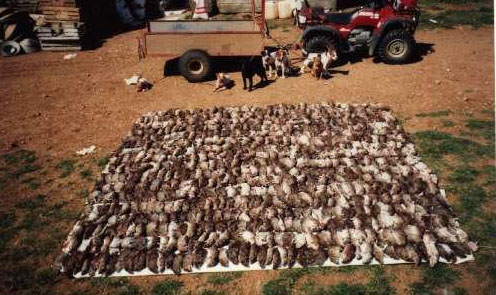
This is the year of the rat in China, which seems as good a time as any to post this rather fantastic terrier ratting picture (see above).
The photo is of more than 900 rats taken from a game farm in England with a pack of terriers and a smoker.
For a primer on rats as food (complete with culturally-sensitive and thoughtful essay as well as stunning pictures) see the page entitled Rat or Ratatouille?
For a primer on rat poison, see Rat Poison and Wildlife Conservation.
.
The photo is of more than 900 rats taken from a game farm in England with a pack of terriers and a smoker.
For a primer on rats as food (complete with culturally-sensitive and thoughtful essay as well as stunning pictures) see the page entitled Rat or Ratatouille?
For a primer on rat poison, see Rat Poison and Wildlife Conservation.
.
Sunday, April 22, 2007
Coffee and Provocation

More Pet Food Recalls:
The massive recall continues, with more pet food brands being added and melamine-tainted corn and rice gluten now added to the list, along with tainted wheat gluten. Corn and rice gluten is often labeled "corn protein," or "rice protein" on dog food labels. Up to now, the concern had just been about tainted wheat gluten. It turns out that melamine may have been deliberately added to pet food stocks in China in order to boost their protein content during testing. For the record, there is no reason at all to think these poisons did not make it into the U.S. food supply, so if you are a vegan that eats seitan, you might reconsider your menu -- at least for a few weeks. See Google News for more information -- there are a million links out there.
FDA is the Problem, Not the SolutionCheck out what the FDA did when dogs started dropping over dead from Proheart 6, an injected drug to prevent heartworm. Hint: they did exactly what Wyeth told them to do and all-but-fired the FDA researcher who reported the problem. Talk about a captive agency!
Canine PerversionNow you can let your dog gets its kink on with this new canine sex toy/doll. And yes, apparently it's real. God help us all.
A Dubious DNA Test:
If you simply have to know what kind of dog might be in the mix of your mutt, there's a company that claims to do that. On the other hand, if you send me $50 and a picture of your dog, I'm pretty sure I can do just as good a job.
Pennsylvania Foxing Stories:
Pete Bassani has recently published a small (85 pg.) soft cover book called "Memories of a Fox Huntin' Terrierman." Each chapter is about driving a fox, mainly grays, in the mountains of New Jersey and Pennsylvania. The book is available from Pete at RR #1, PO Box 479, Hawley, Pa. 18428, for $17.50, postage included. Teddy Moritz says it's a good history of pre-Jack Russell terriers in the eastern U.S.
Will the Energy Crisis Bring Back the Great Plains?
It turns out that native prairie grasses are more effecient at producing ethanol than corn. It's a little early to tell if this might lead to further expansion of the Conservation Reserve Program and a turn around in grass nesting birds, but it's a glimmer of something positive in the middle of a $3-a-gallon world.
Working Pets Store:
An online store in Ohio called WorkingPets.com sells the new Deben locators, so it's not just the JRTCA anymore. Check out both stores and then join the JRTCA for all the reason given here. See below for an example.
Pennsylvania Scraps Poorly Written Law:
Pennsylvania has scrapped regulations that would have made it much more expensive (and perhaps impossible) to breed and raise hounds and hunting dogs in the state. A wide coalition of hunting dog groups, including the Jack Russell Terrier Club of America, helped send the law packing.
The massive recall continues, with more pet food brands being added and melamine-tainted corn and rice gluten now added to the list, along with tainted wheat gluten. Corn and rice gluten is often labeled "corn protein," or "rice protein" on dog food labels. Up to now, the concern had just been about tainted wheat gluten. It turns out that melamine may have been deliberately added to pet food stocks in China in order to boost their protein content during testing. For the record, there is no reason at all to think these poisons did not make it into the U.S. food supply, so if you are a vegan that eats seitan, you might reconsider your menu -- at least for a few weeks. See Google News for more information -- there are a million links out there.
FDA is the Problem, Not the SolutionCheck out what the FDA did when dogs started dropping over dead from Proheart 6, an injected drug to prevent heartworm. Hint: they did exactly what Wyeth told them to do and all-but-fired the FDA researcher who reported the problem. Talk about a captive agency!
Canine PerversionNow you can let your dog gets its kink on with this new canine sex toy/doll. And yes, apparently it's real. God help us all.
A Dubious DNA Test:
If you simply have to know what kind of dog might be in the mix of your mutt, there's a company that claims to do that. On the other hand, if you send me $50 and a picture of your dog, I'm pretty sure I can do just as good a job.
Pennsylvania Foxing Stories:
Pete Bassani has recently published a small (85 pg.) soft cover book called "Memories of a Fox Huntin' Terrierman." Each chapter is about driving a fox, mainly grays, in the mountains of New Jersey and Pennsylvania. The book is available from Pete at RR #1, PO Box 479, Hawley, Pa. 18428, for $17.50, postage included. Teddy Moritz says it's a good history of pre-Jack Russell terriers in the eastern U.S.
Will the Energy Crisis Bring Back the Great Plains?
It turns out that native prairie grasses are more effecient at producing ethanol than corn. It's a little early to tell if this might lead to further expansion of the Conservation Reserve Program and a turn around in grass nesting birds, but it's a glimmer of something positive in the middle of a $3-a-gallon world.
Working Pets Store:
An online store in Ohio called WorkingPets.com sells the new Deben locators, so it's not just the JRTCA anymore. Check out both stores and then join the JRTCA for all the reason given here. See below for an example.
Pennsylvania Scraps Poorly Written Law:
Pennsylvania has scrapped regulations that would have made it much more expensive (and perhaps impossible) to breed and raise hounds and hunting dogs in the state. A wide coalition of hunting dog groups, including the Jack Russell Terrier Club of America, helped send the law packing.
Wednesday, April 11, 2007
An Alarming Story in Computer Code
 One of the things that invisible trackers on a web site can do is provide keyword analysis, i.e. it can tell you what folks that came to your web site from Google or Yahoo or MSN actually typed into those search engines that brought them to your web site or blog.
Tonight I looked into that section of the tracker and found the usual kind of stuff:
- jack russell terrier and queen anne front legs
- dogs in shelters
- bellman & flint
- how does a red fox defend its self
- how to call rat terrier after it has killed his prey
- doxycycline shelf lifetime
- dog has developed skin allergy to urban wolf made with beef should i change to lamb
- tulerimia history
And then, rather distubingly, I found three inquiries from India:
- kill a mad dog poisons
- is thallium sulfate available in shop
- alexander the great wife to poison him after he took a homosexual lover
I suppose this not a bad set up for a modern detective novel, but at 4 am in the morning it is simply disturbing.
Friday, April 6, 2007
Don't Buy Dog Food from Hank Petchow
 Back in 1995 or 1996, long before there was the kind of "Fake News" we now see everynight on Comedy Central, Saturday Night Live ran a fake dog food commercial starring Will Ferrell.
The visuals were a killer (pun intended)
 and showed a huge bag of kibble with an emormous picture of Shep the Huskie, and the words "PetChow" written in large letters underneath.
In very small letters, underneath that it said "Rat Poison."
I cannot find the video anywhere on the internet, but here's the script of the spot:
[Open on Hank Petchow running through the snow with his dog Shep ]
Hank Petchow: Come on, Shep! Here we go!
Voiceover: Like most dog owners, I really enjoy playing with my dog.
[ cut to interior, Petchow household ]
Hank Petchow: Hi! I'm Hank Petchow. I love my dog, and I love taking care of him. But as much as I like feeding ol' Shep here every morning, there's some animals I'd rather not feed - rodents, mice, rats. I hate them. That's why I developed this. Petchow Brand Rat Poison. Petchow's the only rat poison deadly enough to carry my name - Petchow. And Petchow's the most powerful rat poison on the market. In fact, it's so strong, it could easily kill an animal much larger than any rat you'll ever see - instant. And rats love Petchow's big meaty pieces. [ Shep jumps up to the bowl of rat poison ] Whoa, no, Shep! That's rat poison! [ moves Shep ] Just add water for a hearty poison gravy that no rat can resist. He'll be dead on the spot. Right, Shep? [ Shep barks and moves closer to the rat poison gravy ] Whoa, Shep! Down, boy, that's not for you! [ laughs ] So, if rats are your problem, choose a name you can trust. Petchow. Just look for the rat poison with a picture of ol' Shep on it.
[ show two dogs sitting on each side of the Petchow package ]
Jingle: "Petchow. Arf arf. Petchow. Arf arf. Petchow. Arf arf. Rat poison."
Announcer: Petchow. The one they can't resist.
Wednesday, April 4, 2007
PETA, Pet Food and Wheat Gluten
 Over at the Pet Connection Blog, Gina Spadafori is reporting some pretty distressing numbers, with more than 3,000 pets already dead due to over 60 million pounds of rat-poison and melamine-contaminated dog food being shipped around the country.
Some reporters seem to have taken to quoting PETA about this dog food tragedy -- never mind that PETA knows nothing about dog food or nutrition, opposes ownership of both pet dogs and working dogs, euthanizes more than 85 percent of the dogs given up to to it, and steals dogs from shelters in order to kill them.
The poor quality of the reporting on this dog food story is amazing. For example, in all of the writing, no one has taken the time to ask a basic question: What the hell is wheat gluten, and why is it in our dog food?
Here's the answer: Wheat gluten is synthetic meat made from processed wheat.
In vegetarian cuisine, this stuff is called Seiten, and if PETA had its way, not only would your dogs and cats be eating nothing else, but so would you.
The picture at the top of this post is a Taiwanese can of "mock duck" made from 100 percent wheat gluten.

To the right is what the contents of this same can looks like when it is dumped out into a bowl.
Mmmm Good!
Does that look like the "chicken and chunks" you have been serving your pooch?
That's not an accident. Along with "Mock Duck" you can find wheat gluten carefully shaped to look like "mock" beef, mock turkey, and almost anything else.
Wheat gluten is imported from Asia because it is made in massive amounts over there, where is used as an alternative to soy-based meat substitutes such as tofu.
Wheat gluten is cheap and it is a realistic-looking meat substitute. In and of itself, it is not necessarily bad for you, but since most wheat gluten is imported from overseas, almos none of it is inspected by the FDA.
It turns out that folks who thought they were giving their cat or dog "real meat" were -- more often than not -- giving them a little bit of meat and a whole lot of wheat gluten produced overseas by the lowest bidder in a non-FDA-inspected factory.
OK, let's go to a second point: How and when did the dog food companies finally realize that their pet food products really were heavily contaminated by poison?
Early reports from customers were the first sign, of course, but the definitive evidence came from routine "live feed trials."
In a live feed trial, kenneled animals are systematically fed food samples from the production line. When about a third of the cats and dogs in a Menu Foods feed trial subsequently died, that company knew it had a disaster in the making.
What no reporters have mentioned in all their articles about this mess is that PETA is against testing any pet food on any live animals. In fact, in the middle of this pet food recall, PETA actually produced “a list of dog and cat food manufacturers that don’t test on animals.”
Talk about missing the message.
"Don't test on animals"??? That's a good thing??? Not in my house.
Please God, let's keep testing dog food on live animals.
And while we are at it, let's also test prescription drugs and vaccines too.
 Our children are worth it, and so are we.
As for this dog food mess, let's remember that's while it is primarily caused by poor corporate management, human greed, and an incompetent FDA, you can also find the hand of Seitan at work.
And no one loves Seitan more than PETA.
Saturday, March 24, 2007
One in Seven
One in Seven of the test animals given dog food made by Menu Foods have died. The moist and wet dog food (sold by Eukanuba, Iams, Nutro and under various store labels) was contaminated by a type of rat poison that is illegal in the US. Dry food is not included in the recall at this time.
Rat poison came into the dog food from wheat glutten imported from China. Menu Foods is a Canadian company, and the plants linked to the pet deaths were located in Kansas and New Jersey,
The official count of dogs and cat killed is expected to climb into the thousands, as 60 million pounds of cat and dog food are involved and the company was slow to act, running its production line for weeks after contamination problems arose. >> To report a pet-food related pet death.
Rat poison came into the dog food from wheat glutten imported from China. Menu Foods is a Canadian company, and the plants linked to the pet deaths were located in Kansas and New Jersey,
The official count of dogs and cat killed is expected to climb into the thousands, as 60 million pounds of cat and dog food are involved and the company was slow to act, running its production line for weeks after contamination problems arose. >> To report a pet-food related pet death.
Friday, March 23, 2007
Rat Poison in Dog & Cat Food Kills Over 1,000 Pets

A lot of dogs and cats are dying due to the unintentional poisoning of wet and moist dog food manufactured by Menu Foods and sold across North America under store brands carried by Wal-Mart, Kroger, Safeway and other large retailers, as well as private labels such as Iams, Nutro and Eukanuba.
The latest numbers from PetConnection data base shows 1,103 deceased pets (654 cats/449 dogs).
A point under-reported in the popular press: High-price Eukenunba, IAMs and Nutro dog food is the same crap made at the same company as the store-brand dog foods sold at Safeway and WalMart.
For the record, my dogs eat Purina dry bag kibble, and always has.
- For more on rat poisons in general;
- For more on this specific poison, which is not legal in the US and came to the U.S. via imported Chinese wheat (why would anyone in the U.S. import wheat from China??);
- For more on dog food history
Rat Poison Found in Tainted Pet Food By Mark Johnson, Associated Press
ALBANY, N.Y. - Rat poison has been found in pet food blamed for the deaths of at least 16 cats and dogs, a spokeswoman for the State Department of Agriculture and Markets said Friday.
Spokeswoman Jessica Chittenden would not identify the chemical or its source beyond saying it was a rodent poison.
ABC News reported it was aminopterin that may have been on imported wheat used in the pet food. Aminopterin is used to kill rats in some countries but is not registered for that use in the United States, according to the Environmental Protection Agency.
The chemical, also a cancer drug, is highly toxic in high doses.
Officials from the agriculture department and Cornell University's Animal Health Diagnostic Center would not immediately confirm the ABC report but scheduled a news conference Friday afternoon to release laboratory findings from tests on the pet food.
The Food and Drug Administration has said the investigation was focusing on wheat gluten in the food. Wheat gluten itself would not cause kidney failure, but the common ingredient could have been contaminated by heavy metals or mold toxins, the FDA said.
State and FBI officials said they knew of no criminal investigations in the case.
The pet deaths led to a recall of 60 million cans and pouches of pet food produced by Menu Foods and sold throughout North America under 95 brand names. There have been several reports of kidney failure in pets that ate the recalled brands, and the company has confirmed the deaths of 15 cats and one dog.
Menu Foods last week recalled "cuts and gravy" style dog and cat food. The recall sparked concern among pet owners across North America. It includes food sold under store brands carried by Wal-Mart, Kroger, Safeway and other large retailers, as well as private labels such as Iams, Nutro and Eukanuba.
Menu Foods is majority owned by Menu Foods Income Fund of Streetsville. The company also makes foods for zoo cats, but those products are unaffected by the recall.
The company's chief executive and president said Menu Foods delayed announcing the recall until it could confirm that the animals had eaten its product before dying. Two earlier complaints from consumers whose cats had died involved animals that lived outside or had access to a garage, which left open the possibility they had been poisoned by something other than contaminated food, he said.
Menu Foods planned a media teleconference for later Friday, a spokesman said.
A spokesman for New York Attorney General Andrew Cuomo said he was not aware of any criminal investigation involving the tainted food. FBI spokesman Paul Holstein in Albany said Friday he was not aware of any FBI involvement in the case.
"I don't know where we'll go from here," he said.
A complete list of the recalled products along with product codes, descriptions and production dates was posted online by Menu Foods and is available at http://tinyurl.com/2pn6mm. The company also designated two phone numbers that pet owners could call for information: (866) 463-6738 and (866) 895-2708.
___
Associated Press writer Andrew Bridges in Washington contributed to this report.
___
On the Net:
FDA pet food recall information: htp://www.fda.gov/oc/opacom/hottopics/petfood.html
Menu Foods: http://tinyurl.com/2pn6mm
Wednesday, February 28, 2007
Ten Quick Bits on Rats

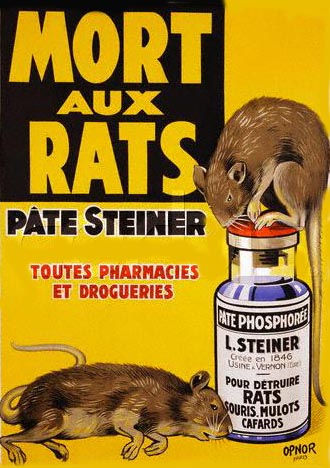
- Size: Adult Brown Rats (aka the Norwegian Rat) generally weigh between 10 and 18 ounces and can reach lengths up to 18 inches, from nose to tail. The average weight of an urban rat is about 12 ounces.
- Food and Water: : Rats can eat a third of their weight in food a day, but unlike other rodents, rats have a strong need for waterand will drink 1/2 to 1 ounce a day. Rats eat 50 pounds of food a year and can eat 1/3 of their weight a day. Favorite foods include oatmeal, potatoes, meat and cooked eggs. The U.S. Government reports that the average rat damages $1 to $10 worth of food and other material per year, and contaminates 5 to 10 times this amount in its travels. U.S. Food and Drug Administration (FDA) guidelines allow "an average of two rodent hairs per one hundred grams of peanut butter."
- Senses: Rats follow the edges of walls or old grease trails left by their own bodies because they can see only three or four feet with any real accuracy. Rats have such an acute sense of taste, however, that they are able to detect some poisons at levels as low as 0.5 parts per million.
- Reproduction: Litters of six to 12 young are born 21 to 23 days after conception. Young rats are completely independent at about four weeks, and reach reproductive maturity at three months of age. A female rat may have sex as often as 20 times a day and can produce a litter about six times a year. Most female rats are pregnant 100 percent of their adult life. A single pair of rats can theoretically multiply more than 15,000 descendants in 1 year; 359 million in 3 years. Like people, and unlike most other animals, rats display homosexuality, even when members of the opposite sex are readily available.
- Locomotion: Rats can run at 24 miles per hour for short bursts -- about as fast as an Olympic runner, even though they weigh less than 1/100 the weight. Rats can swim 1/2 mile in open sea and tread water for 3 days. They can dive 100 feet underwater and hold their breath for as long as 15 minutes.
- Not a Native Animal: Although the Black Rat has been in England since the Third Century AD, the first recorded Brown Rat arrived in 1714, along with King George I, and they may have come over on the same ship from Germany. The first Brown Rats arrive in the U.S. in 1760.
- Rats Can Survive Anything: Warfarin was developed as a rat poison a couple of decades ago, but within a year of its introduction, some rats had grown so resistant to this powerful anti-coagulant that they were seen eating it for food. After several atomic bomb tests on Engebi, in the Eniwetok Atoll in the 1950s, scientists returned to the island to find highly radioactive soil, devastated plant-life, and a huge colony of perfectly healthy rats living off of dead fish washed up on the beach.
- The Power of Rat Teeth: The jaws of a rat can exert pressures of 24,000 lbs per square inch, and rats can readily chew through plastic water pipes, bone, irrigation systems and garbage cans, wood boxes, dry wall, and even cinder block. On the international "hardness index" rat teeth = 5.5, while iron = 4.0, copper = 2.5-3.0, aluminum = 2.0 , and lead = 1.5. Rat teeth grow about 5 inches a year, and rats with mis-aligned jaws have been know to pierce their own brain cases with their incisors.
- Getting Rid of Rats: It is is almost impossible to rid an area of rats by poison and traps alone. Some rats are simply too smart to be caught by traps, and rats grow resistant to any one poison pretty quickly. Poison and traps can work, but ONLY if they are combined with a clean up of garbage-ridden areas. Start by putting all trash into cans with tight-fitting lids, removing large overflowing dumpsters, trimming grass and weeds in the area, plowing up burrows, and removing all possible hiding places. Bird feeders should be removed, dogs cleaned up after, sources of water drained, and wood piles raised off the ground.
- Life and Death: Rats have pushed more animals into extinction in the last 500 years than than any other cause. Most of these extinctions were caused by rats eating the eggs and fledglings of birds endemic to Pacific islands. Rats can transmit at least 35 diseases to humans, including leptospirosis (very common) and the Plague (very rare).While the Bubonic Plague (carried by the Black Rat flea) wiped out scores of millions of people in Europe between 1300 and 1700, the arrival of the Brown Rat in the early 1700s pushed out the Black Rats and Bubonic Plague pandemics in Europe and most of the rest of the world quickly abated. The relatively high quality of life enjoyed by most people in the world today is directly attributable to medical research made possible by generations of laboratory rats bred for more than 150 years from the "fancy" rats first collected by Jack Black, the rat catcher (and terrierman) employed by Queen Victoria.
Tuesday, November 7, 2006
Datura

The big green prickly seed pods are Datura
Datura is sometimes called Jimson Weed, Mad Apple, or Devil's Weed, but whatever you call in, it's a common enough plant on disturbed farm land. The picture above shows Datura growing on the edge of a field on Sunday.
Datura is a very powerful poison, and also one of the most powerful psychotropic plants found anywhere in the world. No one should ever experiment with this drug -- it makes 1500 mics of LSD look like a short beer, and it is not a "nice high" but a nightmare on two legs.
The following description describes the symptoms of Datura ingestion -- something once practiced by native American shammans, but now given a pass even by them:
Stimulation and/or anxiety.
Extreme nausea. Dilated pupils. Blurred or fixed-focus vision. Rapid heartbeat.
Extreme disorientation. Loss of memory. Loss of time. Delirium.
Profound sensitivity to light and noise. Seamless crossover into a variety of realistic dream states.
Extreme uncoordination, loss of body control, and vertigo. Extreme audio, visual, and tactile hallucinations.
Apparent astral travel to familiar places. Interaction with friends, relatives, and other random people who are not physically present.
Extreme drying and irritation of the mouth, throat, eyes, urinary tract, and other mucous membranes.
Potential for uncontrollably emotional or violent activity. Inability to recall anything -- even that you are under the effects of a drug -- for quite some time.
Tuesday, September 5, 2006
Vicious: Wolves and Men in America
 Despite a lot of talk and unfounded rumor, there is no record of a non-rabid wolf killing a human in North America since the arrival of Europeans.
Yet humans have killed wolves wholesale, using poison, traps, clubs, rifles, and even laying out mackerel hooks inside lumps of meat and fat. Nothing was too brutal in the quest to exterminate the wolf, and by 1880 a large part of America was wolf-free.
The wolf hung on into the 20th Century, however, in large part because the bounty system did not pay enough for people to spend months tracking down the last western wolves which were smarter and more trap-shy than most. When the Government began paying a professional cadre of wolfers to exterminate the last of their kind, however, the fate of the wolf was sealed.
Ironically, one of the last Government wolfers was Aldo Leopold, then a young man working for the U.S. Forest Service in New Mexico. Leopold went on to write the first book on Game Management in the U.S., and became, posthumously, an icon of the modern environmental movement with his memoir, A Sand County Almanac.
Buried in that little book is an essay called "Thinking Like a Mountain," and within it a section in which Leopold observes the dying of a "fierce green light" within a wolf as it bleeds out on on rock after being shot.
Up until that hunt, Leopold had thought what he had been doing was good for deer and the mountain, but after seeing the wolf die he suspected neither the deer nor the mountain agreed with that view.
In time, as deer overgrazed sections of the West and East, Leopold began to fully understand the importance of keeping top predators in the eco-system. "A thing is right," he wrote "when it tends to preserve the integrity, stability, and beauty of a biotic community. It is wrong when it tends otherwise."
But Leopold came to this conclusion may decades after shooting out the last wolves of New Mexico, and in his youth he was among the cadres of Government wolfers who told stories about wolf hunts in order to help raise cash to support the public extermination effort.
Government-sponsored wolfers created traveling displays of wolf pelts and wolf skulls. These displays and stories memorialized the last of the western wolves and gave them names: The Custer Wolf, Old Three Toes, Old Lefty, and Old Rags the Digger, among them.
By giving individual wolves names and personalies, Government trappers helped break down the wall between wolf myth and wolf reality. The wolf, which had once seemed threatening, dangerous and mysterious, now became the outlaw hero of the story, and an emblem of the last days of the romantic (and dying) American frontier.
This is the essential plot structure of Jon T. Coleman's book "Vicious: Wolves and Men in America." The book is not a text on wolf biology, but a history book that analyzes the gaps and nexus between wolf myth and wolf reality. Though well-written, it is more than a little burdened by the weight of being overly-academic and spending perhaps too much time on folklore and not enough on basic wolf biology. No matter - if you have ever wondered how the wolf went from pariaha to paragon in the space of 50 years, this book tells the tale.
Coleman suggests that the wolf reintroduction efforts of the 1990s (which have been quite successful) occurred because America is now mostly urban and has little contact with farm animals which now come from protected feed lots rather than the free-range forests and fields where wolf, ranchers, farmers and livestock once battled.
"Human predation has become so technical and abstract [in the lat 20th Century] that the consumers of animal protein no longer feel emotionally connected to the beasts they ingest...
Reintroduced wolves have thrived in a cultural environment that accepts the scientific extermination of millions of domestic animals but rejects violence towards a handful of wild creatures."
Reading Coleman's book hard on the heels of The Omnivore's Dilemma made plain how much our thinking about both food and wildlife has been shaped by our distance from field and forest.
Would the wolf have been reintroduced if Americans lived on grass-fed beef? Perhaps not.
Did cows have to fatten in feed lots in order for America to returns its large predators to their spot on the ecological ladder? Perhaps.
It is an uncomfortable kind of tradeoff.
Wednesday, June 28, 2006
Acts of God

Young Moxie rests in a dry creek bed. A very nice looking little dog.
In theory, June 21st is the longest day of the year. But, as Einstein so famously said, some things are relative and not everything unwinds according to theory.
June 24th had hours that seemed to last for weeks.
The day started out like any other, except that I had gone out for dinner with my wife and daughter the night before, and we had blown a tire on the Ford Expedition. Due to lack of a working jack, this proved to be a bigger problem than it should have been.
All of this is to say, I was a bit discombobulated that evening when I loaded the tools; one possible reason I showed up at the Flint Hill General Store the next morning with everything I needed except the locator collars.
A small problem, but not insurmountable. I have dug on the dogs without a collar before, and with the heat we were unlikely to find a skunk to ground. We would do it "old school" as best we could.
I was anxious to see Chris J., as he had picked up his first working terrier the week before from Tim J. who, in turn, had acquired the dog from an Amish fellow who had a small kennel of patterdales. The young Amish lad had subsequently come down with cancer and had to disperse his dogs.
Out of this tragedy came Moxie, an eight-month old female patterdale of wonderful proportions, a roughish coat, and a very calm disposition. I liked her straight out of the box, admiring her size and general diposition. A wonderful little dog.
I had brought Chris a short go-to-ground tunnel and a new six-foot digging bar, and we transfered both of these to his truck -- my gift to the new pup to get her started off right.
We set off with the dogs, headed down the edge of a rapidly growing cornfield on a narrow path just inside the wood line.
It was amazing what a few months had done to this section of land. Winter sticks and barren trees had fallen away to walls of thick vegetation. It was as if we were traveling down a green hallway, with Mountain ranging ahead (a greedy little dog that likes to find the hole first) with Sailor and Moxie padding along behind us.
We did not hunt the trail, as I had an idea of where we would locate quickly, and for once I was right. Sailor entered a nice one-eyed sette in a waste area with high vegetation, and began to bay. Bingo!
From the sound, I could tell Sailor was pretty deep. We stuck a stick into the sette to gauge direction and depth, and began to dig, but the ground was criss-crossed with shattered quartz mixed with hard pan, and it was very tough digging.
We dropped a four foot hole and barred, but could not locate the pipe.
Sailor came out and Mountain went in. This was a one-eyed sette, and with ground this hard the groundhog was not going to be able to dig away.
But there was some question as to whether we could dig in. We had no collar on the dogs, the ground was as case-hardened as a strong box, and I was not anxious to dig another four- or five-foot exploratory hole.
I suggested we pack it in, give this groundhog law, and see if we could find a shallower sette.
Which we did.
In the next hedgerow the blackberries were just beginning to turn, and there were quite a few holes. Sailor opened up in a large eight-eyed sette and either lost the groundhog or bolted it. Considering the thickness of the vegetation and the intensity of her barking very close to the surface, it was most likely a bolt.
We moved on.
At the base of a cluster of shattered trees on the edge of a scrub field Sailor slid in and opened up. A quick check confirmed that this too was a one-eyed sette. Chris and I moved some of the broken and barkless tree trunks, and cut away the brush.
A pileated woodpecker shattered the quiet, and Chris chuckled a little because he knows I like these big red-headed birds.
Sailor was still in the hole and baying full bore. We eye-balled the pipe, probed the hole, and then cut a few feet of rocky soil off the top.
A little barring, and we soon found the pipe and opened it up to the tube. Bingo.

Sailor slides into a den pipe among the shattered trees.
Sailor had moved back when we were digging, and now she tried to press forward past us. We pulled her for a minute and cleared away the rubble, and then she was hard on it again, baying up a storm and clearly making contact.
We were a bit behind the dog now, and about three feet behind the groundhog, so we started another hole. The dirt was mostly rock, but the pipe was shallow.
As we cut into the pipe again, Chris pointed out a large spider dragging an egg case behind her. It was that time of year. A quick scoop and spider, egg case, and dirt went sailing on to the spoil pile. Happy trails, Mrs. Spider.
At this second hole, we broke through at a little past three feet. We were just behind the groundhog now, and Sailor was grabbing one end through the old hole, and Mountain was grabbing the other end through the new hole.
Enough of that.
We pulled Mountain out of the second hole and allowed Sailor to press the groundhog, which soon bolted to a pole snare and a quick dispatch. This was a young groundhog and I intended to skin it and grill it that evening.
While I was dispatching the first groundhog and placing it in the fork of a tree prior to tying up the dogs, Chris called over to say there was another one in the pipe.
Sure enough, there was. Excellent.
I staked Sailor a few feet away from the hole to allow Mountain her chance to bolt or pull this second groundhog. Mountain grabbed it and pulled it out, and we dispatched it without ceremony. While I was doing that, Chris poured some water for Moxie and Sailor, but Sailor was not interested. She knew I had a groundhog in hand.

Mountain pulls the second groundhog.
The second groundhog was a little dog-worried, so we decided to use it to give Moxie a little training. I slipped the pole snare over the groundhog's body and swung it around for the dog to chase through the grass -- a little action and smell training without danger or darkness.
Moxie had a ball and used her voice a few times too -- a nice deep-timbered bark. I was growing covetous of this little dog.
I handed the snare over to Chris and he swung the groundhog a little more for Moxie while I packed up the small tools, and then we both stopped playing with the pup to repair the sette. Man it was hot!
After we had filled in the holes and moved some sticks and brush around to disguise the dig, I began to pack up the larger tools and Chris went to check on Moxie and Sailor who were off in the tall grass under the shade of a large bush. Moxie was loose, but Sailor was staked.
"Pat. I think Sailor is dead." It was Chris' voice, but it seemed to come from a long way off. I thought it was a joke, but immediately I saw it was not. Chris was unhooking Sailor from the tie-out, and she was limp in his hands.
I ran over, and her eyes were open. I lightly touched her cornea, and she did not blink. Oh Shit. This was unbelievable.
I immediatly gave Sailor mouth-to-mouth resuscitation, putting my mouth over her entire snout and puffing into her chest and squeezing her rib cage as I let away for another breath.
One breath every five seconds, and I then could see she was breathing, but very, very shallowly.
"It's heat stroke," said Chris, and I knew he was right. I grabbed the dog and busted through the thick undergrowth to a creek bed I knew was located two fields over. "What should I do?" Chris yelled. "Take the dogs and leave the tools," I hollered back, and then I was gone, running through the brambles, trying to keep the dog's eyes from being poked out by a branch, but also trying to get her into shade and water as quickly as possible.
Sailor was totally lifeless. I stopped twice in the middle of the first field in order to give her more mouth-to-mouth resuscitation, but the third time I stopped, she did not seem to be breathing at all.
My mind reeled. How could this happen? She had been fine just 20 minutes earlier. How could this .... Oh Jesus, there was another field to go after this one. Please God, keep this dog alive.
But with a shuddering sickness I knew she was dead.
I blew through the second field and came to the last hedge before the creek, and I crashed through it. Now we were in the creek bed, but there was no water. The damn thing was dry.
I placed Sailor on the cool bank, and was amazed to see she was still breathing -- very shallowly, but still breathing.
I touched her pupils again, but she did not blink. Her tongue hung out of her mouth like a slaugherhouse calf. A dry leaf was on it. I plucked it off, and gave her more mouth-to-mouth, but nothing changed.
I broke off two short sticks to prop up under her legs so air could circulate around her body and cool her off, and I ran up the creek bed looking for water, but there was nothing. I needed to cool her off fast, and so I did all that was left: I fanned her.
I was still fanning a half hour later when Chris crashed through to the stream bed. He had carried everything -- all the tools and both packs -- half way, and then left the bar and posthole digger at the midpoint. He had both packs, his shovel, and both dogs with him.
Sailor was clearly not better, but she was still alive. Her breathing was very shallow and her jaw was getting very rigid and locked up.
We went over the possibilities. Could it be a regular stroke? A copperhead snake? A black widow spider?
A copperhead or a regular stroke sounded possible. The edge of a field in the tall grass would be about perfect for a copperhead. A black widow seemed unlikely, as we were in the full sun and it was dry. Black widows liked moist outhouses and porch crawl spaces.
Whatever it was, it had hit Sailor very fast -- she had been fine just 15 minutes earlier. It had to be heat stroke.
We needed to get this dog to water in order to cool her off.
Chris volunteered to run to the truck and get a gallon of distilled water I had there. I gave him my keys and he was gone down the path.
Moxie and Mountain were in the dry creek bed, tied to a pack. I moved Mountain farther away so she would be in the middle of the path. If Chris came down the path fast, he could easily overshoot my location. The dog would be a stop to prevent that.
I remembered I had two small eye wash bottles in my pack, and I got one out and emptied it onto Sailor's flank, head and genitals, hoping it would help cool her off.
I did the same with the next bottle, but saved a shot glass of water for her eyes. It had been at least two hours since she had blinked.
I fanned her, first with my hat and then with a clump of branches I cut for that purpose. I saw her blink once when the branch came very close to her head. Her breathing might have been a little better. I gave her more mouth-to-mouth, and fanned her almost continuouly.
In about half an hour Chris was back with a gallon of water. I slowly poured it over Sailor's body, but it did not seem to matter.
I told Chris to go back and get the remaining tools, and I would stay and fan Sailor. In truth I was afraid to move her. She had stopped breathing entirely the last time I carried her across a field. I worried now about whether she was already brain-damaged.

A soaked Sailor remains unresponsive and paralyzed.
Chris returned with the posthole digger and the bar, and we decided to bust back to the truck. I would carry my pack, my shovel, the six-foot digging bar, and Sailor. Chris would follow with the two dogs, his pack, his shovel and the posthole digger.
I went down the trail fast, determined to be very smooth and very rapid. I slid up the hill and down the path with the walls of green towering up on either side. Please God, please God . . . .
Suddenly there was an explosion just in front of me, and for a second I though it was a horse, but instead it was a wild turkey, as large as sofa cushion, flying up and into the trees. I immediately thought of the Emily Dickinson poem, "Hope is the thing with feathers."
Hope. Was a wild turkey a good sign? I decided it was. "Hope is the thing with feathers, that perches in the soul." Was that how it went?
I said a prayer -- the fourth or fifth full-blown prayer of the day. It is said there are no aetheists in fox holes. I do not know about that. I do know that there are no practiced diggers who have not said a prayer. It is not an accident that John Russell was a minister. A dog will put you in tocuh with God.
As I turned the corner at the bridge abutment, I realized I did not have my truck keys. Chris still had them.
Keep it together. I plotted the next 200 yards. I would wade into the Monocacy River with Sailor -- Chris had suggested it earlier, and now it seemd like a very good idea to bring down her temperature.
I ditched shovel, pack and bar, and remembered to take off my camera pouch, and remove my phone, wallet, and hunting license.
And then Sailor and I were in the river. I was holding up Sailor's head but trying to keep her body under the cool water.
Chris was about 10 minutes behind me. He went directly to the truck and put away the dogs and started the air conditioner (smart man!).
I came out of the water and saw Sailor was now worse off than before I had entered. Now I was not sure she was breathing at all.
At the truck I gave her more mouth-to-mouth again, squeezing her ribs at the exhale.
She was breathing now, but just barely. I touched her eyeballs, but she did not blink. Her jaw was locked in rictus.
I picked her up, along with a towel, and bundled her onto the floor of the front passenger side.
And then I was off.
Chris had suggested a vet, but I had hesitated. What could they do now that I had not? If it was a copperhead bite, the dog would live or die; there was no antivenin at most vets, and besides it was pretty late in the day for that; three and a half hours after the event.
But Chris was right, of course. I wheeled on to the freeway, the air conditioner blasting, my pants dripping with water and mud from the river. Sailor was all but dead on the floor boards next to me.
I realized I had to keep my head on the road for this next part to pay off. A wreck and we were both done.
I drove fast and without mistakes, trying not to look at the dog except for the one time I reached over to put two baseball caps over her body so cold air would not blow straight on her. The air conditioner was cranking full bore.
I braked hard once, and Sailor seemed to lift her head. I called Chris on my cell phone. He had been talking to a vet tech somewhere. "Get her to a vet," he admonished, and I assured him that was exactly where I was going.
I went over the possibilities again.
It was now three and a half hours since the event -- whatever it was -- and she was still not any better. If she was still alive when I got to the vet, four hours would have passed. She had gotten worse after the run to the car, and then she had gotten worse after the river immersion. This was not feeling like heat stroke.
A dog will generally bounce back if cooled after a heat collapse. Could it be a plain stroke? That seemed increasingly possible. I thought about the location where she had been -- in the tall grass, under a bush, near dead trees and logs. It seemed like a good location for a copperhead. It could not be rat poison -- of that I was certain.
What about a black widow? It seemed unlikely. Black widows liked moist holes, outhouses, crawl spaces and the corners of old sheds. It was hot and dry and sunny where we had been. Besides, I had only seen one black widow spider in my life, while I seen at least a dozen copperheads.
Heat stroke was still the most likely problem. It had been hot, and Sailor had worked hard. But really, it had not been that long. A half hour? Forty-five minutes? No more. At least not if all you were counting was the last hole.
It occured to me that it might be an electrolye imbalance. Perhaps some essential salt or sugar was wildly out of skew in Sailor's system.
I pulled into a grocery store parking lot at the end of the freeway and left the car running with the keys in the ignition, the airconditioner on full blast, hazard lights blinking. I quickly found the baby aisle and two bottles of pedialite. By a miracle of timing, I was the only person in the express line.
Back at the car, I pulled a huge irrigation syringe from my vet kit and loaded it up with pedialite. Sailor's jaws were locked shut, but I pried them apart and dripped pedialite down her throat. It simply ran out the side of her mouth. Her tongue was not working and her throat muscles seemed paralyzed.
I loaded up another syringe and jetted it down her throat. I little of it might have rolled down her throat by force of gravity alone, but most fell out of the side of her mouth.
She was paralyzed.
I gave up and raced off to the veterinary clinic closest to my house. This was a small hole-in-the-wall place, and I had not been there for many years.
I went in and explained the situation very quickly. I said I thought it was heat stroke, but it could be a snake bite. I brought in the dog, and a balding middle-aged vet quickly examined her and said it was not heat stroke -- the dog was cold. It was hypothermia.
Hypothermia? You're kidding?! It was 92 degrees in the shade!
He nodded grimly, and rushed into a little room and came back with a space blanket. He wrapped Sailor in it and simultaneously turned a little valve on the wall to start something up. He pushed a rectal thermometer into Sailor and a few seconds later he had her temerature: 91.8 degrees.
She should be at least 101. She was freezing to death.
Without further ado, the vet wrapped Sailor in a full-body hot water heating pad (he had been turning it on with the valve), and then he checked under her gums. There was some slight hemorrhaging there. Something toxic was in her system.
A very nice lady came into the room and held the hot water pad around Sailor.
No one told me to wait outside. I was grateful for that.
The young lady holding the hot water pad ordered up a warm-water IV. While we waited for it to appear I found out she too was a veterinarian. This was her second week on the job, and this was her first job out of vet school at Michigan State. She was very nice.
As much as I liked the lady, I loved the bald guy, who now came in and drew some blood. He was going to run a quick test, he said, to look at sugars and some other functions. How long would that take? Fifteen minutes. Maybe less.
Sailor did not noticeably improve, but in 15 minutes the blood tests came back, and they were good. Sailor was OK for fluids, her sugar was OK and her kidney and liver functions were OK.
This was big deal, and I knew it.
An hour went by. Sailor was still not blinking and her jaws were still locked in rictus. Under the tinfoil of the space blanket and the heavy hot water heating pad, I could not tell if Sailor was breathing easier or if she was breathing at all.
But she was.
Very slowly her temperauture came up, first to 92.5 degrees, and then to 93.5 and then 94.
At 94.5 degrees, the bald doctor let out a smile, and at 95.1 he audibly cheered.
I asked the bald vet where he was originally from, and he said Algeria. I told him I gew up in Hydra, a suburb of Algiers, as well as in Morocco and Tunisia. He said he thought he remembered me now -- from 15 years earlier. I was the only American he had ever met who had lived in Algeria. We talked about Algeria a little, and food, and the Kabylie Mountains. I think he could tell now that I loved more than the dog. But he knew I loved the dog.
It turned out that 10 or 15 years earlier he was the kennel man at this vet. Now he was the doctor. This was a success story that spoke volumes. What a life! To escape the troubles in Algeria, come to America and become a veterinarian. I loved this guy. It turned out that the new lady vet had been the receptionist at this clinic and had then gone off to vet school herself. My new Algerian friend had hired her fresh out of school. Wonderful! What a great country.
At 97 degrees, Sailor closed her eyes for the first time in six hours. At 97.5 degrees, Sailor would open them again if we shook her muzzle. It was a miracle.
At 98 degrees, Sailor licked paste dog food off her lips, and her eyes seemed to focus a little. She was coming back into this world.
It was now 6:30 and at least an hour and a half past when the veterinary should have been closed. Sailor was clearly rallying, but both vets strongly suggested I transfer her to another emergency vet in Vienna. Couldn't I just keep warming her up at home with a heat pad? I was worried about what this vet visit was going to cost me, never mind the next.
It was then that I realized I had never filled out a single piece of paper. They did not even know my name, and we had never discussed expenses.
The bill, for two vets working hard on my dog for over two hours, including blood work and two IV's , was just $275. It was an incredible bargain.
I hugged the vet in the parking lot as I left. They had saved Sailor!
I headed off to the emergency veterinary, with the heat in the car blasting, and found it 20 minutes later. At this vet, I again explained the situation, and they took the dog to the back. I began to follow, but was rather rudely told to stay in the reception area. I was directed to fill out paper work in the front.
The receptionist asked me if I had ever been there before. No, I had not.
I gave her my name and phone number. My phone number came up in her computer system. Did I own Barney?
Barney? Barney. Jesus, yes, but that was a long time ago.
A sad dim light came on in my brain. "Was this on Christmas Day?" I asked.
"Yes," she said.
So this is where I had come. Barney was 15 and had prostate cancer. There was nothing to be done. On Christmas day he could no longer stand, and so while everyone else was opening their presents, or watching their kids do the same, I was putting down my dog. I told the kids that Barney was sick and was in the hospital. It was a week before they found out he was not coming back. That afternoon, while the wife and kids went to Grandma and Grandpa's, I buried Barney under the cherry tree in the back yard.
So this was that place. Was this an omen? If so, it was not a good one.
A veterinarian came out. She was very grim and asked me what had happened to the dog. I recounted the day. She said the dog was still in very serious condition, and that they could not get a pulse.
I watched her listen to me, and then I watched her as she watched me listening to her. What was going on here was not medicine. I got the sense that she was sizing me up for a bill.
And she was.
Fifteen mintes later the receptionist presented me with a "prospective bill" for $1,575 for 36 hours worth of work that included two x-rays (called radiographs here to confuse the client) along with antibiotics, lot and lots of blood tests, and God know what else.
"No, I can't afford this, " I said. "I'll pay your minimal intake fee, just give me my dog back. I know how to heat up a dog, and she doesn't need any of this. X-rays? No. Just give me my dog back."
The receptionist made a phone call to the back, and 30 seconds later the bill dropped from $1,575 to $250 for 12 hours of heat, IVs, antibiotics and monitoring.
I had come this far -- I had expected to pay this cost. Done. This veterinarian was a scammer, but for $250 I would buy 12 hours of security. I was not even mad at this vet. If you cannot say "no" to a veterinarian, don't expect them to say "no" for you. Like anything, there are good honest ones and then there are the others. Caveat emptor.
I went home in a driving rain, pretty sure Sailor was going to be all right. Her eyes were open, and she would get steady heat and IV liquids all night.
There was nothing more I could do right now. But I still knew nothing. What was it? What had done this to Sailor? I was so deep in thought, it was 20 minutes before I remembered to turn off the heat in the truck.
It was not heat stroke or rat poison. The slight hemorhaging at the gum said it was not a regular stroke -- it was some sort of toxin.
It was not a copperhead -- six hours after the event there was no localized swelling or necrotic tissue.
It had to be a black widow spider.
Then, and only then, did I remember the spider dragging the egg case. That spider had been on top of the ground. It did not seem black and shiney like a black widow, but it was a sign. A sure sign. Like the turkey. Like the smart and kind Algerian vet who cheered for my dog.
When I got home, I booted up the internet and learned a little more about black widow spiders. There are a couple of species, but they are all toxic. They are not found in the UK, or in the colder parts of Europe, but they are found across the U.S., in Latin America, Africa and Asia. Our local variant was called the Northern Black Widow.
Black widow spider toxin is 15 times more powerful than that of a prairie rattlesnake, but because a spider is small, it cannot deliver too much of it. That said, back in the 1940s and 50's -- before modern respirators and sedatives improved things -- black widow spiders killed between 4 and 5 percent of their human victims; generally the very old and the very young.
Sailor, at 10 pounds, had been dosed as if she were a human bitten by 15 black widow spiders. She was clearly very, very lucky to be alive.
Black widow spider venom is a powerful neurotoxin. It works by firing off all the nerve cells at once, locking up the muscles of the animal, and making it difficult or impossible for it to move, breath or (apparently) even blink its eyes.
Respiratory failure is what does the killing.
Sailor's breathing and heart had been barely working because her muscles were stretched as tight as a fence wire. The neurotoxins would not let her relax enough to work her diaphragm. A failing diaphragm meant blood and air were not circulating, and so her tempertaure had fallen, crashing her into hypothermia.
Apparenly before there were outhouses, crawl spaces and old sheds (the locations where most humans are now bitten), black widow spiders denned in hollow trees, rock ledges, and animal burrows. But they are not common, that was clear. I have dug on hundreds of animals and my friends have dug on thousands, and none of us had ever had a dog bitten by a black widow spider.
Lucky me. Lucky Sailor.
Most bites occur when blackwidows are defending their egg cases, i.e. at about this time of year.
Apparently blackwidow spider venom takes 2-3 days to completely clear a victim's system, and when humans are bitten, they often report weird nightmares for weeks afterwards.
Spider flashbacks.
That night I checked my cell phone obsessively, but there were no calls from the veterinarian.
I was at the vet's at 7:00 am -- less than 12 hours after I dropped Sailor off. They were slow to bring her out, but her overnight notes said she had eaten a little and gone to the bathroom, and that now she could stand up.
Wonderful! I paid my tab and bundled her off to the truck in a driving rain.
The rain had started to come down at about the time Sailor was discharged from the first vet. Over the course of the next four days, more than a foot of water was dropped across our area.
Creeks and rivers jumped their banks and basements flooded. In Washington, D.C., the Department of Justice, the Internal Revenue Service, the Commerce Department, and the Smithsonian Institution were closed due to flooding.
Up at Great Falls, boulders the size of houses were ripped from the riverside and washed down stream. The Washington Post ran a picture of a groundhog that crawled on top of a car hood to escape its flooded burrow. Aerial pictures of farm country up along the Monocacy River showed fields under standing water.
This was a 200-year record for rain in a 24-hour period, a 48-hour period, and for a week.
It was as of God was trying to drown every spider across a three-state area.
It was an act of God.

Sailor warms up at the house, an hour after coming home from the vet. She is fine now, without brain damage or any other evidence of injury.
- Related Post
** Sailor, A Working Terrier, Has Gone to Earth
Friday, April 14, 2006
The Red Flag of Lunacy
 I received a few pieces of correspondence yesterday which reminded me of just how crazy people are. The first bit came from the UK -- a newsletter from The Countryside Alliance in which Simon Hart, the head of the Alliance, recounted that "This week four animal rights activists admitted their part in the notorious campaign against Darley Oaks Farm in Newchurch which culminated in the theft of the body of the mother-in-law of one of the brothers who ran the farm."
Yes, that's right, the animal rights lunatics are now digging up the dead, desecrating their bodies, and even holding them hostage.
Simon Hart goes on to note that: "The campaign's leader, John Ablewhite, graduated from harassing hunts and was originally arrested with one of the individuals who was imprisoned for attempting to dig up the 10th Duke of Beaufort's grave." Yes, they have done it before.
Hart goes on to note that "there is little separating animal rights organisations like the League Against Cruel Sports from the most extreme of their supporters," and that just because people put on a suit does not make them respectable.
Hart notes that the leaders of the Animal Rights movement "share a common disrespect for humanity and a warped view of the relationship between man and animals. Those politicians who choose to do business with them should not be fooled -- their agenda is not the welfare of animals but a hatred of people."
I could not agree with Simon Hart more.
That said, we have problems on our side as well. There are lunatics in every pond -- where they come from, I do not know, but they hop in from one side or another and are quick to foul the water.
Here's an example: I received an email from someone near Richmond a few weeks ago inquiring about working dogs in his area. He wanted to get into working terriers, he said, but he did not want to travel far to get a dog.
Uhh ... OK . . . but he's sure not sounding too serious about it. I gave him a name or two to call, and invited him down to hunt any Sunday he liked. No worries - no problem.
The second email from this fellow asks me how to make fox nets -- what do they look like? Hmmm. A man without a dog who wants to make fox nets? And out of season? Alright, we were all young and enthusiastic once. Nothing wrong with that. I let him know where he could buy a fox net, and explained their basic mechanics.
My third email came over the transom today, and in it this fellow explains to me what terrier work is all about -- from a man without a dog who does not yet own a fox net (or a locator collar, no doubt).
Here is what my fine red-blooded lunatic writes:
"I think of 'earthhunting' as work, not play. It is not fun. The sole purpose for doing it is to eradicate the vermin.The snuffing of an entire generation is the specific goal. Thus the very best time to conduct these excursions is during the times when the offspring are in or around the den site and essentially helpless from a 'raid' by men with dogs and tools."
Are you thinking what I am thinking? Bet you are! An Animal Rights lunatic, right? My thinking exactly. The funny thing is that I have no fear of the Animal Rights people -- I do not engage in illegal or unethical activity, and if I can enslave an ignorant Animal Rights person to carry my tools for me, I guarantee he will leave the field with a sore back and great deal more knowledge about wildlife than he entered with.
Plus I will get a nice story.
Another possibility is that this is simply a fantasy hunter. The world of working terriers seems to attract quite a number of these people. I have written about them in the past, and will not do so again. All I can say is that some people have thrown more bunk with a keyboard than a ditch digger throws dirt with a shovel.
Fantasy Man, if that is what he is, wanted to impress on me that he was an expert trapper. OK .... except that it seems he does not trap any more. Nor did he seem to know much about the economics of trapping. Instead, he hammered away about the need to eradicate all fox-vermin and raccoon-vermin off of all farms. Not that he has ever trapped them all off a real farm. You see there are so many fox and raccoon on every farm, he simply cannot kill them all.
Hmmm. Anyone else smell a rat in this restaurant?
I inquired about what kind of economic impact fox and raccoon populations actually had on farms that raised beef cattle, milk cows, and horses, but he did not have an answer. He was similarly dumb-struck when asked how fox and raccoon impacted farms that raised hay, corn, soy, apples, wheat, barley and oats. He could not explain how silage and bailage were wrecked by vermin, or why maximizing the kill was in anyone's interest.
I am pretty sure this fellow was an Animal Rights lunatic who thought he was aping the rhetoric of terrierwork, or perhaps he was a young instant-expert who has simply got it all wrong from reading too many board postings from fellow fantasy chasers. Sadly, however, he may have be something far worse: a true sick sadist.
Such people exist, and they can be found in all professions from clergy to doctors, from policemen to factory workers. What is broken here is not related to income or education, but something much deeper in the brain.
Sadly, as elsewhere, these people occasionally turn up in the world of working terriers. Some of these people confuse terrier work with dog fighting, others seem to be working out their short comings as men. As a general rule these folks are very loud and dig very little (if at all). Almost all pass out of the world of working terriers after a year or two.
Sadly, of course, they leave behind them a wreckage of dogs and a near-permanent stain on our sport.
Genuine diggers are careful to protect both the health of their dogs and the reputation of the sport. They show genuine respect for the wildlife and the land. They know there are more efficient ways to kill animals than terrier work -- poison, traps, hooks, gas, snares, bulldozers, bullets -- but none that are more humane.
It is, in fact, the inefficiency and selective nature of terrierwork that is its long suite. The option of letting an animal go unharmed is preserved, while the inefficiencies of digging are such that while fox or raccoon can be easily extirpated from a farm with free-range chickens or ducks, it would be difficult to put up a large bag over a wide area, and so a pleasant balance between general animal welfare and localized animal control is achieved.
The notion of balance is alien to lunatics. In fact, the absence of balance is the very definition of lunacy.
That said, let it never be said I did not have a kind word for lunatics. I, for one, hope they stay warm in their straight jackets.
.
Wednesday, March 23, 2005
Poison Ivy Prevention
Poison Ivy is one of the burdens of American terrier work -- it's out there and you will get it if you work enough hedgerows.
Poison ivy, poison oak and poison sumac are all in the Rhus family of plants, and these plants produce more cases of contact dermatitis than all other substances combined. Plant-caused rashes can affect any part of the body, but commonly affect the forearms, face and back of the hands.
Poison ivy skin rashes are not contagious -- only the toxic oil of the plant (urushiol) causes the poison ivy reaction, and generally it has to be on your skin for an hour or more before it takes effect.
You can reduce or eliminate your chance of getting poison ivy in the field by wiping off your arms with soap and water if they have been dragging around in poison ivy during a dig. A very easy way to do this is with a packet of "handywipes" designed to clean off oils, such as Kimberly-Clark's Professional Heavy-Duty Hand Cleaning Wipes.
Tecnu is a special outdoor skin cleanser that removes Poison Oak and Ivy Oils from your skin. This product stops the irritant from spreading and can also decontaminate pets and tools. Small bottles are at many camping stores and pharmacies, such as Walgrens -- just apply with a small hankerchief..

Friday, October 15, 2004
Will Prairie Dogs Decide the Senate?

Will prairie dogs decide the leadership of the U.S. Senate? That's the way things are shaping up as Republican John Thune of South Dakota attempts to paint Senate Minority Leader Tom Daschle (D-SD) as "soft on prairie dogs."
The question is not between protection and extermination; it's about who has the most agressive plan to gas and poison the little marmots which once existed in colonies of hundreds of millions across the Western United States.
Efforts to protect the prairie dog in order to a provide food source for the endangered black-footed ferret were so successful in South Dakota that ranchers grazing their land on federal property are now complaining about the competition. Across the American West, there are now 18 million praire dogs -- a small fragment of what once existed, but with some notable population densities in parts of South Dakota.
Call me soft on marmots (the marmots themselves, it should be said, have never made that claim), but I think prairie dogs should be allowed to thrive. and that cattle grazing on Federal Land should be curtailed. The great native eco-culture of the West has always included prairie dogs and should be made whole; that's what it is to be a steward to the land. >> Click here to read page one Washington Post article on the controversy.
Subscribe to:
Posts (Atom)