A Pileated Woodpecker calls while excavating a nest hole near Creston, B.C. The Pileated Woodpecker is the largest woodpecker in North America, with a wingspan of almost 3 feet. The woodpecker in the video is a male -- you can tell by the red stripe on the side his face (i.e. the "malar" region) and by the fact that the very front of his forehead and crest is red. In females, these regions are black.
.
Showing posts with label woodpecker. Show all posts
Showing posts with label woodpecker. Show all posts
Sunday, March 28, 2010
The Call of the Pileated Woodepecker

Wednesday, November 14, 2007
David Sibley on Ivory-bills, Science and Priorities

Hawaiian birds, left to right: Kauai O'O (extinct); Kauai Akialoa (extinct); Kauai O'u (extinct) ; Kauai Nukupu'u (extinct); Puaioho (less than 200 left); Kamao (extinct)
The great wildlife illustrator, bird man, and field-book author David Allen Sibley writes of Ivory-bills, sound science and priorities:
I have been skeptical of the Ivory-billed Woodpecker reports since about two weeks after the announcement in April 2005. This view has only become stronger over time and is based on my thorough study of the published evidence, drawing on my 35 years of experience as a birdwatcher and student of bird identification, and on my experience reviewing countless similar rare bird reports.
I find this Draft Recovery Plan fundamentally flawed, as it presumes that there is an urgent need for action based on "convincing evidence of the species' existence" when in fact no independent review finds that evidence convincing. The 2005 claim of "irrefutable proof" was incorrect; and was based on ambiguous evidence misinterpreted through hope and desire (commonly called wishful thinking). The case for the bird's continued existence rests on a few seconds of extremely blurry video (shown to be consistent with Pileated Woodpecker), a handful of fleeting glimpses by observers steeped in expectations, faint audio recordings that more or less resemble Ivory-billed sounds (among other things), and a belief that all of these possibly suggestive bits add up to a compelling body of evidence (1). None of the evidence stands up to scrutiny; there is no proof. Most importantly, hundreds of thousands of person-hours of intensive search efforts since 2005 - which could have confirmed the sight reports - have not produced any confirmation at all.
Based on such weak and ambiguous evidence, the proposal to spend up to $27.7 million of a very limited budget on efforts to find and recover the Ivory-billed Woodpecker is unsupportable. Hundreds of other species with well-documented needs would be better-served by those resources.
Sibley goes on, in the comments section, to note that while attention (and money) is being slathered on "saving" the extinct Ivory-billed woodpecker, dozens of still-living Hawaiian birds are being pushed into extinction without so much as a peep from the public:
The contrast could not be greater between the Ivory-billed fanfare and the relative silence about Hawaiian birds.
Searching the Bird Life database for critically endangered or extinct birds in North America turns up 44 species, 36 of which are Hawaiian endemics! Twenty-two of those Hawaiian birds are listed as extinct, plus Hawaiian Crow which is extinct in the wild with only a few individuals surviving in captivity.
And what is killing off those Hawaiian birds? David Sibley does not mention it, but the main forces of destruction are avian flu and avian pox borne by mosquitoes, and to a lesser extent the predation of rats, and habitat destruction caused by pigs, goats, and humans with chainsaws and development platts. Added to the equation has been some competition with other species of introduced birds.
As odd as it may sound, though Hawaii may have lost more bird species than any other spot on earth it is also home to more introduced bird species than other place on earth, thanks to efforts of a "Bird Lovers Society" (Hui Manu) that began in the 1930s.
A final tip: check out David Sibley's main web site and blog. His field guides really are the best, in my opinion.
.
Tuesday, March 6, 2007
God's Mortising Machine
 On Sunday, I came across this tree on top of a stream bank that the dogs were exploring. The deep mortising you see here is not the work of an over-caffeinated bed-post maker, but the fresh work of a pileated woodpecker.
The pileated woodpecker is about the size of a crow, and is the largest woodpecker in North America, and quite common across the Eastern U.S. The very loud drumming of a pileated woodpecker is used to establish a territory and attract a mate -- an important activity in April or May. The woodpecker and his mate will stay in the same area all year long, holding a territory much like a fox will.
The pileated woodpecker looks quite a bit like an Ivory Billed woodpecker, though these slightly larger woodpeckers have almost certainly been extinct for more than 50 years, despite the fact that a small remnant population was reported to have been found in Arkansas about 18 months ago. There is now considerable reason to believe the Arkansas  reports were either mistaken sightings of a pileated woodpecker (the video tape is inconclusive) or an intentional fabrication.
"Pileated," by the way, is just a fancy word for "capped" and refers to the bird's bright red crest.
For the record, the mortises in the first picture were large enough for my entire fist to disappear inside them, but they were too low to the ground to be prospective nesting holes. They are simply the product of a hungry bird drilling for a few beetle grubs.
.
Saturday, December 2, 2006
Condors and Species Lost
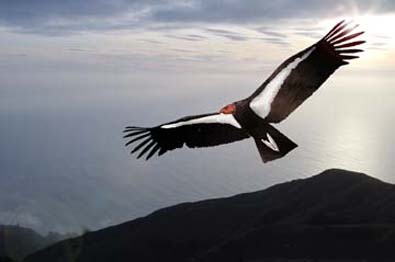
The North American condor's range was reduced to coastal California for reasons that had nothing to do with modern man.
A healthy email discussion yesterday about condors, lead shot and bullets, and the strengths, limits and pitfalls of environmental advocacy reminded me of an older post, appended below, from April of 2005, in which I suggest some caution is needed before the world swallows the extinction hyterics of some environmentalists (such as entomologist E.O. Wilson) who like to proclaim that we are now in the "era of mass extinctions."
I suggest one can be very concerned about extinction (I am), without tossing science and data overboard or engaging in out-and-out distortions about the data. Truth and data are not lesser values, and should not be abandoned by advocates looking to score cheap debating points.
In the case of condors, I am for doing whatever it is we can to ensure their survival and increase their numbers, including baning lead shot and bullets, if necessary (background article here on this controversy).
Having said that, let's acknowledge that this is a bird that was on the decline long before there were guns anywhere in the world.
During the time of mammoths, some 15,000 years ago, there were condors all over North America, but as the herds of these and other giant pre-Columbian animals declined and then slid into extinction, the condor's range was reduced to a narrow part of California (hence the name California Condor).
What few folks are willing to talk about, in a frank and unsentimental kind of way, is that the era of the condor was closing long before the Santa Maria left Spain. The reason for this is not too hard to explain: The condor is a huge, poorly conceived, "line of sight" meat scavenger. It was too specialized to make it.
And yes, God does make mistakes (the Whooping Crane, for example, is simply an "Edsel" Sandhill Crane) and He has plenty of "discontinued models". It is neither sacrilegious to say this, nor bad science: It is plain truth.
Not only is a condor a huge animal (a 9-foot 6-inch wingspan) that requires a lot of meat to keep it in the air, but it is also an animal that cannot kill that meat itself. The feet of a condor are closer in structure to those of a chicken than those of a hawk or eagle -- it cannot lift a rabbit, much less a lamb.
Unlike the turkey vulture, whose population numbers are huge and rising, the California Condor cannot smell rotting flesh from miles away. It is a pure line-of-sight scavenger. What this means is that if a condor does not see a large pile of dead flesh every couple of days for its entire life, it is going to die of starvation. The condor may have survived in coastal California only because of dead whales and seals washing up along the coast -- an easy-to-patrol carrion line.
Another factor in the demise of the condor, even before man showed up, is that it is a very poor and slow breeder, laying only one egg every other year, and not breeding at all until the age of 6 or 7. This is a bird that does not build a nest -- it needs caves and cliff ledges which, as a general rule, are in short supply.
Put it all together, and you have a very maladaptive kind of animal -- an animal whose internal biological problems were, and are, so serious that its range and numbers were shrinking long before the gun, the powerline, or DDT. Which is not to say guns, powerlines and DDT did not push things over the edge. They most assuredly did. Sadly, things on the edge are a little too easily tipped over in this over-fast, too-crowed and intensely-machined modern world.
In the end, the last pair of wild condors were caught and put in a captive breeding program with 20 others back in 1987. Since then, I am happy to report, the population of condors has grown from 22 to about 280, and there are now about 140 condors in the wild, and another 140 birds in captive breeding.
In addition to restocking condors in the shrinking wilds of California, where powerlines and windmills remain a very serious problem, the California Condor has also been restocked in Arizona.
All of this is good news, and it is about as good as it is ever going to get. There will never be large numbers of condors in America because this an animal adapted for a pre-Ice Age era that no longer exists. That said, poisoning from lead (the isotopes from shells has been traced into the dead birds themselves) has killed a large number of the condors released into the wild. If paying a few more dollars for shells will help reverse that phenomenon (while also spurring shel and bulletmakers to do more to develop new composite-type loads), I am all for that.
_ _ _ _ _ _ _ _ _ _ _ _ _ _ _ _ _ _ _ _ _ _ _ _ _ _ _ _ _ _ _ _
Reposted from the April 29, 2005 edition of this blog.
Reposted from the April 29, 2005 edition of this blog.
_ _ _ _ _ _ _ _ _ _ _ _ _ _ _ _ _ _ _ _ _ _ _ _ _ _ _ _ _ _ _ _
Thinking About Species Lost
The rediscovery of the Ivory-billed woodpecker in the hardwood swamps of Arkansas reminds me of how much we hear about wildlife species loss, but how rarely such species loss is quantified, defined, or given proper causation.
Whenever I hear about species loss, I naturally ask five key questions --and I often find the answers surprising.
The rediscovery of the Ivory-billed woodpecker in the hardwood swamps of Arkansas reminds me of how much we hear about wildlife species loss, but how rarely such species loss is quantified, defined, or given proper causation.
Whenever I hear about species loss, I naturally ask five key questions --and I often find the answers surprising.
1. Do the animals exist at all?
This may sound like an odd question, but it's a pretty important one because a lot of what is written about species extinction is totally unsupported by observed data.Here's the scoop: Over the course of the last 400 years, only about 820 species of vascular plants and vertebrate animals are listed as having gone extinct by the IUCN Red List. In addition, the IUCN reports several species being "rediscovered" every year after having previously listed them as "lost".
Though the IUCN cannot report on what has not been discovered, we have clearly discovered most of the mammals, birds, fish, snakes, frogs, shrubs, vines, grasses and trees in the world. While new species of wildlife are being discovered every day, there is no evidence to support the notion that even 50 vertebrates and vascular plants are going extinct every year, much less the 20,000 number commonly cited (invertebrates and fungi are very difficult to push into extinction as any farmer can tell you).
As odd as it may sound, even physical evidence of the existence of a species does not necessarily mean that this species has ever existed. Here, I am specifically talking about birds, where it turns out some "extinct" species are based on single skins collected in the 19th or early 20th Century. The cone-billed tanager is a good example (to read more about the hunt for this "extinct species" read "The Ghost With Trembling Wings" by Scott Weidensaul).
The problem with birds is that they hybridize a lot, and bird species are not always very distinct from each other. Along with the cone-billed tanager, for example, there are several species of hummingbirds that we know of only due to single examples collected for the millenary trade. These
so-called "Bogotá Skins" (for their central shipping point out of South America to Europe) may in fact represent evidence of a new species of now extinct hummingbirds -- or they could simply represent hybrids of other hummingbirds. With about 10 percent of all bird species known to cross the "species barrier," it's hard to know.
2. Is the animal being described really a species?
In fact a lot of stories about species decline are NOT about the decline of a species, but about the decline of a SUB-species in a very specific area.A sub-species is, by definition, NOT a species. In fact most subspecies are nothing more than slightly different colored animals that exhibit no other behavior differences and that freely breed with populations of other animals in their species (animals whose populations may in fact be quite large and growing).
Sub-species are an interesting thing. I have always found it ironic that many environmentalists place little value on the prolific creation of thousands of new subspecies of apples, potatoes, pigs, cattle, and chickens, but assign tremendous value to subspecies of cougars, lions and pronghorns (to give just three examples). In fact, mmany sub-species of wild animals are little more than political artifices designed to boost the careers or egos of the people naming them.
In some cases there is another less vanity-centered reason to name a subspecies -- you can "up list" an animal (and its habitat) for protection by simply singling it out. The Sonoran pronghorn appears to be an example -- an animal made "rare" despite the fact it appears to be little more than a light-colored variant of an animal that actually numbers in the million.
3. Was the species ever very common?
Some threatened and endangered species are animals that were always rare and not very successful to begin with. Take the Whooping Crane, for example. DNA analysis suggests Whoopers never numbered more than about 5,000 individuals. The 1850 population of the bird (when most of the American West was still unsettled and very wild) is estimated to have been just 1,500 individuals. There are now 500 Whoopers in the world, with about 350 of them in the wild. I am very glad the Whooper was pulled back from the edge of extinction, but the fact that the bird was never common or genetically successful is not an inconsequential part of its story (though it is rarely told).The Florida Manatee is another animal that was probably never terribly common. The Manatee population of Florida before there were outboard motors is estimated to have been around 10,000 or so. By the 1980s, the manatee population had declined to about 800, but it has since risen to over 3,000.
Again, bringing the American manatee (Trichechus manatus) back from extirpation in the U.S. is excellent, but we should not expect the population to ever get really huge. Note that the American manatee also exists in many other Caribbean countries south to Brazil, but it is a rare animal there due to hunting by indigenous people .
4. What is the population of the species now?
I am always interested in both the percent decline or increase in a species and the total number of individuals that exist (and existed). For example, if I am told that 97% of all pronghorn antelope are gone, I am shocked. But if I am told that this 3 percent totals 1 million animals, I begin to feel a
little better. I begin to feel pretty good when I know that in Wyoming the pronghorn population is estimated to equal the human population of the states, and even better when I learn that the human population of Wyoming is actually declining.The point here is that numbers are only meaningful within context. Do I wish there were more pronghorn in America? Sure! But one million pronghorn -- up from just 13,000 individuals at the Turn of the 20th Century -- is pretty good news and one we should be celebrating!
5. What has really caused the decline (or increase) of this species?
The death of any species is important, but I also want to know the circumstances of the decline or extinction. I consider the loss of the Passenger Pigeon and the Eskimo Curlew (there were once millions of these birds flying over vast areas of this continent) a much more significant tale than the loss of a species of flightless rail on a small island in the Pacific. One extinction signals the total loss of a once very common species that was successful over a very large area. The other signals the total loss of a very rare species that was NOT successful over a very large area. There are very different lessons to be learned from these very different stories.Most people are surprised to learn that most extinctions are of the latter type (fairly unsuccessful species in very isolated locations) and not the former (fairly successul species in fairly common locations). They are further amazed to discover that habitat loss is a much rarer cause of species extinction than the introduction of rats, cats, goats and pigs -- or of indiscriminate hunting. If you go through the IUCN Redlist of extinct species, for example, you find zeros for most countries (no known endemic species pushed into extinction), but incredible numbers of extinctions for such tiny islands as Mauritius (41 extinct species), Réunion (16 extinct species), Saint Helena (29 extinct species), French Polynesia (67 extinct species), and the Cook Islands (15 extinct species). In fact, these little spots of land, along with Hawaii, account for about 200 of the 812 species pushed into extinction over the course of the last 400 years.
Is the loss of an "unsuccessful species" a bad thing? I think so. But it may not be quite as horrible or as unprecedented as it is commonly made out to be. In fact it may be part of the order of things. After all, instead of a living at a time when there is a "biodiversity bottleneck," as some texts would have you believe, we are actually living at a time of incredible genetic diverity. As the folks at the World Resources Institute note, "Global biological diversity is now close to its all time high. Floral diversity, for example, reached its highest level ever several tens of thousands of years ago. Similarly, the diversity of marine fauna has risen to a peak in the last few million years." In short, we live in a very bio-diverse time, and with diversity will come a lot of failure which is every bit as much a part of Darwin's evolutionary equation as success (if not more so).
It's also worth remembering that even as we are losing species, we are also gaining them -- new types of chickens, pigs, apples, corn, and trees. New hybrids of canaries, geese, ducks, pigeons, cattle, horses, falcons, eagles, dogs and cats. And we are doing it with wild birds too.
The last time I flipped through a Sibley's Audubon guide to birds, I counted one extinct species of parrot (the Carolina parakeet), but 27 new species of introduced parrots that are found in wild flocks in the U.S. (65 species have been encountered in Florida alone). In California and Florida these wild-flocking parrots are already creating new hybrids. Wild parrot colonies are not just found in warm climates by the way -- they are found near my home in suburban Virginia, and in downtown parks in Seattle and Chicago. One hundred and fifty years from now my great grandchildren may find hybridized variations of these same birds listed as entirely new "American" species of parrots (the Sibley guide already notes the presence of many Amazon hybrids in Florida and California).
Food for thought.
Saturday, July 22, 2006
A Pileated Woodpecker Was Here
 Digging on the dogs today, I came across this dead tree that had been worked over pretty well by a local pileated woodpecker.
A pileated will leave holes like these -- very vertical, and looking a bit like a rectangular mortise.
A pileated woodpecker looks very much like an ivory billed woodpecker, but is a little bit smaller -- about the size of a crow. Like the Ivory Bill, they have a red crest and black and white plumage.
Pileated woodpeckers prefer to nest in large old pine trees, but in this part of the country, they are as likely to be found in a Hickory, Yellow Poplar, Maple, Sycamore, Red Oak, White Oak, Chestnut, or Sweetgum trees.
Wednesday, June 28, 2006
Acts of God

Young Moxie rests in a dry creek bed. A very nice looking little dog.
In theory, June 21st is the longest day of the year. But, as Einstein so famously said, some things are relative and not everything unwinds according to theory.
June 24th had hours that seemed to last for weeks.
The day started out like any other, except that I had gone out for dinner with my wife and daughter the night before, and we had blown a tire on the Ford Expedition. Due to lack of a working jack, this proved to be a bigger problem than it should have been.
All of this is to say, I was a bit discombobulated that evening when I loaded the tools; one possible reason I showed up at the Flint Hill General Store the next morning with everything I needed except the locator collars.
A small problem, but not insurmountable. I have dug on the dogs without a collar before, and with the heat we were unlikely to find a skunk to ground. We would do it "old school" as best we could.
I was anxious to see Chris J., as he had picked up his first working terrier the week before from Tim J. who, in turn, had acquired the dog from an Amish fellow who had a small kennel of patterdales. The young Amish lad had subsequently come down with cancer and had to disperse his dogs.
Out of this tragedy came Moxie, an eight-month old female patterdale of wonderful proportions, a roughish coat, and a very calm disposition. I liked her straight out of the box, admiring her size and general diposition. A wonderful little dog.
I had brought Chris a short go-to-ground tunnel and a new six-foot digging bar, and we transfered both of these to his truck -- my gift to the new pup to get her started off right.
We set off with the dogs, headed down the edge of a rapidly growing cornfield on a narrow path just inside the wood line.
It was amazing what a few months had done to this section of land. Winter sticks and barren trees had fallen away to walls of thick vegetation. It was as if we were traveling down a green hallway, with Mountain ranging ahead (a greedy little dog that likes to find the hole first) with Sailor and Moxie padding along behind us.
We did not hunt the trail, as I had an idea of where we would locate quickly, and for once I was right. Sailor entered a nice one-eyed sette in a waste area with high vegetation, and began to bay. Bingo!
From the sound, I could tell Sailor was pretty deep. We stuck a stick into the sette to gauge direction and depth, and began to dig, but the ground was criss-crossed with shattered quartz mixed with hard pan, and it was very tough digging.
We dropped a four foot hole and barred, but could not locate the pipe.
Sailor came out and Mountain went in. This was a one-eyed sette, and with ground this hard the groundhog was not going to be able to dig away.
But there was some question as to whether we could dig in. We had no collar on the dogs, the ground was as case-hardened as a strong box, and I was not anxious to dig another four- or five-foot exploratory hole.
I suggested we pack it in, give this groundhog law, and see if we could find a shallower sette.
Which we did.
In the next hedgerow the blackberries were just beginning to turn, and there were quite a few holes. Sailor opened up in a large eight-eyed sette and either lost the groundhog or bolted it. Considering the thickness of the vegetation and the intensity of her barking very close to the surface, it was most likely a bolt.
We moved on.
At the base of a cluster of shattered trees on the edge of a scrub field Sailor slid in and opened up. A quick check confirmed that this too was a one-eyed sette. Chris and I moved some of the broken and barkless tree trunks, and cut away the brush.
A pileated woodpecker shattered the quiet, and Chris chuckled a little because he knows I like these big red-headed birds.
Sailor was still in the hole and baying full bore. We eye-balled the pipe, probed the hole, and then cut a few feet of rocky soil off the top.
A little barring, and we soon found the pipe and opened it up to the tube. Bingo.

Sailor slides into a den pipe among the shattered trees.
Sailor had moved back when we were digging, and now she tried to press forward past us. We pulled her for a minute and cleared away the rubble, and then she was hard on it again, baying up a storm and clearly making contact.
We were a bit behind the dog now, and about three feet behind the groundhog, so we started another hole. The dirt was mostly rock, but the pipe was shallow.
As we cut into the pipe again, Chris pointed out a large spider dragging an egg case behind her. It was that time of year. A quick scoop and spider, egg case, and dirt went sailing on to the spoil pile. Happy trails, Mrs. Spider.
At this second hole, we broke through at a little past three feet. We were just behind the groundhog now, and Sailor was grabbing one end through the old hole, and Mountain was grabbing the other end through the new hole.
Enough of that.
We pulled Mountain out of the second hole and allowed Sailor to press the groundhog, which soon bolted to a pole snare and a quick dispatch. This was a young groundhog and I intended to skin it and grill it that evening.
While I was dispatching the first groundhog and placing it in the fork of a tree prior to tying up the dogs, Chris called over to say there was another one in the pipe.
Sure enough, there was. Excellent.
I staked Sailor a few feet away from the hole to allow Mountain her chance to bolt or pull this second groundhog. Mountain grabbed it and pulled it out, and we dispatched it without ceremony. While I was doing that, Chris poured some water for Moxie and Sailor, but Sailor was not interested. She knew I had a groundhog in hand.

Mountain pulls the second groundhog.
The second groundhog was a little dog-worried, so we decided to use it to give Moxie a little training. I slipped the pole snare over the groundhog's body and swung it around for the dog to chase through the grass -- a little action and smell training without danger or darkness.
Moxie had a ball and used her voice a few times too -- a nice deep-timbered bark. I was growing covetous of this little dog.
I handed the snare over to Chris and he swung the groundhog a little more for Moxie while I packed up the small tools, and then we both stopped playing with the pup to repair the sette. Man it was hot!
After we had filled in the holes and moved some sticks and brush around to disguise the dig, I began to pack up the larger tools and Chris went to check on Moxie and Sailor who were off in the tall grass under the shade of a large bush. Moxie was loose, but Sailor was staked.
"Pat. I think Sailor is dead." It was Chris' voice, but it seemed to come from a long way off. I thought it was a joke, but immediately I saw it was not. Chris was unhooking Sailor from the tie-out, and she was limp in his hands.
I ran over, and her eyes were open. I lightly touched her cornea, and she did not blink. Oh Shit. This was unbelievable.
I immediatly gave Sailor mouth-to-mouth resuscitation, putting my mouth over her entire snout and puffing into her chest and squeezing her rib cage as I let away for another breath.
One breath every five seconds, and I then could see she was breathing, but very, very shallowly.
"It's heat stroke," said Chris, and I knew he was right. I grabbed the dog and busted through the thick undergrowth to a creek bed I knew was located two fields over. "What should I do?" Chris yelled. "Take the dogs and leave the tools," I hollered back, and then I was gone, running through the brambles, trying to keep the dog's eyes from being poked out by a branch, but also trying to get her into shade and water as quickly as possible.
Sailor was totally lifeless. I stopped twice in the middle of the first field in order to give her more mouth-to-mouth resuscitation, but the third time I stopped, she did not seem to be breathing at all.
My mind reeled. How could this happen? She had been fine just 20 minutes earlier. How could this .... Oh Jesus, there was another field to go after this one. Please God, keep this dog alive.
But with a shuddering sickness I knew she was dead.
I blew through the second field and came to the last hedge before the creek, and I crashed through it. Now we were in the creek bed, but there was no water. The damn thing was dry.
I placed Sailor on the cool bank, and was amazed to see she was still breathing -- very shallowly, but still breathing.
I touched her pupils again, but she did not blink. Her tongue hung out of her mouth like a slaugherhouse calf. A dry leaf was on it. I plucked it off, and gave her more mouth-to-mouth, but nothing changed.
I broke off two short sticks to prop up under her legs so air could circulate around her body and cool her off, and I ran up the creek bed looking for water, but there was nothing. I needed to cool her off fast, and so I did all that was left: I fanned her.
I was still fanning a half hour later when Chris crashed through to the stream bed. He had carried everything -- all the tools and both packs -- half way, and then left the bar and posthole digger at the midpoint. He had both packs, his shovel, and both dogs with him.
Sailor was clearly not better, but she was still alive. Her breathing was very shallow and her jaw was getting very rigid and locked up.
We went over the possibilities. Could it be a regular stroke? A copperhead snake? A black widow spider?
A copperhead or a regular stroke sounded possible. The edge of a field in the tall grass would be about perfect for a copperhead. A black widow seemed unlikely, as we were in the full sun and it was dry. Black widows liked moist outhouses and porch crawl spaces.
Whatever it was, it had hit Sailor very fast -- she had been fine just 15 minutes earlier. It had to be heat stroke.
We needed to get this dog to water in order to cool her off.
Chris volunteered to run to the truck and get a gallon of distilled water I had there. I gave him my keys and he was gone down the path.
Moxie and Mountain were in the dry creek bed, tied to a pack. I moved Mountain farther away so she would be in the middle of the path. If Chris came down the path fast, he could easily overshoot my location. The dog would be a stop to prevent that.
I remembered I had two small eye wash bottles in my pack, and I got one out and emptied it onto Sailor's flank, head and genitals, hoping it would help cool her off.
I did the same with the next bottle, but saved a shot glass of water for her eyes. It had been at least two hours since she had blinked.
I fanned her, first with my hat and then with a clump of branches I cut for that purpose. I saw her blink once when the branch came very close to her head. Her breathing might have been a little better. I gave her more mouth-to-mouth, and fanned her almost continuouly.
In about half an hour Chris was back with a gallon of water. I slowly poured it over Sailor's body, but it did not seem to matter.
I told Chris to go back and get the remaining tools, and I would stay and fan Sailor. In truth I was afraid to move her. She had stopped breathing entirely the last time I carried her across a field. I worried now about whether she was already brain-damaged.

A soaked Sailor remains unresponsive and paralyzed.
Chris returned with the posthole digger and the bar, and we decided to bust back to the truck. I would carry my pack, my shovel, the six-foot digging bar, and Sailor. Chris would follow with the two dogs, his pack, his shovel and the posthole digger.
I went down the trail fast, determined to be very smooth and very rapid. I slid up the hill and down the path with the walls of green towering up on either side. Please God, please God . . . .
Suddenly there was an explosion just in front of me, and for a second I though it was a horse, but instead it was a wild turkey, as large as sofa cushion, flying up and into the trees. I immediately thought of the Emily Dickinson poem, "Hope is the thing with feathers."
Hope. Was a wild turkey a good sign? I decided it was. "Hope is the thing with feathers, that perches in the soul." Was that how it went?
I said a prayer -- the fourth or fifth full-blown prayer of the day. It is said there are no aetheists in fox holes. I do not know about that. I do know that there are no practiced diggers who have not said a prayer. It is not an accident that John Russell was a minister. A dog will put you in tocuh with God.
As I turned the corner at the bridge abutment, I realized I did not have my truck keys. Chris still had them.
Keep it together. I plotted the next 200 yards. I would wade into the Monocacy River with Sailor -- Chris had suggested it earlier, and now it seemd like a very good idea to bring down her temperature.
I ditched shovel, pack and bar, and remembered to take off my camera pouch, and remove my phone, wallet, and hunting license.
And then Sailor and I were in the river. I was holding up Sailor's head but trying to keep her body under the cool water.
Chris was about 10 minutes behind me. He went directly to the truck and put away the dogs and started the air conditioner (smart man!).
I came out of the water and saw Sailor was now worse off than before I had entered. Now I was not sure she was breathing at all.
At the truck I gave her more mouth-to-mouth again, squeezing her ribs at the exhale.
She was breathing now, but just barely. I touched her eyeballs, but she did not blink. Her jaw was locked in rictus.
I picked her up, along with a towel, and bundled her onto the floor of the front passenger side.
And then I was off.
Chris had suggested a vet, but I had hesitated. What could they do now that I had not? If it was a copperhead bite, the dog would live or die; there was no antivenin at most vets, and besides it was pretty late in the day for that; three and a half hours after the event.
But Chris was right, of course. I wheeled on to the freeway, the air conditioner blasting, my pants dripping with water and mud from the river. Sailor was all but dead on the floor boards next to me.
I realized I had to keep my head on the road for this next part to pay off. A wreck and we were both done.
I drove fast and without mistakes, trying not to look at the dog except for the one time I reached over to put two baseball caps over her body so cold air would not blow straight on her. The air conditioner was cranking full bore.
I braked hard once, and Sailor seemed to lift her head. I called Chris on my cell phone. He had been talking to a vet tech somewhere. "Get her to a vet," he admonished, and I assured him that was exactly where I was going.
I went over the possibilities again.
It was now three and a half hours since the event -- whatever it was -- and she was still not any better. If she was still alive when I got to the vet, four hours would have passed. She had gotten worse after the run to the car, and then she had gotten worse after the river immersion. This was not feeling like heat stroke.
A dog will generally bounce back if cooled after a heat collapse. Could it be a plain stroke? That seemed increasingly possible. I thought about the location where she had been -- in the tall grass, under a bush, near dead trees and logs. It seemed like a good location for a copperhead. It could not be rat poison -- of that I was certain.
What about a black widow? It seemed unlikely. Black widows liked moist holes, outhouses, crawl spaces and the corners of old sheds. It was hot and dry and sunny where we had been. Besides, I had only seen one black widow spider in my life, while I seen at least a dozen copperheads.
Heat stroke was still the most likely problem. It had been hot, and Sailor had worked hard. But really, it had not been that long. A half hour? Forty-five minutes? No more. At least not if all you were counting was the last hole.
It occured to me that it might be an electrolye imbalance. Perhaps some essential salt or sugar was wildly out of skew in Sailor's system.
I pulled into a grocery store parking lot at the end of the freeway and left the car running with the keys in the ignition, the airconditioner on full blast, hazard lights blinking. I quickly found the baby aisle and two bottles of pedialite. By a miracle of timing, I was the only person in the express line.
Back at the car, I pulled a huge irrigation syringe from my vet kit and loaded it up with pedialite. Sailor's jaws were locked shut, but I pried them apart and dripped pedialite down her throat. It simply ran out the side of her mouth. Her tongue was not working and her throat muscles seemed paralyzed.
I loaded up another syringe and jetted it down her throat. I little of it might have rolled down her throat by force of gravity alone, but most fell out of the side of her mouth.
She was paralyzed.
I gave up and raced off to the veterinary clinic closest to my house. This was a small hole-in-the-wall place, and I had not been there for many years.
I went in and explained the situation very quickly. I said I thought it was heat stroke, but it could be a snake bite. I brought in the dog, and a balding middle-aged vet quickly examined her and said it was not heat stroke -- the dog was cold. It was hypothermia.
Hypothermia? You're kidding?! It was 92 degrees in the shade!
He nodded grimly, and rushed into a little room and came back with a space blanket. He wrapped Sailor in it and simultaneously turned a little valve on the wall to start something up. He pushed a rectal thermometer into Sailor and a few seconds later he had her temerature: 91.8 degrees.
She should be at least 101. She was freezing to death.
Without further ado, the vet wrapped Sailor in a full-body hot water heating pad (he had been turning it on with the valve), and then he checked under her gums. There was some slight hemorrhaging there. Something toxic was in her system.
A very nice lady came into the room and held the hot water pad around Sailor.
No one told me to wait outside. I was grateful for that.
The young lady holding the hot water pad ordered up a warm-water IV. While we waited for it to appear I found out she too was a veterinarian. This was her second week on the job, and this was her first job out of vet school at Michigan State. She was very nice.
As much as I liked the lady, I loved the bald guy, who now came in and drew some blood. He was going to run a quick test, he said, to look at sugars and some other functions. How long would that take? Fifteen minutes. Maybe less.
Sailor did not noticeably improve, but in 15 minutes the blood tests came back, and they were good. Sailor was OK for fluids, her sugar was OK and her kidney and liver functions were OK.
This was big deal, and I knew it.
An hour went by. Sailor was still not blinking and her jaws were still locked in rictus. Under the tinfoil of the space blanket and the heavy hot water heating pad, I could not tell if Sailor was breathing easier or if she was breathing at all.
But she was.
Very slowly her temperauture came up, first to 92.5 degrees, and then to 93.5 and then 94.
At 94.5 degrees, the bald doctor let out a smile, and at 95.1 he audibly cheered.
I asked the bald vet where he was originally from, and he said Algeria. I told him I gew up in Hydra, a suburb of Algiers, as well as in Morocco and Tunisia. He said he thought he remembered me now -- from 15 years earlier. I was the only American he had ever met who had lived in Algeria. We talked about Algeria a little, and food, and the Kabylie Mountains. I think he could tell now that I loved more than the dog. But he knew I loved the dog.
It turned out that 10 or 15 years earlier he was the kennel man at this vet. Now he was the doctor. This was a success story that spoke volumes. What a life! To escape the troubles in Algeria, come to America and become a veterinarian. I loved this guy. It turned out that the new lady vet had been the receptionist at this clinic and had then gone off to vet school herself. My new Algerian friend had hired her fresh out of school. Wonderful! What a great country.
At 97 degrees, Sailor closed her eyes for the first time in six hours. At 97.5 degrees, Sailor would open them again if we shook her muzzle. It was a miracle.
At 98 degrees, Sailor licked paste dog food off her lips, and her eyes seemed to focus a little. She was coming back into this world.
It was now 6:30 and at least an hour and a half past when the veterinary should have been closed. Sailor was clearly rallying, but both vets strongly suggested I transfer her to another emergency vet in Vienna. Couldn't I just keep warming her up at home with a heat pad? I was worried about what this vet visit was going to cost me, never mind the next.
It was then that I realized I had never filled out a single piece of paper. They did not even know my name, and we had never discussed expenses.
The bill, for two vets working hard on my dog for over two hours, including blood work and two IV's , was just $275. It was an incredible bargain.
I hugged the vet in the parking lot as I left. They had saved Sailor!
I headed off to the emergency veterinary, with the heat in the car blasting, and found it 20 minutes later. At this vet, I again explained the situation, and they took the dog to the back. I began to follow, but was rather rudely told to stay in the reception area. I was directed to fill out paper work in the front.
The receptionist asked me if I had ever been there before. No, I had not.
I gave her my name and phone number. My phone number came up in her computer system. Did I own Barney?
Barney? Barney. Jesus, yes, but that was a long time ago.
A sad dim light came on in my brain. "Was this on Christmas Day?" I asked.
"Yes," she said.
So this is where I had come. Barney was 15 and had prostate cancer. There was nothing to be done. On Christmas day he could no longer stand, and so while everyone else was opening their presents, or watching their kids do the same, I was putting down my dog. I told the kids that Barney was sick and was in the hospital. It was a week before they found out he was not coming back. That afternoon, while the wife and kids went to Grandma and Grandpa's, I buried Barney under the cherry tree in the back yard.
So this was that place. Was this an omen? If so, it was not a good one.
A veterinarian came out. She was very grim and asked me what had happened to the dog. I recounted the day. She said the dog was still in very serious condition, and that they could not get a pulse.
I watched her listen to me, and then I watched her as she watched me listening to her. What was going on here was not medicine. I got the sense that she was sizing me up for a bill.
And she was.
Fifteen mintes later the receptionist presented me with a "prospective bill" for $1,575 for 36 hours worth of work that included two x-rays (called radiographs here to confuse the client) along with antibiotics, lot and lots of blood tests, and God know what else.
"No, I can't afford this, " I said. "I'll pay your minimal intake fee, just give me my dog back. I know how to heat up a dog, and she doesn't need any of this. X-rays? No. Just give me my dog back."
The receptionist made a phone call to the back, and 30 seconds later the bill dropped from $1,575 to $250 for 12 hours of heat, IVs, antibiotics and monitoring.
I had come this far -- I had expected to pay this cost. Done. This veterinarian was a scammer, but for $250 I would buy 12 hours of security. I was not even mad at this vet. If you cannot say "no" to a veterinarian, don't expect them to say "no" for you. Like anything, there are good honest ones and then there are the others. Caveat emptor.
I went home in a driving rain, pretty sure Sailor was going to be all right. Her eyes were open, and she would get steady heat and IV liquids all night.
There was nothing more I could do right now. But I still knew nothing. What was it? What had done this to Sailor? I was so deep in thought, it was 20 minutes before I remembered to turn off the heat in the truck.
It was not heat stroke or rat poison. The slight hemorhaging at the gum said it was not a regular stroke -- it was some sort of toxin.
It was not a copperhead -- six hours after the event there was no localized swelling or necrotic tissue.
It had to be a black widow spider.
Then, and only then, did I remember the spider dragging the egg case. That spider had been on top of the ground. It did not seem black and shiney like a black widow, but it was a sign. A sure sign. Like the turkey. Like the smart and kind Algerian vet who cheered for my dog.
When I got home, I booted up the internet and learned a little more about black widow spiders. There are a couple of species, but they are all toxic. They are not found in the UK, or in the colder parts of Europe, but they are found across the U.S., in Latin America, Africa and Asia. Our local variant was called the Northern Black Widow.
Black widow spider toxin is 15 times more powerful than that of a prairie rattlesnake, but because a spider is small, it cannot deliver too much of it. That said, back in the 1940s and 50's -- before modern respirators and sedatives improved things -- black widow spiders killed between 4 and 5 percent of their human victims; generally the very old and the very young.
Sailor, at 10 pounds, had been dosed as if she were a human bitten by 15 black widow spiders. She was clearly very, very lucky to be alive.
Black widow spider venom is a powerful neurotoxin. It works by firing off all the nerve cells at once, locking up the muscles of the animal, and making it difficult or impossible for it to move, breath or (apparently) even blink its eyes.
Respiratory failure is what does the killing.
Sailor's breathing and heart had been barely working because her muscles were stretched as tight as a fence wire. The neurotoxins would not let her relax enough to work her diaphragm. A failing diaphragm meant blood and air were not circulating, and so her tempertaure had fallen, crashing her into hypothermia.
Apparenly before there were outhouses, crawl spaces and old sheds (the locations where most humans are now bitten), black widow spiders denned in hollow trees, rock ledges, and animal burrows. But they are not common, that was clear. I have dug on hundreds of animals and my friends have dug on thousands, and none of us had ever had a dog bitten by a black widow spider.
Lucky me. Lucky Sailor.
Most bites occur when blackwidows are defending their egg cases, i.e. at about this time of year.
Apparently blackwidow spider venom takes 2-3 days to completely clear a victim's system, and when humans are bitten, they often report weird nightmares for weeks afterwards.
Spider flashbacks.
That night I checked my cell phone obsessively, but there were no calls from the veterinarian.
I was at the vet's at 7:00 am -- less than 12 hours after I dropped Sailor off. They were slow to bring her out, but her overnight notes said she had eaten a little and gone to the bathroom, and that now she could stand up.
Wonderful! I paid my tab and bundled her off to the truck in a driving rain.
The rain had started to come down at about the time Sailor was discharged from the first vet. Over the course of the next four days, more than a foot of water was dropped across our area.
Creeks and rivers jumped their banks and basements flooded. In Washington, D.C., the Department of Justice, the Internal Revenue Service, the Commerce Department, and the Smithsonian Institution were closed due to flooding.
Up at Great Falls, boulders the size of houses were ripped from the riverside and washed down stream. The Washington Post ran a picture of a groundhog that crawled on top of a car hood to escape its flooded burrow. Aerial pictures of farm country up along the Monocacy River showed fields under standing water.
This was a 200-year record for rain in a 24-hour period, a 48-hour period, and for a week.
It was as of God was trying to drown every spider across a three-state area.
It was an act of God.

Sailor warms up at the house, an hour after coming home from the vet. She is fine now, without brain damage or any other evidence of injury.
- Related Post
** Sailor, A Working Terrier, Has Gone to Earth
Monday, April 10, 2006
Knock, Knock, Knocking on Heaven's Door

On Sunday the dogs bottled a groundhog up under the root ball of an American holly tree. While the dogs were underground baying, a pileated woodpecker got to drumming very near us on a large and hollow log. The sound this bird managed to generate was phenomenal!
The pileated woodpecker is the largest woodpecker in North America (about the size of a crow), and is quite common across the Eastern U.S. The very loud drumming of a pileated woodpecker is used to establish a territory and attract a mate -- an important activity at this time of year. The woodpecker and his mate will stay in the same area all year long, holding a territory much like a fox will.
The pileated woodpecker looks quite a bit like an Ivory Billed woodpecker, which was believed to be extinct until a small remnant population was found in Arkansas last year.
"Pileated," by the way, is just a fancy word for "capped" and refers to the bird's bright red crest. You can tell a pileated woodpecker has been working trees in an area, as the birds will knock out a hole that is shaped like a vertical rectangular slot, almost like a perfect mortise.
.
Thursday, April 28, 2005
Thinking About Species Loss

Eskimo Curlew, which may be extinct.
We often hear about wildlife species loss, but only rarely is such species loss quantified, defined, or given proper causation.
Whenever I hear about species loss, I naturally ask five key questions --and I often find the answers surprising.
1. Do the animals exist at all?
This may sound like an odd question, but it's a pretty important one because a lot of what is written about species extinction is totally unsupported by observed data.
Here's the scoop: Over the course of the last 400 years, only about 820 species of vascular plants and vertebrate animals are listed as having gone extinct by the IUCN Red List. In addition, the IUCN reports several species being "rediscovered" every year after having previously listed them as "lost".
Though the IUCN cannot report on what has not been discovered, we have clearly discovered most of the mammals, birds, fish, snakes, frogs, shrubs, vines, grasses and trees in the world. While new species of wildlife are being discovered every day, there is no evidence to support the notion that even 50 vertebrates and vascular plants are going extinct every year, much less the 20,000 number commonly cited (invertebrates and fungi are very difficult to push into extinction as any farmer can tell you).
As odd as it may sound, even physical evidence of the existence of a species does not necessarily mean that this species has ever existed. Here, I am specifically talking about birds, where it turns out some "extinct" species are based on single skins collected in the 19th or early 20th Century. The cone-billed tanager is a good example (to read more about the hunt for this "extinct species" read "The Ghost With Trembling Wings" by Scott Weidensaul).
The problem with birds is that they hybridize a lot, and bird species are not always very distinct from each other. Along with the cone-billed tanager, for example, there are several species of hummingbirds that we know of only due to single examples collected for the millenary trade. These so-called "Bogotá Skins" (for their central shipping point out of South America to Europe) may in fact represent evidence of a new species of now extinct hummingbirds -- or they could simply represent hybrids of other hummingbirds. With about 10 percent of all bird species known to cross the "species barrier," it's hard to know.
2. Is the animal being described really a species?
In fact a lot of stories about species decline are NOT about the decline of a species, but about the decline of a SUB-species in a very specific area.
A sub-species is, by definition, NOT a species. In fact most subspecies are nothing more than slightly different colored animals that exhibit no other behavior differences and that freely breed with populations of other animals in their species (animals whose populations may in fact be quite large and growing).
Sub-species are an interesting thing. I have always found it ironic that many environmentalists place little value on the prolific creation of thousands of new subspecies of apples, potatoes, pigs, cattle, and chickens, but assign tremendous value to subspecies of cougars, lions and pronghorns (to give just three examples). In fact, many sub-species of wild animals are little more than political artifices designed to boost the careers or egos of the people naming them.
In some cases there is another less vanity-centered reason to name a subspecies -- you can "up list" an animal (and its habitat) for protection by simply singling it out. The Sonoran pronghorn appears to be an example -- an animal made "rare" despite the fact it appears to be little more than a light-colored variant of an animal that actually numbers in the million.
3. Was the species ever very common?
Some threatened and endangered species are animals that were always rare and not very successful to begin with. Take the Whooping Crane, for example. DNA analysis suggests Whoopers never numbered more than about 5,000 individuals. The 1850 population of the bird (when most of the American West was still unsettled and very wild) is estimated to have been just 1,500 individuals. There are now 500 Whoopers in the world, with about 350 of them in the wild. I am very glad the Whooper was pulled back from the edge of extinction, but the fact that the bird was never common or genetically successful is not an inconsequential part of its story (though it is rarely told).
The Florida Manatee is another animal that was probably never terribly common. The Manatee population of Florida before there were outboard motors is estimated to have been around 10,000 or so. By the 1980s, the manatee population had declined to about 800, but it has since risen to over 3,000.
Again, bringing the American manatee (Trichechus manatus) back from extirpation in the U.S. is excellent, but we should not expect the population to ever get really huge. Note that the American manatee also exists in many other Caribbean countries south to Brazil, but it is a rare animal there due to hunting by indigenous people .
4. What is the population of the species now?
The point here is that numbers are only meaningful within context. Do I wish there were more pronghorn in America? Sure! But one million pronghorn -- up from just 13,000 individuals at the turn of the 20th Century -- is pretty good news and one we should be celebrating!
5. What has really caused the decline (or increase) of this species?
The death of any species is important, but I also want to know the circumstances of the decline or extinction. I consider the loss of the Passenger Pigeon and the Eskimo Curlew (there were once millions of these birds flying over vast areas of this continent) a much more significant tale than the loss of a species of flightless rail on a small island in the Pacific. One extinction signals the total loss of a once very common species that was successful over a very large area. The other signals the total loss of a very rare species that was NOT successful over a very large area. There are very different lessons to be learned from these very different stories.
Most people are surprised to learn that most extinctions are of the latter type (fairly unsuccessful species in very isolated locations) and not the former (fairly successful species in fairly common locations). They are further amazed to discover that habitat loss is a much rarer cause of species extinction than the introduction of rats, cats, goats and pigs -- or of indiscriminate hunting. If you go through the IUCN Redlist of extinct species, for example, you find zeros for most countries (no known endemic species pushed into extinction), but incredible numbers of extinctions for such tiny islands as Mauritius (41 extinct species), Réunion (16 extinct species), Saint Helena (29 extinct species), French Polynesia (67 extinct species), and the Cook Islands (15 extinct species). In fact, these little spots of land, along with Hawaii, account for about 200 of the 812 species pushed into extinction over the course of the last 400 years.
Is the loss of an "unsuccessful species" a bad thing? I think so. But it may not be quite as horrible or as unprecedented as it is commonly made out to be. In fact it may be part of the order of things. After all, instead of a living at a time when there is a "biodiversity bottleneck," as some texts would have you believe, we are actually living at a time of incredible genetic diversity. As the folks at the World Resources Institute note, "Global biological diversity is now close to its all time high. Floral diversity, for example, reached its highest level ever several tens of thousands of years ago. Similarly, the diversity of marine fauna has risen to a peak in the last few million years." In short, we live in a very bio-diverse time, and with diversity will come a lot of failure which is every bit as much a part of Darwin's evolutionary equation as success (if not more so).
It's also worth remembering that even as we are losing species, we are also gaining them -- new types of chickens, pigs, apples, corn, and trees. New hybrids of canaries, geese, ducks, pigeons, cattle, horses, falcons, eagles, dogs and cats. And we are doing it with wild birds too.
The last time I flipped through a Sibley's Audubon guide to birds, I counted one extinct species of parrot (the Carolina parakeet, since rediscovered in the Caribbean), but 27 new species of introduced parrots that are found in wild flocks in the U.S. (65 species have been encountered in Florida alone). In California and Florida these wild-flocking parrots are already creating new hybrids. Wild parrot colonies are not just found in warm climates by the way -- they are found near my home in suburban Virginia, and in downtown parks in Seattle and Chicago. One hundred and fifty years from now my great grandchildren may find hybridized variations of these same birds listed as entirely new "American" species of parrots (the Sibley guide already notes the presence of many Amazon hybrids in Florida and California).
Food for thought.
.
Subscribe to:
Posts (Atom)