Showing posts with label maladaptive. Show all posts

Saturday, June 26, 2010

Balancing Points

A repost from 2005.


The ideal working terrier, if there is such a thing, represents a set of balancing points. Above all it must be small enough to easily negotiate an earth and follow the quarry wherever it goes. At the same time it has to be large enough and strong enough to spend an entire day in the field, often in miserable weather.

Balancing points do not end with size, of course. There is also the issue of temperament. A very hard dog is likely to come away from too many encounters with gashes to the muzzle. This is not only painful for the dog, it can also be expensive in terms of time and money spent on antibiotics and veterinary care.

Another factor with very hard dogs is that many of them are mute or nearly-mute. A dog without voice is a serious liability because you never know if it has found its quarry or is merely stuck in the pipe.

It is worth remembering that a fox, groundhog or raccoon can see nothing underground. Nada, zip, zilch. The darkness is complete and the picture for both dog and quarry is pure blackness. For an experienced dog, this is less of a liability than for the quarry. The dog, after all, knows what a groundhog is, what a fox is, and what a raccoon is. This is not the dog's first rodeo.

For the quarry, however, this is probably the first time it has encountered a dog in its den. It has no idea what to expect, and its first inclination is to flee -- a response that rises rapidly if the dog is barking and growling just a foot up the pipe.

It is very rare for a fox, groundhog, possum or raccoon not to flee from a baying dog, as standing to fight is a very maladaptive strategy for a small animal. Unless there are young in the den, there is nothing in the pipe to defend, and in most cases a fox, raccoon or groundhog will simply abandon their young to the dog since self-preservation is a genetically encoded response.

A dog that goes in silently and grips the quarry is not allowing the animal to flee, but forcing it to stand and fight. While some terriers do learn to grip a fox by the throat and push it to asphyxiation, most do not, and most dogs take a pounding if they try to grip in every situation -- a bit like a boxer who knows only how to slug. Such fighters do indeed have wins, but they do not have great careers.

A dog that approaches all quarry in every pipe as if it can muscle its way to success is a dog that is going to take a beating over time. Under most circumstances, a groundhog cannot be killed underground -- they have no necks and skulls as thick as a breakfast skillet.

A raccoon is another serious animal with very good canines and a crushing bite. A fox has a very light build, but sharp canines which can leave deep muzzle punctures and take out an eye. If the rip is particularly serious, it may be two or three weeks before a dog can see action in the field -- a lot of time away from work, especially in a foxing season that may last no more than eight weeks in its prime, and offer perfect weather conditions for just a fraction of that.

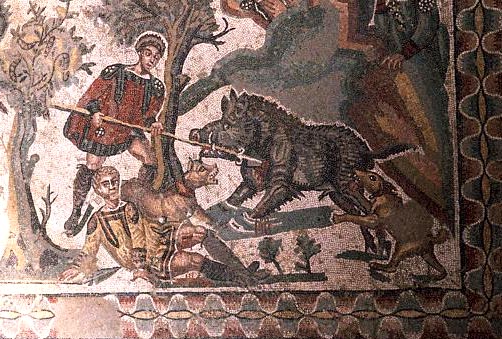
The baying dog, on the other hand, is like a boxer with a full array of skills. If the dog understands its job -- and the digger understands his -- it will use voice and grit (and yes, this means the occassional use of tooth) to move the quarry to a bolt or a stop end, at which point the owner will dig down and either release or dispatch the quarry as required.
.

Tuesday, April 13, 2010

Why Do Dogs Eat Grass?


Why do dogs eat grass?

It's a common question, but in asking the question, an assumption is revealed.

The assumption is that dogs are not supposed to eat grass.

After all, no one asks why we humans eat chicken, corn on the cob, fish, or strawberries.

The short answer is that dogs eat grass because it tastes good and it provides some nutrition.

It is not a sign of worms, an upset stomach, or any kind of nutritional deficit.

That's the short answer.

Now let's look at the question a bit deeper.

Do wolves, fox, coyotes, and dingoes, also eat vegetable matter?

The answer is "yes."

Wolf biologist David Mech notes that grass appears in 14-43% of all wolf scat found in North America and Eurasia. Plant material in fox and coyote scat, including grass, is so common as to be unremarkable.

Leopards, jaguars, mountain lions, and bobcats also eat surprising amounts of grass. A sample of 215 leopard scats collected in the Tai National Forest of the Ivory Coast, for example, found 17% had a considerable amount of grassy vegetable matter.

Bears too eat a lot of plant material. Though classified as the largest carnivores in the world, bears eat more vegetable matter in their diet than flesh, and grass is a major food source.

So why do "carnivores" so often eat grass?

For the same reason you and I eat most of the foods we eat; it tastes good.

Of course the other answer is that it is maladaptive for them not to do so.

Let's explore that idea a bit more.

Specialization in food sources is a terrific idea so long as the world stays exactly the same, day in and day out, season after season, year in and year out.

But, the world is both temperamental and unreliable.

Crippling winters, blistering summers, and poorly timed rains can decimate populations of prey species.

Disease can wipe out herds, migration routes can change without warming, and new species can invade.

Water holes may dry up, salt licks may disappear, and predators can injure themselves in the chase.

And yet every few days, a predator must eat.

And that's the problem: The chain of life is so easily snapped.

For a meat-eating predator, the weakest link is the absence of ready prey, easily caught, day in and day out, in good health and bad, dry season and wet, winter and summer, year after year.

And so wolves, coyotes, dingoes, bears, lions, bobcats and jaguars have all evolved to eat plants, as well as flesh -- a way of "hedging the bet" for a few days against the vicissitudes of life.

Yes these animals will try to bring down a deer- or rabbit-sized meal if they can. But if they cannot, then they will try to catch a few rats or mice, a lizard or a snake, a frog or a turtle.

And if push comes to shove, there's always grasshoppers, crickets, and verdant grass along the creek. And it does not hurt at all that some of that grass actually tastes pretty good!
.

Monday, March 10, 2008

The Architecture of Burrows

A reprint from this blog of April 22, 2005.

The list of animals that hibernate in underground burrows, live in burrows or nest in burrows is astounding: fox, badger, turtles, some owls and parrots, ground squirrels and marmots, some penguins and puffins, European rabbits, bears, wolves and dogs, otter, some wild pigs, some wild cats, many snakes and lizards, possums, wombats, frogs and toads, moles, mice and rats, nutria, crayfish, armadillos, skunks, muskrats, meerkats, some large spiders, and several types of bees.

Many of these animals spend a fair amount of time constructing, maintaining, and modifying their den systems which, in turn, are structured in response to changing external circumstances and changing internal needs.

Anatomy, behavior, and distribution of wild animals are all greatly affected by the burrow environment, with temperature, humidity, oxygen, living space, availability of food, and protection from flooding and predation all being influenced by burrow architecture.

Despite this, the burrow structure of almost all subterranean mammals is barely known, and data and descriptions of den structures as they relate to soil composition, drainage, external defenses (rock, wire fences, farm buildings), proximity to food and water sources, is almost entirely non-existent.

All of this make understanding burrow architecture as an adaptive tool a difficult task, but it nonetheless clear, among humans digging to their terriers, that burrows are designed with a reason and that certain "tricks" keep popping up. A few I have noticed in the construction of groundhog and fox dens:

  • Water and the phreatic zone: Dens of fox and groundhogs are designed to keep the animals dry, yet fox in particular like to locate their dens very near water. Shallow dens are sometimes found carved into the sides of small humps or rises in marshy areas, but these are rarely natal dens. The deeper natal dens of fox are generally found on the rises above the flood plains -- on well-drained hillsides near a creek or pond or water-filled ditch. The ideal spot for a pipe is deep enough to be dry from surface water, but not so deep as to be encountering the water table -- the so-called "phreatic zone".

  • The "plumbers pipe" opening: In these settes the pipes run down for two or three feet before rising again and then dropping again. This creates an earthen "water stop" not so very different from the plumbers p-pipe you will find under your kitchen sink. This is a common feature in many animal burrows, from rat to fox.

  • Depth is determined by soil: This is near-truth. The softer the earth and the easier it drains, the deeper the den is likely to be. One of the chief functions of a den is to keep the animal dry, and in soils that are very light, dryness tends to be achieved with some depth. You may cut through very soft stuff for three or four feet, but below that will be the harder stuff -- a layer of hard sand below the soft, or a layer of hard dry clay below much softer friable soil. The pipe is likely to be in softer soil that lies below the vein of hard stuff. The hard vein works to structurally support the pipe and to keep out the last bits of water. The one exception that I would note is where a ridge is made almost entirely of small cherts, flints or flaked slate. Here digging by a fox or groundhog is so hard, and the drainage of water is so rapid, that the den pipe may be very shallow since water runs through the den as fast as it falls. These shallow and breezy loose-rock dens will not be used in winter, but are likely spots in summer.

  • Rocks, roots and barbed wire at the entrance: This is so common that it is clearly a planned design feature. It is not uncommon to find dens exiting inside a stump or hollow tree, or to have a strand or two of barbed wire running along the lip. Groundhog dens frequently start on one side of a barbed wire fence and exit out another. If there is an abandoned vehicle on the edge of a farm, a groundhog will invariably makes its home under the chassis -- a nice shelter from the rain, but also from predators who will have to slow down to a crawl to avoid beaning themselves on the I-beam and suspension. Hard structures not only make digging out more difficult, it makes a mad dash at the den hole a dangerous and maladaptive strategy for large predators. In addition to hard structures at den entrances and exits, you will frequently find "soft structures" such as thickets of multi-flora rose, bramble, poison ivy, and thick wild grape vines serving the same function.

  • The hard turn after the den entrance: This is a frequent feature of groundhog den entrances and serves two purposes: 1) it makes it difficult for predators to enter, and; 2) water entering the entrance will tend to follow the straight line of gravity and soak into the ground at the end of the pipe rather than run sideways with the turn of the pipe. I have encountered some rather incredible animals that took this "hard turn at the entrance" technique to absurd levels as they never stopped turning -- they corkscrewed their dens in full circles all the way down in a spiral that went four or five feet deep.

  • The pocket room close to the entrance: This is a common feature of groundhog dens, and I believe these serve as "loafing parlors" where the animal can tuck in out of danger between feeding forays. If you are quiet, and the dog is too, you can often bottle a groundhog in one of these little rooms before it goes deeper into the sette.

  • Right angle turns inside the den pipe: These are very frequent features of groundhog and fox dens and seem to serve two purposes. The first purpose is that they help keep the den dry, as water running down a pipe will tend to follow gravity rather than take a sudden turn to the left or right. The second purpose is clearly defensive; a groundhog or fox can take a stand at a corner and slash out at anything coming down the pipe, inflicting considerable damage if the corner is tight, as it invariably is. Often a sette will have several right-angle turns, each providing additional elements of security, like doors on a hallway. A human digging on a dog will often break into a pipe where the dog and quarry are at a standoff at one of these turns, at which point all hell will break loose as the animals grab each other, or else the fox or groundhog will manage to retreat to the next hard corner in the pipe system -- a kind of running battle that can be very frustrating to the digger!

  • Side pipes and stop-end branches: These are common feature of both groundhog pipes and fox dens. Some of these represent unfinished den digging, but for a fox they also provide a place into which one animal can scoot in order to let another pass by, where one animal can lay up without getting overheated from the warmth of its mate and where it can get a better supply of air. Earth dens are all about keeping dry, maintaining the right temperature, keeping the air flowing, and staying secure. Side passages increase the options on all counts.

  • Field settes are generally deeper and larger than hedgerow settes, and often harder for the human to dig up as a consequence: I believe this is due to a conflux of opportunity and necessity. The opportunity for larger and deeper settes is due to the lack of obstructions like roots and rocks. The necessity is that plowed fields with friable soils require deeper dens to remain dry, while larger more complex settes are an element of security, allowing a groundhog or fox to escape danger in one part of the sette by going to another -- or even bolting out of one entrance into another nearby sette.

  • Large "race track" settes are fairly common in fields. These large settes circle back on themselves several times and may have several layers of pipe. More commonly are simple four-, five-, or six-eyed settes with connecting pipes. A groundhog can run around in these large settes, shoveling dirt behind it to block the dog, and effectively preventing the dog from bottling it in a stop end. The solution I employ is to earth stop the den at two or three spots (generally at exits where the pipe goes left and right). If needed I will also allow two experienced dogs that know each other well to enter opposite sides of the settes and work the animal to the middle. This generally prevents the groundhog from digging in and gets the animal pinned against one of the newly-minted stop-ends in short order. Putting two dogs to ground should be left to people who know their dogs well and who are experienced diggers. It is better to lose quarry than a dog. Two very hard dogs to ground, or two dogs in a den occupied by a skunk, could be a disaster! Never enter two dogs on a fox -- it is simply not necessary, as the fox cannot dig away.

  • Winter "fox porches": A fox will often dig out the first three or four feet of a groundhog den and create a kind of "loafing porch" where it can tuck in out of the wind but still not be fully underground. Fox can easily overheat inside the earth, and this "porch" area allows for easy temperature regulation -- go a little deeper if it is very cold, stay right at the entrance if it is warm. The breezeway allows the fox two excellent avenues of escape if danger approaches -- into the nearby woods or thicket, or deeper underground.

  • An observation on what does not dig: Raccoons and possums do not dig earth dens -- they occupy holes made by other animals or find hollow trees, brush piles, rock crevices, hay bales, barns or crawlspaces. Neither animal is equipped to move dirt beyond a little scratching for worms and beetle grubs. Neither animal will modify a den in a significant way (though both will pull plastic bags and other debris into a den in order to improve insulation and provide bedding).

Saturday, December 2, 2006

Condors and Species Lost


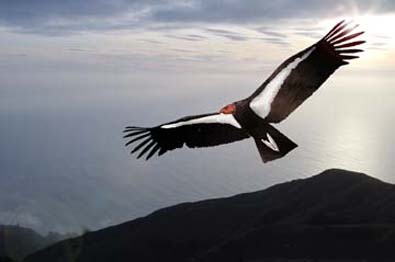
The North American condor's range was reduced to coastal California for reasons that had nothing to do with modern man.


A healthy email discussion yesterday about condors, lead shot and bullets, and the strengths, limits and pitfalls of environmental advocacy reminded me of an older post, appended below, from April of 2005, in which I suggest some caution is needed before the world swallows the extinction hyterics of some environmentalists (such as entomologist E.O. Wilson) who like to proclaim that we are now in the "era of mass extinctions."

I suggest one can be very concerned about extinction (I am), without tossing science and data overboard or engaging in out-and-out distortions about the data. Truth and data are not lesser values, and should not be abandoned by advocates looking to score cheap debating points.

In the case of condors, I am for doing whatever it is we can to ensure their survival and increase their numbers, including baning lead shot and bullets, if necessary (background article here on this controversy).

Having said that, let's acknowledge that this is a bird that was on the decline long before there were guns anywhere in the world.

During the time of mammoths, some 15,000 years ago, there were condors all over North America, but as the herds of these and other giant pre-Columbian animals declined and then slid into extinction, the condor's range was reduced to a narrow part of California (hence the name California Condor).

What few folks are willing to talk about, in a frank and unsentimental kind of way, is that the era of the condor was closing long before the Santa Maria left Spain. The reason for this is not too hard to explain: The condor is a huge, poorly conceived, "line of sight" meat scavenger. It was too specialized to make it.

And yes, God does make mistakes (the Whooping Crane, for example, is simply an "Edsel" Sandhill Crane) and He has plenty of "discontinued models". It is neither sacrilegious to say this, nor bad science: It is plain truth.

Not only is a condor a huge animal (a 9-foot 6-inch wingspan) that requires a lot of meat to keep it in the air, but it is also an animal that cannot kill that meat itself. The feet of a condor are closer in structure to those of a chicken than those of a hawk or eagle -- it cannot lift a rabbit, much less a lamb.

Unlike the turkey vulture, whose population numbers are huge and rising, the California Condor cannot smell rotting flesh from miles away. It is a pure line-of-sight scavenger. What this means is that if a condor does not see a large pile of dead flesh every couple of days for its entire life, it is going to die of starvation. The condor may have survived in coastal California only because of dead whales and seals washing up along the coast -- an easy-to-patrol carrion line.

Another factor in the demise of the condor, even before man showed up, is that it is a very poor and slow breeder, laying only one egg every other year, and not breeding at all until the age of 6 or 7. This is a bird that does not build a nest -- it needs caves and cliff ledges which, as a general rule, are in short supply.

Put it all together, and you have a very maladaptive kind of animal -- an animal whose internal biological problems were, and are, so serious that its range and numbers were shrinking long before the gun, the powerline, or DDT. Which is not to say guns, powerlines and DDT did not push things over the edge. They most assuredly did. Sadly, things on the edge are a little too easily tipped over in this over-fast, too-crowed and intensely-machined modern world.

In the end, the last pair of wild condors were caught and put in a captive breeding program with 20 others back in 1987. Since then, I am happy to report, the population of condors has grown from 22 to about 280, and there are now about 140 condors in the wild, and another 140 birds in captive breeding.

In addition to restocking condors in the shrinking wilds of California, where powerlines and windmills remain a very serious problem, the California Condor has also been restocked in Arizona.

All of this is good news, and it is about as good as it is ever going to get. There will never be large numbers of condors in America because this an animal adapted for a pre-Ice Age era that no longer exists. That said, poisoning from lead (the isotopes from shells has been traced into the dead birds themselves) has killed a large number of the condors released into the wild. If paying a few more dollars for shells will help reverse that phenomenon (while also spurring shel and bulletmakers to do more to develop new composite-type loads), I am all for that.


_ _ _ _ _ _ _ _ _ _ _ _ _ _ _ _ _ _ _ _ _ _ _ _ _ _ _ _ _ _ _ _
Reposted from the April 29, 2005 edition of this blog.
_ _ _ _ _ _ _ _ _ _ _ _ _ _ _ _ _ _ _ _ _ _ _ _ _ _ _ _ _ _ _ _

Thinking About Species Lost

The rediscovery of the Ivory-billed woodpecker in the hardwood swamps of Arkansas reminds me of how much we hear about wildlife species loss, but how rarely such species loss is quantified, defined, or given proper causation.

Whenever I hear about species loss, I naturally ask five key questions --and I often find the answers surprising.


1. Do the animals exist at all?

This may sound like an odd question, but it's a pretty important one because a lot of what is written about species extinction is totally unsupported by observed data.

Here's the scoop: Over the course of the last 400 years, only about 820 species of vascular plants and vertebrate animals are listed as having gone extinct by the IUCN Red List. In addition, the IUCN reports several species being "rediscovered" every year after having previously listed them as "lost".

Though the IUCN cannot report on what has not been discovered, we have clearly discovered most of the mammals, birds, fish, snakes, frogs, shrubs, vines, grasses and trees in the world. While new species of wildlife are being discovered every day, there is no evidence to support the notion that even 50 vertebrates and vascular plants are going extinct every year, much less the 20,000 number commonly cited (invertebrates and fungi are very difficult to push into extinction as any farmer can tell you).

As odd as it may sound, even physical evidence of the existence of a species does not necessarily mean that this species has ever existed. Here, I am specifically talking about birds, where it turns out some "extinct" species are based on single skins collected in the 19th or early 20th Century. The cone-billed tanager is a good example (to read more about the hunt for this "extinct species" read "The Ghost With Trembling Wings" by Scott Weidensaul).

The problem with birds is that they hybridize a lot, and bird species are not always very distinct from each other. Along with the cone-billed tanager, for example, there are several species of hummingbirds that we know of only due to single examples collected for the millenary trade. These
so-called "Bogotá Skins" (for their central shipping point out of South America to Europe) may in fact represent evidence of a new species of now extinct hummingbirds -- or they could simply represent hybrids of other hummingbirds. With about 10 percent of all bird species known to cross the "species barrier," it's hard to know.


2. Is the animal being described really a species?

In fact a lot of stories about species decline are NOT about the decline of a species, but about the decline of a SUB-species in a very specific area.

A sub-species is, by definition, NOT a species. In fact most subspecies are nothing more than slightly different colored animals that exhibit no other behavior differences and that freely breed with populations of other animals in their species (animals whose populations may in fact be quite large and growing).

Sub-species are an interesting thing. I have always found it ironic that many environmentalists place little value on the prolific creation of thousands of new subspecies of apples, potatoes, pigs, cattle, and chickens, but assign tremendous value to subspecies of cougars, lions and pronghorns (to give just three examples). In fact, mmany sub-species of wild animals are little more than political artifices designed to boost the careers or egos of the people naming them.

In some cases there is another less vanity-centered reason to name a subspecies -- you can "up list" an animal (and its habitat) for protection by simply singling it out. The Sonoran pronghorn appears to be an example -- an animal made "rare" despite the fact it appears to be little more than a light-colored variant of an animal that actually numbers in the million.


3. Was the species ever very common?

Some threatened and endangered species are animals that were always rare and not very successful to begin with. Take the Whooping Crane, for example. DNA analysis suggests Whoopers never numbered more than about 5,000 individuals. The 1850 population of the bird (when most of the American West was still unsettled and very wild) is estimated to have been just 1,500 individuals. There are now 500 Whoopers in the world, with about 350 of them in the wild. I am very glad the Whooper was pulled back from the edge of extinction, but the fact that the bird was never common or genetically successful is not an inconsequential part of its story (though it is rarely told).

The Florida Manatee is another animal that was probably never terribly common. The Manatee population of Florida before there were outboard motors is estimated to have been around 10,000 or so. By the 1980s, the manatee population had declined to about 800, but it has since risen to over 3,000.

Again, bringing the American manatee (Trichechus manatus) back from extirpation in the U.S. is excellent, but we should not expect the population to ever get really huge. Note that the American manatee also exists in many other Caribbean countries south to Brazil, but it is a rare animal there due to hunting by indigenous people .


4. What is the population of the species now?

I am always interested in both the percent decline or increase in a species and the total number of individuals that exist (and existed). For example, if I am told that 97% of all pronghorn antelope are gone, I am shocked. But if I am told that this 3 percent totals 1 million animals, I begin to feel a
little better. I begin to feel pretty good when I know that in Wyoming the pronghorn population is estimated to equal the human population of the states, and even better when I learn that the human population of Wyoming is actually declining.

The point here is that numbers are only meaningful within context. Do I wish there were more pronghorn in America? Sure! But one million pronghorn -- up from just 13,000 individuals at the Turn of the 20th Century -- is pretty good news and one we should be celebrating!


5. What has really caused the decline (or increase) of this species?

The death of any species is important, but I also want to know the circumstances of the decline or extinction. I consider the loss of the Passenger Pigeon and the Eskimo Curlew (there were once millions of these birds flying over vast areas of this continent) a much more significant tale than the loss of a species of flightless rail on a small island in the Pacific. One extinction signals the total loss of a once very common species that was successful over a very large area. The other signals the total loss of a very rare species that was NOT successful over a very large area. There are very different lessons to be learned from these very different stories.

Most people are surprised to learn that most extinctions are of the latter type (fairly unsuccessful species in very isolated locations) and not the former (fairly successul species in fairly common locations). They are further amazed to discover that habitat loss is a much rarer cause of species extinction than the introduction of rats, cats, goats and pigs -- or of indiscriminate hunting. If you go through the IUCN Redlist of extinct species, for example, you find zeros for most countries (no known endemic species pushed into extinction), but incredible numbers of extinctions for such tiny islands as Mauritius (41 extinct species), Réunion (16 extinct species), Saint Helena (29 extinct species), French Polynesia (67 extinct species), and the Cook Islands (15 extinct species). In fact, these little spots of land, along with Hawaii, account for about 200 of the 812 species pushed into extinction over the course of the last 400 years.

Is the loss of an "unsuccessful species" a bad thing? I think so. But it may not be quite as horrible or as unprecedented as it is commonly made out to be. In fact it may be part of the order of things. After all, instead of a living at a time when there is a "biodiversity bottleneck," as some texts would have you believe, we are actually living at a time of incredible genetic diverity. As the folks at the World Resources Institute note, "Global biological diversity is now close to its all time high. Floral diversity, for example, reached its highest level ever several tens of thousands of years ago. Similarly, the diversity of marine fauna has risen to a peak in the last few million years." In short, we live in a very bio-diverse time, and with diversity will come a lot of failure which is every bit as much a part of Darwin's evolutionary equation as success (if not more so).

It's also worth remembering that even as we are losing species, we are also gaining them -- new types of chickens, pigs, apples, corn, and trees. New hybrids of canaries, geese, ducks, pigeons, cattle, horses, falcons, eagles, dogs and cats. And we are doing it with wild birds too.

The last time I flipped through a Sibley's Audubon guide to birds, I counted one extinct species of parrot (the Carolina parakeet), but 27 new species of introduced parrots that are found in wild flocks in the U.S. (65 species have been encountered in Florida alone). In California and Florida these wild-flocking parrots are already creating new hybrids. Wild parrot colonies are not just found in warm climates by the way -- they are found near my home in suburban Virginia, and in downtown parks in Seattle and Chicago. One hundred and fifty years from now my great grandchildren may find hybridized variations of these same birds listed as entirely new "American" species of parrots (the Sibley guide already notes the presence of many Amazon hybrids in Florida and California).

Food for thought.

Friday, May 5, 2006

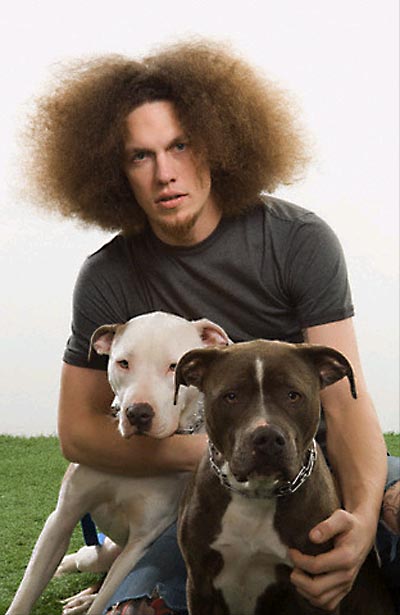
What the Hell is an American Staffordshire Terrier?

If there was ever a stranger group than young bulldog afficionado's, I have not met them. They are a truely odd bunch of people that lurk at the periphery of the working terrier world.

On the one hand, you have the dog fighters and wanna-be dog fighters. These numbskulls range from preening fakes and short-tooled fools to sick sadists. Any way you cut it, they are a sad case with even sadder dogs.

Then you have a few romantics -- those with rich fantasy lives who imagine their cherry-eyed genetic wrecks with undershot jaws are descended from the iron-tough catch dogs of the 18th Century. They glory in leading around over-large dogs with massive heads, bowed legs, and dysplastic hips. Most of these dogs could not catch a cold, much less a pig running flat out in Texas Hill Country.

And then you have the Kennel Club enthusiasts, and their "American Staffordshire Terriers," "Bull Terriers," "Staffordshire Bull Terriers," and English Bulldogs.

Kennel Club owners of these dogs will tell you they have worked hard to breed all aggression and prey drive out of their charges. And no doubt many have. What a comical thing that is, of course -- a bit like an auto club bragging that their sport cars have no engines.

The only thing is .... it's not always true. "Bad breeding" and "poor socialization" are often blamed when dogs descended from pit and catch dogs attack small children, but ... could it be .... perhaps ... that a small bit of genetic code remains unbraided as well? It is certainly in the realm of possibility, is it not?

In fact, molosser breeds can make fine pets in the right hands, but many of these dogs demand much more time, energy, and commitment than their young owners realize.

A large dog in the hands of a young man with shifting interests and an unstable housing situation (i.e. most young men) is a recipie that too often leads to dead dogs at the County shelter.

There has always been a ready market for intimidating dogs, and it seems a new breed of "ancient bulldog" is created every few years. Pick up any dog magazine and there they are advertised in the back, all of them with massive bully heads: the "Alapaha Blue Blood Bulldog" and the "Olde English Bulldogge" and the "American Bulldog," sandwiched between the English, Neopolitan, and Bull Mastiffs, Rottweilers, Dogue de Bordeaux, Dogo Argentino, Fila Brasileriro and, of course, the English Bulldog. Plocked down in between are other bully-headed prey-driven defensive breeds -- Rottweilers, Akitas, Tosas, Rhodesian Ridgebacks, Thai Ridgebacks, and the like.

There have always been men with a need to display power. While the world frowns on a man cleaning an unloaded gun in a public square, it's OK for that same man to tow an enormous dog from corner to corner and park to park -- the canine equivalent of a Harley owner with straight pipes blasting through the neighborhood for the sole purpose of intimidation. If asked, the wanna-be-tough man will explain that his breed was designed to (please pick one): kill escaping slaves, hunt jaguars, fight bears and bulls in the pits, fight other dogs, or catch semi-wild pigs and cows so they can be altered or slaughtered. You are supposed to feel fear, and you are supposed to feel respect for a man in control of such a powerful animal with such an ancient history.

In fact, I generally feel a little amused.

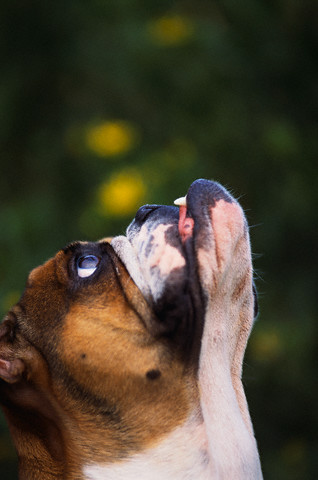
The famed English Bulldog, for example, is mostly Chinese pug -- a show ring creation with legs so deformed it can barely walk, a jaw so undershot it cannot grab a frisbee, and with a face so bracycephalic it cannot breathe. Add to these problems a deformed intestinal system (a by-product of achondroplasia or dwarfism) which makes the dog constantly fart, and a pig tail prone to infection, and you have a dog that considers its own death a blessed relief.


Other molosser breeds are not as wrecked as the English Bulldog, to be sure, but they too are largely the product of the show ring and have little or nothing to do with honest catch dogs or hunting dogs.

A little history is useful here. In England, catch dogs began to disappear with the rise of the Enclosure Movement of the 18th Century. As the Enclosure Movement pushed people off the land and into squalid cities and towns, boredom set in and (in the absence of television, movies, video games, and real theatre), spectacles pitting dogs against bulls, pigs, bears and even monkeys were created for entertainment, much as the Romans had done centuries before.


The dogs used for pit work were different than the catch dogs used a century or two earlier. Pit dogs were quite variable in size, and the goal was to match the dog with its opponent (dog or beast) by weight or sense of threat. While catch dogs had to be fast to catch running stock, and tended to weigh 50-80 pounds (large enough to turn a bull or stop it, but not so large as to be slow), pit dogs weighed anywhere from 10 pounds, in the case of a small ratting terrier, to as much as 140 pounds or more in the case of bear-fighting dogs. Encounters were brief, and no nose at all was required.

Other than rat pits and cock fights, animal baiting spectacles were never common, and were banned altogether by 1835. Though secret underground dog fighting and badger baiting contests continued, they were rare, episodic, and genetically maladaptive. When police raided dog fights, the dogs were killed. When participants went to jail for other reasons, dogs disappeared. And in the era prior to antibiotics, "successful" fighting dogs often died from wounds inflicted in the ring.

In 1859, the first dog show was held. Breeds that had lost their original purpose -- catch dogs, cart dogs, pit dogs, and turnspit dogs -- soon found a new rationale for existence -- rosettes.

In the decades that followed, all manner of dogs were created, proclaimed, and endowed with invented romantic histories. That trend continues to this day.

Far from show ring fantasy and hard-dog poseurs, working catch dogs still exist. At a smaller level we have the whippet and the greyhound -- dogs designed to catch a rabbit or hare at speed. At a larger size we have the long-legged fox hounds favored by the French -- dogs that can run well and chop a fox on the fly. Added to their ranks are various sizes of cross-bred lurchers. And of course, you have the border collie -- a dog that will grip, if it has to, in order to impress upon a semi-wild hill sheep that it means business.

The penultimate cach dogs, of course, are those that work wild pig and cattle. Whether these dogs are found in Hawaii or Texas, the Everglades or Australia, the marshes of Spain, or the river banks of Central America, these dogs tend to be cross-bred dogs that, for a variety of reasons, tend to look suspiciously like rangey pit bulls.

Why is this?

The answer is at least partly morphological. While a small terrier or heeler may be able to move domestic cattle or pig, and may even be able to bust them out of brush, it takes a larger and heavier dog to travel great distances and still have the weight and stamina to initimidate, and even hold, large and truely wild animals in place.

Long coated dogs, and dogs with short muzzles are simply ill-equiped to handle long runs in hot weather. Wild pigs (feral, Russian or javelina) and cattle are generally found in locations that are hot most of the year -- Florida, Georgia, Texas, Australia, Southern Spain, and Hawaii.

When a dog is running 20-40 miles a day after an animal that does not want to be caught, and which may bust in several directions at once if in a group, stopping for a drink of water or a bit of rest in the shade is not an option.

Since dogs do not sweat except through the pads on their feet, the only way a dog has of moderating its temperature is to expel heat through its mouth and sinuses. A short snout, therefore, is maladaptive for honest catch work.

A short muzzle not only makes for a dog that overheats quickly, but also for a weaker bite. In the world of predators, where consistent failure means starvation, neither the wolf nor the tiger, the hyena nor the panther, has a short face with an undershot jaw.

A short bracyophalic maxilla is also poorly designed for scent work. Whether looking for wayward cattle and pigs, or hunting jaquar or mountain lion, most catch dogs have a bit of hound crossed into them, such is the desire for nose, which almost always comes attached to a decent muzzle.

The balance point on a good catch dog changes from area to area, depending on the lay of the land, the temperature, the stock being worked, and each individual dog and owner's technique. In some areas, lighter more greyhound-like dogs may be prefered, while in others greater hound influence is the norm. Dogs may be a little smaller in thick brush, and quite a bit larger in more open country.

And yet, again and again, across the planet, the result tends to be a variation on a unifying theme -- the cross-bred pit bull.

The American Pit Bull is descended from the cross-bred stock-working dogs of the 18th and 19th Century. To the extent they have been altered, it is that modern dogs are often heavier than those found working 200 or even 100 years ago -- a direct function of the fact that most pit bulls are now found on a leash. Today the breeding of pit bulls is heavily influenced by the show ring and the picture book. As a consequence heavier, more impressive-looking animals, are favored over the smaller, faster, and more utilitarian working dogs of the past.

From the beginning, the pit bull has had a stormy career in the U.S.

When it was created in 1878, the American Kennel Club refused to register pit bulls, seeing them as dogs kept by people of low breeding. The Kennel Club was interested in dignified dogs, not working dogs, and especially not dogs that acted as the canine equivalent of a barbed-wire and locust-post fence.

In frustration, pit bull owner Chauncey Bennet created his own registry -- the United Kennel Club -- in order to to register his own dog. Today, the UKC is the second largest all-breed registry in the U.S., and it remains a for-profit, privately-held operation.

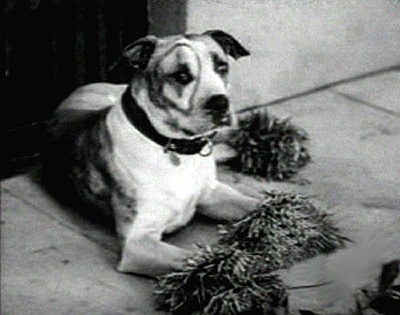
When the "Little Rascal" movies of the 1930s popularized a pit bull by the name of "Petey," the American Kennel Club decided that the smell of cash money beat out sniffing social theories, and so they changed their de facto position on the pit bull, while maintaining a de jure ban on the dog.

How did they do this? Simple: they renamed the Pit Bull the "Staffordshire Terrier," and admitted it to the Kennel Club as a terrier. In 1972, the Kennel Club changed the name of the dog again, making it the "American Staffordshire Terrier," to distinguish it from the smaller and thicker-bodied dog of the U.K.

In fact the American Staffordshire Terrier is not a terrier in any way, shape or form. It is a Pit Bull, plain and simple.

Pit Bulls masquerading as American Stafforshire Terriers is how things more-or-less rested until the fantastic growth of dog shows and hobby breeders began in the 1960s and 70s. Suddenly a new interest in all manner of dogs was fostered, and many "old" breeds were invented almost over night.

For example, in 1970, John D. Johnson and Alan Scott registered their cross-bred pit bulls with the newly created for-profit "National Kennel Club". The name they invented: "American Bulldogs". Their goal, they said, was to get away from the "pit bull" name, which was already taking on negative connotations.

Johnson's line of dogs quickly grew thicker in the head and heavier too, as he realized that the "manly man" pet market favored intimidating dogs that could be paraded around the neighborhood or chained up in the back of a shop to scare kids away from petty pilfering. Never mind that heavy dogs with short faces could not go the distance with cattle and pigs -- these dogs were designed to sell, and what was selling was intimidation.

Alan Scott's dogs remained lighter and did not deviate too much from their working-class origins. Weighing in at around 80 pounds (often 40 pounds lighter than Johnson's) Scott's dogs also had longer muzzles and better bites. Scott and Johnson's dogs began to deviate from each other markedly, and in the end they ended up as distinct breeds with Scott breeding "Standard American Bulldogs" and Johnson a "bully" breed with huge heads that he evenually advertised as "Johnson Bulldogs".

Other bull breeds have followed suit, and other for-profit dog registries have followed on as well. Today, along with the AKC, the UKC, and the National Kennel Club, we have a host of other for-profit registries including the Continental Kennel Club, the American Canine Association, the American Hybrid Canine Club, the American Dog Breeders Association, the American Canine Registry, the American Purebred Association, American's Pet Registry Inc., the World Kennel Club, the Animal Research Foundation, the Universal Kennel Club International, the North American Purebred Dog Registry, the Dog Registry of America, the American Purebred Registry, the United All Breed Registry, the American Canine Association, the World Wide Kennel Club, the Federation of International Canines, and Animal Registry Unlimited -- to offer up only a partial list.

Among the newly minted molosser breeds are the Old English Bulldog, the Original English Bulldogge, Olde Bulldogge, the Campeiro Bulldog, Leavitt Bulldog, the Catahoula Bulldog, the Alapaha Blue Blood Bulldog, the Aussie Bulldog, the Victorian Bulldog, the Valley Bulldog, the Olde Boston Bulldogge, the Dorset Old Tyme Bulldog, the Ca de Bou, the Banter Bulldog, and the Johnson Bulldog, to say nothing of the Alana Espanol, Cane Corso, Bully Kutta, and the recreated "Alaunt."

No doubt there are many others.

Adding to the confusion, in 1972, the AKC recognized the smaller thick-bodied Staffordshire Bull Terrier as a separate breed from the American Staffordshire Terrier, while in 1936 the Bull Terrier (still another breed) was split into two colors (white and non-white), and in 1991 into two sizes (miniature and standard).

None of these machinations have anything to do with working dogs, of course.

In the scrub country of Texas and Australia, the water hummocks of Louisiana, Spain and Florida, and the steep green volcanic mountains of Hawaii, working pig and cattle dogs look pretty much like they always have for the last 250 years. These dogs are fast, have good scissor bites, fully developed muzzles, and straight agile legs.

In the world of honest stock-working catch dogs, no one spends too much time dreaming up fanciful histories and contrived names. Whatever the dog -- pure bred or cross -- the goal is to avoid the heavy-bodied ponderous dogs so popular among the bridge-and-tunnel set, and create a dog capable to going a full day in rough country.

No one who works their terriers to ground, or uses catch dogs to chase semi-wild stock, has any confusion about what kind of dog they need to do their respective jobs, or the differences between them.

By definition, a terrier must be small enough in the chest to go to ground in a natural earth.

By definition, a catch dog has to be fast enough to catch, and large enough to hold an animal that has escape and mayhem on its mind.

Neither dog can do the job if it looks like a "keg on legs" -- an apt description of many of the molosser breeds sold in the back of pet magazines today.

The story then is an old one. In the world of true working dogs, form follows function. In the world of rosettes and puppy peddlers, form always follows fantasy. As ironic as it sounds, the blue-blazer rosette chaser and the young wanna-be bull dog man have that much in common.

.