Showing posts with label enclosure movement. Show all posts

Tuesday, April 13, 2010

Is the End of the Ban at Hand?

In American Working Terriers I detail how the rise of the Enclosure Movement of 18th and 19th Century Britain led to the rise of a wool-based sheep economy, which in turn led to the rise of mounted fox packs in the U.K., and the forcing of the rural poor off of the land and into the kind of squalor made famous in Dickens novels.

Class divisions exacerbated by the Enclosure Movement continue to boil just beneath the skin in Britain, fueling such diverse activities as pedigree dog shows and the RSPCA.

If one is looking for evidence of the pentimento of the Enclosure Movement, however, one could hardly do better than study the current platforms of the Labour and Conservative parties where, perversely, fox-hunting is a front-and-center debate.

As The Farmers Guardian notes:


A CONSERVATIVE Government would introduce a comprehensive package of measures to tackle TB in cattle and badgers and give MPs a free vote to repeal the fox hunting ban, it has been confirmed.

The Tory election manifesto, launched by David Cameron this morning (Tuesday, April 13), said bovine TB had led to the slaughter of over 250,000 cattle since 1997.

In what is seen as a key point of difference with the Labour Party it pledged to tackle the disease which it described as ‘the most pressing animal health problem in the UK’ through ‘a carefully-managed and science-led policy of badger control’.

“While vaccination is an important part of the long-term solution we cannot afford to wait until 2014 when this may be available.

“A carefully managed and science-led policy of badger control in areas of high and persistent levels of TB in cattle is necessary to eradicate this disease,” Jim Paice, Shadow Farm Minister told Farmers Guardian.

In another controversial move, the Conservative manifesto also promised to give Parliament the opportunity to repeal the Hunting Act on a free vote.

“The Hunting Act has proved unworkable,” it says.

The Conservative’s overall manifesto message to farmers and voters was to promote ‘a sustainable and productive’ agriculture.


Right.

Here is a perfect case of both sides starting with their conclusions and carefully crafting their rationales around them.

One side acts as if the badger is an endangered animal rather than a creature more common than the fox in the British countryside.

The other side acts as if badgers are a major threat to farm economies, and never mind if they have been present in the U.K. longer than either man or cow!

But set aside badgers . . . What about fox hunting?

The one uncontested truth here is that "the Ban" on fox hunting is universally seen as having been a complete and total flop.

Not only did it NOT slow down the mounted hunts in the slightest (they are more popular than ever), but it did not save a single fox life, as vehicle impact, snares, disease, and guns have served as alternative methods off trimming off Mother Nature's excess.

What the Ban did do, however, was undermine the rule of law.

Not only was the Ban widely flouted, but the police could not be bothered to enforce it, as the law was so poorly crafted that getting a conviction was nearly impossible, and even when achieved, was never popular.

The good news for common sense and the rule of law is that the Ban on fox hunting with dogs may not survive the Spring. As The Independent notes:


The Conservative lead over Labour widened yet further in the week that the date of the general election was finally announced. As a result, the party now appears tantalisingly close to an overall majority, but is still somewhat short of what it needs to be confident of outright victory on 6 May.

Our latest poll of polls, based on no less than 13 national polls conducted during the course of last week, now puts the Conservatives on 39 per cent, up one point on the previous week. That means David Cameron's party is now nine points ahead of Labour, whose average vote, at 30 percent, is unchanged.


Of course even a Conservative win will not end the debate, if for no other reason than the debate about fox hunting has never been about fox!

The issues here are deeper than that.

These are ancient land and class grievances passed down from one generation to another, for 200 years. Only the naive would imagine they will not be fanned, fed and nurtured into the future.
.

Tuesday, March 3, 2009

Rudyard Kipling: The Fox Meditates

.

Rudyard Kipling traces the history of England and western civilization through the "meditations" of the fox in the poem appended below.

As the last verse notes, the car on the road kills far more fox than any of the mounted hunts ever did -- in fact it kills far more fox in the UK than the mounted hunts, the weekend terrier enthusiast, and the shooter and working lurcher enthusiast combined.

Kipling references the time when "hedging came in fashion" (the Enclosure Movement) and notes too the rise of wire fences and trains which enabled more and more "townies" to come into the countryside.

Carter Fell is mentioned as well -- the same Carter Fell that John Dodd of Catcleugh -- one of the creators of the Border Terrier -- was hunting during Kipling's lifetime.

For more information about the role of the Enclosure Movement in the development of terriers, see >> "A Pictorial History of Terriers; Their Politics & Their Place"

For more about how the rise of cars and easy travel to the countryside has influenced terrier work, see >> "The Sad Rise of Hard Dogs"

Rudyard Kipling was born in 1865 in Bombay India, and died in 1936 in London. He married an American woman in 1889 and, for four years, he lived in Vermont, where he wrote The Jungle Book and the sequel, Just So Stories.

Kipling was the first Englishman to receive the Nobel Prize for Literature.


The Fox Meditates by Rudyard Kipling

When Samson set my brush afire
To spoil the Timnite's barley,
I made my point for Leicestershire
And left Philistia early.
Through Gath and Rankesborough Gorse I fled,
And took the Coplow Road, sir!
And was a gentleman in Red
When all the Quorn wore woad, sir!
When Rome lay massed on Hadrian's Wall,
And nothing much was doing,
Her bored Centurions heard my call
0' nights when I went wooing.
They raised a pack - they ran it well
(For I was there to run 'em)
From Aesica to Carter Fell,
And down North Tyne to Hunnum.

When William landed hot for blood,
And Harold's hosts were smitten,
I lay at earth in Battle Wood
While Domesday Book was written.
Whatever harm he did to man,
I owe him pure affection;
For in his righteous reign began
The first of Game Protection.

When Charles, my namesake, lost his mask,
And Oliver dropped his'n,
I found those Northern Squires a task,
To keep 'em out of prison.
In boots as big as milking-pails,
With holsters on the pommel,
They chevied me across the Dales
Instead of fighting Cromwell.

When thrifty Walpole took the helm,
And hedging came in fashion,
The March of Progress gave my realm
Enclosure and Plantation.
'Twas then, to soothe their discontent,
I showed each pounded Master,
However fast the Commons went,
I went a little faster!

When Pigg and Jorrocks held the stage
And Steam had linked the Shires,
I broke the staid Victorian age
To posts, and rails, and wires.
Then fifty mile was none too far
To go by train to cover,
Till some dam' sutler pupped a car,
And decent sport was over!

When men grew shy of hunting stag,
For fear the Law might try 'em,
The Car put up an average bag
Of twenty dead per diem.
Then every road was made a rink
For Coroners to sit on;
And so began, in skid and stink,
The real blood-sport of Britain!
.

Wednesday, July 12, 2006

The Mammoth in the Hedge


Mammoths roamed the Eastern United States, just 9,000 year ago.


Unbelievably, Steve and I were beat out by actor Ted Danson. Danson beat us with simple logic, arguing in his "long bet" with Mike Elliot (editor-at-large of Time magazine) that the Red Sox would win the World Series before the US men's soccer team would win the World Cup. As Mr. Danson explained:


"The Red Sox have had such bad luck in the 20th century, I have to believe that in the new millennium it can only get better. Besides, statistically, scoring goals is harder than hitting a home run, and in the World Cup, you have the whole WORLD against you, but in baseball, the Red Sox only really have to beat the Yankees."


Danson was right. As a consequence, Steven and I will forever be minor footnotes in the history of Long Bets. Damn that Ted Danson!

But I get ahead of myself. Let us start at the beginning.

But which beginning?

That's always a puzzler for me. When in doubt, I generally start chronologically, so I guess I will do that this time too.

We will start 10,000 years ago.

Ten thousand years ago we had mammoths roaming around my back yard. As far as anyone knows, humans had no written language. Humans had just arrived in North America. No one knew who Bill Gates was.

It was a long time ago.

About 10,000 years ago humans came and spread across this hemisphere. The result was a massive die-off of many large animal species, including the mammoth.

It was more than simply the arrival of the Clovis Point; it was also that humans, with limited ability to store knowledge or record history, had no foresight and no communication. Humans had no past and no future. All we had was a short "now."

Let's jump ahead a few years -- to 1996. That's the year Brian Eno, Stewart Brand and Danny Hillis began an extended conversation about the future. Back in the 1970s and 1980s, when folks were talking about energy, water, population, and economics, everyone was keying their predictions to the year 2000.

But it was 1996 now, and the year 2000 was right around the corner. What was the "Next Future" going to be?

The obvious thing to do was to simply set a new "future point" 20 or 50 years ahead. The obvious thing to do, however, is not necessarily the genius thing to do. The genius looks at the question upside down and sideways, challenges the base line, and thinks in four and five dimensions (time and space), not just three. And so Brian Eno, Stewart Brand and Danny Hillis (true geniuses all), leaped the fence of convention and began to think about 10,000 years.


  • 10,000 years is about the age of the oldest living thing on earth -- the bristle cone pine.

  • 10,000 years is about the time that man first began to turn the wolf into the dog and when the first clay pots were made.

  • 10,000 years ago is about the time that man first began to irreperably hammer-damage the planet.


The human ability to wreck things has expanded exponentially faster than our ability to consider the future.

Clovis points have been replaced by "Daisy Cutter" bombs, dams large enough to flood entire civilizations, and mountaintop removal.

And yet most people still have not planned for their own retirement, much less considered the ramifications of genetic engineering, or the building of entire cities on rapidly dwindling reservoirs of fossil water.

And so, in order to try to shift the time paradigm, Steward Brand, Danny Hillis and Brian Eno decided to build a clock -- a physical, visible thing that would run for 10,000 years. The clock would chime once every 1,000 years, and its very presence would require a different kind of thinking about the future.

What would power the clock? Solar power needs too much maintenance and so too does nuclear power. Could geothermal energy do the job? What power source would never run down and would never submit a bill? And thus was born the beginning of the struggle to answer the first great design question: what would power the clock?

Who would maintain the clock? Clearly not one person, so there would have to be an organizational structure -- and thus was born the Long Now Foundation.

Where would the clock be located? It had to be some spot free from destruction for 10,000 years. And so the Long Now Foundation purchased part of a mountain in Nevada where the clock will be situated deep inside a limetone cliff.

Who would explain the clock? Ten thousand years from now people will not be using any language we know today. And so was born the Rosetta Disk to serve as a translation tool for the future.


The 10,000 year clock being built by the Long Now Foundation.


Changing a paradigm is not easy.
In fact, it is so hard, and so rarely done, that the very idea of it seems more than a little Quixotic.

And yet all important change comes from paradigm shifts, and a paradigm shift about time is, I think, exactly what humans need. Or, as Stewart Brand has put it, "we need to think slower and deeper, not faster."

But to tell the truth, a 10,000 year clock is a little abstract for most people. Never mind that it is physical and visible and magically corrects itself for the long-term global wobble that will result in a deviation in solar time.

People are simply unable to grasp 10,000 years. They have more immediate concerns. Like lunch.

In any case, the future is not built in a 10,000 year lump any more than a cathedral is forged from a single block of stone.

The future will be built like a cathedral, made up of thousands of blocks of action and consequence, each carefully cut and interlocked into place.

And so was born "Long Bets," to promote more robust short-term thinking. Better building blocks to make a better cathedral.

The Long Bets idea was forged when Paul Ehrlich said he would give even odds as to whether Great Britain existed in 2000. Ehrlich was prone to making such provocative apocalyptic statements. His most famous book, "The Population Bomb," predicted massive die-offs in the developing world due to a shortage of food and a "longage" of people.

In fact, such predictions started with Malthus who postulated that population grew exponentially and food arithmatically, and for that reason doom was inevitable and that aiding the poor was foolish and would only abet more misery.

Malthus's tract on population was written to justify land clearances for the Enclosure Movement. Without writing a long essay on Malthus, it is enough to say that he was quite wrong. Since Malthus' time, global food production has outpaced human population growth, life expectancy at birth has increased, and literacy has spread.

Those facts, of course, have not stopped a small parade of apocalyptic predictors from following Malthus, from William Vogt to Paul Ehrlich, Garrett Hardin and William Paddock.

On the other side of the coin have been a few people like Julian Simon -- a University of Maryland economics professor who claimed human ingenuity could solve ALL problems. I will not delve into Simon's intellectual mistakes, but they are as legion as any of those on the opposite side of the coin. My aim here is not to get trapped in the quagmore of Ehrlich and Simon. What we are talking about here is Long Bets -- let's get back to the Long Bet that was made.

Simon challenged Ehrlich to bet on the future price of any 10 commodities. The bet would last 10 years, and the winner would pocket the price differential in the commodities.

Ehrlich quickly accepted the challenge, picked a portfolio of 10 metals, and crowed that he would make out like a bandit.

Ten years later, however, when the value of the portfolio was added up, it turned out that every single metal had declined in value.

Simon pocketed Ehrlich's check with a wink and a nod.

Much has been written about this bet in the past, (google Simon Ehrlich bet). I will not delve into it too deeply other than to say that both men were overly simplistic in their analysis of both resource use, pricing and population.

That said, the idea of a financial bet between two parties intrigued Stewart Brand and his small band of talented brethren.

In their quest to promote "slower and better" thinking, a "Long Bet" seemed like an excellent mechanism to encourage both increased participation and better prognostication.

Money has a way of focusing the mind.

And so was born LongBets.org.

I came across this web site five years ago when I was looking into what Stewart Brand was now up to. Brand had been the creater of The Whole Earth Catalogue -- a series of simple catalogue-like publications, assembled by a merry band of hippies, that were so sweeping in their interests that Steve Jobs (of Apple Computer fame) has credited Brand with creating the paper-and-print conceptual forerunner of the World Wide Web.

All I know is that The Last Whole Earth Catalogue is still worth reading -- again and again -- even today.

When I checked out the Long Bets web site I found some real brainiacs making serious bets -- people like physicist Freeman Dyson, voice-synthesizer guru Ray Kurzweil, Vint Cerf (father of the internet) and Mitchell Kapor (inventor of Lotus software), to say nothing of Stewart Brand, Brian Eno and Danny Hillis themselves.

Very cool, but the bets were too steep for a nonprofit wage-slave like me. Two thousand dollars was the minimum bet, and all "winnings" were to go to charity. That was more than I could give away in a single stroke.

A while later, however, I was on a list-serv in which people were talking rather broadly about the energy crisis. I tried to explain the limits of M. King Hubbert's oil data, a well as the fungibility of energy types and other such thoughts.

As usual no one was convinced of the other person's point of view, and after a point the list drifted off to other topics.

A few months later, on the same list, I mentioned that Stewart Brand had sharply reduced the money limit on a "Long Bet," and that now it was just $200 on each side. Almost immediately, Steven B. Kurtz -- one of the previous energy debaters -- asked me if I wanted to make a "Long Bet" on future energy costs.

Sure, I said. Let's make it the price of a kilowatt hour of electrical power, and let's park the bet two years into the future.

In truth, I had in mind winning the first Long Bet. I bet Steve did too.

Steve took the bet. Now, three year later, it appears he has won it, though not before a serious bit of confusion occured over at the U.S. Department of Energy which initially published data suggesting the price of electrical energy had declined.

Apparently DOE had at least two or three years worth of data wrong (including the initial price of energy at the start of our bet) due to lies, deception and data confusion that grew out of the Enron energy fiasco. In the end, looking at the re-published data, it appears the price of electrial power has gone up very slightly due to the disastrous Middle East policy of George Bush which has (among other things) resulted in a very significant decline in Iraqi oil production. Score one for Steve!

Steve and I actually have a longer, more serious bet on the human condition, in which I argue that "Over the next ten years, we will make measurable global progress in all five areas of the human condition: food, access to clean water, health, education, and the price of energy."

I let Steve pick five data sets from a closed list of about 20 options, all of which are kept by the United Nations, and which therefore have (hopefully) some continuity of collection methodology. If Steve wins on any single point, he wins the entire bet. So far, I think he is losing on all points, but the wager is still young, and we shall see.

That said, I think both Steve and I thought we really would beat Ted Danson. What was the chance that the Boston Red Sox would win the World Series in the next three years?

And yet Danson won. Though the Danson-Elliot bet seems a trifle lightweight on the surface, it's actually a wager about probability and risk, and not mere sports.

With the World Cup played only once every four years, and with far fewer Major League Baseball teams than World Cup soccer teams, Ted Danson had about a 20:1 chance of winning over Mike Elliot.

But I figured I had at least 8:1 odds of beating Ted Danson to win the first Long Bet. After all, the Sox had been losers a long time, and the window for my success was a mere two and a half years.

Of course, luck does play a hand in all things, and on this roll of the dice I lost -- twice.

Such is life.

What does all this have to do with hunting and dogs? Well, not a lot, to tell the truth. But maybe a little. I did manage to work hunting and dogs into the beginning of this piece. Now let's see if I can work it in at the end as well.

There is the small point that Thomas Malthus had quite a lot to do with the Enclosure Movement, which in turn laid the foundation for the fox and terrier work that followed, as well as the speciation of terriers following Robert Bakewell's use of enclosures to improve livestock. To read more about that see this >> illustrated history of working terriers.

Finally, for those who dig in the Eastern and Midwestern United States, the legacy of the mammoth can be found in our hedges and forests. If you are in the right thicket you may find Osage Orange, Honey Locust or Kentucky Coffeetrees.

All three of these trees have large fruits and seed pods with thick protective coatings or thorns -- natural defenses designed to help protect them from over-grazing by mammoths that roamed through this area just 10,000 years ago. The mammoths are gone, but their ghosts remain in the form of these tough and defiant trees.

Hopefully, all this will make you think, just a little, about how fragile this earth is ... about how much damage humans can do if they do not plan ... about the mammoth responsibility that comes with the powers we now have to shape the natural world.

Let's not screw it up this time .... We cannot afford to bet the farm again.

____________________________

  • Note: Of the famous and smart people named in this piece, I personally know only Julian Simon and Garrett Hardin, both of whom are now dead, and Bill Paddock, who is very much alive. Steven Kurtz and I know each other only through the internet. The rest of the folks mentioned are waaaay too smart to even know I am alive. Hats off to Stewart Brand though -- he continues to nudge the world along in the right direction. Amazing. As for Danny Hillis -- he is straight off the planet. Read about him (and the mechanics of the clock) >> here


The last mammoth, a dwarf species, was killed on Wrangle Island about 3,800 years ago -- about the time the pyramids were being made.

Friday, May 26, 2006

Inbred Thinking


Working border collies depend on a performance standard and an open registry.

 When pressed about the poor genetic quality of today's "pure bred" dogs, most Kennel Club breeders parrot the Kennel Club apologia: "We only register dogs, we don't breed them."

In fact, the line is pure bunk. The Kennel Club does far more than register dogs -- it sets the rules that guarantee more and more dogs will suffer serious (and often painful) genetic problems.

The problem, in a nutshell, is the closed registry system. With all Kennel Club breeds, the "founding stock" has always been small in number, and often fairly inbred going in, since breed creation is a product of inbreeding and line breeding to "set" the look of a dog. Because a closed registry never adds new blood, it becomes progressively more inbred over time.

Genetic diversity is never increased in the Kennel Club -- it is only reduced. In practice, it is often reduced quite rapidly due to the fact that show-winning males are in great demand to "cover" as many bitches as possible -- the so-called "popular sire effect."

The result, to be clearly seen by simply comparing 10-generation pedigrees for most breeds, is that many dogs have common male ancestors.

After 25 generations, the genetic overlap within all members of a breed may be complete or nearly complete with every member of the breed traced back to the same root stock.

What is wrong with this? Simple: In the world of genetics, most health-related negative characteristics are recessive. This is true because most dominant negative characteristics result in quick mortality or culling. A negative recessive gene, however, remains hidden and only becomes expressed (i.e. self-evident) when both parents carry the negative gene.

When dog populations are relatively heterogeneous (i.e. genetically diverse) the chance that any two negative genes will combine is low. Result: a dog with a very high chance of being healthy.

In a dog population that is very homogeneous (i.e., not genetically diverse), the chance of two negative recessive genes combining rises in direct relationship to the degree of homogeneity.

The result of two negative recessive genes combining is a real health problem -- the kind of problems we are increasingly seeing in Kennel Club dogs: epilepsy, dysplasia, deafness, congenital skin conditions, heart murmurs, cataracts, polyarthritis, progressive renal atrophy, allergies, hypothyroidism, and Cushing's Syndrome, to name a few.

A closed registry with a small gene pool undergoing a further tightening due to sire selection and overuse guarantees inbreeding and a steady increase in the occurrence of negative genetic issues. There is no getting around this.

The graph, appended below, shows the slow but steady rise in the coefficient of inbreeding among shelties. Similar rising graphs could be produced for most AKC breeds.


Coefficient of inbreeding, 1930-1993, for Shelties, showing trend line.


No population of animals is entirely absent negative recessive genes. Every population of animals contains at least two or three -- bits of fatal code that are "hard wired" into the makeup of the animal. A population of animals that appears to be "clean" is simply one that is still diverse enough that negative genes are not yet combining very often. If a small population is inbred long enough, negative genes will begin to express themselves.

The results of inbreeding are not a closely-held secret. Deuteronomy 27:22 reads: "Cursed be he that lieth with his sister, the daughter of his father, or the daughter of this mother..." Leviticus offers a similar admonition.

Human history too is a guide. Pick up any book about European royalty, and you can read about the idiot King Charles II of Spain, the product of generations of inbreeding by the Hapsburg family. This is a man whose face and chin were so distorted by the "Hapsburg Lip" that he could not eat without assistance. If his picture (appended below) makes you think of a Bulldog, Pekingese, Pug or Boston Terrier, you are not alone.


King Charles II of Spain -- a product of inbreeding in the Hapsburg line.


And yet inbreeding is not an option with the Kennel Club -- it is required. The option of outcrossing a Lakeland Terrier to a Fox Terrier is not possible within the confines of a closed registry, nor is the crossing of a Curly-coated retriever to a Flat-coated Retriever, or a Greyhound to a Saluki.

Along with an increase in the incidence of serious genetic problems within a closed-registry population, you have other problems that may not be clear to an individual pet owner, but which become obvious to those studying canine demographics: increased neo-natal mortality, shortened lifespans, and increased infecundity (dogs that are sterile or barren). All of these characteristics are endemic to deeply inbred populations, and are showing up with increased frequency in the Kennel Club.


In sled dogs, performance is king, and an open registry has proven critical to preserving honest pulling dogs with stamina, good feet, and heart.


How did the Kennel Club come to embrace a closed registry, and why does it maintain this system?

The adoption of a "closed registry" by the Kennel Club is an artifact of its history, while the continuation of this practice is driven by the economics of dog breeding and the political construct of the Kennel Club.

The Kennel Club was created in Victorian England in 1873, at a time when new theories about genetics were being promulgated by learned men who did not yet have a very good idea of what was going on in the natural world.

As noted in American Working Terriers, the "speciation" of domestic breeds of livestock began with the work of Robert Bakewell in the 18th Century, and the control of sires. Bakewell's work helped speed the rise of the Enclosure Movement, which in turn led to large estates, fox hunting, and the rise of terrier work.

Bakewell had no real knowledge of scientific genetics, and his breeding program was largely limited to the control of sires (made easier by enclosures) and the admonition that "like begats like" and that success was to be found by "breeding the best to the best".

The first stud book to document the breeding of animals was the General Stud Book of 1791 which tracked a small pool of racing horses. A stud book for Shorthorn Cattle was produced in 1822.

As more and more farmers followed the tenets of Robert Bakewell, sire selection became increasingly prevalent and inbreeding and line breeding more common. By selecting the best beef and milk producers, and pairing them, rapid improvements in cattle breeds were made.

When Charles Darwin returned from his five-year voyage on the Beagle in 1836, he discovered new breeds of cattle, sheep and pigeons displayed at livestock bench shows.

Over the next 23 years, Darwin ruminated about the aggressive livestock breeding he saw going on around him, and what isolation (enclosure) and selection (the frequent use of popular sires) might mean if some natural version of this phenomenon were driving the diversity of wildlife he had seen on his travels.

In 1859, after more than two decades of thought on the subject, Darwin published The Origin of Species -- the very year the first formal dog show was held in England.

Formal dog shows grew out of the livestock bench shows held by Robert Bakewell and his followers to display their new stock. With dogs, as with farm animals, it was soon discovered that by selecting types of dogs and genetically isolating them in kennels, homes or yards, and then inbreeding and line breeding them, a great deal of variety could be expressed.

In 1800, there were only 15 designated breeds of dogs, but by 1865 that number had grown to more than 50 and over the next 40 years it tripled yet again.

The rapid speciation of dogs that began in 1859 occurred just as Darwin's cousin, Francis Galton, was taking Darwin's work and attempting to generalize it to man.

Both Darwin and Galton had noticed how many people in their own family were smart. Along with Charles Darwin and his biologist father, Erasmus Darwin, there was another grandfather who was a member of the Royal Society, and then there was Galton's own father, who was a banker. As for Galton, by the time he was four years old he could write, read any book in the English language, knew basic math (including the times tables), and had a passing hand in the basic rudiments of both Latin and French.

While at Cambridge, Galton noticed that intelligence seemed to run in other families as well. Students that did well at college had parents and sibling that also did well. From this observation Galton postulated that human intelligence was inherited, and he went to great lengths to test his theory, going so far as to invent important new statistical methods such as regression analysis and mathematical correlation.

Galton was an intellectual whirlwind responsible for advances in meteorology, psychology, and statistics (as well as inventing the silent dog whistle), but like all people he was fallible.

Galton's chief failure was that he did not understand that the elements used to create a breed could, if taken too far, lead to the breed's destruction. With an imperfect knowledge of genetics, Galton argued that "What nature does blindly, slowly, and ruthlessly, man may do providently, quickly, and kindly," by a system he called "eugenics".

Galton postulated that if novel organisms, or "sports of nature" could be found, these sports could be enlisted to create a new breed through genetic isolation and inbreeding.

By engaging in a "positive" system of eugenics, superior individuals could be encouraged to breed more, and by engaging in a system of "negative" eugenics, inferior types could be culled from the line.

This was, to put it simply, Darwin' theory of evolution put into hyper-drive. Surely the direction would be forward, and the road forward would be without end?

Galton's theory of improvement-without-end was embraced by the early Kennel Club. The patina of science -- and a short track record of success on the farm -- lent credibility to the idea of a closed registry of "pure" stock.

On the surface, there was no reason to suspect the seeds of destruction were contained in the closed registry system itself. The work of Gregor Mendel was still undiscovered, and even when it was discovered (around 1900) a true understanding of the nature of negative recessive genes was many decades away.


A winning greyhound is never a bad or boring color.


Conformation dog shows, of course, simply speeded up the drive to homogeneity.
The goal of the conformation show is conformity -- an entire class of cookie-cutter dogs that look as much alike as possible. This is most easily achieved by breeding champion to champion, culling the nonconforming, and then inbreeding and linebreeding to further distill the "type".

As a direct consequence of conformation shows, and the over-use of championship sires, the genetic bottleneck that began with the creation of every dog breed was further reduced.

In the beginning, it was hard for dog breeders to see what was going on. Breeders occasionally had a few health problems in their kennels, of course, but it was hard to see a pattern with so few animals tracked over a relatively few generations. If hip dysplasia, skin infections and cataracts "popped out," it was "just one of those things" and chalked up to a "bad cross" and bad luck.

The idea that the Kennel Club's closed registry system itself was to blame was a deeper thought than most folks were prepared to consider.

On the farm, things took a different turn. The inbreeding of farm stock began earlier than with dogs, but was no less intense.

Because farm herds are large and often kept by families for generations, farmers were able to "tease out" data indicating drops in production, increases in mortality, declining fecundity, and a steady rise in disease and illness.

Inbreeding, which had initially boosted production, now appeared to be reducing it.

Because farmers had a clear "steak and eggs" axis for evaluation of stock, they were ready and willing to outcross to achieve the best results for their needs and their land. Consumers, after all, do not much care what breed of chicken their eggs come from, or what "champion" bull sired their steak.

Through experimentation, farmers discovered that outcrosses and hybrids of two "pure" types produce as well or better, while remaining more disease resistant, more fecund, and longer-lived than deeply homogeneous stock.

What may appear to be a pure Angus (the most common breed of beef cattle in the world) is likely to have a wide variety of cattle genes coursing through its system. In fact, entire breeds of cattle are now kept solely for their outcross potential. On today's farms the cattle in the field may be Brangus (Brahman-Angus crosses), Braford (Brahmam-Hereford crosses), Beefmasters (a cross of Hereford, Shorthorn and Brahman), or any other combination or mix.

Farmers are not alone in favoring a certain degree of heterogeneity. In top winning race horses, a 5% coefficient of inbreeding is considered high. Though much is made of the stud fees paid for the services of retired winners, most of the offspring of these champion horses are not all that distinguished, and lighting is rarely caught twice in a bottle by the same breeder.


Genetic diversity is similarly valued by breeders of performance dogs such as racing greyhounds, working border collies, sled dogs, and working terriers. All of the working versions of these breeds, or types of dogs, are maintained with open registries. It is not an accident that Kennel Club greyhounds are not found at the track, that Kennel Club terriers are not found in the field, that Kennel Club sled dogs are not found on the Iditarod, or that Kennel Club border collies are not found on working sheep farms.

Ironically, it turns out that maintaining a breed and keeping it more-or-less heterogeneous is neither a contradiction nor a difficulty. The trick is simply to follow Mother Nature and to occasionally do true outcrosses to animals that are entirely outside of the gene pool being crossed into. In the case of cattle and chickens, this is commonly achieved by crossing in an animal of similar size and traits, but with a very different genetic history.

It surprises people to find out that Mother Nature does much the same thing. Most people assume a Mallard duck is a Mallard duck. Aren't all Mallards simply clones of each other?


Well, No. You see, ducks hybridize all the time. What appears to be a Mallard may, in fact, have a little Gadwall crossed into it, or a little Black Duck, or even a bit of Greenwinged duck tucked into its double-helix.

In the duck world, where success is defined in Darwinian terms, there are no closed registries. While animals within a species tend to mate with others of the species in the same area, new blood flies, walks or swims in all the time. In the case of ducks, it may even come from across the ocean -- or from an entirely different duck species.

The same effect occurs when young male fox, lions, and wolves are forced out of their natal territories, causing them to travel great distances to find unoccupied territories. A young male wolf sired in Wyoming may travel as far as Oregon before it "settles down" to rear its own family.

What is true for ducks is true for a lot of animals. Not only will individual animals often travel great distances to find unoccupied territories, they may also cross the species barrier as they do so. A wolf will mate with both a dog AND a coyote, while finches leap across the species barrier at the drop of a hat. A spotted owl will freely mate with a barred owl, while most amazon parrots freely cross breed. A lion can mate with a tiger and produce fertile offspring, and an African elephant can cross breed with an Asian elephant. A muskellunge will cross with a northern pike, and a sunfish will cross with a bluegill. Trout and salmon species readily hybridize. Many species of hawks and falcons will also cross the species line, while a buffalo will cross with a cow. Just last week a hunter in Alaska shot an animal that turned out to be a cross between a polar bear and a grizzly.

The point here is not that trans-species outcrosses are common, but that even between distinct species Mother Nature often runs her train "loose on the tracks," and a considerable amount of genetic wobble is allowed.

Mother Nature allows outcrosses because she values heterogeneous genes, while she punishes homogeneous genes by "culling" animals through a process of dwindling survivorship (neonatal mortality), shortened lifespans, and infecundity.


The facts outlined here are not closely held information and are supported by sound science. Why then has the Kennel Club not changed its policy?

The short answer is economics.

The Kennel Club is a huge money-making bureaucracy dependent upon selling people on the "exclusivity" of a closed registry and a scrap of paper that says a dog is a "pure breed". So long as people are willing to buy Kennel Club registered dogs that have predictably higher chances of serious physical impairments than cross-bred dogs, the Kennel Club (and Kennel Club breeders) have little motivation to change the way they do business.

Let me hasten to say that the Kennel Club is not filled with evil people intent on doing harm to dogs. It is, in fact, filled with regular people who are different from the rest of the world only in the degree (and the way) they seek ego-gratification and are status-seeking.

This last point is import: the Kennel Club is not primarily about dogs. Dogs do not care about ribbons, pedigrees, titles, and points. These are human obsessions. The reason a human will drive several hundred miles and stand around all day waiting for 10 minutes in the ring is not because of the dog, but because the human needs that ribbon, that title, and that little bit of extra status that comes from a win.

Each to his own, but let us be honest about what dog shows are about -- they are about ribbons for people. The dogs themselves could not give a damn.

It is unfair to fault individual breeders and breed clubs for the failures of the Kennel Club, as these smaller units are powerless to change the larger whole.

Breed clubs are small and largely impotent by design. Because the Kennel Club does not require breeders, pet owners, or even show ring ribbon-chasers to join a breed club as a condition of registration, these entities remain small, underfunded, and unrepresentative.

Breed clubs, like dog shows themselves, are also steeped in internecine politics and dominated by big breeders and people who over-value "conformation."

It is only by conforming to the AKC system for decades that anyone can hope to move up in the AKC hierarchy -- a situation that guarantees intellectual and bureaucratic inbreeding.


In the end, the AKC is a closed registry in every sense of that word. It continues to embrace the failed genetic theories of Victorian England because it is incapable of serious reform within the Club itself.

Is there a bright light anywhere? Yes and no.

Back in 1922, Sewell Wright, a famous early geneticist, devised a method of calculating a coefficient of inbreeding (COI). Under Wright's system, inbreeding coefficients ranging from 0% to 100% defined the percentage of a dog's genes that might be homozygous (note that this is a probability equation).


The equation was neat and discrete, as such things went, but incredibly complex and cumbersome in practice. Without mathematical training, an enormous stack of pedigrees, and at least a week's worth of hand calculation, a 10-generation coefficient of inbreeding was impossible to calculate. As a result, Wright's coefficient of inbreeding (COI) was not much used.

The good news is that in the modern era, thanks to the advent of the personal computer and the internet, it is now much easier to build a 10- or 20-generation pedigree using list-servs, email, and ready-made software.


Sadly, few breeders seem willing to do even this work -- and even fewer are willing to do what is right. Breeders hell-bent to make it in the show world continue to inbreed their dogs and consumers continue to buy their cast-offs, completely ignoring the fact that 25 percent of the time they are buying a heath care liability -- one that may cost them many thousands of dollars in veterinary care in a just a few years time.

On the positive side, more and more breeders are testing their dogs for hip dysplasia (OFA), eye problems (CERF), and deafness (BAER). Unfortunately, testing and culling alone are not a curative for genetic problems. In fact, culling large numbers of dogs from a gene pool only serves to further reduce the size of the gene pool. So long as you are operating within a closed registry, the engine of disaster is still on the tracks ... and only increasing its speed.


Within the Kennel Club, two breeds of dogs stand at polar opposites when coefficients of inbreeding are examined, and both of them are terriers [Marsha Eggleston, report on "Genetic Diversity" to the AKC's DNA Committee, 2002].

The Bull Terrier may be the most inbred of Kennel Club breeds, having first entered the Club with relatively few individual members and having, since then, been split into two color phases (colored and white) and two sizes (miniature and standard).


On the opposite end of the spectrum, we have the "Parson" Russell Terrier. The "Parson" is a new entry to the Kennel Club and has benefited greatly from the large and diverse gene pool (and open-registry) of the Jack Russell Terrier Club of America (JRTCA) from which most of the AKC dogs were only recently drawn.

The JRTCA remains the largest Jack Russell terrier club in the world.
The genetic diversity of the JRTCA is not an accident -- it is mandated. Under JRTCA rules, a dog cannot be registered if it has a Coefficient of Inbreeding of 16% or greater.

This is not a particularly low coefficient;


Out-crosses to non-Russells are quite rare in the JRTCA, but such outcrosses are technically possible -- a genetic parachute individual breeders can use if needs arise -- or if a particular cross may be salient in order to increase the working traits (size, nose, voice, gameness, tractability) in a particular line. The progeny of such an outcross may or may not be registered with the JRTCA, depending on the look of the dog.

Some controversy has arisen over whether the Parson Russell Terrier and the JRTCA dogs are, in fact, the same animal with different names. While some folks continue to quibble over the status of individual dogs that may have been dual-registered at the time of the split a few years back, there can be little doubt that there are now two distinct breeds. Not only are there two registries (one of which is closed and locked), but there are also two breed standards which only partly overlap. With the absence of small dogs, and an "ideal" AKC dog listed as 14" tall, the average Kennel Club animal is quickly getting larger, and as a consequence it is quickly losing utility in the field.

In closing, it is worth recounting where "race improvement," through eugenics, took Darwin and the rest of the world.


It seems Charles Darwin was interested in maintaining the 'genetic superiority' of his own bloodline and so he married his first cousin. From this marriage, Darwin produced ten children.

Of Darwin's four daughters, one girl, Mary, died shortly after birth; another girl, Anne, died at the age of ten years from Scarlet Fever; while his eldest daughter, Henrietta, had a serious and prolonged breakdown at age fifteen.

Of Darwin's six sons, three suffered such frequent illness that Darwin considered them semi-invalids, while his last son, Charles Jr., was born mentally retarded and died nineteen months after birth.

Of Darwin's adult children, neither William Darwin, Elizabeth Darwin, Leonard Darwin or Henrietta Darwin had children of their own -- a startling high incidence of infecundity.

Of the three children that grew up reasonably unafflicted physically and mentally, Leonard Darwin went on to serve as chairman of the Eugenics Society (serving from 1911 to 1928) where he used the value of his father's name to lecture the world about "good breeding."

He too married his first cousin.

It was the Eugenics Society, under Leonard Darwin, that popularized the "Great Idea" of improving man through selective breeding and encouraged a program of state-sponsored negative eugenics.

Model laws, popularized by the Eugenics Society, advocated the mandatory sterilization of the retarded and the feeble-minded. Within a few decades, Europe was rounding up of entire classes of "mongrel" people of "low breeding" and shipping them off to be disposed of in the ovens.

Through it all, the Kennel Club has held fast, never wavering from its closed registry system, and never doubting the value of an aggressive system of eugenics centered on looks and appearance alone.

Never mind that science, data, or experience has shown that a closed registry serves neither human utility nor canine health.

Never mind the dog.

The dog, after all, has never been what what the Kennel Club has been all about.
it is more than for first cousins (6.25%).


Friday, May 5, 2006

What the Hell is an American Staffordshire Terrier?

If there was ever a stranger group than young bulldog afficionado's, I have not met them. They are a truely odd bunch of people that lurk at the periphery of the working terrier world.

On the one hand, you have the dog fighters and wanna-be dog fighters. These numbskulls range from preening fakes and short-tooled fools to sick sadists. Any way you cut it, they are a sad case with even sadder dogs.

Then you have a few romantics -- those with rich fantasy lives who imagine their cherry-eyed genetic wrecks with undershot jaws are descended from the iron-tough catch dogs of the 18th Century. They glory in leading around over-large dogs with massive heads, bowed legs, and dysplastic hips. Most of these dogs could not catch a cold, much less a pig running flat out in Texas Hill Country.

And then you have the Kennel Club enthusiasts, and their "American Staffordshire Terriers," "Bull Terriers," "Staffordshire Bull Terriers," and English Bulldogs.

Kennel Club owners of these dogs will tell you they have worked hard to breed all aggression and prey drive out of their charges. And no doubt many have. What a comical thing that is, of course -- a bit like an auto club bragging that their sport cars have no engines.

The only thing is .... it's not always true. "Bad breeding" and "poor socialization" are often blamed when dogs descended from pit and catch dogs attack small children, but ... could it be .... perhaps ... that a small bit of genetic code remains unbraided as well? It is certainly in the realm of possibility, is it not?

In fact, molosser breeds can make fine pets in the right hands, but many of these dogs demand much more time, energy, and commitment than their young owners realize.

A large dog in the hands of a young man with shifting interests and an unstable housing situation (i.e. most young men) is a recipie that too often leads to dead dogs at the County shelter.

There has always been a ready market for intimidating dogs, and it seems a new breed of "ancient bulldog" is created every few years. Pick up any dog magazine and there they are advertised in the back, all of them with massive bully heads: the "Alapaha Blue Blood Bulldog" and the "Olde English Bulldogge" and the "American Bulldog," sandwiched between the English, Neopolitan, and Bull Mastiffs, Rottweilers, Dogue de Bordeaux, Dogo Argentino, Fila Brasileriro and, of course, the English Bulldog. Plocked down in between are other bully-headed prey-driven defensive breeds -- Rottweilers, Akitas, Tosas, Rhodesian Ridgebacks, Thai Ridgebacks, and the like.

There have always been men with a need to display power. While the world frowns on a man cleaning an unloaded gun in a public square, it's OK for that same man to tow an enormous dog from corner to corner and park to park -- the canine equivalent of a Harley owner with straight pipes blasting through the neighborhood for the sole purpose of intimidation. If asked, the wanna-be-tough man will explain that his breed was designed to (please pick one): kill escaping slaves, hunt jaguars, fight bears and bulls in the pits, fight other dogs, or catch semi-wild pigs and cows so they can be altered or slaughtered. You are supposed to feel fear, and you are supposed to feel respect for a man in control of such a powerful animal with such an ancient history.

In fact, I generally feel a little amused.

The famed English Bulldog, for example, is mostly Chinese pug -- a show ring creation with legs so deformed it can barely walk, a jaw so undershot it cannot grab a frisbee, and with a face so bracycephalic it cannot breathe. Add to these problems a deformed intestinal system (a by-product of achondroplasia or dwarfism) which makes the dog constantly fart, and a pig tail prone to infection, and you have a dog that considers its own death a blessed relief.


Other molosser breeds are not as wrecked as the English Bulldog, to be sure, but they too are largely the product of the show ring and have little or nothing to do with honest catch dogs or hunting dogs.

A little history is useful here. In England, catch dogs began to disappear with the rise of the Enclosure Movement of the 18th Century. As the Enclosure Movement pushed people off the land and into squalid cities and towns, boredom set in and (in the absence of television, movies, video games, and real theatre), spectacles pitting dogs against bulls, pigs, bears and even monkeys were created for entertainment, much as the Romans had done centuries before.


The dogs used for pit work were different than the catch dogs used a century or two earlier. Pit dogs were quite variable in size, and the goal was to match the dog with its opponent (dog or beast) by weight or sense of threat. While catch dogs had to be fast to catch running stock, and tended to weigh 50-80 pounds (large enough to turn a bull or stop it, but not so large as to be slow), pit dogs weighed anywhere from 10 pounds, in the case of a small ratting terrier, to as much as 140 pounds or more in the case of bear-fighting dogs. Encounters were brief, and no nose at all was required.

Other than rat pits and cock fights, animal baiting spectacles were never common, and were banned altogether by 1835. Though secret underground dog fighting and badger baiting contests continued, they were rare, episodic, and genetically maladaptive. When police raided dog fights, the dogs were killed. When participants went to jail for other reasons, dogs disappeared. And in the era prior to antibiotics, "successful" fighting dogs often died from wounds inflicted in the ring.

In 1859, the first dog show was held. Breeds that had lost their original purpose -- catch dogs, cart dogs, pit dogs, and turnspit dogs -- soon found a new rationale for existence -- rosettes.

In the decades that followed, all manner of dogs were created, proclaimed, and endowed with invented romantic histories. That trend continues to this day.

Far from show ring fantasy and hard-dog poseurs, working catch dogs still exist. At a smaller level we have the whippet and the greyhound -- dogs designed to catch a rabbit or hare at speed. At a larger size we have the long-legged fox hounds favored by the French -- dogs that can run well and chop a fox on the fly. Added to their ranks are various sizes of cross-bred lurchers. And of course, you have the border collie -- a dog that will grip, if it has to, in order to impress upon a semi-wild hill sheep that it means business.

The penultimate cach dogs, of course, are those that work wild pig and cattle. Whether these dogs are found in Hawaii or Texas, the Everglades or Australia, the marshes of Spain, or the river banks of Central America, these dogs tend to be cross-bred dogs that, for a variety of reasons, tend to look suspiciously like rangey pit bulls.

Why is this?

The answer is at least partly morphological. While a small terrier or heeler may be able to move domestic cattle or pig, and may even be able to bust them out of brush, it takes a larger and heavier dog to travel great distances and still have the weight and stamina to initimidate, and even hold, large and truely wild animals in place.

Long coated dogs, and dogs with short muzzles are simply ill-equiped to handle long runs in hot weather. Wild pigs (feral, Russian or javelina) and cattle are generally found in locations that are hot most of the year -- Florida, Georgia, Texas, Australia, Southern Spain, and Hawaii.

When a dog is running 20-40 miles a day after an animal that does not want to be caught, and which may bust in several directions at once if in a group, stopping for a drink of water or a bit of rest in the shade is not an option.

Since dogs do not sweat except through the pads on their feet, the only way a dog has of moderating its temperature is to expel heat through its mouth and sinuses. A short snout, therefore, is maladaptive for honest catch work.

A short muzzle not only makes for a dog that overheats quickly, but also for a weaker bite. In the world of predators, where consistent failure means starvation, neither the wolf nor the tiger, the hyena nor the panther, has a short face with an undershot jaw.

A short bracyophalic maxilla is also poorly designed for scent work. Whether looking for wayward cattle and pigs, or hunting jaquar or mountain lion, most catch dogs have a bit of hound crossed into them, such is the desire for nose, which almost always comes attached to a decent muzzle.

The balance point on a good catch dog changes from area to area, depending on the lay of the land, the temperature, the stock being worked, and each individual dog and owner's technique. In some areas, lighter more greyhound-like dogs may be prefered, while in others greater hound influence is the norm. Dogs may be a little smaller in thick brush, and quite a bit larger in more open country.

And yet, again and again, across the planet, the result tends to be a variation on a unifying theme -- the cross-bred pit bull.

The American Pit Bull is descended from the cross-bred stock-working dogs of the 18th and 19th Century. To the extent they have been altered, it is that modern dogs are often heavier than those found working 200 or even 100 years ago -- a direct function of the fact that most pit bulls are now found on a leash. Today the breeding of pit bulls is heavily influenced by the show ring and the picture book. As a consequence heavier, more impressive-looking animals, are favored over the smaller, faster, and more utilitarian working dogs of the past.

From the beginning, the pit bull has had a stormy career in the U.S.

When it was created in 1878, the American Kennel Club refused to register pit bulls, seeing them as dogs kept by people of low breeding. The Kennel Club was interested in dignified dogs, not working dogs, and especially not dogs that acted as the canine equivalent of a barbed-wire and locust-post fence.

In frustration, pit bull owner Chauncey Bennet created his own registry -- the United Kennel Club -- in order to to register his own dog. Today, the UKC is the second largest all-breed registry in the U.S., and it remains a for-profit, privately-held operation.

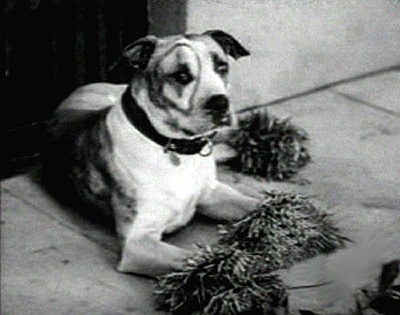
When the "Little Rascal" movies of the 1930s popularized a pit bull by the name of "Petey," the American Kennel Club decided that the smell of cash money beat out sniffing social theories, and so they changed their de facto position on the pit bull, while maintaining a de jure ban on the dog.

How did they do this? Simple: they renamed the Pit Bull the "Staffordshire Terrier," and admitted it to the Kennel Club as a terrier. In 1972, the Kennel Club changed the name of the dog again, making it the "American Staffordshire Terrier," to distinguish it from the smaller and thicker-bodied dog of the U.K.

In fact the American Staffordshire Terrier is not a terrier in any way, shape or form. It is a Pit Bull, plain and simple.

Pit Bulls masquerading as American Stafforshire Terriers is how things more-or-less rested until the fantastic growth of dog shows and hobby breeders began in the 1960s and 70s. Suddenly a new interest in all manner of dogs was fostered, and many "old" breeds were invented almost over night.

For example, in 1970, John D. Johnson and Alan Scott registered their cross-bred pit bulls with the newly created for-profit "National Kennel Club". The name they invented: "American Bulldogs". Their goal, they said, was to get away from the "pit bull" name, which was already taking on negative connotations.

Johnson's line of dogs quickly grew thicker in the head and heavier too, as he realized that the "manly man" pet market favored intimidating dogs that could be paraded around the neighborhood or chained up in the back of a shop to scare kids away from petty pilfering. Never mind that heavy dogs with short faces could not go the distance with cattle and pigs -- these dogs were designed to sell, and what was selling was intimidation.

Alan Scott's dogs remained lighter and did not deviate too much from their working-class origins. Weighing in at around 80 pounds (often 40 pounds lighter than Johnson's) Scott's dogs also had longer muzzles and better bites. Scott and Johnson's dogs began to deviate from each other markedly, and in the end they ended up as distinct breeds with Scott breeding "Standard American Bulldogs" and Johnson a "bully" breed with huge heads that he evenually advertised as "Johnson Bulldogs".

Other bull breeds have followed suit, and other for-profit dog registries have followed on as well. Today, along with the AKC, the UKC, and the National Kennel Club, we have a host of other for-profit registries including the Continental Kennel Club, the American Canine Association, the American Hybrid Canine Club, the American Dog Breeders Association, the American Canine Registry, the American Purebred Association, American's Pet Registry Inc., the World Kennel Club, the Animal Research Foundation, the Universal Kennel Club International, the North American Purebred Dog Registry, the Dog Registry of America, the American Purebred Registry, the United All Breed Registry, the American Canine Association, the World Wide Kennel Club, the Federation of International Canines, and Animal Registry Unlimited -- to offer up only a partial list.

Among the newly minted molosser breeds are the Old English Bulldog, the Original English Bulldogge, Olde Bulldogge, the Campeiro Bulldog, Leavitt Bulldog, the Catahoula Bulldog, the Alapaha Blue Blood Bulldog, the Aussie Bulldog, the Victorian Bulldog, the Valley Bulldog, the Olde Boston Bulldogge, the Dorset Old Tyme Bulldog, the Ca de Bou, the Banter Bulldog, and the Johnson Bulldog, to say nothing of the Alana Espanol, Cane Corso, Bully Kutta, and the recreated "Alaunt."

No doubt there are many others.

Adding to the confusion, in 1972, the AKC recognized the smaller thick-bodied Staffordshire Bull Terrier as a separate breed from the American Staffordshire Terrier, while in 1936 the Bull Terrier (still another breed) was split into two colors (white and non-white), and in 1991 into two sizes (miniature and standard).

None of these machinations have anything to do with working dogs, of course.

In the scrub country of Texas and Australia, the water hummocks of Louisiana, Spain and Florida, and the steep green volcanic mountains of Hawaii, working pig and cattle dogs look pretty much like they always have for the last 250 years. These dogs are fast, have good scissor bites, fully developed muzzles, and straight agile legs.

In the world of honest stock-working catch dogs, no one spends too much time dreaming up fanciful histories and contrived names. Whatever the dog -- pure bred or cross -- the goal is to avoid the heavy-bodied ponderous dogs so popular among the bridge-and-tunnel set, and create a dog capable to going a full day in rough country.

No one who works their terriers to ground, or uses catch dogs to chase semi-wild stock, has any confusion about what kind of dog they need to do their respective jobs, or the differences between them.

By definition, a terrier must be small enough in the chest to go to ground in a natural earth.

By definition, a catch dog has to be fast enough to catch, and large enough to hold an animal that has escape and mayhem on its mind.

Neither dog can do the job if it looks like a "keg on legs" -- an apt description of many of the molosser breeds sold in the back of pet magazines today.

The story then is an old one. In the world of true working dogs, form follows function. In the world of rosettes and puppy peddlers, form always follows fantasy. As ironic as it sounds, the blue-blazer rosette chaser and the young wanna-be bull dog man have that much in common.

.

Saturday, February 5, 2005

How Foxhunting Became So Divisive in the UK


In a 6,800-word article in the January 24 edition of New Yorker magazine, Jane Kramer tries to figure out how fox hunting became so divisive in England. Though a very long piece, and well-writtten, Ms. Kramer paints a muddier picture than necessary. The core story is that fox hunting rose up with the rise of the Enclosure Movement in the late 18th and early 19th Century. Much of the class issues in the UK today derive from this push of people off the land and into the cities at this time. Apparenty teaching animus acorss generations is a practice not restricted to the Middle East and certain African tribes.


Where Ms. Kramer gets it right is in the very important role of the hunt in protecting wildlife habitat, and the very marginal role that fox hunting plays in actually controlling fox numbers.


Hunt volunteers protect the habitat of hundreds of species. They mend fences, maintain the walls and hedges they jump, root out foxes that have gone to ground on local farms, dispose of dead farm animals, tend the covers in which foxes hide or dig their lairs, and, most important, help to manage a fox population that has multiplied so wantonly since the extinction of Britain's wolves (the fox's natural predator), in the seventeenth century, that foxes are now dug into the back yards and public parks of Central London and can be seen daily strolling around the city. On Armistice Day, in November, hundreds of people watched a fox circle the "remembrance" poppies in the gardens of Westminster Abbey while the Queen was leading a silent prayer. A month later, a Guardian photographer recording "a day in the life of 10 Downing Street" snapped pictures of a fox strutting past the Prime Minister's front door, right between visits from the Italian and Azerbaijani Prime Ministers and the arrival of the German Chancellor. ("Four old foxes in one day," a policeman at the corner said.)


Somewhere between twenty and twenty-five thousand foxes are killed in hunts in England and Wales each year, and hunters maintain that, while this accounts for less than a quarter of the total killed -- most are run over, or shot or trapped or poisoned by farmers, or savaged by farm dogs -- foxhunting is by far the most rational way of culling, or, you could say, the least compromising to the "welfare of the fox."


"The hound goes for the fox, it's natural," Captain Farquhar says. "But the process is selective. It follows the rules of nature. The weak fox and the sick fox get caught, but a vixen, say, either heavy or in milk, doesn't scent, and so she's safe." Most foxes get away. And most people regret it. Even the country's prodigious animal-rights lobby -- which includes, among others, the R.S.P.C.A., the League Against Cruel Sports, and the Political Animal Lobby -- admits that foxes can be serious pests."