Showing posts with label lurcher. Show all posts

Tuesday, March 3, 2009

Rudyard Kipling: The Fox Meditates

.

Rudyard Kipling traces the history of England and western civilization through the "meditations" of the fox in the poem appended below.

As the last verse notes, the car on the road kills far more fox than any of the mounted hunts ever did -- in fact it kills far more fox in the UK than the mounted hunts, the weekend terrier enthusiast, and the shooter and working lurcher enthusiast combined.

Kipling references the time when "hedging came in fashion" (the Enclosure Movement) and notes too the rise of wire fences and trains which enabled more and more "townies" to come into the countryside.

Carter Fell is mentioned as well -- the same Carter Fell that John Dodd of Catcleugh -- one of the creators of the Border Terrier -- was hunting during Kipling's lifetime.

For more information about the role of the Enclosure Movement in the development of terriers, see >> "A Pictorial History of Terriers; Their Politics & Their Place"

For more about how the rise of cars and easy travel to the countryside has influenced terrier work, see >> "The Sad Rise of Hard Dogs"

Rudyard Kipling was born in 1865 in Bombay India, and died in 1936 in London. He married an American woman in 1889 and, for four years, he lived in Vermont, where he wrote The Jungle Book and the sequel, Just So Stories.

Kipling was the first Englishman to receive the Nobel Prize for Literature.


The Fox Meditates by Rudyard Kipling

When Samson set my brush afire
To spoil the Timnite's barley,
I made my point for Leicestershire
And left Philistia early.
Through Gath and Rankesborough Gorse I fled,
And took the Coplow Road, sir!
And was a gentleman in Red
When all the Quorn wore woad, sir!
When Rome lay massed on Hadrian's Wall,
And nothing much was doing,
Her bored Centurions heard my call
0' nights when I went wooing.
They raised a pack - they ran it well
(For I was there to run 'em)
From Aesica to Carter Fell,
And down North Tyne to Hunnum.

When William landed hot for blood,
And Harold's hosts were smitten,
I lay at earth in Battle Wood
While Domesday Book was written.
Whatever harm he did to man,
I owe him pure affection;
For in his righteous reign began
The first of Game Protection.

When Charles, my namesake, lost his mask,
And Oliver dropped his'n,
I found those Northern Squires a task,
To keep 'em out of prison.
In boots as big as milking-pails,
With holsters on the pommel,
They chevied me across the Dales
Instead of fighting Cromwell.

When thrifty Walpole took the helm,
And hedging came in fashion,
The March of Progress gave my realm
Enclosure and Plantation.
'Twas then, to soothe their discontent,
I showed each pounded Master,
However fast the Commons went,
I went a little faster!

When Pigg and Jorrocks held the stage
And Steam had linked the Shires,
I broke the staid Victorian age
To posts, and rails, and wires.
Then fifty mile was none too far
To go by train to cover,
Till some dam' sutler pupped a car,
And decent sport was over!

When men grew shy of hunting stag,
For fear the Law might try 'em,
The Car put up an average bag
Of twenty dead per diem.
Then every road was made a rink
For Coroners to sit on;
And so began, in skid and stink,
The real blood-sport of Britain!
.

Saturday, April 19, 2008

American Coyote Lurchers, Old and New


There's a history of working coyotes with lurchers and long dogs in the American west. The top five pictures in this post were taken in Montana between 1910-1920, and some of the other photos were taken in Nebraska and Colorado. Several have an unknown origin (I keep these things pretty randomly on my hard drive as I come across them).


Lurchers and long dogs still run coyote in the American West, along with jack rabbits, which are actually a kind of hare. The American dogs are mostly greyhound and staghound crosses, and tend to be a little bigger than their UK counterparts.


While a red fox anywhere in the world, averages 12-15 pounds, a western coyote weighs an average of 35-45 pounds, and the eastern variant runs even larger (45-55 pounds).


Two running dogs are generally required to take down a coyote and avoid injury to the lurcher or long dog. Even absent a run-in with barbed wire, the potential of getting a dog wrecked working coyote is enough to give most people pause.

A coyote is a serious animal -- it is not a big fox.


The pictures, above, shows a pair of modern American coyote trucks -- a Geo Tracker on top, and a larger Chevy truck on the bottom. The dogs are loaded in the back and released with the pull of a string when a coyote is spotted in the basin-and-range country of the American west. These pictures are from Dan Gauss, whose Shot on Site blog is in the blogroll on right, and there are more pictures here. All these shots were taken at the annual coyote hound swap meet and races held in Loomis, Nebraska on the first Friday-Saturday of October by Dan.

The land here in the U.S. is so vast here that most people in Europe cannot fathom it. To put it in perspective, the U.S. is more than 66 times bigger than England, and 38 times bigger than all of the UK. All of the UK, with a population of over 60 million, is smaller than Oregon, which has a population of over 3.5 million . . . and Oregon is crowded when compared to states like Wyoming, Montana, South Dakota, North Dakota, and Idaho.

The pictures below are from the Badlands Tradewinds Kennel in South Dakota, and show modern U.S. coyote-lurchers. As you can see, not much has changed from 100 years ago.


Coyotes now reside in every state of the Union except Hawaii, and some states will actually pay you to kill them (my home state of Virginia has a bounty on them, for example). That said, despite the fact that 500,000 coyotes a year are taken in the U.S. (mostly by gun and trap), the numbers keep going up.


.

Thursday, March 20, 2008

Order Earth Dog Running Dog Online

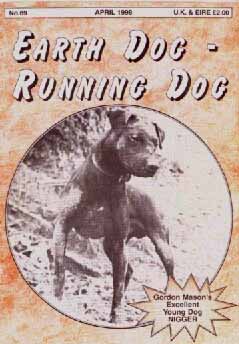
Earth Dog - Running Dog Magazine is the oldest and largest-circulation publication on lurchers and terrier work in the United Kingdom.

Edited by David Harcombe (profiled in Terriermen & Terriers by John Broadhurst), this publication features pictures and tales of working terriers and long dogs in England, Scotland, Wales, Ireland and even the U.S, and mainland Europe.

If you're looking for a gift for yourself, a trial judge, or a fellow sportsman that has taken you out into the field and taught you the ropes, an annual subscription to Earth Dog - Running Dog is the way to go!

To order by credit card (Visa, MasterCard, American Express, Discover, eCheck >> click here
.

Tuesday, December 18, 2007

Earth Dog - Running Dog Magazine


You can subscribe to Earth Dog - Running Dog magazine on line by simply clicking here. MasterCard, Visa, American Express, Discover, eCheck and several other forms of payment are accepted.

It's never been easier to subscribe (or to renew your subscription!) to the oldest and largest-circulation publication on lurchers and terrier work in the UK.
.

Monday, April 30, 2007

P.T. Barnum and the Beastiaries of the Imagination


Over at the Querencia blog a while back, Matt M. reported that he had been reading a book called Big Foot Exposed, which was written by his wife's first cousin, who happens to be a specialist in primate anatomy and biomechanics. Big Foot data is looked at straight-faced and is -- not too surprisingly -- found wanting.

Meanwhile, over at the Tetrapod Zoology blog, the always-interesting Darren Naish went to a Big Cat conference in the U.K. and seems to have gotten sucked in to believing that there are large mystery cats running around Britain. Well maybe they're not large cats ... maybe they're little ones about the size of a house cat or a Scottish Wild Cat. Hmmmm . . . . could they possible be just house cats and Scottish Wild Cats?

On my end, I have to say I rather enjoy the cryto-zoology crowd because it's an odd alamgam of P. T. Barnum myth makers, city slickers that that have never touched a cow, country rubes easily fooled at the carnival, and regular folks with a deep-seated desire to find (please!) some level of mystery, fantasy and novelty in a world that is pretty well explored and explained.

At some level we all desperately want there to be a Santa Clause, a flying Yogi, a living T-Rex, and an anaconda large enough to swallow a house trailer.

If we canot find it, we will invent it, and who is to say that it does not exist? You cannot prove that the non-existent does not exist -- an interesting fall back position for every kind of fun thing from Sasquatch and Cold Fusion theorists to the Church of the Invisible Pink Unicorn.

It's a bit fun to stoke the fires of misbelief, as anyone who has even taken a troop of cub scouts "Snipe Hunting" at night can tell you. After you have them beat the brush for half an hour looking for a "snipe" (described as an animal that looks like a thin rabbit with a white stripe downs its back) you aim your flashlight up a tree and bounce it around a bit while telling the kids you just saw .... a Ho-Dag!

I plead guilty of pulling a few tricks like this. Regular readers might remember the "Chupacabra" that I reported the dogs killing a while back. The post came complete with pictures, and they were not faked. All I did was take a natural oddity, add a tall tale which I told straight, and presto -- a real Chupacabra.

In fact, my "Chubacabra" was nothing more than a groundhog victimized by four or five very large tumors that had distorted its body to the point that it looked like an alien beast. The purple color was due to the fact that the poor creature was dragging itself over nearby pokeberry plants as it tried to find food in the final days of its misery.

Similar "mystery creatures" are reported all the time, and in almost every case they are nothing more than a mangey fox or coyote, or a bear that has lost its hair or -- in some rare cases -- an escaped exotic pet like a mouflon goat or a wallabee.

The "Beast of Stronsay" turned out to be nothing more than a half-rotted basking shark.

Pulling people's leg is big business. I could point to Big Tobacco here (or the Bush Administration and Haliburton), but let me stick to the natural world and not digress too much.

Phineas T. Barnum made his fortune by parading people into a museum to see a "Feejee Mermaid," which was nothing more than a faked bit of taxidermy combining a monkey and a fish. That gag worked so well, he began parading a pair of retarded dwarf brothers from Connecticut around as the "Wild Men of Borneo," and he found a 5-year old midget he paraded around as an adult named "General Tom Thumb."

Today, thanks to PhotoShop, the gags have never been easier. In the great tradition of western postcards that show Rainbow Trout so large that just one of them fills a wagon pulled by a team of 20 mules, we now have pictures of massive sharks looming over surfers or jumping out of the water to snatch National Guardsmen off of ladders dangling from helicopters. Even video tape can be faked.

And yet, we want to believe. I regularly get interesting bits of stuff sent my way from folks who are sure it is true. After Hurricane Katrina hit New Orleans, an office mate sent me a picture of a giant alligator that was caught in New Orleans' streets. There was just one problem -- the picture was not an alligator, but a crocodile. I tracked down the origin of the picture in a few minutes ... ditto with the enormous snake "in Australia" that I quickly recognized as an African Rock Python.

Some of my favorite tall tales are the myriad "Beast of" stories that come out of the U.K. People who believe in such things are entirely immune to rational thought. Here's a hint: there are about 200 mounted fox hound packs working every inch of a very crowded U.K., and yet they have never turned up a big cat.

Yet people want to believe there is real danger in the English countryside -- never mind that the last wolf in the U.K. was shot dead more than 250 years ago, and the last bear more than 1500. If there is a dead sheep with a torn throat it must be a giant cat, never mind all the sheep-worrying lurchers that regularly get loose and go feral for a few days, weeks or months. Sir Arthur Conan Doyle understood the mind set well when he wrote "The Hound of the Baskervilles."

People want to believe and will suspend all logic to do so, and if it also helps sell a few newspapers and T-shirts, so much the better.

The folks around Loch Ness have a small business selling postcards, tours and trinkets. The same is true around Lake Champlain where the locals have invented their own version of "the monster" which they call "Champ." Add to the mix the Yetti of the Himalayas and the Sasquatch of the Pacific Northwest.

And while we're at it, let's not forget the thousands of "Jackaplope" heads gracing the walls of western bars and tourist stores in Wyoming, Colorado and Montana.

And, of course, if there is ever a Museum of Humbuggery, the alien autopsy gag has to get its own case, as does the running gag known as "crop circles," which turned out to be nothing more than a collection of pranksters with a bit of rope and a couple of two-by-fours.

The real story, however, is that most of the earth has been well-swarmed by biologists, hunters, anglers, explorers, bug collectors, small children, foreign aid workers, and old men. Sadly, on land and in the air, there is no longer too much new under the sun.

Not all mystery is gone, of course. About once every decade we find something as "amazing" as a new small deer or striped rabbit in the forests of Southeast Asia.

Several times a year a scientist or two declares he has found a new species of mouse, frog, large insect, or small bird.

The deep oceans contain a lot of things yet unseen and unnamed. Perhaps the Creature from the Black Lagoon really does exist .... somewhere ... out there.

And even if not, we can still sell a book, a movie, and a few T-shirts about it, eh? What's the harm in believing?


.

Thursday, April 19, 2007

The Last Great Lurcherman

Parody is always a form of compliment, even if a back-handed one, and when it is done well it can rise to an art form as it does here in this piece from Gary Hosker's web site. Wonderful!

This is, of course, a twist on the sometime fawning magazine profiles about the late Brian Plummer (including one that once appeared in The New Yorker), which generally featured his ratting terriers, but sometimes his Hancock-bred lurchers as well.


I will see if I can find the old New Yorker piece and post it -- I think I have it somewhere. Note that the jump link at the end of this exerpt takes you to the rest of the story on the original web site.


John Higginbottom, the Last Great Lurcherman.


For this report we are indebted to the Sunday Spineless and its roving correspondent, Miss Wilhelmina Wordspinner.

This article first appeared in the 1991 lurcher yearbook. However, Miss Wordspinner has made ‘several’ trips to the Yorkshire Dales since 1991 and has agreed to publish her articles and extracts from her private diaries here on the Official Lurcher Web Site.


Part 1.

I drove north the three hundred long miles from my comfortable air-conditioned London office to interview a recluse, a self- styled eccentric, a man above men, a lurcherman. Name, John Higginbottom.

My journey started with a long drive north, then north and north again along the MI for what seemed an age. As the flat lands of the south turned first to gently rolling meadows of Northamptonshire and then to the hills of Derbyshire I drove ever onwards, finally arriving in the windswept dales of Yorkshire; a land where, if it's not raining one instinctively knows it must be snowing.

High limestone and millstone grit fells clad in an ever-present mist seemingly sweep up to the very base of the stratosphere. This North of England that lies on the wrong side of a theoretical line known as the north-south divide; a North of dark satanic cotton mills that belch black smoke out of imposing, discoloured and misshapen chimneys, chimneys reaching almost as high as the fells that surround them, blending with the landscape yet at the same time destroying it. A North of coal mines and colliers, of iron foundries and smelters, where work- hardened men lead lives so arduous their circumstances could best be described as an existence.

Yet, leave this industrial landscape that was once the pulsating heart of a proud British Empire and drive only a few short miles through the bitter driving rain and take a side road (track would be a more accurate description for metalled roads have yet to come to this part of Britain) signposted 'to the edge of the world' and one encounters an altogether unique England.

An England so blissfully isolated from the twentieth century that one feels encapsulated in an age long past.

Sheep hardened by many a long winter shelter behind 'dry' stone walls from the ever present torrent of rain, where men still scrape a meagre living for themselves behind horse and plough, cultivating crops on half an acre of boulder-strewn land, subsistence living that is this England. Yes this can truly be called a place on the edge of the world.

I took this path to find lurcherman John Higginbottom, John, a giant of a man with ruddy complexion, short greying hair, a beard of flaming red, and hands like the proverbial size ten shovel. Hands that were cut, bruised and contorted, he told me, through many a long desperate dig, rescuing his battle-hardened terrier 'Tootsie' from life or death conflicts with rabbit and other subterranean creatures, this reclusive, almost shy man refused to talk about.

John, a youthful forty-seven, a taciturn man who still retains most of his own teeth, was brought up in the Midlands and is a spot welder by trade. I asked him why? Why does any man try and live here, all alone pushing himself to the very limits of endurance in order to eke out a shallow existence in this particularly inhospitable place, with only the bark of his seven lurcher dogs and sound of the occasional crow for company. “Have you ever spot welded?” replied John philosophically. He sat quite still reading Kipling to himself.

Breaking the silence I enquired about the breeding of his battle-hardened terrier, Tootsie. “That,” explained John, ”is a Higginbottom terrier, the culmination of a twenty-five year selective breeding programme based on the Yorkshire terrier with just a dash of King Charles spaniel for temperament.”


Feeling that I had in some small way penetrated his rock-hard exterior and socialized myself with John, I asked, nay begged, to accompany him on one of his famous hunting expeditions -- expeditions, on which I was informed, he uses his homogeneous pack of Higginbottom lurchers to hunt all legal quarry. For John truly is the last of the self-confessed great hunters.

John fell silent, gritted his teeth, pursed his lips, and went into deep thought, almost a trance as if he were going through a metamorphosis or having an out-of-body experience.

Then as suddenly as he had entered the trance he snapped back to reality, kicked his dog and snapped: “Yes, the mad are in God's keeping. Tomorrow morning, crack of ten thirty, not a minute later and I hope for your sake you have a high attention span.”

Glancing in my direction before walking into his meagre shanty home, shared with his pack of Higginbottom hounds, John continued “I insist upon complete and utter obedience from both my dogs and those who chose to follow me.” Fixing me with those steely blue eyes, he gave a penetrating stare, a stare that I would come to know as his force 7 stare. I felt as the Apostles must have felt on the banks of sea of Galilee. I was in awe of this demigod.

Next morning we set off across the fields at a quarter-past- eleven precisely. I asked John why he was late. “Time has no relevance here on the edge of the world,” replied he, wiping the sleep from his eyes.

'Ferrets, ferrets I must have ferrets,' he whispered gently. Suddenly he opened a hutch door, and plunged his gigantic hand into a cage of these ferocious little carnivores. Five ferrets bit deep into the flesh of each of his massive digits -- yet did this man flinch? Not he.

With blood trickling down his forearm he throttled each ferret in turn in order to prise them from his fingers. "Aren't you concerned about infection' I asked “No,” said he “The poker's in the fire. I'll cauterize the wounds when we return.” I glanced ominously at the cumulus clouds gathering overhead, said a silent prayer and thought – ‘If we return.’ >> TO READ MORE

Wednesday, March 28, 2007

Small World Department


Steve Bodio gives a "big water bowl" boost to Lilly the dacshund.


The world is a small southern town. A while back, I discovered that Teddy Moritz's Harris Hawk was sired by Matt Mullenix's retired bird Charlie. Now it turns out that Steve Bodio's long-haired dachshund, Lilly, is related to Teddy's line of long-haired min-dachshunds, while his two lurchers, Pearlie and Plum (short for Plummer), are Hancock-bred animals as was Keeper, Teddy's old shattered-eye lurcher which was, I think, one of the spookiest-looking dogs I ever looked in the face.


Pearlie the lurcher looking guilty for having found a soft seat.


Bear the stag hound (left) and Plum the lurcher (right).


Since I've got a couple of lurcher pictures up, and I mentioned Col. David Hancock, I will quote from a Hancock article that first appeared in the The Countryman's Weekly back on July 14, 2000:


"Dog breeders have a huge moral responsibility, magnified by the increasing loss of role for breeds which once worked. Function once decided design. Now the whim of man all too often distorts a design originally drawn up by knowledgeable people who worked their dogs.

"Pastoral breeds were never intended to possess coats, which would hamper them at work. Working Bloodhounds do not display the degree of wrinkle seen in the breed in the show rings of today. Working Bassets, or English Bassets as they have now become known, do not display the over-long backs and under-length legs found in their show ring counterparts.

"The pursuit of undesirable and harmful exaggerations in breeds of dog tells you more
about the moral shortcomings of man than about the faults in individual dogs."

8 To read the full article

Wednesday, November 22, 2006

Bellman & Flint's New Web Site: Well Worth a Visit


I am a tough sell. I get a lot of links forwarded to me from folks that want to cross link in order to help sell some piece of dog paraphenalia or another, and I generally ignore them.

Consequently, if I give something a thumbs up, it tends to mean something. With that caveat, take a look at Bellman & Flint's new web site. It's not perfect yet, but it's the right stuff and the price seems fair for what appears to be very high quality goods.

This is the right direction for a small business to take -- specialized quality goods sold around the world to those of us who care and look for such things.

In the terrier world, most folks over here in the U.S. have heard of Bellman & Flint because they were the first folks, other than Deben, to make a terrier-dedicated locator collar.

I have used the Bellman and Flint kit, and while it is extremely well made (no complaints there!), I found the locator collar too big for the earths we have here in the Eastern U.S.

That said, not every place on earth has such tight pipes, and in the U.K. where old badger settes, deep rock fissures and 9 inch drains are more common, the Bellman & Flint kit has its enthusiastic champions. There is no reason in the world that everyone has to embrace the same technology. Different horses for different courses.

Now what else is Bellman and Flint selling on their new web site? For one thing, a wide variety of well-made terrier and hound couples. These appear to be made of top-quality leather and can be custom-assembled in any number of sizes, leather types and bits of gleaming hardware for terrier, beagle, lurcher, and hound alike. Beautiful stuff.

Along with very nice terrier, hound and lurcher couples and leads, there is also a nice collection of digging tools along with some very nice knives that, from their labeling, appear to be made in America. I am a bit of an old stick with my cheap Opinal knife, but I have to say these pretty wooden-handled locking blades are a very tempting acquisition ....

Christmas is just a month away, so for those of you looking to bring a smile on the face of a digger's heart, visit the Bellman and Flint site.

And while you are ordering things, don't forget to give a gift of American Working Terriers to someone you love!

Sunday, March 12, 2006

The Working Bedlington


This book, by John Glover, is said to cover all aspects of choosing, keeping, breeding and working Bedlington Terriers, and includes important information on the history of the breed and how the working type has been kept alive. There is also a chapter on the increasingly popular Bedlington Lurcher. The author is said to be a well known figure in the Bedlington terrier world, "and has played a major part in the resurgence of popularity this type of Bedlington is now enjoying."

In fact, I do not think it is too much of a resurgence -- though there is no doubt people are trying. Bedlingtons are still uncommon in the field as they are quite large and prone to some very serious health problems. In addition, among most of the Bedlingtons I have seen, the coat is very linty and does little to keep the animal warm and dry in bad weather. A Bedlington x Greyhound or Whippet is a popular small lurcher, however.

>> To order a copy of this book, try Coch-y-Bonddu Books ( http://www.anglebooks.com ) or Read Country Books ( http://www.readcountrybooks.com ) I can vounch for both sellers -- great service and fair prices for hard-to-get books.

Saturday, July 2, 2005

Lurchers, Terriers & Ferrets


Paul Dooley's blog at http://lurchersterriersferrets.blogspot.com is worth a visit as it has some nice pictures and narrative. Why you are at it you might invest a little money in Paul's book >> ordering information here

As for the picture above, it's a lot of rabbit holes being netted, with a ferret below ground and a deben box in hand. Looking at this picture, I am reminded of the Beatles lyric in the song Day in the Life: "Four thousand holes in Blackburn, Lancashire / And though the holes were rather small / They had to count them all".

And net them too ...

Tuesday, May 31, 2005

Earth Dog - Running Dog - Order Online


Earth Dog - Running Dog Magazine is the oldest and largest-circulation publication on lurchers and terrier work in the United Kingdom. Edited by David Harcombe, this publication features pictures and tales of working terriers and long dogs in England, Scotland, Wales, Ireland and even the U.S, and mainland Europe. If you're looking for a gift for yourself, a trial judge, or a fellow sportsman that has taken you out into the field and taught you the ropes, an annual subscription to Earth Dog - Running Dog is the way to go! To order by credit card (Visa, MasterCard, American Express, Discover, eCheck >> click here

Tuesday, April 19, 2005

Veni, Vici, Vidi Bunny: Roman Rabbits Conquer All


This extraordinary picture is from Sue Rothwell in the Outer Hebrides, and shows an enormous take of rabbits that were lamped at night and taken by well-trained lurchers. Though Sue raises Plummer Terriers and has Scottish Wildcats as well (the native wild cat of Scotland, which was nearly driven to extinction), I suspect rabbit is on the menu a few times a week! To read more about Sue's Plummer and Hancock-bred lurchers, see >> here.

The article below was bird-dogged for me by Steve who knows of my interest in such things -- thank you! It turns out that archeologists now think the rabbit was introduced to the UK by the Romans, rather than the Normans, giving new meaning to the old Latin phrase: Veni, vidi, vici ("we came, we saw, we conquered").

For more on the archeology of hunting, see the April 10th post on this topic.

The Daily Telegraph (London), April 14, 2005

Romans Introduced the Rabbit,
By David Sapsted

__________

Years of division among academics over whether the Romans or the Normans introduced rabbits into Britain appears to have been resolved.

An archaeological dig in Norfolk has uncovered the remains of a 2,000-year-old rabbit -- by far the oldest of its kind found on these shores and regarded as final proof that the creatures are now on the list of what the Romans ever did for us.

Many believed that the Normans introduced rabbits for their meat and fur.

However, others have always insisted that the creatures were brought in by the Romans, citing Marcus Terrentius Varro (116-27BC) who wrote that the legions brought rabbits from Spain, where they were reared in walled enclosures and then served up as a gourmet dish.

The remains were found at Lynford, near Thetford.

Jayne Bown, the manager of the Norfolk Archaeological Unit, which is conducting the dig, said yesterday: "We can date the rabbit to the first or second century AD from the pottery fragments found beside it. Some of these fragments included domestic pots which could have been used for cooking. "We could tell the bones had been butchered."

Thursday, July 22, 2004

New Book on Lurchers and Terriers


Paul Dooley has written a new book on lurchers and terrier work in the U.K. entitled Stormy Nights and Frosty Mornings .


You can now order this book by credit card and on line at: http://www.terrierman.com/dooley.htm . Prices posted are in U.S. dollars, Pounds Sterling and Euros, and include shipping.