Showing posts with label Plummer. Show all posts

Wednesday, August 4, 2010

A Question of Breed

This is a repost from October 2005


The quarry does not care what breed a dog is so long as it is doing the job.

Yet breeds do matter to humans for the simple reason that the more we know about breeds, and lines within breeds, the more likely we are to get a dog that is of real use to us in the field. There is always a chance we will get a dud, of course, but we can reduce that risk if we pick the right breed, select the right breeder, go slow, and use a modicum of common sense.

There are more than 28 types of terrier, but only six working breeds worth talking about, and even fewer worth considering if you are looking for a dog in America, as of this writing (2005).

There are two closely-related white breeds (the Jack Russell Terrier and the Plummer Terrier), two closely-related black breeds (the Patterdale Terrier and the Jagt Terrier), and two closely-related red breeds (the Border Terrier and the Fell Terrier).

Of these six breeds, only three are real options for U.S. earth work. Let us dispose of the generally unsuitable dogs first.

The Plummer Terrier is simply a color variant of the Jack Russell Terrier. I like the look of this dog, but in truth a good terrier does not come in a bad color, and breeding for coat markings has always been a dangerous thing.

The Plummer Terrier started off as a genetic mess — a point well documented by Brian Plummer himself. The good news is that thanks to culling and out-cross breeding, most of the serious genetic problems have been worked out of the gene pool.

The bad news is that a new problem has worked its way in: the dogs are generally too large, standing 13-15 inches tall, with 14- and 15-inch dogs very common.

Of course size is not a problem if you are ratting, which was Brian Plummer’s specialty and passion and mostly what the dogs are use for to this day. If you intend to dig to groundhog, raccoon, and fox in the U.S., however, a 14-inch dog is simply too big for our tight earths. The issue is moot, in any case; as of 2005, Plummer Terriers simply do not exist as a working terrier breed in this country.

The Jagt Terrier is another breed that fails the American working terrier size test. The Jagt Terrier was created in Germany in the 1930s with the idea of being an “all purpose” hunting terrier able to flush rabbits and wild boar from dense brush, retrieve shot birds, blood track gutshot deer, and go to ground on fox and badger.

Unfortunately, dogs are specialized for a reason, and the Jagt Terrier is, at best, a second choice in all of these tasks. When it comes to fox work, the standard for the Jagt Terriers (13" to 15" tall) calls for a dog that is simply too big for our tight American earths. There are some very small Jagts that do well, but the gene pool is dominated by larger dogs, and Jagts should only be considered, in my opinion, if it is a full-grown adult and significantly smaller than the standard.

The red Fell Terrier is a type of non-pedigree Lakeland Terrier found in the north of England. This dog would have much to recommend it if small versions of this breed could be found in the U.S. Unfortunately, as of 2005, there are only a handful of red fells in the U.S., and even fewer that are sized for our tight earths. If you can find a small dog, go for it, but the chances of locating such an animal are slim to none.

We now come to the three types of working terriers available in the U.S. which also have some hope of being the right size: the Border Terrier, the Patterdale Terrier, and the Jack Russell Terrier.

Border Terriers are wonderful dogs, but finding one that is the correct size and has a small chest is very difficult in the U.S. Few Kennel Club Border Terrier owners keep size records going back generations, and the chance of being able to select a small one out of a gene pool dominated by large dogs is about as likely a picking the trifecta at Belmont Raceway. The chance of finding one that has worked three types of quarry is close to zero.

Unfortunately, the other alternative — buying a small adult dog — is also virtually impossible as Border Terriers are not common in the U.S., and most dogs are placed as pups and never relinquished (hardly surprising after a sum of more than a $1000 has changed hands). As for finding a small adult working dog for sale -- forget it.

Border Terriers have wonderful winter coats, but these same coats tend to result in an overheated dog in summer when so much groundhog work is done. The dog that never gets cold in winter, simply flops over in summer heat.

Finally, it is worth mentioning that Border Terriers are, as a rule, slow to start. While a Jack Russell or Patterdale will usually start to work between 10 months and one year of age, Borders Terriers seem to start a full year later. There are exceptions to the rule, to be sure, but I have spent a fair amount of time around Border Terriers, and it’s best to plan on a late starter and be surprised than depend on an early starter, and be disappointed. Borders are not the “One Minute Rice” dogs so popular with young terrier enthusiasts today — one reason they may have experienced a decline in popularity in the field.

Patterdale Terriers are rapidly rising in popularity in the U.S. and they have much to commend them. Unfortunately, as Patterdales have grown in popularity, they have also grown in size. This is particularly true in America, I am afraid to say, where Patterdale Terriers have suffered a terrific genetic beating at the hands of young want-to-bes who have crossbred them with small pit bulls. Large numbers of these overlarge black dogs have been cranked out to be sold off on places like “Bay Dogs Online.” Here the ads read “will hunt anything.” “Has hunted nothing” is more likely the story. Pictures of chained out “yard dogs” may be offered at referring web sites, and dogs are sometimes swapped for auto parts or sold in groups by get-rich-quick failures who are now having “Kennel Reduction” sales.

Having raised a caution about size and breeders, it should be said that if you can find a nice small Patterdale, 12 inches tall or smaller, and with a nice tight chest of 14 inches or less, these dogs generally make exceptional workers. Caveat emptor, as with all terrier purchases, but if are flinty and properly focused on getting a small enough dog, you can do very well with a Patterdale.

Finally, we get to the Jack Russell Terrier. What a divergent mess of registries and types this breed has become! Some Jack Russellls have ears that are erect, some down, some are longer than they are tall, some are pure white, some are as parti-colored as a beagle. There are smooth coats, broken coats and dogs hairier that a Wookie straight out of Star Wars. A Jack Russell’s legs may be straight as sticks or as ornately curved as those of a Queen Anne bench. Its chest may be as small around as a lady’s bracelet, or as big around as a bowling ball.

How do you sort it out?

Simple: Get a dog registered with the Jack Russell Terrier Club of America, and accept no substitutes if you are looking for a working Jack Russell. Let is be said that I am not affiliated with the JRTCA in any way. I do not breed dogs, I do not show dogs, and I do not judge dogs. My reason for recommending the JRTCA is solely practical: The JRTCA records the size of dogs and also offers working certificates. The result is a documented track record of work and size that can be tracked across a five-generation pedigree. When you are looking for a working terrier, nothing is more valuable.

Buyer beware, of course. Most JRTCA dogs are show dogs or pets, and only about 5 percent hunt. The good news, is that with a JRTCA dog you can look through a pedigree and see whether there is a track record of work, and also ascertain the size of the dog’s dam, sire, grand-dam and grand-sire. With hundreds of well-documented working JRTCA dogs in America, the chance of finding an acceptable working terrier is higher in the JRTCA gene pool than anywhere else.
..

Thursday, April 15, 2010

Terriers at the Tar Pit


Dogs from the early 1980s were decidedly smaller than the Plummers seen today.

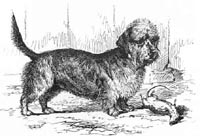
Like all working terriers, a Plummer Terrier is a composite animal. The Plummer is made mostly out of Jack Russell, with a strong dash of beagle (added for nose, voice and coat color), and bull terrier (added for toughness and head size). A fell terrier was mixed in to improve the overall appearance.

This strain of terriers, first created by Brian Plummer in the late 1970s and 80s, started out -- by Plummer's own admission -- as genetic wrecks with shot jaws, an ugly appearance, foul tempers, and a tendency to be mute.

For anyone with a lick of sense, a caution flag should now pop up: Who in their right mind begins to breed from such a canine mess?

Brian Plummer did.

After a long period of outbreeding and culling, obvious genetic problems were worked out of the breed, but a new problem worked its way in -- today's dogs are often too big for truly tight underground work. Perhaps that is not a problem if you are developing a dog just for ratting, but was a new ratting dog actually needed?

In fact, is any new terrier breed needed? Is it too much to ask people to simply preserve and work the terrier breeds we already have?

It is not a question Plummer asked, and now the point is moot. The dog that has been created is attractive, and they certainly have their fans. The question now is whether the breed will make it as a worker among workers, will remain a generalized ratting terrier, or will be pulled into the Kennel Club to be little more than another show-ring trotter.

If salvation is to be had, it is in the hands of those few genuine diggers and dedicated ratters that are trying to size down the breed and keep it working (to one thing or another) on a regular basis. A proper nod to such people -- they certainly exist even if there are not too many of them.

If doom is to rear its head, it is in the form of internecine rivalries between breed clubs, hump-and-dump breeders, and rosette chasers that do not work their own dogs.

In fact, this is a threat to all working dogs of all breeds, and the Plummer terrier is no different.

As for Brian Plummer himself, he is dead, and presumably not too concerned with critics of his dogs, his books, or himself.

His books live on, and continue to be very fun reads, and deserve their spot in the lexicon of terrier literature.

They are certainly no worse than any others, and quite a bit better than most.

There seems to be universal agreement that Brian Plummer himself was a little odd. He liked to bait others into intemperance, and he was known to lift stories from others and present them as his own. He wrote an entire book, under a pseudonym, in which he variously quoted and criticized his own books -- a decidedly odd thing to do.

Plummer suffered from both depression (a true illness) and very marginal finances, and cranked out Cavalier King Charles Spaniels for cash even as he dabbled in recreating "lost" breeds like the Lucas Terrier and the Alaunt -- breeds that had slid into extinction in generations past because they no longer had a rational reason for existence or preservation. Today Plummer's "Lucas Terrier" is a scruffy show ring dog, while his "Alaunt" appears to be little more than a variation of the pig-working pitbull so common in the American South.

While he was alive, Plummer was drowning in dogs -- Bearded Collies, Alaunts, Lurchers, Plummer Terriers, Cavalier King Charles Spaniels, fell terriers, and White German Shepherds, to name just a few. He could not possibly have had time to work so many dogs, and those who visited his kennels reported they were often in a disgraceful state of upkeep.

That said, Plummer's books and dogs remain. Plummer terriers continue to rat and even work fox to ground if placed in the right hands.

The fact that some dogs do indeed work to ground seems to cause some distress to people that despised the man for his pretensions and slights. The fact that relatively few dogs work to ground, is similarly distressing to the other side. No matter. The dogs are what they are, same as the books.

The trouble ahead for the Plummer terrier appears to be a rush, by a foolish few, to usher the Plummer terrier into the tar pit of the Kennel Club, from which no other working breed has ever emerged intact and still working.

Tar pits look benign -- cool water tends to pool on top -- but nothing has ever come out of them but bones.

In the case of the Kennel Club, what has emerged, time and time again, are exaggerated dogs devoid of working instinct, nose, and common sense, with coats inappropriate for the job, and skeletal structures that are often inadequate for a day in the field.

No one who courses dogs looks to a Kennel Club dog to do the job, and the same is true for working sled dogs, herding dogs, cart dogs, pointers, setters, and retrievers.

Terriers are not an exception to the rule.

The key and recurring problem with working terriers drawn into the Kennel Club-- from Fox terriers to Sealyhams, Borders, Jack ("Parson") Russells to Fell ("Welsh") Terriers -- is size.

Why do working terrier breeds always seem to get too big in the chest after being listed on Kennel Club roles?

The answer is to be found in an inherent defect of the show ring, and a basic understanding of canine anatomy.

The essential elements of a working terrier are small chest size, strong prey-drive, a loud voice, a sensitive nose, and a clever kind of problem-solving intelligence.

Aside from size, none of these attributes can be judged at ringside.

In a judging field of 20 or 30 dogs, a selection filter of size alone does not provide the gradients required to articulate a reason for choosing a single dog or bitch as a winner.

The breed club solution has been to generate pages of cosmetic criteria which effectively devalue the only important attribute of a working terrier that can be judged in the ring — a small chest.

And it is no small matter that chest size is defined rather vaguely -- the span of a man's hand. Whose hand? Wilt Chamberlain's? In a world of micrometers, surely there is solid research on the true size of fox chests all over the world? Yet it is not used, because Kennel Club pretenders with hulking dogs find it easier to breed good-looking large dogs than small well-proportioned working dogs.

In the Kennel Club, head size and shape are deemed to be very important by theorists who assign a great number of points to this feature (see the Border Terrier for an example). It is head shape, after all, that gives each breed its distinctive look. It is the head that faces the quarry in the hole.

Surely the shape and size of a terrier's head is important?

In fact, when it comes to working terriers, head shape is only important to the extent that it leaves space for brains, produces a strong enough jaw to grip, and allows for unobstructed breathing.

Most crossbred mongrel terriers have heads shaped well enough to do the job.

As for size, in the world of working terriers, a bigger head is not necessarily better -- a point that is often overlooked by theorists who have spent far more time listening to show ring judges than they have their own dogs working their way through a tight den pipe.

Larger heads tend to be attached to larger chests — the latter being necessary to support the former. When terriers are bred for the "bully heads" that Kennel Club judges favor, the resulting dog is often large-chested as well.

It does not take too much gain in the chest for a dog to have quickly diminishing use in the field -- a point easily overlooked if you spend more hours at shows than you do with a shovel in the field.

Paths to destruction are often well-worn. The Plummer terrier is apparently sliding straight down the Kennel Club chute that so many other terrier breeds have gone down before.

The current rage is now to "out cross" Plummer terriers with bull terriers in order to "improve" and "strengthen" the head, which a few show ring breeders claim has grown "snipey."

Whatever.

It is their dog to breed and do with as they see fit. Each to his or her own, etc.

The fact that terrier breed after terrier breed has fallen into the Kennel Club trap of exaggerated heads and overlarge chests will not stop others from following on, any more than the predicament of a trapped Mastodon at the La Brea tar pits served as a warning to the Dire Wolf and Saber Tooth that followed.

Will the entire breed disappear into the tar pit? Time will tell. The tar is cunning, powerful and above all patient. It waits. Time will tell if it is fed.


A dire wolf and a saber tooth at the tar pit. "It looked like a good idea at the time."
.
This post is recycled from April 2006.

Saturday, April 10, 2010

Dubious Terrier Breeds


Only in America, the land of P.T. Barnum:
"Hairless Terrier" at left, "Tunnel Terrier" at right.


There is nothing new about the creation of terrier breeds, many of which have lasted just long enough to be named in a book before coming up "extinct" or renamed and then declared extinct.

The "Black and Tan" terrier, for example is nothing more than a Fell Terrier that the English tried to rename and claim as their own. The gambit failed and the breed "disappeared" in name, if not in fact. The Fell Terrier can be found in the Kennel Club ring as the Welsh Terrier, though the Kennel Club Welsh terrier has been "improved" to the point that few, if any, work in the field today.

The "English White" terrier was another attempt to create a breed, this time with a degenerated smooth Jack Russell that may have been cross-bred with a small lap dog. This breed also failed to catch on and disappeared shortly after it was created. Note this "English White" is not related, in any way, to the white molosser dog used for bull baiting two centuries earlier; same name, but an entirely different dog with different origins and histories.

The Glen of Imaal terrier is nothing more than a turn-spit dog given a fancy name and an invented history as a badger working dog. In fact the Kennel Club dog is totally unsuited to earth work due to its size and a propensity for muteness, though badger baiters tried to cobble together "trials" for this type of dog after badger baiting was banned. The dog all but disappeared before recently being given new life as a show dog -- admitted to the AKC on October 1, 2004.

The creation of new terrier breeds continues unabated. A few variations of existing terrier breeds occassionally catch on, but most do not.

The "Plummer Terrier" looks like it is here to stay and may, in fact, be getting a bit of a boost from the U.K. ban on fox hunting, as ratting moves a bit closer to center stage.

The Patterdale terrier is often described as being a black fell terrier, but in fact a Patterdale is visually quite distinct from a regular fell terrier. At this point, I think Patterdales Terriers stand as a breed apart.

Another terrier breed with a clear provenance in the 20th Century is the Norfolk Terrier which was popularized by a stable man and dog dealer by the name of Frank Jones right after World War I. Originally called a "Trumpington Terrier" and then a "Jones Terrier," the dog has since split into two breeds, the Norwich Terrier (ears up) and the Norfolk Terrier (ears down).

Most new terrier breeds do not catch on. Though a breed may flourish at the point of creation, most fade into obscurity rather quickly due to uglyness, uselessness, or failure to understand the politics, economics and genetics inherent to breed creation and maintenance.

  • American Hairless Terrier: This is simply a mutant rat terrier -- a genetic anomaly that was born hairless. Someone in Louisiana figured "yippe" I can sell this freak to people with allergies, and it was off to the races.

  • American Tunnel Terrier: This is nothing more than a cross between two non-working breeds, a Boston terrier and a Rat terrier. Despite the name, they are never found at artificial den trials, and despite the breeder hype of being a "verminator" they seem to have never done anything heavier than nailing a few rats and mice.

  • Capheaton Terrier: This is nothing more than a smooth red fell terrier renamed by a woman too silly or stupid to know the breed already existed -- and has for generations.

  • Atlas Terrier: This is nothing more than a Jack Russell terrier with a merle gene -- a gene most Jack Russell breeders breed away from since it is so often associated with deafness. The creator of this breed is waiting to go to trial on animal abuse charges in Philadelphia.

  • Lucas Terrier: First bred by Jocelyn Lucas, this is nothing more than a cross between a Sealyham female and a Norfolk male, and was produced because the show Sealyhams were getting too big to work. This dog proved to be unpopular with the show set and the working set, and has largely disappeared. The "Sporting Lucas" terrier has cropped up in recent years as an attempt to revive this breed, but it is doubtful that it will succeed considering the state of hunting with terriers in the UK.

  • Teddy Roosevelt Terrier: This is nothing more than a rat terrier with short legs, and is quite unlike the orginal rat terrier (Skip) owned by Teddy Roosevelt. The American Rat Terrier, of course, is nothing more than a degenerated version of the old working fox terrier, now known as the Jack Russell Terrier.

  • Tenterfield Terrier: This an Australian toy fox terrier of dubious linneage.

  • James Pocket Terrier: This is less than a breed and more like a chest measurement for a very small working Jack Russell terrier. There is no physical standard for this breed other than a dog with a very small chest (under 14 inches) and a desire to work.

  • Shelburne Terrier: This dog never really existed other than in someone's imagination and Jocelyn Lucas's book. Created by the Shelburne Hunt in Vermont, it was a cross between a Norfolk terrier and Sealyham-Jack Russell cross, and it does not seem to have existed beyond a few litters.
    .

Friday, April 3, 2009

Plummer on the Rise of Mute Dogs

A repost from 2005
Forty Years Onwards, By D. Brian Plummer
I believe I have mentioned this before, but in the mid 1960's, Britain experienced 'Fell Fever' a time when a host of Lake District terrier men came south to judge Terrier Shows, They were treated like gods and many southern terrier buffs who had a reputation for being of sound mind suddenly began speaking in a Cumbrian accent. At that time Jack Russell terriers won most of the shows, though from time to time a rather spectacular Border terrier was selected as BIS (Best in show). Quite suddenly all the major prizes went to fell terriers, quite attractive dogs with excellent coats but sometimes over fourteen inches at the shoulder. In 1964 most winning terriers seemed to be twelve inches at the shoulder, but within ten years the winners seemed to be over fourteen inches at the withers. I'm losing the point of my article, so two points to the starboard to correct my drift.

Some of the elderly terrier men who came south as savants to judge the shows had a good knowledge of working terriers others, - 'were not good enough to be allowed to carry my ferret box'. Many owned terriers which were devils to worry sheep and were totally uncontrollable in the field, and hence it became fashionable to allow a totally wild terrier to be hunted and stone daft comments such as, 'If he came out when I called him, I'll shoot him'. The reputation of the terrier man suffered greatly and those who owned working terriers were regarded as buffoons by the rest of the field sport fraternity.

In the 1960's most terrier men expected their wards to behave while hunting, some terriers even dropped to shot when worked with the gun. Others retrieved to hand -'mine still do', yet the appeal of the self-entering easy to start fell terrier was such that tractability was sacrificed providing the terrier raced to ground and grabbed the fox.

Prior to the 1960's hard terriers, those who would go to ground and grapple without giving tongue were not considered worthwhile. Indeed such dogs were sold for a song or given away. Game, but mute terriers which simply engaged the fox in silence were undesirable. Not only was such a dog virtually useless as a bolter of foxes, but it was difficult in the extreme to dig to such a terrier. In the 18th Century Iron-Hard ultra game terriers were mated to beagles, to give the hybrid 'voice' (Memories of The Old Charlton Hunt)

Foxes rarely bolt if they are faced with a very hard dog in a natural earth, though a fox encountered in a smooth sided glazed drain will vacate the den quite quickly if faced with a hard dog. In a natural earth, particularly in a den interlaced with tree roots, matters are very different!

A 'gentle' dog, one that bays at its fox rather than tackles it will, by dint of its barking, annoy a fox so much that it seeks to leave an earth for the sound of baying is multiplied ten fold in a deep earth.

A harder dog races to ground and seizes its fox, foxes quite often adopt the practice of playing dead when attacked or frightened, though in point of fact the condition is closer to catatonia rather than a cleverly thought out plot. Hence the hard dog seizes its fox, which goes into a death like trance, only to find itself in a life and death encounter, when it recovers from its 'fit'. Such a fox cannot bolt and must fight to the death- though most terriers find it surprisingly difficult to kill a large fox in a subterranean struggle.

Hence the terrier man of the 1960's did not require a very hard mute dog. Indeed such a dog was a liability where foxes were required to be bolted, yet changes in the way terriers would work foxes were at hand.

In the 1960's moves were afoot to develop detectors, which would locate a terrier below ground. Hither to the barking of the terrier guided the digger to the fox (hence the mute terrier was a liability) now even mute terriers could be used providing the terrier was fitted out with a locator collar or the terrier had not engaged with the fox out of range of the locator.

Absurd statements such as 'this terrier had never been known to make a sound below ground and I intended to found my strain on the dog' began to appear in the sporting press. Old timers shook their heads at such nonsense, but youngsters not old enough to know better, delighted in such rubbish and sought to buy dogs with similar attributes.

The locator also changed the face of ferreting - once the sport of the patient and the silent now became the sport of those eager to catch a rabbit quickly with little regard to damaging the rabbit burrows. Ferrets were simply fitted with locators, put to ground and on encountering their rabbits were dug to in double quick time. If left to its own devices the rabbit would have bolted and hit the nets - with little or no damage to the burrow.

Likewise the use of locators in the hunting of foxes. Many fresh foxes - not foxes chased to ground by hounds - will bolt when a terrier goes to ground and engages them. Most will bolt if the terrier engages them for long enough and noisily enough. Now by dent of using locators an amateur terrier man, and a crass amateur at that, is able to locate a fox with almost pinpoint accuracy and puts spade to sod instantly destroying age old earths which have housed a thousand or so foxes. Dan Russell. A savant of the 'old school' once wrote of the dangers of premature digging and not allowing the terrier to work its fox- and possibly bolt it. Sadly no one heeded his advice. Ronald Jones of West Wales, regarded by some as the greatest expert on the management of gun packs, once stated that he has yet to have encountered a terrier, which was too small for bolting foxes. These days a visit to a hunt terrier show will see huge sixteen-inch dogs winning classes - terriers far too large to work the majority of fox earths. Hideously scarred terriers are prized by terrier owners, most of whom seem unable to get a terrier to return to hand and well-trained terriers are noticeable by their absence.

This is a study of the evolution of the terrier and its owner over nearly half a century, I confess that its not a pretty picture that has been painted , but never the less a true one.

.

Friday, November 9, 2007

Nutria: The Tabasco Sauce Rat

Example

The Nutria or Coypu (Myocastor coypus) was first brought to the United States from South America by the McIlheny family, of Tabasco Sauce fame. Their idea was to start a fur farm on Avery Island, Louisiana. Unfortunately, in 1941 a hurricane blew in and wrecked the cages, releasing about 150 nutria into the local marshes.

By 1959, these 150 nutria expanded to a population estimate of 20 million!

Nutria are considered a serious pest. Wherever they have gone, there has been a steep decline in muskrat populations, with whom they directly compete. In addition, nutria are voracious eaters of vegetation and are capable of cutting huge holes in marshes, leading to increased soil loss, shell-fish deaths, lost fish spawning grounds, and lost song and game bird habitat. Not for nothing are they sometimes called "that rat that ate Louisiana".

On the up side, there is little doubt that the introduction of the nutria has had a very beneficial impact on the American alligator, whose numbers were pushed perilously close to the edge in the 1960s, but which are now in superabundance thank to better game management laws and a steady supply of nutria (as well as cats, possums, small dogs, raccoons, turtles and fish).

Efforts are underway to wipe out the nutria in Maryland, where populations have been destroying the Blackwater Wildlife Refuge. In the American South (Louisiana, Florida, Mississippi, Texas, Georgia) it is probably impossible to turn the tide, no matter how many conibear traps are set out.

Nutria were introduced to England sometime prior to 1944, when a few escaped from a Sussex fur farm, but they were exterminated by 1988 thanks to a concerted trapping campaign.

The nutria is not considered much of game animal by those that have worked other terrier quarry. Despite the fact that the Jack Russell Terrier Club of America is headquartered about 45 minutes away from very large and thriving nutria colonies where a very aggressive trapping regime is now underway, the JRTCA does not list them as a species they will give a working certification for. I am told that this is because the dens they inhabit are generally so shallow and large that working them is not really earth work. The American Working Terrier Association also does not give a working certification for nutria.

In The Working Terrier, Brian Plummer notes that nutria make a great deal of noise chattering their teeth, but that this largely bluff.

“Coypu are not particularly exciting animals to hunt. Their burrows are large and not especially deep, so there is little chance of a dog getting trapped while hunting them. Furthermore, the coypu is reluctant to fight and much prefers to bolt if it encounters a terrier. Bites from coypu are never really serious, though pieces of the incisor sometimes break off and remain in wounds, causing sepsis. Wounds are rarely more than skin deep, for, in spite of its rat-like appearance, the coypu is unable to mete out the savage wounds of which the brown rat is capable. . . . the coypu can scarcely be called a sporting animal.”


Others, of course, disagree. That's what makes the world go 'round. If they ever stop setting conibear traps at Blackwater Wildlife Refuge, maybe I could find out for myself. Until then, it strictly dry land for the dogs.

.

Wednesday, August 22, 2007

Will Not Work for Food

Back in 1946, Field and Stream's Horace Lytle wrote an article noting that Irish Setters were almost completely absent from the hunting field.

In fact, between 1874 and 1948, Irish Setters produced 760 conformation champions, but only five field champions -- a rather dismal state of affairs.

Lytle proposed that Irish Setters be rescued and returned to their working roots by implementing an outcross program.

Lytle noted that the Irish Setter once had quite a lot of white in its coat, and he thought it would not be too bad a thing for the few remaining working Irish Setters to be outcrossed to working English Setters. Yes, some white might show up in the coats, but So What? The dogs had always had that when they had actually been working dogs.

Sports Afield endorsed the call to rescue the Irish Setter from the show ring, and Ned LaGrange of Pennsylvania took up the challenge of creating a systematic outcrossing program based on breeding the few remaining working Irish Setters that were left, with the best field champion English setters.

The result was the "Red Setter" which was blessed and maintained as a working setter by the Field Dog Stud Book (FDSB), with reciprocal registration with the American Kennel Club (AKC).

The problem, of course, was that nonworking AKC Irish setters found it nearly impossible to compete in AKC field trials against Red Setters.

What to do? Well, eliminate the competition, of course!

In 1975 the Irish Setter Club of America petitioned the AKC to deny reciprocal registration to Field Dog Stud Book-registered dogs, and the AKC obliged.

As a result, the AKC Irish Setter remains, to this day
, the "least likely to succeed" bird-hunting dog to be found in America, while the Red Setter is a dog that is at least sometimes found under a shotgun.

Now rumor has it that the Irish Setter Club of America has indicated it may reverse itself and grant reciprocal registrations to any Field Dog Stud Book or North American Versatile Hunting Dog Association-registered Irish red setter that has a three-generation pedigree and DNA verification for the same. Final approval awaits a vote of the Irish Setter Club of America Field Trial Committee (the same folks who voted to toss them out 27 years ago).

Of course, what the Irish Setter Club of America has to say on the matter may not matter a whit. You see, no breed club in the AKC actually controls its own registry. The American Kennel Club issues the papers and holds the trials. AKC breed clubs are not allowed to exclude pet shop or puppy mill dogs, and they cannot greenlight registerable outcrosses without the AKC’s expressed permission, nor can they agree to have an open registry or allow dual registration, nor can they require field work as a condition of winning a championship, or require OFA or CERF-testing for registration, etc.

In short, the AKC is not a democracy; it is a business and the larger business model always overrides any breed club carping about genetics, work, or canine health.

As to the business side of the Irish Setter vs. Red Setter controversy, there is a new Joker in the card deck, and that is the fact that the AKC has added the "Irish Red and White Setter" to its Foundation Stock Service roles in expectation of bringing this "new" breed into the fold.

Of course, the "Irish Red and White Setter" is not a new breed; it is simply the old generic working Setter that used to exist before the Kennel Club split the Setters into red "Irish" setters and white "English" setters, and black and tan "Gordon" setters.

Never mind: the Kennel Club split the setters into three breeds of dogs, and now they are hell-bent on splitting them into four. Extending a reciprocal registration to the working "Red Setter" (which frequently presents with white markings adding confusion and diluting the "brand" of the Irish Red and White Setter) may upset the apple cart a little too much.

Or maybe not.

After all, the AKC has not only added the "Parson Russell Terrier" to the AKC roles, but also the the "Russell Terrier" to its Foundation Stock Service. Can the "Irish Jack" be far behind? No doubt it is being penciled in for next year, or the year after that. The 10-year plan for terriers no doubt includes adding the Patterdale Terrrier, the Plummer Terrier, and the Fell Terrier to the mix. Business demands a diversified product, after all, and the business is not canine health or work (things the AKC affirmatively hurts through a closed registry system) but registration money to underwrite the money-loser called dog shows. (For more on that see >> HERE).

One does not need to be a weatherman to guess which way the wind will eventually blow with some breeds. I think it's only a matter of time before the AKC splits the Labrador Retriever into the Black Lab, the Yellow Lab, and the Chocolate Lab, and the various dachshunds into coat types, as well as size. The Parson Russell and Russell Terriers may get split based on coat type as well. Look at what has already been done with bull terriers, collies, and fox terriers, to name just three examples.

Ah well, there's nothing to be done about it. Sleep with dogs, expect fleas. And the Kennel Club is the kind of flea-bitten dog that just keeps giving, and giving and giving in that regard. I expect more breeds to be carved out of old breeds, and working breeds to be continually gobbed up and ruined by the Kennel Club. Some things never change, even if the dogs do.

.

- Working Terriers -

.

Thursday, May 10, 2007

Working Terrier Year Book: A Box Full of Jewels

The compilation volume entitled The Working Terrier Year Book, 1987-1991 is a box of small jewels, and a good read for the dedicated working terrier enthusiast.

The book is eclectic and full of short pieces on a wide variety of themes related to working terriers, but if there is a central thread that holds these pearls together, it is that the sand is always slipping steadily through the glass. Some of what what has gone before will never come back, and some of what what exists now may soon be lost forever.

The passage of time is not entirely unexpected as a theme in a Year Book, least of all one on working terriers in the U.K.

It was during during this five-year period, after all, when the political pressures to ban fox hunting really began their ascendency, and when the last vestiges of legal badger work had only recently gone the way of the buggy whip.

At the same time, the push was on to pull the Jack Russell Terrier into the Kennel Club, while some of the legendary greats of the terrier world from the 1940s, 1950s and 1960s, were getting long in the tooth and passing on to the Great Hunting Ground in the sky.

Add to this mix one of the constant beats in the terrier world: the loss of great dogs before their time, coupled with the rise of young know-nothings and fools who continue to give the sport a bad name.

So is the book grim, then?

Suprisingly, not at all, for the central voice is that of the diggers that have endured and will always endure, not the least of whom is editor David Harcombe himself.

A short section bemoaning "Which way for the Jack Russell Terrier?" is also somewhat bemused that otherwise intelligent people are going down the road to Kennel Club oblivion thinking this old road must now lead to somewhere else.

A piece entitled "The Spirit is Willing," is a celebration of an old dog who nearly loses his life due to the mistake of his owner.

A piece entitled "Respect for the Quarry" reminds us all that we safeguard our own self-respect when we treat dogs and wildlife with some reverance.

Again and again in this book we get quick profiles of notable characters, famous names, and unique voices in the world of digging. We also get a regular peppering of concern and amazement about about how terrier work is presented in the press.

I have to say I do not wonder why terrier work is often misrepresented: the world seems to be full of young fools only too happy to do it all wrong and present the ugly side up. This last week, for example, I was rather alarmed to read one person on a semi-public forum who suggested that a ban on fighting dogs was a threat to terrier work (it is not, and to equate the two is pure nonsense and an insult), while on another semi-public board a young digger posted pictures of the ugliest kind of fox culling. Did we need to see that?

Of coure the young who have done very little have to show all they have ever done, no matter how pathetic. And if some people waited for knowledge before they spoke, we would still not know they existed.

As an antidote to the poseurs, this Working Terrier Year Book gives us the varied voices of experience -- of those who observe that a mute dog was never valued in the old days, and who note that a really hard dog cannot stick with it over the several hours (or more) that it may take to dig deep.

My favorite line, is stolen from Napoleon Bonaparte, and is used to describe why show rings are incapable of judging the invisible but not emphemeral, qualities of a true working terrier: "The spirit is to the material as three is to one." Excellent!

Some book reviews are also included: a very nice (and well deserved) review of David MacDonald's Running With the Foxes, and an excoriating (and equally well-deserved) review of the awful novel Trog by D. Brian Plummer.

And, of course, there are stories of digs and dogs and men. The murky pedigrees of some famous terriers are debated as if they are important, while a well-thought out piece on Jocelyn Lucas wonders whether his dogs were really any good and whether Lucas himself was more of a writer than a digger (good question, good question!) Short profiles are given of such "names" in the world of working terriers as Bert Gripton, Arthur Nixon, John Park, Ken Smith, and Ken Gould.

All in all, this book was an easy and quite enjoyable read, as it presents a varied set of topics in easy-to-digest bits and pieces that are perfect for consumption between coffee and work, dinner and bed. A very worthy addition to any working terrier book collection.


4Hard cover, 425 pages, edited (and often written) by David Harcombe

4Available from: Fieldfare, P.O. Box 2, Llandro SA19 6EW at cost of £25 pounds including postage and shipping within the U.K. and £27 pounds to Europe and Ireland, and £29 pounds to the U.S.A.

4To order via credit card (PayPal), >> CLICK HERE

.

Thursday, April 19, 2007

The Last Great Lurcherman

Parody is always a form of compliment, even if a back-handed one, and when it is done well it can rise to an art form as it does here in this piece from Gary Hosker's web site. Wonderful!

This is, of course, a twist on the sometime fawning magazine profiles about the late Brian Plummer (including one that once appeared in The New Yorker), which generally featured his ratting terriers, but sometimes his Hancock-bred lurchers as well.


I will see if I can find the old New Yorker piece and post it -- I think I have it somewhere. Note that the jump link at the end of this exerpt takes you to the rest of the story on the original web site.


John Higginbottom, the Last Great Lurcherman.


For this report we are indebted to the Sunday Spineless and its roving correspondent, Miss Wilhelmina Wordspinner.

This article first appeared in the 1991 lurcher yearbook. However, Miss Wordspinner has made ‘several’ trips to the Yorkshire Dales since 1991 and has agreed to publish her articles and extracts from her private diaries here on the Official Lurcher Web Site.


Part 1.

I drove north the three hundred long miles from my comfortable air-conditioned London office to interview a recluse, a self- styled eccentric, a man above men, a lurcherman. Name, John Higginbottom.

My journey started with a long drive north, then north and north again along the MI for what seemed an age. As the flat lands of the south turned first to gently rolling meadows of Northamptonshire and then to the hills of Derbyshire I drove ever onwards, finally arriving in the windswept dales of Yorkshire; a land where, if it's not raining one instinctively knows it must be snowing.

High limestone and millstone grit fells clad in an ever-present mist seemingly sweep up to the very base of the stratosphere. This North of England that lies on the wrong side of a theoretical line known as the north-south divide; a North of dark satanic cotton mills that belch black smoke out of imposing, discoloured and misshapen chimneys, chimneys reaching almost as high as the fells that surround them, blending with the landscape yet at the same time destroying it. A North of coal mines and colliers, of iron foundries and smelters, where work- hardened men lead lives so arduous their circumstances could best be described as an existence.

Yet, leave this industrial landscape that was once the pulsating heart of a proud British Empire and drive only a few short miles through the bitter driving rain and take a side road (track would be a more accurate description for metalled roads have yet to come to this part of Britain) signposted 'to the edge of the world' and one encounters an altogether unique England.

An England so blissfully isolated from the twentieth century that one feels encapsulated in an age long past.

Sheep hardened by many a long winter shelter behind 'dry' stone walls from the ever present torrent of rain, where men still scrape a meagre living for themselves behind horse and plough, cultivating crops on half an acre of boulder-strewn land, subsistence living that is this England. Yes this can truly be called a place on the edge of the world.

I took this path to find lurcherman John Higginbottom, John, a giant of a man with ruddy complexion, short greying hair, a beard of flaming red, and hands like the proverbial size ten shovel. Hands that were cut, bruised and contorted, he told me, through many a long desperate dig, rescuing his battle-hardened terrier 'Tootsie' from life or death conflicts with rabbit and other subterranean creatures, this reclusive, almost shy man refused to talk about.

John, a youthful forty-seven, a taciturn man who still retains most of his own teeth, was brought up in the Midlands and is a spot welder by trade. I asked him why? Why does any man try and live here, all alone pushing himself to the very limits of endurance in order to eke out a shallow existence in this particularly inhospitable place, with only the bark of his seven lurcher dogs and sound of the occasional crow for company. “Have you ever spot welded?” replied John philosophically. He sat quite still reading Kipling to himself.

Breaking the silence I enquired about the breeding of his battle-hardened terrier, Tootsie. “That,” explained John, ”is a Higginbottom terrier, the culmination of a twenty-five year selective breeding programme based on the Yorkshire terrier with just a dash of King Charles spaniel for temperament.”


Feeling that I had in some small way penetrated his rock-hard exterior and socialized myself with John, I asked, nay begged, to accompany him on one of his famous hunting expeditions -- expeditions, on which I was informed, he uses his homogeneous pack of Higginbottom lurchers to hunt all legal quarry. For John truly is the last of the self-confessed great hunters.

John fell silent, gritted his teeth, pursed his lips, and went into deep thought, almost a trance as if he were going through a metamorphosis or having an out-of-body experience.

Then as suddenly as he had entered the trance he snapped back to reality, kicked his dog and snapped: “Yes, the mad are in God's keeping. Tomorrow morning, crack of ten thirty, not a minute later and I hope for your sake you have a high attention span.”

Glancing in my direction before walking into his meagre shanty home, shared with his pack of Higginbottom hounds, John continued “I insist upon complete and utter obedience from both my dogs and those who chose to follow me.” Fixing me with those steely blue eyes, he gave a penetrating stare, a stare that I would come to know as his force 7 stare. I felt as the Apostles must have felt on the banks of sea of Galilee. I was in awe of this demigod.

Next morning we set off across the fields at a quarter-past- eleven precisely. I asked John why he was late. “Time has no relevance here on the edge of the world,” replied he, wiping the sleep from his eyes.

'Ferrets, ferrets I must have ferrets,' he whispered gently. Suddenly he opened a hutch door, and plunged his gigantic hand into a cage of these ferocious little carnivores. Five ferrets bit deep into the flesh of each of his massive digits -- yet did this man flinch? Not he.

With blood trickling down his forearm he throttled each ferret in turn in order to prise them from his fingers. "Aren't you concerned about infection' I asked “No,” said he “The poker's in the fire. I'll cauterize the wounds when we return.” I glanced ominously at the cumulus clouds gathering overhead, said a silent prayer and thought – ‘If we return.’ >> TO READ MORE

Wednesday, March 28, 2007

Small World Department


Steve Bodio gives a "big water bowl" boost to Lilly the dacshund.


The world is a small southern town. A while back, I discovered that Teddy Moritz's Harris Hawk was sired by Matt Mullenix's retired bird Charlie. Now it turns out that Steve Bodio's long-haired dachshund, Lilly, is related to Teddy's line of long-haired min-dachshunds, while his two lurchers, Pearlie and Plum (short for Plummer), are Hancock-bred animals as was Keeper, Teddy's old shattered-eye lurcher which was, I think, one of the spookiest-looking dogs I ever looked in the face.


Pearlie the lurcher looking guilty for having found a soft seat.


Bear the stag hound (left) and Plum the lurcher (right).


Since I've got a couple of lurcher pictures up, and I mentioned Col. David Hancock, I will quote from a Hancock article that first appeared in the The Countryman's Weekly back on July 14, 2000:


"Dog breeders have a huge moral responsibility, magnified by the increasing loss of role for breeds which once worked. Function once decided design. Now the whim of man all too often distorts a design originally drawn up by knowledgeable people who worked their dogs.

"Pastoral breeds were never intended to possess coats, which would hamper them at work. Working Bloodhounds do not display the degree of wrinkle seen in the breed in the show rings of today. Working Bassets, or English Bassets as they have now become known, do not display the over-long backs and under-length legs found in their show ring counterparts.

"The pursuit of undesirable and harmful exaggerations in breeds of dog tells you more
about the moral shortcomings of man than about the faults in individual dogs."

8 To read the full article

Friday, November 3, 2006

More on Dandie Dinmonts -- and a Small Challenge

In yesterday's post, I noted that the Dandie Dinmont was sliding over the abyss of extinction with more Giant Pandas born last year than these once-upon-a-time working dogs.

I suggested that the cause for the demise of this dog was that market forces were at work: the Dandie Dinmont was no longer a working dog and no longer satisfied a need, and so had lost whatever constituency it once had.

Forced to compete head-to-head with other poodle-coated mops, this dog found few customers due to a high initial expense, an odd-looking sway back, and poor movement. If the Dandie had ever been bred for work in the last 100 years, it might have a client base today; it would certainly have much better structure. Instead, one of the oldest terrier breeds is about to go all the way throught the fanciers pipe and into the dustbin of extinction. Or at least that is the fear of some.

In short order I was inundated by lengthy emails ... from two people (a small joke). The first post was from Hilary Cheyne (quoted in the first article) who runs the Caledonian Dandie Dinmont Terrier Club. She wrote to say they were not trying to market the dog -- did I get that impression from their press release?

She went on to say that there were almost no Dandie puppies being born and that in her Club they were now running coefficients of inbreeding on the remaining dogs "so hopefully we will realise that what we call 'linebreeding' is just another name for 'inbreeding'." She then went on to say that "Outcrossing has and will be considered but it isn't needed at the moment" and then, a few sentences later, she observed that "Everyone now knows that Dandies can have Cushings, Glaucoma and Hypothyroidism" and that the dog also sometimes has "narrow angle glaucoma that is unique to Dandies."

OK. Good to know. A very small gene pool with serious health problems and even unique health problems? No reason to outcross then! Carry on!

Ms. Cheyne then went on to let me know that there were a lot of working Dandies -- look at all those American earthdog trials. At this point, I have to tell you, I started to chortle a little bit. So it's come down to this, has it -- fake work against a caged rat in a foreign country (and not many Dandies showing up even for that). Nothing wrong with earthdog trials (I have a section on the web site and in the book on earthdog trials, and I have written articles for magazines in favor of them), but let's not confuse a go-to-ground trial with real work, please.

The next letter in the email box was from Paul Keevil who wanted me to know that "it is actually against the law to hunt with dogs here in the United Kingdom, just as it is against the law to own firearms," so I was completely off the mark to suggest the Dandie might yet be saved if it ever saw a bit of honest work underground.

Of course, Paul is simply wrong. It's NOT illegal to hunt with terriers in the UK -- many thousands of fox are being dug to legally every year under the brand-new Hunting Act thanks to the exception for fox abatement on private bird-shooting lands.

And, ironically, the new law requires that any fox that is dug be shot with a gun -- you cannot move it to a new location as before.

In fact, guns and hunting fox with terriers is regulated in the UK, but neither is banned, as anyone who hunts with terriers in the UK can affirm. BASC alone has 120,000 gun-toting members, and somewhere between 10,000 and 20,000 fox a year are being dug to today.

The funny thing here is that the Hunting Act is just one year old and the Dandie Dinmont has been sliding into the abyss for 100 years due to the fact that the shape of the dog has been seriously distorted by show ring breeders.

Mr. Keevil and Ms. Cheyne were not digging on the dogs when it was wide-open to them; and neither was almost anyone else in the incredible shrinking Dandie Dinmont community.

Mr. Keevil upbraided me for only quoting Rawdon Lee, asking me if that was "the best terrier book you have?" Well, no, I have quite a few more books. So let's quote a few of the ones that are actually about working terriers and are not all-breed books or historical novels:


  • Mark Giles in "Working Terriers" (1988): "I don't know anyone who has a Dandie Dinmont that works."

  • Jocelyn Lucas in "Hunt and Working Terriers" (1931) does not mention the breed as a worker.

  • David Harcombe in "The World of the Working Terrier" (1989): Mentions Dandie Dinmonts in a single sentence list of 20 Kennel Club breeds, which is followed by "There, I have mentioned them and now we can forget about them. All, for various reasons, including size and temperament are not suitable to be considered for earth work. Any working terrierman who outcrosses his stock to such animals, and hopes to improve the working qualities, quite simply needs his head examined."

  • Brian Plummer in "The Working Terrier" (1978): "[T]he Dandie can scarcely be regarded as a force to be reckoned with as a working terrier. I find them far too slow to suit my requirements, and their very shape indicates a fundamental lack of agility that is essential in working terriers...."

  • John Broadhurst, et. al. in "Terriers and Terriermen" (2002): Not one of the 51 terriermen interviewed works this type of dog or even mentions the breed.

  • Sean Frain in "The Traditional Working Terrier" (2001): Does not mention the breed at all.


And, of course, there are two books on American working terriers, neither one of which mentions the breed as a worker.

In a friendly exchange of emails, I extended a challenge to Mr. Keevil who says he has no interest in working his terriers but is very well-connected in the picture world (he runs a canine graphics-art business).

My challenge is for him to find even one picture of a Kennel Club Dandie Dinmont that was dug to in the last 50 years. I want a photograph of a Dandie (wearing a locator collar) and his fox or badger standing next to a hole freshly dug. No roadkill photos now! I noted that "It's very easy for show ring fanciers to drift into fantasy and spend their days mooning over paintings and standards. The end result is what you have with the Dandie Dinmont today -- a dog teetering on the edge of extinction and as far from its roots as a (theoretical) working dog can get."

The challenge is not yet very old yet (made yesterday), and I hope a photograph of a working Dandie will arrive and I can post it. That said, I am not all that hopeful. The first flurry of activity from Mr. Keevil produced five illustrations of Dandie Dinmont's (none of the illustrations showing a dog working fox or badger). I am confident we can do better than this. Even the Loch Ness monster and Sasquatch have real action photographs of themselves!

Perhaps we shall yet get an old picture of Alf Rhodes who the Caledonian Dandie Dinmont Terrier Club itself describes as "the last man going to ground with Dandies." Rhodes went to the Great Hunting Ground in the Sky in 2003 at the age of 81 or so. He did not work his dogs in his later years, but he did have a working Dandie or two in the mid-1970s. Since that's only 30 years ago, and well within my 50-year challenge, we may yet see a picture of a working Dandie.

A picture, of course, will not save the dog anymore than will pets-and-rosettes promotion of the breed. The last Dandie Dinmont owner on earth will talk of the "3rd Duke of Buccleuch" on the day he or she slides that last dog into the ground, but in fact, if past is prologue (and it so often is) the grave is the first and last hole that that Dandie Dinmont will have ever seen. There is some irony in that. Perhaps that will be the Last Great Dandie Dinmont Story. Sadly, I may yet be around to hear it.

Sunday, June 19, 2005

Pierce O'Conner Terrier Book


Sporting Terriers: Their History, Training and Management by Piece O'Conor was reissued in 2001. This book was originally published in 1926. Chapters One and Two deal with Medieval earthdogs and Tudor and Stuart period earth dogs (a lot of myth here!), Chapters Three and Four cover "Modern Terriers" and "qualities which make a good working terrier," Chapters Five and Six cover "Choice of Breed" and raising and training. Chapter Seven is on the Fox, Eight on the Badger, Nine on the Otter, Ten on equipment for badger digging, Eleven on "notes on badger hunting," with subsequent chapters on otter hunting, weasel hunting, rats, rabbiting, terrier trials, housing terriers, feeding, sickness and injury.

The book is 157 pages long and has black and white illustrations and a new foreward by the late Brian Plummer.

To order, try Coch-y-Bonddu Books or www.ebay.com or www.alibris.com or www.abebooks.com

Tuesday, April 19, 2005

Veni, Vici, Vidi Bunny: Roman Rabbits Conquer All


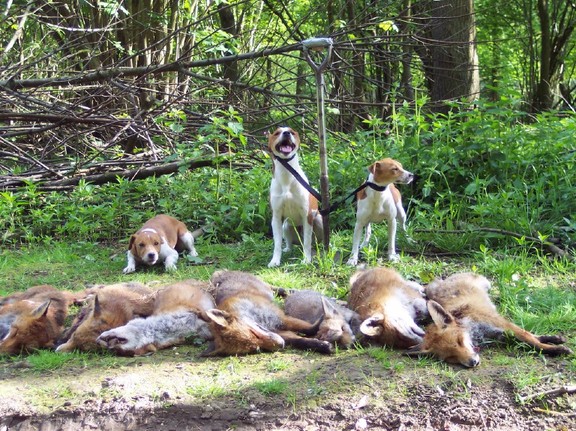
This extraordinary picture is from Sue Rothwell in the Outer Hebrides, and shows an enormous take of rabbits that were lamped at night and taken by well-trained lurchers. Though Sue raises Plummer Terriers and has Scottish Wildcats as well (the native wild cat of Scotland, which was nearly driven to extinction), I suspect rabbit is on the menu a few times a week! To read more about Sue's Plummer and Hancock-bred lurchers, see >> here.

The article below was bird-dogged for me by Steve who knows of my interest in such things -- thank you! It turns out that archeologists now think the rabbit was introduced to the UK by the Romans, rather than the Normans, giving new meaning to the old Latin phrase: Veni, vidi, vici ("we came, we saw, we conquered").

For more on the archeology of hunting, see the April 10th post on this topic.

The Daily Telegraph (London), April 14, 2005

Romans Introduced the Rabbit,
By David Sapsted

__________

Years of division among academics over whether the Romans or the Normans introduced rabbits into Britain appears to have been resolved.

An archaeological dig in Norfolk has uncovered the remains of a 2,000-year-old rabbit -- by far the oldest of its kind found on these shores and regarded as final proof that the creatures are now on the list of what the Romans ever did for us.

Many believed that the Normans introduced rabbits for their meat and fur.

However, others have always insisted that the creatures were brought in by the Romans, citing Marcus Terrentius Varro (116-27BC) who wrote that the legions brought rabbits from Spain, where they were reared in walled enclosures and then served up as a gourmet dish.

The remains were found at Lynford, near Thetford.

Jayne Bown, the manager of the Norfolk Archaeological Unit, which is conducting the dig, said yesterday: "We can date the rabbit to the first or second century AD from the pottery fragments found beside it. Some of these fragments included domestic pots which could have been used for cooking. "We could tell the bones had been butchered."