Showing posts with label chest size. Show all posts

Wednesday, August 4, 2010

A Question of Breed

This is a repost from October 2005


The quarry does not care what breed a dog is so long as it is doing the job.

Yet breeds do matter to humans for the simple reason that the more we know about breeds, and lines within breeds, the more likely we are to get a dog that is of real use to us in the field. There is always a chance we will get a dud, of course, but we can reduce that risk if we pick the right breed, select the right breeder, go slow, and use a modicum of common sense.

There are more than 28 types of terrier, but only six working breeds worth talking about, and even fewer worth considering if you are looking for a dog in America, as of this writing (2005).

There are two closely-related white breeds (the Jack Russell Terrier and the Plummer Terrier), two closely-related black breeds (the Patterdale Terrier and the Jagt Terrier), and two closely-related red breeds (the Border Terrier and the Fell Terrier).

Of these six breeds, only three are real options for U.S. earth work. Let us dispose of the generally unsuitable dogs first.

The Plummer Terrier is simply a color variant of the Jack Russell Terrier. I like the look of this dog, but in truth a good terrier does not come in a bad color, and breeding for coat markings has always been a dangerous thing.

The Plummer Terrier started off as a genetic mess — a point well documented by Brian Plummer himself. The good news is that thanks to culling and out-cross breeding, most of the serious genetic problems have been worked out of the gene pool.

The bad news is that a new problem has worked its way in: the dogs are generally too large, standing 13-15 inches tall, with 14- and 15-inch dogs very common.

Of course size is not a problem if you are ratting, which was Brian Plummer’s specialty and passion and mostly what the dogs are use for to this day. If you intend to dig to groundhog, raccoon, and fox in the U.S., however, a 14-inch dog is simply too big for our tight earths. The issue is moot, in any case; as of 2005, Plummer Terriers simply do not exist as a working terrier breed in this country.

The Jagt Terrier is another breed that fails the American working terrier size test. The Jagt Terrier was created in Germany in the 1930s with the idea of being an “all purpose” hunting terrier able to flush rabbits and wild boar from dense brush, retrieve shot birds, blood track gutshot deer, and go to ground on fox and badger.

Unfortunately, dogs are specialized for a reason, and the Jagt Terrier is, at best, a second choice in all of these tasks. When it comes to fox work, the standard for the Jagt Terriers (13" to 15" tall) calls for a dog that is simply too big for our tight American earths. There are some very small Jagts that do well, but the gene pool is dominated by larger dogs, and Jagts should only be considered, in my opinion, if it is a full-grown adult and significantly smaller than the standard.

The red Fell Terrier is a type of non-pedigree Lakeland Terrier found in the north of England. This dog would have much to recommend it if small versions of this breed could be found in the U.S. Unfortunately, as of 2005, there are only a handful of red fells in the U.S., and even fewer that are sized for our tight earths. If you can find a small dog, go for it, but the chances of locating such an animal are slim to none.

We now come to the three types of working terriers available in the U.S. which also have some hope of being the right size: the Border Terrier, the Patterdale Terrier, and the Jack Russell Terrier.

Border Terriers are wonderful dogs, but finding one that is the correct size and has a small chest is very difficult in the U.S. Few Kennel Club Border Terrier owners keep size records going back generations, and the chance of being able to select a small one out of a gene pool dominated by large dogs is about as likely a picking the trifecta at Belmont Raceway. The chance of finding one that has worked three types of quarry is close to zero.

Unfortunately, the other alternative — buying a small adult dog — is also virtually impossible as Border Terriers are not common in the U.S., and most dogs are placed as pups and never relinquished (hardly surprising after a sum of more than a $1000 has changed hands). As for finding a small adult working dog for sale -- forget it.

Border Terriers have wonderful winter coats, but these same coats tend to result in an overheated dog in summer when so much groundhog work is done. The dog that never gets cold in winter, simply flops over in summer heat.

Finally, it is worth mentioning that Border Terriers are, as a rule, slow to start. While a Jack Russell or Patterdale will usually start to work between 10 months and one year of age, Borders Terriers seem to start a full year later. There are exceptions to the rule, to be sure, but I have spent a fair amount of time around Border Terriers, and it’s best to plan on a late starter and be surprised than depend on an early starter, and be disappointed. Borders are not the “One Minute Rice” dogs so popular with young terrier enthusiasts today — one reason they may have experienced a decline in popularity in the field.

Patterdale Terriers are rapidly rising in popularity in the U.S. and they have much to commend them. Unfortunately, as Patterdales have grown in popularity, they have also grown in size. This is particularly true in America, I am afraid to say, where Patterdale Terriers have suffered a terrific genetic beating at the hands of young want-to-bes who have crossbred them with small pit bulls. Large numbers of these overlarge black dogs have been cranked out to be sold off on places like “Bay Dogs Online.” Here the ads read “will hunt anything.” “Has hunted nothing” is more likely the story. Pictures of chained out “yard dogs” may be offered at referring web sites, and dogs are sometimes swapped for auto parts or sold in groups by get-rich-quick failures who are now having “Kennel Reduction” sales.

Having raised a caution about size and breeders, it should be said that if you can find a nice small Patterdale, 12 inches tall or smaller, and with a nice tight chest of 14 inches or less, these dogs generally make exceptional workers. Caveat emptor, as with all terrier purchases, but if are flinty and properly focused on getting a small enough dog, you can do very well with a Patterdale.

Finally, we get to the Jack Russell Terrier. What a divergent mess of registries and types this breed has become! Some Jack Russellls have ears that are erect, some down, some are longer than they are tall, some are pure white, some are as parti-colored as a beagle. There are smooth coats, broken coats and dogs hairier that a Wookie straight out of Star Wars. A Jack Russell’s legs may be straight as sticks or as ornately curved as those of a Queen Anne bench. Its chest may be as small around as a lady’s bracelet, or as big around as a bowling ball.

How do you sort it out?

Simple: Get a dog registered with the Jack Russell Terrier Club of America, and accept no substitutes if you are looking for a working Jack Russell. Let is be said that I am not affiliated with the JRTCA in any way. I do not breed dogs, I do not show dogs, and I do not judge dogs. My reason for recommending the JRTCA is solely practical: The JRTCA records the size of dogs and also offers working certificates. The result is a documented track record of work and size that can be tracked across a five-generation pedigree. When you are looking for a working terrier, nothing is more valuable.

Buyer beware, of course. Most JRTCA dogs are show dogs or pets, and only about 5 percent hunt. The good news, is that with a JRTCA dog you can look through a pedigree and see whether there is a track record of work, and also ascertain the size of the dog’s dam, sire, grand-dam and grand-sire. With hundreds of well-documented working JRTCA dogs in America, the chance of finding an acceptable working terrier is higher in the JRTCA gene pool than anywhere else.
..

Thursday, July 22, 2010

My Teachers: Mountain, Sailor and Trooper


Two true workers.

Mountain and Sailor. Mountain, at left, is 12" tall. Sailor, at right, 11" tall.

You would not think a one inch difference in height (and about the same in chest size) would make a lot of difference in the field, but it does in our very tight earths.

On this day, these two dogs had worked raccoon, groundhog and possum. Once washed off, they were as good as new.

Sailor taught me most of what I know. She will never be forgotten.

Below is a picture, taken from above, of Trooper my 15" tall Border Terrier who recently went to the Great Kennel in the Sky, and Sailor, my 11" tall Jack Russell who preceeded him by a few years.

Both dogs are dead now, but in this picture they can still do a bit of teaching. Size is fundamental, and with true working terriers bigger is not better.


.

Wednesday, May 5, 2010

The Limits of Flexibile Chests


Apologists for over large terriers will sometimes argue that their animals have flexible chests and a great deal of desire, and can "eventually get there".

Perhaps, but some skepticism is in order.

Yes a flexible chest is important, but only at the margins of correct size. If a dog has a 17 inch chest, it is not going to find 3 inches of flex in its rib cage. Nothing is more plastic than water, but you cannot put a gallon of water in a pint bottle, no matter how hard you pound!

Desire and gameness is important, of course, but if a dog is too large for the earth, it is not going to be able to excavate a 20 foot length of pipe to get to its groundhog, fox or raccoon.

Dogs at the very margin of correct size in youth, are likely to be less useful as old age (and perhaps pregnancy and added weight) result in the chest springing out a little more and getting stiffer as well.

Start with a dog that has a chest under 14 inches, and you will never regret it.
.

Thursday, April 15, 2010

Terriers at the Tar Pit


Dogs from the early 1980s were decidedly smaller than the Plummers seen today.

Like all working terriers, a Plummer Terrier is a composite animal. The Plummer is made mostly out of Jack Russell, with a strong dash of beagle (added for nose, voice and coat color), and bull terrier (added for toughness and head size). A fell terrier was mixed in to improve the overall appearance.

This strain of terriers, first created by Brian Plummer in the late 1970s and 80s, started out -- by Plummer's own admission -- as genetic wrecks with shot jaws, an ugly appearance, foul tempers, and a tendency to be mute.

For anyone with a lick of sense, a caution flag should now pop up: Who in their right mind begins to breed from such a canine mess?

Brian Plummer did.

After a long period of outbreeding and culling, obvious genetic problems were worked out of the breed, but a new problem worked its way in -- today's dogs are often too big for truly tight underground work. Perhaps that is not a problem if you are developing a dog just for ratting, but was a new ratting dog actually needed?

In fact, is any new terrier breed needed? Is it too much to ask people to simply preserve and work the terrier breeds we already have?

It is not a question Plummer asked, and now the point is moot. The dog that has been created is attractive, and they certainly have their fans. The question now is whether the breed will make it as a worker among workers, will remain a generalized ratting terrier, or will be pulled into the Kennel Club to be little more than another show-ring trotter.

If salvation is to be had, it is in the hands of those few genuine diggers and dedicated ratters that are trying to size down the breed and keep it working (to one thing or another) on a regular basis. A proper nod to such people -- they certainly exist even if there are not too many of them.

If doom is to rear its head, it is in the form of internecine rivalries between breed clubs, hump-and-dump breeders, and rosette chasers that do not work their own dogs.

In fact, this is a threat to all working dogs of all breeds, and the Plummer terrier is no different.

As for Brian Plummer himself, he is dead, and presumably not too concerned with critics of his dogs, his books, or himself.

His books live on, and continue to be very fun reads, and deserve their spot in the lexicon of terrier literature.

They are certainly no worse than any others, and quite a bit better than most.

There seems to be universal agreement that Brian Plummer himself was a little odd. He liked to bait others into intemperance, and he was known to lift stories from others and present them as his own. He wrote an entire book, under a pseudonym, in which he variously quoted and criticized his own books -- a decidedly odd thing to do.

Plummer suffered from both depression (a true illness) and very marginal finances, and cranked out Cavalier King Charles Spaniels for cash even as he dabbled in recreating "lost" breeds like the Lucas Terrier and the Alaunt -- breeds that had slid into extinction in generations past because they no longer had a rational reason for existence or preservation. Today Plummer's "Lucas Terrier" is a scruffy show ring dog, while his "Alaunt" appears to be little more than a variation of the pig-working pitbull so common in the American South.

While he was alive, Plummer was drowning in dogs -- Bearded Collies, Alaunts, Lurchers, Plummer Terriers, Cavalier King Charles Spaniels, fell terriers, and White German Shepherds, to name just a few. He could not possibly have had time to work so many dogs, and those who visited his kennels reported they were often in a disgraceful state of upkeep.

That said, Plummer's books and dogs remain. Plummer terriers continue to rat and even work fox to ground if placed in the right hands.

The fact that some dogs do indeed work to ground seems to cause some distress to people that despised the man for his pretensions and slights. The fact that relatively few dogs work to ground, is similarly distressing to the other side. No matter. The dogs are what they are, same as the books.

The trouble ahead for the Plummer terrier appears to be a rush, by a foolish few, to usher the Plummer terrier into the tar pit of the Kennel Club, from which no other working breed has ever emerged intact and still working.

Tar pits look benign -- cool water tends to pool on top -- but nothing has ever come out of them but bones.

In the case of the Kennel Club, what has emerged, time and time again, are exaggerated dogs devoid of working instinct, nose, and common sense, with coats inappropriate for the job, and skeletal structures that are often inadequate for a day in the field.

No one who courses dogs looks to a Kennel Club dog to do the job, and the same is true for working sled dogs, herding dogs, cart dogs, pointers, setters, and retrievers.

Terriers are not an exception to the rule.

The key and recurring problem with working terriers drawn into the Kennel Club-- from Fox terriers to Sealyhams, Borders, Jack ("Parson") Russells to Fell ("Welsh") Terriers -- is size.

Why do working terrier breeds always seem to get too big in the chest after being listed on Kennel Club roles?

The answer is to be found in an inherent defect of the show ring, and a basic understanding of canine anatomy.

The essential elements of a working terrier are small chest size, strong prey-drive, a loud voice, a sensitive nose, and a clever kind of problem-solving intelligence.

Aside from size, none of these attributes can be judged at ringside.

In a judging field of 20 or 30 dogs, a selection filter of size alone does not provide the gradients required to articulate a reason for choosing a single dog or bitch as a winner.

The breed club solution has been to generate pages of cosmetic criteria which effectively devalue the only important attribute of a working terrier that can be judged in the ring — a small chest.

And it is no small matter that chest size is defined rather vaguely -- the span of a man's hand. Whose hand? Wilt Chamberlain's? In a world of micrometers, surely there is solid research on the true size of fox chests all over the world? Yet it is not used, because Kennel Club pretenders with hulking dogs find it easier to breed good-looking large dogs than small well-proportioned working dogs.

In the Kennel Club, head size and shape are deemed to be very important by theorists who assign a great number of points to this feature (see the Border Terrier for an example). It is head shape, after all, that gives each breed its distinctive look. It is the head that faces the quarry in the hole.

Surely the shape and size of a terrier's head is important?

In fact, when it comes to working terriers, head shape is only important to the extent that it leaves space for brains, produces a strong enough jaw to grip, and allows for unobstructed breathing.

Most crossbred mongrel terriers have heads shaped well enough to do the job.

As for size, in the world of working terriers, a bigger head is not necessarily better -- a point that is often overlooked by theorists who have spent far more time listening to show ring judges than they have their own dogs working their way through a tight den pipe.

Larger heads tend to be attached to larger chests — the latter being necessary to support the former. When terriers are bred for the "bully heads" that Kennel Club judges favor, the resulting dog is often large-chested as well.

It does not take too much gain in the chest for a dog to have quickly diminishing use in the field -- a point easily overlooked if you spend more hours at shows than you do with a shovel in the field.

Paths to destruction are often well-worn. The Plummer terrier is apparently sliding straight down the Kennel Club chute that so many other terrier breeds have gone down before.

The current rage is now to "out cross" Plummer terriers with bull terriers in order to "improve" and "strengthen" the head, which a few show ring breeders claim has grown "snipey."

Whatever.

It is their dog to breed and do with as they see fit. Each to his or her own, etc.

The fact that terrier breed after terrier breed has fallen into the Kennel Club trap of exaggerated heads and overlarge chests will not stop others from following on, any more than the predicament of a trapped Mastodon at the La Brea tar pits served as a warning to the Dire Wolf and Saber Tooth that followed.

Will the entire breed disappear into the tar pit? Time will tell. The tar is cunning, powerful and above all patient. It waits. Time will tell if it is fed.


A dire wolf and a saber tooth at the tar pit. "It looked like a good idea at the time."
.
This post is recycled from April 2006.

Tuesday, February 16, 2010

Scotties: The Working Dog That Never Was


Scottish Terrier Club of America, 1915

Most people do not know that the Cairn Terrier, the West Highland White and the Scottie were considered the same breed of dog until the last two decades of the 19th Century. As late as 1900 it was said that these three "breeds" could, in fact, be found in the same litter.

Until the last decade of the 19th Century, the term "Scottish terrier" was less of a description of a specific breed of dog than it was a geographical suggestion of where a wide array of dogs was said to originate from.

Within the "Scottish terrier" umbrella, were Cairns, Westies, Skye, and "Aberdeen" terriers. It was this last dog that was transformed into the "Scottie" we know today.

The Scottish Terrier was registered by the American Kennel Club in 1885 and the first "Scottish Terrier Club" was created in England in 1887, and in Scotland in 1888.

Yes, those dates are correct -- the Scottish terrier breed name was recognized in the U.S. before England, and in England before Scotland. Clearly this was a breed made in the ring and not in the ground!

In fact, it was not until 1917 that the Kennel Club of Great Britain prohibited interbreeding between Scotties, Westies and Cairns -- the first step toward true breed recognition.

By 1917 few Scotties were being worked, and for a very simple reason: the dogs were too big.

Today's breed description for the Scottie is of a dog with a chest that is "very deep & broad" -- the exact opposite of what one wants in a working terrier!

Due to large heads, enormous chests, and excessive body weight, many of today's Scotties are born Cesarean. It is hard to imagine a clearer indication of how much show-ring breeders have distorted this dog to the point of ruination.

This post is recycled from February of 2009.
.

Saturday, May 9, 2009

Tales of Terriers Too Big

I have been doing a LOT of reading of old books and have come away with one general observation: Mounted fox hunting does not have much to do with terrier work!

A 50-year history of the Grafton Hunt (published in 1900) mentions a terrier only once, and just in passing!

So what is this book about? People long dead that no one cared about even when they were alive!

A close reading of dozens of other books on mounted fox hunting finds little mention of either terriers or hounds and, as a group, they can all be flushed with few exceptions. I will talk about the exceptions in later posts.

For now, let me mention one book, written in 1826, and entitled "Observations on Fox-hunting and the Management of Hounds in the Kennel and the Field, Addressed to Young Sportsman, about to Undertake a Hunting Establishment." Here we find two short tales of terriers.

With regard to the use of Terriers in the field; — they are no doubt sometimes of service, particularly when Foxes use drains, but if they are not perfectly steady, they will do a great deal of mischief. They should invariably be entered with the young hounds, and always be kept in the kennel.

As a matter of curiosity, I here give you an instance or two of the extraordinary length of time terriers will exist without food; one occurred the other day. I was staying at a friend's house in Hertfordshire, who had lost a favourite terrier seven days: on going out to look at his sporting dogs near the house, he thought he heard the voice of his lost dog. He recollected the last time it was seen was near the mouth of a drain, upwards of two hundred yards from the spot from whence the sound came. He immediately ordered his workmen to open the drain, and they found the terrier jammed in a narrow part of it ; the animal appeared lively, and not the worse for her long fasting, except being a little reduced in flesh, and the next day very lethargic.

I heard at the same time a still more extraordinary instance of a terrier remaining in an earth for twenty days, and I dare venture to vouch for the truth of it. The Hatfield hounds had run a Fox to ground, and the terrier followed it in. They dug many hours without coming up to the fox or the dog ; and at last were obliged to give it up as a hopeless job. The terrier was the property of old Joe, the then whipper-in, and a great favourite. He therefore had the earth watched, and on the twentieth day the dog crawled out a mere skeleton, but with proper attention was recovered.


A small observation: The use of over-large terriers has been normalized in the U.K. by the presence of many land drains and the large number of badger earths which a fox can use to get to ground.

An over-larger terrier in a branching drain system, of course, is a problem, as a fox with a 14" chest span can slide into a 9" pipe with ease, and then quite easily slide down a 6" pipe that branches off it.

The too-large terrier, of course, will be fine in a 9" drain, but in the 6" inch drain into which the fox has entered, things are going to be very tight, and for the terrier getting stuck is very likely.

Today, of course, we have electronic terrier locator collars, but in 1824 there was no such thing. The best you could do was drive a bar into the ground, put a cup to the bar, and listen. If the dog was 20 feet away and still shallow, you might get a read, but if it was 40 yards away away, and running deep, you were out of luck and so was the dog.

For more on the problems that come with over-reliance on large drains and artificial earths, see Out of the Ring and Into the Den and Artificial Dens, Big Dogs and Fair Chase.

.

.

Sunday, April 13, 2008

Fox Size Around the World


The above table is from Paolo Cavallini's paper entitled "Variation in the Body Size of the Red Fox," which was printed in the December 1995 edition of Ann. Zoological Fennici, in Helsinki, Finland.

Dr. Cavallini's paper includes data on the size of red fox from all over the world (Australia, Italy, Jordan, Spain, Switzerland, several states in the USA, several regions within Scotland, several regions within England, the Netherlands, Denmark, Norway, Wales, Ireland, and East Germany).

In all the countries and regions listed, the number of fox measured was greater than 10 for each sex, while 300 were measured in Italy alone. In short, Dr. Cavallini's global data set totals well over 700 weighed fox.

What did Dr. Cavalini discover about fox weight? For one, he found that across the globe the average male (dog) fox weighs just 13.85 pounds, while the average vixen weighs just 11.60 pounds.

The heaviest fox came from a subsection of Scotland where the average adult dog fox weighed 16.09 pounds, while the heaviest average vixen from the same area weighed 13.7 pounds.

Dr. Cavallini provides detailed information about the 300 Italian foxes weighed and measured. The heaviest dog fox in this sample weighed 17.97 pounds, while the lightest vixen weighed 7.16 pounds, and the average fox weight was 12.01 pounds and the average chest size was 14.13 inches for males and 13.27 inches for females.

Dr. Cavallini's research concludes that "body size of the red fox may be variable even within a small area," but also suggests that the average red fox, wherever it is found in the world, is a much smaller animal than commonly believed, and that even in the regions with notably "big" fox, the average fox weighs only between 13.7 and 16 pounds.
.

Sunday, March 2, 2008

Canine Achondroplastic Dwarves


A "puddin'" Jack Russell is a dog that is an achondroplastic dwarf. The clear visual signs of this genetic condition are a large chest on short, benched or "Queen Anne" legs. These dogs are also referred to as "shorties" by some people, and as "Irish Jacks" by others.

An achondroplastic dwarf is an animal that cannot run as fast as a well built dog, and it's chest will often be too large for it to go to ground, no matter how much they have "the fire called desire."

Achondroplastic dwarfs are not smaller dogs -- they are almost always larger in the only way that really counts when hunting, which is chest size.

Though an achondroplastic dwarf terrier may be only 10 inches tall, it may be anywhere from 15 to 20 pounds in weight due to the huge chest, big bones, and large head.

Breeds commonly associated with achondroplastic dwarfism are basset hounds, dachshunds, shih-tzus, pekingese, sharpeis and English and French bulldogs. These dog always have limbs that are shorter than their body and often have over-large heads as well.

Achondroplastic dwarfism is a genetic defect and should not be perpetuated. This is not "just another type of small dog" -- this is a dog with non-proportional limbs and very clear symptoms caused by a genetic defect.. "Achondroplasia" literally means "an absence of good shape" and refers to a distortion of the legs (as in the Dachshund and Jack Russell) or head (as in the English Bulldog). Achonodroplasia is associated with back problems, weight problems, and patella problems, as the short legs make it more difficult for the dogs to run, while any added weight further compromises an already unsound skeletal system.

Some ill-informed breeders are intentionally breeding achondroplastic dwarf dogs because they think they are "cute." This is a very bad turn of events, as it simply increases the genetic load on all dogs. The UKC dogs being bred as "Russell Terriers" are often (though not always) achondroplastic dwarves.

A "puddin" Jack Russell terrier does NOT have a different nature or temperament than a regular Jack Russell terrier; they are just as likely to be a cat chaser, hamster killer, and back-yard garden digger, and will do just as poorly in a home where training, exercises, and physical activity is not provided. The defective gene that causes achondroplastic dwarfism is not tied to temperament or personality in any way, shape or form.

Puddin Jack Russell terriers are generally happy and active dogs that seem to enjoy life and they, in turn, should be enjoyed and loved. Please do not breed more achondroplastic dwarfs, however. There are more than enough Jack Russell Terriers in the world looking for pet homes right now. The world does not need more "cute" dogs and it does not need more dogs with genetic problems. Every day perfectly wonderful and cute dogs are being put down in shelters across the U.S., and their only crime is that they are not a puppies.

If you are looking for a pet Jack Russell terrier, the place to start is with Russell Rescue.
.

Sunday, February 3, 2008

Cracking Tired Chestnuts About Form and Function


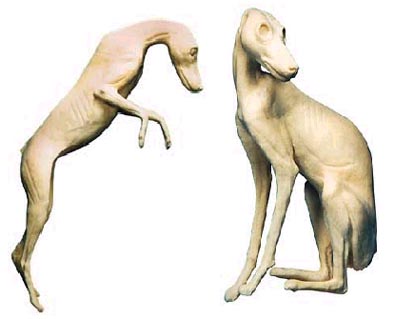
Red fox taxidermy mannequins. There is no red fox taxidermy mannequin anywhere in the world that has a chest span of greater than 14 inches.


At the side of every show ring, there is always some well-dressed individual talking about "the standard" and how "form follows function."

It all sounds good, of course -- wonderful rhetorical chestnuts -- but it's pretty much nonsense.

I mean think about it. A working dachshund is a great little animal in the field and does the same work as a terrier, but it does not look like a terrier, does it?

By the same token, a Patterdale Terrier does not look too much like a Jack Russell, which does not look too much like a Border Terrier. Smooth coats and rough do equally well in the field, as do coats of black or white, red or brown, or any combination in between. A folded ear is the same as a prick ear, a black nose the same as a liver-colored nose. Every working earth dog breed has a different head shape, and many have different tails as well. A perfect scissors bite is not necessary for work.

So when people say "form follows function," what the hell are they talking about?

Let us hope they are not talking about movement. Movement is one of those words show people toss around with a wink and a nod as if they have the secret knowledge of a wine connoisseur.

It is pure bunk. "Movement" may be important to a greyhound, a pulling dog, or even a border collie, but it is not much of a concern as it relates to a working terrier. So long as a dog can walk well, and has decent muscle mass, it can work fine. Hocks in or out hardly matters a whit.

Which is not to say that movement is irrelevant to terrier work. In fact, it is critical. But the important movement is .... wait for it .... an owner that will move off the couch, and move out of the car, and move into a hedgerow, and move a lot of dirt while digging down to a dog that is in full voice with rising adrenaline. That's the only important part of movement that matters. After you have done that a few dozen times, you will know a little more about movement, and terriers in particular.

We hear a great deal of nodding nonsense from folks who talk a good game about "protecting" their breed. But protect it from what? And by what right or qualification do these people think they are particularly well chosen to protect the bred? And what do they intend to protect it with?

In almost every case they are people who do not dig, and who seek to "protect" the terrier with nothing but a scrap of paper proclaiming a show dog "up to the standard."

And who do these people hope to protect the breed from? Why, show ring breeders, of course!

It is all laughable nonsense. And it becomes nonsense on stilts when people begin to talk about "the standard" as if it were a sacred text delivered to Moses on the Mount.

In fact, is there anything standard about "the standard?" I defy you to find a single canine standard that is more than 20 years old that has not been changed at least once.

And then there is the little matter that the standard is not the same from one country to another, or one registry to another. So what is so "standard" about the standard?

Ironically, what is NOT part of any standard in the UK or the US, is a requirement that the dog actually be a proven worker in the field. That, apparently is not "the standard." That function is not required for the rosette. A black nose, is a "Yes," but working a dozen fox, raccoon, badger, or groundhog in the field, is a "No."

The one issue of any importance in "the standard" as it relates to "form follows function," is chest size. Yet on this point, "the standard" is awfully vague, isn't it?

We are told a chest span is a man's hands. Yes, but whose hands? We do not measure a house in cubits, so why are we measuring dogs in "hand spans"? Who but the puppy peddler profits by keeping chest measurements this vague?

The Germans are not so coy and facile about chest size. A standard working dachshund (a "Teckel" in German) has a chest of just under 14 inches. The measurement is precise -- 35 cm -- and it reflects the chest size of the average red fox. The Germans are not ones to shave dice when it comes to working dogs.

It is interesing that the same 14" chest size is named not only by fox biologists, but also by such terriermen as Barry Jones, Ken James, and Eddie Chapman. In fact, if any one thing separates the digger from the rosette chaser, it's clarity on chest size.

The rosette chaser is always a bit vague about what a "span" actually means. A digger knows it means his fingers better well overlap, and if he is working fox in a natural fox-dug earth, it is best if his fingers overlap by more than one joint!

And so we come back to the real meaning of "form follows function" as used by academics in the dog world.

For these folks the "form" being refered to seems to be a paper form showing the pedigree of the animal being displayed. And "the function" is either the rosette from a show judge, or the cash to be gotten from a prospective dog-buyer.

Form follows function, indeed!

.

Friday, November 23, 2007

Form for Function: Span Quarry, Not Just Dogs


Spanning a small-to-average groundhog. Notice how long a groundhog body can get when stretched under its own weight. These things are built like sacks of water.

This groundhog spans to the spot on my thumbs where I want a dog to span to. If my thumbs do not overlap all or most of the first joint, the dog is too big to easily get into most earths in the Eastern U.S.

I look for dogs with chests of 14 inches or less, and recommend that people who are serious about hunting their dogs do not compromise on this all-important point.

Remember that as a dog gets older, it's chest will generally spring out a bit and sometimes it gets less flexible too. A dog that is marginal for size at one year of age is only going to get bigger in the chest as time goes on. You want a dog that can hunt well past age six or seven, right? Then get a smaller dog.

But aren't fox bigger? Nope -- not really. It says quite a lot that the largest red fox taxidermy mannequin in the world has a 14" chest, while some are sold with chests as small as 11 inches.

A fox is not built like a dog; it is built like a cat and underneath all that fur, it has the body shape of a small whippet.
.

Monday, September 3, 2007

The Real Jack Russell Terrier: A Complete History


Sawrey Gilpin, A Huntsman with Hounds Foxhunting


I got a call earlier this week from someone trying to assemble (or dissect) the history of how the U.K. Kennel Club (i.e. The Kennel Club) managed to add the "Parson Russell Terrier" to its roles approximately 100 years after the Reverend John Russell himself had died.

Good question!

Well, first of all, let's ground ourselves in a few basics (and reality) just a little bit.

The first point is that white fox-working terriers predate the Reverend John Russell. Remember that the young Russell bought Trump from a milkman who had her tied to a string tied to his cart. Or so the legend goes.

The picture, at top, is by painter Sawrey Gilpin, who was born in Cumbria in 1722, and died in 1803, some years before the Reverend John Russell ever acquired his famous first terrier, Trump. Gilpin was a painter that specialize in painting animals, particularly horses, cattle and dogs.

I bring this up, not only to show that riding hounds to fox was already being practiced before John Russell arrived on the scene, but to point out the little dog, to the right, that is featured in another Gilpin painting.

The dog in this picture is a terrier by the name of "Pitch," who was owned by Colonel Thornton.

The painting was done in 1790, and you will note that this is the very model of the (undocked) white fox-working terrier we know today as the Jack Russell Terrier, complete with spot above the tail, and split-head markings.

Let us also remember that not only did Russell buy the bitch without ever seeing her work, he seemed to have no trouble finding another suitable white-bodied fox-working terrier to mate her with.

In fact, this rather cavalier pickup of dogs seems to have been Russell's way of doing business his whole life. His financial fortunes were such that he had to sell off his hounds several times, and the notion that he kept a strain of line-bred terriers descended from Trump is nonsense -- he took dogs as offered, kept them if they worked, and moved them along as needed -- and money was certainly a pressing need throughout much of Russell's life.

No doubt Russell tried to breed the best dogs he could find, but in those early days of the mounted hunts, dogs were a practical matter. In the era before dog shows, telephones and the Internet, there was no fame or fortune in to be found in working terriers.

Most of what is said about Russell's dogs is pure nonsense. The famous picture of Trump, for example, was painted more than 40 year after the dog had died, and it was painted by someone that had never seen the original animal at all. Russell said the painting was “a good likeness” but in fact he may have been trying to be polite, as the painting was commissioned by Edward VII (then Prince of Wales) who befriended Russell in his old age, and had the painting done as an homage to the old man (it hangs today at Sandringham).

Russell's real claim to fame is that he had the good fortune of living his entire life during the period in which mounted fox hunting became popularized in the U.K. Though primarily a houndsman, Russell had a fondness for terriers, as did his wife Penelope (a picture of her with a terrier is at right), and his terriers were known to be generally good workers of the right sort.

Russell had been hunting with terriers for about 40 years when the first dog show in Great Britain was held in 1859. That same year, Charles Darwin's book "The Origin of Species" was published.

It should be said that Darwin's famous book and dogs shows themselves have a common root stock -- the agricultural stock shows that began with Robert Bakewell at the very end of the 18th Century.

Prior to Bakewell, animals were free to chose their own mates. Bakewell was the first person to show that by selecting and controlling for sires (through fencing, or enclosure) breeds of farm stock could be rapidly improved or even created.

It was Bakewell's work with sire selection and controlled breeding of farm stock which Erasmus Darwin -- Charles Darwin's father -- pointed out to his son as perhaps being a driving force in the shaping of the natural world.

With publication of The Origin of Species in 1859, Victorian England became besotted by natural history studies. Massive bird egg, butterfly and beetle collections were started, and keeping a small menagerie of exotic birds was far from uncommon.

Dogs, of course, were always the thing to own, and this natural trend was perhaps tweaked by Queen Victoria who herself was an avid dog collector, and whose approval of the Society to Prevent Cruelty to Animals transformed it from the SPCA to the RSPCA.

Darwin's work and theories were expanded upon by his cousin, Sir Francis Galton. Galton was the founder of the modern field of statistics, the inventor of fingerprint identification, and the creator of the first silent dog whistle. More importantly to this discussion, he was also the founder of study and experimentation we know as eugenics.

Galton's eugenics theories argued that species and breeds could be created and improved upon ad nauseum by selecting for defined characteristics.

To put it simply, this was Darwin' theory of evolution put into hyper-drive. The notion that overly close or tight breeding might result in a rise in inherited defects or seriously deficient animals was unimagined; evolution was thought to be a one-way street, and by breeding "best to the best," man would simply improve and speed up what Mother Nature had already started.

That was the theory.

It was a theory warmly embraced by The Kennel Club, which was founded in 1873, and which was deeply influenced by Galton's work.

The Kennel Club's thesis was a simple one: Create a visual standard for a breed, accept into a closed registry only those dogs that conformed to that standard, and then encourage the breeding of "the best to the best" of these "pure bred" dogs through a program of prize-awarding conformation shows.

Like most new organizations, The Kennel Club began on somewhat shaky legs, and sought to promote itself by trying to associate itself with "names" and money as quickly as possible. The Reverend John Russell had no money, but at age 78 he was one of the grand old men of mounted fox hunting, and well-loved by all. Who better than Russell to judge the fox terrier class at one of the first dogs shows?

Russell was no doubt flattered by The Kennel Club's solicitous offer, and he warmly agreed to judge the Crystal Palace show. Very old, and quite broken financially, Russell had been forced to give up his hounds two years earlier (1871). Perhaps here was a way to keep a hand in with the dogs? Apparently, however, Russell did not much like what he saw in The Kennel Club ring, for he never agreed to judge a Kennel Club show again, and he refused to let his own dogs be registered.

Later, Russell described the Kennel Club terriers he saw as being a bit like hot house roses: "True terriers [my own dogs] were, but differing from the present show dogs as the wild eglantine differs from a garden rose."


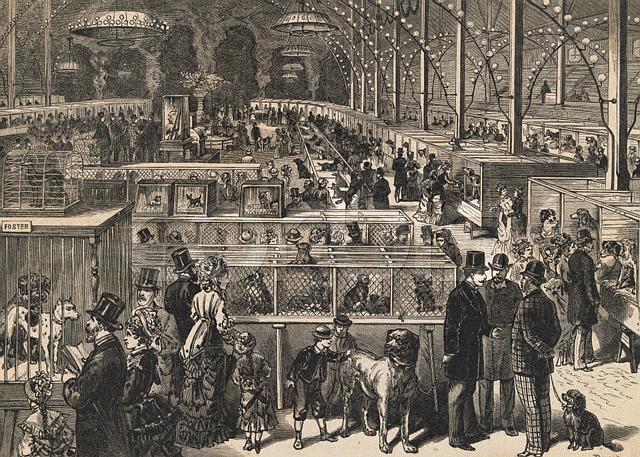
1877 dog show


In 1883, John Russell died at the age of 88. After his funeral, the few remaining dogs he had with him at Black Torrington (four very old terriers by the name of "Rags", "Sly", "Fuss" and "Tinker") were given away.

On the day of his funeral, his old sermons and other papers were found blowing around in the farm yard. Little or no self-authored record of Reverend John Russell survives to the present day.

In 1893, Rawdon Lee, Kennel Editor of "The Field" magazine, published Modern Dogs and noted the absence of Devon terriers on the show ring bench:


"There appears a semblance of strangeness that the wire-haired terriers from Devonshire have not been more used for show bench purposes, and by all accounts some of them were as good in looks as they had on many occasions proved in deeds. Those owned by the Rev. John Russell acquired a world-wide reputation, yet we look in vain for many remnants of the strain in the Stud Books, and the county of broad acres [the north] has once again distanced the southern one in the race for money. But, although the generous clerical sportsman occasionally consented to judge terriers at some of the local shows in the West, he was not much of a believer in such exhibitions. So far as dogs, and horses too, were concerned, with him it was 'handsome is that handsome does,' and so long as it did its work properly, one short leg and three long ones was no eye-sore in any terrier by the late Rev. John Russell."

Lee went on to note that the best working dogs, even in his day, were not found in the Kennel Club:


"As a matter of fact, those [terriers] best adapted for hard work either with foxhounds or otterhounds are cross-bred, hardy dogs, specially trained for the purpose, although many of the 'pedigree' animals will do similar duty to the best of their ability, but their 'pedigree' and no doubt inbreeding to a certain extent, has made them constitutionally and generally weaker than their less blue-blooded cousins."

Finally, to put a cap on it, Lee wrote:


"I have known a man act as a judge of fox terriers who had never bred one in his life, had never seen a fox in front of hounds, had never seen a terrier go to ground ... had not even seen a terrier chase a rabbit."

Only 20 years had passed since the founding of The Kennel Club, but already the death knell was being sounded for the fox terrier.

How was this possible? The short answer is that at the time Rawdon Lee was writing, The Kennel Club was undergoing a "terrier craze."

Why was this? One can only guess, but I would venture to say that terriers then, as now, fit both practical and psychological needs.

On the practical side, they are small, easy-to-keep dogs. On the psychological side, they are active dogs and not too "girly" for a man or active woman to own.

Fox terriers, in particular, have a pretension to field sports about them, and they particularly appealed to those that sought to associate themselves with the money, romance and aristocracy of the mounted hunts.

In fact, the first breed-specific publication was the Fox Terrier Chronicle, which tracked the comings and goings of Kennel Club shows as if they were High Society.

Special dog shows were started just to showcase terriers, and in 1886, a dog food salesman by the name of Charles Cruft took over the Allied Terrier Club Show at the Royal Aquarium at Westminster, with an eye towards making it a cash venture. This terrier show became the first formal Cruft's Show" when it was booked into the Royal Agricultural Hall, Islington in 1891.

In 1884, the American Kennel Club was started, and the terrier craze that had begun in the U.K. swept into the United States as well. Some small indication of this strength of this craze suggested by looking at the history of the Westminster Dog Show which awarded its first "best in show" award in 1907. The first winner was a fox terrier. A fox terrier won again in 1908, 1909, 1910, 1911, 1915, 1916, and 1917.

It was into this terrier-besotted world that Arthur Heinemann stepped -- a young man with an interest in badger digging. Heinemann was born in 1871, the year that John Russell gave up his hounds for the last time, and he was only 12 year old when the Reverend John Russell died.

Heinemann became interested in badger digging when he was in his 20s, and in 1894, he create the Devon and Somerset Badger Digging Club -- a small regional club composed of similar like-minded friends.

Where did Heinemann get his dogs? Not from John Russell.

As noted earlier, Russell gave up hunting the year Heinemann was born, and he died when Heinemann was only 12 years old. Heinemann and Russell never met.

Getting a working terrier was not much of a problem in any case. As noted earlier, white-bodied fox-working dogs were far from uncommon even in Russell's youth, and by the 1880s they were a fixture in the Kennel Club and cross-bred types were to be found all over the countryside.

As noted earlier, Russell himself did not keep a pure line of dogs, and was a bit of a dog dealer himself. By the time of Russell's death, almost anyone could have said they owned a dog descended from Russell's stock. Since Russell did not register his own dogs, and no pedigree charts survived his death (if they existed at all), who was to say otherwise? Anyone that wanted to make a claim that they had dogs descended from John Russell was free to do so -- and a few did so.

One of those people was Annie Rawl Harris, who was Kennelmaid to Squire Nicholas Snow of Oare and a relative of Will Rawl, John Russell's kennel man.

Did Annie Harris have direct descendants of John Russell's dogs? Of course. Who didn't?

As Dan Russell (the pen name of Exmoor hunt terrierman Gerald Jones) once observed in an interview with Eddie Chapman,


"John Russell was very much a dog dealer, as well as a breeder. He would buy or scrounge any terrier he thought looked like work, make it and sell it on. He always went each year to Scorrier House in Cornwall for a stay. They had their own strain of Fox Terrier there called the Scorrier terrier, which was reputed to be bred pure for over 200 years, and on leaving he would take on any terriers they didn't want."

And so we come to it: Not only were John Russell's type of dogs not unique to the Parson, he was not shy about selling them off and buying more terrier stock to breed back in. Any small white-bodied dog in the West Country could claim (perhaps legitimately) that it was descended from John Russell's own dogs.

Perhaps here is a good time to point out that Arthur Heinemann's terrier club was called the Devon and Somerset Badger Digging Club. His hound pack (acquired in 1902) was the Cheriton Otterhounds.

Badger. Otter.

The point here is that Heinemann was not chasing fox -- he was digging badger with terriers, and chasing otters with hounds and terriers. This is a point glossed over by some, but it is not insignificant, as chest size is far less of a concern when working badger and otter, than it is with fox.

In any case, in 1914 the Devon and Somerset Badger Digging Club changed its name to "The Parson Russell Terrier Club."

Why the name change? Well, to be blunt, and to use the words of his friend Dan Russell (aka Gerald Jones), Heinemann was a bit of a dog dealer who “sold a hell of a lot of dogs," both in the U.K. and overseas. He and his friend Annie Rawl Harris found that if they branded and sold their dogs as "Jack Russell Terriers" they sold better.

Why did they sell better? Well, to put it simply, no one wanted a Kennel Club Fox Terrier!

As Rawdon Lee had observed, the best working terriers were not Kennel Club dogs -- they were cross-bred dogs or dogs that were found far outside of the show ring. While the Reverend John Russell had called his own dogs fox terriers, and Rawdon Lee was still calling them fox terriers 10 years after Russell's death, by the turn of the Twentieth Century, a new name for working dogs was needed.

And that name was NOT the "Parson Russell" Terrier." It was the "Jack Russell" terrier. That was what Robert Leighton called them in his 1910 book, Dogs and All About Them, and it was the term increasingly being used in the working terrier community as well.

For evidence of this we need only turn to Jocelyn Lucas's Hunt and Working Terriers, written between 1927 and 1930, and published in 1931.

At the back of this book, Lucas lists more than 100 mounted hunts in the U.K. and details the types of terriers they themselves say they used in the field.

This was a period when the name of the dog was in transition. I say transition, because the word "fox terrier" is used in the list about as much as "Jack Russell," and other phrases appear as well, such as "white hunt terriers" and "Devonshire working terrier." In a listing of over 100 mounted hunts, however, not one claims to be working a "Parson Russell Terrier," and most of the time the word "fox terrier" is carefully proceeded by the words "cross," "cross bred," "non-pedigree," or even "mongrel."

In short, whatever a working terrier was been called in Heinemann's era, it was never called a "Parson Russell Terrier." The confusion arises, perhaps because Heinemann's badger digging Club was renamed, in 1912, the Parson Russell Terrier Badger Digging Club. The dog, however, was always called a Jack Russell Terrier. A club is not a dog.

Arthur Heinemann died in 1930 from pneumonia after coursing his lurchers in the rain (and falling through the ice on a pond), but Annie Rawl Harris continued selling Jack Russells and maintained the Parson Russell Terrier Club until it dissolved just before the Second World War.

Again, to quote Dan Russell from his own book Jack Russell and His Terriers:


"[Mrs. Harris] very quickly took the place of Heinemann as the arbiter of the Russell type terriers and she carried on breeding the type of terrier Heinemann had loved. In her heyday, she had some 50 puppies out to walk each year. She sent her stock all over the world. Her method of breeding was to use only dogs and bitches of proven gameness."

After War World War II, England seemed to get along perfectly fine without a Parson Russell Terrier Club. In fact, the 1950s, 60s and 70s were the Golden Age of terrier work in the U.K., as the weekend was invented (a product of the union movement), and it was now easier to get out to the countryside than ever before.


Add into the equation was the rise of distemper vaccines which prevented massive kennel loss, and the advent of antibiotics which helped prevent occassional gashes and wounds from getting infected, and it was truly the best of times.

Though myxomatosis arrived in the 1950s and devastated many ancient rabbit warrens throughout the U.K, the decline in rabbit populations was offset somewhat by a ban on the use of leghold traps (gins).

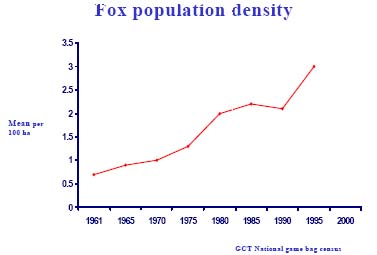
All through the 60s, 70s, and 80s, the fox population rose (see graph at left), and with it the chance of finding a bit of sport with the terriers in the countryside.

In 1974, the Jack Russell Terrier Club of Great Britain was founded "to promote and preserve the working terrier known as the Jack Russell".

In 1976, its U.S. analog was created -- the Jack Russell Terrier Club of America (JRTCA).

Both clubs have prospered and stuck to their original mission, and today the Jack Russell Terrier Club of America remains the largest Jack Russell terrier clubs in the world.

With an increase in the popularity of the Jack Russell terrier in Great Britain and the U.S., a push was initiated in 1983 to pull the Jack Russell into The Kennel Club. In 1990 this was finally done with representatives from several smaller Jack Russell Clubs meeting to draw up a conformation "standard" that called for a dog standing 12-15 inches at the withers.

It is claimed that this Kennel Club Standard was adopted from one originally written by Arthur Heinemann, but no evidence to support this claim has ever been presented so far as I know.

Dan Russell, who hunted with Heinemann and knew him well, says Heinemann did not value a large dog.


"As I remember it, and I am going back now sixty years or more, his main Badger dogs were about 12". He always said there was nothing a good fourteen inch terrier could do that a good eleven inch terrier couldn't do better. But it must be remembered he was referring to Badger digging in his own part of the West Country. His smaller terriers could manuever so much better in the large drawn out pipes of a badger set, they depended on their voice to keep the badger cornered for the diggers to hear, not brute force as some people seem to think. They were clever, game baying terriers, nothing more. Some of his best workers were no more than ten inches."

In his own book, "Jack Russell and His Terriers," written in 1979, before The Kennel Club controversty, Dan Russell quotes Heinemann directly:


"We are very much opposed to the modern show terrier and his type. Once you begin to breed it for show type, you lose the working qualities upon which you pride those terriers. I have been, I might say, the protagonist of the terrier bred for sport as against the terrier bred for show. I have no interest in cup hunting."

What Reverand John Russell or Arthur Heinemann wanted for the dogs, or what they actually used in the field, however, mattered not a whit to the Kennel Club.

In 1990 the Kennel Club admitted on to its roles a dog they called the "Parson Jack Russell Terrier," a name just invented for the occassion. In 1999 The Kennel Club changed the name to the "Parson Russell Terrier," another name invented wholecloth by Kennel Club theorists.

The American Kennel Club followed the U.K. Kennel Club in embracing both the 12-15 inch standard and in embracing the various inventeed names and name changes.

In 2005, The Kennel Club added a bit more confusion to the story by changing the standard for the dog they were now calling the Parson Russell Terrier, extending it to encompass dogs ranging from 10 to 15 inches tall at the shoulders.

The American Kennel Club has not followed the U.K Kennel Club in changing the standard, instead chosing to simply create another breed of dog (now in its Foundation Stock Service) called the "Russell Terrier."

The breed description of this dog claims it "originated" in the United Kingdom, but that it was "developed" in Australia -- a country which John Russell never so much as visited, which had no Jack Russells at all until the very late 1960s, and where the dog in question remains a pet and show dog that never sees a moment's work. The AKC "Russell terrier" standard calls for a dog standing 10-12 inches tall at the shoulder.

How to sort it all out then?

I think simplicity is best. In my opinion, there are only two types of terriers in the world: those that work, and those that don't. The white ones that work are called Jack Russell Terriers, and they are called that out of respect for the working standard that the Reverend John Russell himself honored throughout his life. Many of these white-bodied working terriers are not registered, but neither were any of the Reverend's own dogs.

What are we to make of the Kennel Club dogs? Simple: They are not Jack Russell terriers.

They are not Jack Russells in name, nor are they Jack Russell terriers in terms of performing regular honest work.

They are simply another white terrier being combed out, powdered, and fussed over by Kennel Club matrons.

So is there any place where the Parson Russell theorists and the practical working Jack Russell people might find common ground?

Oddly enough there is, though it is an area generally overlooked by the show ring crowd, and one they will no doubt surpress as time goes by.

The issue is chest size.

Barry Jones, a professional terrierman to the Cotswold Foxhounds in Andovers Ford, and a former Chairman and President of the Fell and Moorland Working Terrier Club, and the founding Chairman of the National Working Terrier Federation, was also a founding member of the Parson Russell Terrier Club. He warned the club to keep its eye on chest size, noting that:


"The chest is, without doubt, the determining factor as to whether a terrier may follow its intended quarry underground. Too large and he/she is of little use for underground work, for no matter how determined the terrier may be, this physical setback will not be overcome in the nearly-tight situations it will encounter in working foxes. It may be thought the fox is a large animal - to the casual observer it would appear so. However, the bone structure of the fox is finer than that of a terrier, plus it has a loose-fitting, profuse pelt which lends itself to flexibility.

I have not encountered a fox which could not be spanned at 14 inches circumference - this within a weight range of 10 lbs to 24 lbs, on average 300 foxes spanned a year. You may not wish to work your terrier. However, there is a Standard to be attained, and spannability is a must in the Parson Russell Terrier. "

Eddie Chapman, a working Devon hunt terrierman for more than 30 years, agrees that 14 inches is the maximum chest size for a fox. In The Working Jack Russell Terrier, he writes:


"I am a small man and have reasonably small hands, but in more than 20 years in which I have handled well over 1000 foxes, I have never handled a full grown fox which came anywhere near the span of my hands. The biggest I can remember was a South Hereford fox that was one and a half inches smaller than my hand span, and that without my squeezing him. It therefore follows that if I can pick up a dog and just span him with a squeeze, then the dog cannot get to the fox in a tight place and a dog that cannot get to a fox cannot be considered a Jack Russell. Either you are breeding a terrier suitable to work fox or, if he is too big to get to a fox, you are just breeding for looks. This is, of course, what happened to the pedigree Fox Terrier and look where that has got him!"

What is the future of the Jack Russell Terrier? The same as it has always been: as a working terrier in the hands of owners that will actually take it out to work it. Such people have always been rare. They were rare in John Russell's day, they were rare in Arthur Heinemann's day, and they are just as rare today.

As for the "Parson Russell" terrier and the "Russell" terrier they are completely interchangeable with every other terrier on the Kennel Club's roles. These dogs have no claim to history, and they have no future as honest workers. They stand as a complete rejection of every value ever held by John Russell and Arthur Heinemann, both of whom rejected Kennel Club registration and valued their own dogs based on performance in the field rather than Kennel Club points in the ring.

The good news is that with the name changes, no one will now confuse these Kennel Club dogs with the real Jack Russell Terrier.
.
_____________

Footnotes:


  • It should be said that Dan Russell (i.e. Gerald Jones) was himself terrierman for the Exmoor, Enfield Chace, and Old Berks hunts, and knew more than a bit about what was needed in a working dog.
  • Annie Rawl Harris was, for a time, housekeeper for Henry Williamson who wrote the book "Tarka the Otter."
  • The Scorrier terrier is associated with the Williams family and the Four Burrow Hunt.
  • The quotes in this piece come from the various books cited (and often pictured). For those that want a visual presentation of the history of working terriers, see A Pictorial History of Terriers; Their Politics & Their Place on the www.terrierman.com web site.
    .

Monday, August 20, 2007

A Quick History of American Terrier Work


A repost from this blog circa August 20, 2005.


For all practical purposes, the story of American terrier work begins in 1971 with Patricia Adams Lent, who founded the American Working Terrier Association to promote working terriers and dachshunds.

The American Working Terrier Association (AWTA) was, and is, a modest organization with fewer than 100 members. It has no headquarters or paid staff, and produces a simple Xeroxed newsletter four times a year. Its web site (as of 2005) has no information about actual hunting or wildlife, and is focused almost entirely on go-to-ground trials.

That said, AWTA is a very important organization in the history of American working terriers, not only because it was the first "club" devoted to the sport, but also because Ms. Lent invented go-to-ground trials, and the basic set of rules governing them.

Since 1971, go-to-ground trials have served as a kind of "on ramp" for actual field work. The basic AWTA format has been widely copied, first by the Jack Russell Terrier Club of America (1976) and then by the American Kennel Club (1994).

The origin of the American go-to-ground tunnel can be found in the artificial fox earths first constructed in the UK in the 1920s, but which came into their own in the 1950s and 60s with the collapse of so many ancient rabbit warrens under the onslaught of myxomatosis.

Artificial earths are generally constructed of two parallel rows of brick stacked three bricks high and topped by overlapping slates, or out of 9-inch clay or concrete drainage pipe laid end-to-end. The result is a very spacious and dry fox earth. If sited within 200 feet of a water source (it does not have to be large), far from residences, and on the edge of fields and small woods, the chance of a fox taking up residence is excellent.

The first artificial fox earths were constructed in order to guarantee that a fox could be found on hunt day, and to encourage fox to run along known courses away from roadways. That said, they also found favor because they proved easy locations for a terrier to bolt a fox from. Even an overlarge dog could negotiate the straight or gently curving unobstructed nine-inch pipes of an artificial earth.

The go-to-ground tunnels devised by Patricia Adams Lent were constructed of wood instead of stone, brick or clay pipe, but were equally commodious, measuring 9 inches on each side with a bare dirt floor for drainage and traction.

From the beginning AWTA's goal was to be inclusive. Scottish Terriers with enormous chests were encouraged to join AWTA, as were owners of West Highland Whites, Cairns, Norfolks, Norwiches, Border Terriers, Fox Terriers, Lakelands, Welsh Terriers and Bedlingtons. All were welcome, with the simple goal of having a little fun with the dogs, and perhaps giving American Kennel Club terrier owners some small idea of what actual terrier work was about.

In AWTA trials, wooden den "liners" are sunk into a trench in the ground. The tunnels are up to 35 feet long with a series of right-angle turns, false dens and exits. The “quarry” at the end of the tunnel is a pair of "feeder" lab rats safely protected behind wooden bars and wire mesh. The rats are not only not harmed, but after 100 years of breeding for docility, some lab rats have been know to go to sleep!

Without a doubt, go-to-ground trials have been a huge hit with American terrier owners. The interior dimensions of the den liners -- 81 inches square -- means even over-large terriers are able to negotiate them with ease. With nothing but a caged rat to face as "quarry," the safety of dogs is guaranteed, and since the dogs only have to bay or dig at the quarry for 90-seconds, most dogs end up qualifying for at least an entry-level certificate or ribbon.

Though the die-hard hunter may sneer, the increasing popularity of go-to-ground terrier trials is a welcome thing, for it has brought more people a little closer to real terrier work.

Owners of dogs that do well in go-to-ground trials should take pride in their dog’s achievements. Like all sports that emulate real work (lumber jack contests, bird dog trials, and sheep dog trials, to name a few), a go-to-ground trial is both harder and easier than its real-world cousin.

A dog that will exit a 30-foot tunnel backwards in just 90 seconds and on a single command (a requirement for earning an AKC Senior Earthdog certificate) is a dog that has been trained to a fairly high degree of proficiency.

Having said that, it should be stressed that a go-to-ground trial has little relationship to true hunting. In the field dogs are not rewarded for speed. In fact, if a hunt terrier were to charge down a real earth like it were a go-to-ground tunnel it would quickly run into quarry capable of inflicting real damage.

In addition, in a real hunting situation a dog must do a great deal more than “work” the quarry for 90 seconds. A good working dog will stick to the task for as long as it can hear people moving about overhead – whether that is 15 minutes or three hours.

The real division street between go-to-ground and earthwork, however, is size. And the real problem with a go-to-ground trial is not that it teaches a dog to go too fast down a tunnel (dogs understand the difference between fake liners and real earth), but that it suggests to terrier owners that any dog that can go down a cavernous go-to-ground tunnel is a dog “suitable for work.”

To its credit, the American Working Terrier Association recognizes the difference between a go-to-ground tunnel and real earth work, and implicitly underscores this difference in its rules for earning a Working Certificate.

AWTA rules note that a terrier or dachshund can earn a working certificate on woodchuck, fox, raccoon, badger, or an “aggressive possum” found in a natural earth, but that “this does not include work in a drain or otherwise man-made earth.”

In short, a drain is not a close proxy for a natural earth, and terriers that are too large to work a natural earth do not meet the requirements of a working terrier.

The American Working Terrier Association issues Certificates of Gameness to dogs qualifying at their artificial den trials. Working Certificates are awarded to dogs that work groundhog, fox, raccoon, possum, or badger in a natural den provided that at least one AWTA member is there as a witness. AWTA also issues a Hunting Certificate to a dog that hunts regularly over a period of a year.

Six years after the American Working Terrier Association was created, Mrs. Alisia Crawford, one of the first Jack Russell Terrier breeders in the U.S., founded the Jack Russell Terrier Club of America (JRTCA)

Ms. Crawford and the early founders of the Jack Russell Terrier Club put a lot of thought into structuring the JRTCA so that work remained front and center. Towards that end, the club decided that its highest award -- the "bronze medallion" -- would not go to show dogs, but to working dogs that had demonstrated their ability in the field by working at least three of six types of American quarry -- red fox, Gray fox, raccoon, groundhog, possum, and badger -- in front of a JRTCA-certified field judge.

In the show ring the JRTCA decided to ban professional handlers as it was thought this would keep the shows fun and less important than the essential element of work.

Instead of mandating the kind of narrow conformation ranges demanded by the Kennel Club for their terrier breeds, the JRTCA divided the diverse world of the Jack Russell Terrier into three coat types (smooth, broken and rough), and two sizes (10 inches tall to 12.5 inches tall, and 12.5 inches tall to 15 inches tall).

"Different horses for different courses" became a watch word, with overt recognition that the world of working terriers required dogs able to work different quarry in different earths, and in different climates.

Unlike the Kennel Club the JRTCA also decided to keep their registry an "open" registry so that new blood might be infused at times. At the same time, the Club discouraged inbreeding and eventually restricted line breeding to a set percentage.

To balance off an open-registry with the desire to keep Jack Russell-type dogs looking like Jack Russells, the JRTCA decided not to allow dogs to be registered at birth or to register entire litters. Instead, each dog would be photographed from each side and the front, and admitted to the registry on their own merit, and as an adult. In addition, each dog had to be measured for height and chest span.

What this meant is that at the time of registration, the height and chest measurement of an adult dog could be recorded. Over time, both height and chest size could be tracked through pedigrees -- an essential element of breeding correctly-sized working terriers.

The JRTCA was not shy about their rationale for these rules: they openly and emphatically opposed Kennel Club registration, maintaining that time had show that dogs brought into the Kennel Club quickly grew too big and often lost other essential working attributes such as nose, voice, and prey drive.

Today the Jack Russell Terrier Club of America is the largest Jack Russell Terrier club and registry in the world, and its Annual National Trial attracts approximately 1,200 Jack Russell terriers from all over the U.S. and Canada.

The JRTCA's small professional staff cranks out a solid bi-monthly magazine that is 80-100 pages long, holds a regular schedule of dog shows, and sells deben locator collars, fox nets, and a host of other items ranging from hats and jackets to coffee cups.

The web site of the Jack Russell Terrier Club of America ( http://www.terrier.com/ is one of the very best dog sites in the United States, packed with well-presented information, high-quality graphics and a user-friendly layout.

Perhaps the most important service work of the JRTCA are the ads that the Club routinely runs in all-breed publications warning people that Jack Russell Terriers are not a dog for everyone, are primarily a hunting dog, and are not like the cute dogs seen on TV.

Sometime in the last 1990s, following the appearance of Jack Russell Terriers in a host of TV and Hollywood productions ranging from "Wishbone" and "Frasier" to "My Dog Skip" and "The Mask," the American Kennel Club decided to add the Jack Russell Terrier to its roles.

As they had previously done with the Border Collie, the AKC ignored the strong opposition of the large existing breed club, and quietly assembled a new club of show-ring breeders to serve as their stalking horse.

The "Jack Russell Terrier Breeders Association" (later called the Jack Russell Terrier Association of America, and now called the "Parson Russell Terrier Association of America") petitioned for the admission of the Jack Russell Terrier into the Kennel Club and, despite the objections of the JRTCA, the breed was admitted in January of 2001.

The admission of the Jack Russell Terrier into the American Kennel Club was a contentious affair, with the JRTCA standing firm on its long-held rule that no dog could be dual-registered.

What this meant is that breeders had to chose whether to remain in the JRTCA or to "get in early" with the AKC before they closed their registry.

Some of the breeders that chose the AKC did so because they thought they could then sell their puppies for more money, others were eager to be the "big fish in a small pond" at the beginning of a new AKC breed registry. Still others were anxious to attend more dog shows,.

Whatever the reason, the Kennel Club required that the Jack Russell Terrier breed description be narrower than that of the JRTCA. The goal of a Kennel Club breed description is to craft a narrow "standard" -- the wide variance in size, coat and look allowed and encouraged in the world of working terriers would not do.

The American Kennel Club breed standard stipulated that an AKC Jack Russell terrier could not be under 12 inches in height nor over 15 inches in height, and further stipulated that "ideal" dog was 14 inches tall and the ideal bitch was 13" tall.

Ironically, this breed description effectively eliminated about 40% of all the American dogs that had actually worked red fox in the U.S.

More importantly, this narrow standard eliminated the small dogs necessary to "size down" a breed -- something absolutely necessary in order to keep working terriers small enough to work.

Of course the American Kennel Club has never been interested in working terriers and the breed club they created has shown no interest in work either.

Under continuing pressure from the working Jack Russell Terrier community in England and the U.S., the British and American Kennel Clubs decided to jettison the "Jack Russell Terrier" name to more easily identify the non-working show ring dog they favored.

Now called the "Parson Russell Terrier," the AKC dog is quickly getting too big in the chest to work -- though not many dogs are actually taken out into the field to try.

After just three years in the Kennel Club, the "Parson Russell Terrier Club" tried to modify the show ring standard so that the dog no longer had to be spanned. In fact, many Kennel Club judges do not know how to span a terrier and many do not do it as a consequence.

In 2001, the United Kennel Club started an "earth work" program modeled after that of the Jack Russell Terrier Club of America. The UKC working terrier program remains small, with relatively few judges, and it does not appear to be growing very rapidly.
.