Showing posts with label Lakeland. Show all posts

Wednesday, August 4, 2010

A Question of Breed

This is a repost from October 2005


The quarry does not care what breed a dog is so long as it is doing the job.

Yet breeds do matter to humans for the simple reason that the more we know about breeds, and lines within breeds, the more likely we are to get a dog that is of real use to us in the field. There is always a chance we will get a dud, of course, but we can reduce that risk if we pick the right breed, select the right breeder, go slow, and use a modicum of common sense.

There are more than 28 types of terrier, but only six working breeds worth talking about, and even fewer worth considering if you are looking for a dog in America, as of this writing (2005).

There are two closely-related white breeds (the Jack Russell Terrier and the Plummer Terrier), two closely-related black breeds (the Patterdale Terrier and the Jagt Terrier), and two closely-related red breeds (the Border Terrier and the Fell Terrier).

Of these six breeds, only three are real options for U.S. earth work. Let us dispose of the generally unsuitable dogs first.

The Plummer Terrier is simply a color variant of the Jack Russell Terrier. I like the look of this dog, but in truth a good terrier does not come in a bad color, and breeding for coat markings has always been a dangerous thing.

The Plummer Terrier started off as a genetic mess — a point well documented by Brian Plummer himself. The good news is that thanks to culling and out-cross breeding, most of the serious genetic problems have been worked out of the gene pool.

The bad news is that a new problem has worked its way in: the dogs are generally too large, standing 13-15 inches tall, with 14- and 15-inch dogs very common.

Of course size is not a problem if you are ratting, which was Brian Plummer’s specialty and passion and mostly what the dogs are use for to this day. If you intend to dig to groundhog, raccoon, and fox in the U.S., however, a 14-inch dog is simply too big for our tight earths. The issue is moot, in any case; as of 2005, Plummer Terriers simply do not exist as a working terrier breed in this country.

The Jagt Terrier is another breed that fails the American working terrier size test. The Jagt Terrier was created in Germany in the 1930s with the idea of being an “all purpose” hunting terrier able to flush rabbits and wild boar from dense brush, retrieve shot birds, blood track gutshot deer, and go to ground on fox and badger.

Unfortunately, dogs are specialized for a reason, and the Jagt Terrier is, at best, a second choice in all of these tasks. When it comes to fox work, the standard for the Jagt Terriers (13" to 15" tall) calls for a dog that is simply too big for our tight American earths. There are some very small Jagts that do well, but the gene pool is dominated by larger dogs, and Jagts should only be considered, in my opinion, if it is a full-grown adult and significantly smaller than the standard.

The red Fell Terrier is a type of non-pedigree Lakeland Terrier found in the north of England. This dog would have much to recommend it if small versions of this breed could be found in the U.S. Unfortunately, as of 2005, there are only a handful of red fells in the U.S., and even fewer that are sized for our tight earths. If you can find a small dog, go for it, but the chances of locating such an animal are slim to none.

We now come to the three types of working terriers available in the U.S. which also have some hope of being the right size: the Border Terrier, the Patterdale Terrier, and the Jack Russell Terrier.

Border Terriers are wonderful dogs, but finding one that is the correct size and has a small chest is very difficult in the U.S. Few Kennel Club Border Terrier owners keep size records going back generations, and the chance of being able to select a small one out of a gene pool dominated by large dogs is about as likely a picking the trifecta at Belmont Raceway. The chance of finding one that has worked three types of quarry is close to zero.

Unfortunately, the other alternative — buying a small adult dog — is also virtually impossible as Border Terriers are not common in the U.S., and most dogs are placed as pups and never relinquished (hardly surprising after a sum of more than a $1000 has changed hands). As for finding a small adult working dog for sale -- forget it.

Border Terriers have wonderful winter coats, but these same coats tend to result in an overheated dog in summer when so much groundhog work is done. The dog that never gets cold in winter, simply flops over in summer heat.

Finally, it is worth mentioning that Border Terriers are, as a rule, slow to start. While a Jack Russell or Patterdale will usually start to work between 10 months and one year of age, Borders Terriers seem to start a full year later. There are exceptions to the rule, to be sure, but I have spent a fair amount of time around Border Terriers, and it’s best to plan on a late starter and be surprised than depend on an early starter, and be disappointed. Borders are not the “One Minute Rice” dogs so popular with young terrier enthusiasts today — one reason they may have experienced a decline in popularity in the field.

Patterdale Terriers are rapidly rising in popularity in the U.S. and they have much to commend them. Unfortunately, as Patterdales have grown in popularity, they have also grown in size. This is particularly true in America, I am afraid to say, where Patterdale Terriers have suffered a terrific genetic beating at the hands of young want-to-bes who have crossbred them with small pit bulls. Large numbers of these overlarge black dogs have been cranked out to be sold off on places like “Bay Dogs Online.” Here the ads read “will hunt anything.” “Has hunted nothing” is more likely the story. Pictures of chained out “yard dogs” may be offered at referring web sites, and dogs are sometimes swapped for auto parts or sold in groups by get-rich-quick failures who are now having “Kennel Reduction” sales.

Having raised a caution about size and breeders, it should be said that if you can find a nice small Patterdale, 12 inches tall or smaller, and with a nice tight chest of 14 inches or less, these dogs generally make exceptional workers. Caveat emptor, as with all terrier purchases, but if are flinty and properly focused on getting a small enough dog, you can do very well with a Patterdale.

Finally, we get to the Jack Russell Terrier. What a divergent mess of registries and types this breed has become! Some Jack Russellls have ears that are erect, some down, some are longer than they are tall, some are pure white, some are as parti-colored as a beagle. There are smooth coats, broken coats and dogs hairier that a Wookie straight out of Star Wars. A Jack Russell’s legs may be straight as sticks or as ornately curved as those of a Queen Anne bench. Its chest may be as small around as a lady’s bracelet, or as big around as a bowling ball.

How do you sort it out?

Simple: Get a dog registered with the Jack Russell Terrier Club of America, and accept no substitutes if you are looking for a working Jack Russell. Let is be said that I am not affiliated with the JRTCA in any way. I do not breed dogs, I do not show dogs, and I do not judge dogs. My reason for recommending the JRTCA is solely practical: The JRTCA records the size of dogs and also offers working certificates. The result is a documented track record of work and size that can be tracked across a five-generation pedigree. When you are looking for a working terrier, nothing is more valuable.

Buyer beware, of course. Most JRTCA dogs are show dogs or pets, and only about 5 percent hunt. The good news, is that with a JRTCA dog you can look through a pedigree and see whether there is a track record of work, and also ascertain the size of the dog’s dam, sire, grand-dam and grand-sire. With hundreds of well-documented working JRTCA dogs in America, the chance of finding an acceptable working terrier is higher in the JRTCA gene pool than anywhere else.
..

Friday, January 23, 2009

No Tolerance for Diversity


The American Kennel Club has very little tolerance for diversity. The goal of conformation, after all is to conform.

And so, if we follow the history of AKC breeds, we find that the Norwich Terriers could not be shown very long with both ears up and ears down -- they had to be split into two breeds to conform to the AKC's intolerance for diversity.

The Fox Terrier could not come in both smooth coats and wire coats -- they had be split into two breeds.

The Corgis were split into the Cardigan Welsh Corgi and the Pembroke Welsh Corgi.

The retrievers were split into Curly Coated and Flat Coated (to say nothing of all the other divisions).

Cocker Spaniels were split into "American" and "English" varieties, while the Springer Spaniel was split into "English" and "Welsh" varieties.

The Mountain Dog was split into the Bernese Mountain Dog and the Greater Swiss Mountain Dog, while the Cairn Terrier cleaved itself into colored dogs and the all-white "West Highland White."

Can you tell the difference between a show Lakeland Terrier and a show Welsh Terrier? The difference is only a slight shift in color, but it is an intolerable difference to the AKC show ring.

Similar intolerances led to collies being split into Rough and Smooth coated collies (to say nothing of Border Collies).

The Poodle was shattered into three separate breeds based on size (while also being moved from its sporting roots into the "nonsporting" category).

Now, in the AKC, there is a push to split the Akita into two breeds -- the American Akita and the Japanese Akita.

As for the Jack Russell Terrier, the AKC is already moving to split it into two different breeds -- the "Parson Russell Terrier" and the "Russell Terrier."

And what is the point to all this breed atomization? No point higher than the chasing of rosettes. Work never enters the picture.

.

Tuesday, January 29, 2008

Non-Extinct Terriers & Other Mysteries

Many of the terrier breeds that people now lament the "extinction" of, never actually existed except in the minds of Victorian picture book makers.

In "The Welsh Terrier Leads the Way," Bardi McLennan recounts the relatively recent origins of the Welsh Terrier.

"In 1800 there were only 15 designated breeds of dogs, and 50 years later there were only 50."

That is of ALL dogs, not just terriers. As late as 1850, a lot of breeds were still not very distinct and several breeds were known by different names. For example, in 1851, the Yorkshire Terrier was also known as "the broken-haired scotch terrier." Only in 1870 was a Yorkshire Terrier firmly designated as a breed and breed name. Before then litter mates were often shown in different breed categories -- a situation that occurred with the first prize-winning Jack Russell, which had previously won shows as a "white Lakeland."

The Welsh Terrier and Old English Black and Tan" terriers were the same dog -- a type of rough-stock Lakeland dog used in Wales and in the North. These dogs had a fair amount of variation in terms of size and shape, but generally had more color than the "white foxing terriers" preferred in the South.

These rough-coated terriers existed without too much conformity in name or shape (as they still do in the working terrier community in the U.K.), but conformity and a brand name were essential characteristics of Kennel Club registration, and an intrepid history (however fanciful) certainly did not hurt sales.

With the rise of dog shows in the 1860s, the race was on to give every odd-looking dog a name and "improve" them, and terriers were at the top of the list.

One group of Kennel Club breeders decided to embrace a rather ponderous name and an incredible assertion for the brown and black dogs of the North: they were, they asserted, "the root stock" of all terriers in the British Isles, and that they were to be called the "Old English Broken-Haired Black and Tan."

The assertion that these dogs were the root stock of all terriers in the UK is rather laughable -- no one know what the "root stock" was, and in any case there probably was no single "tap root," but instead a fine net of "rootlets" that spread far and wide and included a lot of dogs that were not terriers at all -- dachshunds, whippets, beagles, and lap dogs, for example.

In any case, the Welsh were somewhat outraged to have the English bring down a few of "their" dogs and claim they were an "Old English" anything. These were Welsh dogs, and the welshmen moved quickly to establish that fact. The Welsh got organized quickly, and in 1884 they held the first dog show with classes just for Welsh Terriers in Pwllheli, North Wales with 90 dogs in attendance -- a rather impressive opening shot in this little "terrier war."

For their part, proponents of the "Old English Black and Tan" moniker could not seem to coalesce into a real club; in fact they could not even agree on a name for their supposedly "Old English" breed. Some called it the Old English Broken-Haired Black and Tan Terrier, some the Old English Wire Haired Black and Tan, some the Broken-Haired Black and Tan, and some just "Black and Tan" -- a color-descriptive name that had been used about as often as "white dog" or "yellow hound".

Whatever they might have called the dogs, this new Kennel Club "breed" was in fact a put-up job comprised of a mix of terrier types and they had difficulty breeding true.

In 1885 a survey of the winning dogs in the ring found that all of them were, in fact, first generation dogs, i.e. not Black and Tans out of Black and Tan sires and dams, but Black and Tans produced out of crosses with other breeds. For example, the winner of the first show in 1884 was a dog named Crib that was a cross between a blue-black rough terrier and a famous smooth fox terrier owned by L.P.C. Ashley called Corinthian.

In 1885, the Kennel Club took a Solomonic approach to the name and breed standard for the dog, featuring both dogs at their 1885 show. On April 5, 1887, however, because the English could not get organized, they were dropped from Kennel Club listings, and the new "Welsh Terrier" breed was born, perhaps propelled forward in popularity a bit by the rise of David Lloyd George, the son of a Welsh cobbler, who himself has risen from humble origins to stand should-to-shoulder with the gentry.

The "Black and Tan" terrier is not the only breed that either never existed (or still exists today, depending on how you look at it).

At the same time that one faction was pushing for the introduction of the "Old English Black and Tan Terrier" another faction was pushing for the introduction of the "English White" terrier which, it should be said, has nothing to do with the old English White molosser dog used as a butcher's dog 150 years earlier.

In fact this new dog was really a toy breed created by crossing a small smooth-coated white foxing terrier with some sort of lap dog, which left the resulting progeny with a propensity towards deafness and a bulging "apple head" like that of so many modern Chihuahua.

Both the "Black and Tan" terrier and the "English White" terrier live on in the fevered minds of the breed-obsessed thanks to a book by Vero Shaw entitled "The Illustrated Book of the Dog."

Printed in 1881, right in the middle of the "terrier wars," this book contains about 100 chromo-lithograph plates and engravings of dog breeds that were being put forth as distinct entities at that time. Shaw rather optimistically included the "Black and Tan" as well as the "English White," betting that the political machinations of English Kennel Club dog breeders would prevail.

He was wrong, which is how two "ancient" breeds of terriers, that in fact never exited, managed to appear on the scene for less than 20 years and then disappear altogether.
.

Friday, September 14, 2007

Nannying Idiots Continue to Ignore Real Problems


I got an email tonight from Char (Pearl's first mom and breeder) letting me know that a woman in the U.K. has been jailed for violating the ban on tail docking that exists over there.

For those who do not keep up on such things, the new U.K. law states that only veterinarians can dock puppy tails, and that even then it can only be done if it is deemed to be "medically necessary."

Heads up. In this increasingly interconnected world, even stupid ideas in other countries can quickly creep in over here. A while back, for example, I received an email from Canada suggesting that the idea was gaining ground in that country. My correspondent wrote:

"I am writing you for help in clarifying a long standing dispute among terrier fanciers involved in conformation dog shows. I am involved in several traditionally docked terrier breeds (Lakeland, Fox, Welsh etc.) and it is becoming increasingly common to see these breeds undocked. Is there a functional purpose for docking tails? Is it required to work terriers?


Why I am supposed to be an expert on these things?

I don't know, but I guess I'm as good as the next guy to ask for an opinion. So here goes.

This is a European debate. You remember Europe. Europe is the place where the rivers are so polluted that the eels no longer run up the rivers to spawn, and where carp are considered a game fish. Europe is the place that has shot out almost all its wolves and bears. Europe is the place that colonized Africa and now lets Africans starve due to lack of aid or political intervention.

Europe has ignored these things, and decided that the the real horror in the world is docking puppy dog tails!

What morons.

The Brits were fools to follow Europe in this. Now let's hope Canada does not go follow the Brits, or I may have to burn my Joni Mitchell and Neil Young CD's.

Tail docking is a very minor procedure and does no harm to the dog. It is largely aesthetic and historical with certain breeds. That said, some terriers and other breeds have long thin tails that can be damaged when whipped in brush, worked in rock, etc. so they may benefit, medically, if they are docked. How often an over-thin and fragile tail is a real medical problem depends on the breed, the dog, how it works, where it works (and if it is worked at all).

A terrier's tail, of course, is an essential part of the dog, and I consider it a very stupid thing to dock a terrier tail too short. I always advise people to err on the side of leaving the tail too long. You do not want to lose a good handle on the rear end of a working terrier by being too quick or aggressive with a pair of tail nippers.

That said, a very long tail is of no use to a terrier, and could be a small health liability. A dog often has to exit a hole backwards and around curves. In that situation, a long thin tail could be a problem -- imagine exiting a tight and winding tunnel with a spring-pole stuck out behind you, and you get the idea. And then there are the thin tail tips that bleed when banged against rocks and brush.

Some caveats. At least one breed of working terrier does not have a docked tail -- the border terrier -- and neither do working dachshunds. The tail on a border, however, is a very solid thing and is not easily damaged. If you cannot pick up a border terrier by its tail and throw it over a fence, it's not a true border terrier. A tail that is left intact on a working Jack Russell terrier, however, often ends up being very long and thin, and as a consequence it could be subject to real damage, and so it is generally docked.

Another issue for working dogs is that digging on a dog is not an absolutely precise thing, and so the length, form and placement of the tail becomes an issue. To put it bluntly, a long thin whippy tail trailing behind an underground dog could be subject to being trimmed by a shovel.

Has it ever happened to me or anyone I know? No. I am careful and my dogs rarely come in direct contact with a shovel. That said, it does not take too much imagination to think harm could result if a digger were very inattentive.

All in all, however, and as I said before, tail docking is mostly done for cosmetic and historical reasons.

But so what? We do a lot of things for cosmetic and historical reasons. Why can't tail tail docking be one of them? For God's sake, people, let's use a little common sense!

People circumcise their children, women get themselves nipped for child birth (it's called an episiotomy), and every third teenager has a pierced tongue, nipple, eyebrow or navel.

Whole TV shows are devoted to full-body tattoos.

Women are getting breast implants or breast reductions, and men are getting hair transplants and scalp reductions.

Noses are bobbed, fat is sucked out, teeth are capped, botox is injected, and ears are being pierced, ringed, barbelled, and pinned.

Ever been to a PETA rally? If you look around, you will see a lot of metal hanging out of nostrils, off of eye brows, or rammed through tongues. Every other girl will be showing off her "tramp stamp" tattoo on the small of her back. God only knows what you might find ringed, belled and pierced if you were foolish enough to ever see one of these PETA lunatics standing before you naked. The mind shudders.

Consider PETA spokes-idiot Pamela Anderson, who not only married the walking Erector Set known as Tommy Lee, but who also got her own body repeatedly tucked, sucked, injected, lifted, dyed, bobbed, and implanted. And these people are worried about a ten-second tail nip? What on earth for?

There are real problems in the world, and this is NOT one of them.

The anti-tail docking people have no sensible rationale to oppose tail docking -- it is a ten-second thing done when the dog is one or two days old, and it is over with very little fuss or pain. People who love dogs more than their own lives have been doing it for generations -- proof alone that it is a small thing and does no damage to the dog while sometimes serving a health function in the field.

Here are some real things to worry about with dogs:

  • Closed genetic registries which mean that the genetic diversity of dogs is dramatically reduced in time, and with it the health of every breed with a closed registry (i.e. all Kennel Club breeds);
  • Fat dogs which do not see exercise and which have sad and shortened lives (about 1/3 of all dogs);
  • Slick floors in kitchens which increases the chance of hip dysplasia for all large canines (a serious and sad thing);
  • Poor fencing, poor obedience training, and the complete absence of tags and microchipping which means dogs are easily lost and frequently struck by cars.


These are REAL dog problems. Tail docking does not even come close to making the list of things to be concerned about -- in the world of working dogs or otherwise.

Not everything in the world needs to be legislated, and this is something that fits under the umbrella of "leave it alone and let freedom ring."

If a breeder of nonworking dogs wants to leave the tails on their dog long, so what? If a breeder wants a sensible working dog with a properly docked tail, so what?

What interest, business or concern is it of society?

None.

The tail docking debate is really about a very small but vocal sector of society wanting to be nannies to the rest of us.

As a general rule these people know very little about dogs, know nothing about working dogs, and do not give a rat's behind about honest animal welfare -- if they did, they would pick a real issue to take action on.

And there are a LOT of real animal welfare issues. How about habitat protection? How about disease control in wild animal populations (rabies, distemper, mange, tuberculosis, chronic wasting disease, West Nile)? How about pushing to lower the price of veterinary care and improving access to it as well? These are real issues.

Fair warning, however -- making a change in these arenas might involve actually going out into the environment with mud, bugs, rain and cold (Ugh!).

In addition, a real problem might be inconveniently complex and serious (God forbid!), and actually involve something more involved than self-righteous bullying of ignorant legislators and dog owners.

But of course, the tail-docking debate is not really about dogs, is it? It's about people who want to feel smarter and superior to others. These people will always be with us and I suggest they simply find something new to feel smarter and superior about.

If, faced with all the issues and problems in the world (hunger, violence, hurricanes, disease, lack of health insurance, war, poverty, illiteracy, racism, deforestation, violence against women, animal extinctions, loss of global fisheries, pollution, child abuse, etc.), someone thinks tail docking of well-loved pets and working dogs is a major concern worthy of time and energy, they are idiots.

Nannying idiots.

Nannying European idiots.

.

Tuesday, February 20, 2007

The Average Size of Fox


All kinds of nonsense is written and said to justify over-large Kennel Club terriers that cannot fit down a hole. Yet, when push comes to shove, a very small dog is needed. As Barry Jones, terrierman to the Cotswold Foxhounds, a former Chairman and President of the Fell and Moorland Working Terrier Club, and the founding Chairman of the National Working Terrier Federation writes:

"I have not encountered a fox which could not be spanned at 14 inches circumference - this within a weight range of 10 lbs to 24 lbs, on average 300 foxes spanned a year."


In his excellent book The Working Jack Russell Terrier, Eddie Chapman writes:

"I am a small man and have reasonably small hands, but in more than 20 years in which I have handled well over 1000 foxes, I have never handled a full grown fox which came anywhere near the span of my hands"
In Foxes, Foxhounds & Foxhunting, written in 1923, Richard Clapham notes that:

"With regard to the weights of foxes, these differ considerably in various parts of the country. Roughly speaking the average dog fox weighs about 15lb., and the vixen 13½lb. It is quite safe to say that nowadays there are far more foxes under than over 16lb. The heaviest fox I have a record of, killed by hounds, was one of 23lb, which was run into by the Ullswater on Cross Fell. This fox measured 4ft. 4in. from tip of nose to end of brush, about 4in. of the latter being white. On the Lakeland fells weights of 18lb. and 19lb. are not uncommon, and this season 1921-22 I handled a 19½lb. fox killed by a fell pack. Extra heavy foxes are occasionally accounted for in the Midlands. When Frank Gillard was huntsman to the Belvoir, his hounds on one occasion killed a fox of 17½lb."


What is interesting is how quick show ring breeders leap over the fact that the average fox weights less than 15 pounds -- so great is their need to find a fox that weights a great deal more so that their over-large dogs can be seen as "correct."

Friday, December 8, 2006

A Bit More on the Border-Patterdale Connection


In the last post, I talked of how Joe Bowman, Huntsman for the Ullswater, was the person to coin the term "Patterdale Terrier," and that he had also been an early breeder of Border Terriers.

In previous posts, I have noted that the Border Terrier is itself a relatively young breed, created from Fell Terriers at about the time the Kennel Club was first created.

To add a point to the pencil, it's worth putting a few pictures side-by-side and fleshing out the relationships and history a little bit more. The picture at top is an early "Patterdale Breed" terrier. This picture comes from Foxes, Foxhounds & Foxhunting by Richard Clapham, published in 1923.

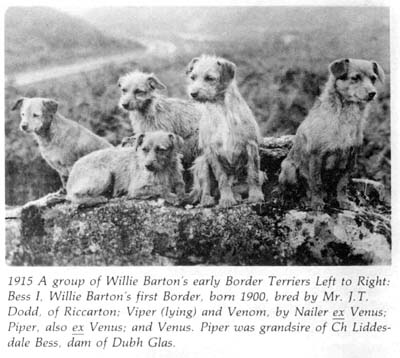
The picture below is of a group of early Border Terriers, taken in 1915. This picture is from Walter Gardner's book, About the Border Terrier.


The first Border Terrier entered on to Kennel Club roles to win a working certificate was a dog by the name of Ivo Roisterer, born on August 12, 1915, and receiving his working certificate in 1920. His pedigree is appended below, and clearly shows his great grand sire and great grand dam were from the Ullswater Hunt at a time when Joe Bowman was Huntsman.


The picture, appended below, shows Joe Weir, the Ullswater Huntsman that replaced Jow Bowman. Like Bowman, he held his position for an incredibly long period of time, from the 1924-1971 -- a period of 47 years. The dog in Joe Weir's arms is "Butcher" -- a picture apparently taken after a rescue. This photo, taken sometime in the late 1940s or 1950s, shows a dog very much like Joe Bowman's "Patterale Breed" and also very much like the early Border Terriers. It says quite a lot that this dog could be called a Border Terrier, a Patterdale Terrier, a "Fell Terrier," or a "Working Lakeland" -- evidence enough that all of these breeds are so closely related, and so recently differentiated, as to be interchangeable just a generation ago.

Of course, now we have generally decided that a "Patterdale" is a smooth or slape-coated black dog, while a "black Fell" is a rough-coated black dog.

Perhaps some day we will do away with names all together and simply divide the world of terriers as they should be cleaved: Dogs that work (regardless of color, coat or name) and those that don't. If we look at what we see in the field today, we can broadly state that Border Terriers tend to line up in the latter camp, while Patterdale Terriers tend to still reside in the former.


Thursday, December 7, 2006

Joe Bowman's Patterdale


Joe Bowman, the Ullswater Huntsman, from Foxes, Foxhounds & Foxhunting
by Richard Clapham, published in 1923.


Most of the folks that write books on dogs would like their breeds to be ancient and have romantic and mysterious origins. Pick up any book on Jack Russell Terriers, for example, and Trump will be presented as the first white foxing terrier on earth -- never mind that the young John Russell selected it for looks alone and had no problem finding another white foxing terrier to mate with it.

The Border Terrier folks have wrapped the story of their dog completely around the axle in an attempt to give it an ancient origin. In fact this breed was created at about the same time as the Kennel Club was created, and it was pulled on to the Kennel Club roles as quickly as could be.

As for the Patterdale Terrier, quite a few people claim one person or another created the dog, and yet all seem quite confused as to the shape of the head. Where did that come from?

In fact it is no mystery, and the true story of the Patterdale is not too deeply buried or very old.

In 1873, the Patterdale and Matterdale hunts were combined to form the Ullswater Foxhounds. In 1879 Joe Bowman (just 22 years old) was made master of the Ullswater, a position he held (with a few short interruptions) until 1924, when he was replaced by Joe Wear who held the position for then next 47 years. Joe Bowman died in 1940 -- one of the most famous huntsmen of all time (there is even a song about him)

Joe Bowman was an early Border Terrier breeder, and he was also the first person to cross up a blue-black Border Terrier with a black and tan Fell Terrier (also called a working Lakeland) to create what he called a Patterdale Terrier.

In Jocelyn Lucas' book, Hunt and Working Terriers, a table at the back notes that the United Hunt preferred a "Lakeland, Patterdale, from J. Boroman's strain (Ullswater kennels)."

In fact, "J. Boroman" is a typo, and the real man was Joe Bowman.


From Appendix II of Jocelyn Lucas' Hunt and Working Terriers (1931).


Lucas published his book in 1931, and the information in it was collected between 1925 and 1930. The Patterdale Terrier was clearly a type (if not a widely used type) by the 1920s, and it centered on the Ullswater Hunt and Joe Bowman.

With that knowledge, it was not too difficult a thing (but not too easy either!) to lay a hand on Foxes, Foxhounds & Foxhuning by Richard Clapham, published in 1923. Here we find not only a good picture of Joe Bowman (see top), but the picture reproduced below with caption. Click on the picture for a larger image.


"One of the 'Patterdale' breed."
Click on the picture for a larger version.

Now we can see that the Patterdale name goes back to at least the Nineteen-teens, a period just before the Border Terrier (which, like the Patterdale, started out as little more than what we would call today a Fell terrier today) was pulled into the show ring. To see what Border Terriers looked like in 1915, click here.

At about the time that Joe Bowman was fading out of the dog breeding business, in the 1930s, a young Cyril Breay was stepping up. Breay, like Bowman, had been a Border Terrier breeder.

In the early 1930s Breay met Frank Buck, when Buck rescued one of Breay's dogs that had gotten stuck in a deep rock cleft and Buck -- an expert at dynamite -- had blasted it free.

Bucks own line of dogs at the time were descended from Ullswater terriers kept by Joe Bowman, and Breay and Buck soon became fast friends with Breay breeding black dogs from Frank Buck into his line, and Buck crossing tight Border Terrier coats into his. Over time, the dogs of the two men devolved to a type as lines were crossed and condensed.

Cyril Breay was always adamant that the Patterdale Terrier was not made by crossing in Bull Terrier, and he was not lying. The Patterdale head is no mystery to a border terrier owner - the same broad cranial outlines are evident in both breeds.

Brian Nuttal began breeding Patterdales in the late 1950s, and says that his dogs are very much like those his father kept in the 1930s. It would not surprise me a bit to find that Nuttal's father got his dogs from Bowman, or from intervening hands that had gotten their dogs from Bowman. What is clear is that the Patterdale Terrier was already a recognized type by the time Nuttal's father owned his dogs.

The fact that Joe Bowman started the Patterdale strain and named it takes nothing away from folks like Cyril Breay, Frank Buck and Brian Nuttal, all of whom did quite a lot to popularize the breed, maintain it as a working dog, and perhaps improve and stabilize its looks. It is an easy thing to name a new breed (it's done every day by puppy peddlers), but quite another to find a market and a following for the dogs based on their performance in the field.

I mention all of this (I have told the story before and it is in the book), because I found a rather interesting old obituary on the internet the other day. Note the byline. With some amusement I note that "Greystoke Castle" was (supposedly) the ancestral home of Tarzan:


September 1956
PATTERDALE - One of Ullswaterside’s oldest residents, Mrs. Esther Pattinson, Broadhow, Patterdale, died at the age of 85. Formerly Miss Bowman, Matterdale, she hailed from a noted hunting family — her uncle was the celebrated Joe Bowman, huntsman of the Ullswater foxhounds for 42 years, while her great-grandfather, Joe Dawson, was for many years huntsman of the one-time Matterdale foxhounds. Mrs. Pattinson was only 13 years of age when she was hired as a farm girl, later working at Lyulph’s Tower for Mr. James Wood, who was agent for Lady Mabel Howard, Greystoke Castle.


In the end, it turns out that Joe Bowman was born in Patterdale -- a perfectly good reason for him to give a nod to the spot. It was, no doubt, an added bonus that Patterdale was also the old name of the Hunt that was both his employer and his passion. Finally, it should be noted that Patterdale was also the town where Joseph Dawson Bowman died, at the age of 88.
.

Sunday, February 12, 2006

The Transvestite Terriers of Westminster

Example


People who care about working terriers are generally dismissive of the Kennel Club, for the simple reason that they know what the Kennel Club has done, through either omission or comission, to the working terriers they care about.

The simple fact is that no working terrier has ever been created by the Kennel Club, but every working terrier breed that has been drawn in, has been destroyed there.

The Reverend John Russell noted the negative impact of dog shows on working terriers -- he judged only one show (when he was a very old man), and he swore he would never do it again!.

Though the destruction of working terriers started with the Allied Terrier Shows run by Charles Crufts in the U.K. (Crufts was a dog food salesman who never even owned a dog himself!), the Americans quickly got into the game as well.

A quick historical tour of "Best in Show" winners at the Westminster Kennel Club Show in New York City suggests the intense attention given to terriers at the turn of the 20th Century.


  • The first "Best in Show" winner at Westminster in New York City was in 1907. This first "Best in Show" winner was a smooth fox terrier that looked a little bit like today's Jack Russell.
  • Fox terriers won again in 1908, 1909, 1910, 1911, 1915, 1916, 1917, 1926, 1928, 1930, 1931, 1934, 1937 and 1942.
  • A Sealyham (another working breed ruined by the show ring) won in 1924, 1927 and 1936.
  • Airedales made Best in Show in 1912, 1919, 1920, 1933, and 1936.
  • A bull terrier went Best In Show in 1918, and a Welsh Terrier in 1944.


As you can see, almost all the early winners were terriers
, and most of them were fox terriers.
It was during this period the face of the fox terrier was elongated and the chest enlarged by show ring breeders. Prior to World War II, if you were really intent on wining the top award at a dog show, you went into fox terriers.

Probably no breed could have survived such intense attention without being wrecked by fad, and the fox terrier certainly did not.

A popular line of rhetoric within the Kennel Club crowd is that individual breeders ruin the dogs, not the Kennel Club itself. This rhetoric is designed to absolve the Kennel Club of its responsibility for the genetic decline of working dogs. In fact, the rules and selection bias of the Kennel Club are a very large part of the problem -- every much a part of the problem as individual breeders (who have no power to reform the Kennel Club itself).

The genetic destruction of working dogs begins with the fact that the Kennel Club mandates that each breed club "close" its registry after an initial influx of "pure bred" dogs. In fact most breed clubs start with a very small base of dogs, and then move to close breed roles as quickly as possible in order to create economic value for the breeders that are "in" the club.

A closed genetic registry results in increasing levels of inbreeding and increased concentrations of genetic faults. In fact, Kennel Club dogs are so deeply inbred and rich with genetic defects that mapping the genome of Kennel Club dogs was one of the first tasks undertaken by genetic scientists eager to crack the human genetic code in order to eradicate diseases.

If you are looking for the gene associated with genetic deafness, it is rather hard trait to find in a random-bred human, cat or chimpanzee, but thanks to Kennel Club inbreeding, there are entire lines of deaf dogs, with deafness common to 25% or more of all puppies from some breeds. Genetic defects associated with ataxia, cataracts, dysplasia, and dwarfism are similarly easy to find by simply comparing one breed, or line of dogs, with another.

Along with a requirement that breed registries be closed, the Kennel Club rejects the notion that there should be a morphological continuum witin the world of dogs. In fact, "speciation" of dogs based on looks alone is what the Kennel Club is all about. Under Kennel Club rules and "standards," a cairn terrier cannot look too much like a norwich terrier, which cannot look too much like a norfolk terrier, which cannot look too much like a border terrier, which cannot look too much like a fell terrier, which cannot look too much like a welsh terrier, which cannot look too much like a lakeland terrier, which cannot look too much like a fox terrier, which cannot look too much like a "Parson Russell" terrier (the non-hunting, show-ring version of the Jack Russell Terrier).

The show ring is all about "breeds," and all about differentiating one breed from another. In the world of the working terrier, of course, the fox or raccoon or groundhog does not care too much what breed the dog is! In fact, the fox or raccoon cannot even see the dog it faces underground, as there is no light inside a den pipe. What the fox cares about is whether the dog can actually reach it at the back of the sette. The good news (at least as far as the fox is concerned!) is that a Kennel Club dog often cannot get very close to the quarry . The reason for this? A Kennel Club dog is likely to have too big a chest.

The overlarge chests you find on so many Kennel Club terriers are a byproduct of putting too much emphasis on head shape and size. By requiring all the terriers to be morphologically distinct from each other, the Kennel Club puts tremendous emphasis on heads. People who do not dig much (if at all) imagine that a big head is important to work. In fact, it really is not; most small cross-bred working terriers have heads big enough to do the job, and are well-enogh shaped to boot.

An over-emphasis on terrier head size almost invariably leads to a larger chest size on the dog -- a bigger chest size is needed to counterbalance the larger head, since one is attached to the other. A large chest size, in turn, results in a dog that cannot easily get to ground in a tight naturally-dug earth.

The end result is what we see in the Kennel Club show ring today -- transvestite terriers. These dogs may LOOK like they can do the part (and they are so eager!), but when push comes to shove, most of them lack the essential equipment to do the job, whether that is chest size, nose, voice, brains or a game and gritty character.

Thursday, November 17, 2005

A Brief History of AWTA


For all practical purposes, the story of American terrier work begins in 1971 with Patricia Adams Lent who founded the American Working Terrier Association (AWTA) to promote working terriers and dachshunds. Ms. Lent owned a 120-acre farm in New York State and raised Lakeland Terriers and Cairn Terriers as well as Border Terriers. She worried that “since there is no longer a need for terriers to actively take part in vermin control” that small Kennel Club terriers would loose their prey-drive and devolve to mere companion animals.
The American Working Terrier Association was, and is, a modest organization with about 100 members. It has no headquarters or paid staff, and produces a simple Xeroxed newsletter four times a year. Its web site (as of the end of 2005) has no information about actual hunting or wildlife, and is focused almost entirely on go-to-ground trial notices.

That said, AWTA is an important organization in the history of American working terriers, not only because it was the first “club” devoted to the sport, but also because Ms. Lent invented go-to-ground trials and the basic set of rules governing them.

Since 1971, go-to-ground trials have served as a kind of “on ramp” for actual field work in the U.S. The basic AWTA format has been widely copied, first by the Jack Russell Terrier Club of America (1976) and then by the American Kennel Club (1994).

The origin of the American go-to-ground tunnel can be found in the artificial fox earths first constructed in the U.K. in the 1920s, but which came into their own in the 1950s and 60s with the collapse of rabbit populations and warrens under the onslaught of myxomatosis.

In the U.K., artificial earths are generally constructed of two parallel rows of brick stacked three bricks high and topped by overlapping slates, or out of 9-inch clay or concrete drainage pipe laid end-to-end. The result is a very spacious and dry fox earth. If sited within 200 feet of a water source (it does not have to be large), far from houses, and on the edge of fields and small woods, the chance of a fox taking up residence is excellent.

The first artificial fox earths were constructed in order to guarantee that a fox could be found on hunt day, and to encourage fox to run along known courses away from roadways. That said, they also found favor because they proved easy locations for a terrier to bolt a fox from. Even an overlarge dog could negotiate the straight or gently curving unobstructed nine-inch pipes of an artificial earth.

The go-to-ground tunnels devised by Patricia Adams Lent were constructed of wood instead of stone, brick or clay pipe, but were equally commodious, measuring 9 inches on each side, with a bare dirt floor for drainage and traction.

From the beginning, AWTA’s goal was to be inclusive. Scottish Terriers with enormous chests were encouraged to join AWTA, as were owners of West Highland Whites, Cairns, Norfolks, Norwitches, Border Terriers, Fox Terriers, Lakelands, Welsh Terriers and Bedlingtons. All were welcome. The goal was not to replicate actual hunting, but to give people an opportunity to have a little fun with the dogs, and perhaps give Kennel Club terrier owners some small idea of what a terrier’s “prey drive” was supposed to be about.

In AWTA trials, wooden den “liners” are sunk into a trench in the ground. The tunnels are up to 35 feet long with a series of right-angle turns, false dens and exits. The “quarry” at the end of the tunnel is a pair of “feeder” lab rats safely protected behind wooden bars and wire mesh. The rats are not only not harmed, but after 100 years of breeding for docility, some lab rats have been know to go to sleep in the middle of a trial!

Without a doubt, go-to-ground trials have been a huge hit with American terrier owners. The interior dimensions of the den liners — 81 inches square — allow even over-large terriers enough room to negotiate the turns, and with nothing but a caged rat as “quarry,” the safety of a dog is guaranteed. In addition, since dogs only have to bay or dig at the quarry for 90-seconds, most dogs end up qualifying for at least an entry-level certificate or ribbon — an award for the owner, and a bit of encouragement to join AWTA and perhaps even take a dog out into the field for real hunting.

Though the die-hard hunter may discount large wooden “earths” and caged rats as quarry, the increasing popularity of go-to-ground trials should be seen as a welcome thing, as it has been a door to genuine field work for many people.

Owners of dogs that do well in go-to-ground trials should take pride in their dog’s achievements. Like all sports that emulate real work (lumber jack contests, bird dog trials, sheep dog trials), a go-to-ground trial is both harder and easier than its real-world cousin.

A dog that will exit a 30-foot tunnel backwards in just 90 seconds and on a single command (a requirement for earning an AKC Senior Earthdog certificate) is a dog that has been trained to a fairly high degree of proficiency.

Having said that, it should be stressed that a go-to-ground trial has little relationship to true hunting. In the field, dogs are not rewarded for speed. In fact, if a hunt terrier were to charge down a real earth like it were a go-to-ground tunnel, it would quickly run into quarry capable of inflicting real damage.

In addition, in a real hunting situation a dog must do a great deal more than “work” the quarry for 90 seconds. A good working dog will stick to the task for as long as it can hear people moving about overhead – whether that is 15 minutes or three hours.

The real division street between go-to-ground and earthwork, however, is size. And the real problem with a go-to-ground trial is not that it teaches a dog to go too fast down a tunnel (dogs understand the difference between fake liners and real earth), but that it suggests to Kennel Club terrier owners that any dog that can go down a cavernous go-to-ground tunnel is a dog “suitable for work.”

To its credit, the American Working Terrier Association recognizes the difference between a go-to-ground tunnel and real earth work, and implicitly underscores this difference in its rules for earning a Working Certificate.

AWTA rules note that a terrier or dachshund can earn a working certificate on groundhog, fox, raccoon, badger, or an “aggressive possum” found in a natural earth, but that “this does not include work in a drain or otherwise man-made earth.”

In short, a drain is not a close proxy for a natural earth, and terriers that are too large to work a natural earth do not meet the requirements of a working terrier.

The American Working Terrier Association issues Certificates of Gameness to dogs qualifying at their artificial den trials. Working Certificates are awarded to dogs that work groundhog, fox, raccoon, possum, or badger in a natural den provided that at least one AWTA member is there as a witness. AWTA also issues a Hunting Certificate to a dog that hunts regularly over a period of a year.

Saturday, November 12, 2005

A Brief History of the Patterdale Terrier


It’s amazing how mixed up and convoluted a breed history can become, and even more amazing that it can be confounded so quickly.

Consider, for example, the Patterdale.

First, there is the question of whether it is a breed at all, or simply a black smooth-coated Fell Terrier.

If one wants to argue that a Patterdale is simply a smooth coated black Fell Terrier, that’s fine. We could also say that a Jack Russell is a white Fell Terrier, couldn’t we? In any case, people who know Patterdales know one when they see one. Is there any other meaningful definition of a terrier breed ?

The use of the Patterdale name for a type of terrier goes back to at least the 1930s. Jocelyn Lucas notes that the United Hunt said it preferred to use Lakeland Terriers and “Patterdales from J. Boroman’s strain at the Ullswater Kennels”.

The characteristics of these 1930s Patterdales is not known, but it is worth noting that the Ullswater Kennels were famous for Border Terriers and the Patterdale breed, as we know it today, first sprang up in the 1950s in the breeding program of Cyril Breay who had been a Border Terrier breeder.

While the 1930s Patterdales are reported to have been shaggy black Fells, Breay’s early dogs are described as slape-coated black-ticked dogs with massive heads. Could these “Patterdale Terriers” have been genetic sports descended from a “blue and tan” Border Terrier? We will never know, as Cyril Breay kept no records, though he swore there was no Bull Terrier in his dogs.

Breay was a slight man and did not work his dogs himself, leaving that part of the job to his friend Frank Buck. Buck’s own line of dogs were descended from the Ullswater terriers kept by Joe Bowman (no doubt the “J. Boroman” noted by Lucas), and the dogs of the two men began to devolve to a type as lines were crossed and condensed.

Whatever their origin, the dog that showed up in the field in the 1960s, and continuing today, is a smooth, hard-coated dog of variable size and looks, and with a good track record of honest work. Patterdales have a reputation as being enthusiastic self-starters.

Though still a pure working dog, the future of the Patterdale is precarious. On one side are the show ring pretenders who value looks over utility, while on the other side are young fools crossing Patterdales with Bull Terriers and Pit Bulls, resulting in dogs that are too big and overly hard.

The good news is that there are a handful of breeders trying to keep the dogs right-sized and well-balanced between the ears. Some of these breeders have been breeding good dogs for decades, but it is a tough job and it is not clear that the next generation of terriermen is up to the task. Time will surely tell.

Sunday, June 12, 2005

New Italian Terrier Book Translated into English


I have not read this book myself, but it is said to focus exclusive
ly on working terrier breeds (Paterdale Terrier, Jack Russell Terrier, Border Terrier, Deutsche Jagdterrier and Working Lakeland Terrier). Chapters deal with various aspects of field work, from the training of dogs for earth work to working boar, and with notes on first aid in the field. There is a section of interviews with terriermen.

The book is 224 pages long with 157 photographs and 15 illustrations. The foreword is by David Harcombe, editor of Earth Dog - Running Dog magazine.

Greg D. who has read the book, reports that it is a great read with a lot of good pictures and excellent interviews.

To order: Indigo Editor \ Via Case Palmerini, 8803020 \ Casamari (FR) \ email: info@indigo-editore.it

Thursday, December 23, 2004

The Cost of New Locator Collars!


Bellman and Flint are about to come out with a new terrier locator collar that they say "incorporates revolutionary, state of the art features specifically for the location of terriers."

Summary: A single locator box can track more than one collar underground at once, can locate above ground for over 190 feet, and can locate underground to a depth of 50 feet. The collar battery is larger than the deben locator collar and is acticated with a magnetic switch.

Price: The cost for U.S. residents is approximately £250.00 plus £45.00 shipping by FedEx, or about $570 U.S. This is more than TWICE the cost of new "Mark II" terrier collar from Deben (£127 pounds or about $250), and the new Mark II Deben collar is, in turn, about TWICE the cost of the old deben box ($125 for a complete set) For residents of Europeran Union Countries the cost of the Bellman and Flint rig is approximately £280.00 plus VAT plus postage for one collar and one receiver. No word yet on what an extra collar costs.

Availability: The product is currently undergoing extensive testing and will only be available to purchase direct from Bellman and Flint by mail order and at trade stands, from mid January 2005. Details on this website.

After Sales: Bellman and Flint will provide technical advice and full after-sales service.

Range: Maximum depth - Approximately 15m ( 50'). Depending on soil conditions. Maximum Distance - Approximately 60m (198').Example: Dog is 3m ( 9’ ) to ground and the receiver is approximately 50m (165’) from the mark. Screen will show 50m and a directional arrow.

Transmit field: The signal can be received from any direction, ie: above, below or from the side. Transmit field strength is constant over the entire battery lifetime.

_ _ _ _ _ _ _ _ _ _ _ _ _ _ _ _


COLLAR SPECIFICIATIONS

Specification: Frequency: 457khz. To +20 degrees celsius. Transmit power:1.8 mA / m.

Battery Type: CR2 3V Lithium photo battery. High performance in extreme temperatures: - 20 degrees Celsius to +60 degrees Celsius. Readily available.

Battery life: 90 hours on constantly. Over 90 hours when used in intervals of 2 –6 hours. Times are approximate and may vary depending on battery manufacturer.

Switch: Internal magnetic On / Off switch. Allows the transmitter collar to be turned on and off without removing the battery. Hand held swipe magnet supplied. The battery will not discharge when the transmitter is turned off.

Battery Change: Four screws open the casing to allow access to the battery.

LED: 2 LED Lights ( green and red ). Visible through the casing. Flashing Green light indicates that the collar is on and transmitting. Red and Green together indicates 20 hours of battery life remaining. Red alone indicates approximately 10 hours remaining. ( Change battery ).

Casing: Industrial Polycarbonate. Ergonomically designed to minimise snagging and holding by the quarry. Bite resistant in normal use. Shockproof and waterproof. With integral loop for the dog collar. Size at largest points: 3" x 1.5" x 1.5". This is larger than the Deben system, but has huge benefits in terms of signal strength and distance, as well as vastly increased battery life. It has been used on the smallest Jack Russell to the largest Lakeland in digging situations without noticeably impeding the dog.

Collar: 3/4 ” Biothane nylon encased collar. Extremely robust. Bright red for visibility. Solid brass buckle and keeper, copper riveted for strength.

Parts: All parts are guaranteed and can be purchased separately.This includes: Casing, collar, transmitter, magnet, stainless steel screws, and the waterproof seal.

_ _ _ _ _ _ _ _ _ _ _ _ _ _ _ _


RECEIVER BOX SPECIFICATIONS.

The Pieps DSP receiver has been recently developed using state of the art technology for the location and rescue of avalanche and landslide victims. The design of the receiver, its ease of use in stressful conditions, and the manufacturing quality are of the highest standards because it is a life saving device. Bellman and Flint have chosen the Pieps DSP to use with our specially designed collar transmitter due to its revolutionary specifications. The device is enhanced with the latest DSP technology ( = signal processing with a digital signal processor ). It is the only unit currently available which incorporates three antennas, enabling triangulation of the transmitter collar signal. This gives incredible accuracy of distance and depth.

Maximum Range: 60 metres, 195’ ( digital evaluation ).

Transmission Frequency: 457 khz ( international standard frequency ).

Power Supply: 3 batteries, alkaline ( AAA ). IEC-LR03, 1.5 volt. Readily available.

Battery lifetime: Minimum 200 hours in Send mode. Screen shows remaining battery life percentage.

Temperature Range: - 20 degrees Celsius to + 45 degrees. Weight: 198g ( including batteries ).

Dimensions ( LxWxH ): 116 x 75 x 27mm

Battery change: One screw opens battery housing.

Screen & Accoustics: Shows distance in digital figures from 60m to 10cm. Only available in metric. To convert to feet multiply by 3 or read as yards. eg: 3m = 9' or 3 yards. Five arrows indicate the direction of the transmitter collar. ( Straight on, Left & Right ). Automatic backlighting in poor light conditions. An Acoustic beeper changes frequency between 2m and 10cm. Symbol on screen indicates if more than one collar is activated.

Casing: Brightly coloured for visibility. Shockproof and waterproof. Supplied with a nylon case and belt loop. 5 year guarantee.

Thursday, August 5, 2004

The Irish In America

.

An adolescent coyote. Back in August of 2003 Wendy Palmer of Thistleridge Kennels in Missouri got a new Lakeland hand-delivered by Dessi Mackin from Ireland. They went out looking to dig badger in 100 degree heat in Nebraska, but found this young coyote instead. Pics above and more here.

.