Showing posts with label border terrier. Show all posts

Wednesday, August 4, 2010

A Question of Breed

This is a repost from October 2005


The quarry does not care what breed a dog is so long as it is doing the job.

Yet breeds do matter to humans for the simple reason that the more we know about breeds, and lines within breeds, the more likely we are to get a dog that is of real use to us in the field. There is always a chance we will get a dud, of course, but we can reduce that risk if we pick the right breed, select the right breeder, go slow, and use a modicum of common sense.

There are more than 28 types of terrier, but only six working breeds worth talking about, and even fewer worth considering if you are looking for a dog in America, as of this writing (2005).

There are two closely-related white breeds (the Jack Russell Terrier and the Plummer Terrier), two closely-related black breeds (the Patterdale Terrier and the Jagt Terrier), and two closely-related red breeds (the Border Terrier and the Fell Terrier).

Of these six breeds, only three are real options for U.S. earth work. Let us dispose of the generally unsuitable dogs first.

The Plummer Terrier is simply a color variant of the Jack Russell Terrier. I like the look of this dog, but in truth a good terrier does not come in a bad color, and breeding for coat markings has always been a dangerous thing.

The Plummer Terrier started off as a genetic mess — a point well documented by Brian Plummer himself. The good news is that thanks to culling and out-cross breeding, most of the serious genetic problems have been worked out of the gene pool.

The bad news is that a new problem has worked its way in: the dogs are generally too large, standing 13-15 inches tall, with 14- and 15-inch dogs very common.

Of course size is not a problem if you are ratting, which was Brian Plummer’s specialty and passion and mostly what the dogs are use for to this day. If you intend to dig to groundhog, raccoon, and fox in the U.S., however, a 14-inch dog is simply too big for our tight earths. The issue is moot, in any case; as of 2005, Plummer Terriers simply do not exist as a working terrier breed in this country.

The Jagt Terrier is another breed that fails the American working terrier size test. The Jagt Terrier was created in Germany in the 1930s with the idea of being an “all purpose” hunting terrier able to flush rabbits and wild boar from dense brush, retrieve shot birds, blood track gutshot deer, and go to ground on fox and badger.

Unfortunately, dogs are specialized for a reason, and the Jagt Terrier is, at best, a second choice in all of these tasks. When it comes to fox work, the standard for the Jagt Terriers (13" to 15" tall) calls for a dog that is simply too big for our tight American earths. There are some very small Jagts that do well, but the gene pool is dominated by larger dogs, and Jagts should only be considered, in my opinion, if it is a full-grown adult and significantly smaller than the standard.

The red Fell Terrier is a type of non-pedigree Lakeland Terrier found in the north of England. This dog would have much to recommend it if small versions of this breed could be found in the U.S. Unfortunately, as of 2005, there are only a handful of red fells in the U.S., and even fewer that are sized for our tight earths. If you can find a small dog, go for it, but the chances of locating such an animal are slim to none.

We now come to the three types of working terriers available in the U.S. which also have some hope of being the right size: the Border Terrier, the Patterdale Terrier, and the Jack Russell Terrier.

Border Terriers are wonderful dogs, but finding one that is the correct size and has a small chest is very difficult in the U.S. Few Kennel Club Border Terrier owners keep size records going back generations, and the chance of being able to select a small one out of a gene pool dominated by large dogs is about as likely a picking the trifecta at Belmont Raceway. The chance of finding one that has worked three types of quarry is close to zero.

Unfortunately, the other alternative — buying a small adult dog — is also virtually impossible as Border Terriers are not common in the U.S., and most dogs are placed as pups and never relinquished (hardly surprising after a sum of more than a $1000 has changed hands). As for finding a small adult working dog for sale -- forget it.

Border Terriers have wonderful winter coats, but these same coats tend to result in an overheated dog in summer when so much groundhog work is done. The dog that never gets cold in winter, simply flops over in summer heat.

Finally, it is worth mentioning that Border Terriers are, as a rule, slow to start. While a Jack Russell or Patterdale will usually start to work between 10 months and one year of age, Borders Terriers seem to start a full year later. There are exceptions to the rule, to be sure, but I have spent a fair amount of time around Border Terriers, and it’s best to plan on a late starter and be surprised than depend on an early starter, and be disappointed. Borders are not the “One Minute Rice” dogs so popular with young terrier enthusiasts today — one reason they may have experienced a decline in popularity in the field.

Patterdale Terriers are rapidly rising in popularity in the U.S. and they have much to commend them. Unfortunately, as Patterdales have grown in popularity, they have also grown in size. This is particularly true in America, I am afraid to say, where Patterdale Terriers have suffered a terrific genetic beating at the hands of young want-to-bes who have crossbred them with small pit bulls. Large numbers of these overlarge black dogs have been cranked out to be sold off on places like “Bay Dogs Online.” Here the ads read “will hunt anything.” “Has hunted nothing” is more likely the story. Pictures of chained out “yard dogs” may be offered at referring web sites, and dogs are sometimes swapped for auto parts or sold in groups by get-rich-quick failures who are now having “Kennel Reduction” sales.

Having raised a caution about size and breeders, it should be said that if you can find a nice small Patterdale, 12 inches tall or smaller, and with a nice tight chest of 14 inches or less, these dogs generally make exceptional workers. Caveat emptor, as with all terrier purchases, but if are flinty and properly focused on getting a small enough dog, you can do very well with a Patterdale.

Finally, we get to the Jack Russell Terrier. What a divergent mess of registries and types this breed has become! Some Jack Russellls have ears that are erect, some down, some are longer than they are tall, some are pure white, some are as parti-colored as a beagle. There are smooth coats, broken coats and dogs hairier that a Wookie straight out of Star Wars. A Jack Russell’s legs may be straight as sticks or as ornately curved as those of a Queen Anne bench. Its chest may be as small around as a lady’s bracelet, or as big around as a bowling ball.

How do you sort it out?

Simple: Get a dog registered with the Jack Russell Terrier Club of America, and accept no substitutes if you are looking for a working Jack Russell. Let is be said that I am not affiliated with the JRTCA in any way. I do not breed dogs, I do not show dogs, and I do not judge dogs. My reason for recommending the JRTCA is solely practical: The JRTCA records the size of dogs and also offers working certificates. The result is a documented track record of work and size that can be tracked across a five-generation pedigree. When you are looking for a working terrier, nothing is more valuable.

Buyer beware, of course. Most JRTCA dogs are show dogs or pets, and only about 5 percent hunt. The good news, is that with a JRTCA dog you can look through a pedigree and see whether there is a track record of work, and also ascertain the size of the dog’s dam, sire, grand-dam and grand-sire. With hundreds of well-documented working JRTCA dogs in America, the chance of finding an acceptable working terrier is higher in the JRTCA gene pool than anywhere else.
..

Friday, May 2, 2008

Rise Up Ye Black and Tans


This is The Wolf Tones singing "Rise Up Ye Black and Tans."

"Come out ye Black and Tans
come out and fight me like a man.
Show your wife how you won medals out in Flanders.
Tell her how the IRA
made you run like hell away
from the green and lovely lanes in Killeshandra."


For those who do not know, the "Black and Tans" refer to the Royal Irish Constabulary Reserve Force which were put together by the British to suppress the Irish Republican Army.

Peggy Noonan (Ronald Reagan's speech writer) made reference to them today in her excellent piece in today's edition of The Wall Street Journal about why Jeremiah Wright doesn't get her Irish up. Read the whole thing at the link, above

And, to swing it around to terriers, a "Black and Tan" terrier is the old name for what we now refer to as a red-and-black fell terrier, or non-pedigree Welsh or Lakeland terrier, or even (in some circles) a "rough-coated Patterdale."

Thursday, April 3, 2008

The Beam in the Eye of Kennel Club Breeders


I notice that some of the AKC Border Terriers folks are all atwitter over the fact that Oprah Winfrey is going to be doing a segment on puppy mills.

It seems that Mainline Animal Rescue sponsored a billboard four blocks from Oprah Winfrey's Harpo Studios in Chicago, which got Oprah and her producers interested in exposing the puppy mill industry in America.

Now some of the Border Terrier folks are suggesting "Oprah's new cause has the potential to negatively impact responsible breeders."

Which has me rolling on the floor laughing.

Responsible breeders in the American Kennel Club? It's an oxymoron.

The closed registry system of the American Kennel Club is one of the primary reasons the quality of Kennel Club dogs is going into the toilet.

I have written about this at some length in a post entitled Inbred Thinking, but I am hardly the first. Time magazine devoted a whole cover article to it.

So are the Border Terrier folks pushing for an open registry? They are not.

Are they pushing to pull their dog out of the AKC? They are not.

And yet, it was an open registry that created the Border Terrier, was it not?

And, for the record, it's an open registry that keeps the Patterdale Terrier a working terrier and keeps the Jack Russell Terrier working too. Just look at the "Parson Russell Terrier" if you want to see how fast the Kennel Club can wreck a breed. Astounding!

Most folks who hunt any breed of dog generally run away from Kennel Club stock. As I have noted in the past:


"The number of working dogs ruined by the AKC grows every year. Irish setters, once famed at finding birds, are now so brain-befogged they can no longer find the front door. Cocker spaniels, once terrific pocket-sized birds dogs, have been reduced to poodle-coated mops incapable of working their way through a field or fence row. Fox terriers are now so large they cannot go down a fox hole. Saint Bernards, once proud pulling dogs, are now so riddled with hip dysplasia that it's hard to find one that can walk without surgery in old age."


And don't kid yourself; it wasn't "puppy mills" or "unscrupulous backyard breeders" that did this. It was the same kind of people who are on every AKC breed list-serv; folks who do not work their dogs, and who judge a dog mostly by how many times the word "champion" shows up in its pedigree.

And so I have to laugh out loud. The Border Terrier folks are concerned that Oprah Winfrey's little show "might negatively impact responsible breeders"?!

Right. Let's be honest here for a minute, eh?

The Border Terrier community is part of the problem when it comes to the wreckage of dogs in America.

This is a Border Terrier community where almost no one actually hunts their dogs.

This is a Border Terrier community where "protect and preserve" the breed really means protect and preserve the price structure, not the true working abilities of the dogs.

And these folks now want to take inventory of Mainline Animal Rescue which seems to simply be looking to find good homes for dogs in serious distress?

Ha!

When will they take inventory of their very own AKC which subsidizes every dog show with revenue from puppy mill misery pups?

And so pardon me if I do not hyperventilate over what Mainline Animal Rescue is all about.

There is no way they could be doing any more harm to dogs than the American Kennel Club and its rosette chasers are already doing.

Of course, as is so often the case, the fish stinks from the head down. As I wrote in piece for Just Terriers magazine some years back, the "experts" you find judging AKC terrier trials are, for the most part, a laughable group of fantasists.


In the AKC, for example, most judges are experts in a half dozen breeds. In the terrier ring, it's almost a guarantee none has ever owned a Deben collar or cut a shoulder into a trench in order to get down another two feet. As a rule these authorities are experts by dint of having spent far too many nights in bad hotels attending show trials. In 20 years of owning dogs, they have logged a thousand miles bouncing around show rings in plaid skirts and blue blazers. They may have driven to the moon and back to pick up rosettes, but few have driven 10 miles out into the country to even see a fox den, much less put a dog down one or dig to it.

A few will claim expertise because they have bought an airplane ticket and attended a mounted hunt or two in the U.K.. They have seen "the real thing" they will tell you, and know what is required of a working dog thanks to their two-week vacation in Scotland! Just don't ask them how to extract quarry from the stop-end of a pipe or how to treat a bite wound.


And so you will pardon me if I am laughing because the Border Terrier community is all atwitter over the fact that Oprah would dare to talk about puppy mills.

My God, she she might talk about the long-standing nexus between puppy mills and the American Kennel Club.

She might talk about how many AKC misery pups it takes to subsidize an AKC rosette.

Damn, I hope so! Bring it on Oprah!!

I do not fear Oprah's expose of the dog breeding business in this country, any more than I fear the morons and lunatics at PETA. Oprah, at least, might do a little good.

No, I do not fear Oprah.

What I fear are rosette chasers at the American Kennel Club and the scores of thousands of nodding know-nothings and "hump and dump" breeders who say their goal is to "protect and preserve" a breed with a closed registry system.

God save us from them!

_ _ _ _ _ _ _ _ _ _ _


44Some related posts on this blog:


.

Sunday, February 3, 2008

Cracking Tired Chestnuts About Form and Function


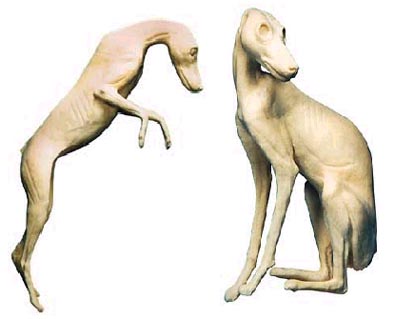
Red fox taxidermy mannequins. There is no red fox taxidermy mannequin anywhere in the world that has a chest span of greater than 14 inches.


At the side of every show ring, there is always some well-dressed individual talking about "the standard" and how "form follows function."

It all sounds good, of course -- wonderful rhetorical chestnuts -- but it's pretty much nonsense.

I mean think about it. A working dachshund is a great little animal in the field and does the same work as a terrier, but it does not look like a terrier, does it?

By the same token, a Patterdale Terrier does not look too much like a Jack Russell, which does not look too much like a Border Terrier. Smooth coats and rough do equally well in the field, as do coats of black or white, red or brown, or any combination in between. A folded ear is the same as a prick ear, a black nose the same as a liver-colored nose. Every working earth dog breed has a different head shape, and many have different tails as well. A perfect scissors bite is not necessary for work.

So when people say "form follows function," what the hell are they talking about?

Let us hope they are not talking about movement. Movement is one of those words show people toss around with a wink and a nod as if they have the secret knowledge of a wine connoisseur.

It is pure bunk. "Movement" may be important to a greyhound, a pulling dog, or even a border collie, but it is not much of a concern as it relates to a working terrier. So long as a dog can walk well, and has decent muscle mass, it can work fine. Hocks in or out hardly matters a whit.

Which is not to say that movement is irrelevant to terrier work. In fact, it is critical. But the important movement is .... wait for it .... an owner that will move off the couch, and move out of the car, and move into a hedgerow, and move a lot of dirt while digging down to a dog that is in full voice with rising adrenaline. That's the only important part of movement that matters. After you have done that a few dozen times, you will know a little more about movement, and terriers in particular.

We hear a great deal of nodding nonsense from folks who talk a good game about "protecting" their breed. But protect it from what? And by what right or qualification do these people think they are particularly well chosen to protect the bred? And what do they intend to protect it with?

In almost every case they are people who do not dig, and who seek to "protect" the terrier with nothing but a scrap of paper proclaiming a show dog "up to the standard."

And who do these people hope to protect the breed from? Why, show ring breeders, of course!

It is all laughable nonsense. And it becomes nonsense on stilts when people begin to talk about "the standard" as if it were a sacred text delivered to Moses on the Mount.

In fact, is there anything standard about "the standard?" I defy you to find a single canine standard that is more than 20 years old that has not been changed at least once.

And then there is the little matter that the standard is not the same from one country to another, or one registry to another. So what is so "standard" about the standard?

Ironically, what is NOT part of any standard in the UK or the US, is a requirement that the dog actually be a proven worker in the field. That, apparently is not "the standard." That function is not required for the rosette. A black nose, is a "Yes," but working a dozen fox, raccoon, badger, or groundhog in the field, is a "No."

The one issue of any importance in "the standard" as it relates to "form follows function," is chest size. Yet on this point, "the standard" is awfully vague, isn't it?

We are told a chest span is a man's hands. Yes, but whose hands? We do not measure a house in cubits, so why are we measuring dogs in "hand spans"? Who but the puppy peddler profits by keeping chest measurements this vague?

The Germans are not so coy and facile about chest size. A standard working dachshund (a "Teckel" in German) has a chest of just under 14 inches. The measurement is precise -- 35 cm -- and it reflects the chest size of the average red fox. The Germans are not ones to shave dice when it comes to working dogs.

It is interesing that the same 14" chest size is named not only by fox biologists, but also by such terriermen as Barry Jones, Ken James, and Eddie Chapman. In fact, if any one thing separates the digger from the rosette chaser, it's clarity on chest size.

The rosette chaser is always a bit vague about what a "span" actually means. A digger knows it means his fingers better well overlap, and if he is working fox in a natural fox-dug earth, it is best if his fingers overlap by more than one joint!

And so we come back to the real meaning of "form follows function" as used by academics in the dog world.

For these folks the "form" being refered to seems to be a paper form showing the pedigree of the animal being displayed. And "the function" is either the rosette from a show judge, or the cash to be gotten from a prospective dog-buyer.

Form follows function, indeed!

.

Thursday, December 6, 2007

Christmas Just Around the Corner

It's that time of year, with Christmas just around the corner.

As I do every year, I recommend making a donation in someone's name to the Heifer Project -- a good organization that gives farm animals and animal husbandry skills to impoverished people in the developing world. You can give modest gifts of a flock of chickens or ducks or a hive of bees, a goat or even a water buffalo. These are gifts that keep on giving and make the rural world a more sustainable and less frightening place.

A gift your dog will love is American Working Terriers. Order now to get it in time -- I do not stock them here and the JRTCA is sure to run out. While you are at it, order an American Working Terrier mug or shirt from one of the online stores at the right of this blog -- 100% of any money raised here (i.e. every dime over cost) goes to terrier rescue.

I used to tell folks to check out low-cost places like Cheaper Than Dirt , Sportmans's Guide, and Bargain Outfitters, but they are not the great deals they once were. Check them out anyway; time is money. Also take a spin at AM Leonard for great shovels (Ames Pony, D-Handle), and consider getting the greatest leather leash ever made (in my opinion), a 1/2" Eurolead.

.

Friday, September 14, 2007

Nannying Idiots Continue to Ignore Real Problems


I got an email tonight from Char (Pearl's first mom and breeder) letting me know that a woman in the U.K. has been jailed for violating the ban on tail docking that exists over there.

For those who do not keep up on such things, the new U.K. law states that only veterinarians can dock puppy tails, and that even then it can only be done if it is deemed to be "medically necessary."

Heads up. In this increasingly interconnected world, even stupid ideas in other countries can quickly creep in over here. A while back, for example, I received an email from Canada suggesting that the idea was gaining ground in that country. My correspondent wrote:

"I am writing you for help in clarifying a long standing dispute among terrier fanciers involved in conformation dog shows. I am involved in several traditionally docked terrier breeds (Lakeland, Fox, Welsh etc.) and it is becoming increasingly common to see these breeds undocked. Is there a functional purpose for docking tails? Is it required to work terriers?


Why I am supposed to be an expert on these things?

I don't know, but I guess I'm as good as the next guy to ask for an opinion. So here goes.

This is a European debate. You remember Europe. Europe is the place where the rivers are so polluted that the eels no longer run up the rivers to spawn, and where carp are considered a game fish. Europe is the place that has shot out almost all its wolves and bears. Europe is the place that colonized Africa and now lets Africans starve due to lack of aid or political intervention.

Europe has ignored these things, and decided that the the real horror in the world is docking puppy dog tails!

What morons.

The Brits were fools to follow Europe in this. Now let's hope Canada does not go follow the Brits, or I may have to burn my Joni Mitchell and Neil Young CD's.

Tail docking is a very minor procedure and does no harm to the dog. It is largely aesthetic and historical with certain breeds. That said, some terriers and other breeds have long thin tails that can be damaged when whipped in brush, worked in rock, etc. so they may benefit, medically, if they are docked. How often an over-thin and fragile tail is a real medical problem depends on the breed, the dog, how it works, where it works (and if it is worked at all).

A terrier's tail, of course, is an essential part of the dog, and I consider it a very stupid thing to dock a terrier tail too short. I always advise people to err on the side of leaving the tail too long. You do not want to lose a good handle on the rear end of a working terrier by being too quick or aggressive with a pair of tail nippers.

That said, a very long tail is of no use to a terrier, and could be a small health liability. A dog often has to exit a hole backwards and around curves. In that situation, a long thin tail could be a problem -- imagine exiting a tight and winding tunnel with a spring-pole stuck out behind you, and you get the idea. And then there are the thin tail tips that bleed when banged against rocks and brush.

Some caveats. At least one breed of working terrier does not have a docked tail -- the border terrier -- and neither do working dachshunds. The tail on a border, however, is a very solid thing and is not easily damaged. If you cannot pick up a border terrier by its tail and throw it over a fence, it's not a true border terrier. A tail that is left intact on a working Jack Russell terrier, however, often ends up being very long and thin, and as a consequence it could be subject to real damage, and so it is generally docked.

Another issue for working dogs is that digging on a dog is not an absolutely precise thing, and so the length, form and placement of the tail becomes an issue. To put it bluntly, a long thin whippy tail trailing behind an underground dog could be subject to being trimmed by a shovel.

Has it ever happened to me or anyone I know? No. I am careful and my dogs rarely come in direct contact with a shovel. That said, it does not take too much imagination to think harm could result if a digger were very inattentive.

All in all, however, and as I said before, tail docking is mostly done for cosmetic and historical reasons.

But so what? We do a lot of things for cosmetic and historical reasons. Why can't tail tail docking be one of them? For God's sake, people, let's use a little common sense!

People circumcise their children, women get themselves nipped for child birth (it's called an episiotomy), and every third teenager has a pierced tongue, nipple, eyebrow or navel.

Whole TV shows are devoted to full-body tattoos.

Women are getting breast implants or breast reductions, and men are getting hair transplants and scalp reductions.

Noses are bobbed, fat is sucked out, teeth are capped, botox is injected, and ears are being pierced, ringed, barbelled, and pinned.

Ever been to a PETA rally? If you look around, you will see a lot of metal hanging out of nostrils, off of eye brows, or rammed through tongues. Every other girl will be showing off her "tramp stamp" tattoo on the small of her back. God only knows what you might find ringed, belled and pierced if you were foolish enough to ever see one of these PETA lunatics standing before you naked. The mind shudders.

Consider PETA spokes-idiot Pamela Anderson, who not only married the walking Erector Set known as Tommy Lee, but who also got her own body repeatedly tucked, sucked, injected, lifted, dyed, bobbed, and implanted. And these people are worried about a ten-second tail nip? What on earth for?

There are real problems in the world, and this is NOT one of them.

The anti-tail docking people have no sensible rationale to oppose tail docking -- it is a ten-second thing done when the dog is one or two days old, and it is over with very little fuss or pain. People who love dogs more than their own lives have been doing it for generations -- proof alone that it is a small thing and does no damage to the dog while sometimes serving a health function in the field.

Here are some real things to worry about with dogs:

  • Closed genetic registries which mean that the genetic diversity of dogs is dramatically reduced in time, and with it the health of every breed with a closed registry (i.e. all Kennel Club breeds);
  • Fat dogs which do not see exercise and which have sad and shortened lives (about 1/3 of all dogs);
  • Slick floors in kitchens which increases the chance of hip dysplasia for all large canines (a serious and sad thing);
  • Poor fencing, poor obedience training, and the complete absence of tags and microchipping which means dogs are easily lost and frequently struck by cars.


These are REAL dog problems. Tail docking does not even come close to making the list of things to be concerned about -- in the world of working dogs or otherwise.

Not everything in the world needs to be legislated, and this is something that fits under the umbrella of "leave it alone and let freedom ring."

If a breeder of nonworking dogs wants to leave the tails on their dog long, so what? If a breeder wants a sensible working dog with a properly docked tail, so what?

What interest, business or concern is it of society?

None.

The tail docking debate is really about a very small but vocal sector of society wanting to be nannies to the rest of us.

As a general rule these people know very little about dogs, know nothing about working dogs, and do not give a rat's behind about honest animal welfare -- if they did, they would pick a real issue to take action on.

And there are a LOT of real animal welfare issues. How about habitat protection? How about disease control in wild animal populations (rabies, distemper, mange, tuberculosis, chronic wasting disease, West Nile)? How about pushing to lower the price of veterinary care and improving access to it as well? These are real issues.

Fair warning, however -- making a change in these arenas might involve actually going out into the environment with mud, bugs, rain and cold (Ugh!).

In addition, a real problem might be inconveniently complex and serious (God forbid!), and actually involve something more involved than self-righteous bullying of ignorant legislators and dog owners.

But of course, the tail-docking debate is not really about dogs, is it? It's about people who want to feel smarter and superior to others. These people will always be with us and I suggest they simply find something new to feel smarter and superior about.

If, faced with all the issues and problems in the world (hunger, violence, hurricanes, disease, lack of health insurance, war, poverty, illiteracy, racism, deforestation, violence against women, animal extinctions, loss of global fisheries, pollution, child abuse, etc.), someone thinks tail docking of well-loved pets and working dogs is a major concern worthy of time and energy, they are idiots.

Nannying idiots.

Nannying European idiots.

.

Wednesday, September 12, 2007

Border Terriers vs Border Collies


An older, but still great, commercial which illuminates the difference between a border collie and a border terrier.

.

Monday, August 20, 2007

A Quick History of American Terrier Work


A repost from this blog circa August 20, 2005.


For all practical purposes, the story of American terrier work begins in 1971 with Patricia Adams Lent, who founded the American Working Terrier Association to promote working terriers and dachshunds.

The American Working Terrier Association (AWTA) was, and is, a modest organization with fewer than 100 members. It has no headquarters or paid staff, and produces a simple Xeroxed newsletter four times a year. Its web site (as of 2005) has no information about actual hunting or wildlife, and is focused almost entirely on go-to-ground trials.

That said, AWTA is a very important organization in the history of American working terriers, not only because it was the first "club" devoted to the sport, but also because Ms. Lent invented go-to-ground trials, and the basic set of rules governing them.

Since 1971, go-to-ground trials have served as a kind of "on ramp" for actual field work. The basic AWTA format has been widely copied, first by the Jack Russell Terrier Club of America (1976) and then by the American Kennel Club (1994).

The origin of the American go-to-ground tunnel can be found in the artificial fox earths first constructed in the UK in the 1920s, but which came into their own in the 1950s and 60s with the collapse of so many ancient rabbit warrens under the onslaught of myxomatosis.

Artificial earths are generally constructed of two parallel rows of brick stacked three bricks high and topped by overlapping slates, or out of 9-inch clay or concrete drainage pipe laid end-to-end. The result is a very spacious and dry fox earth. If sited within 200 feet of a water source (it does not have to be large), far from residences, and on the edge of fields and small woods, the chance of a fox taking up residence is excellent.

The first artificial fox earths were constructed in order to guarantee that a fox could be found on hunt day, and to encourage fox to run along known courses away from roadways. That said, they also found favor because they proved easy locations for a terrier to bolt a fox from. Even an overlarge dog could negotiate the straight or gently curving unobstructed nine-inch pipes of an artificial earth.

The go-to-ground tunnels devised by Patricia Adams Lent were constructed of wood instead of stone, brick or clay pipe, but were equally commodious, measuring 9 inches on each side with a bare dirt floor for drainage and traction.

From the beginning AWTA's goal was to be inclusive. Scottish Terriers with enormous chests were encouraged to join AWTA, as were owners of West Highland Whites, Cairns, Norfolks, Norwiches, Border Terriers, Fox Terriers, Lakelands, Welsh Terriers and Bedlingtons. All were welcome, with the simple goal of having a little fun with the dogs, and perhaps giving American Kennel Club terrier owners some small idea of what actual terrier work was about.

In AWTA trials, wooden den "liners" are sunk into a trench in the ground. The tunnels are up to 35 feet long with a series of right-angle turns, false dens and exits. The “quarry” at the end of the tunnel is a pair of "feeder" lab rats safely protected behind wooden bars and wire mesh. The rats are not only not harmed, but after 100 years of breeding for docility, some lab rats have been know to go to sleep!

Without a doubt, go-to-ground trials have been a huge hit with American terrier owners. The interior dimensions of the den liners -- 81 inches square -- means even over-large terriers are able to negotiate them with ease. With nothing but a caged rat to face as "quarry," the safety of dogs is guaranteed, and since the dogs only have to bay or dig at the quarry for 90-seconds, most dogs end up qualifying for at least an entry-level certificate or ribbon.

Though the die-hard hunter may sneer, the increasing popularity of go-to-ground terrier trials is a welcome thing, for it has brought more people a little closer to real terrier work.

Owners of dogs that do well in go-to-ground trials should take pride in their dog’s achievements. Like all sports that emulate real work (lumber jack contests, bird dog trials, and sheep dog trials, to name a few), a go-to-ground trial is both harder and easier than its real-world cousin.

A dog that will exit a 30-foot tunnel backwards in just 90 seconds and on a single command (a requirement for earning an AKC Senior Earthdog certificate) is a dog that has been trained to a fairly high degree of proficiency.

Having said that, it should be stressed that a go-to-ground trial has little relationship to true hunting. In the field dogs are not rewarded for speed. In fact, if a hunt terrier were to charge down a real earth like it were a go-to-ground tunnel it would quickly run into quarry capable of inflicting real damage.

In addition, in a real hunting situation a dog must do a great deal more than “work” the quarry for 90 seconds. A good working dog will stick to the task for as long as it can hear people moving about overhead – whether that is 15 minutes or three hours.

The real division street between go-to-ground and earthwork, however, is size. And the real problem with a go-to-ground trial is not that it teaches a dog to go too fast down a tunnel (dogs understand the difference between fake liners and real earth), but that it suggests to terrier owners that any dog that can go down a cavernous go-to-ground tunnel is a dog “suitable for work.”

To its credit, the American Working Terrier Association recognizes the difference between a go-to-ground tunnel and real earth work, and implicitly underscores this difference in its rules for earning a Working Certificate.

AWTA rules note that a terrier or dachshund can earn a working certificate on woodchuck, fox, raccoon, badger, or an “aggressive possum” found in a natural earth, but that “this does not include work in a drain or otherwise man-made earth.”

In short, a drain is not a close proxy for a natural earth, and terriers that are too large to work a natural earth do not meet the requirements of a working terrier.

The American Working Terrier Association issues Certificates of Gameness to dogs qualifying at their artificial den trials. Working Certificates are awarded to dogs that work groundhog, fox, raccoon, possum, or badger in a natural den provided that at least one AWTA member is there as a witness. AWTA also issues a Hunting Certificate to a dog that hunts regularly over a period of a year.

Six years after the American Working Terrier Association was created, Mrs. Alisia Crawford, one of the first Jack Russell Terrier breeders in the U.S., founded the Jack Russell Terrier Club of America (JRTCA)

Ms. Crawford and the early founders of the Jack Russell Terrier Club put a lot of thought into structuring the JRTCA so that work remained front and center. Towards that end, the club decided that its highest award -- the "bronze medallion" -- would not go to show dogs, but to working dogs that had demonstrated their ability in the field by working at least three of six types of American quarry -- red fox, Gray fox, raccoon, groundhog, possum, and badger -- in front of a JRTCA-certified field judge.

In the show ring the JRTCA decided to ban professional handlers as it was thought this would keep the shows fun and less important than the essential element of work.

Instead of mandating the kind of narrow conformation ranges demanded by the Kennel Club for their terrier breeds, the JRTCA divided the diverse world of the Jack Russell Terrier into three coat types (smooth, broken and rough), and two sizes (10 inches tall to 12.5 inches tall, and 12.5 inches tall to 15 inches tall).

"Different horses for different courses" became a watch word, with overt recognition that the world of working terriers required dogs able to work different quarry in different earths, and in different climates.

Unlike the Kennel Club the JRTCA also decided to keep their registry an "open" registry so that new blood might be infused at times. At the same time, the Club discouraged inbreeding and eventually restricted line breeding to a set percentage.

To balance off an open-registry with the desire to keep Jack Russell-type dogs looking like Jack Russells, the JRTCA decided not to allow dogs to be registered at birth or to register entire litters. Instead, each dog would be photographed from each side and the front, and admitted to the registry on their own merit, and as an adult. In addition, each dog had to be measured for height and chest span.

What this meant is that at the time of registration, the height and chest measurement of an adult dog could be recorded. Over time, both height and chest size could be tracked through pedigrees -- an essential element of breeding correctly-sized working terriers.

The JRTCA was not shy about their rationale for these rules: they openly and emphatically opposed Kennel Club registration, maintaining that time had show that dogs brought into the Kennel Club quickly grew too big and often lost other essential working attributes such as nose, voice, and prey drive.

Today the Jack Russell Terrier Club of America is the largest Jack Russell Terrier club and registry in the world, and its Annual National Trial attracts approximately 1,200 Jack Russell terriers from all over the U.S. and Canada.

The JRTCA's small professional staff cranks out a solid bi-monthly magazine that is 80-100 pages long, holds a regular schedule of dog shows, and sells deben locator collars, fox nets, and a host of other items ranging from hats and jackets to coffee cups.

The web site of the Jack Russell Terrier Club of America ( http://www.terrier.com/ is one of the very best dog sites in the United States, packed with well-presented information, high-quality graphics and a user-friendly layout.

Perhaps the most important service work of the JRTCA are the ads that the Club routinely runs in all-breed publications warning people that Jack Russell Terriers are not a dog for everyone, are primarily a hunting dog, and are not like the cute dogs seen on TV.

Sometime in the last 1990s, following the appearance of Jack Russell Terriers in a host of TV and Hollywood productions ranging from "Wishbone" and "Frasier" to "My Dog Skip" and "The Mask," the American Kennel Club decided to add the Jack Russell Terrier to its roles.

As they had previously done with the Border Collie, the AKC ignored the strong opposition of the large existing breed club, and quietly assembled a new club of show-ring breeders to serve as their stalking horse.

The "Jack Russell Terrier Breeders Association" (later called the Jack Russell Terrier Association of America, and now called the "Parson Russell Terrier Association of America") petitioned for the admission of the Jack Russell Terrier into the Kennel Club and, despite the objections of the JRTCA, the breed was admitted in January of 2001.

The admission of the Jack Russell Terrier into the American Kennel Club was a contentious affair, with the JRTCA standing firm on its long-held rule that no dog could be dual-registered.

What this meant is that breeders had to chose whether to remain in the JRTCA or to "get in early" with the AKC before they closed their registry.

Some of the breeders that chose the AKC did so because they thought they could then sell their puppies for more money, others were eager to be the "big fish in a small pond" at the beginning of a new AKC breed registry. Still others were anxious to attend more dog shows,.

Whatever the reason, the Kennel Club required that the Jack Russell Terrier breed description be narrower than that of the JRTCA. The goal of a Kennel Club breed description is to craft a narrow "standard" -- the wide variance in size, coat and look allowed and encouraged in the world of working terriers would not do.

The American Kennel Club breed standard stipulated that an AKC Jack Russell terrier could not be under 12 inches in height nor over 15 inches in height, and further stipulated that "ideal" dog was 14 inches tall and the ideal bitch was 13" tall.

Ironically, this breed description effectively eliminated about 40% of all the American dogs that had actually worked red fox in the U.S.

More importantly, this narrow standard eliminated the small dogs necessary to "size down" a breed -- something absolutely necessary in order to keep working terriers small enough to work.

Of course the American Kennel Club has never been interested in working terriers and the breed club they created has shown no interest in work either.

Under continuing pressure from the working Jack Russell Terrier community in England and the U.S., the British and American Kennel Clubs decided to jettison the "Jack Russell Terrier" name to more easily identify the non-working show ring dog they favored.

Now called the "Parson Russell Terrier," the AKC dog is quickly getting too big in the chest to work -- though not many dogs are actually taken out into the field to try.

After just three years in the Kennel Club, the "Parson Russell Terrier Club" tried to modify the show ring standard so that the dog no longer had to be spanned. In fact, many Kennel Club judges do not know how to span a terrier and many do not do it as a consequence.

In 2001, the United Kennel Club started an "earth work" program modeled after that of the Jack Russell Terrier Club of America. The UKC working terrier program remains small, with relatively few judges, and it does not appear to be growing very rapidly.
.

Friday, December 8, 2006

A Bit More on the Border-Patterdale Connection


In the last post, I talked of how Joe Bowman, Huntsman for the Ullswater, was the person to coin the term "Patterdale Terrier," and that he had also been an early breeder of Border Terriers.

In previous posts, I have noted that the Border Terrier is itself a relatively young breed, created from Fell Terriers at about the time the Kennel Club was first created.

To add a point to the pencil, it's worth putting a few pictures side-by-side and fleshing out the relationships and history a little bit more. The picture at top is an early "Patterdale Breed" terrier. This picture comes from Foxes, Foxhounds & Foxhunting by Richard Clapham, published in 1923.

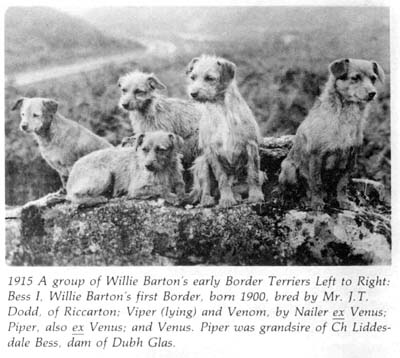
The picture below is of a group of early Border Terriers, taken in 1915. This picture is from Walter Gardner's book, About the Border Terrier.


The first Border Terrier entered on to Kennel Club roles to win a working certificate was a dog by the name of Ivo Roisterer, born on August 12, 1915, and receiving his working certificate in 1920. His pedigree is appended below, and clearly shows his great grand sire and great grand dam were from the Ullswater Hunt at a time when Joe Bowman was Huntsman.


The picture, appended below, shows Joe Weir, the Ullswater Huntsman that replaced Jow Bowman. Like Bowman, he held his position for an incredibly long period of time, from the 1924-1971 -- a period of 47 years. The dog in Joe Weir's arms is "Butcher" -- a picture apparently taken after a rescue. This photo, taken sometime in the late 1940s or 1950s, shows a dog very much like Joe Bowman's "Patterale Breed" and also very much like the early Border Terriers. It says quite a lot that this dog could be called a Border Terrier, a Patterdale Terrier, a "Fell Terrier," or a "Working Lakeland" -- evidence enough that all of these breeds are so closely related, and so recently differentiated, as to be interchangeable just a generation ago.

Of course, now we have generally decided that a "Patterdale" is a smooth or slape-coated black dog, while a "black Fell" is a rough-coated black dog.

Perhaps some day we will do away with names all together and simply divide the world of terriers as they should be cleaved: Dogs that work (regardless of color, coat or name) and those that don't. If we look at what we see in the field today, we can broadly state that Border Terriers tend to line up in the latter camp, while Patterdale Terriers tend to still reside in the former.


Thursday, December 7, 2006

Joe Bowman's Patterdale


Joe Bowman, the Ullswater Huntsman, from Foxes, Foxhounds & Foxhunting
by Richard Clapham, published in 1923.


Most of the folks that write books on dogs would like their breeds to be ancient and have romantic and mysterious origins. Pick up any book on Jack Russell Terriers, for example, and Trump will be presented as the first white foxing terrier on earth -- never mind that the young John Russell selected it for looks alone and had no problem finding another white foxing terrier to mate with it.

The Border Terrier folks have wrapped the story of their dog completely around the axle in an attempt to give it an ancient origin. In fact this breed was created at about the same time as the Kennel Club was created, and it was pulled on to the Kennel Club roles as quickly as could be.

As for the Patterdale Terrier, quite a few people claim one person or another created the dog, and yet all seem quite confused as to the shape of the head. Where did that come from?

In fact it is no mystery, and the true story of the Patterdale is not too deeply buried or very old.

In 1873, the Patterdale and Matterdale hunts were combined to form the Ullswater Foxhounds. In 1879 Joe Bowman (just 22 years old) was made master of the Ullswater, a position he held (with a few short interruptions) until 1924, when he was replaced by Joe Wear who held the position for then next 47 years. Joe Bowman died in 1940 -- one of the most famous huntsmen of all time (there is even a song about him)

Joe Bowman was an early Border Terrier breeder, and he was also the first person to cross up a blue-black Border Terrier with a black and tan Fell Terrier (also called a working Lakeland) to create what he called a Patterdale Terrier.

In Jocelyn Lucas' book, Hunt and Working Terriers, a table at the back notes that the United Hunt preferred a "Lakeland, Patterdale, from J. Boroman's strain (Ullswater kennels)."

In fact, "J. Boroman" is a typo, and the real man was Joe Bowman.


From Appendix II of Jocelyn Lucas' Hunt and Working Terriers (1931).


Lucas published his book in 1931, and the information in it was collected between 1925 and 1930. The Patterdale Terrier was clearly a type (if not a widely used type) by the 1920s, and it centered on the Ullswater Hunt and Joe Bowman.

With that knowledge, it was not too difficult a thing (but not too easy either!) to lay a hand on Foxes, Foxhounds & Foxhuning by Richard Clapham, published in 1923. Here we find not only a good picture of Joe Bowman (see top), but the picture reproduced below with caption. Click on the picture for a larger image.


"One of the 'Patterdale' breed."
Click on the picture for a larger version.

Now we can see that the Patterdale name goes back to at least the Nineteen-teens, a period just before the Border Terrier (which, like the Patterdale, started out as little more than what we would call today a Fell terrier today) was pulled into the show ring. To see what Border Terriers looked like in 1915, click here.

At about the time that Joe Bowman was fading out of the dog breeding business, in the 1930s, a young Cyril Breay was stepping up. Breay, like Bowman, had been a Border Terrier breeder.

In the early 1930s Breay met Frank Buck, when Buck rescued one of Breay's dogs that had gotten stuck in a deep rock cleft and Buck -- an expert at dynamite -- had blasted it free.

Bucks own line of dogs at the time were descended from Ullswater terriers kept by Joe Bowman, and Breay and Buck soon became fast friends with Breay breeding black dogs from Frank Buck into his line, and Buck crossing tight Border Terrier coats into his. Over time, the dogs of the two men devolved to a type as lines were crossed and condensed.

Cyril Breay was always adamant that the Patterdale Terrier was not made by crossing in Bull Terrier, and he was not lying. The Patterdale head is no mystery to a border terrier owner - the same broad cranial outlines are evident in both breeds.

Brian Nuttal began breeding Patterdales in the late 1950s, and says that his dogs are very much like those his father kept in the 1930s. It would not surprise me a bit to find that Nuttal's father got his dogs from Bowman, or from intervening hands that had gotten their dogs from Bowman. What is clear is that the Patterdale Terrier was already a recognized type by the time Nuttal's father owned his dogs.

The fact that Joe Bowman started the Patterdale strain and named it takes nothing away from folks like Cyril Breay, Frank Buck and Brian Nuttal, all of whom did quite a lot to popularize the breed, maintain it as a working dog, and perhaps improve and stabilize its looks. It is an easy thing to name a new breed (it's done every day by puppy peddlers), but quite another to find a market and a following for the dogs based on their performance in the field.

I mention all of this (I have told the story before and it is in the book), because I found a rather interesting old obituary on the internet the other day. Note the byline. With some amusement I note that "Greystoke Castle" was (supposedly) the ancestral home of Tarzan:


September 1956
PATTERDALE - One of Ullswaterside’s oldest residents, Mrs. Esther Pattinson, Broadhow, Patterdale, died at the age of 85. Formerly Miss Bowman, Matterdale, she hailed from a noted hunting family — her uncle was the celebrated Joe Bowman, huntsman of the Ullswater foxhounds for 42 years, while her great-grandfather, Joe Dawson, was for many years huntsman of the one-time Matterdale foxhounds. Mrs. Pattinson was only 13 years of age when she was hired as a farm girl, later working at Lyulph’s Tower for Mr. James Wood, who was agent for Lady Mabel Howard, Greystoke Castle.


In the end, it turns out that Joe Bowman was born in Patterdale -- a perfectly good reason for him to give a nod to the spot. It was, no doubt, an added bonus that Patterdale was also the old name of the Hunt that was both his employer and his passion. Finally, it should be noted that Patterdale was also the town where Joseph Dawson Bowman died, at the age of 88.
.

Sunday, September 24, 2006

Breed Clubs Do Not Run the AKC: Money Does


[Permission to cross post. Also see: this related story ]

Following the signing of a contract with puppy-mill distributor Petland, the American Kennel Club has begun to feel the heat.

Odds are still 7 to 3 that nothing will come of the protests (the AKC staff does not give a rat's ass what the breed clubs say), but there have been some small bursts of eloquence, nonetheless.

Former AKC Board member and current AKC judge Patricia Laurans (an eight-time Westminster judge) told the AKC Board (click on link for PDF of AKC Board Meeting minutes):


"I would like to call attention to every single Parent clubs’ that I know of code of ethics that says we will not sell to pet stores.

"I would like to call attention to the fact that, from my humble belief, we are selling our birthright for a few shekels.

"I would like to call attention that this is a club of clubs and that we are your constituency. We are the groups that are asked to help out with medallions, to work at shows, to educate the public, to make our clubs and our events more friendly so we can help increase registration on a volunteer basis.

"I would like to make note of the fact, and pardon me, I feel we are prostituting some of our values, I feel we are going against what I believe most of the members and member clubs would want to see happen, and I feel that we should have at least had some sort of way to give you our thoughts before contracts were signed, sealed and delivered. You said, and I supported the fact, that we don’t want to let the enemy in. I question the fact right now if the enemy is already here."

What was the reaction of the AKC hierarchy to this speech? Basically, they patted Ms. Laurans on the head, told her she was a naive fool, and asked her to shut up.

For example, Steven Gladstone, who is on the current AKC Board, said:


"With all respect, Pat, we have been taking their money for 75 years and cashing their checks....we have got to accept the fact, we are taking their money; and, yes, ... we are endorsing them with our papers. We are telling the world these people meet AKC standards. Now, you may not like that, but the fact is that we have lived off of that for the last 60 years."

David Merriam, Vice Chairman of the AKC Board of Directors, said:


"What has changed is that we have competitors, and these competitors now are in the pet stores. They’re in the commercial channels. And they say, 'Okay, it costs $15 to register a puppy, XYZ Registry will do it for $12, and we’ll kickback three dollars to the pet shop.' That’s the competition we’re in, and don’t believe that it hasn’t had an effect on our registration.

Every meeting, Jim Stevens relates the decline of our registration. If we are going to address this in a serious, honest and a realistic way, we have got to address that segment of the registration. That is the commercial. And that’s simply the answer.

If you want to tell the Board and your fellow clubs that we are willing to go inward, support ourselves, pay the price, then that’s a direction you can go. But I think if we go that direction, the American Kennel Club will not exist 100 years from today."

Bottom Line:What the breed clubs think has as much chance of shaping the AKC as rain water on a stone.


And besides, what are the breed clubs going to do, resign?

It would not matter to the AKC if they did. Look at the Border Collie and the Jack Russell Terrier to see what the AKC does if an existing breed club will not drink the toxic Koolaid being offered up. In both cases the AKC simply went out and recruited an ego-hungry group of fools to start a new breed club that was more than ready and willing to follow AKC staff direction.

At this point in the game, registrations and money wag the dog in the AKC, and the breed clubs have little or no control over what the AKC does.

And from the AKC staff's perspective, why should they? After all, it's not like the AKC breed clubs are a major financial engine within the organization.

In fact, from a purely cash-and-cost point of view, the breed clubs are revenue calfs sucking money out of the AKC -- a lot of money

The folks paying the bills -- the cash cows producing most of the milk -- are the dog breeders who are not members of breed clubs, and whose canine philosophy can be boiled down to two short sentences: "Puppies are cute," and "I clear $3,000 a litter."

Of course the AKC is no better than these a cash-and-carry dog breeders. For them too, a litter of dogs is nothing but a profit center.

As for the Board of the AKC, they appear to be led by idiots. Business plans are not supposed to be 100 years long -- not even the Chinese think like that. Nor is the "Big Box Store" the best business plan model for the AKC. When people purchase a dog, they are not supposed to think of the animal as a bulk commodity, like beans and rice, but as a one-off purchase of a thing of quality. But that point of view is apparently not shared by the current Board of the AKC which voted 12-to-1 in favor of the Petland contract.

In truth, the AKC has fallen down a manhole. For as long as I can remember, their focus has not been on doing the right thing for dogs, but on keeping the money flowing.

Mr. Merriam, it appears, is more than willing to sacrifice principle and prestige to keep the Club going, but he is not willing to remake the AKC so that it is an organizaton identified with high-quality healthy dogs able to engage in performance functions. And above all, he is not willing to tender the idea of the AKC ever going out of business.

It seems that in the struggle to keep the doors open at the AKC, certain things can be discussed (like endorsing puppy mills), but others cannot (like moving out of their Madison Avenue digs in New York City in order to save millions on rent and salaries). The AKC Board of Directors and staff are willing to sacrifice dogs for cash, but they are not willing to tuck in the belt or pack up the bag for a move to Minnesota.

This is not to say that the AKC staff and Board of Directors do not have a clear view on some things. They are clearly right when they say the folks in the breed clubs are naive. After all, the AKC has been sucking on the puppy mill teat for more than 60 years - - on this point, nothing has changed.

Nor has this information been closely held: just "google" AKC and "puppy mill" and see how many hits you get.

Nor is the only AKC problem the "big wink" of puppy mill money. No one in the world of dogs can have possibly missed the genetic decline in dogs that has occured over the course of the last 60 years. The causal reason here is that the AKC and show ring afficionadoes continue to embrace the failed eugenics theories of the 19th Century (see Inbred Thinking for more on this topic).

And so we get down to it now, don't we? Will the AKC representative of the Border Terrier Club of America resign in protest and will the Border Terrier Club disenthrall itself from the AKC? Will it matter if it does? How about the representatives of the Parson Russell Terrier Association of America? What will it do? How about all the other breed clubs?

My bet is that the Board of Directors and staff of the AKC are betting right in their calculations.

In the end, most breeders and show ring enthusiasts in AKC breed clubs will lower their heads and shuffle forward like cattle. They have always done so in the past. A few dozen may bawl and mew, and one or two may even jump the fence, but it's a big country and the AKC will replace them quickly and move forward.

In truth, I think very few people will make a stink.

And why should they? After all, the AKC is simply doing what it has always done. In for a penny, in for a pound.

It would be silly for anyone in the AKC quit over the Petland deal because, as AKC Boad of Directors Chairman David Merriam notes, all the AKC is doing now is telling the truth and putting their ethics in the front window for all to see. Anyone who quits now is quiting not because of the practice of taking cash and doing business with puppy mills, but because they are embarassed at being seen as part of the deal.

To which I can only advise: "Don't do things you are ashamed of." But then, I am a bit of a Puritan, aren't I?.

As for the AKC, their longterm business plan is not much of a secret. The AKC has teamed up with the Humane Society of the United States and PETA to push for legislation mandating the microchipping of all pets. This is a great idea as far as the AKC is concerned, as they happen to own one of the most popular microchip products around. PAWS legislation would, in effect, be a multi-million dollar subsidy for the AKC.

The AKC is also getting into the heath care and insurance business -- two notoriously crooked arenas. The AKC figures it will be able to make many millions of dollars in kickbacks from veterinarians, while the veterinarians will get a steady supply of gullible customers -- a win-win for everyone but the consumer.

Gilding the lilly is the fact that the AKC will have a steady stream of veterinarians willing to speak up and testify on the AKC's behalf should a reporter come poking around asking hard questions. The veterinarians, in turn, will give the AKC their "seal of approval" (doctors are generally trusted by the public), while the AKC will give the veterinarians their seal of approval (after all, who is better qualified to "certify" a veterinarian than the AKC?).

At the same time that all this is going on, the Humane Society, PETA and other lunatic fringe "animal rights" groups have been successfully pushing legislation that would require all non-show dogs to be neutered or spayed. These laws are ostensibly designed to reduce the number of "unwanted" puppies in America, and mandatory spay-netuer laws have already been embraced in Los Angeles and San Francisco, and are under consideration in places as diverse as Sacramento, New Jersey, and Virginia.

Is it just a coincidence that these mandatory spay-neuter laws will have a very positive benefit for the AKC? After all, if enough of these laws are passed, the end result will be that almost every dog in America will come from a show breeder (most of whom will be affiliated with the AKC) or a commerical breeder (with whom the AKC will have a licensing contract). How perfect is that?

The AKC says it opposes mandatory spay-neuter laws, but their opposition has been pretty tepid as far as I can see. In truth, I suspect the AKC is simply on the road to another "Big Wink" in which they profess to oppose something (like puppy mills) even as they maneuver to make more money from the "inevitable" (like puppy mills).

Like Brer Rabbit they warn, "Don't throw me into that briar patch."


Why are all of these shenanigans necessary? To put it simply, this puppy-mill seal of approval scheme is necessary because the American Kennel Club is producing a product fewer and fewer people are willing to buy. The secret is out that Kennel Club dogs are no better than any other kind of dog.

In fact, due to the Kennel Club's long embrace of inbreeding and line breeding, AKC dogs may be less healthy than a cross bred dog collected from the pound.

Failing businesses are insidious places because owners and managers are so often willing to do unethical things in order to try to stay afloat. In a failing church the pastor may torch the building for the insurance money. In a failing dry cleaning business, the proprietor may report only a portion of his income to the IRS. At a failing construction company, the owner might stop making OSHA-required safety improvements or stop paying into the pension fund. And, of course, at the AKC you end up endorsing the puppy mill industry and price-gouging veterinarians.

From the point of view of the AKC Board of Directors, of course, "something" had to be done to bring in more money. After all, the Club is only running a net profit of $5.7 million a year. Clealy what is needed is more money, more money, more money.

The problem is that while are a thousand and one ways to spend money at the AKC (an expensive building on Madison Avenue, an expensive New York City staff, a magazine that no one reads, lawyers and lobbyists, lots of travel, etc.), there are precious few ways to raise revenue.

Forget the dogs shows -- they consume money (a $10 million loss in 2005), they do not produce it. Behind every AKC rosette is puppy mill dog making that rosette possible. Say what you will, but the AKC is not givng up those rosettes. The show must go on.

Which leaves us with the central dilemma faced by the AKC Board: How to "make the nut" from year to year.

A core element in the AKC solvency scheme has always been to mass-produce registrations for mass-produced dogs. And really, the AKC is not doing anything different now than what it always has.

Sure it's a bit of a leap in the dark and a calculated risk that there will not be a mass exodus of dog breeders from the AKC's roles.

But the AKC has done the math, and they know their audience and their business. That audience is human, not canine, and the business is ego, not better-bred dogs.

And so, when the day is done, I expect a small flury of outraged mewing and bawling from the cattle, but in the end most will march smartly through the gate at their next AKC show.

Sure a few old cranky's will walk away in a huff, but so what? The AKC is a business, and the bottom line is the bottom line.

In a few years the Petland deal will be seen as a "normal" thing, and the new cattle coming into the feed lot will pay it no mind, while the AKC itself will be able to "keep on keeping on" -- Madison Avenue offices, inflated salaries, and puppy mills profits as usual.


,

Sunday, February 12, 2006

The Transvestite Terriers of Westminster

Example


People who care about working terriers are generally dismissive of the Kennel Club, for the simple reason that they know what the Kennel Club has done, through either omission or comission, to the working terriers they care about.

The simple fact is that no working terrier has ever been created by the Kennel Club, but every working terrier breed that has been drawn in, has been destroyed there.

The Reverend John Russell noted the negative impact of dog shows on working terriers -- he judged only one show (when he was a very old man), and he swore he would never do it again!.

Though the destruction of working terriers started with the Allied Terrier Shows run by Charles Crufts in the U.K. (Crufts was a dog food salesman who never even owned a dog himself!), the Americans quickly got into the game as well.

A quick historical tour of "Best in Show" winners at the Westminster Kennel Club Show in New York City suggests the intense attention given to terriers at the turn of the 20th Century.


  • The first "Best in Show" winner at Westminster in New York City was in 1907. This first "Best in Show" winner was a smooth fox terrier that looked a little bit like today's Jack Russell.
  • Fox terriers won again in 1908, 1909, 1910, 1911, 1915, 1916, 1917, 1926, 1928, 1930, 1931, 1934, 1937 and 1942.
  • A Sealyham (another working breed ruined by the show ring) won in 1924, 1927 and 1936.
  • Airedales made Best in Show in 1912, 1919, 1920, 1933, and 1936.
  • A bull terrier went Best In Show in 1918, and a Welsh Terrier in 1944.


As you can see, almost all the early winners were terriers
, and most of them were fox terriers.
It was during this period the face of the fox terrier was elongated and the chest enlarged by show ring breeders. Prior to World War II, if you were really intent on wining the top award at a dog show, you went into fox terriers.

Probably no breed could have survived such intense attention without being wrecked by fad, and the fox terrier certainly did not.

A popular line of rhetoric within the Kennel Club crowd is that individual breeders ruin the dogs, not the Kennel Club itself. This rhetoric is designed to absolve the Kennel Club of its responsibility for the genetic decline of working dogs. In fact, the rules and selection bias of the Kennel Club are a very large part of the problem -- every much a part of the problem as individual breeders (who have no power to reform the Kennel Club itself).

The genetic destruction of working dogs begins with the fact that the Kennel Club mandates that each breed club "close" its registry after an initial influx of "pure bred" dogs. In fact most breed clubs start with a very small base of dogs, and then move to close breed roles as quickly as possible in order to create economic value for the breeders that are "in" the club.

A closed genetic registry results in increasing levels of inbreeding and increased concentrations of genetic faults. In fact, Kennel Club dogs are so deeply inbred and rich with genetic defects that mapping the genome of Kennel Club dogs was one of the first tasks undertaken by genetic scientists eager to crack the human genetic code in order to eradicate diseases.

If you are looking for the gene associated with genetic deafness, it is rather hard trait to find in a random-bred human, cat or chimpanzee, but thanks to Kennel Club inbreeding, there are entire lines of deaf dogs, with deafness common to 25% or more of all puppies from some breeds. Genetic defects associated with ataxia, cataracts, dysplasia, and dwarfism are similarly easy to find by simply comparing one breed, or line of dogs, with another.

Along with a requirement that breed registries be closed, the Kennel Club rejects the notion that there should be a morphological continuum witin the world of dogs. In fact, "speciation" of dogs based on looks alone is what the Kennel Club is all about. Under Kennel Club rules and "standards," a cairn terrier cannot look too much like a norwich terrier, which cannot look too much like a norfolk terrier, which cannot look too much like a border terrier, which cannot look too much like a fell terrier, which cannot look too much like a welsh terrier, which cannot look too much like a lakeland terrier, which cannot look too much like a fox terrier, which cannot look too much like a "Parson Russell" terrier (the non-hunting, show-ring version of the Jack Russell Terrier).

The show ring is all about "breeds," and all about differentiating one breed from another. In the world of the working terrier, of course, the fox or raccoon or groundhog does not care too much what breed the dog is! In fact, the fox or raccoon cannot even see the dog it faces underground, as there is no light inside a den pipe. What the fox cares about is whether the dog can actually reach it at the back of the sette. The good news (at least as far as the fox is concerned!) is that a Kennel Club dog often cannot get very close to the quarry . The reason for this? A Kennel Club dog is likely to have too big a chest.

The overlarge chests you find on so many Kennel Club terriers are a byproduct of putting too much emphasis on head shape and size. By requiring all the terriers to be morphologically distinct from each other, the Kennel Club puts tremendous emphasis on heads. People who do not dig much (if at all) imagine that a big head is important to work. In fact, it really is not; most small cross-bred working terriers have heads big enough to do the job, and are well-enogh shaped to boot.

An over-emphasis on terrier head size almost invariably leads to a larger chest size on the dog -- a bigger chest size is needed to counterbalance the larger head, since one is attached to the other. A large chest size, in turn, results in a dog that cannot easily get to ground in a tight naturally-dug earth.

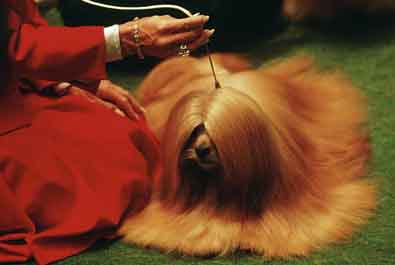
The end result is what we see in the Kennel Club show ring today -- transvestite terriers. These dogs may LOOK like they can do the part (and they are so eager!), but when push comes to shove, most of them lack the essential equipment to do the job, whether that is chest size, nose, voice, brains or a game and gritty character.