Showing posts with label Eddie Chapman. Show all posts

Wednesday, April 16, 2008

How to Breed Small & Avoid the Show Ring Trap

Terrierman Eddie Chapman writes in The Real Jack Russell Terrier (1993):

"Breeding good small Jack Russells, and I do mean real good ones, that are a genuine strain of 10" to 12" type, is the biggest and most satisfying challenge of all in Jack Russell breeding circles, not only from a show point, but a working one as well, for there is nothing a South Country hunt terrier man admires more than a real good small one....

"People have asked me for years just how I always seem to be able to breed Jack Russells that are of a very handy size, and the answer is quite simple .... I first of all need the smallest of workers and here lies my secret, for I have always had a policy that whenever possible I have always put a stud dog on a bitch that was smaller than the bitch, which the majority of show-only breeders will realize is the complete opposite of they way they breed. Having my small line enables me to do just that with my larger bitches, so I am forever breeding down hill as it were."

"If you are a worker of Jack Russell terriers you will find over the years that you will always be plagued with the problem of keeping to a handy size, and particularly so if you are a keen competitor in the show ring. This you will discover, is because the vast majority of the top show class study dogs are themselves in the bigger height range, and so to breed good lookers as well as good workers you find yourself compelled to use stud dogs in the higher range of the breed standard. It is, if one wants to look at it that way, one of the traps of the show ring."

Sunday, February 3, 2008

Cracking Tired Chestnuts About Form and Function


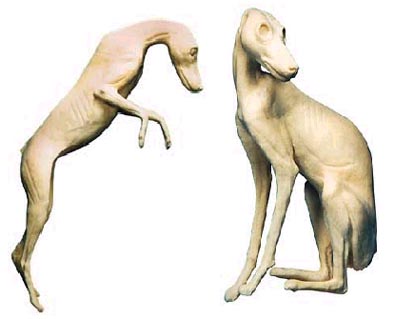
Red fox taxidermy mannequins. There is no red fox taxidermy mannequin anywhere in the world that has a chest span of greater than 14 inches.


At the side of every show ring, there is always some well-dressed individual talking about "the standard" and how "form follows function."

It all sounds good, of course -- wonderful rhetorical chestnuts -- but it's pretty much nonsense.

I mean think about it. A working dachshund is a great little animal in the field and does the same work as a terrier, but it does not look like a terrier, does it?

By the same token, a Patterdale Terrier does not look too much like a Jack Russell, which does not look too much like a Border Terrier. Smooth coats and rough do equally well in the field, as do coats of black or white, red or brown, or any combination in between. A folded ear is the same as a prick ear, a black nose the same as a liver-colored nose. Every working earth dog breed has a different head shape, and many have different tails as well. A perfect scissors bite is not necessary for work.

So when people say "form follows function," what the hell are they talking about?

Let us hope they are not talking about movement. Movement is one of those words show people toss around with a wink and a nod as if they have the secret knowledge of a wine connoisseur.

It is pure bunk. "Movement" may be important to a greyhound, a pulling dog, or even a border collie, but it is not much of a concern as it relates to a working terrier. So long as a dog can walk well, and has decent muscle mass, it can work fine. Hocks in or out hardly matters a whit.

Which is not to say that movement is irrelevant to terrier work. In fact, it is critical. But the important movement is .... wait for it .... an owner that will move off the couch, and move out of the car, and move into a hedgerow, and move a lot of dirt while digging down to a dog that is in full voice with rising adrenaline. That's the only important part of movement that matters. After you have done that a few dozen times, you will know a little more about movement, and terriers in particular.

We hear a great deal of nodding nonsense from folks who talk a good game about "protecting" their breed. But protect it from what? And by what right or qualification do these people think they are particularly well chosen to protect the bred? And what do they intend to protect it with?

In almost every case they are people who do not dig, and who seek to "protect" the terrier with nothing but a scrap of paper proclaiming a show dog "up to the standard."

And who do these people hope to protect the breed from? Why, show ring breeders, of course!

It is all laughable nonsense. And it becomes nonsense on stilts when people begin to talk about "the standard" as if it were a sacred text delivered to Moses on the Mount.

In fact, is there anything standard about "the standard?" I defy you to find a single canine standard that is more than 20 years old that has not been changed at least once.

And then there is the little matter that the standard is not the same from one country to another, or one registry to another. So what is so "standard" about the standard?

Ironically, what is NOT part of any standard in the UK or the US, is a requirement that the dog actually be a proven worker in the field. That, apparently is not "the standard." That function is not required for the rosette. A black nose, is a "Yes," but working a dozen fox, raccoon, badger, or groundhog in the field, is a "No."

The one issue of any importance in "the standard" as it relates to "form follows function," is chest size. Yet on this point, "the standard" is awfully vague, isn't it?

We are told a chest span is a man's hands. Yes, but whose hands? We do not measure a house in cubits, so why are we measuring dogs in "hand spans"? Who but the puppy peddler profits by keeping chest measurements this vague?

The Germans are not so coy and facile about chest size. A standard working dachshund (a "Teckel" in German) has a chest of just under 14 inches. The measurement is precise -- 35 cm -- and it reflects the chest size of the average red fox. The Germans are not ones to shave dice when it comes to working dogs.

It is interesing that the same 14" chest size is named not only by fox biologists, but also by such terriermen as Barry Jones, Ken James, and Eddie Chapman. In fact, if any one thing separates the digger from the rosette chaser, it's clarity on chest size.

The rosette chaser is always a bit vague about what a "span" actually means. A digger knows it means his fingers better well overlap, and if he is working fox in a natural fox-dug earth, it is best if his fingers overlap by more than one joint!

And so we come back to the real meaning of "form follows function" as used by academics in the dog world.

For these folks the "form" being refered to seems to be a paper form showing the pedigree of the animal being displayed. And "the function" is either the rosette from a show judge, or the cash to be gotten from a prospective dog-buyer.

Form follows function, indeed!

.

Friday, July 13, 2007

The Nonsense of Pull Dogs

.

This is a repost from this blog, circa Feb 2005:


In "The Working Jack Russell Terrier," Eddie Chapman writes:

"Something that makes my blood boil is when I hear terrier men talk about dogs they call Caesar dogs. They will show you a Russell type that has been bred too big and say, 'I use him as a Caesar dog'. If I ask what a Caesar dog is, they say it is a dog which will hold the badger, he won't let go,' they say. I have never heard such rubbish in my life. Besides being unnecessary, it is invariably cruel to the dog and more often than not he will be badly bitten for his pains. Besides that, it is unnecessarily cruel to the badger and the sort of behavior that got badger digging banned. I have tried to explain how to remove badgers from a sett without injury to dog or badger. There is nothing clever about getting a hard dog smashed up by a badger. On the contrary, it shows ignorance and a lack of responsibility and feeling. Bravery in a terrier should never be exploited."


I found it quite refreshing to read this passage, as I have often noted that there is is little reason to own a "pull dog" if you actually know how to handle things at the end of a dig. The use of "pull dogs" damages dogs and quarry alike and is wasteful as it often necessitates time out of the field and expensive veterinary work.

In the U.S., the use of pull dogs (what Chapman and some others call "Caesar" dogs) is to due to the prevalence of too many over-large terriers that cannot go to ground in a real earth. To say you have a "good pull dog," is to say you do not have a dog capable of actually going to ground.

If you have followed the Kennel Club dictates, and embraced a 14 inch tall dog with a 17" or 18" chest (or larger!), you are forced to rationalize a job for it. No matter that it is a stupid job forged in pain. Most people would rather see their dog injured than swallow their pride and admit they have drunk the Koolaid offered up by the Kennel Club know-nothings who think a fox den is as big around as a go-to-ground tunnel.

Another factor is that many people simply have no idea of how to handle quarry and so use the dog to to do the job. Having gotten to the end of a dig, they do not know how to get the animal out of the pipe, nor do they know how to dispatch it. In such a situation, the use of a "pull dog" is ignorance in motion.

The simplest way for a novice to handle quarry is with a snare. You can make your own for about $5, or else buy a pig snare from a feedstore. An alternative is a "coon tong" available from Bill Boatman's raccoon hunting supply catalogue.

Groundhogs can also be tailed out alive -- it is not hard if the groundhog's tail is presented, as it so often is. If very much of the pipe is remaining, however, you may find yourself in a tug-of-war with the groundhog who can jamb up inside a pipe so tightly that even a large man can have difficulty pulling one free.

Always use a snare for raccoons -- they can twist all the way around on their short fat bodies. They can grab you with their hands and have crushing bites. Rabies is not uncommon in raccoons, especially on the East Coast.

If you have entangled a fox in a net, be carefully when extricating the fox. The best advice is to pin the animal to the ground under your boot while removing the net. Work the net off the fox in sections, and then release it to hunt another day.

.

Tuesday, February 20, 2007

The Average Size of Fox


All kinds of nonsense is written and said to justify over-large Kennel Club terriers that cannot fit down a hole. Yet, when push comes to shove, a very small dog is needed. As Barry Jones, terrierman to the Cotswold Foxhounds, a former Chairman and President of the Fell and Moorland Working Terrier Club, and the founding Chairman of the National Working Terrier Federation writes:

"I have not encountered a fox which could not be spanned at 14 inches circumference - this within a weight range of 10 lbs to 24 lbs, on average 300 foxes spanned a year."


In his excellent book The Working Jack Russell Terrier, Eddie Chapman writes:

"I am a small man and have reasonably small hands, but in more than 20 years in which I have handled well over 1000 foxes, I have never handled a full grown fox which came anywhere near the span of my hands"
In Foxes, Foxhounds & Foxhunting, written in 1923, Richard Clapham notes that:

"With regard to the weights of foxes, these differ considerably in various parts of the country. Roughly speaking the average dog fox weighs about 15lb., and the vixen 13½lb. It is quite safe to say that nowadays there are far more foxes under than over 16lb. The heaviest fox I have a record of, killed by hounds, was one of 23lb, which was run into by the Ullswater on Cross Fell. This fox measured 4ft. 4in. from tip of nose to end of brush, about 4in. of the latter being white. On the Lakeland fells weights of 18lb. and 19lb. are not uncommon, and this season 1921-22 I handled a 19½lb. fox killed by a fell pack. Extra heavy foxes are occasionally accounted for in the Midlands. When Frank Gillard was huntsman to the Belvoir, his hounds on one occasion killed a fox of 17½lb."


What is interesting is how quick show ring breeders leap over the fact that the average fox weights less than 15 pounds -- so great is their need to find a fox that weights a great deal more so that their over-large dogs can be seen as "correct."

Sunday, April 17, 2005

A Well Written Book With Something to Say


Eddie Chapman's book, The Working Jack Russell Terrier, is one of the best books written on working terriers.

It is a very short book -- just over 100 pages long including 35 illustrations -- but it is enough because Chapman has something to say, and says it plain and without a lot of wind-up.

A key theme of the book is that a useful dog has to be small in the chest. Chapman writes:

"There is one point of a study dog's anatomy which is more important than any other and that is the size of the chest, or rib diameter if you like. The standard states that a Jack Russell should be capable of being spanned by the hands behind the shoulder blades. This, to my mind, is extremely misleading as any adult man and most women have a hand span which is bigger than the chest of an average fox. I am a small man and have reasonably small hands, but in more than 20 years in which I have handled well over 1000 foxes, I have never handled a full grown fox which came anywhere near the span of my hands.... It therefore follows that if I pick up a dog and can only just span him with a squeeze, then the dog cannot get to a fox in a tight place and a dog that cannot get to a fox in a tight place cannot be considered a Jack Russell. Either you are breeding a dog that is suitable to work fox or, if he is too big to get to a fox, you are just breeding for looks. This, of course, is what happened to the pedigree Fox Terrier and look where that has got him!"

Chapman writes later on in the book:

"[The Rev. Jack Russell] hunted the Exmoor area and was master of the North Devon Hounds. I know the country well and have worked my terriers in most of the Exmoor Earths off and on for nearly twenty years and at one time I was there professionally. So I think I can claim to know what sort of terrier is needed to work those earths efficiently. The earths in Exmoor are the same as those in which Mr. Russell worked his dogs. . . .

There are many hunt countries that have earths similar to the Exmoor and so they find it necessary to use the standard, small-chested Russell Terrier. I do not think I would be wrong if I spoke for all their men and said that good small dogs have a definite advantage over good big dogs in their bigger earths. They have more manoeuvreability in the bigger earths and the big dogs are useless in the small earths because of the size of their chests, so they are very limited in their use .... On the working side, I think if we look at the country as a whole, I think we will find that the most used size is between 10 and a half inches and twelve and a half inches."

The Working Jack Russell Terrier can be ordered from Coch-Y-Bonddu Books in Wales. This book is well worth the price, with nice chapters on handling fox, a chapter on locators/bleepers (I find it amazing that so many recent books never even mention them!) and hints on how to breed a proper-sized dog.

For other books on working terriers see Read Country Books. For the only practical book written on American working terriers, go here.
.

Monday, January 17, 2005

"Silence is Golden"


The Story, below, was written by Eddie Chapman and comes from Earth Dog - Running Dog, No. 20, December 1993, pp. 12-14. This was on a UK bulletin board and so someone else had to type it in, thank goodness.


To order Earth Dog - Running Dog magazine >> Click here.


To order copies of either of Eddie Chapman's two books >> Click here.


"I have been known to get quite hot under the collar when someone has interfered when a fox is about to bolt for besides upsetting the plan it is unfair on the terrier who has probably already worked quite hard to get his fox out. My most memorable occasion when this happened almost cost me my job for I was, at the time, doing terrier work for a pack on the Welsh border.


Hounds had met at a really big country house and the "Lord of the Manor" was an eighty year old ex-Master -- an arrogant old son of a bitch and as big a snob as one could possibly find. Hounds found immediately in a big old spinny near the house and after a short circuit of the property they marked to ground within three hundred yards of the meet.


It was a three hole earth but about twelve feet deep and I could see it would be a difficult dig....I asked the master to take hounds well back so that I could try for a bolt.....I slipped a little bitch, a cracker for bolting a fox....five minutes passed, then ten, but I was sure of a bolt....just then this old boy from the big house came ambling down the field with an even older looking terrier under his arm. I waved to indicate to him to keep back, or at least out of the line of fire....I shouted at him to keep back but as he reached the stream he threw the dog across and as the dog landed, so the fox

came to the entrance, saw both the dog and the old man, and did a quick about turn back into the earth.... I literally screamed at the master to get the old fool out of the way, swearing at him and leaping across the stream to tell him what I thought of him. I could hear the fox lay hold of my bitch as he turned back at her, which sent me into more of a rage.... I shouted to the master to take hounds on as there was no chance of a bolt now and he would probably not see me again that day as, thanks to the old idiot, I was now faced with a long and difficult dig.....


I netted the holes and, leaving one man to watch them, set about trying to find the terrier.... After about three hours we were down to the sandstone but although the bitch could now be heard quite plainly, it would have taken a jack hammer to make an impression on that rock.....We would have to tunnel between the two layers of sandstone.... By eleven thirty that night I was just about done in and I had only gone in about ten feet or so.... I decided to call it a night and, lifting the nets, I left my coat on the top hole and drove the two hours home..... The next morning, with my brother to help, I got back to the earth at nine o’clock....the old bitch was still baying away steadily so I reset the nets and started to dig into the tunnel once more.....we got lucky and broke into a pipe that led directly to the bitch....She was lying on her back baying upwards, for the fox was directly above her. It would take several hours to reach her so I decided to call her back and try another terrier that might get hold of the fox....I released Cooper, with lots of encouragement to send her on her way. She hit the fox like a train and, taking an instant firm hold, started to draw. Actually, she had

gone in and then up a couple of feet to reach the fox so she was now really swinging in mid air, her back end six inches from the floor, jerking like mad to try to pull the fox away from his elevated position....The old man from the house brought us tea and sandwiches....Half an hour later Cooper had not made any progress, just swinging there, jerking so we just had to tunnel in to reach her. By late afternoon I had managed to get near enough to reach her and I got hold of her, helping her by pulling with her. The first bit of pressure saw the fox come with a rush and if I had not blinded him with the torch, which halted him for a moment, I reckon he would have been over me and away, even with the bitch holding him, for he was as big as an alsation and just as strong. I got him by the scruff with my free hand then, dropping the torch, got a leg, by mistake, with my other hand and before I could change my hold he got me, fair across the hand.


The next few minutes were murder as my brother dragged me back by my boots, fox, terrier and all and we shot this very big specimen, still gripping me like a vice. And all that just because the old man had interfered at the crucial time!"


Wednesday, August 4, 2004

"Any Chance of a Good Small One?"


A repost from this blog from October, 2004.

In The Real Jack Russell Terrier (1993), Eddie Chapman writes:

"As a breeder of Jack Russells, I get a steady string of enquiries for working dogs, especially from hunt terrier men, and I can state categorically that if give the choice, ninety-nine percent of hunt terrier men would buy an under 12" worker, if it was available, over a 14" one.

For the last twenty years I have always has the policy of lending out any surplus working terriers I have to other hunts. The most I had out at any one time was the season 1986/87 when I had no less than twenty-six workers on loan to different hunts up and down the country. At the start of each season I regularly get requests from hunt terrier men for the loan of a worker or two and the same request is always made with the enquiry. 'Any chance of a good small one?' and very often it's only a small one they want.

These small Jack Russells are invaluable for hunt terrier work, and not only in the South, for all hunts gets their quota of Foxes that run into those tiny ungettable places where a really small terrier can make a difference between a quick dig and an all day effort to locate the vulpine."


To order, Eddie's book, click here, and never mind that the cover looks a bit like a box of chocolates -- it's a very good read, and second only to his previous effort, The Working Jack Russell Terrier, also available at the same link.
.