Showing posts with label JRTCA. Show all posts

Wednesday, August 4, 2010

A Question of Breed

This is a repost from October 2005


The quarry does not care what breed a dog is so long as it is doing the job.

Yet breeds do matter to humans for the simple reason that the more we know about breeds, and lines within breeds, the more likely we are to get a dog that is of real use to us in the field. There is always a chance we will get a dud, of course, but we can reduce that risk if we pick the right breed, select the right breeder, go slow, and use a modicum of common sense.

There are more than 28 types of terrier, but only six working breeds worth talking about, and even fewer worth considering if you are looking for a dog in America, as of this writing (2005).

There are two closely-related white breeds (the Jack Russell Terrier and the Plummer Terrier), two closely-related black breeds (the Patterdale Terrier and the Jagt Terrier), and two closely-related red breeds (the Border Terrier and the Fell Terrier).

Of these six breeds, only three are real options for U.S. earth work. Let us dispose of the generally unsuitable dogs first.

The Plummer Terrier is simply a color variant of the Jack Russell Terrier. I like the look of this dog, but in truth a good terrier does not come in a bad color, and breeding for coat markings has always been a dangerous thing.

The Plummer Terrier started off as a genetic mess — a point well documented by Brian Plummer himself. The good news is that thanks to culling and out-cross breeding, most of the serious genetic problems have been worked out of the gene pool.

The bad news is that a new problem has worked its way in: the dogs are generally too large, standing 13-15 inches tall, with 14- and 15-inch dogs very common.

Of course size is not a problem if you are ratting, which was Brian Plummer’s specialty and passion and mostly what the dogs are use for to this day. If you intend to dig to groundhog, raccoon, and fox in the U.S., however, a 14-inch dog is simply too big for our tight earths. The issue is moot, in any case; as of 2005, Plummer Terriers simply do not exist as a working terrier breed in this country.

The Jagt Terrier is another breed that fails the American working terrier size test. The Jagt Terrier was created in Germany in the 1930s with the idea of being an “all purpose” hunting terrier able to flush rabbits and wild boar from dense brush, retrieve shot birds, blood track gutshot deer, and go to ground on fox and badger.

Unfortunately, dogs are specialized for a reason, and the Jagt Terrier is, at best, a second choice in all of these tasks. When it comes to fox work, the standard for the Jagt Terriers (13" to 15" tall) calls for a dog that is simply too big for our tight American earths. There are some very small Jagts that do well, but the gene pool is dominated by larger dogs, and Jagts should only be considered, in my opinion, if it is a full-grown adult and significantly smaller than the standard.

The red Fell Terrier is a type of non-pedigree Lakeland Terrier found in the north of England. This dog would have much to recommend it if small versions of this breed could be found in the U.S. Unfortunately, as of 2005, there are only a handful of red fells in the U.S., and even fewer that are sized for our tight earths. If you can find a small dog, go for it, but the chances of locating such an animal are slim to none.

We now come to the three types of working terriers available in the U.S. which also have some hope of being the right size: the Border Terrier, the Patterdale Terrier, and the Jack Russell Terrier.

Border Terriers are wonderful dogs, but finding one that is the correct size and has a small chest is very difficult in the U.S. Few Kennel Club Border Terrier owners keep size records going back generations, and the chance of being able to select a small one out of a gene pool dominated by large dogs is about as likely a picking the trifecta at Belmont Raceway. The chance of finding one that has worked three types of quarry is close to zero.

Unfortunately, the other alternative — buying a small adult dog — is also virtually impossible as Border Terriers are not common in the U.S., and most dogs are placed as pups and never relinquished (hardly surprising after a sum of more than a $1000 has changed hands). As for finding a small adult working dog for sale -- forget it.

Border Terriers have wonderful winter coats, but these same coats tend to result in an overheated dog in summer when so much groundhog work is done. The dog that never gets cold in winter, simply flops over in summer heat.

Finally, it is worth mentioning that Border Terriers are, as a rule, slow to start. While a Jack Russell or Patterdale will usually start to work between 10 months and one year of age, Borders Terriers seem to start a full year later. There are exceptions to the rule, to be sure, but I have spent a fair amount of time around Border Terriers, and it’s best to plan on a late starter and be surprised than depend on an early starter, and be disappointed. Borders are not the “One Minute Rice” dogs so popular with young terrier enthusiasts today — one reason they may have experienced a decline in popularity in the field.

Patterdale Terriers are rapidly rising in popularity in the U.S. and they have much to commend them. Unfortunately, as Patterdales have grown in popularity, they have also grown in size. This is particularly true in America, I am afraid to say, where Patterdale Terriers have suffered a terrific genetic beating at the hands of young want-to-bes who have crossbred them with small pit bulls. Large numbers of these overlarge black dogs have been cranked out to be sold off on places like “Bay Dogs Online.” Here the ads read “will hunt anything.” “Has hunted nothing” is more likely the story. Pictures of chained out “yard dogs” may be offered at referring web sites, and dogs are sometimes swapped for auto parts or sold in groups by get-rich-quick failures who are now having “Kennel Reduction” sales.

Having raised a caution about size and breeders, it should be said that if you can find a nice small Patterdale, 12 inches tall or smaller, and with a nice tight chest of 14 inches or less, these dogs generally make exceptional workers. Caveat emptor, as with all terrier purchases, but if are flinty and properly focused on getting a small enough dog, you can do very well with a Patterdale.

Finally, we get to the Jack Russell Terrier. What a divergent mess of registries and types this breed has become! Some Jack Russellls have ears that are erect, some down, some are longer than they are tall, some are pure white, some are as parti-colored as a beagle. There are smooth coats, broken coats and dogs hairier that a Wookie straight out of Star Wars. A Jack Russell’s legs may be straight as sticks or as ornately curved as those of a Queen Anne bench. Its chest may be as small around as a lady’s bracelet, or as big around as a bowling ball.

How do you sort it out?

Simple: Get a dog registered with the Jack Russell Terrier Club of America, and accept no substitutes if you are looking for a working Jack Russell. Let is be said that I am not affiliated with the JRTCA in any way. I do not breed dogs, I do not show dogs, and I do not judge dogs. My reason for recommending the JRTCA is solely practical: The JRTCA records the size of dogs and also offers working certificates. The result is a documented track record of work and size that can be tracked across a five-generation pedigree. When you are looking for a working terrier, nothing is more valuable.

Buyer beware, of course. Most JRTCA dogs are show dogs or pets, and only about 5 percent hunt. The good news, is that with a JRTCA dog you can look through a pedigree and see whether there is a track record of work, and also ascertain the size of the dog’s dam, sire, grand-dam and grand-sire. With hundreds of well-documented working JRTCA dogs in America, the chance of finding an acceptable working terrier is higher in the JRTCA gene pool than anywhere else.
..

Sunday, February 24, 2008

The Geography of American Working Terriers

.
This is a repost. Originally from August 2004.

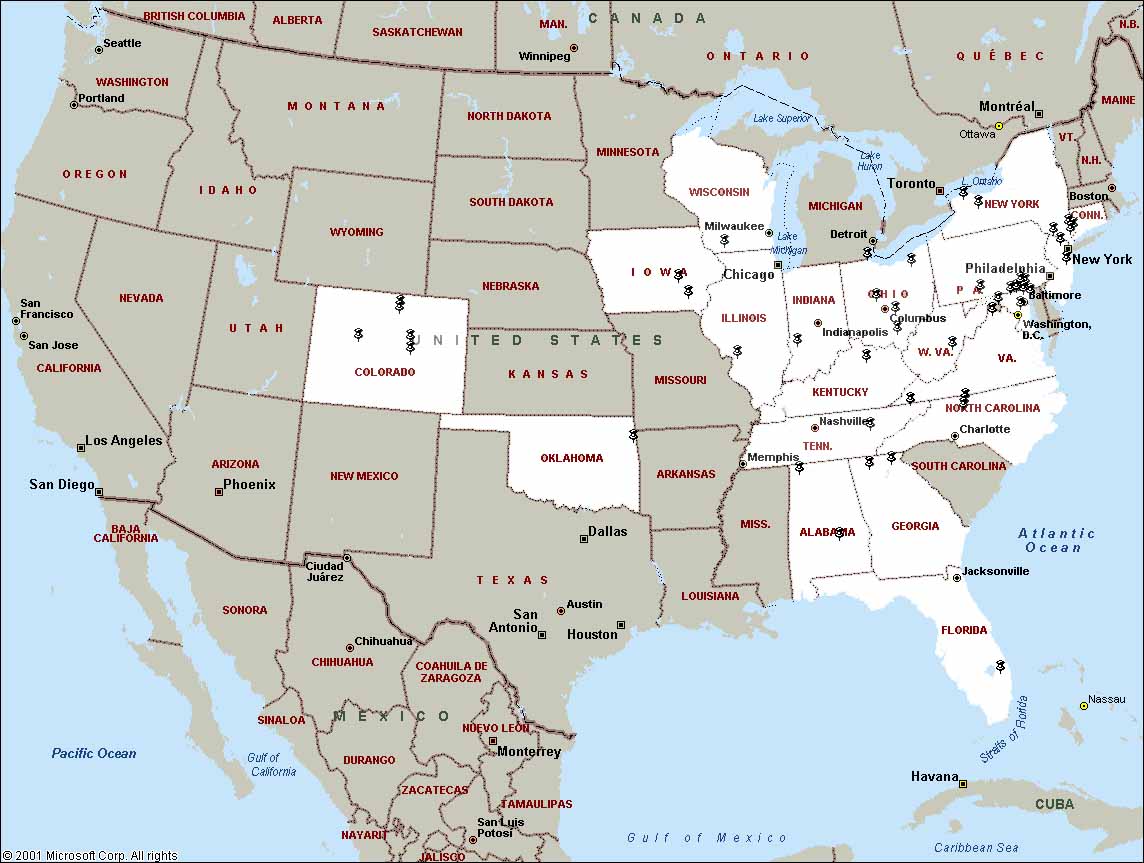
The map, above, is fairly illuminating, as it graphically represents where working judges sanctioned by the Jack Russell Terrier Club of America live.

The states in white are those that have any JRTCA working judges at all. The states that are muddy-grey colored have no JRTCA working judges. A pin (see a larger version of the map by clicking on it) represents the zip code of every JRTCA working judge in the U.S. in the current edition of True Grit magazine.

To get a "bronze medallion" for special merit in the field from the JRTCA, a dog has to work at least three types of quarry underground (fox, raccoon, groundhog, badger or an aggressive possum) operating as if it were out alone, and with the owner doing the digging, and a JRTCA judge has to be in attendance as witness the work. To get a certificate, a dog cannot work quarry in a barn, brush pile, artificial earth or man-made location (such as the crawlspace of an outbuilding).

Jack Russell Terriers are, far and away, the most commonly worked terrier in America. There are very few Fell Terriers in this country, and almost no working Border Terriers at all. Patterdale terriers in the U.S. are still relatively rare, and though some very good dogs are being bred by a handful of reputable breeders, too many over-large dogs are being produced -- many of them cross-bred in the not-too-distant past with small pit bulls in order to get a larger dog that can work game above-ground game -- barn raccoons and feral hogs in particular. There are some excellent Patterdales and a few good Fells in the US, but most of these seem to be owned by people that have had Jack Russell terriers at one time or another -- the dogs they started with before there were any Patterdales or Fells in the U.S.

In short, most working terriers in the U.S. are Jack Russell Terriers, and the map above tells a story.

Why does this JRTCA map look this way?

Some of it has to do with a population bias -- there are more people per square mile in the East and Midwest, and as a consequence associations are easier to maintain.

Another factor is that there are only about 50 pins on the map at all. This paucity of pins is partly a reflection of how few people actually work terriers in the U.S. beyond two-or-three time a year digs, and in part a reflection of the fact that being a working judge is truly a thankless task.

Of course there are more than 50 serious diggers in the U.S. Some of these diggers are ex-JRTCA working judges, some are people that dig a lot but have no desire to sign up for the thankless job of being a working judge, a very few diggers have Kennel Club registered dogs, some folks dig their dogs but have no club affiliation at all. And of course there are the patterdale-only owners, some of whom have joined the new UKC working terrier program or are members of the Patterdale Terrier Club of America.

That said, while this map is clearly not inclusive of everyone that digs their terriers, it is more-or-less geographically representative of the broad TREND of those that that do -- they tend to be in the East and in the Midwest, rather than in the Western United States. For example, of the 15 UKC working judges, as of August 2004, six are not in America, two are in California and come East to hunt, and the rest are in New Jersey, Kentucky, Virginia or Georgia -- states well-represented on the map above.

One of the reasons the map is skewed has to do with quarry availability. In the U.S., the bread-and-butter quarry of the working terrier is the groundhog. Raccoons cannot dig their own dens, and neither can possums. If dirt dens are not available, they will seek other alternatives -- hay lofts, brush piles, hollow trees, farm outbuildings, hay stacks, rock crevices, or old squirrel nests. With the exception of rock dens, these are not locations where a small dog follows quarry to ground and is then dug to. In short, it is not earthwork.

Red fox will dig dens on their own, of course, but in the American west they face real on-the-ground competition in the form of the coyote. A coyote will generally kill a red fox if given half a chance, and they directly compete with red fox for food.

In addition, the red fox is not native to most of the U.S., and its dispersal in the West is uneven as a consequence. While red fox are common in some areas (such as the prairie pothole region) they are quite rare in other areas (such as western Oklahoma).

Weather and time are another important reason fewer people hunt in the West. Fox will not den in warm weather unless they have kits, and in the U.S. we will not put a dog on a vixen with young. Without hounds to drive fox to ground, our fox-digging season is very short -- generally only 10 weeks long, and for most people with jobs this presents a very short period of time to get out into the field.

When people do get out into the field, of course, they have to find your fox! This is easier said than done, and is very hard job for a novice hunter with a novice dog. Red fox densities are variable, but settlement is generally much thinner in the West where there is less food than in the East, and where the fox faces direct competition with coyotes for food and den sites.

Raccoons are not native to the West, though they have spread with humans during the last 50 years, helped immeasurably by the creation of denning shelters in the form of barns, out buildings, road culverts, abandoned cars, and brush piles. A raccoon can expand a ground den a little bit, but it is not really made for digging. A skunk can and will dig its own hole, which is suitable for possum, but too small for anything but the smallest of adolescent raccoons.

Due to the absence of natural forage, raccoons are rarely found above 5,000 feet in the Rocky Mountain, unless they are living in close proximity to humans, though they have been reported at elevations as high as 10,000 feet if a steady food source is available.

Marmots and prairie dogs are found in some locations in the West, but the prairie dog is far too small for a dog to work, while the various species of rock marmots tend to gravitate towards areas with large boulders and talus slopes -- areas very hard to dig. Marmots are also absent from larger parts of the West outside of the Rockie Mountains. That said, if found in the right location, marmots are excellent quarry for working terriers in the Mountain States.

Some states -- notably California -- have very diverse geography and wildlife but also have very restrictive game laws which make working terriers difficult.

The American badger is common in some parts of the West, but more often than not its population is numerically thin on the ground. Badger are also hard to locate, as they will move every few days or so as they eat out, or chase out, a local rodent population (rats, mice, ground squirrels, and prairie dogs). Once the food is gone, so too is the badger. Unlike in Europe, the presence of a badger hole in the U.S. does not mean you have actually found a badger. More likely you have found a blank hole or, in some areas, worse -- a skunk, porcupine or snake.

Porcupines, rattlesnakes and skunks are fairly common in many parts of the West, and all three animals are a very serious threat to a dog. A dog sprayed underground by a skunk can be overpowered and die from anemia if not gotten out of the ground in pretty short order. A porcupine's defense system are barbed quills which can leave a dog wrecked in short order (and the owner's wallet drained after a visit to the vet). A dog bitten by a rattlesnake rarely lives, as the venom from even a small rattler is more than enough to kill a terrier.

In the South there are tens of millions of nutria, but they do not seem to be worked very often. In part this is due to the fact that in many Southern locations where nutria are numerous alligators also tend to be present. Another factor is that neither the American Working Terrier Association nor the JRTCA will give a working certificate to nutria as the holes are too big and shallow to qualify as real earth work. In addition the nutria, like the possum, is an animal whose primary defensive mechanism is bluffing. While AWTA will not give a certificate to possum, and the JRTCA will provided it is an "aggressive" possum, both seem to think the nutria is less than fomidable quarry for a working terrier.

A final obstacle to terrier work in the West is experienced people to show newcomers where to start. While the basics of terrier work are not overly complex, there are things to learn about locating quarry, digging, dispatch, and healthcare. To work any terrier in a safe manner requires several hundred dollars worth of equipment, as well as permissions from land owners. And then, of course, you have to have the desire to hunt, be in relatively sound physical shape, and be willing to devote the time to get out in the field in all kinds of wearther. It turns out all of this is a rare combination.

All of the factors above combine to create a "tipping effect" in much of the West where the chance of finding quarry is lower than in the East, and the chance of getting a dog injured is higher. When combined with a paucity of other working terrier owners, a very short working season, and the abundance of other kind of hunting opportunities, it is not surprising to find fewer working terriers in the Western United States than in the East and Midwest

Many of the western diggers that do exist actually come East to work their dogs, going to the trouble of loading themselves and their dogs into airplanes, trucks and cars for a week or two of hunting where quarry can be found on the ground.

This clearly takes a great deal of work and commitment, making these folks among the most dedicated working terrier enthusiasts in the U.S. A special hats off to them!
.

Sunday, January 6, 2008

Bad Dog: An Article for Prospective Terrier Owners


If you are in the business of breeding and selling dogs (and I am not) or you have dogs that people think are cute (pretty much everyone), you will get people inquiring about working terriers who have not have done their research, may not be living in a stable home (i.e. they travel a lot or move often), have never had a dog or trained a dog, or perhaps they have unstable relationships (this includes married people!), or perhaps they simple need to hear the Whole Truth about what a working terrier brings to the table.

A dog is a 15-year obligation and is not to be taken lightly. The average small terrier will end up costing its owner about $500 a year in food, vet care, pet sitting, and other kinds of upkeep and maintenance. This is to say nothing of the cost of major fence installation, major medical events that can occur, etc. Add a few thousand for those, and consider yourself lucky if you never need to spend it.

The bottom line is that a terrier is a $7,500 -$10,000 liability -- not quite as expensive as a child, but a lot less disposable than a guinea pig. On top of it all, a terrier can be a 15-year headache for people that are not ready for a terrier brings to the table.


The Ottawa Citizen, March 3, 1997

Bad Dog:
Author Philip Lee learns the hard way why you should not buy a Jack Russell terrier

Every family makes mistakes. Our mistake is named Richie. Richie is a Jack Russell terrier we purchased a year and a half ago as a gift for my wife on her birthday. He is a short-haired dog, white with brown spots and worry wrinkles on his brown and black forehead. He is about a foot and a half long and weighs 17 pounds.

When I say this little creature has taken over our lives, I'm not exaggerating, not a bit.

We decided to buy Richie after we met a lively Jack Russell named Robbie and concluded that it would be fun to have a personable little dog like him around the house. When told about our plan, one of my relatives who has had a female Jack Russell for many years said simply: "Tell them their lives will never be the same." While we thought this was a strange comment at the time, we don't think so any more.

Mistakes often result from a lack of information and poor preparation, and I admit we are at fault here. We didn't do our homework, and we paid the price.

Richie was an only pup, a fat little ball of fur, four weeks old and stumbling along behind his mother on the day we visited him and decided that we wanted him. When he was seven weeks old, we returned to pick him up. As we walked through the yard outside the farmhouse where he was born, his breeder warned: "You'll have to be careful, he's awfully rough."

The little dog we saw romping through the yard was harmless, no larger than a small kitten. Rough? Please. We already had horses, dogs and cats at home. We were animal lovers. We knew what we were doing. We smiled the confident smile of the blissfully ignorant.

Then Richie reappeared, dangling in mid-air with his teeth closed on the throat of the breeder's long-suffering German shepherd. The two dogs disappeared around the corner of the barn. Richie returned alone, choking on a mouthful of fur.

We laughed, nervously, picked him up and took him home.

Since Richie has become part of our lives, I've discovered that these little dogs are quite fashionable. A Jack Russell named Wishbone, who wears cute outfits, acts like a human and tells classic tales, has his own television show for children. Plastic Wishbones, complete with a variety of stage outfits, have been featured as toy of the week at Wendy's restaurants.

A long-haired Jack Russell named Eddie stars in the popular television comedy Frasier. A Jack Russell named Milo played a prominent role in Jim Carrey's movie The Mask. These dogs are regularly featured in television commercials; lately they have been helping to sell Nissans. The other day we saw one in a music video by the Toronto band Skydiggers. There was a picture of a Jack Russell on my daughter's Valentines this year (chosen, of course, in honour of Richie). These little dogs are everywhere.

All I can say to the person who is thinking about how nice it would be to have one of Wishbone's cousins at home, or have a dog like Eddie or Milo in your apartment is: Look before you leap.

Since Richie took over our household, I've done the research that might have prevented our mistake.

A recent issue of Audubon magazine featured a photo essay about the reclusive, wily fox. The spread of marvelous photographs showed a beautiful, athletic red fox at play. The fox was completely self-absorbed, standing up on his hind legs, leaping high into the air, twisting, whirling and almost flying over the tall grasses as he ran. When I saw those photographs, I was looking at Richie.

Jack Russells are working dogs, bred to hunt foxes. Their name comes from Rev. John Russell, "The Sporting Parson," who bred a fine strain of terriers in Devonshire, England, in the mid-1800s. The legend goes something like this: One day, when the Parson was attending Exeter College at Oxford, he spotted a sturdy white terrier riding confidently on top of a wagon. He was so taken with this feisty little dog that he purchased her on the spot and named her Trump. She is the founder of the breed. The Parson bred these dogs throughout his life, keeping careful records and placing emphasis on the characteristics that enabled the dogs to work and hunt. The Sporting Parson's tradition has continued in Jack Russell clubs in England and North America for more than 100 years.

Today at Barnstaple, England, there is an inn named Jack Russell, and there hangs a portrait of Trump and the Sporting Parson, the man I hold at least partly responsible for my troubles.

Jack Russell terriers are fox-hunting machines, possessing superior intelligence and gifted with great speed. They have athletic, muscular, compact bodies that run low to the ground, perfectly balanced. They have small chests that allow them to run down fox holes, or in any other small space you can imagine. Some of them can climb trees and fences.

In short, these are remarkable little dogs. Bad dogs.

Members of the Jack Russell terrier Club of America have posted a warning on the Internet about the dogs they love. The web site is called The "Bad Dog" Talk and it asks the one important question we failed to ask ourselves before we brought Richie home: "Is a Jack Russell terrier the right dog for you?"

Many dog owners are overwhelmed by these small, high-maintenance pets and they abandon them. I consider myself an experienced dog owner, yet I understand the sheer panic these poor people feel when they realize what a problem they have on their hands. The statistics are tragic. Jack Russells are the most commonly abandoned dogs in North America.

The Bad Dog website points out that the little terriers are bred to hunt, and if they are not hunting, they will "invent new and fun jobs for themselves," which includes their favourite job, "guardian of the world," when they become fierce protectors of their possessions and family. They also like to chase cars, hunt birds and dig holes both outside and inside the house.

I can tell you that all of this is absolutely true. If anything, The Bad Dog Talk is understated.

Richie, I am proud to say, has lived up to his breed's reputation.

In the past year and a half he has been run over by vehicles twice. The first time, last September, he disappeared when he was on a supervised walk, made his way from our upper meadow down through the woods to the highway, where he chased a car and caught it. When we found him he was in shock. He had a broken leg and all the fur was scraped off the top of his head. That little accident slowed him down for a couple of weeks. We hoped he had learned a lesson about cars, but resolved to keep him chained to a tree when we weren't walking him in the woods.

Then, one afternoon during hunting season, he darted under the tire of a truck that was driving slowly along the dirt road that runs past our yard. He was on his chain, tied to a tree. We had negligently allowed the chain to reach the edge of the dirt road. Witnesses to this accident swear the rear truck tire ran right over his body, and they were convinced that he must have been badly, if not fatally, injured. The chain broke and he disappeared for a couple of hours.

He finally showed up at the house, a little shaken, with a raspy voice from a minor neck injury, but very much alive. That accident slowed him down for a couple of days. We now know he doesn't learn lessons.

He likes to jump up onto our kitchen table to snatch food or lick the plates after a meal. (He consumed an entire apple tart at Christmas.)

He fights with every dog that comes near our property. The only dog he has any respect for is our eight-year-old Doberman, who put him in his place at an early age, although he still harasses her and encourages her to play rough. She loves him.

One of his favourite games is chasing our two horses. The closer their hooves come to kicking him in the head and killing him the better he likes it. His horse game scares me, and when he starts playing it I have to turn my head away.

He enjoys sitting on the couch and protecting his perch. He has to sleep on our bed at night, with his little body touching ours. I haven't slept soundly in months.

When he was a puppy and we left him alone in the house, we locked him in the kitchen, where we figured he couldn't do much damage. He started digging a hole through the kitchen door. After he made it halfway through the door and we got tired of coming home to a pile of wood chips, we stopped locking him in there.

He's virtually untrainable and often won't come when called. (This may be the result of our shortcomings as trainers, but we did manage to turn our Doberman into one of the most obedient dogs on the planet.) Richie will sit for the blink of an eye if you're holding a piece of food in your hand. And after an epic struggle, we finally managed to housebreak him. Or perhaps I should put it this way -- he pees outside when he wants to, which is most of the time.

We recently asked the owner of that cute terrier named Robbie, the one that inspired our mistake, if she had any humorous terrier stories to pass on. She replied grimly: "How about tragic?"

Incidentally, Richie hates Robbie. They can't be left together.

Fourteen years ago, Catherine Romaine Brown of Mt. Holly, New York, received two Jack Russells as a gift, and her life immediately became a shambles. Today she has 10 of the little dogs and is a Jack Russell breeder. She wrote a book about Jack Russells that was published last September and admits that her life has gone to the dogs.

Six years ago, a dog she sold to one of her neighbours was killed when she was trying to find him a new home. She realized that there were dogs out there who needed her help, so through the Jack Russell Terrier Club of America she pioneered a rescue service that places unwanted or abandoned terriers in good homes.

Since 1991, her rescue service, which quickly expanded into a nationwide network, has placed more than 600 Jack Russells abandoned by people who couldn't handle living with a bad dog.

A Canadian version of the rescue service is run by Marla Robinson in Guelph, Ont., in conjunction with the Jack Russell Terrier Club of Canada.

Ms. Brown says the problems often begin when a family realizes their terrier is the most intelligent member of the household. "You soon realize you're their pets," she says.

People buy these dogs because they're small and cute, then they move the dogs into the city, where both the owners and the dogs have nervous breakdowns. "They can't take the stress of a city," she says. Even if the dogs are being walked in city parks, they'll challenge every dog they encounter and often have disastrous battles with German shepherds, rottweilers and other large dogs.

"They think they can conquer the planet," she says. "I call them loaded guns."

She says the television exposure given to Jack Russells has created grave misconceptions about the breed. She has met Wishbone's trainer and now knows that the canine television star is a typical Jack Russell: "a very difficult dog." Television Jack Russells are bad, but they're good actors. Then people bring one home and "find the cat dead."

She has heard stories about Jack Russells who have dug through the outside walls of a house and escaped, and another who dug down through the kitchen floor and spent the day roaming in the subflooring of the home.

They need exercise and lots of it, far away from roadways because cars are the leading killers of Jack Russells. "They're little heartbreakers," she says.

Meanwhile, the members of the Jack Russell Terrier Club of America are waging a campaign to keep their dogs from being "recognized" by kennel clubs. If these dogs were bred for the show ring instead of the woods, they would lose what makes them special: their great intelligence and strong bodies.

The club points to what has happened to the fox terrier, a close cousin of the Jack Russell, which is a prized show dog but has lost its working traits. The fox terrier's conformation has changed over the years: its jaw lengthened, shoulders straightened and chest deepened, so that today these terriers couldn't run down a foxhole even if they wanted to.

The club wants Jack Russells to remain what they are -- feisty, bad little dogs -- which is a courageous and admirable stand.

As for us, we're learning to cope with our mistake, for when we couldn't train him, he trained us.

We take him for a long walk every day through the woods in back of our house. He tears out the back door, heads for the trail with his nose to the ground, and does what he was born to do. He's a pleasure to watch. These walks offer a pause in our busy lives.

When we leave him alone in the house, we put him in a large, well-built, steel-mesh kennel with a rawhide bone to chew. He doesn't seem to mind as long as he's had his run first. His runs keep his mind right.

As for all of his other bad habits, we've simply admitted defeat.

Through it all, I've grown fond of this bizarre little creature. He amuses me and I admire his blind courage and absolute devotion to our family.

We're stuck with a bad dog, and as penance for our mistake, we'll spend the next 15 years trying to keep Richie alive.

I don't mind so much. In our digital, plastic, conformist world, I figure it's a fine thing to love a creature who has to be protected from his own reckless spirit.

__________________


Philip Lee is the editor of the Atlantic Salmon Journal and author of Home Pool.

Thinking of buying a true working terrier? >> Read this first
.

Thursday, December 6, 2007

Christmas Just Around the Corner

It's that time of year, with Christmas just around the corner.

As I do every year, I recommend making a donation in someone's name to the Heifer Project -- a good organization that gives farm animals and animal husbandry skills to impoverished people in the developing world. You can give modest gifts of a flock of chickens or ducks or a hive of bees, a goat or even a water buffalo. These are gifts that keep on giving and make the rural world a more sustainable and less frightening place.

A gift your dog will love is American Working Terriers. Order now to get it in time -- I do not stock them here and the JRTCA is sure to run out. While you are at it, order an American Working Terrier mug or shirt from one of the online stores at the right of this blog -- 100% of any money raised here (i.e. every dime over cost) goes to terrier rescue.

I used to tell folks to check out low-cost places like Cheaper Than Dirt , Sportmans's Guide, and Bargain Outfitters, but they are not the great deals they once were. Check them out anyway; time is money. Also take a spin at AM Leonard for great shovels (Ames Pony, D-Handle), and consider getting the greatest leather leash ever made (in my opinion), a 1/2" Eurolead.

.

Friday, November 9, 2007

Nutria: The Tabasco Sauce Rat

Example

The Nutria or Coypu (Myocastor coypus) was first brought to the United States from South America by the McIlheny family, of Tabasco Sauce fame. Their idea was to start a fur farm on Avery Island, Louisiana. Unfortunately, in 1941 a hurricane blew in and wrecked the cages, releasing about 150 nutria into the local marshes.

By 1959, these 150 nutria expanded to a population estimate of 20 million!

Nutria are considered a serious pest. Wherever they have gone, there has been a steep decline in muskrat populations, with whom they directly compete. In addition, nutria are voracious eaters of vegetation and are capable of cutting huge holes in marshes, leading to increased soil loss, shell-fish deaths, lost fish spawning grounds, and lost song and game bird habitat. Not for nothing are they sometimes called "that rat that ate Louisiana".

On the up side, there is little doubt that the introduction of the nutria has had a very beneficial impact on the American alligator, whose numbers were pushed perilously close to the edge in the 1960s, but which are now in superabundance thank to better game management laws and a steady supply of nutria (as well as cats, possums, small dogs, raccoons, turtles and fish).

Efforts are underway to wipe out the nutria in Maryland, where populations have been destroying the Blackwater Wildlife Refuge. In the American South (Louisiana, Florida, Mississippi, Texas, Georgia) it is probably impossible to turn the tide, no matter how many conibear traps are set out.

Nutria were introduced to England sometime prior to 1944, when a few escaped from a Sussex fur farm, but they were exterminated by 1988 thanks to a concerted trapping campaign.

The nutria is not considered much of game animal by those that have worked other terrier quarry. Despite the fact that the Jack Russell Terrier Club of America is headquartered about 45 minutes away from very large and thriving nutria colonies where a very aggressive trapping regime is now underway, the JRTCA does not list them as a species they will give a working certification for. I am told that this is because the dens they inhabit are generally so shallow and large that working them is not really earth work. The American Working Terrier Association also does not give a working certification for nutria.

In The Working Terrier, Brian Plummer notes that nutria make a great deal of noise chattering their teeth, but that this largely bluff.

“Coypu are not particularly exciting animals to hunt. Their burrows are large and not especially deep, so there is little chance of a dog getting trapped while hunting them. Furthermore, the coypu is reluctant to fight and much prefers to bolt if it encounters a terrier. Bites from coypu are never really serious, though pieces of the incisor sometimes break off and remain in wounds, causing sepsis. Wounds are rarely more than skin deep, for, in spite of its rat-like appearance, the coypu is unable to mete out the savage wounds of which the brown rat is capable. . . . the coypu can scarcely be called a sporting animal.”


Others, of course, disagree. That's what makes the world go 'round. If they ever stop setting conibear traps at Blackwater Wildlife Refuge, maybe I could find out for myself. Until then, it strictly dry land for the dogs.

.

Friday, October 19, 2007

25th Annual JRTCA Nationals Trial

The Jack Russell Terrier Association's National Trial starts tomorrow in Havre de Grace, Maryland, just North of Baltimore. Click here for a 9-page PDF of the flyer. The actual location is Stepping Stone Park. Directions are as follows:


  • Take Interstate 95 to Exit 89. Turn onto Route 155 towards Bel Air. Follow 1/2 mile to right on Earlton Road. Follow for 1/2 mile, bear left on Quaker Bottom Road. Follow Quaker Bottom Rd. to Steppingstone Park entrance.


The JRTCA Nationals trial runs Friday, Saturday and Sunday, and I will be there at least part of the day Saturday (the only show I go to all year long), mostly to see a few people, look through a few bits and pieces of dog stuff for sale, and see the Bronze medallions presented to the dogs that have worked three types of quarry in the field before a JRTCA-certified working judge.

A reminder: No dogs other than Jack Russells or working terriers are permitted on the trial grounds for any reason, and pups under the age of four months, and bitches in season, are not permitted on the trial grounds at all.

There is a BAER test (for hearing) clinic for $45, and a CERF clinic for $27, but due to the number of dogs at the trial, it is only open to Jack Russells and to JRTCA members.

If you attend Nationals this year, say something nice to anyone who looks like they are setting up or taking down. These kinds of things are a lot of greasy, hard, thankless work with long hours put in and absolutely no recompense. A little applause costs you nothing and will long be remembered.
.

Ten Reasons to Join the JRTCA


Ten reasons to join the JRTCA that have nothing to do with showing:

1. You will get a good, and sometimes useful, publication. Most issues have a story or two, or an article or two, on working terriers. Considering the diversity of the JRTCA, the editors do a pretty good job of speaking to all terrier interests. This is a house organ, not Newsweek, but at 68 pages or so, it's a pretty nice job and often has a health tip or two as well. Research on bronze medallion dogs in True Grit helped me assemble the data on the average size of American working dogs in North America.

2. Picture ads in every major off-the-shelf dog magazine telling people NOT to get a Jack Russell terrier without doing more research. The "unselling" of this breed to "Wishbone" and "Eddie" wannabe owners is a very useful thing if you care about working terriers. I consider this important (and expensive) work worth supporting. No other breed or Club does this; I am very glad the JRTCA does.

3. An excellent web site ( www.terrier.com ) that presents the full range of interests in the Jack Russell terrier. A very nice job and full accolades to the web master. Interactive quizzes help make sure people know what they are getting into with a hunting terrier, and a FAQ section provides more information. Again, this is the kind of effort no other breed or Club does, and it is no small effort.

4. Status is given to working terriers in the show-ring-world which, in turn, brings more people in
to the working world. A special page or two at the front of the magazine is always devoted to working terriers, the highest JRTCA awards go to working terriers, and a dog in the field is always featured on the cover. Since the dog-show world is mostly about status, the elevation of the status of real work by the JRTCA encourages more "show people" to hunt at least once or twice. Some of these folks have decided they like hunting better than showing -- a very positive thing, and the way hunting with terriers has actually been established in the U.S. Without the JRTCA there would not be much terrier work in the U.S.

5. A working terrier program that has a full page-and-a-half of working judges complete with addresses and phone numbers listed. It may not be enough, but it's more than exists anywhere else on the planet. It's amazing that so many people have signed up to be working judges considering how thankless a job it is. Going out with a working judge is not the only way to learn how to hunt, of course, but it's how many people actually do.

6. A ready supply of Deben locator boxes, Deben collars, and fox nets that folks can order on the Internet, pay by credit card, and receive in 2-3 days. Break a collar on a Sunday, and another will be in hand by Wednesday or Thursday. The JRTCA will sell locator boxes, collars and nets to anyone, and prices are fair.

7. A registry which discourages inbreeding. Some would argue about the value of this in some situations, but without a doubt it is a good thing for the long-term future of the dogs.

8. JRTCA Rescue which does a highly commendable job of housing and finding homes for dogs that deserve stability and love.

9. A code of ethics and various rules to discourage breeding too young, working too young, etc. Some may sneer at rules, but in fact a code of conduct (think Ten Commandments) is not such a bad thing to have on paper.

10. The past and the future. If terrier work has taken hold in the U.S. it is because of the JRTCA, and if it is going to spread (or be defended) it will be because of the JRTCA. Membership dues is a small thing to pay for all of the above.


Monday, September 3, 2007

The Real Jack Russell Terrier: A Complete History


Sawrey Gilpin, A Huntsman with Hounds Foxhunting


I got a call earlier this week from someone trying to assemble (or dissect) the history of how the U.K. Kennel Club (i.e. The Kennel Club) managed to add the "Parson Russell Terrier" to its roles approximately 100 years after the Reverend John Russell himself had died.

Good question!

Well, first of all, let's ground ourselves in a few basics (and reality) just a little bit.

The first point is that white fox-working terriers predate the Reverend John Russell. Remember that the young Russell bought Trump from a milkman who had her tied to a string tied to his cart. Or so the legend goes.

The picture, at top, is by painter Sawrey Gilpin, who was born in Cumbria in 1722, and died in 1803, some years before the Reverend John Russell ever acquired his famous first terrier, Trump. Gilpin was a painter that specialize in painting animals, particularly horses, cattle and dogs.

I bring this up, not only to show that riding hounds to fox was already being practiced before John Russell arrived on the scene, but to point out the little dog, to the right, that is featured in another Gilpin painting.

The dog in this picture is a terrier by the name of "Pitch," who was owned by Colonel Thornton.

The painting was done in 1790, and you will note that this is the very model of the (undocked) white fox-working terrier we know today as the Jack Russell Terrier, complete with spot above the tail, and split-head markings.

Let us also remember that not only did Russell buy the bitch without ever seeing her work, he seemed to have no trouble finding another suitable white-bodied fox-working terrier to mate her with.

In fact, this rather cavalier pickup of dogs seems to have been Russell's way of doing business his whole life. His financial fortunes were such that he had to sell off his hounds several times, and the notion that he kept a strain of line-bred terriers descended from Trump is nonsense -- he took dogs as offered, kept them if they worked, and moved them along as needed -- and money was certainly a pressing need throughout much of Russell's life.

No doubt Russell tried to breed the best dogs he could find, but in those early days of the mounted hunts, dogs were a practical matter. In the era before dog shows, telephones and the Internet, there was no fame or fortune in to be found in working terriers.

Most of what is said about Russell's dogs is pure nonsense. The famous picture of Trump, for example, was painted more than 40 year after the dog had died, and it was painted by someone that had never seen the original animal at all. Russell said the painting was “a good likeness” but in fact he may have been trying to be polite, as the painting was commissioned by Edward VII (then Prince of Wales) who befriended Russell in his old age, and had the painting done as an homage to the old man (it hangs today at Sandringham).

Russell's real claim to fame is that he had the good fortune of living his entire life during the period in which mounted fox hunting became popularized in the U.K. Though primarily a houndsman, Russell had a fondness for terriers, as did his wife Penelope (a picture of her with a terrier is at right), and his terriers were known to be generally good workers of the right sort.

Russell had been hunting with terriers for about 40 years when the first dog show in Great Britain was held in 1859. That same year, Charles Darwin's book "The Origin of Species" was published.

It should be said that Darwin's famous book and dogs shows themselves have a common root stock -- the agricultural stock shows that began with Robert Bakewell at the very end of the 18th Century.

Prior to Bakewell, animals were free to chose their own mates. Bakewell was the first person to show that by selecting and controlling for sires (through fencing, or enclosure) breeds of farm stock could be rapidly improved or even created.

It was Bakewell's work with sire selection and controlled breeding of farm stock which Erasmus Darwin -- Charles Darwin's father -- pointed out to his son as perhaps being a driving force in the shaping of the natural world.

With publication of The Origin of Species in 1859, Victorian England became besotted by natural history studies. Massive bird egg, butterfly and beetle collections were started, and keeping a small menagerie of exotic birds was far from uncommon.

Dogs, of course, were always the thing to own, and this natural trend was perhaps tweaked by Queen Victoria who herself was an avid dog collector, and whose approval of the Society to Prevent Cruelty to Animals transformed it from the SPCA to the RSPCA.

Darwin's work and theories were expanded upon by his cousin, Sir Francis Galton. Galton was the founder of the modern field of statistics, the inventor of fingerprint identification, and the creator of the first silent dog whistle. More importantly to this discussion, he was also the founder of study and experimentation we know as eugenics.

Galton's eugenics theories argued that species and breeds could be created and improved upon ad nauseum by selecting for defined characteristics.

To put it simply, this was Darwin' theory of evolution put into hyper-drive. The notion that overly close or tight breeding might result in a rise in inherited defects or seriously deficient animals was unimagined; evolution was thought to be a one-way street, and by breeding "best to the best," man would simply improve and speed up what Mother Nature had already started.

That was the theory.

It was a theory warmly embraced by The Kennel Club, which was founded in 1873, and which was deeply influenced by Galton's work.

The Kennel Club's thesis was a simple one: Create a visual standard for a breed, accept into a closed registry only those dogs that conformed to that standard, and then encourage the breeding of "the best to the best" of these "pure bred" dogs through a program of prize-awarding conformation shows.

Like most new organizations, The Kennel Club began on somewhat shaky legs, and sought to promote itself by trying to associate itself with "names" and money as quickly as possible. The Reverend John Russell had no money, but at age 78 he was one of the grand old men of mounted fox hunting, and well-loved by all. Who better than Russell to judge the fox terrier class at one of the first dogs shows?

Russell was no doubt flattered by The Kennel Club's solicitous offer, and he warmly agreed to judge the Crystal Palace show. Very old, and quite broken financially, Russell had been forced to give up his hounds two years earlier (1871). Perhaps here was a way to keep a hand in with the dogs? Apparently, however, Russell did not much like what he saw in The Kennel Club ring, for he never agreed to judge a Kennel Club show again, and he refused to let his own dogs be registered.

Later, Russell described the Kennel Club terriers he saw as being a bit like hot house roses: "True terriers [my own dogs] were, but differing from the present show dogs as the wild eglantine differs from a garden rose."


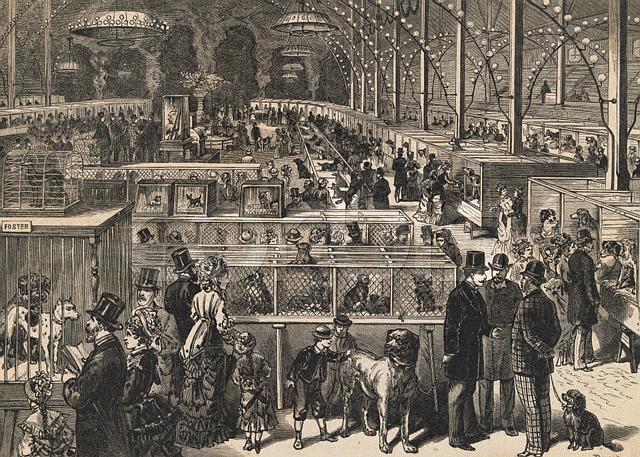
1877 dog show


In 1883, John Russell died at the age of 88. After his funeral, the few remaining dogs he had with him at Black Torrington (four very old terriers by the name of "Rags", "Sly", "Fuss" and "Tinker") were given away.

On the day of his funeral, his old sermons and other papers were found blowing around in the farm yard. Little or no self-authored record of Reverend John Russell survives to the present day.

In 1893, Rawdon Lee, Kennel Editor of "The Field" magazine, published Modern Dogs and noted the absence of Devon terriers on the show ring bench:


"There appears a semblance of strangeness that the wire-haired terriers from Devonshire have not been more used for show bench purposes, and by all accounts some of them were as good in looks as they had on many occasions proved in deeds. Those owned by the Rev. John Russell acquired a world-wide reputation, yet we look in vain for many remnants of the strain in the Stud Books, and the county of broad acres [the north] has once again distanced the southern one in the race for money. But, although the generous clerical sportsman occasionally consented to judge terriers at some of the local shows in the West, he was not much of a believer in such exhibitions. So far as dogs, and horses too, were concerned, with him it was 'handsome is that handsome does,' and so long as it did its work properly, one short leg and three long ones was no eye-sore in any terrier by the late Rev. John Russell."

Lee went on to note that the best working dogs, even in his day, were not found in the Kennel Club:


"As a matter of fact, those [terriers] best adapted for hard work either with foxhounds or otterhounds are cross-bred, hardy dogs, specially trained for the purpose, although many of the 'pedigree' animals will do similar duty to the best of their ability, but their 'pedigree' and no doubt inbreeding to a certain extent, has made them constitutionally and generally weaker than their less blue-blooded cousins."

Finally, to put a cap on it, Lee wrote:


"I have known a man act as a judge of fox terriers who had never bred one in his life, had never seen a fox in front of hounds, had never seen a terrier go to ground ... had not even seen a terrier chase a rabbit."

Only 20 years had passed since the founding of The Kennel Club, but already the death knell was being sounded for the fox terrier.

How was this possible? The short answer is that at the time Rawdon Lee was writing, The Kennel Club was undergoing a "terrier craze."

Why was this? One can only guess, but I would venture to say that terriers then, as now, fit both practical and psychological needs.

On the practical side, they are small, easy-to-keep dogs. On the psychological side, they are active dogs and not too "girly" for a man or active woman to own.

Fox terriers, in particular, have a pretension to field sports about them, and they particularly appealed to those that sought to associate themselves with the money, romance and aristocracy of the mounted hunts.

In fact, the first breed-specific publication was the Fox Terrier Chronicle, which tracked the comings and goings of Kennel Club shows as if they were High Society.

Special dog shows were started just to showcase terriers, and in 1886, a dog food salesman by the name of Charles Cruft took over the Allied Terrier Club Show at the Royal Aquarium at Westminster, with an eye towards making it a cash venture. This terrier show became the first formal Cruft's Show" when it was booked into the Royal Agricultural Hall, Islington in 1891.

In 1884, the American Kennel Club was started, and the terrier craze that had begun in the U.K. swept into the United States as well. Some small indication of this strength of this craze suggested by looking at the history of the Westminster Dog Show which awarded its first "best in show" award in 1907. The first winner was a fox terrier. A fox terrier won again in 1908, 1909, 1910, 1911, 1915, 1916, and 1917.

It was into this terrier-besotted world that Arthur Heinemann stepped -- a young man with an interest in badger digging. Heinemann was born in 1871, the year that John Russell gave up his hounds for the last time, and he was only 12 year old when the Reverend John Russell died.

Heinemann became interested in badger digging when he was in his 20s, and in 1894, he create the Devon and Somerset Badger Digging Club -- a small regional club composed of similar like-minded friends.

Where did Heinemann get his dogs? Not from John Russell.

As noted earlier, Russell gave up hunting the year Heinemann was born, and he died when Heinemann was only 12 years old. Heinemann and Russell never met.

Getting a working terrier was not much of a problem in any case. As noted earlier, white-bodied fox-working dogs were far from uncommon even in Russell's youth, and by the 1880s they were a fixture in the Kennel Club and cross-bred types were to be found all over the countryside.

As noted earlier, Russell himself did not keep a pure line of dogs, and was a bit of a dog dealer himself. By the time of Russell's death, almost anyone could have said they owned a dog descended from Russell's stock. Since Russell did not register his own dogs, and no pedigree charts survived his death (if they existed at all), who was to say otherwise? Anyone that wanted to make a claim that they had dogs descended from John Russell was free to do so -- and a few did so.

One of those people was Annie Rawl Harris, who was Kennelmaid to Squire Nicholas Snow of Oare and a relative of Will Rawl, John Russell's kennel man.

Did Annie Harris have direct descendants of John Russell's dogs? Of course. Who didn't?

As Dan Russell (the pen name of Exmoor hunt terrierman Gerald Jones) once observed in an interview with Eddie Chapman,


"John Russell was very much a dog dealer, as well as a breeder. He would buy or scrounge any terrier he thought looked like work, make it and sell it on. He always went each year to Scorrier House in Cornwall for a stay. They had their own strain of Fox Terrier there called the Scorrier terrier, which was reputed to be bred pure for over 200 years, and on leaving he would take on any terriers they didn't want."

And so we come to it: Not only were John Russell's type of dogs not unique to the Parson, he was not shy about selling them off and buying more terrier stock to breed back in. Any small white-bodied dog in the West Country could claim (perhaps legitimately) that it was descended from John Russell's own dogs.

Perhaps here is a good time to point out that Arthur Heinemann's terrier club was called the Devon and Somerset Badger Digging Club. His hound pack (acquired in 1902) was the Cheriton Otterhounds.

Badger. Otter.

The point here is that Heinemann was not chasing fox -- he was digging badger with terriers, and chasing otters with hounds and terriers. This is a point glossed over by some, but it is not insignificant, as chest size is far less of a concern when working badger and otter, than it is with fox.

In any case, in 1914 the Devon and Somerset Badger Digging Club changed its name to "The Parson Russell Terrier Club."

Why the name change? Well, to be blunt, and to use the words of his friend Dan Russell (aka Gerald Jones), Heinemann was a bit of a dog dealer who “sold a hell of a lot of dogs," both in the U.K. and overseas. He and his friend Annie Rawl Harris found that if they branded and sold their dogs as "Jack Russell Terriers" they sold better.

Why did they sell better? Well, to put it simply, no one wanted a Kennel Club Fox Terrier!

As Rawdon Lee had observed, the best working terriers were not Kennel Club dogs -- they were cross-bred dogs or dogs that were found far outside of the show ring. While the Reverend John Russell had called his own dogs fox terriers, and Rawdon Lee was still calling them fox terriers 10 years after Russell's death, by the turn of the Twentieth Century, a new name for working dogs was needed.

And that name was NOT the "Parson Russell" Terrier." It was the "Jack Russell" terrier. That was what Robert Leighton called them in his 1910 book, Dogs and All About Them, and it was the term increasingly being used in the working terrier community as well.

For evidence of this we need only turn to Jocelyn Lucas's Hunt and Working Terriers, written between 1927 and 1930, and published in 1931.

At the back of this book, Lucas lists more than 100 mounted hunts in the U.K. and details the types of terriers they themselves say they used in the field.

This was a period when the name of the dog was in transition. I say transition, because the word "fox terrier" is used in the list about as much as "Jack Russell," and other phrases appear as well, such as "white hunt terriers" and "Devonshire working terrier." In a listing of over 100 mounted hunts, however, not one claims to be working a "Parson Russell Terrier," and most of the time the word "fox terrier" is carefully proceeded by the words "cross," "cross bred," "non-pedigree," or even "mongrel."

In short, whatever a working terrier was been called in Heinemann's era, it was never called a "Parson Russell Terrier." The confusion arises, perhaps because Heinemann's badger digging Club was renamed, in 1912, the Parson Russell Terrier Badger Digging Club. The dog, however, was always called a Jack Russell Terrier. A club is not a dog.

Arthur Heinemann died in 1930 from pneumonia after coursing his lurchers in the rain (and falling through the ice on a pond), but Annie Rawl Harris continued selling Jack Russells and maintained the Parson Russell Terrier Club until it dissolved just before the Second World War.

Again, to quote Dan Russell from his own book Jack Russell and His Terriers:


"[Mrs. Harris] very quickly took the place of Heinemann as the arbiter of the Russell type terriers and she carried on breeding the type of terrier Heinemann had loved. In her heyday, she had some 50 puppies out to walk each year. She sent her stock all over the world. Her method of breeding was to use only dogs and bitches of proven gameness."

After War World War II, England seemed to get along perfectly fine without a Parson Russell Terrier Club. In fact, the 1950s, 60s and 70s were the Golden Age of terrier work in the U.K., as the weekend was invented (a product of the union movement), and it was now easier to get out to the countryside than ever before.


Add into the equation was the rise of distemper vaccines which prevented massive kennel loss, and the advent of antibiotics which helped prevent occassional gashes and wounds from getting infected, and it was truly the best of times.

Though myxomatosis arrived in the 1950s and devastated many ancient rabbit warrens throughout the U.K, the decline in rabbit populations was offset somewhat by a ban on the use of leghold traps (gins).

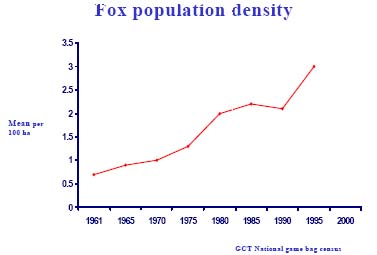
All through the 60s, 70s, and 80s, the fox population rose (see graph at left), and with it the chance of finding a bit of sport with the terriers in the countryside.

In 1974, the Jack Russell Terrier Club of Great Britain was founded "to promote and preserve the working terrier known as the Jack Russell".

In 1976, its U.S. analog was created -- the Jack Russell Terrier Club of America (JRTCA).

Both clubs have prospered and stuck to their original mission, and today the Jack Russell Terrier Club of America remains the largest Jack Russell terrier clubs in the world.

With an increase in the popularity of the Jack Russell terrier in Great Britain and the U.S., a push was initiated in 1983 to pull the Jack Russell into The Kennel Club. In 1990 this was finally done with representatives from several smaller Jack Russell Clubs meeting to draw up a conformation "standard" that called for a dog standing 12-15 inches at the withers.

It is claimed that this Kennel Club Standard was adopted from one originally written by Arthur Heinemann, but no evidence to support this claim has ever been presented so far as I know.

Dan Russell, who hunted with Heinemann and knew him well, says Heinemann did not value a large dog.


"As I remember it, and I am going back now sixty years or more, his main Badger dogs were about 12". He always said there was nothing a good fourteen inch terrier could do that a good eleven inch terrier couldn't do better. But it must be remembered he was referring to Badger digging in his own part of the West Country. His smaller terriers could manuever so much better in the large drawn out pipes of a badger set, they depended on their voice to keep the badger cornered for the diggers to hear, not brute force as some people seem to think. They were clever, game baying terriers, nothing more. Some of his best workers were no more than ten inches."

In his own book, "Jack Russell and His Terriers," written in 1979, before The Kennel Club controversty, Dan Russell quotes Heinemann directly:


"We are very much opposed to the modern show terrier and his type. Once you begin to breed it for show type, you lose the working qualities upon which you pride those terriers. I have been, I might say, the protagonist of the terrier bred for sport as against the terrier bred for show. I have no interest in cup hunting."

What Reverand John Russell or Arthur Heinemann wanted for the dogs, or what they actually used in the field, however, mattered not a whit to the Kennel Club.

In 1990 the Kennel Club admitted on to its roles a dog they called the "Parson Jack Russell Terrier," a name just invented for the occassion. In 1999 The Kennel Club changed the name to the "Parson Russell Terrier," another name invented wholecloth by Kennel Club theorists.

The American Kennel Club followed the U.K. Kennel Club in embracing both the 12-15 inch standard and in embracing the various inventeed names and name changes.

In 2005, The Kennel Club added a bit more confusion to the story by changing the standard for the dog they were now calling the Parson Russell Terrier, extending it to encompass dogs ranging from 10 to 15 inches tall at the shoulders.

The American Kennel Club has not followed the U.K Kennel Club in changing the standard, instead chosing to simply create another breed of dog (now in its Foundation Stock Service) called the "Russell Terrier."

The breed description of this dog claims it "originated" in the United Kingdom, but that it was "developed" in Australia -- a country which John Russell never so much as visited, which had no Jack Russells at all until the very late 1960s, and where the dog in question remains a pet and show dog that never sees a moment's work. The AKC "Russell terrier" standard calls for a dog standing 10-12 inches tall at the shoulder.

How to sort it all out then?

I think simplicity is best. In my opinion, there are only two types of terriers in the world: those that work, and those that don't. The white ones that work are called Jack Russell Terriers, and they are called that out of respect for the working standard that the Reverend John Russell himself honored throughout his life. Many of these white-bodied working terriers are not registered, but neither were any of the Reverend's own dogs.

What are we to make of the Kennel Club dogs? Simple: They are not Jack Russell terriers.

They are not Jack Russells in name, nor are they Jack Russell terriers in terms of performing regular honest work.

They are simply another white terrier being combed out, powdered, and fussed over by Kennel Club matrons.

So is there any place where the Parson Russell theorists and the practical working Jack Russell people might find common ground?

Oddly enough there is, though it is an area generally overlooked by the show ring crowd, and one they will no doubt surpress as time goes by.

The issue is chest size.

Barry Jones, a professional terrierman to the Cotswold Foxhounds in Andovers Ford, and a former Chairman and President of the Fell and Moorland Working Terrier Club, and the founding Chairman of the National Working Terrier Federation, was also a founding member of the Parson Russell Terrier Club. He warned the club to keep its eye on chest size, noting that:


"The chest is, without doubt, the determining factor as to whether a terrier may follow its intended quarry underground. Too large and he/she is of little use for underground work, for no matter how determined the terrier may be, this physical setback will not be overcome in the nearly-tight situations it will encounter in working foxes. It may be thought the fox is a large animal - to the casual observer it would appear so. However, the bone structure of the fox is finer than that of a terrier, plus it has a loose-fitting, profuse pelt which lends itself to flexibility.

I have not encountered a fox which could not be spanned at 14 inches circumference - this within a weight range of 10 lbs to 24 lbs, on average 300 foxes spanned a year. You may not wish to work your terrier. However, there is a Standard to be attained, and spannability is a must in the Parson Russell Terrier. "

Eddie Chapman, a working Devon hunt terrierman for more than 30 years, agrees that 14 inches is the maximum chest size for a fox. In The Working Jack Russell Terrier, he writes:


"I am a small man and have reasonably small hands, but in more than 20 years in which I have handled well over 1000 foxes, I have never handled a full grown fox which came anywhere near the span of my hands. The biggest I can remember was a South Hereford fox that was one and a half inches smaller than my hand span, and that without my squeezing him. It therefore follows that if I can pick up a dog and just span him with a squeeze, then the dog cannot get to the fox in a tight place and a dog that cannot get to a fox cannot be considered a Jack Russell. Either you are breeding a terrier suitable to work fox or, if he is too big to get to a fox, you are just breeding for looks. This is, of course, what happened to the pedigree Fox Terrier and look where that has got him!"

What is the future of the Jack Russell Terrier? The same as it has always been: as a working terrier in the hands of owners that will actually take it out to work it. Such people have always been rare. They were rare in John Russell's day, they were rare in Arthur Heinemann's day, and they are just as rare today.

As for the "Parson Russell" terrier and the "Russell" terrier they are completely interchangeable with every other terrier on the Kennel Club's roles. These dogs have no claim to history, and they have no future as honest workers. They stand as a complete rejection of every value ever held by John Russell and Arthur Heinemann, both of whom rejected Kennel Club registration and valued their own dogs based on performance in the field rather than Kennel Club points in the ring.

The good news is that with the name changes, no one will now confuse these Kennel Club dogs with the real Jack Russell Terrier.
.
_____________

Footnotes:


  • It should be said that Dan Russell (i.e. Gerald Jones) was himself terrierman for the Exmoor, Enfield Chace, and Old Berks hunts, and knew more than a bit about what was needed in a working dog.
  • Annie Rawl Harris was, for a time, housekeeper for Henry Williamson who wrote the book "Tarka the Otter."
  • The Scorrier terrier is associated with the Williams family and the Four Burrow Hunt.
  • The quotes in this piece come from the various books cited (and often pictured). For those that want a visual presentation of the history of working terriers, see A Pictorial History of Terriers; Their Politics & Their Place on the www.terrierman.com web site.
    .

Monday, August 20, 2007

A Quick History of American Terrier Work


A repost from this blog circa August 20, 2005.


For all practical purposes, the story of American terrier work begins in 1971 with Patricia Adams Lent, who founded the American Working Terrier Association to promote working terriers and dachshunds.

The American Working Terrier Association (AWTA) was, and is, a modest organization with fewer than 100 members. It has no headquarters or paid staff, and produces a simple Xeroxed newsletter four times a year. Its web site (as of 2005) has no information about actual hunting or wildlife, and is focused almost entirely on go-to-ground trials.

That said, AWTA is a very important organization in the history of American working terriers, not only because it was the first "club" devoted to the sport, but also because Ms. Lent invented go-to-ground trials, and the basic set of rules governing them.

Since 1971, go-to-ground trials have served as a kind of "on ramp" for actual field work. The basic AWTA format has been widely copied, first by the Jack Russell Terrier Club of America (1976) and then by the American Kennel Club (1994).

The origin of the American go-to-ground tunnel can be found in the artificial fox earths first constructed in the UK in the 1920s, but which came into their own in the 1950s and 60s with the collapse of so many ancient rabbit warrens under the onslaught of myxomatosis.

Artificial earths are generally constructed of two parallel rows of brick stacked three bricks high and topped by overlapping slates, or out of 9-inch clay or concrete drainage pipe laid end-to-end. The result is a very spacious and dry fox earth. If sited within 200 feet of a water source (it does not have to be large), far from residences, and on the edge of fields and small woods, the chance of a fox taking up residence is excellent.

The first artificial fox earths were constructed in order to guarantee that a fox could be found on hunt day, and to encourage fox to run along known courses away from roadways. That said, they also found favor because they proved easy locations for a terrier to bolt a fox from. Even an overlarge dog could negotiate the straight or gently curving unobstructed nine-inch pipes of an artificial earth.

The go-to-ground tunnels devised by Patricia Adams Lent were constructed of wood instead of stone, brick or clay pipe, but were equally commodious, measuring 9 inches on each side with a bare dirt floor for drainage and traction.

From the beginning AWTA's goal was to be inclusive. Scottish Terriers with enormous chests were encouraged to join AWTA, as were owners of West Highland Whites, Cairns, Norfolks, Norwiches, Border Terriers, Fox Terriers, Lakelands, Welsh Terriers and Bedlingtons. All were welcome, with the simple goal of having a little fun with the dogs, and perhaps giving American Kennel Club terrier owners some small idea of what actual terrier work was about.

In AWTA trials, wooden den "liners" are sunk into a trench in the ground. The tunnels are up to 35 feet long with a series of right-angle turns, false dens and exits. The “quarry” at the end of the tunnel is a pair of "feeder" lab rats safely protected behind wooden bars and wire mesh. The rats are not only not harmed, but after 100 years of breeding for docility, some lab rats have been know to go to sleep!

Without a doubt, go-to-ground trials have been a huge hit with American terrier owners. The interior dimensions of the den liners -- 81 inches square -- means even over-large terriers are able to negotiate them with ease. With nothing but a caged rat to face as "quarry," the safety of dogs is guaranteed, and since the dogs only have to bay or dig at the quarry for 90-seconds, most dogs end up qualifying for at least an entry-level certificate or ribbon.

Though the die-hard hunter may sneer, the increasing popularity of go-to-ground terrier trials is a welcome thing, for it has brought more people a little closer to real terrier work.

Owners of dogs that do well in go-to-ground trials should take pride in their dog’s achievements. Like all sports that emulate real work (lumber jack contests, bird dog trials, and sheep dog trials, to name a few), a go-to-ground trial is both harder and easier than its real-world cousin.

A dog that will exit a 30-foot tunnel backwards in just 90 seconds and on a single command (a requirement for earning an AKC Senior Earthdog certificate) is a dog that has been trained to a fairly high degree of proficiency.

Having said that, it should be stressed that a go-to-ground trial has little relationship to true hunting. In the field dogs are not rewarded for speed. In fact, if a hunt terrier were to charge down a real earth like it were a go-to-ground tunnel it would quickly run into quarry capable of inflicting real damage.

In addition, in a real hunting situation a dog must do a great deal more than “work” the quarry for 90 seconds. A good working dog will stick to the task for as long as it can hear people moving about overhead – whether that is 15 minutes or three hours.

The real division street between go-to-ground and earthwork, however, is size. And the real problem with a go-to-ground trial is not that it teaches a dog to go too fast down a tunnel (dogs understand the difference between fake liners and real earth), but that it suggests to terrier owners that any dog that can go down a cavernous go-to-ground tunnel is a dog “suitable for work.”

To its credit, the American Working Terrier Association recognizes the difference between a go-to-ground tunnel and real earth work, and implicitly underscores this difference in its rules for earning a Working Certificate.

AWTA rules note that a terrier or dachshund can earn a working certificate on woodchuck, fox, raccoon, badger, or an “aggressive possum” found in a natural earth, but that “this does not include work in a drain or otherwise man-made earth.”

In short, a drain is not a close proxy for a natural earth, and terriers that are too large to work a natural earth do not meet the requirements of a working terrier.

The American Working Terrier Association issues Certificates of Gameness to dogs qualifying at their artificial den trials. Working Certificates are awarded to dogs that work groundhog, fox, raccoon, possum, or badger in a natural den provided that at least one AWTA member is there as a witness. AWTA also issues a Hunting Certificate to a dog that hunts regularly over a period of a year.

Six years after the American Working Terrier Association was created, Mrs. Alisia Crawford, one of the first Jack Russell Terrier breeders in the U.S., founded the Jack Russell Terrier Club of America (JRTCA)

Ms. Crawford and the early founders of the Jack Russell Terrier Club put a lot of thought into structuring the JRTCA so that work remained front and center. Towards that end, the club decided that its highest award -- the "bronze medallion" -- would not go to show dogs, but to working dogs that had demonstrated their ability in the field by working at least three of six types of American quarry -- red fox, Gray fox, raccoon, groundhog, possum, and badger -- in front of a JRTCA-certified field judge.

In the show ring the JRTCA decided to ban professional handlers as it was thought this would keep the shows fun and less important than the essential element of work.

Instead of mandating the kind of narrow conformation ranges demanded by the Kennel Club for their terrier breeds, the JRTCA divided the diverse world of the Jack Russell Terrier into three coat types (smooth, broken and rough), and two sizes (10 inches tall to 12.5 inches tall, and 12.5 inches tall to 15 inches tall).

"Different horses for different courses" became a watch word, with overt recognition that the world of working terriers required dogs able to work different quarry in different earths, and in different climates.

Unlike the Kennel Club the JRTCA also decided to keep their registry an "open" registry so that new blood might be infused at times. At the same time, the Club discouraged inbreeding and eventually restricted line breeding to a set percentage.

To balance off an open-registry with the desire to keep Jack Russell-type dogs looking like Jack Russells, the JRTCA decided not to allow dogs to be registered at birth or to register entire litters. Instead, each dog would be photographed from each side and the front, and admitted to the registry on their own merit, and as an adult. In addition, each dog had to be measured for height and chest span.

What this meant is that at the time of registration, the height and chest measurement of an adult dog could be recorded. Over time, both height and chest size could be tracked through pedigrees -- an essential element of breeding correctly-sized working terriers.

The JRTCA was not shy about their rationale for these rules: they openly and emphatically opposed Kennel Club registration, maintaining that time had show that dogs brought into the Kennel Club quickly grew too big and often lost other essential working attributes such as nose, voice, and prey drive.

Today the Jack Russell Terrier Club of America is the largest Jack Russell Terrier club and registry in the world, and its Annual National Trial attracts approximately 1,200 Jack Russell terriers from all over the U.S. and Canada.

The JRTCA's small professional staff cranks out a solid bi-monthly magazine that is 80-100 pages long, holds a regular schedule of dog shows, and sells deben locator collars, fox nets, and a host of other items ranging from hats and jackets to coffee cups.

The web site of the Jack Russell Terrier Club of America ( http://www.terrier.com/ is one of the very best dog sites in the United States, packed with well-presented information, high-quality graphics and a user-friendly layout.

Perhaps the most important service work of the JRTCA are the ads that the Club routinely runs in all-breed publications warning people that Jack Russell Terriers are not a dog for everyone, are primarily a hunting dog, and are not like the cute dogs seen on TV.

Sometime in the last 1990s, following the appearance of Jack Russell Terriers in a host of TV and Hollywood productions ranging from "Wishbone" and "Frasier" to "My Dog Skip" and "The Mask," the American Kennel Club decided to add the Jack Russell Terrier to its roles.

As they had previously done with the Border Collie, the AKC ignored the strong opposition of the large existing breed club, and quietly assembled a new club of show-ring breeders to serve as their stalking horse.

The "Jack Russell Terrier Breeders Association" (later called the Jack Russell Terrier Association of America, and now called the "Parson Russell Terrier Association of America") petitioned for the admission of the Jack Russell Terrier into the Kennel Club and, despite the objections of the JRTCA, the breed was admitted in January of 2001.

The admission of the Jack Russell Terrier into the American Kennel Club was a contentious affair, with the JRTCA standing firm on its long-held rule that no dog could be dual-registered.

What this meant is that breeders had to chose whether to remain in the JRTCA or to "get in early" with the AKC before they closed their registry.

Some of the breeders that chose the AKC did so because they thought they could then sell their puppies for more money, others were eager to be the "big fish in a small pond" at the beginning of a new AKC breed registry. Still others were anxious to attend more dog shows,.

Whatever the reason, the Kennel Club required that the Jack Russell Terrier breed description be narrower than that of the JRTCA. The goal of a Kennel Club breed description is to craft a narrow "standard" -- the wide variance in size, coat and look allowed and encouraged in the world of working terriers would not do.

The American Kennel Club breed standard stipulated that an AKC Jack Russell terrier could not be under 12 inches in height nor over 15 inches in height, and further stipulated that "ideal" dog was 14 inches tall and the ideal bitch was 13" tall.

Ironically, this breed description effectively eliminated about 40% of all the American dogs that had actually worked red fox in the U.S.

More importantly, this narrow standard eliminated the small dogs necessary to "size down" a breed -- something absolutely necessary in order to keep working terriers small enough to work.

Of course the American Kennel Club has never been interested in working terriers and the breed club they created has shown no interest in work either.

Under continuing pressure from the working Jack Russell Terrier community in England and the U.S., the British and American Kennel Clubs decided to jettison the "Jack Russell Terrier" name to more easily identify the non-working show ring dog they favored.

Now called the "Parson Russell Terrier," the AKC dog is quickly getting too big in the chest to work -- though not many dogs are actually taken out into the field to try.

After just three years in the Kennel Club, the "Parson Russell Terrier Club" tried to modify the show ring standard so that the dog no longer had to be spanned. In fact, many Kennel Club judges do not know how to span a terrier and many do not do it as a consequence.

In 2001, the United Kennel Club started an "earth work" program modeled after that of the Jack Russell Terrier Club of America. The UKC working terrier program remains small, with relatively few judges, and it does not appear to be growing very rapidly.
.