Showing posts with label genetic. Show all posts

Wednesday, August 4, 2010

A Question of Breed

This is a repost from October 2005


The quarry does not care what breed a dog is so long as it is doing the job.

Yet breeds do matter to humans for the simple reason that the more we know about breeds, and lines within breeds, the more likely we are to get a dog that is of real use to us in the field. There is always a chance we will get a dud, of course, but we can reduce that risk if we pick the right breed, select the right breeder, go slow, and use a modicum of common sense.

There are more than 28 types of terrier, but only six working breeds worth talking about, and even fewer worth considering if you are looking for a dog in America, as of this writing (2005).

There are two closely-related white breeds (the Jack Russell Terrier and the Plummer Terrier), two closely-related black breeds (the Patterdale Terrier and the Jagt Terrier), and two closely-related red breeds (the Border Terrier and the Fell Terrier).

Of these six breeds, only three are real options for U.S. earth work. Let us dispose of the generally unsuitable dogs first.

The Plummer Terrier is simply a color variant of the Jack Russell Terrier. I like the look of this dog, but in truth a good terrier does not come in a bad color, and breeding for coat markings has always been a dangerous thing.

The Plummer Terrier started off as a genetic mess — a point well documented by Brian Plummer himself. The good news is that thanks to culling and out-cross breeding, most of the serious genetic problems have been worked out of the gene pool.

The bad news is that a new problem has worked its way in: the dogs are generally too large, standing 13-15 inches tall, with 14- and 15-inch dogs very common.

Of course size is not a problem if you are ratting, which was Brian Plummer’s specialty and passion and mostly what the dogs are use for to this day. If you intend to dig to groundhog, raccoon, and fox in the U.S., however, a 14-inch dog is simply too big for our tight earths. The issue is moot, in any case; as of 2005, Plummer Terriers simply do not exist as a working terrier breed in this country.

The Jagt Terrier is another breed that fails the American working terrier size test. The Jagt Terrier was created in Germany in the 1930s with the idea of being an “all purpose” hunting terrier able to flush rabbits and wild boar from dense brush, retrieve shot birds, blood track gutshot deer, and go to ground on fox and badger.

Unfortunately, dogs are specialized for a reason, and the Jagt Terrier is, at best, a second choice in all of these tasks. When it comes to fox work, the standard for the Jagt Terriers (13" to 15" tall) calls for a dog that is simply too big for our tight American earths. There are some very small Jagts that do well, but the gene pool is dominated by larger dogs, and Jagts should only be considered, in my opinion, if it is a full-grown adult and significantly smaller than the standard.

The red Fell Terrier is a type of non-pedigree Lakeland Terrier found in the north of England. This dog would have much to recommend it if small versions of this breed could be found in the U.S. Unfortunately, as of 2005, there are only a handful of red fells in the U.S., and even fewer that are sized for our tight earths. If you can find a small dog, go for it, but the chances of locating such an animal are slim to none.

We now come to the three types of working terriers available in the U.S. which also have some hope of being the right size: the Border Terrier, the Patterdale Terrier, and the Jack Russell Terrier.

Border Terriers are wonderful dogs, but finding one that is the correct size and has a small chest is very difficult in the U.S. Few Kennel Club Border Terrier owners keep size records going back generations, and the chance of being able to select a small one out of a gene pool dominated by large dogs is about as likely a picking the trifecta at Belmont Raceway. The chance of finding one that has worked three types of quarry is close to zero.

Unfortunately, the other alternative — buying a small adult dog — is also virtually impossible as Border Terriers are not common in the U.S., and most dogs are placed as pups and never relinquished (hardly surprising after a sum of more than a $1000 has changed hands). As for finding a small adult working dog for sale -- forget it.

Border Terriers have wonderful winter coats, but these same coats tend to result in an overheated dog in summer when so much groundhog work is done. The dog that never gets cold in winter, simply flops over in summer heat.

Finally, it is worth mentioning that Border Terriers are, as a rule, slow to start. While a Jack Russell or Patterdale will usually start to work between 10 months and one year of age, Borders Terriers seem to start a full year later. There are exceptions to the rule, to be sure, but I have spent a fair amount of time around Border Terriers, and it’s best to plan on a late starter and be surprised than depend on an early starter, and be disappointed. Borders are not the “One Minute Rice” dogs so popular with young terrier enthusiasts today — one reason they may have experienced a decline in popularity in the field.

Patterdale Terriers are rapidly rising in popularity in the U.S. and they have much to commend them. Unfortunately, as Patterdales have grown in popularity, they have also grown in size. This is particularly true in America, I am afraid to say, where Patterdale Terriers have suffered a terrific genetic beating at the hands of young want-to-bes who have crossbred them with small pit bulls. Large numbers of these overlarge black dogs have been cranked out to be sold off on places like “Bay Dogs Online.” Here the ads read “will hunt anything.” “Has hunted nothing” is more likely the story. Pictures of chained out “yard dogs” may be offered at referring web sites, and dogs are sometimes swapped for auto parts or sold in groups by get-rich-quick failures who are now having “Kennel Reduction” sales.

Having raised a caution about size and breeders, it should be said that if you can find a nice small Patterdale, 12 inches tall or smaller, and with a nice tight chest of 14 inches or less, these dogs generally make exceptional workers. Caveat emptor, as with all terrier purchases, but if are flinty and properly focused on getting a small enough dog, you can do very well with a Patterdale.

Finally, we get to the Jack Russell Terrier. What a divergent mess of registries and types this breed has become! Some Jack Russellls have ears that are erect, some down, some are longer than they are tall, some are pure white, some are as parti-colored as a beagle. There are smooth coats, broken coats and dogs hairier that a Wookie straight out of Star Wars. A Jack Russell’s legs may be straight as sticks or as ornately curved as those of a Queen Anne bench. Its chest may be as small around as a lady’s bracelet, or as big around as a bowling ball.

How do you sort it out?

Simple: Get a dog registered with the Jack Russell Terrier Club of America, and accept no substitutes if you are looking for a working Jack Russell. Let is be said that I am not affiliated with the JRTCA in any way. I do not breed dogs, I do not show dogs, and I do not judge dogs. My reason for recommending the JRTCA is solely practical: The JRTCA records the size of dogs and also offers working certificates. The result is a documented track record of work and size that can be tracked across a five-generation pedigree. When you are looking for a working terrier, nothing is more valuable.

Buyer beware, of course. Most JRTCA dogs are show dogs or pets, and only about 5 percent hunt. The good news, is that with a JRTCA dog you can look through a pedigree and see whether there is a track record of work, and also ascertain the size of the dog’s dam, sire, grand-dam and grand-sire. With hundreds of well-documented working JRTCA dogs in America, the chance of finding an acceptable working terrier is higher in the JRTCA gene pool than anywhere else.
..

Friday, May 14, 2010

The Always New and Continuing Evolution of Dogs


A repost from this blog, circa February 2007.

A lot of people want the undifferentiating affection of a dog, but are not entirely willing to pay the price: forced awakenings at 7 am, expensive fencing, veterinary care, shedding coats, barking, and strange smells in the living room.

Dogs are small tyrants that crap on your rug, chew up your glasses and steal your sandwiches.

If you own a dog, you can still ride off into the sunset, but you better be back by 8:30 to feed it, and by midnight to put it to bed for the evening.

In the era of schooners and candles, when people lived on large farms with slow traffic, things were probably a little bit easier. Back then a large dog could sleep in the barn and roam more-or-less at will.

Now a lot of folks live in condominiums and multi-story apartment buildings surrounded by six-lanes of traffic. Others are retirees looking for less work. The result is a growing market for small dogs that are as easy to take care of as a cat.

In fact, what is wanted today is a dog that acts like a cat, and a cat that acts like a dog.

Towards that end breeders on both ends of the spectrum are working towards a middle ground, with cats that have affectionate personalities and legs too short to jump up on the furniture, and dogs that do not shed, rarely bark, and are so small they can be tucked inside a handbag.

I suppose all of this is simply a logical extension of Robert Bakewell's earlier efforts to control sires in order to produce animals for a particular function.

Cats, of course, were slow to domesticate as prior to the rise of the "indoor" cat, felines were free to roam and cross-breed at will.

Dogs, on the other hand, have been the product of controlled breeding for so long that most Kennel Club breeds now seem to specialize in two or three genetic defects. As a consequence, more and more prospective pet owners are are now looking at cross breeds in some hope of avoiding expensive veterinary work to "fix" defective canine hips, eyes, knees and teeth.

Another factor, of course, is that a lot of the small "toy" breeds are so fru-fru that no self-respecting heterosexual man is eager to be seen walking one. A Toy Poodle? A Papillon? Please.

A cross-bred small dog at least offers the potential dignity of being something a little "outside the box."A small dog described as a "little mutt" or "attack rat" by the husband, can be described by the wife as a Shitpoo (a Shih Tzu crossed with a Toy Poodle), a Cockapoo (a Cocker Spaniel crossed with a Toy Poodle), a Schnoodle (a Schnauzer crossed with a poodle), a Bagel (a Beagle crossed with a Bassett Hound) or a Puggle (a Pug crossed with a Beagle).

Pardon me if I do not join the Kennel Club crowd which clucks and moans about "little mongrels" being cranked out by puppy millers and "back yard breeders".

How, I would ask, does that differentiate these new dogs from most Kennel Club breeds? After all, most of the dog breeds on earth today are less than 140 years old, and most were invented by puppy peddlers doing their business between 1860 and 1900.

The harsh truth is that most canine breeds were not forged by honest field work, but by professional breeders seeking to sell dogs for the pet trade.

In short, the true history of most dog breeds is one of "backyard breeders" creating contrived names and fake histories for their dogs and producing enough of the dogs in a short enough period (a puppy mill by any name) to create a "class" of dogs to fill a Kennel Club ring.

And it's not like the Kennel Club breeds cannot be improved by a little outcrossing!

The Yorkie has such serious teeth problems that they invariably require attention from expensive veterinary dentists.

The Pug's bulging eyes make it prone to eye injury, and nearly every one of them is born caesarian.

The Toy Poodle is a barker and often mentally unbalanced.

Dachshunds are prone to serious back and joint problems.

Papillons and Chihuahuas have all kinds of health problems, not the least of which are that their bones may be so light they can break jumping off the couch.

The Lhasa Apso is a walking mop requiring more grooming than a Hollywood starlet, and is often a mental case as well.

Of course, most cross-breeds are not all that successful, and only a very few show a marked advantage over a common pound dog.

That said, enough crosses are working out that a few crosses are developing into regular replicable breeds. The most obvious candidate for "new breed" distinction is the "Labradoodle" -- a cross between a Labrador Retriever and a Standard Poodle. In Australia, this very tractable dog has been standardized and now breeds true after more than 15-years of focused work. In the U.S., however, most "Labradoodles" remain hybrids which, when crossed with each other, throw a wide array of very different-looking pups.

Contrary to what many hybrid dog advocates will tell you, a hybrid dog is not always healthier that its purebred cousin. Genetic loads are never revealed in one breeding, and "hybrid vigor" is not a perfect curative for all canine ills.

A final note is that when dogs are combined, the positive characteristics of a breed are not necessarily those that are transfered.

The tale is told of the time when Marilyn Monroe met Albert Einstein and coyly mewed, "Professor Einstein, we should get together. With my looks and your brains think of the wonderful babies we could produce." To which Einstein is supposed to have replied: "Yes, but what if they have my looks and your brains? That too is an equal possibility."
.

Thursday, April 15, 2010

Terriers at the Tar Pit


Dogs from the early 1980s were decidedly smaller than the Plummers seen today.

Like all working terriers, a Plummer Terrier is a composite animal. The Plummer is made mostly out of Jack Russell, with a strong dash of beagle (added for nose, voice and coat color), and bull terrier (added for toughness and head size). A fell terrier was mixed in to improve the overall appearance.

This strain of terriers, first created by Brian Plummer in the late 1970s and 80s, started out -- by Plummer's own admission -- as genetic wrecks with shot jaws, an ugly appearance, foul tempers, and a tendency to be mute.

For anyone with a lick of sense, a caution flag should now pop up: Who in their right mind begins to breed from such a canine mess?

Brian Plummer did.

After a long period of outbreeding and culling, obvious genetic problems were worked out of the breed, but a new problem worked its way in -- today's dogs are often too big for truly tight underground work. Perhaps that is not a problem if you are developing a dog just for ratting, but was a new ratting dog actually needed?

In fact, is any new terrier breed needed? Is it too much to ask people to simply preserve and work the terrier breeds we already have?

It is not a question Plummer asked, and now the point is moot. The dog that has been created is attractive, and they certainly have their fans. The question now is whether the breed will make it as a worker among workers, will remain a generalized ratting terrier, or will be pulled into the Kennel Club to be little more than another show-ring trotter.

If salvation is to be had, it is in the hands of those few genuine diggers and dedicated ratters that are trying to size down the breed and keep it working (to one thing or another) on a regular basis. A proper nod to such people -- they certainly exist even if there are not too many of them.

If doom is to rear its head, it is in the form of internecine rivalries between breed clubs, hump-and-dump breeders, and rosette chasers that do not work their own dogs.

In fact, this is a threat to all working dogs of all breeds, and the Plummer terrier is no different.

As for Brian Plummer himself, he is dead, and presumably not too concerned with critics of his dogs, his books, or himself.

His books live on, and continue to be very fun reads, and deserve their spot in the lexicon of terrier literature.

They are certainly no worse than any others, and quite a bit better than most.

There seems to be universal agreement that Brian Plummer himself was a little odd. He liked to bait others into intemperance, and he was known to lift stories from others and present them as his own. He wrote an entire book, under a pseudonym, in which he variously quoted and criticized his own books -- a decidedly odd thing to do.

Plummer suffered from both depression (a true illness) and very marginal finances, and cranked out Cavalier King Charles Spaniels for cash even as he dabbled in recreating "lost" breeds like the Lucas Terrier and the Alaunt -- breeds that had slid into extinction in generations past because they no longer had a rational reason for existence or preservation. Today Plummer's "Lucas Terrier" is a scruffy show ring dog, while his "Alaunt" appears to be little more than a variation of the pig-working pitbull so common in the American South.

While he was alive, Plummer was drowning in dogs -- Bearded Collies, Alaunts, Lurchers, Plummer Terriers, Cavalier King Charles Spaniels, fell terriers, and White German Shepherds, to name just a few. He could not possibly have had time to work so many dogs, and those who visited his kennels reported they were often in a disgraceful state of upkeep.

That said, Plummer's books and dogs remain. Plummer terriers continue to rat and even work fox to ground if placed in the right hands.

The fact that some dogs do indeed work to ground seems to cause some distress to people that despised the man for his pretensions and slights. The fact that relatively few dogs work to ground, is similarly distressing to the other side. No matter. The dogs are what they are, same as the books.

The trouble ahead for the Plummer terrier appears to be a rush, by a foolish few, to usher the Plummer terrier into the tar pit of the Kennel Club, from which no other working breed has ever emerged intact and still working.

Tar pits look benign -- cool water tends to pool on top -- but nothing has ever come out of them but bones.

In the case of the Kennel Club, what has emerged, time and time again, are exaggerated dogs devoid of working instinct, nose, and common sense, with coats inappropriate for the job, and skeletal structures that are often inadequate for a day in the field.

No one who courses dogs looks to a Kennel Club dog to do the job, and the same is true for working sled dogs, herding dogs, cart dogs, pointers, setters, and retrievers.

Terriers are not an exception to the rule.

The key and recurring problem with working terriers drawn into the Kennel Club-- from Fox terriers to Sealyhams, Borders, Jack ("Parson") Russells to Fell ("Welsh") Terriers -- is size.

Why do working terrier breeds always seem to get too big in the chest after being listed on Kennel Club roles?

The answer is to be found in an inherent defect of the show ring, and a basic understanding of canine anatomy.

The essential elements of a working terrier are small chest size, strong prey-drive, a loud voice, a sensitive nose, and a clever kind of problem-solving intelligence.

Aside from size, none of these attributes can be judged at ringside.

In a judging field of 20 or 30 dogs, a selection filter of size alone does not provide the gradients required to articulate a reason for choosing a single dog or bitch as a winner.

The breed club solution has been to generate pages of cosmetic criteria which effectively devalue the only important attribute of a working terrier that can be judged in the ring — a small chest.

And it is no small matter that chest size is defined rather vaguely -- the span of a man's hand. Whose hand? Wilt Chamberlain's? In a world of micrometers, surely there is solid research on the true size of fox chests all over the world? Yet it is not used, because Kennel Club pretenders with hulking dogs find it easier to breed good-looking large dogs than small well-proportioned working dogs.

In the Kennel Club, head size and shape are deemed to be very important by theorists who assign a great number of points to this feature (see the Border Terrier for an example). It is head shape, after all, that gives each breed its distinctive look. It is the head that faces the quarry in the hole.

Surely the shape and size of a terrier's head is important?

In fact, when it comes to working terriers, head shape is only important to the extent that it leaves space for brains, produces a strong enough jaw to grip, and allows for unobstructed breathing.

Most crossbred mongrel terriers have heads shaped well enough to do the job.

As for size, in the world of working terriers, a bigger head is not necessarily better -- a point that is often overlooked by theorists who have spent far more time listening to show ring judges than they have their own dogs working their way through a tight den pipe.

Larger heads tend to be attached to larger chests — the latter being necessary to support the former. When terriers are bred for the "bully heads" that Kennel Club judges favor, the resulting dog is often large-chested as well.

It does not take too much gain in the chest for a dog to have quickly diminishing use in the field -- a point easily overlooked if you spend more hours at shows than you do with a shovel in the field.

Paths to destruction are often well-worn. The Plummer terrier is apparently sliding straight down the Kennel Club chute that so many other terrier breeds have gone down before.

The current rage is now to "out cross" Plummer terriers with bull terriers in order to "improve" and "strengthen" the head, which a few show ring breeders claim has grown "snipey."

Whatever.

It is their dog to breed and do with as they see fit. Each to his or her own, etc.

The fact that terrier breed after terrier breed has fallen into the Kennel Club trap of exaggerated heads and overlarge chests will not stop others from following on, any more than the predicament of a trapped Mastodon at the La Brea tar pits served as a warning to the Dire Wolf and Saber Tooth that followed.

Will the entire breed disappear into the tar pit? Time will tell. The tar is cunning, powerful and above all patient. It waits. Time will tell if it is fed.


A dire wolf and a saber tooth at the tar pit. "It looked like a good idea at the time."
.
This post is recycled from April 2006.

Saturday, April 10, 2010

Dubious Terrier Breeds


Only in America, the land of P.T. Barnum:
"Hairless Terrier" at left, "Tunnel Terrier" at right.


There is nothing new about the creation of terrier breeds, many of which have lasted just long enough to be named in a book before coming up "extinct" or renamed and then declared extinct.

The "Black and Tan" terrier, for example is nothing more than a Fell Terrier that the English tried to rename and claim as their own. The gambit failed and the breed "disappeared" in name, if not in fact. The Fell Terrier can be found in the Kennel Club ring as the Welsh Terrier, though the Kennel Club Welsh terrier has been "improved" to the point that few, if any, work in the field today.

The "English White" terrier was another attempt to create a breed, this time with a degenerated smooth Jack Russell that may have been cross-bred with a small lap dog. This breed also failed to catch on and disappeared shortly after it was created. Note this "English White" is not related, in any way, to the white molosser dog used for bull baiting two centuries earlier; same name, but an entirely different dog with different origins and histories.

The Glen of Imaal terrier is nothing more than a turn-spit dog given a fancy name and an invented history as a badger working dog. In fact the Kennel Club dog is totally unsuited to earth work due to its size and a propensity for muteness, though badger baiters tried to cobble together "trials" for this type of dog after badger baiting was banned. The dog all but disappeared before recently being given new life as a show dog -- admitted to the AKC on October 1, 2004.

The creation of new terrier breeds continues unabated. A few variations of existing terrier breeds occassionally catch on, but most do not.

The "Plummer Terrier" looks like it is here to stay and may, in fact, be getting a bit of a boost from the U.K. ban on fox hunting, as ratting moves a bit closer to center stage.

The Patterdale terrier is often described as being a black fell terrier, but in fact a Patterdale is visually quite distinct from a regular fell terrier. At this point, I think Patterdales Terriers stand as a breed apart.

Another terrier breed with a clear provenance in the 20th Century is the Norfolk Terrier which was popularized by a stable man and dog dealer by the name of Frank Jones right after World War I. Originally called a "Trumpington Terrier" and then a "Jones Terrier," the dog has since split into two breeds, the Norwich Terrier (ears up) and the Norfolk Terrier (ears down).

Most new terrier breeds do not catch on. Though a breed may flourish at the point of creation, most fade into obscurity rather quickly due to uglyness, uselessness, or failure to understand the politics, economics and genetics inherent to breed creation and maintenance.

  • American Hairless Terrier: This is simply a mutant rat terrier -- a genetic anomaly that was born hairless. Someone in Louisiana figured "yippe" I can sell this freak to people with allergies, and it was off to the races.

  • American Tunnel Terrier: This is nothing more than a cross between two non-working breeds, a Boston terrier and a Rat terrier. Despite the name, they are never found at artificial den trials, and despite the breeder hype of being a "verminator" they seem to have never done anything heavier than nailing a few rats and mice.

  • Capheaton Terrier: This is nothing more than a smooth red fell terrier renamed by a woman too silly or stupid to know the breed already existed -- and has for generations.

  • Atlas Terrier: This is nothing more than a Jack Russell terrier with a merle gene -- a gene most Jack Russell breeders breed away from since it is so often associated with deafness. The creator of this breed is waiting to go to trial on animal abuse charges in Philadelphia.

  • Lucas Terrier: First bred by Jocelyn Lucas, this is nothing more than a cross between a Sealyham female and a Norfolk male, and was produced because the show Sealyhams were getting too big to work. This dog proved to be unpopular with the show set and the working set, and has largely disappeared. The "Sporting Lucas" terrier has cropped up in recent years as an attempt to revive this breed, but it is doubtful that it will succeed considering the state of hunting with terriers in the UK.

  • Teddy Roosevelt Terrier: This is nothing more than a rat terrier with short legs, and is quite unlike the orginal rat terrier (Skip) owned by Teddy Roosevelt. The American Rat Terrier, of course, is nothing more than a degenerated version of the old working fox terrier, now known as the Jack Russell Terrier.

  • Tenterfield Terrier: This an Australian toy fox terrier of dubious linneage.

  • James Pocket Terrier: This is less than a breed and more like a chest measurement for a very small working Jack Russell terrier. There is no physical standard for this breed other than a dog with a very small chest (under 14 inches) and a desire to work.

  • Shelburne Terrier: This dog never really existed other than in someone's imagination and Jocelyn Lucas's book. Created by the Shelburne Hunt in Vermont, it was a cross between a Norfolk terrier and Sealyham-Jack Russell cross, and it does not seem to have existed beyond a few litters.
    .

Wednesday, February 17, 2010

A Healthcare Basketcase Wins Westminster


It is with shame and sadness that I report that a Scottish Terrier won the Westminster Dog Show last night.

It is with shame, because the breed is a dog that has never worked and in fact is constructed so poorly -- with a massive chest and too short a back -- that it can never get down a fox hole.

A terrier that cannot get down a fox hole?

What's next, a bird dog that cannot find birds? A retriever that cannot retrieve? A herding dog that cannot herd? A guard dog that cannot guard? A bulldog that cannot grab a bull?

Well yes, all that and more could be seen at Westminster yesterday. Such is the state of American Kennel Club dogs.

It is with saddness that I report a Scottish Terrier won Westminster, because the Scottie, as a breed, is a health care basket case.

  • This is a breed in which 45 percent of all dogs die of cancer.

  • This is a small breed dog where the average lifespan of the dog is just 10.15 years -- not the 15 years it should be.

  • This is a breed where a person buying a professionally-bred Scottish Terrier is twice as likely to have that well-bred dog die at two years of age as they are to have that Scottie live to age 16.

  • This is a breed where AKC show breeders have demonstrably less healthy dogs. As Joesph Harvill, editor of Great Scots Magazine notes, professionally bred Scotties are more expensive than casually-bred dogs, but they are not healthier. He concludes that "The empirical evidence indicates that the best shot — even if a long shot — at a long-lived Scottie is from a non-professional breeder."

  • This is a breed in which the health of the dog is in rapid decline. When Joseph Harvill, the editor of Great Scots Magazine compared health survey results between 1995 and 2005, he found "an alarming trend" that "may signal the rapid declension in a gene pool which can happen when inbreeding depression reaches critical mass in a small, closed population."

  • This is a breed where owners spent an average of $492 per dog per year on medical bills — and 12.9% spent between $1,000-$5,000 per dog per year.


As Great Scots Magazine notes on its blog:

What is killing us and our dogs are ‘typy’ good looks that hide recessive genes and late-onset diseases. However, the contamination of our Scottish Terrier gene pool can only worsen until we grasp this elemental truth of population genetics: kinship-increasing breeding practices, sustained over time, in a small breed population, lead inexorably to what population geneticists call “inbreeding depression.” Classic signs of inbreeding depression abound in Scottish Terriers today: (1) shorter lifespans (2) weakened immunology (3) smaller litters (4) increased whelping problems (5) spread of genetic diseases. Take one example: Scottie longevity. In 1995 the STCA did a small health survey limited to their registered breeders and pegged the average Scottie lifespan at 11.2 years. In 2005, a decade later, Great Scots Magazine sponsored a comprehensive Scottie health survey, encompassing over 1600 case studies comprising both show bred and pet Scottish Terriers, and found the average lifespan is 10.15 years. Assuming the STCA numbers from 1995 were accurate (those are the only longevity numbers the national club ever produced in their 95-year history to that date)—assuming their numbers are accurate, it shows our breed’s lifespan dropped by 10% in a single decade! That’s equivalent to humans losing perhaps eight years or more off our life-expectancy.

The tragedy here is simply this: a purebreed system lacking the perspective of biological conservation and driven rigidly by the aesthetics of ‘type’ is a system obsessed with a small portion of the genetic picture and functionally blind to larger gene pool dynamics. Despite manifest signs of a troubled gene pool, we persist in our bargain with the devil for ‘typy’ good looks blind to the fact that handsome, ‘typy’ Scotties that have high coefficients of inbreeding can only deepen our inbreeding depression.

Worse still, our kinship-raising/diversity-reducing breeding practices now are normalized and ensconced as responsible practice setting in motion the irony of breed guardians who believe they are saving the gene pool by holding for rigid showring ‘type’ when in fact they are adding to the ravages of depleted genetic diversity in our best dogs.

The Scottie gene pool, it turns out, is poisoned most by our own contaminated values, traditions, and rituals and our proud breed has most to lose at the hands of its staunchest friends. The mind-set and the ‘typy’-motivated line-breeding traditions which have brought our dogs to this predicament will continue to justify patch work band-aid fixes until the stark reality of our dogs’ jeopardy is driven home to the public. Until it informs us and frightens us and angers us it won’t motivate us to change the way we breed and buy Scottish Terriers.


Read the whole thing here. Subscribe to the magazine here.

Of course Sadie, the Scottish terrier that won, was not bred by the owner, nor was she even walked around the ring by the owner -- a professional "handler" was paid to do that.

The handler was interviewed by the media -- not the owner or breeder.

Handler Gabriel Rangel described his relationship with the dog as "like a marriage" -- pushing the owner and breeder far back into the weeds of existence.

Mr. Rangel explained that he and Sadie like to "have dinner together at the hotel and watch Animal Planet."

The Owner? The Breeder? Who are they, and what do they have to do with this dog?

Nothing!

So forget Mary O'Neal at Anstamm Kennel who bred the dog, and kick to the curb Amelia Musser who owns the dog.

The portly Mr. Rangel, the "handler", did all the interviews, took all the bows, and injected his frame into every shot.


And of course, there was no mention of work.

Dig on the dog? You must be kidding. Neither dog nor handler were in any shape to do that!

Just to add a final spritz to the clown car of ego, disease and deformity that is Westminster, Sadie's brief moment in the limelight was interrupted by two protesters from PeTA.

Nice.

And why not have PeTA at this circus? They too are all about ego, and have nothing to do with dogs.

In fact, why not remove the dog from the picture entirely and have professional dog handler Gabriel Rangel and PeTA President Ingrid Newkirk battle to the death over a microphone?

I would pay cash money to see that, and I bet you would too!
.

Monday, July 20, 2009

Woman Tries to Stop the Canine Freak Show

A kind-hearted woman tries to stop the canine freak show. All we can say is "Good luck with that!:

From The Charlotte Observor:

How much would you pay for a dog with five legs?

If you're Allyson Siegel, the answer is $4,000, plus at least $2,000 more for medical expenses to remove said leg.

The 45-year-old Charlotte woman bought Precious the puppy – whom she has renamed Lilly – from Gastonia resident Calvin Owensby last week because she couldn't bear to see her sold to a show that features deformed animals.

Lilly was born about six weeks ago to Owensby's Chihuahua Diamond and is a Chihuahua-terrier mix. One of six puppies, she seemed healthy, except for the extra appendage. The fifth leg, white and without feeling, hangs down between her two back legs.

When John Strong, the owner of a Coney Island sideshow, heard about Lilly from a friend, he knew he had to have her.

Owensby asked for $3,000, and Strong immediately agreed to the price. “There are millions of dogs with four legs, and there are only three with five legs I'm aware of,” said Strong, who makes it his business to find the deformed animals.

Ms. Siegel says she was motivated by a simple creed: “Don't do to animals what you wouldn't do to your kids.”

Wow! There's a idea.

I wonder how many dog owners would like to have children born with the same deformities -- flattened faces, bowed legs, dwarfism, bulging eyes -- that they cherish and find so adorable in dogs?

For the record, along with paying $4,000 for the dog, Ms. Siegel will now shell out another $2,000 for surgery to remove the Chihuahua's extra leg, which is tripping the dog as it tries to walk. Then, if the Chihuahua survives the surgery, she will give the pup to her sister.

Meanwhile, across America, breeders are no doubt trying to figure out how to breed more five-legged puppies so they can be sold for $4,000 apiece.

What teratogens might work to fuel the twisted get-rich-quick dog breeder schemes that are sure to follow?
.

Friday, July 17, 2009

Dwarf Dogs Defective By Design


Canine achondroplastic dwarf terrier with curved legs and big chest.

What is a poorly shaped canid with disproportionately short legs called?

For most of earth's history it was called "lunch."

If you can't run, you get eaten.

If you can't catch, you starve.

Somewhere along the line, however, humans decided that canine freaks were cute, and so they left them in the gene pool, and even began to breed them and create nonsense histories to rationalize their very existence.

Now, scientists have figured out that why short-legged canine breeds are short.

You and I, being true geniuses, would simply say "because their legs aren't very long," or perhaps "because of a genetic defect."

Scientists being scientists, of course, have to put a point on it, and so after a lot of money and time they have concluded it is because there is an extra copy of a single gene that codes for a growth-promoting protein called fibroblast growth factor 4 (FGF4).

"Although functional, the extra gene lacks certain parts of the DNA code, called introns, found in normal genes."

Great! So what?

Exactly.

The dog world has always known that short-legged dogs were genetic mutants. The fact that science has named the gene is interesting, but not particularly illuminating.

It should be said, however, that just because a dog is small does not mean it is "short-legged."

When we talk about short-legged dogs, we are talking about legs that are short relative to the rest of the body size.

The legs in these mis-shaped dwarf dogs are generally curved (i,.e. "benched") and the dog's chest is also quite large as well. As the scientists helpfully note in their paper:

Veterinary researchers already know that in certain dog breeds the development of long bones is curtailed due to calcification of growth plates, resulting in short legs with a curved appearance. The trait, called disproportional dwarfism, or chondrodysplasia, is an American Kennel Club standard for more than a dozen domestic dog breeds, including the dachshund, corgi, Pekingese and basset hound. This trait is distinct from the uniformly miniature size of toy breeds, such as the toy poodle.


Got it. We already knew it. Now we have named the gene.

Here's a thought: perhaps, in memory of Michael Jackson's passing, we could call in the "Billy Gene?"

Yes, I am going to hell. If you get there before me, keep my seat warm.


Human achondroplastic dwarves. Note the curved legs.
.

Sunday, July 12, 2009

Discount Furniture Store Crufts Back on Television


Crufts is no longer Crufts.

It is now to be called DFS Crufts. DFS stands for "Discount Furniture Store" -- its new corporate sponsor, now that both the BBC and Pedigree dog food have bowed out (along with Hills dog food, the RSPCA, Dogs Trust, and several others).

Crufts is also going to be back on television, albeit in seriously reduced circumstances. Instead of being on BBC1, it will be shown on "More 4," a niche digitial television station, and instead of the excellent camera work and editing done by the BBC, the videography will be done by a company called "Sunset+Vine" -- a "pay to shoot" outfit employed by The Kennel Club this year to film Crufts and put it on Youtube.

Is The Kennel Club still paying Sunset+Vine to do the filming, and is it giving the video tape to "More 4" to show for free? Hard to say, but it sure smells like it.

What is clear is that larger and more respected venues like Sky Television and Animal Planet will not touch Crufts, which is now seen as a canine freak show for people whose personal need for ribbons and rosettes far outweighs their concern for canine welfare and health.

If you stand for dogs, you can no longer be seen standing at Crufts!
.

Thursday, July 2, 2009

Crufts Takes a Hit, While Harrison Takes an Award


Two squibs, which I think benefit from juxtaposition:

  1. Dog World reports that Eukanuba has withdrawn its support from the agility classes at Crufts. Prior to Eukanuba's withdrawal, Pedigree dog food, the BBC, Hill's dog food, the RSPCA, Dogs Trust, and the PDSA (Britain's leading veterinary charity), had all withdrawn from Crufts. Crufts major sponsor is now a company that sells half-priced sofas.

  2. K9 Magazine reports that Jemima Harrison, the producer of Pedigree Dogs Exposed for the BBC, has been awarded the RSPCA's highest honor "for her commitment to the welfare of pedigree dogs." It is the first time the RSPCA award has gone to a filmmaker. For the record, Pedigree Dogs Exposed was commissioned by Richard Klein, the Executive producer was Eamon Hardy for the BBC, and the cameraman throughout was Jemima's partner, Jon Lane. Congratulations to all!


.

Thursday, June 25, 2009

"Pedigree Dogs Exposed" to Air on Canadian TV


Pedigree Dogs Exposed, the documentary that rocked the dog world in Britain and Australia, is coming to CBC in Canada on Sunday, June 28, 2009 at 8 pm ET.

Spread the word!

Since the broadcast of this documentary in the U.K. last August, the British and Australian Kennel Clubs have announced a wholesale review of every pedigree dog breed.

Now comes word from the CBC that Canadian Kennel Club is also undertaking it's own review.

Progress! And more to come, I will wager.

.

Wednesday, June 24, 2009

What's It All About?


A recycled post from this blog, circa 2005


What is it about dogs?

There is no simple answer to such a simple question. Instead there are as many answers as there are people.

For most a dog is simply a happy greeter at the door that never asks too many questions. For this alone people spend enormous sums on food and veterinary care, forgiving stains on rugs and holes in gardens, hair on the couch and strange smells in the den.

For other people dogs are other things.

Some show ring enthusiasts love the competition, while others value the friendships that develop at ringside.

Agility and fly ball competitors love the speed of their sport, the cleverness of their dogs, and the challenge of cross-species communication and instruction.

For those of us with hunting dogs, the joy is going into field and forest with a companion that offers an entirely new way of looking at the world. For many of us it is a return to childhood, when we saw nature at a smaller level as we turned over rocks looking for fishing worms, or caught frogs and turtles by the pond, or climbed trees to steal a peak at a nest of doves.

Dogs give us us an excuse to venture back into thickets again, to jump from rock to rock down a stream, and to poke about in fields.

The process of hunting forces those of us that rush too fast through life to slow down and pay attention to detail. If we are going to get any good, we have to learn about wildlife and the land. We have to give the dog experience and gain some ourselves.

As dog and owner progress, they begin to work as a team and a kind of trust develops. The dog is seeing the world through the human's eyes, and the human is seeing the world through the dog's eyes. Both are looking at the world through a new set of glasses.

Nothing brings joy to an honest working dog so much as the work. I have only to pick up a shovel and put it into the truck to get my terriers bouncing off the driveway in anticipation. The genetic code explodes in them like a watch spring released from tension. The dogs know what shovels are about, and they can think of nothing but work until they are nearly too tired to stand at the end of the day.

I confess I do not understand people that buy well-built hunting dogs and then do not allow them to hunt. In my mind, owning a well-built working terrier and not working it is like owning a rare bottle of wine just to read the label. People do such things, but I do not understand it.

Each to their own, of course. Different strokes for different folks. God bless them all.

That said, if all a person wants is a house pet or a show dog, may I recommend a Shitzu or Pekingese, a West Highland White or even a Fox Terrier?

Leave the hunting dogs for the people willing to hunt them, and leave the good wines for the people willing to pop the cork.
.

Thursday, June 11, 2009

The Kennel Club Gets It Right on the Wire Dachs

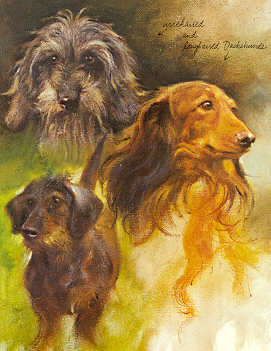
An odd, but very positive, thing has occurred: The Kennel Club is moving to embrace an outcross breeding of miniature wire-haired dachshunds to miniature smooth-coats.

What has motivated this?

The optimist in me notes that a recent study of wire-haired dachshunds found that 10 percent of the breed carried the gene for day blindness -- an extraordinarily high genetic load for a very serious condition in these wonderful little dogs.

Perhaps the Kennel Club was simply motivated to do the right thing? Perhaps they are really serious about putting health first?

Perhaps.

But the pessimist in my asks: If the Kennel Club is concerned about negative genetic loads alone, then why have they not greenlighted the Dalmatian Backcross Project?

Good question! And I have no good answer other than to note that the person who petitioned the Kennel Club for permission to outcross a wire-haired dachshund to a smooth dachshund is Sigurd Wilberg who happens to be quite wealthy thanks to his co-owning a string of Domino's Pizza franchises.

To be clear, there is nothing wrong with being rich, and I am all for pizza in any shape or form. That said, is this what it takes to get approval for an outcross -- bags of money and special access to the right people in the right circles?

Maybe. Perhaps.

But so what?

Let's just this once celebrate the fact that the Kennel Club is doing the right thing, no matter what the motivation or mechanism.

Click and treat.

Maybe, if we are patient, they will do it again!

.

Tuesday, June 9, 2009

Inbreeding and the Axis of Production


In an earlier post entitled Inbred Thinking, I noted that the cattle industry was the first to create a formal registry of breeding stock, and that this industry was also the first to note that milk and meat production dropped when animals were inbred very deeply or for very long.

Because farmers had a clear "steak and eggs" axis for evaluation of stock, they were ready and willing to outcross to achieve the best results for their needs and their land. Consumers, after all, do not much care what breed of chicken their eggs come from, or what "champion" bull sired their steak.

Through experimentation, farmers discovered that outcrosses and hybrids of two "pure" types produce as well or better, while remaining more disease resistant, more fecund, and longer-lived than deeply homogeneous stock.


Of course, what was true 150 years ago is still true today!

Anyone who wants to look at the deleterious effect of inbreeding animals beyond the single-digit threshold need only look at performance records for racing animals or farm stock where there is a real axis for evaluation.

As I have noted in the past, winning race horses are not heavily inbred, nor are winning Greyhounds.

In both animals, a Coefficient of Inbreeding of less than 5% is the norm.

What about production farm animals? Here too we find rising levels of inbreeding correlating perfectly with declining performance. As The Dairy Site notes:

The effects of inbreeding have been so much more negative than positive in animal breeding that the term "inbreeding depression" was coined. Table 1 shows inbreeding depression for lifetime and individual lactation traits of Holsteins from a recent study by Smith, et al. at Virginia Tech. The changes are expressed "per 1% increase in inbreeding." This means that the lifetime economic loss for a mating producing 6.25% inbreeding would be $24 X 6.25 = $150 expected loss from such a mating. Notice that, with the exception of somatic cell score where inbreeding has no apparent effect, all consequences of inbreeding in Table 1 are undesirable. Age at first freshening goes up, length of productive life goes down, all production traits are reduced, and first calving interval is lengthened as inbreeding increases.


The table referenced in the paragraph, above, is appended below:


What about egg production and beef cattle?

Here too we find exactly what we have found with racing dogs, racing horses, and mik cows: increased inbreeding results in less productivity.

The bottom line is a simple one: breeding any animal beyond the single-digit threshold is a recipe for infecundity and sickness.

As Heather Lorimer, associate professor of genetics at Youngstown State University notes:

Mammals, most other animals, and higher plants as well, have evolved mechanisms to avoid inbreeding of any sort. Some, like sweet cherries, have even evolved elaborate biochemical mechanism to ensure that their flowers can not be fertilized by themselves or by very genetically similar individuals.

Most pack animals (like lions, primates, and dogs), kick young males out of the pack so as to prevent them from mating with female relatives. Humans have very strong taboos against mating with relatives. Even fruit-flies apparently have a sensing mechanism to avoid too close of inbreeding; even in a closed population they maintain more genetic diversity than they ought to by random mating.


Professor Lorimer goes on to detail a quick list of the negative consequence of inbreeding:

  1. Elevated incidence of recessive genetic diseases
  2. Reduced fertility both in litter size and in sperm viability
  3. Increased congenital defects such as cryptorchidism, heart defects, cleft palates.
  4. Fluctuating assymetry (such as crooked faces, or uneven eye placement and size).
  5. Lower birthweight
  6. Higher neonatal mortality
  7. Slower growth rate
  8. Smaller adult size, and
  9. Loss of immune system function.


And what are the positive benefits
according to Kennel Club rosette chasers?

Simple: They can incrementally increase their chance of winning a $2 rosette made in China.

That's it!

Want to read more? Try these links:

  • Dairy Crossbreeding: Why and How: There has been renewed interest in dairy crossbreeding as new advantages come to light.... Crossbreeding is more widely practiced by dairy producers every year.

  • Inbreeding in Cattle: Inbreeding does not create undesirable recessive genes, but it does tend to bring to light these unfavorable genetics. This leads to a decline in average phenotypic performance called inbreeding depression. This phenomenon is well documented in all the major livestock species....
    .

Saturday, June 6, 2009

The Tribe of the Dog


Lakota woman with dog travois, Rosebud reservation.

This piece is from the July issue of Dogs Today.


From a great distance the indigenous people of the U.S. appear be "American Indian," but as you travel west, you discover it's not one people, but many tribes, and by the time you get to North Datoka, the question is not whether you are Sioux, but what type of Sioux -- Lakota, Yankton, or Santee?

Much the same goes on in the world of angling where we also find tribalism at work. From a distance, it's all "fishing," but in fact the 12-year old bait-baller with a cane pole on the bank has a different world view than the 60-year old man with a deep sea rod trolling for shark off-shore.

In the world of dogs, it is much the same. People obsessed with dogs may fall into any one of dozens of over-lapping categories, and move from one tribe to another over the years.

To an outsider, it is all rather confusing, and the cacophony of bitter voices and conflicting perspectives is a bit overwhelming.

Pit Bull rescuers damn the lunatics at PETA who say the only good Pit Bull is a dead one.

Vegan cucumber crunchers curse dog show matrons and their pedigree pooches, arguing that with so many dogs in shelters, “Every dog bred is another one dead.”

The small hobby breeder, only 10 years in dogs, parrots a potted history made up whole cloth 100 years ago by a dog dealer. The problem is the “backyard breeder” he says, never defining the term, but speaking in the confident tone of one who is certain he is not one. He points to a classified ad for retriever pups, $250 apiece, and a phone number.

On the telephone the woman describes her dogs as “fur babies,” and says she is not one of “those horrible commercial breeders.” Does she have hip scores for the sire and dam? No, but she has papers, she says hopefully.

The commercial breeder has hip scores – at least for some dogs. He is rather vague. What breed do you want? He has 200 dogs and raises 15 breeds, most of them lap dogs raised in battery cages similar to those used for chickens. He points out that the floors of his cages are made of plastic mesh, not chicken wire, and he says his waste management system is “state of the art.” All 200 of the dogs are taken care of by his wife and himself alone. And are there papers? Oh sure! Kennel Club papers for one price, another registry for a bit less – whichever you prefer.

In a telephone conversation, the breed club President waves off the commercial breeder. Only a fool would look there for a dog he says, oblivious to the fact that the head of the American Kennel Club says he started in dogs this way, and that he thinks the financial future of the AKC lies in more puppy mill registrations.

And so it goes, in a round-robin of blame and questions, challenged ethics, and sniffing aesthetics.

The people roar, but is anyone listening to the dog?

And what is it that we should be listening for? How do we read signs that are not written in pen? How do we translate language that is not written in words? How can we tell if we are doing good or doing bad?

One small idea is to look to original design. It is not hard to see what God intended. Left to their own devices, dogs devolve quickly to “pye-dogs” or pariah dogs weighing 30-45 pounds with short yellow coats and pointed faces.

This animal is not a Wolf, but it can breed with wolves and produce fertile young, same as it can breed with a Coyote, Golden Jackal, or Dingo and produce a fertile cross.

What can we say about these natural dogs? Well, for one thing, none have the kind of crooked or “benched” legs common to anchondroplastic breeds such as Bassets, Dachshunds, Bulldogs, and the like.

None have the smashed-in faces common to brachycelphalic breeds, such as Pugs, Toy Spaniels, French Bulldogs, Boston Terriers, and the like.

None have long coats with wild hair cascading down their sides. All have erect ears.

Most of the wild canids are sized between 10 pounds (a small red fox) and 150 pounds (a massive wolf).

In all cases, inbreeding is sharply discouraged. The “lone wolf,” after all, not a myth – it is a very young or old male driven out of the pack to find a harem of its own or die trying. The same occurs with coyote, fox, dingo, and jackal. Mother Nature prefers an out-cross.

What do we hear if we listen to pedigree dogs?

The data here is not deeply hidden. Canine pet insurance companies keep vast data sets on breeds and cross-breeds alike, and they will tell you that mutts are healthier than Kennel Club dogs, and they price their premiums accordingly.

Not only is there less inbreeding among cross-bred dogs than among their Kennel Club analogs, there is also less morphological exaggeration.

With mixed breeds you are less likely to get teacup dogs with serious teeth and neurological issues, and you are less likely to get giant dogs with torsion, cancer, and heart issues.

A mixed breed is less likely to have the skin problems found in deeply wrinkled dogs, and more likely to have the kind of muzzle that prevents eye damage and predictable respiratory and palette problems.

With Kennel Club dogs, there is not only a tendency to select for morphologies unseen in nature, but there is also the requirement that these exaggeration be maintained in a closed registry system in which coefficients of inbreeding tend to drift upward due to popular sire selection.

Of course, what I have said here is not new. Biologists, canine genetic experts, and working dog people have been making these points for decades. But their quiet message has been drowned out by the foot-stomping of those with economic and political interests.

Much the same has occurred with indigenous people the world over.

Their concerns too have been blotted out by issues of money, power, and prestige.

"The native tribes? Who cares about them? The natives don't vote and they don't pay taxes."

And of course neither do the dogs.

But does that mean we should not be listening to them?

Does the welfare of dogs not matter at the top?

Who will speak for the tribe called Dog?
.

Tuesday, May 19, 2009

Stonehenge: The Root of the Inbreeding Problem


If you tease through history books looking for the roots of the Kennel Club, you eventually come to The Field magazine, and John Henry Walsh.

The Field was founded in London 1853, and its target audience was "those who loved shooting, fishing, hunting and could sniff out a decent claret at 1,000 paces."

In short, The Field has never been a pure hunting magazine; it's always been about social status as well. Articles include not only gun reviews, but also tips on how to select a good butler, and suggestions on where you can get the best catered lunch served to you on a linen tablecloth while shooting big game in African. Though The Field is the oldest country sports publication in the world, its circulation remains a paltry 30,000.

It's no surprise to learn that a publication written for pedigree people was one of the driving forces behind the creation of pedigree dog shows. In fact, The Field can properly be described as the birth place of The Kennel Club, and one of its early editors -- a former surgeon by the name of John Henry Walsh -- can fairly be called its midwife.

Walsh put himself out as an expert on nearly everything from home economics to cooking recipes, from brewing beer and playing croquet to shoeing horses, and from building and firing guns, to breeding and judging dogs.

The All-England Croquet Club, from The Illustrated London News,
July 1870. In the foreground: Miss Walsh, Mr. and Mrs. J.H. Walsh


Often writing under the pen name "Stonehenge," Walsh took charge of The Field as the first Information Age was exploding under the advent of low-cost paper made from wood pulp and movable metal type.

By diving into older texts, and compiling, rewording, and adding a little bit of new information, Walsh was able to liberate a great deal of basic knowledge and disseminate it out to an eager public.

Consider some of the publications Walsh wrote or edited between 1849 and 1884:


  • The Provincial Medical and Surgical Journal (edited 1849–52)


  • The Greyhound, on the Art of Breeding, Rearing, and Training Greyhounds for Public Running, their Diseases and Treatment (1853)


  • Manual of British Rural Sports (1856)


  • A Manual of Domestic Medicine and Surgery (1858)


  • The English Cookery Book (edited, 1858)


  • The Shot-Gun and Sporting Rifle (1859)


  • The Dog in Health and Disease (1859)


  • The Horse in the Stable and in the Field (1861)


  • The Shot-gun and Sporting Rifle: And the Dogs, Ponies, Ferrets Used (1862)


  • Riding and Driving (1863)


  • Archery, Fencing, and Broadsword (edited, 1863)


  • Athletic Sports and Manly Exercises (edited, 1864)


  • Pedestrianism, Health and General Training (1866)


  • Dogs of the British Isles (1867)


  • A Table of Calculations for use with the Field Force Gauge for Testing Shot Guns (1882)


  • The Modern Sportsman's Gun and Rifle (1882-84 in two volumes)


Walsh had a burning passion for horses, dogs, guns, and all things outdoors, and it did not hurt at all that he had been trained as a surgeon as this meant he had an appreciation for the scientific method, and could talk with some expertise about physiological problems common to humans, dogs, and horses.

Walsh's publication on the Greyhound was one of the first breed-specific publications ever produced, and Walsh was also a judge at the first real dog show, held in Newscastle-on-Tyne, in 1859. Ironically, there were no Greyhounds at this dog show: just 60 Pointers and Setters, with one class for each breed.

The same year that the first formal dog show was held (sponsored by two shotgun vendors it should be said), Walsh produced one of the first "all breed" books on dogs -- a publication which lifted much of its information from earlier authors who, in turn, freely plagiarized from even earlier authors.

As a result of copying from so many older texts, Walsh's 1859 publication contains solid fact which nests cheek-to-jowl with vague descriptions, absurd assertions, obvious truths, glaring omissions, and confusing verbiage.

It should be noted that Walsh's 1859 book and the first formal dog show coincide with the publication of Charles Darwin's Origin of Species. This is not a complete accident.

As noted in Inbred Thinking, both Darwin's work and the first dogs shows sprang quite organically from the work of Robert Bakewell and the stock shows he promulgated in the last half of the 18th Century.

The grass over Bakewell's grave had not yet grown over before farmers with a flinty eye on the steak-and-eggs axis of production, began to raise questions.

Among the first was John Saunders Sebright.

Sebright was a chicken producer and a falconry enthusiast who also wrote one of the first books on animal husbandry, entitled, The Art of Improving the Breeds of Domestic Animals.

First published in 1809, Sebright's book argued that the inbreeding and line breeding of animals, which had been so necessary to create breeds, could actually destroy them if continued for too long.

Sebright, of course, was right, and it was not long before progressive farmers began quoting Sebright at every turn as an explanation for declining fecundity and productivity in flocks and herds.

It should be said that Sebright was not some minor figure in his day. Darwin himself quotes Sebright repeatedly in his correspondence and books, and Sebright's ideas on the dangers of inbreeding were frequently cited in American farming periodicals as early as 1825.

Sebright's warnings were also picked up by those trying to tease out an explanation for the decline of Europe's aristocracy. In an 1838 publication entitled: Intermarriage: or the Mode in Which and the Causes Why Beauty, Health and Intelligence Result from Certain Unions, and Deformity, Disease and Insanity From Others," Alexander Walker not only quotes Sebright while framing the eugenics debate to come, he pecifically notes the parallels between the breeding of farm stock, dogs, and humans.

In one paragraph, he quotes Delabere Blaine, who wrote the first serious veterinary text on dogs:


That is as true today as it was then!

Walsh, of course, had read Blaine and Sebright. He quotes each of them once, and parrots their conclusions on a number of matters.

That said, Walsh's work is so slap-dash and hedging that it is often hard to tease out a straight sentence. As a result, when the reader does find a declarative sentence or two, they tend to leap out and perhaps be overemphasized beyond what the author intended.

Such may be the case on page 175 of The Dog, in Health and Disease, in which Walsh clearly sets out a series of "principles of breeding," one of which is rather boldly stated:

Breeding in-and-in is not injurious to the dog, as may be proved both from theory and practice ; indeed it appears, on the contrary, to be very advantageous in many well-marked instances of the greyhound, which have of late years appeared in public.


Now there's a declarative sentence! "Breeding in-and-in (i.e. inbreeding) is not injurious to the dog!

And yet, on page 188, just 13 pages later, Walsh writes:

The questions relating to in-and-in breeding and crossing are of the greatest importance, each plan being strongly advocated by some people and by others as strenuously opposed. Like many other practices essentially good, in-breeding has been grossly abused; owners of a good kennel having become bigoted to their own strain, and, from keeping to it exclusively, having at length reduced their dogs to a state of idiocy and delicacy of constitution which has rendered them quite useless. Thus I have seen in the course of twenty years a most valuable breed of pointers, by a persistence in avoiding any cross, become so full of excitability that they were perpetually at "a false point," and backing one another at the same time without game near them, and, what is worse, they could not be stirred from their position.


Eh? What the hell is Walsh prattling on about now? If inbreeding is not injurious to the dog, then why is any corrective breeding action needed?

You mean inbreeding can wreck the working ability of a dog? Eh?

What happened to that nice unambiguous sentence about inbreeding not being injurious?

And what's with all this nonsense about "once in and twice out?" What evidence does Walsh have that this is a "cure" for the problem which, just 13 pages earlier, he had denied even existed?

No answer is forthcoming, I am afraid.


The good news is that we no long live in the age of schooners and candles, and we can put Walsh's breeding theories to the test by simply looking at modern data for the Greyhound, one of the oldest breeds on earth, and the type of dog which Walsh himself knew best and cited as his "proof" that inbreeding does no harm.

Are today's Kennel Club Geryhounds deeply inbred?

No. In fact they are not. A recent Imperial College study of 10 Kennel Club breeds found Greyhounds had the lowest Coefficient of Inbreeding among the breeds studied -- and this despite the relatively small number of Greyhounds on the Kennel Club's roles.

We find extremely inbred dogs in each breed except the Greyhound, and estimate an inbreeding effective population size between 40 and 80 for all but two breeds. For all but three breeds, more than 90% of unique genetic variants are lost over six generations, indicating a dramatic effect of reeding patterns on genetic diversity.


OK, but that's Kennel Club Greyhounds.

Surely a great deal of inbreeding is occurring at the race tracks where speed is everything, and ethics must take a back seat to cash bets placed on performance animals?

In fact, if we look at racing Greyhounds we find a meticulous tracking of of Coefficients of Inbreeding (COI).

And why?

Simple: Because the higher the COI on a racing Greyhound, the less likely it is to be a winner.

Most racing Greyhounds have very low COIs, same as most racing horses.

In fact, with both racing dogs and racing horses, Coefficients of Inbeeding are tracked with precision and turn up on racing indexes where high numbers are treated as a bad sign. As one horse racing index notes:

[The Coefficient of Inbreeding] can generally be ignored unless you see a number over 5.00%. In that case, there's almost too much inbreeding in the horse's pedigree. A number over 10% indicates too much inbreeding and generally such horses don't do well at the track.


Of course, this is not the kind of information that John Henry Walsh was sharing with his readers, was it?

No. And why not?

Well, for one thing, Sewall Wright's Coefficient of Inbreeding calculation had not yet been developed.

Nor had the era of dog shows and closed registries begun. Yes, some people like Blaine and Sebright urged caution when it came to inbreeding animals, but aren't naysayers always with us? Progress always demands that we ignore the naysayers!

And then, of course, there was the matter of class and commerce.

John Henry Walsh could see there was a ready market for books about dogs, and the more breeds there were, the more words that could be written, and the more books that could be sold.

This is the same intellectual engine that drives the Kennel Club train to this day. The Kennel Club has shattered every type of dog into scores of breeds not because the dogs do different work, but because with every breed comes more ribbons and more people to chase those ribbons.

The business of the Kennel Club is not dogs you see, it is ribbon chasing, and it is not the dog that is interested in the ribbon, but the owner.

Of course, John Henry Walsh and The Field magazine meant no harm. They were simply trying to make a little money and gain a little social position by catering to a growing public interested in field sports and dogs.

And, as far as I can tell, though Walsh was clearly one of the hands pushing the business of dog shows forward, he also had real questions about the idea and nature of canine registries, even as he took the Kennel Club's money and acted as their publisher.

More about that in a later post. Suffice it to say that closed registries did not begin in 1859!

A Sebright Rooster
.