Showing posts with label Pedigree Dogs Exposed. Show all posts

Thursday, September 23, 2010

How Much is That Bulldog in the Window?

Back in 2006, I wrote of the English Bulldog:

The famed English Bulldog... is mostly Chinese pug -- a show ring creation with legs so deformed it can barely walk, a jaw so undershot it cannot grab a Frisbee, and with a face so bracycephalic it cannot breathe. Add to these problems a deformed intestinal system (a by-product of achondroplasia or dwarfism) which makes the dog constantly fart, and a pig tail prone to infection, and you have a dog that considers its own death a blessed relief.

I have not changed my opinion, but you do not have to listen to me to hear about the congenital defects inherent to the breed.

Listen to what a top AKC show breeder told ABC television's Nightline program in April of 2009:


Why should anyone care that English Bulldogs are genetic and conformation wrecks?

Well for one, because this dog is a Top Ten AKC breed, along with the Golden Retriever, whose health care costs I have previously described.

We are talking about scores of thousands of dogs that will spend a lifetime in misery, struggling for breath even as they sleep.

And this struggle is not some sort of accident or an unintended genetic aberration.

This is perpetual torture by design, and it is common to one of the most abundant dogs to be found in the American Kennel Club.

Then there is the expense of taking care of these dogs. As with Golden Retrievers, the financial costs can be jaw-dropping.

Consider some of the common health care expenses that Embrace Pet Insurance has documented with this breed:


Embrace Pet Insurance pulls no punches in their description of the health of English Bulldogs:

The Bulldog may be perfect in spirit, but in the flesh is a different story. These dogs are intolerant of warm weather, and may die if over-heated. Too much exercise or stress can make it difficult for them to breath. Without exception, Bulldogs must live indoors, and need air conditioning in all but the mildest summer weather.

More than 90 percent of all Bulldogs are born by C-section. Because breeding them is expensive, the puppies are, too. Love is an expensive proposition when you own a Bulldog....

...Bulldogs' hips and spines are often malformed, as are their mouths. They suffer from a long list of respiratory ailments. Their many wrinkles and folds, and tightly curled tails, mean lots of skin infections. Cherry eye, inverted eyelids, cataracts and dry eye are just a few of the eye abnormalities that can affect the Bulldog.

...Many conditions have no screening tests, even though they're known or believed to be genetic. These include seizure disorders, allergies and skin problems, several kinds of bladder stone, a long list of airway defects, birth defects, infertility and cancer, and more. Bulldogs are also at high risk for "bloat and torsion," where the stomach twists on itself, trapping air inside, and requiring immediate emergency surgery.


Of course, more could be said.

Embrace Pet Insurance mentions the high cost of Cesarean births, but they do not mention the rape racks that are used in mating because this dog is so deformed and defective that it can only rarely breed on its own.

Do you still want an English Bulldog?

So you still think they are "oh so cute?"

Are you still reading all-breed books that leave all the important information out?

Friday, September 10, 2010

Pedigree Dogs Not as Healthy as Mutts & Mixes


In a comment to an earlier post, a reader writes to suggest that one reason folks may think mutts are healthier than pedigree dogs is "because vets don't attribute specific problems to their breeding - how could they? It's a mix!"

An interesting point, but actually, that's not the reason.

We think mutts are healthier than pure-breeds because they actually are healthier!

And the research, as I noted in an earlier post entitled Pet Insurance Data Shows Mutts ARE Healthier!, is not closely held.

When it comes to warranties and insurance, predictive values are important, and fortunes are made by determining the correct digits to place to the right of a point mark.

What does this have to do with dogs?

Quite a lot.

You see, pet insurance companies are in a competitive business to get your dollar. If they get the numbers wrong, and price a premium too high, potential customers may forgo pet insurance altogether or else sign up with a competitor's plan. On the other hand, if the company routinely prices insurance premiums too low, they may push themselves into bankruptcy.

And so, pet insurance companies have collected data on hundreds of thousands of dogs and analyzed that data, in order to assign correct premiums to predictive risks.


And what do the insurance records show? As I note, by way of example:

Embrace Pet Insurance... will insure a mixed breed dog up to 8 years of age, but the cut-off for purebred dogs is 6 years.

What's that about?

Simple: Taken as a whole, there is a "health gap" between cross-bred and pedigree dogs, and that gap is about two years. The insurance industry is simply mirroring in policy, what has been proven true on the ground.


Of course, there is more data. Over at the Cold Wet Nose blog, Beverley Cuddy has put up some of the citations from Jemima Harrison's current piece in Dogs Today which reviews some of the literature. Citations, with a summary "kicker" quote line to encapsulate the piece, follow:

  • B.N. Bonnett, A. Egenvall, P. Olson, A. Hedhammar, Mortality in Swedish dogs: rates and causes of death in various breeds, The Veterinary Record, 1997. ("Mongrels were consistently in the low-risk category.")

  • P.D. McGreevy & W.F. Nicholas, Some Practical Solutions to Welfare Problems in Pedigree Dog Breeding, Animal Welfare, 1999. ("Hybrids have a far lower chance of exhibiting the disorders that are common with the parental breeds. Their genetic health will be substantially higher.")

  • A. Egenvall, B.N. Bonnett, P. Olson, A. Hedhammar, Gender, age, breed and distribution of morbidity and mortality in insured dogs in Sweden during 1995 and 1996, The Veterinary Record, 2000. ("Mongrel dogs are less prone to many diseases then the average purebred dog.")

  • A. R. Michell, Longevity of British breeds of dog and its relationship with sex, size, cardiovascular variables and disease, Veterinary Record, 1999. ("There was a significant correlation between body weight and longevity. Crossbreeds lived longer than average but several pure breeds lived longer than cross breeds, notably Jack Russell, miniature poodles and whippets.”)

  • G.J. Patronek, D.J. Walters, L.T. Glickman, Comparative Longevity of Pet Dogs and Humans: Implications for Gerontology Research, Journal of Gerontology, Biological Sciences, 1997. ("The median age at death was 8.5 years for all mixed breed dogs and 6.7 years for all pure breed dogs. For each weight group, the age at death of pure breed dogs was significantly less than for mixed breed dogs.")

  • H.F. Proschofsky et al, Mortality of purebred and mixed breed dogs in Denmark, Preventive Veterinary Medicine, 2003. (Higher average longevity of mixed breed dogs. Age at death when split into three age bands: mixed breeds 8,11,13, purebreds 6, 10, 12.)

  • Marta Vascellar et al, Animal tumour registry of two provinces in northern Italy: incidence of spontaneous tumours in dogs and cats. BMC Veterinary Research 2009. (“In both dogs and cats, purebreds had an almost two-fold higher incidence of malignant tumours than mixed breeds.”)

  • Agneta Egenvall et al, Mortality in over 350,000 Insured Swedish Dogs from 1995–2000; Breed-Specific Age and Survival Patterns and Relative Risk for Causes of Death. Acta Veterinaria Scandinavica, 2005. (No difference overall, but mongrels low-risk for locomotor problems and heart disease.)


Of course, not all pure breed dogs are a complete mess, and not all mongrels or mixes are the picture of health. "Hybrid vigor" does not quite live up to its hype either. Mix two genetic messes, and you may not get gold out of the opposite side.

That said, all things being equal, mongrels and mixes ARE healthier than pure breeds. Fancy that! And yes, the pun is intended.
.

Wednesday, June 23, 2010

You Will Know It By ... Her Master's Voice


In a world of 6.7 billion people, it seems only a trusted and much-loved member of the Kennel Club could chair the new Advisory Council on Welfare Issues of Dog Breeding in the U.K.

The new chair, Sheila Crispin, is a veterinary opthamologist who has spent decades in dogs and yet has never been vocal in criticizing the Kennel Club about it practices, and never mind the obvious pain and misery caused by those practices.

Is this opthamologist blind? We shall see.

Here's what I suspect will happen: a lot of movement and not much action.

Look for Crispin to tackle everything but the real issues of contrived standards leading to deformed dogs in misery, and inbreeding practices leading to jaw-dropping rates of disease.

Open the registries? Require working dogs to work in order to win rosettes? Those are words that will never pass her lips.

Instead, look for her to launch off on a campaign against puppy mills, and perhaps to initiate a drive to mandate microchipping.

Those are worthy problems deserving attention, but they are not why this Advisory Council was created.

They will be within her comfort zone, however.

Her comfort zone, after all, has always been close to the Kennel Club's hierarchy which has given her an honorary membership and tapped her as a member of its own "Breed Health and Welfare Strategy Group" which, you will remember, is the cause of the current mess.

Will I be wrong?

Nothing would make me happier if I am! But when it comes to dogs, I have learned to keep my expectations low, and this is a good example.

Patrick Bateson promised that this new Advisory Council on Welfare Issues of Dog Breeding would be appointed on the Nolan Principles. I am not sure how appointing a Kennel Club member and insider to "reform" the world of dog breeding fits those principles. In fact, let me say quite clearly that I think it does not.

Job One for Crispin, if she is serious (and I hope she is!), is to repudiate the nonsense put out by the Kennel Club which says that "the vast majority of breeds and dogs are healthy." This is demonstrably not true as even the most cursory examination of the Kennel Club's own health surveys make clear.

Truth and reform cannot start with lies and distraction. Let us see which way Crispin heads...
.

Friday, June 18, 2010

The Humane Society did WHAT?

Has Hell frozen over?

You might think so.

You see, the Humane Society of the U.S. (HSUS) is quoting this blog in the cover story of All Animals magazine, which is HSUS's full-color bimonthly membership magazine which goes out to their 10 million members.

In a long, well-written, and fair piece, author Carrie Allan lays out The Purebred Paradox whose strap line is "Is the quest for the 'perfect dog' driving a genetic health crisis?"

Once upon a time, people believed that purebred dogs were naturally healthier than mixed breeds. How have we arrived at a point where it may be safer to presume the opposite? ....

.... The more limited the number of mates, the greater the chance a dog will be bred with a relative who shares similar genes. Genetic diseases are caused by recessive genes, so a good gene from one parent will trump a bad gene from the other. But if both parents have a bad gene—such as one that predisposes them to hip dysplasia or blindness—the likelihood of a sick puppy increases.

“What happens when you have a small and inbreeding population is that the probability of two negative recessive genes finding each other increases as the gene pool chokes down to a smaller and smaller pool,” says Patrick Burns, a Dogs Today columnist who frequently writes about genetic health issues on his blog, Terrierman’s Daily Dose.

A closed registry that allows no “new blood” into the mix exacerbates the problem, he argues: “In many AKC dogs, the founding gene pool was less than 50 dogs. For some breeds, it was less than 20 dogs.”

This year’s Westminster champion, a Scottish terrier named Sadie, hails from one of these tiny gene pools and is “very heavily inbred,” says Burns. The limited ancestry for AKC-registered Scotties, he adds, helps explain why 45 percent die of cancer.

“We do not need to have a closed registry to keep a breed,” Burns says, pointing out that breeds existed long before there was an organization to track them. “We did not create the dogs we love in a closed registry system—we have only ruined them there.”


Read the whole thing. The HTML version (multiple jump pages) is here, and the PDF version (8 pages) is here.

This is one of the longest and best articles done so far on the American "dog mess" that is a confluence between disease, deformity and defect caused by inbreeding and contrived and twisted breed standards, and the sick internacine economic relationships that exist between puppy mills and the AKC.

This article also details what has been going on in the United Kingdom since the advent of Pedigree Dogs Exposed. As Carrie Allan writes:

[I]in the United Kingdom, at least, there seems to be momentum for change. Whether that momentum will gather steam in the U.S. remains to be seen


Spread this article around!

Remember that if you want the Humane Society of the U.S. to move in the right direction, you need to click and treat.

I assure you this is the right direction. They have not taken any gratuitous swipes at pedigree dogs or dog breeders. Quite the opposite, in fact.

Take this line for example. Anyone think this is not fair and well-said?

At The HSUS, we’re big fans of adoption. By going to a local shelter or rescue group, you stand a good chance of both saving a life and finding a purebred — after all, they make up an estimated 25 percent of dogs in shelters.

When you can’t find the dog you’re looking for, however, responsible breeders are another option; they are devoted to their animals’ well-being and committed to placing them in loving homes. And if every shelter dog were adopted and every puppy mill were shuttered, there would still be a need for good breeders to supply dogs to American households.


Full applause to HSUS for this article, and to author Carrie Allan in particular. This is a big subject, and she has done an extraordinarily good job of wrapping herself around it and presenting it in a cogent and fair manner.

Thursday, April 29, 2010

Will Crufts Lose Its Discount Sofa Sponsor?


The Crufts dog show is like an old couch kicked to the curb and left out in the rain: a broken down thing that looks bad, smells worse, and is now looking for a place to die in peace.

The problems started a long time ago, of course, back when it was the Allied Terrier Show.

Perhaps a clear warning was that it was always a commercial venture. Charles Crufts himself, believe it or not, never even owned a dog.

Crufts has always celebrated the bizarre and contrived; dogs with pushed in faces, bug eyes, and coats so long and thick they satisfy the pent up needs of even the most frustrated of wannabe hair dressers.

And of course, work was never celebrated, and inbreeding was not only encouraged, but required in breed after breed.

How could anything but disaster come from this?

Everyone saw it, but it was not until Pedigree Dogs Exposed put it on tape and explained it, that the consciousness of consumers was properly shocked.

In rapid succession, companies pulled out of Crufts, not the least of which was the BBC and Pedigree dog food.

Who wanted their products identified with animal abuse, defect, disease and deformity?

No one!

Finally, the Kennel Club found Graham Kirkham, a wealthy breeder of Dalmatians (a breed famous for deafness and a uric acid disorder that requires some dogs to have a hole drilled into the base of their penis).

Kirkham had a company that sold discount furniture, and in exchange for Crufts adding a couch to its logo (no, we are not making this up), he agreed to have his corporation underwrite the Crufts fiasco show.

Now, however, Dog World reports:


THE FUTURE of DFS’ sponsorship of Crufts may be in doubt following owner and chairman Lord Kirkham’s decision to sell the Yorkshire-based company.

Kennel Club member and Dalmatian owner Graham Kirkham is believed to have pocketed about £300m from the sale to private equity firm Advent International.

DFS sponsored this year’s Crufts and told DOG WORLD at the time that the arrangement between the company and the Kennel Club was based on an informal arrangement with no contractual commitment.


DFS's contractual support for Crufts is assured through 2011, but after that, things are adrift.

Who wants to pick up this dirty, damaged and smelly couch and make it the center piece of their living room? Anyone? Time will tell.

Thursday, April 8, 2010

Thursday, March 11, 2010

This Pack Does Not Have a True Leader

The Kennel Club pack does not have a true leader at the helm says veterinarian Peter Wedderburn, writing in The Telegraph.

Crufts, the world’s largest dog show, opens this morning with a strapline that some may regard as wishful thinking: “Celebrating happy, healthy dogs”. The show is still highly popular, with nearly 28,000 dogs attending, along with an anticipated audience of over 150,000 human visitors over the next four days. But the mood at the event will be very different to its glory days.

As recently as two years ago, Crufts was widely applauded as a manifestation of the traditional British “love of animals”. Then, in the autumn of 2008, the BBC documentary “Pedigree Dogs Exposed” changed everything. A different pall was cast on the notion of breeding dogs for the showring, with claims that dogs had been deliberately bred to look a certain way, despite the fact that their show-winning appearance was accompanied by poor health. The Kennel Club was accused of inaction in the face of evidence that pedigree dogs were suffering. The BBC and major sponsors withdrew support from Crufts. An event that had been central to British culture was sidelined.....

....But it’s not easy for casual onlookers to get an accurate sense of what’s really happening on the ground. When the Kennel Club takes actions and promises to take more actions, are changes really happening, or is the organisation just making sounds that are pleasing to the ear?

Jemima Harrison, the producer of the original BBC documentary, has continued to be a vocal and well-informed critic of the Kennel Club. In an open letter to the organisation, published today in the April edition of the Dogs Today magazine, she lists nine actions that she’d like the Kennel Club to take ...

....To a veterinary surgeon who’s been watching the debate carefully, these seem like reasonable requests. I know that the Kennel Club is an organisation run by dog lovers who want the best for the animals whose lives are affected by their decisions. I know that it can be difficult to take some unpopular but necessary actions when there’s a fear that members of the organisation may rebel or even leave to set up their own breed organisations. But if there ever was a time for leadership, it’s now.

Here’s a reminder of a simple definition: “to lead” means “to guide by going in front”. The Kennel Club; it’s over to you.
.

Wednesday, March 10, 2010

AKC To Go Out of Business By 2025?


SOURCE :: Click to enlarge

The American Kennel Club appears to be ready to go out of business by 2025.

That's the take-away message from an analysis of the perilously steep decline in AKC registrations that has occurred since 1992.

Between 1992 and 2008, AKC registrations declined by more than 55 percent, and a "best fit" trend line done by DVM magazine suggests the organization will be gone by 2025 unless a drastic change is made.

If we looks at AKC registrations per capita, the decline is even steeper -- a 61% decline in registrations over the same period of time.


SOURCE :: Click to Enlarge

What's the reason for the decline? You can chase it around the barn any number of ways, but the simple story is that No one wants to register their dogs with the AKC anymore.

Most dog buyers would rather go to the pound (the source of more than half of all pet dogs in the U.S.) while those that still go to breeders are looking for healthy dogs, not show dogs.

But what about that piece of paper that says "AKC" on it?

No one believes it's a sign of a either healthy dog or a knowledgeable breeder producing quality dogs.

In fact, quite the opposite.

The word is out that the AKC has been in bed with backyard breeders and puppy mill dog peddlers for decades, and the AKC's own board minutes and the statements of its Chairman reflect that.

The word is out that AKC dogs, on average, are less healthy than mutts and cross-breeds, and canine health insurance records and premiums reflect that.

And the word is out that AKC breeders have been giving "the big wink" to defect, disease and deformity for more than 50 years. Who wants to be associated with that?

And so the AKC is crashing to the ground.

Like a drunk hugging a vodka bottle as it speeds down the road, it is unable and unwilling to change until it is too late.

Monday, March 8, 2010

The Farce That is Crufts


The face of a winner.

The farce that is the Crufts Dog Show continues unabated.

Named after a dog food salesman that never owned a dog, it started out as the Allied Terrier Show and helped speed the rapid destruction of almost ever breed of working terrier, from Fox and Welsh, to Borders and Bedlingtons.

Crufts is also the location where the genetic disaster know as the Cavalier King Charles Spaniel first appeared, spurred by an American by the name of Roswell Eldridge who put up a cash prize for anyone who could come up with a dog that looked like those in the paintings of van Dyck. The resulting dog was inbred to the point that today more than 50% of Cavaliers die from heart disease. In addition to jaw-dropping levels of heart disease, well over one-third of Cavaliers have Syringomyelia, a disorder of the brain and spinal cord.

In the last year, insult has been added to injury, as Crufts has now taken on a discount sofa company as its sponsor, going so far as to include a sofa in the Crufts logo. The owner of DFS, the discount sofa company, has said (and I could not make this up): "If DFS was a dog, it would be a Crufts champion." Translated into English that means: "We sell products that look good in the picture but they fall to pieces the moment you try and actually put them to use."

So what's the latest charade? Just this: The London Times is reporting that "The Kennel Club has rewritten the rules for the Crufts dog show to give a veterinary surgeon the authority to exclude any unfit dog."

Right.

And how does that work?

There are entire breeds that are unfit, starting with the English Bulldog.

Listen to the bobble-headed Bulldog breeder in the clip, below, explaining why all English Bulldogs are unfit for ANY function:

"In the heat and the lights of the show, they can overheat and actually go down in five minutes. Instead of a long snout, where it's an open airway, it's smashed like a coke can and the breathing has to go through many, many curves and turns."


Flash located here (right click on link to copy) Youtube link here


Now look at the German Shepherds below, which were show at the Manchester Kennel Club show in 2008.

I guarantee you will see exactly the same slope-backed wrecks walking on their hocks at the Crufts show in 2010!


Border Terrier breeder and veterinarian Steve Dean will be Crufts chief veterinarian, and his word is to be law.

But what good is the law if it will never cry foul?

When the Bulldogs enter the ring the whole thing will become a joke. The German Shepherds, Cavaliers, Pekingese, and Chinese Cresteds will simply be the punchline at the end of a long wind-up going back more than 100 years.
.

Saturday, February 20, 2010

When Direct Mail Is a Threat to Dogs


In the last week we have seen PeTA and the Humane Society of the U.S. inject themselves into the arena of pedigree dog health.

Wayne Pacelle wrote a piece over on his blog, trying to inject himself into the debate, while PeTA crashed center ring at the Westminster dog show with two activists holding placards that were laughably off-message.

My position is pretty simple: direct mail professionals and vegan clowns will not improve the debate on the health and future of pedigree dogs.

Here's a thought: The men and women who actually care about dogs have brought this debate up to to this point, and they continue to move things along quite smartly.

Maybe they don't need any "help" from people whose primary interest in dogs is direct mail fundraising?

Of course, I am not the first to say it.

Jemima Harrison, the producer of BBC's Pedigree Dogs Exposed, has already blasted PeTA for its stunt theatrics, noting that the world hardly needs a lesson in dog health from a group that kills 97% of the dogs brought to its shelter.

So why are PeTA and HSUS suddenly so interested in dog health?

It is not because these are new issues!

In fact, this debate is as old as the Humane Society and far older than PeTA. But for more than 100 years, the "humane" movement has said nothing. Problem? What problem?

In fact, as I have noted in the past, this silence was not entirely accidental. The animal rights movement and the parade of mutants we see in the Kennel Club show ring today are different roses that have sprouted from the same root. And that root has nothing to do with dogs.

"Pedigree people have pedigree dogs" sniff the over-weight matrons of the Kennel Club who seek to associate their common lives with aristocrats or historical figures who once owned "their" breed.

"And pedigree people do not abuse animals by hunting them, or eating them" sniff the under-weight vegans of PeTA who are trying to find a "cause" that will elevate their lives over the humdrum.

For both sides, the only "work" required of a dog is for it sit on a couch.

And that's why both sides are so dangerous to dogs.

You see, most dog types and breeds were created for something: improved function.

Herding dogs were created to herd.

Livestock guarding dogs were created to guard.

Terriers and dachshunds were created to go down tight holes to bolt or battle a fox or badger.

Pointers and setters were created to hold steady over birds -- first for nets, and later for firearms.

Retrievers were designed to retrieve shot birds, tossed boat lines, and pretty much anything else a human might suggest.

But of course the folks at PeTA and HSUS do not buy the premise.

These organizations are actually opposed to hunting and herding.

Have a husky pull a sled? That's cruel!

Have a greyhound catch a rabbit on the fly? That's cruel!

Have a collie herd sheep? Thats cruel!

PeTA and HSUS deny the functional reason hunting, herding, and pulling dogs exist.

For PeTA and HSUS the only purpose of a dog is to be a pet.

And since a pet has no real function other than not to bite the hand that feeds it, there is no need for dog breeds at all.

Knowing this, why would anyone ever listen to HSUS or PeTA when it comes to breed health?

A concern about breed health assumes you actually care about the breed.

But, of course, that is a bit hard when you have open contempt for the work that breed was created to do!

Which is not to say that the AKC and the Kennel Club are not thrilled to see PeTA and the HSUS start talking about canine health.

Perfect!'

Now the kennel clubs can try to frame the "debate" as being about "animal right lunatics" who are in opposition to all canine work and breed purposes, versus kennel club "dog experts".

And never mind that the Kennel Club's dog "experts" have never dug a terrier, shot a bird, hitched a sled, or coursed a rabbit.

And never mind that this debate was created and is being pursued by those who have put "Dogs First" rather than direct mail economics.

Neither side cares about that now.

For PeTA and HSUS this looks like a new topic with which to fill their direct mail coffers.

For the kennel clubs, this looks like a new development which can be used to deflect serious charges about pedigree dog health and welfare.

Each will try to use the other to carry on with their "business as usual."

And if that happens, the dogs are sure to suffer.
.

Thursday, July 2, 2009

Crufts Takes a Hit, While Harrison Takes an Award


Two squibs, which I think benefit from juxtaposition:

  1. Dog World reports that Eukanuba has withdrawn its support from the agility classes at Crufts. Prior to Eukanuba's withdrawal, Pedigree dog food, the BBC, Hill's dog food, the RSPCA, Dogs Trust, and the PDSA (Britain's leading veterinary charity), had all withdrawn from Crufts. Crufts major sponsor is now a company that sells half-priced sofas.

  2. K9 Magazine reports that Jemima Harrison, the producer of Pedigree Dogs Exposed for the BBC, has been awarded the RSPCA's highest honor "for her commitment to the welfare of pedigree dogs." It is the first time the RSPCA award has gone to a filmmaker. For the record, Pedigree Dogs Exposed was commissioned by Richard Klein, the Executive producer was Eamon Hardy for the BBC, and the cameraman throughout was Jemima's partner, Jon Lane. Congratulations to all!


.

Thursday, June 25, 2009

"Pedigree Dogs Exposed" to Air on Canadian TV


Pedigree Dogs Exposed, the documentary that rocked the dog world in Britain and Australia, is coming to CBC in Canada on Sunday, June 28, 2009 at 8 pm ET.

Spread the word!

Since the broadcast of this documentary in the U.K. last August, the British and Australian Kennel Clubs have announced a wholesale review of every pedigree dog breed.

Now comes word from the CBC that Canadian Kennel Club is also undertaking it's own review.

Progress! And more to come, I will wager.

.

Thursday, March 12, 2009

Nightline: AKC Terrified of Dog Health Topic


More than 45 percent of Bernese Mountain Dogs die of get cancer. Is that a problem?

From ABC's Nightline, March 11, 2009

Best of Breed?

Pedigree Dogs Face Disease
Critics Say Purebred Dogs Have Health Problems
Because of Inbreeding, Show Standards


By: Nick Watt, ABC Nightline Special Investigation
Watch the Video - Click
HERE

The Westminster Dog Show is the showpiece for a multi-billion dollar industry, a festival of primped pooches, prestigious prizes and perfect pedigrees. This year's big winner, a Sussex Spaniel called Stump, became an instant celebrity.

The owners love it. But whether such competitive shows are good for the dogs is debatable.

Consider the Bulldog ring at Madison Square Garden last month, where the show's smushed-face dogs were getting a cooling spray.

"In the heat and the lights of the show, they can overheat and actually go down in five minutes," one handler said. "They have, instead of a long snout where it's an open airway, it's smashed like a Coke can and the breathing has to go through many, many curves and many turns." That's the desired look for a Bulldog to win ribbons at dog shows. In other words, it's a world in which dogs are bred with exaggerated features to please the judges, features that can cause extreme discomfort and serious distress, some veterinarians say.

Backstage at the Garden, a German Shepherd breeder explained how show-winning traits can be passed from generation to generation. Something called "line breeding" is common practice. That's breeding, for example, a grandfather with his granddaughter. Mating of direct relatives, or inbreeding, also happens.

"That dog I kept, out of the brother-sister breeding," Susan Legg, the German Shepherd breeder, said. "[It] was one of the best stud dogs I've ever owned and produced over 80 champions."

Competitive dog breeding has been a popular sport since it was imported from England more than 130 years ago. The first Westminster Kennel Club show was in 1877.

"These dogs are some of the most pampered pooches that there are," Tony Carter, a Chinese Shar-Pei owner, said at Westminster.

Every breed has specific genetic defects. "All Cavaliers are carrying the potential for mitral valve disease," said Jennifer Wehking, a breeder of Cavalier King Charles Spaniels.

According to the Web site www.CavalierHealth.org, half of Cavaliers will suffer this heart-valve defect before their fifth birthday.

Similarly, Meg Callea, a Dalmatian breeder at Westminster, said, "We have a very unique stone-forming disease in our breed. It's uric acid, which is very similar to gout in people."

Male dogs that suffer from the condition can't urinate properly.

Breeders and the American Kennel Club have long admitted that pedigree dogs do face health issues. They say they do all they can to tackle them.

The club declined to be interviewed for this story. The organization also e-mailed its members and recommended "politely declining" requests for interviews, although it said in a written statement that the group conducts hundreds of kennel and breeder inspections each year and donates millions of dollars to improve dogs' heath.

The club and some of its members appear to be circling the wagons largely because of a British documentary called "Pedigree Dogs Exposed," which aired last year. The filmmakers showed dogs in distress, allegedly stricken by genetic diseases. They likened pedigree dog breeding to the eugenics principles of Adolf Hitler and questioned the practices of inbreeding and breeding to a "standard."


Pedigree Dogs Face Health Challenges

"I'm heartened by the reaction to the film," Jemima Harrison, the producer, said. "We always knew that what we were doing was going to have a huge impact. Our fear was that it would have a huge temporary impact." The effect was anything but temporary. After 42 years televising Crufts in the U.K., the world's biggest dog show, the BBC just pulled the plug in protest, Britain's Kennel Club has reviewed its "breed standards," and Britain's Royal Society for the Prevention of Cruelty to Animals recently released a report titled, "Pedigree Dog Breeding in the UK: a Major Welfare Concern?"

The report makes the following conclusions: "Many different breeds now experience compromised welfare. ... The desire to produce an unusual, exaggerated or spectacular conformation have often produced dogs which tend towards abnormality."

In the United States, the American Kennel Club, founded 1884, is the authority. It recognizes 161 breeds, registers purebreed dogs, oversees many dog shows and is guardian of the so-called "breed standards." According to its breed standard, the venerable Bulldog must have "very heavy" shoulders, "very short" forelegs, a "very large" skull and an "extremely short" face.

"Characteristics of the breed, say, in the 19th century were much less accentuated than they are now," said James Serpell, director for the Interaction of Animals and Society at the University of Pennsylvania. "I think it was rather like the cartoonist; you know how a cartoonist can accentuate features of someone's face and make them look even more like they look."

The Bulldog of today looks very different from the Bulldog of 150 years ago. With their exaggerated, show-winning proportions, most Bulldogs can't even mate on their own. They need the help of a cradle, which can be bought on the Internet. Also, many Bulldog bitches can't give birth naturally because the puppies' heads are too big. "They do need to be artificially inseminated, and C-sections," Linda Johnson, a Bulldog breeder at Westminster, said. Ed Sayres, president of the ASPCA, said, "If an animal can't reproduce, that's obviously a message that it's headed for extinction."

Pedigree dogs face two potential health challenges. The first is breeding them to fit their "breed standard": The Bulldog's large head, for example, and the Boston Terrier's short muzzle, which results in 25 percent of them having difficulty breathing. Some major airlines have, for health reasons, banned Bulldogs, Bostons and other breeds from flying in warm weather.

"Take your own nose and pinch it, then try to breathe," Patrick Burns said of the feeling for a Boston Terrier or Bulldog with breathing problems.

Burns, who hunts in Maryland's fields with terriers of fuzzier pedigree and longer snouts, and blogs voraciously as "Terrierman," is scathingly critical of the dog-show world. "Most of the breeds don't have a function," he said. "They're not running dogs, they're not catching rabbits. That's fine. There's nothing wrong with that. But if their only function is to be a pet, then they have to put health first."

The other potential issue for pedigree dogs is inherited disease. For example, pure bred Flat-Coated Retrievers have a high incidence of cancer. And line breeding, which some say accentuates the problem, is standard practice for show dogs.

"There's nothing to say that a close breeding on one occasion would produce anything but superior stock, not inferior stock," Tom Bradley, show chairman at Westminster, said.

Many academics disagree. "If they didn't practice all this inbreeding and line breeding to begin with, those genetic diseases wouldn't be a problem," Serpell of the University of Pennsylvania said.

Although the American Kennel Club declined to be interviewed, it did e-mail a statement:

"The American Kennel Club is the nation's leading not-for-profit organization devoted to canine health, breeding and responsible dog ownership. The AKC's breeding policies and high ethical standards have made us the most widely respected registry in the world. Each year, the AKC performs approximately 5,000 kennel and breeder inspections to ensure the proper care and conditions of dogs and has led the charge in regards to advancing canine health, including founding the AKC Canine Health Foundation in 1995. Since that time, $22 million has been given to more than 500 research projects at 74 vet schools and research institutes worldwide to improve the health of all dogs. For More Information Visit: www.akcdoghealth.com"


Are Mixed-Breed Dogs Better?

With funding from the Canine Health Foundation, vets and researchers have begun isolating disease-causing genes.

"To be fair to the Kennel Club, they are doing quite a lot to try and fix some of the problems that are there," Serpell said. "So they created the AKC Canine Health Foundation. ... But for me, that's a bit like closing the gate after the horse has bolted."
One approach the Kennel Club and others are trying is to first isolate a defective gene, treat the dog that carries it and stop breeding from the dog so the gene isn't passed on.

"I think 95 percent of the people who exhibit dogs here are responsible breeders," Bradley, the Westminster show chairman, said. "They want their dogs to be healthy."
But, as seen at Westminster, not every breeder stops breeding from a dog that they know has a problem. It's not quite that simple.

"I have bred one of my girls to a dog that heard in one ear," Callea, the Dalmatian breeder, said. "And I knew that when I did it. But he was an exceptional dog with a phenomenal temperament and he had a lot of really good things to offer."

But not every breeder will breed with a Dalmatian that hears in only one ear, she said.

"My hearing is real strong on my end," she said. "Otherwise, I wouldn't have done it on that dog." Many breeders at Westminster raised the million-dollar question: Are mixed breed dogs any healthier?

"The misconception out there is that mutts are healthier," Legg, the German Shepherd breeder, said. "That is not true."

It is a gray area. But the records of a Swedish company that insured 200,000 dogs between 1995 and 2002 found that of the 80 most popular breeds, the dog requiring the most medical care was the pedigree Boxer. A "mixed breed" category came in at 68. Healthiest was something called a Norbottenspitz, a Scandinavian hunting dog.

Breeders of pedigree dogs say that at least with a pedigree, you know what ailments your breed is susceptible to. You can treat them.

With a mutt, Legg said, "You don't know what's in the blood line, you don't know the temperament behind the dogs, you don't know anything."

Backstage at Westminster, owners and breeders said the problems are not on the show floor.

"The problem isn't with the standard, the problem isn't with any of the breeders in this room," Phoebe Booth, a Bulldog owner, said. "The problem is with people who see the dollar signs and want to market these breeds as commodities."

Such so-called puppy mills, or high-volume breeders, produce up to 400,000 pedigree dogs every year, according to the ASPCA. In some, the conditions are terrible and dogs aren't screened for disease. "Some of these dogs are only 8-months when they're first bred," Bob Baker of the ASPCA's Anti-Cruelty Unit said as he walked among dozens of dogs he says were rescued from a puppy mill and are waiting to be adopted at the society's headquarters in New York City. "And many of them, by the time they're 5 years of age, they're burnt out. And the breeders take them out and shoot them."

Baker, who often goes undercover to investigate conditions in puppy mills, said that the dogs are often treated like livestock. "Greed takes over," he said. According to the ASPCA, around 25 percent of pedigree dogs bought in the United States every year come from puppy mills or unscrupulous backyard breeders. The ASPCA claims that every single dog bought from a pet store, not direct from a breeder, comes from a breeder they would deem "irresponsible."

ASPCA president Sayres said, "A responsible breeder would no more sell their puppies through a pet shop than a responsible parent would sell their children on eBay."

The ASPCA and the Kennel Club do carry out inspections on breeders, and the U.S. Department of Agriculture is the ultimate authority over large-scale puppy breeders.


Putting Health Before History

But health problems are not confined to the puppy mill dogs. In Philadelphia, Dougie the French Bulldog, bought from an apparently reputable breeder, cost his owner $4,500 for an operation to correct a severe breathing problem. "I tried to look for the best of the litter," owner Lauren Brown said. "But, obviously, with him we couldn't predict."

The ASPCA said its main concern is abandoned dogs. According to its figures, up to 4 million are destroyed every year because they can't find a home. For the ASPCA, dog shows and pure bred health issues are a low priority, but still a concern.

"Yes, some of the dog show stuff is silly and some of it is definitely detrimental to the health and welfare of dogs," Sayres said. But Sayres does not want to see a vitriolic battle, such as the one now being waged in Britain. "I'm much more solution oriented," he said. "And I think that has to come from a dialogue."

Dr. Lisa Esposito, a volunteer from the Veterinary Medical Association of New York City who was on duty at Westminster agreed. "I think [there should be] some dialogue concerning the standard," she said. "For example, the tight tails, the tight nostrils." Serpell at the University of Pennsylvania advocates cross breeding: Sacrificing purity for health. Why not cross a Boston with another terrier, he says, give it a slightly longer snout, let it breathe more easily?

"It would still have the basic features of the Boston Terrier," he said. "It wouldn't have such a squashed face."

Burns, aka "Terrierman," said, "Let their faces come out a little bit. They don't have to have a lot of muzzle to be able to breathe. But they have to have some. That's all it is. Give the dog a little bit of face." And, in Philadelphia, Brown, the French Bulldog owner and vet student, has had similar thoughts. "I think that would be met with a lot of resistance," she said. "But, overall, I think, in time, the health issue would win over history. I think it would be better for the breed. I would like to see that happen."


Many Boston Terrier have a hard time breathing. Is that a problem?

Mountain and Pearl Make It to ABC's Nightline


Mountain and Pearl made it on to ABC's Nightline last night in a segment called "Best in Show?"

Click here to see the whole thing.

Also featured, of course, were Pedigree Dogs Exposed, Jemima Harrison, Ronnie Irving, Marc Evans, James Serpell, and this blog (yes, this blog!), with excellent reporting by Nick Watt of ABC.

Best of all, the fear of the AKC was featured front and center.

This is an enormous multi-million dollar organization with splendid (and expensive!) headquarters on Madison Avenue in New York City, but they cut and run when asked to explain the dogs.

Now there's pride!

Not only would they not even attempt to defend what they have done to the dogs, but they sent out a notice to all the breeders and top breed clubs to cut and run as well.

God forbid that the Dalmatian owners explain the deafness and the uric acid stones in their breed, that the bulldog owners explain their dog's defective respiratory tract, that the chihuahua owner explain the hole in their dog's skull, or that breed after breed explain the jaw-dropping rates of cancer and dysplasia.

Of course, having told all the breeders and dog show people not to talk, but to send all press inquiries to the American Kennel Club, the AKC then turned around and said it also would not talk to the press!

And what are they going to say this morning? Simple: the show was biased! It did not represent their views! Who are you going to be believe, they will say, your lying eyes and the number one news station in the world, or our paid apologists and slick Madison Avenue liars-for-hire?

And who cares if the dogs are defective by design and hamstrung by disease?

Don't you know the AKC now sells veterinary insurance and recommends veterinarians as well?

Sure we sell poison -- but we sell the antidote as well!

It turns out -- and no, I could not make this up -- that selling health care for defective dogs is now the AKC's new busines plan!


Mountain slides in while Pearl supervises.
.

Bulldogs: How Did We Come to Select for Defect?


I got a very nice email yesterday from someone who wanted to know who wrote a piece on the main www.Terrierman.com web site entitled Rosettes to Ruin: Making & Breaking Dogs in the Show Ring.

That would be me. I suggested that if they liked that piece, they might want to take a look at Inbred Thinking.

They wrote back: Did I have a "before" picture of what an English Bulldog looked like?

Before the Kennel Club got to it? Ah, there's a question!

I replied: "There is no before with the Bulldog. The dog is mostly Chinese Pug crossed with what is now called a Staffordshire Terrier. The English Bulldog is a dog created at the time of the Kennel Club or shortly before, complete with invented history. The true 'Pitbull' was a stock-catching dog and sometimes fighting dog. It is what we now call the Pitbull." For more history and background, I suggested she read an earlier post entitled What the Hell is an American Staffordshire Terrier?

OK, I thought. But she wanted dog skull pictures. I have those somewhere, don't I? Now where were they?

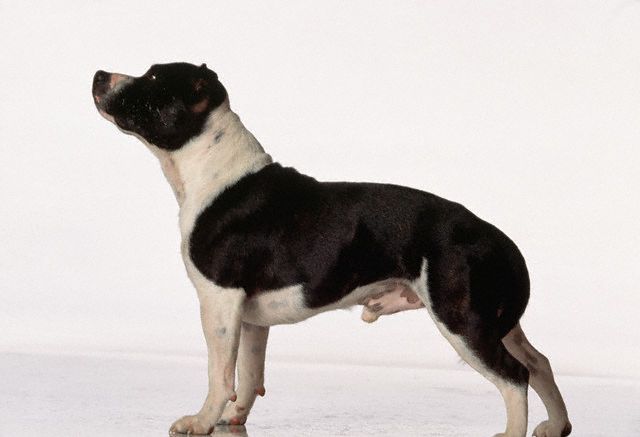
And so I found them on my hard drive, and post them here. The dog skull pictured below is that of a Pitbull, with a wide head and a short powerful jaw designed to catch farm stock.


You can find a living example of this dog in almost any animal shelter in America today. Some dogs have a shortened jaw, as seen here, but most of the true working pitbulls have slightly longer muzzles.

Most of these dogs make wonderful pets, and their only real fault is that they are no longer puppies and are members of a much-maligned breed.

The American Pitbull was not always treated with such contempt. In fact, this is the most American of dogs, and was once among the most popular.

Anyone who grew up with the Little Rascals television shorts in their living room on Saturday morning also grew up with Pitbulls. Petey (pictured at right) was a Pitbull. That's what the dog was called before it became an "American Staffordshire Terrier."

And, of course, long before it was called a "Pitbull," it was simply called a "Bull Dog."

To be clear, however, the old "Bulldog" has little or no relation to the short, flat-faced dog that is now called an English Bulldog.

Let us not confuse lightning and the lightning bug!

The change, of course, started with dog shows.

The card below was printed in 1859, the year the very first dog show was held in the UK, and the same year that Charles Darwin's Origin of Species was published.


As can be seen, the dog that was then called a Bulldog was a pretty tall dog with straight legs, a real muzzle, and a real tail. Today, we would call this dog and its antecedents a "Pitbull."

With the rise of dog shows, however, exaggeration and odd choices quickly reared their ugly head.

By 1890, as the dog show poster below makes clear, the Bulldog was already starting to change shape, with the face shortening even more, and the the size coming down as well.


By 1915, the English Bulldog no longer had any resemblance to its old Pitbull form.

The new dog, as seen below, was shorter and had gained an enormous number of wrinkles, along with a much flatter face and bowed legs.

The Bulldog was now so unlike the original dog, that the original dog was now being presented as an American breed!


What had happened?

The simple story is that this new dog was no longer purely British.

In fact, it was now mostly Chinese Pug crossed with Staffordshire Terrier!

The resulting cross breed had the flat face, bowed legs, and pig tail of the Pug, but the larger size and coloring of the Staffie.


Since the introduction of Pug blood, the English Bulldog has been "perfected" by show ring exaggeration.

Today's modern dog has been selected for profound brachycephalism (a flat face) with the result being that the modern dog has a hard time breathing, and has a higher-than-average chance of getting brain tumors as well.

Due to the very flat face, the dog has no place to put its tongue, and its eyes are more easily damaged.

In order to try to get oxygen into its system, the dog has a habit of gulping air which, combined with a twisted gut (a by-product of dwarfism) and a poor digestive tract, means the dog farts so often, it is now a defining characteristic of the breed.

The pig tail on the dog is a source of such routine infection, that is is generally amputated after a show ring career.

The dog is also achondroplastic (a type of dwarfism), and with this condition comes a tendency towards heart and joint defects, and also benched (Queen Anne) legs, which means the dog cannot run very well.

Because the dog has been positively selected for a massive head, bent legs, and a narrow pelvis, the dog has a hard time mating on its own (see Does the Breed Standard Require a Rape Rack?), and is generally born cesarean section in a veterinarians office.

As for the skull of the dog, as can be seen below, the nose has all but disappeared, while the jaw has shot out from underneath to such a degree that many British Bulldogs are incapable of picking up Frisbee.


To which many people may simple say, So what? Why does the Bulldog have to be "fit for function" if it no longer has to do any function?

Good question. And the answer is that the dog does not have to be for its original function.

It should, however, be fit for its current function, which is that of simple pet. The bar here is very low.

Job One for a pet is to be healthy. There is no Job Two.

And yet, basic health is something the British Bulldog fails at from birth through death.

This is a dog noted for both crushing veterinary expense and a short life.

It is a dog that lives most of its life in respiratory distress, and is likely to to be plagued with skin infections, eye damage, spinal problems, and heart disease as well.

This is what the Kennel Club did to healthy, happy Pitbulls!

The good news is that a fine and friendly Pitbull can be had at almost any shelter in this country.

The bad news is that due to prejudice, thousands of these healthy and friendly dogs are being killed every day and are, in fact, banned in Britain, while the dysfunctional and unhealthy English Bulldog is not only a Top Ten breed in the American Kennel Club, it is the veritable symbol of the United Kingdom!
.

Tuesday, March 10, 2009

British Veterinary Assoc. Says It's Time for Change


This Bulldog is unfit for function; it cannot even mate or give birth unassisted.


The Veterinary Record, the publication of the British Veterinary Association has a commentary editorial in the magazine's March 7, 2009 edition:


Breeding Opportunity

It may have been controversial, and the issues highlighted may not have been new, but the programme 'Pedigree Dogs Exposed' broadcast on BBC last August has certainly stimulated interest in tackling some of the inherited animal welfare problems associated with the selective breeding of dogs. Subsequent developments have included a revision of breed standards by the Kennel Club, and the initiation of various reviews into the welfare aspects of dog breeding. The ramifications continue, and the topic will no doubt be the subject of much discussion among those attending Crufts this week. Among other things, this year's event will include a dedicated 'health zone', at which vets and scientists will be on hand to discuss some of the means available for reducing the risks of inherited defects in dogs. Crufts itself will not be broadcast by the BBC this year, as the Corporation decided to suspend its coverage of the event in the light of some of the issues raised by the programme.

The BVA has called for an independent review of the breeding of all dogs, not just pedigrees, and for all registered pedigree dogs to be permanently identified (VR, November 8, 2008). Earlier this week, it welcomed news that the chairmen of a review of breeding being undertaken by the Associated Parliamentary Group on Animal Welfare and of an independent review commissioned by the Kennel Club and Dogs Trust have agreed to collaborate on the grounds that this will add weight to the case for action (see p 286 of this issue).

The current level of interest presents an ideal opportunity to make progress in tackling hereditary defects in dogs. However, this will be a long and difficult process requiring the active collaboration of everyone involved. Some of the challenges have been highlighted in recent reports from the Companion Animal Welfare Council (VR, December 6, 2008). Given the nature of the task, the BVA feels it is important that the reviews currently under way should consider solutions that would benefit the health and welfare of dogs in the long term. These include permanent identification, accreditation schemes, genetic testing and better use of the Animal Welfare Act.

The BVA believes that secondary legislation could be put in place under the Animal Welfare Act to protect the health and welfare of potential offspring produced as a result of breeding from dogs with known hereditary defects. It further believes that guidelines being developed under the animal welfare code for dogs could he amended to include a recommendation against mating closely related dogs and restricting the number of puppies an individual stud dog can sire. As well as making best use of the legal means available for restricting inappropriate breeding, it believes that there is scope for progress through voluntary mechanisms such as breeder accreditation schemes.

As with any other measures aimed at improving animal health and welfare, it is important to he able to relate any actions to the animals concerned. Permanent identification of all registered pedigree dogs would facilitate the reporting of hereditary health problems and of surgical procedures resulting in conformational changes. In addition, the introduction of a 'pet passport' database, linked to an identification microchip, would allow information such as parentage, DNA and health test results to be known for a particular animal.

To introduce breeding programmes which control hereditary defects without eliminating desirable traits, it will be necessary to isolate the specific genetic mutation(s) responsible. Funding will be required to create DNA databases of affected and unaffected animals and for the development of appropriate tests.

The BVA believes that breed standards should be based primarily on health and temperament, with less emphasis on the conformation of the dog. While welcoming a commitment from the Kennel Club to review all breed standards in consultation with the veterinary profession, it believes that, in addition, an independent expert advisory group should be formed to review and advise on the way forward on a case-by-case basis.

Vets see the impact of inbreeding on a daily basis in practices across the UK. Consultations provide an opportunity to advise clients but, unless veterinary advice is sought before animals are purchased, options are limited to reactive advice and treatment. Methods to enable owners to make more informed choices before they purchase their animals need to be investigated.

Advances in genetics, diagnostic tests and information technology, combined with the current level of interest, present unprecedented opportunities for tackling inherited welfare problems in dogs. The current level of interest in the subject makes it all the more important that these are used to best effect.
.