Showing posts with label Misery Puppies. Show all posts

Friday, June 18, 2010

The Humane Society did WHAT?

Has Hell frozen over?

You might think so.

You see, the Humane Society of the U.S. (HSUS) is quoting this blog in the cover story of All Animals magazine, which is HSUS's full-color bimonthly membership magazine which goes out to their 10 million members.

In a long, well-written, and fair piece, author Carrie Allan lays out The Purebred Paradox whose strap line is "Is the quest for the 'perfect dog' driving a genetic health crisis?"

Once upon a time, people believed that purebred dogs were naturally healthier than mixed breeds. How have we arrived at a point where it may be safer to presume the opposite? ....

.... The more limited the number of mates, the greater the chance a dog will be bred with a relative who shares similar genes. Genetic diseases are caused by recessive genes, so a good gene from one parent will trump a bad gene from the other. But if both parents have a bad gene—such as one that predisposes them to hip dysplasia or blindness—the likelihood of a sick puppy increases.

“What happens when you have a small and inbreeding population is that the probability of two negative recessive genes finding each other increases as the gene pool chokes down to a smaller and smaller pool,” says Patrick Burns, a Dogs Today columnist who frequently writes about genetic health issues on his blog, Terrierman’s Daily Dose.

A closed registry that allows no “new blood” into the mix exacerbates the problem, he argues: “In many AKC dogs, the founding gene pool was less than 50 dogs. For some breeds, it was less than 20 dogs.”

This year’s Westminster champion, a Scottish terrier named Sadie, hails from one of these tiny gene pools and is “very heavily inbred,” says Burns. The limited ancestry for AKC-registered Scotties, he adds, helps explain why 45 percent die of cancer.

“We do not need to have a closed registry to keep a breed,” Burns says, pointing out that breeds existed long before there was an organization to track them. “We did not create the dogs we love in a closed registry system—we have only ruined them there.”


Read the whole thing. The HTML version (multiple jump pages) is here, and the PDF version (8 pages) is here.

This is one of the longest and best articles done so far on the American "dog mess" that is a confluence between disease, deformity and defect caused by inbreeding and contrived and twisted breed standards, and the sick internacine economic relationships that exist between puppy mills and the AKC.

This article also details what has been going on in the United Kingdom since the advent of Pedigree Dogs Exposed. As Carrie Allan writes:

[I]in the United Kingdom, at least, there seems to be momentum for change. Whether that momentum will gather steam in the U.S. remains to be seen


Spread this article around!

Remember that if you want the Humane Society of the U.S. to move in the right direction, you need to click and treat.

I assure you this is the right direction. They have not taken any gratuitous swipes at pedigree dogs or dog breeders. Quite the opposite, in fact.

Take this line for example. Anyone think this is not fair and well-said?

At The HSUS, we’re big fans of adoption. By going to a local shelter or rescue group, you stand a good chance of both saving a life and finding a purebred — after all, they make up an estimated 25 percent of dogs in shelters.

When you can’t find the dog you’re looking for, however, responsible breeders are another option; they are devoted to their animals’ well-being and committed to placing them in loving homes. And if every shelter dog were adopted and every puppy mill were shuttered, there would still be a need for good breeders to supply dogs to American households.


Full applause to HSUS for this article, and to author Carrie Allan in particular. This is a big subject, and she has done an extraordinarily good job of wrapping herself around it and presenting it in a cogent and fair manner.

Wednesday, June 16, 2010

Dogs In America Today


Before Chris Hansen was catching pedophiles and predators, he was catching puppy mill peddlers, and those who wink at puppy mill misery.

Watch this whole piece, which Chris Hansen put together for NBC's Dateline back in 2000.

Nothing much has changed.

In fact, things are actually a little bit worse, as I will explain.

Because most folks will not take the time to watch the whole 45-minute video, I have appended an excerpt below, which shows the unblinking reaction of Ron DeHaven, the man in charge of puppy mill inspection at the U.S, Department of Agriculture.


Ron DeHaven, of course, is now head of the American Veterinary Medical Association (AVMA).

As for Petland, puppy mills, and the AKC (see the entire Dateline piece here), they are still in bed with each other right up to their eyeballs.

In fact, the AKC has even created special software for Petland so that Petland's puppy mill dogs can be sold even faster under the auspices of the AKC.

And is the AKC still in bed with puppy mills? Absolutely.

In fact, AKC Chairman Ron Menaker says the AKC has always been in bed with puppy mills, and that it's financial future depends on being in bed with "high volume breeders," because dog shows actually lose money for the AKC.

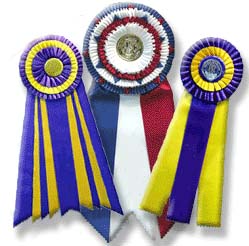
Yes, that's right, "misery puppies" have to die so that people can go on collecting rosettes and ribbons at dog shows.

Nice!

This is the American Kennel Club (AKC).

This is the American Veterinary Medical Association (AVMA).

This is the the U.S. Department of Agriculture (USDA).

This is puppy mills.

This is Petland.

And this is dogs in America today.
.

Tuesday, June 15, 2010

Puppy Mills, Veterinary Bills and the AVMA


This aisle of dog feces did not result in a direct violation from the USDA.

If I told you the current head of the American Veterinary Medical Association had been in charge of puppy mill inspections at the U.S. Department of Agriculture at a time when inspectors rarely issued a citation for even the most horrific situation, would you believe me?

Would you believe me if I told you this same gentleman -- Ron DeHaven -- is now a cheerleader for veterinary bill padding?

The good news is that you do not have to believe me.

I have video tape and records from the U.S. Department of Agriculture itself to prove it.

Let's start with the USDA's "Animal Care" division.

The U.S. Department of Agriculture's own Inspector General released a report last month admitting the Agency has done a very poor job of enforcing the Animal Welfare Act, the law designed to make sure that "commercial breeding facilities" for dogs and cats are something less than centers for horror, pain and misery.

You can read the entire report yourself right here [PDF], complete with graphic pictures.

The report starts off noting that:


In our last audit [2005] on animals in research facilities, we found that the agency was not aggressively pursuing enforcement actions against violators of AWA [Animal Welfare Act] and that it assessed minimal monetary penalties against them....


And guess what? Things did not improve!

As The Los Angeles Times summarized in its story on the USDA's Inspector General report:


An internal government report says dogs are dying and living in horrific conditions due to lax government enforcement of large kennels known as puppy mills.

Investigators say the Department of Agriculture agency in charge of enforcing the Animal Welfare Act often ignores repeat violations, waives penalties and doesn't adequately document inhumane treatment of dogs. In one case cited by the department's inspector general, 27 dogs died at an Oklahoma breeding facility after inspectors had visited the facility several times and cited it for violations.

The review, conducted between 2006 and 2008, found that more than half of those who had already been cited for violations flouted the law again. It details grisly conditions at several facilities and includes photos of dogs with gaping wounds, covered in ticks and living among pools of feces.


So who was running Animal Control during those years?

None other than Ron DeHaven, the current head of the American Veterinary Medical Association (AVMA).

DeHaven was deputy administrator for Animal Care (AC) from 1996-2001, deputy administrator of APHIS for Veterinary Services from 2002-2004 and head administrator of the Animal and Plant Health Inspection Service from April 2004-July 2007.

In short, if commerial dog breeding facilities in the U.S. are a mess, that mess is parked right at his door.


Ticks on this dog were deemed to not be a direct violation, and so no follow up.


So what's DeHaven's message now?
Watch the video below to find out.


Isn't that wonderful? Ron DeHaven is the new face of veterinary bill padding; a pusher for contrived crisis and the "dependency model" of veterinary care.

The current head of the AVMA is the same fellow who gave a "big wink" to the kind of puppy mill abuse the USDA's Inspector General found so shocking only last month.

This is who represents your veterinarian on Capitol Hill.

Nice!

You know what you won't find the AVMA talking about?

You won't hear them talking about contrived standards in Kennel Club dogs.

You won't hear them talking inbreeding and disease in Kennel Club dogs.

And why would they? For veterinarians, silence has been golden.


Saturday, March 28, 2009

Battery Cage Dogs are the AKC's Cash Machine

ABC TV's Nightline program will be featuring a "state of the art" puppy mill tonight.

Some promotional video is up right now, however. Check it out.

The owner of this establishment is correct, in that he is running a state-of-the-art commercial dog breeding facility with a high-tech waste management system.

This is what a pretty good commercial dog breeding facility looks like: Small dogs (toy breeds and terriers) raised like chickens in battery cages.

And, for the record, this is what the AKC wants more of ... provided they are all AKC registered puppies, of course.

And why does the AKC want more commercial facilities breeding AKC dogs?

Simple: it needs more commercial kennel registrations in order to subsidize dog shows, which are not paying their way.

In the minutes of the September, 2006 AKC Board meeting (link to PDF file), Ron Menaker notes that the AKC has been registering puppy mill dogs "for the past 122 years" and "we have collected millions of dollars" as a result.

In short: Get over it!

And why does the AKC snuggle up to the puppy mill industry?

The Board of the AKC is rather blunt about the problem: though the AKC made a profit of several million dollars last year, it is not enough, as registration numbers are trending sharply downward and "events" are costing millions more than they are bringing in.

"Events," of course, is a euphemism for dog shows.

In short, because rosette-chasing is a money-losing proposition for the American Kennel Club, they need more puppy mill registrations in order to subsidize dog shows.

As recently as September of 2008, AKC President Ron Menaker wrote:

Today, there are at least 30 All-Breed registries in addition to the AKC, whose combined registration numbers exceed that of the AKC. If this trend is allowed to continue, if we do not stop the hemorrhaging of declining registrations, we will no longer be the premier registry in the world, let alone in our country.

Management has been directed by the Board to aggressively pursue all dogs eligible for AKC registration....

.... AKC used to dominate the marketplace. Even places like Macy’s and Gimbels sold AKC puppies. Many pet owners who bought these puppies, and I was one of them, tried their hand at showing and breeding. These owners who purchased their first purebred from a retail outlet, not only added to AKC’s registrations, but those who wanted to advance in the sport, then sought out fanciers to continue their
journey....

....Last year less than one half of our revenues came from registrations. Dog registrations peaked at 1.5 million in 1992. By the end of 2008 it is projected we will register only 725,000 dogs. This is a staggering 53% decline....

.... If the current trend continues and dog registrations decline to 250,000 over the next several years, AKC will face an annual revenue shortfall of $40 million. To put this in perspective, if this scenario occurred, and we relied solely on raising the event service fees to make up for this revenue shortfall, the fee would be a staggering $20 per entry.


.

Wednesday, November 7, 2007

AKC Depends on Puppy Mills to Subsidize Shows


"In order to recoup the money lost from dog shows, the AKC needs to register 666,666 puppy mill dogs a year."

One of the dirty little secrets of the AKC is that the organization would go bankrupt without puppy mill registration dollars.

Ron Menaker, Chairman of the AKC's Board of Directors notes in the minutes of the September, 2006 AKC Board meeting (link to PDF file), that the AKC has been registering puppy mill dogs "for the past 122 years" and "we have collected millions of dollars" as a result.
He goes on to further observe that "registering puppies that come from these puppy brokers or pet shops" "is not a new phenomenon."

Why does the AKC snuggle up to the puppy mill industry? The Board of the AKC is rather blunt about the problem: though the AKC made a profit of $5.7 million last year, that is not enough. A core problem, says Jim Stevens Chief Financial Officer of the AKC, is that events "lost approximately ten million dollars in 2005."

"Events" is a euphemism for dog shows. In short, because rosette-chasing is a money-losing proposition for the American Kennel Club, they have to subsidize dog shows with blood-money derived from puppy mill registrations.

So how many AKC puppy mill registrations does it take to zero out the deficit created by AKC dog shows?

The math is simple. It costs $15 to register a puppy with the AKC. In order to recoup the $10 million a year lost from dog shows, the AKC needs to register 666,666 "misery puppies" a year.

To put it another way, the AKC is losing about $1,175 dollars per event (i.e. per dog show), which means about 78 misery puppies need to be registered to underwrite every AKC event.

How many rosettes are awarded at an AKC show? I have no idea, and the number shifts, but I think it's safe to say that every breed and performance win requires at least one puppy mill "misery puppy" to be registered.

So enjoy those dog shows! Take pride in those ribbons, especially those of you who did not breed the dog and then paid a handler to walk it around the ring.

And remember that with every rosette comes an added bonus -- a little bit of misery in fur huddled in some commercial breeding pen pulled well back from the highway. There the dogs are pregnant for life, and when they are too old to produce more, they are killed to make room for the next generation of breeders. And all of this is AKC-approved and rationalized in your name!


[ Feel free to cross post ]
.

Friday, October 5, 2007

Border Collie Owners Battle What Doesn't Work


In 1848, Queen Victoria was introduced to working Collies at Balmoral Castle. She became captivated by these intelligent dogs and brought a few back with her to London, where they became the rage -- hitting center stage just as the first dog shows were starting to take off in the U.K.

With the rise of organized dog shows between 1860 and 1890, a show standard was written up for the Collie by John Henry Walsh (aka "Stonehenge"), a man who himself did not own or work Collies, but who felt himself expert enough in nearly every breed of dog to write a standard by which they could be judged by appearance alone.

Needless to say, dogs were soon being bred to this "standard," which assigned large numbers of points to head shape and size, coat length, and coat color.

A Collies ability to actually work sheep or take commands was not allotted a single point.


A Border Collie rides herd on sheep in a chute.


In 1893, the fate of the Collie took another bad turn when the very young Czar Nicholas II sent 15 Borzois to the aged Queen Victoria. Intended as a diplomatic gift to curry favor with an aged dog collector who also happened to be his wife's grandmother, the Borzois more than left their mark, as they were soon crossed with Queen Victoria's Collies, thereby helping to create the strange-looking, impossibly narrow-headed dog we now know as "the Lassie" Rough-coated Collie.

By the 1920s, these non-working and narrow-headed Collies appeared to be a different breed from the working Collies found in rural parts of Scotland, Wales and the rest of the British Isles.

While the show dogs were increasingly homogeneous, the working dogs were of varied sizes and colors. Some had short coats and prick ears, others had longer coats and folded ears. The dogs themselves ranged from 25 to 75 pounds, and they came in a wide variety of colors from brown or red, to black and white, from dappled Merle to various hues of gun metal gray. In fact, almost the only thing all these dogs had in common was an obsessive devotion to work created by breeding worker-to-worker for generations.


"Big one, little one, handsome one, ugly ones, long-coated, short-coated: nobody gave a damn. How's his outrun? Can he read sheep? Can he move a rank old cow?"
. . . . - Don McCaig, Dog Wars

Needless to say, these were not the kind of questions being asked by the folks at The Kennel Club shows!

As a result of divergent selection criteria -- working ability versus conformation -- the smart, working, heterogeneous collies that had been so admired by Queen Victoria in 1848, were systematically selected out of The Kennel Club gene pool in favor of more homogeneous conformation stock.

Could these pretty show dogs herd a cat across a living room? Perhaps, but no one had much illusion that they would be of any real use on a mountain side with 500 head of semi-wild sheep to pen before an approaching storm. Shepherds looked elsewhere for their working dogs.

But what did that matter? How many people really had sheep to pen? Never mind that the sheep and the hill created the Collie. How could a dog be harmed if it still looked good? A non-working Collie could be bred to a non-working Collie, and it would still chase a stick. What else was needed?

In fact, by The Kennel Club's light, what mattered was not the dog, but the name. And so, in 1924, when the International Sheep Dog Society (ISDS) brought working Collies to Hyde Park for a sheepdog trial, The Kennel Club objected. How could these feral-looking dogs be called Collies, they demanded!? They had no resemblance at all to the dogs in The Kennel Club ring!

"Fine," the ISDS replied, and promptly began calling their working dogs by a new name: "Border Collies," to differentiate them from their non-working Kennel Club cousins.


A Border Collie at Crufts: a bored animal at a dog show started by a man that never owned a dog.


Much the same story played out with working Fox Terriers at about this same period of time (complete with Queen Victoria in a supporting role).

Here too a breed of working dog, was quickly wrecked by Kennel Club breeders focused on pure conformation standards within a closed-registry system.

And here too, the true working dog continued to live on in the countryside under a different name -- the Jack Russell Terrier.

Move forward 100 years, and the tale plays out anew, as the Kennel Club bureaucracy circles back to try to round up two popular working dog breeds that somehow (how?) slipped out of sight and off their roles.

"The Border Collie? The Jack Russell Terrier? Oh, we must have them."

Never mind that these dogs had already been pulled onto the Kennel Club roles. By now the Kennel Clun dogs were ruined beyond recognition and operating under a different name. Time to try again!

It is here, at the start of the Second Battle for the Border Collie that Virginia sheep man and writer Don McCaig begins his tale in The Dog Wars: How the Border Collie Battled the American Kennel Club.

In its simplest form, McCaig's book is a battle between what works and what doesn't.

On one side you have the American Kennel Club -- a 19th Century organization driven by 19th Century genetic theories and an almost Kremlin-like bureaucracy in New York City. These people have the strange notion that all canine breeds can best be judged at a glance while trotting a dog around a ring on a thin string leash.

On the other side, you have a small collection of not-too-sophisticated farmers and sheep dog trialers; the very people who made the working collie what it is. These folks may not own a tuxedo or ball dress, but by God they know two true things; 1) that the show ring has never made a working dog, and; 2) that the mettle of a Border Collie can only be determined on the hill while working cattle, sheep or goats.

The fact that McCaig is a partisan in this war does not mean he has not written a fair book.

In fact, he is more than fair.

While he mentions some of the breeds ruined by the Kennel Club's love affair with closed registries and show ring standards, he does not catalogue them (or their ills) to the extent he could.

Nor does McCaig open up both barrels in order to blast the AKC' for their sordid history as puppy mill profiteers.

Instead, McCaig's book focuses on the straight-forward history of the "Border Collie War" of the 1990s, leavening historical chronology with short divergent tales of his own working dogs, Silk, Moose and Harry.

McCaig does a pretty fair job of puncturing the American Kennel Club lie that they "only register dogs," and that it is individual breeders -- not AKC policies -- that are responsible for the general decline in pure-breed quality and performance.

In fact, McCaig notes, the Kennel Club does far more than register dogs. It also mandates that all AKC breed be maintained in a closed registry which almost guarantees mounting levels of inbreeding.

The AKC also prohibits performance tests as a requirement of winning a championship, and they will not allow a club to ban puppy mill or pet store registrations which are a large part of the AKC's bread-and-butter business plan.

The staff of the AKC have forced the rewriting of show standards (as they did with the Labrador Retriever), and they will not allow a breed club to mandate a health check as a condition of registration, even if the breed has a serious, pervasive, debilitating, gene-based health care issue such as deafness, cataracts or dysplasia.

In fact, as McCaig makes clear, the AKC is really not interested in power-sharing with a strong breed club. If a strong breed club already exists outside the AKC, they are not willing to do much to woo its support in order to have them join the AKC.

It's much easier -- and safer -- to simply create a new club from whole cloth; a simple matter of finding a few dozen people who are anxious to "get in on the ground floor" with a new AKC breed.

These new AKC converts are likely to already believe that dog shows are the beginning-and-end-all in the world of dogs.

What does it matter that geneticists have said that the AKC's breeding scheme is unsound and bad for working dogs? They will be careful and breed smart.

So what if the AKC is a major engine driving the puppy mill and pet shop trade of dogs? If the AKC was not pocketing the cash, someone else would.

And who really needs working dogs any more anyway? Sheep herding with dogs is an anachronism, and fox hunting has been banned in the U.K. The modern world is all about fly-ball, agility, and Frisbee. If the dogs have a little less obsession and drive, they will still be fine for that.

And, so the AKC charges ahead and does what it wants.

When the Cavalier King Charles Spaniel Club (founded in 1954) turned down AKC overtures because the AKC would not allow their Club to deny membership and registration to puppy millers and breeders that sold their dogs to pet shops, the AKC simply created its own Cavalier King Charles Spaniel Club to compete.

When the Border Collie folks said they would greenlight AKC admission only if there was a performance standard, the AKC would have none of it.

When the Jack Russell Terrier folks opposed a too-limited conformation standard and maintenance of the breed in a closed registry system with no limits on coefficients of inbreeding, the AKC simply rounded up a collection of breeders who cared more about blue ribbons and green cash than the future of this working dog.

McCaig gives a nod to these other dog battles, of course, but his concern is the Border Collie.

McCaig details an AKC in which both officials and staff are secretive, arrogant and clannish. They think nothing of omitting facts, telling lies, and stretching the truth. When asked to explain their intentions, they become a collection of Know Nothings, and when asked to sit down to see if common ground can be found, they express outrage that -- after 100 years of wrecking dogs -- the entire world is not willing to roll over and give them the benefit of the doubt on their say-so alone.

After all, they will tell you, they are the experts on dogs. What, you don't believe it? Well, just ask any of their all-breed judges who claim they can judge the value of a sheep-working dog at 40 feet, never mind that they themselves have never seen a sheep.

Ask any one of the terrier judges who have never dug four feet to a fox, or carried a shovel out of their own backyard.

You want to to know about whippets and greyhounds? Well the AKC has experts on chasing plastic bags on a string. Who would know more about running dogs than people with experience like that?


Though McCaig's book is brutal in its accounting, his tone is generally dispassionate and he sticks to the facts.

In fact, I would argue that McCaig's book is actually generous to the American Kennel Club.

Recognizing that the organization is behaving irrationally -- spending money to lose money, winking at puppy mills, capriciously changing breed standards, and ignoring the wishes of both breed clubs and dog owners alike, he wonders what is going on. How could people, whom he generously supposes are neither evil nor stupid, be so terribly misguided?

He dismisses the notion that it's all about money. He says it is not -- in discussions with the AKC they never mention money, and they seem offended that anyone would suggest theirs is a business (never mind the Madison Avenue offices, high salaries, black-tie galas, and plethora of cross-promotional activities with dog food companies, veterinarians, and dog toy manufacturers).

McCaig generously suggests that the AKC is guided by something else -- a vision that can best be described as religious in nature, since it seems to operate both independent of fact and based on faith alone.

And what is that faith? McCaig writes:

"Throughout the fight, I kept stumbling over a simple truth without quite seeing it: dog fanciers and their creature, the AKC, really do believe that what is most valuable about any dog can be judged in the show ring, that the show ring is the sole legitimate purpose and reward for all dog breeding. They even believe, against all evidence, that the show ring 'improves' breeds."


And, to give credit, McCaig cuts them a little slack about their belief system. He even tries to identify in -- at least a little bit.

"The AKC's faith in the show ring is no more implausible than the fourth-century creed I recite every Sunday in the Williamsville Presbyterian Church."


McCaig
goes on to note
that while AKC dog show folks really do believe a dog is all about looks, the AKC staff is motivated by something else in their eternal quest to pull ever-more breeds into the AKC show ring.

"When AKC staffers argued with traditionalists that they should abandon their venerable snobberies and recognize every breed they could, the staffers were just doing what staffers have done since the time of the pharaohs; increase their importance by swelling their organization."


And so, in the end, McCaig tries to humanize the AKC. He does not forgive them their lies, their pettifoggery, or for what they have done to the Border Collie and other working breeds, but he does try to see the world through their eyes.

Unfortunately, it's still not a pretty picture.

One big issue seems to be that the staff of the AKC feels that their power in the world of dogs is slipping from their fingers.

The United Kennel Club already registers more breeds, and other for-profit dog registries are popping up left and right.

The American Press Corps (from Time magazine to ABC's 20/20) have informed everyone that AKC dogs are more likely to have specific genetic defects than run-of-the-mill pound puppies.

And with their recent disastrous attempt to form an alliance with Petland, everyone now knows that a huge portion of AKC's bottom line comes from the registration fees pocketed from the sale of "misery puppies" cranked out by commercial puppy mill breeders.

Slowly, the glow is coming off the rose. So what to do?

Well of course, your double down your efforts and continue doing the same thing! Isn't that so often the way?

So how does it all end?

When the smoke and fog of war lifted, it turned out that both sides had lost the Border Collie War.

The Border Collie had lost because they were now just one more dog within the American Kennel Club where they were to be judged on looks alone rather on the brains, obsessive drive, and bidability that make them truly unique in the world of dogs.

The American Kennel Club lost because they not only activated a permanent (and growing) base of opposition outside of the AKC, but also because the public was apparently not deceived by their shennaningans. Ten years after the Border Collie were first drawn into the AKC, that organization registers only 2,000 border collies annually; only a tenth of the dogs the American Border Collie Association registers.

And while McCaig notes that the AKC has twice the number of herding trial events as the American Border Collie Association, the AKC events are poorly attended because "ordinary citizens seem to understand what's real and what's not."

At least for now, it seems, common sense has won out.

The same can be said in the battle for the Jack Russell. Not only is the AKC version of the dog not as popular as the AKC had hoped it would be, but it is no longer even called a Jack Russell Terrier. Meanwhile, the Jack Russell Terrier Club of America continues to prosper and thrive as the largest Jack Russell Terrier registry in the world. It's focus: to preserve and protect the Jack Russell as "first and foremost" a hunting dog.

And so, as George Santayana might have predicted, the world of working dogs has come full circle.

The AKC once again has drawn into its folds a type of working collie (and a type of working terrier too), and put them on the fast track to ruin in a closed registry system with a pure-conformation standard.

Within 50 years, these new AKC dogs will be as as close to their working cousins as chalk is to cheese, and 100 years from now, if the AKC is still around, the whole process will probably start all over again. Nonetheless, I suspect the working Border Collie and the working Jack Russell Terrier will continue to endure.

Bottom Line: Buy and read Don McCaig's new book about the battle for the Border Collie. It's a good book, and an important book. And, truth be told, there are damn few of those.


A Proposed New AKC Class: "Working Dogs Ruined by the Show Ring"


.

Friday, September 29, 2006

The AKC Embraces the "Big Wink" of Misery Pups

On Thursday the AKC sent out the following notice to AKC Breed Clubs representatives:


"In the past few weeks we have received many comments about this [Petland] agreement, both positive and negative. We have listened to the concerns and because this issue has become so divisive, we believe it is in the best interest of our sport and the American Kennel Club not to go forward with this initiative.
-- Ron Menaker, Chairman of the Board
-- Dennis B. Sprung, President and CEO


They received many positive comments? Really? From whom? Or is this just the flourish of the pen you do before you Eat Crow?

No matter.

Ironically, the fact that the AKC has decided to scuttle their contract with Petland changes nothing.

As the minutes of the September board meeting of the AKC make clear, the AKC has happily and purposefully derived millions of dollars every year from registering puppy mill dogs, and the Club depends on puppy mill registrations to pay the rent on its rather elaborate offices on Madison Avenue in New York City.

To the AKC's credit, it was -- at last -- putting this in the front window for everyone to see.

Now that brief shining moment of honesty is over -- it's back to the "Big Wink" again.

You see, what the membership of the AKC has NOT done is change the conduct of the AKC. The AKC will continue to knowingly register puppy mill puppies from the Hunte Corporation and from far worse commercial breeders.

The board members of the AKC and the breed club representatives to the AKC have always known that the AKC finances itself through puppy mill registrations of this type.

This information has NOT been closely held information among AKC breed club representatives.

What is being protested by the breed clubs is not the ACTION of the AKC as it relates to puppy mill registrations, but the fact that this action was being made public.

The reason the AKC feels it has to increase the number of AKC puppy mill registrations is that "events" are not paying for themselves. With rare exception, these "events" are dog shows. The net loss due to "events" is now $10 million a year, and to recover this loss the AKC will have to register 666,666 pet shop "Misery Puppies" a year at $15 each.

In short, with every AKC rosette comes a little bundle of puppy mill misery.

Now here's a question: Is it unthinkable to ask AKC event participants to simply pay their own way rather than rely on puppy mill and pet shop registrations?

Apparently.

The "per event" registration cost would have to be raised by $7 per dog just for the current show-ring deficit to be erased.

And remember, if that were done the AKC would still be giving the "Big Wink" to current levels of AKC pet shop and puppy mill registrations. My guess is that the AKC per-event fee would have to rise by an additional $15 per dog for the AKC to be able to afford to drop their endorsement (through routine registration) of puppy mill and pet shop puppies.

Gregg Barrow, a trainer of hounds, Giant Schnauzers and schutzhund dogs (among other things), sent me an email this evening asking why so many folks in the AKC have been willing to look the other way for so long.

Good question. I have spent a lot of time pondering that issue.

I am not sure I have a complete answer, but this is what I shot back to Gregg before I scurried away from the computer for the evening:


I think there are a lot of bits and pieces that have to be disaggregated in the world of dogs and hunting.

Or, to put it another way, there are a number of severable issues.

Take the dogs.

An ugly dog can hunt, but life is too short to have an ugly dog. Uglyness does not improve a dog's working ability. That said, a dog does not have to conform to a narrow set of arbitrary standards to be a pretty dog. And, ironically, a lot of pretty show ring standards (soft coats and an over-large size in terriers) are actually antithetical to work.

For a lot of people, showing dogs and hunting with dogs has nothing to do with the dogs at all.

I have come to realize that for most people, shows and hunting are a social experience. I hunt alone, but not too many people do. A fellow that hunts alone is unusual to the point of being odd.

For most folks hunting is a human bonding experience and it is the human bonding experience that they are after -- no different than golf or bridge or what have you. Added to this bonding experience is a little competition ("my buck is bigger than yours") and a slather of nature and bug spray. If all people were required to hunt alone, I think there would be a lot fewer hunters.

For most folks, the dog shows are also not about the dogs -- they are a way of socializing without getting too deeply into anyone's "stuff". When you go to a dog show, notice how many people have crated their dogs or left them in the truck while they spend hours gossiping under the tents. This is about dogs? I don't think so. At the same time, it is not about a deep personal relationship with people. Most of these folks only see each other a few times a year, and are happy to keep their relationships at that level and no deeper.

And, of course, dog shows are also a way of working out a competitive edge and achieving a pecking order. Humans are, after all, pack animals, and we have pecking orders just like dog packs and chicken flocks. Every time people "pack up" at a dog show, they have the hope of achieving a higher ranking this time around.

An additional attraction is that dog shows are a way of achieving or demonstrating an area of expertise away from home and office, and also of creating a form of self- and communal identificiation. In the world of dogs, people identify themselves as "breeders" or as flyball competitors, or agility competitors, or whatever. They identify themselves by what type of dog they have. They identify themselves as "the number one breeder of miniature dachshunds" or even as "Barney's owner."

So a lot of stuff is wrapped up in dog shows, and asking people to give that up by rejecting the nonsense espoused by the AKC is asking them to give up a lot that they have developed over the years -- their community, their identity, their hobby, and their area of expertise. They have painted themselves into an emotional corner.

For AKC breeders and dog shows folks it's hard to face all this. It's much easier to give the "Big Wink" to puppy mills and pet shops than it is to pay more money or walk away from the AKC.

Instead of listening to what is being said about the role of the AKC in keeping the puppy mill business afloat, AKC breeders and show dog enthusiasts prefer to do what little kids do: Put their fingers in their ears and begin chanting or singing until the ugly noise goes away. I cannot hear you!

To read about two breed clubs that have done it differently, and yet still manage to hold a lot of "events" and have publications that are closely read (dream on AKC Gazette) >> Read here

Wednesday, September 27, 2006

The Mathematics and Symbolism of Misery Puppies


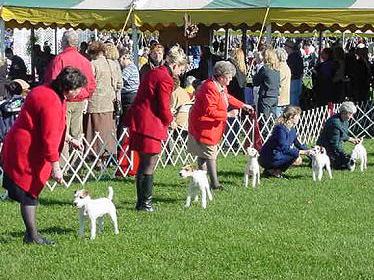
At the AKC, it's not just the dogs that look alike. Here you have three ladies all dressed in red to catch the judge's eye. Judging up the leash is common at all dog shows, and the winner in the AKC is often led around by a professional handler. For more on dog show clothes for handlers (for women only, alas) see >> http://www.dog-showclothes.com/ )


As noted in the two previous posts, the American Kennel Club has decided to enter into a formal contract with Petland to encourage the registration of Hunte Corporation "puppy mill" dogs as AKC animals. As Ron Menaker, Chairman of the AKC's Board of Directors notes in the minutes of the September AKC Board meeting (link to PDF file), the AKC has been registering dubious dogs "for the past 122 years" and "we have collected millions of dollars" as a result. He goes on to further observe that "registering puppies that come from these puppy brokers or pet shops" "is not a new phenomenon."

Why does the AKC now want to snuggle up next to the puppy mill industry? The Board of the AKC is rather blunt about the problem: though the AKC made a profit of $5.7 million last year, that is not enough. A core problem, Jim Stevens Chief Financial Officer of the AKC told the board is that events "lost approximately ten million dollars in 2005. This year there have been 8,500 events to date, which was up 12 and a half percent from 2005. The total number of entries in events so far this year has been 1.8 million, which is two and a half percent above last year. Based on how the current year is shaping up, we would anticipate that this year's loss from events will be comparable to last year."

Events. That would be dog shows for those of you who are wondering. They are losing money. And so the AKC has to endorse puppy mill puppys (as they always have) in order to make up for the economic loss caused by dog show rosette chasers.

And yes, the AKC IS endorsing Petland. As AKC board member Steve Gladstone notes, "yes ... we are endorsing them with our papers. We are telling the world these people meet AKC standards."

OK, so let's see if we can do a little math here.

It costs $15 to register a puppy with the AKC. So, in order to recoup the money lost from shows, the AKC needs to register 666,666 misery puppies a year. To see what those puppies look like in a Petland stores, see this video clip taken by two idiot teenagers and loaded up to YouTube.


"In order to recoup the money lost from shows, the AKC needs to register 666,666 misery puppies a year."
To put it another way, the AKC is losing about $1,175 dollars per event (dog show), which means about 78 misery puppies need to be registered to underwrite every AKC event.

How many rosettes are awarded at an AKC event? I have no idea, and the number shifts, but I think it's safe to say that every breed and performance win requires at least one puppy mill misery puppy to be registered.

And of course, more misery puppies will have to be sold because some will not get registered. A lot of folks coming to Petland will see the "AKC registerable" sign and banners and think this is proof they are getting a quality product for their kid or themselves. But, at the cash register, these same folks may do a little math of their own. After all, the dog cost $600, and then there was the crate ($40), the leash and collar ($20), the dog tag ($7), dog food ($15), and the registration ($15). What here looks like something we can do without right at this moment? So, bottom line, there will be a lot more misery puppies sold than registered.

A core problem for the AKC is that sales of their "product" (registrations) is slipping.

What to do?

Well, I have spent a great deal of time in meeting with professional marketing geniuses, and I will tell you what they will all recommend: Develop an icon for your brand.

And I have the perfect icon in mind. Instead of awarding rosettes to the winners, perhaps the AKC could, in honor of their new Petland contract, award every winner a plush toy "Misery Puppy?" The toy would not have to be spattered in blood. It is enough that the plush toy is poorly made, and has an odd color and perhaps an odd odor. I imagine any child-labor sweat shop that makes plush toys has a whole bin of defective cast offs that can be bought for a song. In fact, "Misery Puppies" may become quite popular and, if the AKC markets them right, they can be the new symbol of the American Kennel Club.

To go with AKC tradition, the Kennel Club can even invent a history or "provenance" for their defective plush toys, just as they have with so many dog breeds.

"These plush toy are not defective," they can sniff. "They are worn and ragged because they have been loved so much. They are like the Velveteen Rabbit."

Perfect!

Now I know some people will think this is over the top, but really it isn't. After all, the causal relationship between the economics of dog shows and the economics of the Petland deal and the sale of pet store puppies has now been made clear by the minutes of the September AKC board meeting.

Now we know exactly how many Misery Puppies it takes to get an AKC rosette. And yet, the core problem remains -- the AKC is without an iconic brand.

Now they have one. Let the registration begin!

_