Showing posts with label closed registries. Show all posts

Tuesday, March 30, 2010

Basenji's: A Classic Tale of Kennel Club Defect


Modern African Basenjis after a hunt.


In correspondence this weekend, a reader wrote to note that not all was darkness in the American Kennel Club.

For example, when Basenji's began to present with jaw-dropping rates of hemolytic anemia in the 1970s, a test for the disease was developed and affected animals were then culled.

Unfortunately, the now smaller gene pool came down with a new disorder, an eye problem called persistent pupillary membrane, which was quickly followed by a kidney disease called Fanconi syndrome, and IPSID (a fatal malabsorption syndrome).

To combat these three diseases, it was decided to open up the U.S. Basenji registry to increase genetic diversity within the breed.

That does sound like a positive thing, doesn't it?

Sadly, however, the tale does not survive scrutiny.

In fact, it underscores the real problem with Kennel Club thinking.

To start with, let's state the obvious: the Kennel Club did not create the Basenji.

This breed has been around since before recorded history, and is a landrace dog used for hunting in the tropical jungles and scrub brush regions of central subSaharan Africa.

Point two is as important as point one: this breed is not about to go extinct in its native lands.

Basenjis are still used as hunting dogs throughout central Africa, and it takes little or no effort to find excellent specimens in nearly every local village.

So exactly where is the dog in trouble, and why?

The short answer is that the Basenji is only in trouble in the western industrialized world, and it is only in trouble because of the kennel club's closed registry system.

The full story is told here in a paper from the July 2007 Bulletin of the Basenji Club of America, but suffice to say that in the U.K. the breed was founded with just 7 dogs, while in the U.S., the breed was founded with just 9 dogs.

A few more dogs were added in to the mix over the years but, as the paper notes:

"[T]he Basenji modern population was derived from 18 original progenitors, with varying degrees of gene representation."


Even this overstates the genetic variability found within the modern Basenji, however.

As the Basenji Club of America notes, much of the founding stock in both the U.K. and the U.S. did not contribute much in terms of get. In addition, due to the popular sire effect, the true male "founder" side of the breed is really no more than four or five dogs. In fact, just three dogs -- Bongo of Blean, Wau of the Congo, and Kindu -- are estimated to represent over 95% of the Y chromosomes in modern AKC dogs!

In response to the collapsing and inbred genetic mess that is the Kennel Club Basenji, the AKC has now decided to open up the registry to dogs imported from Africa provided they can pass a 10-step hurdle.

Of course, no one is asking the most obvious question: Why do we need Kennel Club Basenjis at all?

The answer, of course, is that Kennel Club Basenjis are needed so people can win ribbons showing these dogs, and perhaps make a little cash breeding them as well.

Is there any other reason to ever own a Kennel Club dog?

Of course, some folks are always looking for a "project" or a cause, and the Basenji serves them well in that regard.

If they tell the story right, they can convince themselves and others that they are trying to "save" a rare breed, and never mind that the dog is not rare and does not need "saving"!

And so the push is on, once again, to import a few more dogs from the Congo, Benin and Cameroon.

And what will this achieve in the end? Not much.

Yes, the rate of genetic collapse of the Basenji within the AKC may slow down a bit, but the numbers imported are going to be so low that they will only change the velocity, not the direction, of the curve.

And, of course, the registry is not going to stay open forever, is it?

Once it closes, dominant sire selection will again raise its ugly head, and the gene pool will once again choke down, and inbreeding will continue apace.

In the interim, a few dog dealers will have made a profit selling "outcross" dogs imported from Africa, but not much else will have been achieved.

The good news for the Basenji is that the survival of this breed does not depend on Kennel Club "saviors."

Darwin and the hand of God are still working, as they always have, to save and preserve the Basenji. As Susan Shott has noted:


The owners of African Basenjis do not provide veterinary care for their dogs, and they do not interfere with their dogs' breeding. This insures that African Basenjis are subjected to the rigors of natural selection. Dogs with genetic problems that reduce their fitness early will be much less likely to breed than healthy dogs. For this reason, African Basenjis are less likely than American Basenjis to have serious genetic health problems


Right. But there's more to it than that isn't there? You see, the working African Basenji was not created in a closed registry system, and today's healthy dogs are not maintained in a closed registry system.

Let's not forget that.

And let's not forget that today's unhealthy, non-working American and European Basenjis are a byproduct of a closed registry system that has resulted in nothing but genetic defect cropping up within this breed.

But thanks to God and Africa, we can say: No loss. The Basenji is still alive, well and thriving in its native land.

_ _ _ _


End Note:

Novus sends an email (thanks!) with some data (and links!) which I will summarize:

Friday, May 16, 2008

Annals of the Law


From: The New Yorker, August 28, 1954, p. 30, "DOGGY" by E. J. Kahn

Out in Kalamazoo, there has existed since 1898 the United Kennel Club, which registers some 15,000 dogs annually & with which, over the years the A.K.C.s relations have been less than cordial.

In 1927 the U.K.C., a privately run concern, tried to get an injunction in a federal court to restrain the A.K.C. from taking disciplinary action against individuals who participated in U.K.C.-sponsored shows. While this squabble was in progress the A.K.C., which had had reservations about the reliability of the pedigrees issued by U.K.C., asked the National Better Business Bureau to look into the matter. The Bureau prankishly invented two terriers, gave them spurious ancestors, and submitted them to U.K.C. for registration. The U.K.C. fell into the trap and certified both without question, whereupon the A. K. C. triumphantly made the deception public.

The U. K. C. dropped its suit soon afterward.


This post is perhaps a little too "inside baseball" for anyone not boiled in the oil of the politics of the terrier world (something I try to stay clear of myself), but suffice it to say that in October of 2002, the Jack Russell Terrier Club of America was sued over its policy of excluding folks who attempted to register their dogs with the American Kennel Club.

The JRTCA's position was that a closed registry system, such as that embraced by the American Kennel Club, is antithetical to the long term best interests of working terriers. The suit was defeated in October of 2002, and in May of 2005, the U.S. Court of Appeals for the Ninth Circuit affirmed.

Today, the Jack Russell Terrier remains a working terrier, while the American Kennel Club dog (which decided to change the name of its dog to the "Parson Russell Terrier") is almost never found working in the field.

As for registration standards, the JRTCA will only register adult dogs as individuals (entire litters of puppies cannot be registered), and color pictures of the dog from the front and sides must be submitted with each application, along with a four-generation pedigree, a veterinary certificate (the vet must sign the photos), and precise measurements of the adult dog (height, length, and chest size).

In contrast, the American Kennel Club now allows folks to register entire litters of dogs on line, no photos required, no veterinary checks required, and no measurements required. So long as the check clear, your litter will probably be registered!

Has stringent recording criteria and a broader conformation standard hurt the Jack Russell Terrier Club of America? Not apparently: the JRTCA remains the largest Jack Russell registry in the world, while the Parson Russell Terrier has fallen from the 65th ranking (2002) to the 75th ranking (2007) in the AKC. What's the 75th ranking in the AKC mean? It means fewer Parson Russell Terriers were registered last year than Silky Terriers, Japanese Chins, or Brussels Griffons.
.

Thursday, April 3, 2008

The Beam in the Eye of Kennel Club Breeders


I notice that some of the AKC Border Terriers folks are all atwitter over the fact that Oprah Winfrey is going to be doing a segment on puppy mills.

It seems that Mainline Animal Rescue sponsored a billboard four blocks from Oprah Winfrey's Harpo Studios in Chicago, which got Oprah and her producers interested in exposing the puppy mill industry in America.

Now some of the Border Terrier folks are suggesting "Oprah's new cause has the potential to negatively impact responsible breeders."

Which has me rolling on the floor laughing.

Responsible breeders in the American Kennel Club? It's an oxymoron.

The closed registry system of the American Kennel Club is one of the primary reasons the quality of Kennel Club dogs is going into the toilet.

I have written about this at some length in a post entitled Inbred Thinking, but I am hardly the first. Time magazine devoted a whole cover article to it.

So are the Border Terrier folks pushing for an open registry? They are not.

Are they pushing to pull their dog out of the AKC? They are not.

And yet, it was an open registry that created the Border Terrier, was it not?

And, for the record, it's an open registry that keeps the Patterdale Terrier a working terrier and keeps the Jack Russell Terrier working too. Just look at the "Parson Russell Terrier" if you want to see how fast the Kennel Club can wreck a breed. Astounding!

Most folks who hunt any breed of dog generally run away from Kennel Club stock. As I have noted in the past:


"The number of working dogs ruined by the AKC grows every year. Irish setters, once famed at finding birds, are now so brain-befogged they can no longer find the front door. Cocker spaniels, once terrific pocket-sized birds dogs, have been reduced to poodle-coated mops incapable of working their way through a field or fence row. Fox terriers are now so large they cannot go down a fox hole. Saint Bernards, once proud pulling dogs, are now so riddled with hip dysplasia that it's hard to find one that can walk without surgery in old age."


And don't kid yourself; it wasn't "puppy mills" or "unscrupulous backyard breeders" that did this. It was the same kind of people who are on every AKC breed list-serv; folks who do not work their dogs, and who judge a dog mostly by how many times the word "champion" shows up in its pedigree.

And so I have to laugh out loud. The Border Terrier folks are concerned that Oprah Winfrey's little show "might negatively impact responsible breeders"?!

Right. Let's be honest here for a minute, eh?

The Border Terrier community is part of the problem when it comes to the wreckage of dogs in America.

This is a Border Terrier community where almost no one actually hunts their dogs.

This is a Border Terrier community where "protect and preserve" the breed really means protect and preserve the price structure, not the true working abilities of the dogs.

And these folks now want to take inventory of Mainline Animal Rescue which seems to simply be looking to find good homes for dogs in serious distress?

Ha!

When will they take inventory of their very own AKC which subsidizes every dog show with revenue from puppy mill misery pups?

And so pardon me if I do not hyperventilate over what Mainline Animal Rescue is all about.

There is no way they could be doing any more harm to dogs than the American Kennel Club and its rosette chasers are already doing.

Of course, as is so often the case, the fish stinks from the head down. As I wrote in piece for Just Terriers magazine some years back, the "experts" you find judging AKC terrier trials are, for the most part, a laughable group of fantasists.


In the AKC, for example, most judges are experts in a half dozen breeds. In the terrier ring, it's almost a guarantee none has ever owned a Deben collar or cut a shoulder into a trench in order to get down another two feet. As a rule these authorities are experts by dint of having spent far too many nights in bad hotels attending show trials. In 20 years of owning dogs, they have logged a thousand miles bouncing around show rings in plaid skirts and blue blazers. They may have driven to the moon and back to pick up rosettes, but few have driven 10 miles out into the country to even see a fox den, much less put a dog down one or dig to it.

A few will claim expertise because they have bought an airplane ticket and attended a mounted hunt or two in the U.K.. They have seen "the real thing" they will tell you, and know what is required of a working dog thanks to their two-week vacation in Scotland! Just don't ask them how to extract quarry from the stop-end of a pipe or how to treat a bite wound.


And so you will pardon me if I am laughing because the Border Terrier community is all atwitter over the fact that Oprah would dare to talk about puppy mills.

My God, she she might talk about the long-standing nexus between puppy mills and the American Kennel Club.

She might talk about how many AKC misery pups it takes to subsidize an AKC rosette.

Damn, I hope so! Bring it on Oprah!!

I do not fear Oprah's expose of the dog breeding business in this country, any more than I fear the morons and lunatics at PETA. Oprah, at least, might do a little good.

No, I do not fear Oprah.

What I fear are rosette chasers at the American Kennel Club and the scores of thousands of nodding know-nothings and "hump and dump" breeders who say their goal is to "protect and preserve" a breed with a closed registry system.

God save us from them!

_ _ _ _ _ _ _ _ _ _ _


44Some related posts on this blog:


.

Sunday, December 30, 2007

Another Year of Failure

Once again a year has gone by, and I did not get an Oscar or a Nobel Prize despite having put together a couple of really excellent PowerPoint presentations.

Damn Al Gore!

I was not voted Sexiest Man Alive despite the fact that I lost 30 pounds.

Damn Matt Damon!

I was overlooked for the Pritzker Prize despite having designed -- and even constructed -- a very novel and successful housing for my new trail-cam.

I did not win a MacArthur "Genius" grant award despite the fact that, by my calculation, I won every argument I got into.

The Pulitzer Prize committee managed to overlook my work again, saying they really did not have a category for "a series of random quotes gleaned from newspapers and magazines." Well yes, but I was quoted in those damn articles. A freaking Dictaphone can do what a reporter does. Oats are not improved having been run through the horse. The Pulitzer people disagreed, of course, and asked me, via restraining order, to stop calling their offices to argue the matter.

I did not win an Emmy, a Tony, or a SAG award despite some truly magnificent performances feigning interest in repeated stories told by others, which really were not that interesting the first time they were told.

The Country Music Association took no notice of my fine work singing backup in the truck with Lyle Lovett on the CD player.

The Rock and Roll Hall of Fame chose not to honor my excellent Led Zeppelin air guitar solos.

I did not win the Archon X-Prize for Genomics despite my deep thinking about canine devolution within a closed registry system.

I was not considered for the Templeton Prize despite having founded the First Church of Field and Stream.

"The People" did not chose me for a People's Choice Award. I was similarly passed over for a Golden Globe.

Now, to tell the truth, this last one is fine with me because I would not accept a Golden Globe even if one were offered.

I have standards. And the Golden Globes -- given by the foreign press -- is beneath those standards.

"He's big in France," is the unkindest cut of all.

So to sum it up, this year has not been a banner year.

On the upside, by Mr. Soichiro Honda's calculation, I am about halfway to success. Another 50 of these kinds of years, and I may be ready for a Darwin Award. And really, isn't that the award with the very best name? I think so!


.

Friday, October 5, 2007

Border Collie Owners Battle What Doesn't Work


In 1848, Queen Victoria was introduced to working Collies at Balmoral Castle. She became captivated by these intelligent dogs and brought a few back with her to London, where they became the rage -- hitting center stage just as the first dog shows were starting to take off in the U.K.

With the rise of organized dog shows between 1860 and 1890, a show standard was written up for the Collie by John Henry Walsh (aka "Stonehenge"), a man who himself did not own or work Collies, but who felt himself expert enough in nearly every breed of dog to write a standard by which they could be judged by appearance alone.

Needless to say, dogs were soon being bred to this "standard," which assigned large numbers of points to head shape and size, coat length, and coat color.

A Collies ability to actually work sheep or take commands was not allotted a single point.


A Border Collie rides herd on sheep in a chute.


In 1893, the fate of the Collie took another bad turn when the very young Czar Nicholas II sent 15 Borzois to the aged Queen Victoria. Intended as a diplomatic gift to curry favor with an aged dog collector who also happened to be his wife's grandmother, the Borzois more than left their mark, as they were soon crossed with Queen Victoria's Collies, thereby helping to create the strange-looking, impossibly narrow-headed dog we now know as "the Lassie" Rough-coated Collie.

By the 1920s, these non-working and narrow-headed Collies appeared to be a different breed from the working Collies found in rural parts of Scotland, Wales and the rest of the British Isles.

While the show dogs were increasingly homogeneous, the working dogs were of varied sizes and colors. Some had short coats and prick ears, others had longer coats and folded ears. The dogs themselves ranged from 25 to 75 pounds, and they came in a wide variety of colors from brown or red, to black and white, from dappled Merle to various hues of gun metal gray. In fact, almost the only thing all these dogs had in common was an obsessive devotion to work created by breeding worker-to-worker for generations.


"Big one, little one, handsome one, ugly ones, long-coated, short-coated: nobody gave a damn. How's his outrun? Can he read sheep? Can he move a rank old cow?"
. . . . - Don McCaig, Dog Wars

Needless to say, these were not the kind of questions being asked by the folks at The Kennel Club shows!

As a result of divergent selection criteria -- working ability versus conformation -- the smart, working, heterogeneous collies that had been so admired by Queen Victoria in 1848, were systematically selected out of The Kennel Club gene pool in favor of more homogeneous conformation stock.

Could these pretty show dogs herd a cat across a living room? Perhaps, but no one had much illusion that they would be of any real use on a mountain side with 500 head of semi-wild sheep to pen before an approaching storm. Shepherds looked elsewhere for their working dogs.

But what did that matter? How many people really had sheep to pen? Never mind that the sheep and the hill created the Collie. How could a dog be harmed if it still looked good? A non-working Collie could be bred to a non-working Collie, and it would still chase a stick. What else was needed?

In fact, by The Kennel Club's light, what mattered was not the dog, but the name. And so, in 1924, when the International Sheep Dog Society (ISDS) brought working Collies to Hyde Park for a sheepdog trial, The Kennel Club objected. How could these feral-looking dogs be called Collies, they demanded!? They had no resemblance at all to the dogs in The Kennel Club ring!

"Fine," the ISDS replied, and promptly began calling their working dogs by a new name: "Border Collies," to differentiate them from their non-working Kennel Club cousins.


A Border Collie at Crufts: a bored animal at a dog show started by a man that never owned a dog.


Much the same story played out with working Fox Terriers at about this same period of time (complete with Queen Victoria in a supporting role).

Here too a breed of working dog, was quickly wrecked by Kennel Club breeders focused on pure conformation standards within a closed-registry system.

And here too, the true working dog continued to live on in the countryside under a different name -- the Jack Russell Terrier.

Move forward 100 years, and the tale plays out anew, as the Kennel Club bureaucracy circles back to try to round up two popular working dog breeds that somehow (how?) slipped out of sight and off their roles.

"The Border Collie? The Jack Russell Terrier? Oh, we must have them."

Never mind that these dogs had already been pulled onto the Kennel Club roles. By now the Kennel Clun dogs were ruined beyond recognition and operating under a different name. Time to try again!

It is here, at the start of the Second Battle for the Border Collie that Virginia sheep man and writer Don McCaig begins his tale in The Dog Wars: How the Border Collie Battled the American Kennel Club.

In its simplest form, McCaig's book is a battle between what works and what doesn't.

On one side you have the American Kennel Club -- a 19th Century organization driven by 19th Century genetic theories and an almost Kremlin-like bureaucracy in New York City. These people have the strange notion that all canine breeds can best be judged at a glance while trotting a dog around a ring on a thin string leash.

On the other side, you have a small collection of not-too-sophisticated farmers and sheep dog trialers; the very people who made the working collie what it is. These folks may not own a tuxedo or ball dress, but by God they know two true things; 1) that the show ring has never made a working dog, and; 2) that the mettle of a Border Collie can only be determined on the hill while working cattle, sheep or goats.

The fact that McCaig is a partisan in this war does not mean he has not written a fair book.

In fact, he is more than fair.

While he mentions some of the breeds ruined by the Kennel Club's love affair with closed registries and show ring standards, he does not catalogue them (or their ills) to the extent he could.

Nor does McCaig open up both barrels in order to blast the AKC' for their sordid history as puppy mill profiteers.

Instead, McCaig's book focuses on the straight-forward history of the "Border Collie War" of the 1990s, leavening historical chronology with short divergent tales of his own working dogs, Silk, Moose and Harry.

McCaig does a pretty fair job of puncturing the American Kennel Club lie that they "only register dogs," and that it is individual breeders -- not AKC policies -- that are responsible for the general decline in pure-breed quality and performance.

In fact, McCaig notes, the Kennel Club does far more than register dogs. It also mandates that all AKC breed be maintained in a closed registry which almost guarantees mounting levels of inbreeding.

The AKC also prohibits performance tests as a requirement of winning a championship, and they will not allow a club to ban puppy mill or pet store registrations which are a large part of the AKC's bread-and-butter business plan.

The staff of the AKC have forced the rewriting of show standards (as they did with the Labrador Retriever), and they will not allow a breed club to mandate a health check as a condition of registration, even if the breed has a serious, pervasive, debilitating, gene-based health care issue such as deafness, cataracts or dysplasia.

In fact, as McCaig makes clear, the AKC is really not interested in power-sharing with a strong breed club. If a strong breed club already exists outside the AKC, they are not willing to do much to woo its support in order to have them join the AKC.

It's much easier -- and safer -- to simply create a new club from whole cloth; a simple matter of finding a few dozen people who are anxious to "get in on the ground floor" with a new AKC breed.

These new AKC converts are likely to already believe that dog shows are the beginning-and-end-all in the world of dogs.

What does it matter that geneticists have said that the AKC's breeding scheme is unsound and bad for working dogs? They will be careful and breed smart.

So what if the AKC is a major engine driving the puppy mill and pet shop trade of dogs? If the AKC was not pocketing the cash, someone else would.

And who really needs working dogs any more anyway? Sheep herding with dogs is an anachronism, and fox hunting has been banned in the U.K. The modern world is all about fly-ball, agility, and Frisbee. If the dogs have a little less obsession and drive, they will still be fine for that.

And, so the AKC charges ahead and does what it wants.

When the Cavalier King Charles Spaniel Club (founded in 1954) turned down AKC overtures because the AKC would not allow their Club to deny membership and registration to puppy millers and breeders that sold their dogs to pet shops, the AKC simply created its own Cavalier King Charles Spaniel Club to compete.

When the Border Collie folks said they would greenlight AKC admission only if there was a performance standard, the AKC would have none of it.

When the Jack Russell Terrier folks opposed a too-limited conformation standard and maintenance of the breed in a closed registry system with no limits on coefficients of inbreeding, the AKC simply rounded up a collection of breeders who cared more about blue ribbons and green cash than the future of this working dog.

McCaig gives a nod to these other dog battles, of course, but his concern is the Border Collie.

McCaig details an AKC in which both officials and staff are secretive, arrogant and clannish. They think nothing of omitting facts, telling lies, and stretching the truth. When asked to explain their intentions, they become a collection of Know Nothings, and when asked to sit down to see if common ground can be found, they express outrage that -- after 100 years of wrecking dogs -- the entire world is not willing to roll over and give them the benefit of the doubt on their say-so alone.

After all, they will tell you, they are the experts on dogs. What, you don't believe it? Well, just ask any of their all-breed judges who claim they can judge the value of a sheep-working dog at 40 feet, never mind that they themselves have never seen a sheep.

Ask any one of the terrier judges who have never dug four feet to a fox, or carried a shovel out of their own backyard.

You want to to know about whippets and greyhounds? Well the AKC has experts on chasing plastic bags on a string. Who would know more about running dogs than people with experience like that?


Though McCaig's book is brutal in its accounting, his tone is generally dispassionate and he sticks to the facts.

In fact, I would argue that McCaig's book is actually generous to the American Kennel Club.

Recognizing that the organization is behaving irrationally -- spending money to lose money, winking at puppy mills, capriciously changing breed standards, and ignoring the wishes of both breed clubs and dog owners alike, he wonders what is going on. How could people, whom he generously supposes are neither evil nor stupid, be so terribly misguided?

He dismisses the notion that it's all about money. He says it is not -- in discussions with the AKC they never mention money, and they seem offended that anyone would suggest theirs is a business (never mind the Madison Avenue offices, high salaries, black-tie galas, and plethora of cross-promotional activities with dog food companies, veterinarians, and dog toy manufacturers).

McCaig generously suggests that the AKC is guided by something else -- a vision that can best be described as religious in nature, since it seems to operate both independent of fact and based on faith alone.

And what is that faith? McCaig writes:

"Throughout the fight, I kept stumbling over a simple truth without quite seeing it: dog fanciers and their creature, the AKC, really do believe that what is most valuable about any dog can be judged in the show ring, that the show ring is the sole legitimate purpose and reward for all dog breeding. They even believe, against all evidence, that the show ring 'improves' breeds."


And, to give credit, McCaig cuts them a little slack about their belief system. He even tries to identify in -- at least a little bit.

"The AKC's faith in the show ring is no more implausible than the fourth-century creed I recite every Sunday in the Williamsville Presbyterian Church."


McCaig
goes on to note
that while AKC dog show folks really do believe a dog is all about looks, the AKC staff is motivated by something else in their eternal quest to pull ever-more breeds into the AKC show ring.

"When AKC staffers argued with traditionalists that they should abandon their venerable snobberies and recognize every breed they could, the staffers were just doing what staffers have done since the time of the pharaohs; increase their importance by swelling their organization."


And so, in the end, McCaig tries to humanize the AKC. He does not forgive them their lies, their pettifoggery, or for what they have done to the Border Collie and other working breeds, but he does try to see the world through their eyes.

Unfortunately, it's still not a pretty picture.

One big issue seems to be that the staff of the AKC feels that their power in the world of dogs is slipping from their fingers.

The United Kennel Club already registers more breeds, and other for-profit dog registries are popping up left and right.

The American Press Corps (from Time magazine to ABC's 20/20) have informed everyone that AKC dogs are more likely to have specific genetic defects than run-of-the-mill pound puppies.

And with their recent disastrous attempt to form an alliance with Petland, everyone now knows that a huge portion of AKC's bottom line comes from the registration fees pocketed from the sale of "misery puppies" cranked out by commercial puppy mill breeders.

Slowly, the glow is coming off the rose. So what to do?

Well of course, your double down your efforts and continue doing the same thing! Isn't that so often the way?

So how does it all end?

When the smoke and fog of war lifted, it turned out that both sides had lost the Border Collie War.

The Border Collie had lost because they were now just one more dog within the American Kennel Club where they were to be judged on looks alone rather on the brains, obsessive drive, and bidability that make them truly unique in the world of dogs.

The American Kennel Club lost because they not only activated a permanent (and growing) base of opposition outside of the AKC, but also because the public was apparently not deceived by their shennaningans. Ten years after the Border Collie were first drawn into the AKC, that organization registers only 2,000 border collies annually; only a tenth of the dogs the American Border Collie Association registers.

And while McCaig notes that the AKC has twice the number of herding trial events as the American Border Collie Association, the AKC events are poorly attended because "ordinary citizens seem to understand what's real and what's not."

At least for now, it seems, common sense has won out.

The same can be said in the battle for the Jack Russell. Not only is the AKC version of the dog not as popular as the AKC had hoped it would be, but it is no longer even called a Jack Russell Terrier. Meanwhile, the Jack Russell Terrier Club of America continues to prosper and thrive as the largest Jack Russell Terrier registry in the world. It's focus: to preserve and protect the Jack Russell as "first and foremost" a hunting dog.

And so, as George Santayana might have predicted, the world of working dogs has come full circle.

The AKC once again has drawn into its folds a type of working collie (and a type of working terrier too), and put them on the fast track to ruin in a closed registry system with a pure-conformation standard.

Within 50 years, these new AKC dogs will be as as close to their working cousins as chalk is to cheese, and 100 years from now, if the AKC is still around, the whole process will probably start all over again. Nonetheless, I suspect the working Border Collie and the working Jack Russell Terrier will continue to endure.

Bottom Line: Buy and read Don McCaig's new book about the battle for the Border Collie. It's a good book, and an important book. And, truth be told, there are damn few of those.


A Proposed New AKC Class: "Working Dogs Ruined by the Show Ring"


.

Friday, September 14, 2007

Nannying Idiots Continue to Ignore Real Problems


I got an email tonight from Char (Pearl's first mom and breeder) letting me know that a woman in the U.K. has been jailed for violating the ban on tail docking that exists over there.

For those who do not keep up on such things, the new U.K. law states that only veterinarians can dock puppy tails, and that even then it can only be done if it is deemed to be "medically necessary."

Heads up. In this increasingly interconnected world, even stupid ideas in other countries can quickly creep in over here. A while back, for example, I received an email from Canada suggesting that the idea was gaining ground in that country. My correspondent wrote:

"I am writing you for help in clarifying a long standing dispute among terrier fanciers involved in conformation dog shows. I am involved in several traditionally docked terrier breeds (Lakeland, Fox, Welsh etc.) and it is becoming increasingly common to see these breeds undocked. Is there a functional purpose for docking tails? Is it required to work terriers?


Why I am supposed to be an expert on these things?

I don't know, but I guess I'm as good as the next guy to ask for an opinion. So here goes.

This is a European debate. You remember Europe. Europe is the place where the rivers are so polluted that the eels no longer run up the rivers to spawn, and where carp are considered a game fish. Europe is the place that has shot out almost all its wolves and bears. Europe is the place that colonized Africa and now lets Africans starve due to lack of aid or political intervention.

Europe has ignored these things, and decided that the the real horror in the world is docking puppy dog tails!

What morons.

The Brits were fools to follow Europe in this. Now let's hope Canada does not go follow the Brits, or I may have to burn my Joni Mitchell and Neil Young CD's.

Tail docking is a very minor procedure and does no harm to the dog. It is largely aesthetic and historical with certain breeds. That said, some terriers and other breeds have long thin tails that can be damaged when whipped in brush, worked in rock, etc. so they may benefit, medically, if they are docked. How often an over-thin and fragile tail is a real medical problem depends on the breed, the dog, how it works, where it works (and if it is worked at all).

A terrier's tail, of course, is an essential part of the dog, and I consider it a very stupid thing to dock a terrier tail too short. I always advise people to err on the side of leaving the tail too long. You do not want to lose a good handle on the rear end of a working terrier by being too quick or aggressive with a pair of tail nippers.

That said, a very long tail is of no use to a terrier, and could be a small health liability. A dog often has to exit a hole backwards and around curves. In that situation, a long thin tail could be a problem -- imagine exiting a tight and winding tunnel with a spring-pole stuck out behind you, and you get the idea. And then there are the thin tail tips that bleed when banged against rocks and brush.

Some caveats. At least one breed of working terrier does not have a docked tail -- the border terrier -- and neither do working dachshunds. The tail on a border, however, is a very solid thing and is not easily damaged. If you cannot pick up a border terrier by its tail and throw it over a fence, it's not a true border terrier. A tail that is left intact on a working Jack Russell terrier, however, often ends up being very long and thin, and as a consequence it could be subject to real damage, and so it is generally docked.

Another issue for working dogs is that digging on a dog is not an absolutely precise thing, and so the length, form and placement of the tail becomes an issue. To put it bluntly, a long thin whippy tail trailing behind an underground dog could be subject to being trimmed by a shovel.

Has it ever happened to me or anyone I know? No. I am careful and my dogs rarely come in direct contact with a shovel. That said, it does not take too much imagination to think harm could result if a digger were very inattentive.

All in all, however, and as I said before, tail docking is mostly done for cosmetic and historical reasons.

But so what? We do a lot of things for cosmetic and historical reasons. Why can't tail tail docking be one of them? For God's sake, people, let's use a little common sense!

People circumcise their children, women get themselves nipped for child birth (it's called an episiotomy), and every third teenager has a pierced tongue, nipple, eyebrow or navel.

Whole TV shows are devoted to full-body tattoos.

Women are getting breast implants or breast reductions, and men are getting hair transplants and scalp reductions.

Noses are bobbed, fat is sucked out, teeth are capped, botox is injected, and ears are being pierced, ringed, barbelled, and pinned.

Ever been to a PETA rally? If you look around, you will see a lot of metal hanging out of nostrils, off of eye brows, or rammed through tongues. Every other girl will be showing off her "tramp stamp" tattoo on the small of her back. God only knows what you might find ringed, belled and pierced if you were foolish enough to ever see one of these PETA lunatics standing before you naked. The mind shudders.

Consider PETA spokes-idiot Pamela Anderson, who not only married the walking Erector Set known as Tommy Lee, but who also got her own body repeatedly tucked, sucked, injected, lifted, dyed, bobbed, and implanted. And these people are worried about a ten-second tail nip? What on earth for?

There are real problems in the world, and this is NOT one of them.

The anti-tail docking people have no sensible rationale to oppose tail docking -- it is a ten-second thing done when the dog is one or two days old, and it is over with very little fuss or pain. People who love dogs more than their own lives have been doing it for generations -- proof alone that it is a small thing and does no damage to the dog while sometimes serving a health function in the field.

Here are some real things to worry about with dogs:

  • Closed genetic registries which mean that the genetic diversity of dogs is dramatically reduced in time, and with it the health of every breed with a closed registry (i.e. all Kennel Club breeds);
  • Fat dogs which do not see exercise and which have sad and shortened lives (about 1/3 of all dogs);
  • Slick floors in kitchens which increases the chance of hip dysplasia for all large canines (a serious and sad thing);
  • Poor fencing, poor obedience training, and the complete absence of tags and microchipping which means dogs are easily lost and frequently struck by cars.


These are REAL dog problems. Tail docking does not even come close to making the list of things to be concerned about -- in the world of working dogs or otherwise.

Not everything in the world needs to be legislated, and this is something that fits under the umbrella of "leave it alone and let freedom ring."

If a breeder of nonworking dogs wants to leave the tails on their dog long, so what? If a breeder wants a sensible working dog with a properly docked tail, so what?

What interest, business or concern is it of society?

None.

The tail docking debate is really about a very small but vocal sector of society wanting to be nannies to the rest of us.

As a general rule these people know very little about dogs, know nothing about working dogs, and do not give a rat's behind about honest animal welfare -- if they did, they would pick a real issue to take action on.

And there are a LOT of real animal welfare issues. How about habitat protection? How about disease control in wild animal populations (rabies, distemper, mange, tuberculosis, chronic wasting disease, West Nile)? How about pushing to lower the price of veterinary care and improving access to it as well? These are real issues.

Fair warning, however -- making a change in these arenas might involve actually going out into the environment with mud, bugs, rain and cold (Ugh!).

In addition, a real problem might be inconveniently complex and serious (God forbid!), and actually involve something more involved than self-righteous bullying of ignorant legislators and dog owners.

But of course, the tail-docking debate is not really about dogs, is it? It's about people who want to feel smarter and superior to others. These people will always be with us and I suggest they simply find something new to feel smarter and superior about.

If, faced with all the issues and problems in the world (hunger, violence, hurricanes, disease, lack of health insurance, war, poverty, illiteracy, racism, deforestation, violence against women, animal extinctions, loss of global fisheries, pollution, child abuse, etc.), someone thinks tail docking of well-loved pets and working dogs is a major concern worthy of time and energy, they are idiots.

Nannying idiots.

Nannying European idiots.

.

Thursday, September 6, 2007

The Kennel Club's Scheme

The Kennel Club has a scheme, and they want you to know about it.

I found out about this scheme while cruising The U.K. Kennel Club web site and clicking on the ad/link for their "Puppy Sales Register."

Here's what it says:

"Buyers of puppies from Accredited Breeders will gain the assurance that the breeder has undertaken to follow basic good practice as laid out by the scheme."


The scheme? Now there's truth in advertising!

So what is "the scheme"?

Well, let's start with what it is NOT. While the above paragraph offers "assurance," be forewarned that there is no insurance that a Kennel Club dog will not be an expensive genetic nightmare for you and your family.

As this bold faced warning on The Kennel Club web site notes:

"The Kennel Club makes no warranty as to the quality or fitness of any puppies offered for sale and can accept no responsibility for any transaction between purchaser and vendor arising from publication of the listing."


So "the scheme" is not an assurance of quality. They make no warranty and accept no responsibility. Good luck, and you're on your own. Don't let us know if it doesn't work out.

So then, what is "the scheme" all about?

Well, apparently, "the scheme" is all about overcoming the information people are hearing about the problems associated with Kennel Club dogs. As The Kennel Club web site notes:

"Some canine commentators have written and filmed recently with regard to the disadvantages of pedigree dog ownership, including expense and the possible health problems that owners may inherit when they take on a pedigree puppy."


Good God! These people have passed on information.

And they have even stooped to FILMING.

The bastards! Come on people, who are you going to believe, the Kennel Club, or your lying eyes?

Never mind that the problems associated with inbreeding are so well-known that they are warned about in the Bible (see Deuteronomy 27:22).

Never mind that genetic problems foisted on dogs by the Kennel Club's closed registry system are so legion they serve as a genetic gold mine for dysfunction and disease. As William Saletan noted in the Slate Magazine of Dec. 14, 2005:

"The reason we targeted the dog genome for decoding is that it's useful for genetic research. The reason it's useful for genetic research is that dogs are neatly divided into breeds, each of which is plagued by specific diseases. And the reason dogs are divided into diseased breeds is that we made them that way. Dogs are the world's longest self-serving, ecologically reckless genetic experiment, perpetrated by the world's first genetically engineering species: us. . . .


"In the course of engineering dogs to look, feel, and act as we wanted, we ruined millions of them. We gave them legs so short they couldn't run, noses so flat they couldn't breathe, tempers so hostile they couldn't function in society. Even our best intentions backfired. Nature invented sexual reproduction to diversify gene pools and dilute bad variants. By forcing dogs into incest (which we ban among humans, in part for biological reasons), we defied nature. We concentrated each bad gene in a breed, magnifying its damage: epilepsy for springer spaniels, diabetes for Samoyeds, bone cancer for Rottweilers. That's why the dog genome is so nifty: We can find disease genes just by comparing one breed's DNA to another's."


Does The Kennel Club admit they have anything to do with the genetic problems within their own closed registry system?

Of course not! Instead, they say:

"Many breeds benefit from health screening schemes ... There is huge potential for wiping out diseases in pedigree dogs, and within a matter of a few generations of rigorous DNA testing and selection of appropriate breeding mates, faulty genes can be removed from the breed's gene pool. This benefit simply does not exist in the cross breed or mongrel population, primarily due to the fact that the dog’s parentage is unknown, while it is a myth that these types are healthier than their pedigree cousins and do not suffer from inherited problems."


This is, of course, complete nonsense, on a par with the Vietnam-era mantra, "We must burn down the village to save it." In fact, no one has ever said that non-pedigree dogs do not have genetic disorders. What is being said is that non-pedigree dogs are far less likely to have specific genetic disorders, and that the chance of getting a specific (and often quite serious) genetic problem is directly linked to the narrowness of a gene pool.

And so what is the Kennel Club's answer to the very real problems associated with having too narrow a gene pool in the world of show-bred dogs?

It's narrowing the gene pool even further through a program of expensive genetic testing followed by a program of culling, exclusion and sterlization.

Their genius idea is that if they just keep cutting away at the rotten wood, they'll eventually get a solid boat.

Or not. Maybe they'll just end up in the water.

You see, the problem is not a handful of "bad dogs" with "defective" genes; it's the closed registry system itself. No mattter how "good" a gene pool is, if it is very narrow and inbreeding, it will produce defective stock, and culling an already narrow gene pool will only exacerbate the underlying problem. You may get rid of one problem, such as catacts, by culling a narrow gene pool, but another defect will soon crop up due to the doubling down of the invisible recessive genetic load. An eye disease may be scrubbed out, but a liver disease will crop up. Keep testing and culling, and a breed's genetic base will get narrower and narrower, and more problems (albeit different ones) will pop up and express themselves in an increasingly-inbred population of animals.

Or to put it simply: There is a reason that Mother Nature outcrosses animals, and there is a reason the Law of the Land affirmatively prevents you from marrying your sister, and there is a reason that Zoo's all over the world are shipping animals from one country and continent to another in order to increase genetic variability.

But of course, the Kennel Club does not want you to think clearly on this matter, do they?

Above all, they do not want you to consider that specific genetic disorders are being bred for in Kennel Club dogs.

  • Ignore the Dachshund, the Basset Hound and the Skye Terrier, which suffer from achondroplasia (dwarfism) which is associated with heart, back and patella problems.

  • Ignore the English Bull dog, the Lhaso Apso, the Pekingese, the French Bulldog, the Pug, the Boston Terrier, and the Cavalier King Charles Spaniel which suffer from brachycephalic syndrome and have such difficulty breathing that they often have sudden deaths which are written off as "heart attacks."


  • Ignore the dogs bred for merle and piebald coats which are often deaf -- dogs like Dalmatians and Harlequin Great Danes.


  • Ignore dogs like the Boston terrier and the Bulldog whose heads are now so large they must be born Caesarean-section.

How is the Kennel Club going to breed out these genetic problems when in most cases these genetic problems are written into the Kennel Club standards for these dogs?

The Kennel Club does not want you to think about that.

Nor do they want you to focus too much attention on all the breeds that are wracked by hip dysplasia, skin diseases, cataracts, liver failure, von Willebrand’s Disease, and the rest.

Never mind that there is now a veritable online catalog of breed-specific diseases in which you can "pick a breed, any breed".

Above all, gloss over that little disclaimer in which The Kennel Club specifically warns you that buying a dog from a kennel that is enrolled in their "Puppy Sales Register" does not ensure that you will get a healthy dog.

Instead, focus on "the scheme."

So what is "the scheme"? Why should anyone buy a Kennel Club dog? Well, to their credit, they are pretty straight up about it:

"[Buying a Kennel Club registered dogs] ensures that money is being put back into the canine world and enables the Kennel Club to run many schemes for the good of dogs and also be the voice for dogs on behalf of all their registered owners."


In other words, you should buy a Kennel Club dog so that the Kennel Club can perpetuate itself and the closed registry system that is wrecking dogs.

That's the scheme! And you are being invited to participate.

Oh, and good news -- the Pug has "Gone Top 20" thanks to rising breed popularity.

Never mind the atopy, the Brachycephalic syndrome, or the Demodicosis.

Let's not mention Entropion, Exposure keratopathy syndrome, Fold dermatitis, Hemivertebra, Pug encephalitis, or Sick sinus syndrome.

The slightly undershot jaw is supposed to be how they look.

And the snorting? That's normal too.

Woo-hoo, the Pug has gone Top 20. This is a dog that's part of "The Scheme!"

________________

Monday, September 3, 2007

The Real Jack Russell Terrier: A Complete History


Sawrey Gilpin, A Huntsman with Hounds Foxhunting


I got a call earlier this week from someone trying to assemble (or dissect) the history of how the U.K. Kennel Club (i.e. The Kennel Club) managed to add the "Parson Russell Terrier" to its roles approximately 100 years after the Reverend John Russell himself had died.

Good question!

Well, first of all, let's ground ourselves in a few basics (and reality) just a little bit.

The first point is that white fox-working terriers predate the Reverend John Russell. Remember that the young Russell bought Trump from a milkman who had her tied to a string tied to his cart. Or so the legend goes.

The picture, at top, is by painter Sawrey Gilpin, who was born in Cumbria in 1722, and died in 1803, some years before the Reverend John Russell ever acquired his famous first terrier, Trump. Gilpin was a painter that specialize in painting animals, particularly horses, cattle and dogs.

I bring this up, not only to show that riding hounds to fox was already being practiced before John Russell arrived on the scene, but to point out the little dog, to the right, that is featured in another Gilpin painting.

The dog in this picture is a terrier by the name of "Pitch," who was owned by Colonel Thornton.

The painting was done in 1790, and you will note that this is the very model of the (undocked) white fox-working terrier we know today as the Jack Russell Terrier, complete with spot above the tail, and split-head markings.

Let us also remember that not only did Russell buy the bitch without ever seeing her work, he seemed to have no trouble finding another suitable white-bodied fox-working terrier to mate her with.

In fact, this rather cavalier pickup of dogs seems to have been Russell's way of doing business his whole life. His financial fortunes were such that he had to sell off his hounds several times, and the notion that he kept a strain of line-bred terriers descended from Trump is nonsense -- he took dogs as offered, kept them if they worked, and moved them along as needed -- and money was certainly a pressing need throughout much of Russell's life.

No doubt Russell tried to breed the best dogs he could find, but in those early days of the mounted hunts, dogs were a practical matter. In the era before dog shows, telephones and the Internet, there was no fame or fortune in to be found in working terriers.

Most of what is said about Russell's dogs is pure nonsense. The famous picture of Trump, for example, was painted more than 40 year after the dog had died, and it was painted by someone that had never seen the original animal at all. Russell said the painting was “a good likeness” but in fact he may have been trying to be polite, as the painting was commissioned by Edward VII (then Prince of Wales) who befriended Russell in his old age, and had the painting done as an homage to the old man (it hangs today at Sandringham).

Russell's real claim to fame is that he had the good fortune of living his entire life during the period in which mounted fox hunting became popularized in the U.K. Though primarily a houndsman, Russell had a fondness for terriers, as did his wife Penelope (a picture of her with a terrier is at right), and his terriers were known to be generally good workers of the right sort.

Russell had been hunting with terriers for about 40 years when the first dog show in Great Britain was held in 1859. That same year, Charles Darwin's book "The Origin of Species" was published.

It should be said that Darwin's famous book and dogs shows themselves have a common root stock -- the agricultural stock shows that began with Robert Bakewell at the very end of the 18th Century.

Prior to Bakewell, animals were free to chose their own mates. Bakewell was the first person to show that by selecting and controlling for sires (through fencing, or enclosure) breeds of farm stock could be rapidly improved or even created.

It was Bakewell's work with sire selection and controlled breeding of farm stock which Erasmus Darwin -- Charles Darwin's father -- pointed out to his son as perhaps being a driving force in the shaping of the natural world.

With publication of The Origin of Species in 1859, Victorian England became besotted by natural history studies. Massive bird egg, butterfly and beetle collections were started, and keeping a small menagerie of exotic birds was far from uncommon.

Dogs, of course, were always the thing to own, and this natural trend was perhaps tweaked by Queen Victoria who herself was an avid dog collector, and whose approval of the Society to Prevent Cruelty to Animals transformed it from the SPCA to the RSPCA.

Darwin's work and theories were expanded upon by his cousin, Sir Francis Galton. Galton was the founder of the modern field of statistics, the inventor of fingerprint identification, and the creator of the first silent dog whistle. More importantly to this discussion, he was also the founder of study and experimentation we know as eugenics.

Galton's eugenics theories argued that species and breeds could be created and improved upon ad nauseum by selecting for defined characteristics.

To put it simply, this was Darwin' theory of evolution put into hyper-drive. The notion that overly close or tight breeding might result in a rise in inherited defects or seriously deficient animals was unimagined; evolution was thought to be a one-way street, and by breeding "best to the best," man would simply improve and speed up what Mother Nature had already started.

That was the theory.

It was a theory warmly embraced by The Kennel Club, which was founded in 1873, and which was deeply influenced by Galton's work.

The Kennel Club's thesis was a simple one: Create a visual standard for a breed, accept into a closed registry only those dogs that conformed to that standard, and then encourage the breeding of "the best to the best" of these "pure bred" dogs through a program of prize-awarding conformation shows.

Like most new organizations, The Kennel Club began on somewhat shaky legs, and sought to promote itself by trying to associate itself with "names" and money as quickly as possible. The Reverend John Russell had no money, but at age 78 he was one of the grand old men of mounted fox hunting, and well-loved by all. Who better than Russell to judge the fox terrier class at one of the first dogs shows?

Russell was no doubt flattered by The Kennel Club's solicitous offer, and he warmly agreed to judge the Crystal Palace show. Very old, and quite broken financially, Russell had been forced to give up his hounds two years earlier (1871). Perhaps here was a way to keep a hand in with the dogs? Apparently, however, Russell did not much like what he saw in The Kennel Club ring, for he never agreed to judge a Kennel Club show again, and he refused to let his own dogs be registered.

Later, Russell described the Kennel Club terriers he saw as being a bit like hot house roses: "True terriers [my own dogs] were, but differing from the present show dogs as the wild eglantine differs from a garden rose."


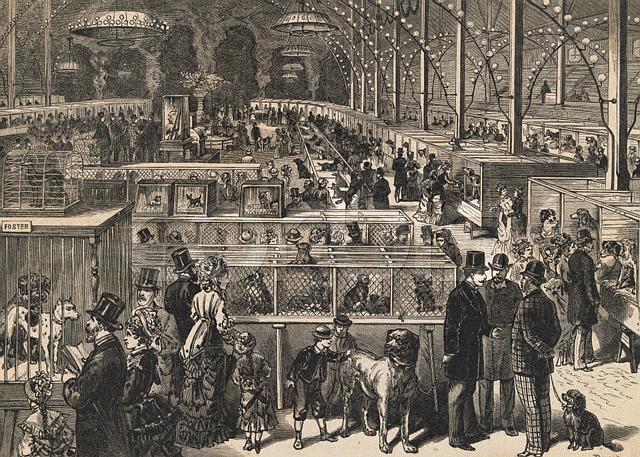
1877 dog show


In 1883, John Russell died at the age of 88. After his funeral, the few remaining dogs he had with him at Black Torrington (four very old terriers by the name of "Rags", "Sly", "Fuss" and "Tinker") were given away.

On the day of his funeral, his old sermons and other papers were found blowing around in the farm yard. Little or no self-authored record of Reverend John Russell survives to the present day.

In 1893, Rawdon Lee, Kennel Editor of "The Field" magazine, published Modern Dogs and noted the absence of Devon terriers on the show ring bench:


"There appears a semblance of strangeness that the wire-haired terriers from Devonshire have not been more used for show bench purposes, and by all accounts some of them were as good in looks as they had on many occasions proved in deeds. Those owned by the Rev. John Russell acquired a world-wide reputation, yet we look in vain for many remnants of the strain in the Stud Books, and the county of broad acres [the north] has once again distanced the southern one in the race for money. But, although the generous clerical sportsman occasionally consented to judge terriers at some of the local shows in the West, he was not much of a believer in such exhibitions. So far as dogs, and horses too, were concerned, with him it was 'handsome is that handsome does,' and so long as it did its work properly, one short leg and three long ones was no eye-sore in any terrier by the late Rev. John Russell."

Lee went on to note that the best working dogs, even in his day, were not found in the Kennel Club:


"As a matter of fact, those [terriers] best adapted for hard work either with foxhounds or otterhounds are cross-bred, hardy dogs, specially trained for the purpose, although many of the 'pedigree' animals will do similar duty to the best of their ability, but their 'pedigree' and no doubt inbreeding to a certain extent, has made them constitutionally and generally weaker than their less blue-blooded cousins."

Finally, to put a cap on it, Lee wrote:


"I have known a man act as a judge of fox terriers who had never bred one in his life, had never seen a fox in front of hounds, had never seen a terrier go to ground ... had not even seen a terrier chase a rabbit."

Only 20 years had passed since the founding of The Kennel Club, but already the death knell was being sounded for the fox terrier.

How was this possible? The short answer is that at the time Rawdon Lee was writing, The Kennel Club was undergoing a "terrier craze."

Why was this? One can only guess, but I would venture to say that terriers then, as now, fit both practical and psychological needs.

On the practical side, they are small, easy-to-keep dogs. On the psychological side, they are active dogs and not too "girly" for a man or active woman to own.

Fox terriers, in particular, have a pretension to field sports about them, and they particularly appealed to those that sought to associate themselves with the money, romance and aristocracy of the mounted hunts.

In fact, the first breed-specific publication was the Fox Terrier Chronicle, which tracked the comings and goings of Kennel Club shows as if they were High Society.

Special dog shows were started just to showcase terriers, and in 1886, a dog food salesman by the name of Charles Cruft took over the Allied Terrier Club Show at the Royal Aquarium at Westminster, with an eye towards making it a cash venture. This terrier show became the first formal Cruft's Show" when it was booked into the Royal Agricultural Hall, Islington in 1891.

In 1884, the American Kennel Club was started, and the terrier craze that had begun in the U.K. swept into the United States as well. Some small indication of this strength of this craze suggested by looking at the history of the Westminster Dog Show which awarded its first "best in show" award in 1907. The first winner was a fox terrier. A fox terrier won again in 1908, 1909, 1910, 1911, 1915, 1916, and 1917.

It was into this terrier-besotted world that Arthur Heinemann stepped -- a young man with an interest in badger digging. Heinemann was born in 1871, the year that John Russell gave up his hounds for the last time, and he was only 12 year old when the Reverend John Russell died.

Heinemann became interested in badger digging when he was in his 20s, and in 1894, he create the Devon and Somerset Badger Digging Club -- a small regional club composed of similar like-minded friends.

Where did Heinemann get his dogs? Not from John Russell.

As noted earlier, Russell gave up hunting the year Heinemann was born, and he died when Heinemann was only 12 years old. Heinemann and Russell never met.

Getting a working terrier was not much of a problem in any case. As noted earlier, white-bodied fox-working dogs were far from uncommon even in Russell's youth, and by the 1880s they were a fixture in the Kennel Club and cross-bred types were to be found all over the countryside.

As noted earlier, Russell himself did not keep a pure line of dogs, and was a bit of a dog dealer himself. By the time of Russell's death, almost anyone could have said they owned a dog descended from Russell's stock. Since Russell did not register his own dogs, and no pedigree charts survived his death (if they existed at all), who was to say otherwise? Anyone that wanted to make a claim that they had dogs descended from John Russell was free to do so -- and a few did so.

One of those people was Annie Rawl Harris, who was Kennelmaid to Squire Nicholas Snow of Oare and a relative of Will Rawl, John Russell's kennel man.

Did Annie Harris have direct descendants of John Russell's dogs? Of course. Who didn't?

As Dan Russell (the pen name of Exmoor hunt terrierman Gerald Jones) once observed in an interview with Eddie Chapman,


"John Russell was very much a dog dealer, as well as a breeder. He would buy or scrounge any terrier he thought looked like work, make it and sell it on. He always went each year to Scorrier House in Cornwall for a stay. They had their own strain of Fox Terrier there called the Scorrier terrier, which was reputed to be bred pure for over 200 years, and on leaving he would take on any terriers they didn't want."

And so we come to it: Not only were John Russell's type of dogs not unique to the Parson, he was not shy about selling them off and buying more terrier stock to breed back in. Any small white-bodied dog in the West Country could claim (perhaps legitimately) that it was descended from John Russell's own dogs.

Perhaps here is a good time to point out that Arthur Heinemann's terrier club was called the Devon and Somerset Badger Digging Club. His hound pack (acquired in 1902) was the Cheriton Otterhounds.

Badger. Otter.

The point here is that Heinemann was not chasing fox -- he was digging badger with terriers, and chasing otters with hounds and terriers. This is a point glossed over by some, but it is not insignificant, as chest size is far less of a concern when working badger and otter, than it is with fox.

In any case, in 1914 the Devon and Somerset Badger Digging Club changed its name to "The Parson Russell Terrier Club."

Why the name change? Well, to be blunt, and to use the words of his friend Dan Russell (aka Gerald Jones), Heinemann was a bit of a dog dealer who “sold a hell of a lot of dogs," both in the U.K. and overseas. He and his friend Annie Rawl Harris found that if they branded and sold their dogs as "Jack Russell Terriers" they sold better.

Why did they sell better? Well, to put it simply, no one wanted a Kennel Club Fox Terrier!

As Rawdon Lee had observed, the best working terriers were not Kennel Club dogs -- they were cross-bred dogs or dogs that were found far outside of the show ring. While the Reverend John Russell had called his own dogs fox terriers, and Rawdon Lee was still calling them fox terriers 10 years after Russell's death, by the turn of the Twentieth Century, a new name for working dogs was needed.

And that name was NOT the "Parson Russell" Terrier." It was the "Jack Russell" terrier. That was what Robert Leighton called them in his 1910 book, Dogs and All About Them, and it was the term increasingly being used in the working terrier community as well.

For evidence of this we need only turn to Jocelyn Lucas's Hunt and Working Terriers, written between 1927 and 1930, and published in 1931.

At the back of this book, Lucas lists more than 100 mounted hunts in the U.K. and details the types of terriers they themselves say they used in the field.

This was a period when the name of the dog was in transition. I say transition, because the word "fox terrier" is used in the list about as much as "Jack Russell," and other phrases appear as well, such as "white hunt terriers" and "Devonshire working terrier." In a listing of over 100 mounted hunts, however, not one claims to be working a "Parson Russell Terrier," and most of the time the word "fox terrier" is carefully proceeded by the words "cross," "cross bred," "non-pedigree," or even "mongrel."

In short, whatever a working terrier was been called in Heinemann's era, it was never called a "Parson Russell Terrier." The confusion arises, perhaps because Heinemann's badger digging Club was renamed, in 1912, the Parson Russell Terrier Badger Digging Club. The dog, however, was always called a Jack Russell Terrier. A club is not a dog.

Arthur Heinemann died in 1930 from pneumonia after coursing his lurchers in the rain (and falling through the ice on a pond), but Annie Rawl Harris continued selling Jack Russells and maintained the Parson Russell Terrier Club until it dissolved just before the Second World War.

Again, to quote Dan Russell from his own book Jack Russell and His Terriers:


"[Mrs. Harris] very quickly took the place of Heinemann as the arbiter of the Russell type terriers and she carried on breeding the type of terrier Heinemann had loved. In her heyday, she had some 50 puppies out to walk each year. She sent her stock all over the world. Her method of breeding was to use only dogs and bitches of proven gameness."

After War World War II, England seemed to get along perfectly fine without a Parson Russell Terrier Club. In fact, the 1950s, 60s and 70s were the Golden Age of terrier work in the U.K., as the weekend was invented (a product of the union movement), and it was now easier to get out to the countryside than ever before.


Add into the equation was the rise of distemper vaccines which prevented massive kennel loss, and the advent of antibiotics which helped prevent occassional gashes and wounds from getting infected, and it was truly the best of times.

Though myxomatosis arrived in the 1950s and devastated many ancient rabbit warrens throughout the U.K, the decline in rabbit populations was offset somewhat by a ban on the use of leghold traps (gins).

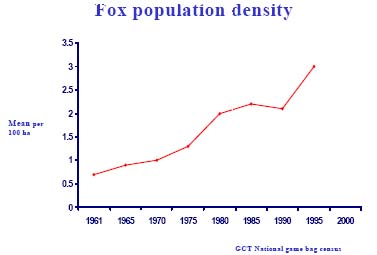
All through the 60s, 70s, and 80s, the fox population rose (see graph at left), and with it the chance of finding a bit of sport with the terriers in the countryside.

In 1974, the Jack Russell Terrier Club of Great Britain was founded "to promote and preserve the working terrier known as the Jack Russell".

In 1976, its U.S. analog was created -- the Jack Russell Terrier Club of America (JRTCA).

Both clubs have prospered and stuck to their original mission, and today the Jack Russell Terrier Club of America remains the largest Jack Russell terrier clubs in the world.

With an increase in the popularity of the Jack Russell terrier in Great Britain and the U.S., a push was initiated in 1983 to pull the Jack Russell into The Kennel Club. In 1990 this was finally done with representatives from several smaller Jack Russell Clubs meeting to draw up a conformation "standard" that called for a dog standing 12-15 inches at the withers.

It is claimed that this Kennel Club Standard was adopted from one originally written by Arthur Heinemann, but no evidence to support this claim has ever been presented so far as I know.

Dan Russell, who hunted with Heinemann and knew him well, says Heinemann did not value a large dog.


"As I remember it, and I am going back now sixty years or more, his main Badger dogs were about 12". He always said there was nothing a good fourteen inch terrier could do that a good eleven inch terrier couldn't do better. But it must be remembered he was referring to Badger digging in his own part of the West Country. His smaller terriers could manuever so much better in the large drawn out pipes of a badger set, they depended on their voice to keep the badger cornered for the diggers to hear, not brute force as some people seem to think. They were clever, game baying terriers, nothing more. Some of his best workers were no more than ten inches."

In his own book, "Jack Russell and His Terriers," written in 1979, before The Kennel Club controversty, Dan Russell quotes Heinemann directly:


"We are very much opposed to the modern show terrier and his type. Once you begin to breed it for show type, you lose the working qualities upon which you pride those terriers. I have been, I might say, the protagonist of the terrier bred for sport as against the terrier bred for show. I have no interest in cup hunting."

What Reverand John Russell or Arthur Heinemann wanted for the dogs, or what they actually used in the field, however, mattered not a whit to the Kennel Club.

In 1990 the Kennel Club admitted on to its roles a dog they called the "Parson Jack Russell Terrier," a name just invented for the occassion. In 1999 The Kennel Club changed the name to the "Parson Russell Terrier," another name invented wholecloth by Kennel Club theorists.

The American Kennel Club followed the U.K. Kennel Club in embracing both the 12-15 inch standard and in embracing the various inventeed names and name changes.

In 2005, The Kennel Club added a bit more confusion to the story by changing the standard for the dog they were now calling the Parson Russell Terrier, extending it to encompass dogs ranging from 10 to 15 inches tall at the shoulders.

The American Kennel Club has not followed the U.K Kennel Club in changing the standard, instead chosing to simply create another breed of dog (now in its Foundation Stock Service) called the "Russell Terrier."

The breed description of this dog claims it "originated" in the United Kingdom, but that it was "developed" in Australia -- a country which John Russell never so much as visited, which had no Jack Russells at all until the very late 1960s, and where the dog in question remains a pet and show dog that never sees a moment's work. The AKC "Russell terrier" standard calls for a dog standing 10-12 inches tall at the shoulder.

How to sort it all out then?

I think simplicity is best. In my opinion, there are only two types of terriers in the world: those that work, and those that don't. The white ones that work are called Jack Russell Terriers, and they are called that out of respect for the working standard that the Reverend John Russell himself honored throughout his life. Many of these white-bodied working terriers are not registered, but neither were any of the Reverend's own dogs.

What are we to make of the Kennel Club dogs? Simple: They are not Jack Russell terriers.

They are not Jack Russells in name, nor are they Jack Russell terriers in terms of performing regular honest work.

They are simply another white terrier being combed out, powdered, and fussed over by Kennel Club matrons.

So is there any place where the Parson Russell theorists and the practical working Jack Russell people might find common ground?

Oddly enough there is, though it is an area generally overlooked by the show ring crowd, and one they will no doubt surpress as time goes by.

The issue is chest size.

Barry Jones, a professional terrierman to the Cotswold Foxhounds in Andovers Ford, and a former Chairman and President of the Fell and Moorland Working Terrier Club, and the founding Chairman of the National Working Terrier Federation, was also a founding member of the Parson Russell Terrier Club. He warned the club to keep its eye on chest size, noting that:


"The chest is, without doubt, the determining factor as to whether a terrier may follow its intended quarry underground. Too large and he/she is of little use for underground work, for no matter how determined the terrier may be, this physical setback will not be overcome in the nearly-tight situations it will encounter in working foxes. It may be thought the fox is a large animal - to the casual observer it would appear so. However, the bone structure of the fox is finer than that of a terrier, plus it has a loose-fitting, profuse pelt which lends itself to flexibility.

I have not encountered a fox which could not be spanned at 14 inches circumference - this within a weight range of 10 lbs to 24 lbs, on average 300 foxes spanned a year. You may not wish to work your terrier. However, there is a Standard to be attained, and spannability is a must in the Parson Russell Terrier. "

Eddie Chapman, a working Devon hunt terrierman for more than 30 years, agrees that 14 inches is the maximum chest size for a fox. In The Working Jack Russell Terrier, he writes:


"I am a small man and have reasonably small hands, but in more than 20 years in which I have handled well over 1000 foxes, I have never handled a full grown fox which came anywhere near the span of my hands. The biggest I can remember was a South Hereford fox that was one and a half inches smaller than my hand span, and that without my squeezing him. It therefore follows that if I can pick up a dog and just span him with a squeeze, then the dog cannot get to the fox in a tight place and a dog that cannot get to a fox cannot be considered a Jack Russell. Either you are breeding a terrier suitable to work fox or, if he is too big to get to a fox, you are just breeding for looks. This is, of course, what happened to the pedigree Fox Terrier and look where that has got him!"

What is the future of the Jack Russell Terrier? The same as it has always been: as a working terrier in the hands of owners that will actually take it out to work it. Such people have always been rare. They were rare in John Russell's day, they were rare in Arthur Heinemann's day, and they are just as rare today.

As for the "Parson Russell" terrier and the "Russell" terrier they are completely interchangeable with every other terrier on the Kennel Club's roles. These dogs have no claim to history, and they have no future as honest workers. They stand as a complete rejection of every value ever held by John Russell and Arthur Heinemann, both of whom rejected Kennel Club registration and valued their own dogs based on performance in the field rather than Kennel Club points in the ring.

The good news is that with the name changes, no one will now confuse these Kennel Club dogs with the real Jack Russell Terrier.
.
_____________

Footnotes:


  • It should be said that Dan Russell (i.e. Gerald Jones) was himself terrierman for the Exmoor, Enfield Chace, and Old Berks hunts, and knew more than a bit about what was needed in a working dog.
  • Annie Rawl Harris was, for a time, housekeeper for Henry Williamson who wrote the book "Tarka the Otter."
  • The Scorrier terrier is associated with the Williams family and the Four Burrow Hunt.
  • The quotes in this piece come from the various books cited (and often pictured). For those that want a visual presentation of the history of working terriers, see A Pictorial History of Terriers; Their Politics & Their Place on the www.terrierman.com web site.
    .