Showing posts with label Galton. Show all posts

Wednesday, March 25, 2009

Howard Galton's Bloodhounds


I have written before about the intellectual history behind the the Kennel Club's theories, tracing them from Robert Bakewell to Erasmus Darwin to Charles Darwin and finally to Francis Galton (Charles Darwin's nephew) who was the father of eugenics.

Along the way, and without interruption, the talk was of dogs as well as other breeds of animals, including humans.

One of the more interesting notes is a letter from W.D. Fox to Charles Darwin about the effects of inbreeding in blood hounds owned by Howard Galton, who was Sir Francis Galton's uncle.

W.D. Fox quotes Howard Galton as saying:

"I have found from breeding in & in that there is considerable difficulty in keeping up the breed. Many of the females have never exhibited any sexual appetite & those which do so at all, very rarely.

The Knot in the tail appeared by accident in one of the finest Dog puppies I had, so fine that I kept it, notwithstanding this imperfection, and all his descendants had it until at last I got a cross with one of Lord Aylesfords' Bloodhounds, since which time it has disappeared.

The knot was always in the same part of the tail. Another consequence of breeding in and in is that the animals become prematurely old."

There is nothing new here, of course.

The deleterious effects of inbreeding have been known for as long as man has been alive, which is why there is a ban on it in all religions (one of the very few commonalities across the religious spectrum).

What is only notable here is the provenance of the observation: Darwin's inquiry into the effects of inbreeding in Howard Galton's blood hound pack dates back to 1838, more than 20 years before the first formal dog show in the U.K., and 35 years before the start of the Kennel Club.
.

Sunday, February 15, 2009

The AKC Skates on Thin Ice to the Apocalypse


YES, a product of frozen semen, was the top poodle at Westminster.

Miki broke the story on this blog which The New York Times missed, which is that top Standard Poodle at Westminster was not only sired from frozen semen, but that this long-dead dog has sired hundreds of dogs, as well as more than 10 that reportedly grew up to be dogs with Addison's disease, a serious endocrine disorder.

Does the sire of the top poodle at Westminster carry a genetic load that perhaps should not be passed on? Who knows? A case can be made that nearly ALL living creatures carry such a load, and that this is a very good reason not to inbreed dogs.

This idea is so fundamental that it was obvious to illiterate shepherds living in the deserts of the Middle East more than 4,000 years ago, which is why Christianity, Judaism, and Islam all have prohibitions on incest (see Leviticus Chapters 18-20).

So how inbred is the Westminster Poodle? Quite a lot!

The good news here is that the late John Armstrong, who founded the Canine Diversity Project, did the work on CH Eaton Affirmed (aka "Snapper"), the sire of the current Westminster Poodle winner, and he even drew out a family tree, which, as you can see below, twists back on itself more often than a cable-knit sweater,


The bottom line is that Snapper's 10-generation coefficient of inbreeding is over 30 per cent.

What does that mean? Consider this: In an effort to keep birth defects out of the human population (and to avoid the attendant social costs of providing care to the mentally and physically disabled), we ban marriages between First Cousins in this country.

  • Marriage between First Cousins is a 6.25 percent coefficient of inbreeding.

  • Having a baby with your Grandmother would result in a 12.50 coefficient of inbreeding.

  • Having a baby with your Mother or Father would result in a 25% coefficient of inbreeding.


But Eaton Affirmed, the sire of the top poodle at Westminster has a Coefficient of Inbreeding higher that 30 percent!

Thirty percent!

And this dog has not only sired 150 champions (God Himself has no ides how many puppies he has helped shoot into the world) -- there are plans for him, even in death, to sire more thanks to the miracle of frozen sperm and artificial insemination.

In fact, as The New York Times makes clear, the owners of the current Westminster Winner, Ch. Randenn Tristar Affirmation (aka "Yes") are thinking of impregnating her with frozen semen from her own father!

Whiskey. Tango. Foxtrot. Doubling down on an already-inbred pup-sicle.

When will the madness stop?

Not any time soon, that's for sure.

In fact, the American Kennel Club, which is desperate for money due to a 53% decline in dog registrations over the last 15 years, is talking about cashing in on a "frozen kennel' program they call "The Future Program"

AKC President Dennis Sprung outlined the plan at the December 16, 2008 AKC delegates meeting:

How many of us have dreamed of breeding to Shirkhan, Ceiling Zero, Dictator or the Brat?

The first priority of the Future Program is the collection of frozen semen for the breeding of outstanding dogs. The second priority is to generate significant revenue for AKC and has four elements: 1. fully subsidize all program expenses; 2. fund an endowment to ensure its continuation; 3. be significantly profitable to AKC; 4. provide any residual income to benefit existing programs – for example: CHF, Museum, the Humane Fund and legislative initiatives.


Do you see any mention in there of health testing?

Any mention of limits on Coefficients of Inbreeding?

Any mention of self-restraint, or even a nod to popular sire problems in existing Kennel Club breeds?

No, of course not!

This is all about the Kennel Club making money.

What does the health and welfare of DOGS have to do with it?

Not a thing!

And so, it is "carry on to the apocalypse."

Why are people no longer buying Kennel Club dogs? It's a complete mystery to Dennis Sprung!

Wednesday, May 7, 2008

Standards and Stonehenge


John Henry Walsh invented the Kennel Club "standard" -- cookie cutter judging based on a series of arbitrary points compiled by folks who may not have even owned any of the dogs they were writing a "standard" for.

Walsh was editor of The Field magazine, and wrote for that publication under the pseudonym of ‘Stonehenge.’

In 1867, a scant eight years after the first formal dog show, Walsh published The Dogs of the British Islands, in which he and several friends set out to to detail the physical attributes of various breeds, and to assign various "points" to these features so that the dogs could be judged in a systematic way from show to show.

Walsh's point system (along wih the eugenics theories of Francis Galton) served as the backbone and architectural model of the Kennel Club point system which is used to judge dogs in the ring, and on the bench, to this day.

Yet, here's a question: Do these show-ring standards actually tell us anything about the dogs in question?

For example, without resorting to a search engine, can you even tell what breed of dog this is?

And how, exactly, are the attributes of this breed different from other breeds of a similar type?

Other than guessing, how do you know that this dog is definitively a "This" rather than dedinitively a "That?"

And if standards are so damn important and immutable, why has every canine standard been changed at least once?

Head
Long and narrow, fairly wide between the ears, scarcely perceptible stop, little or no development of nasal sinuses, good length of muzzle, which should be powerful without coarseness. Teeth very strong and even in front.

Ears
Small and fine in texture, thrown back and folded, except when excited, when they are semi-pricked.

Eyes
Dark, bright, intelligent, indicating spirit.

Neck
Long, muscular, without throatiness, slightly arched, and widening gradually into the shoulder.

Shoulders
Placed as obliquely as possible, muscular without being loaded.

Forelegs
Perfectly straight, set well into the shoulders, neither turned in nor out, pasterns strong.

Chest
Deep, and as wide as consistent with speed, fairly well-sprung ribs.

Back
Muscular and broad.

Loins
Good depth of muscle, well arched, well cut up in the flanks.

Hindquarters
Long, very muscular and powerful, wide and well let down, well-bent stifles. Hocks well bent and rather close to ground, wide but straight fore and aft.

Feet
Hard and close, rather more hare than catfeet, well knuckled up with good strong claws.

Tail
Long, fine and tapering with a slight upward curve.

Coat
Short, smooth and firm in texture.

Color
Immaterial.

Weight
Dogs, 65 to 70 pounds; bitches 60 to 65 pounds

.

Saturday, February 9, 2008

PETA Vs. AKC: The Killers vs. the Wreckers


NOTE: This is a repost from 2.13/08

What do PETA and the AKC have in common?

Quite a lot: Neither one gives a damn about dogs; it's all about human ego.

For the AKC ribbon-chaser, owning a blue-ribbon dog is a way of suggesting that the owner might also be a person of "good breeding."

In short, the ribbon chase is not about the dog.

For PETA, animals issues are all about ego-inflating publicity and holier-than-thou brow-beating of anyone who likes a hamburger.

Once again, it's not about the animals.

As to the PETA notion that all dogs are equal, I suppose that's true if you do not pay vet bills, if you do not own a working dog, and if you do not much care if a dog has a brain or not.

And, of course, you also have to completely discount the fact that dogs are different from one breed or type to another.

A chihuahua is not a Saint Bernard, is not a terrier, is not a border collie, is not a borzoi.

The ironic thing here is that the Animal Rights folks rose to prominence by playing footsie with the Kennel Club set, and they often draw from the same demographics to this very day.

To read more see: "Intertwined Roots: Rosettes and Animal Rights"

To read about PETA Killing Dogs:

To read about the AKC Wrecking Dogs:

.

Monday, September 3, 2007

The Real Jack Russell Terrier: A Complete History


Sawrey Gilpin, A Huntsman with Hounds Foxhunting


I got a call earlier this week from someone trying to assemble (or dissect) the history of how the U.K. Kennel Club (i.e. The Kennel Club) managed to add the "Parson Russell Terrier" to its roles approximately 100 years after the Reverend John Russell himself had died.

Good question!

Well, first of all, let's ground ourselves in a few basics (and reality) just a little bit.

The first point is that white fox-working terriers predate the Reverend John Russell. Remember that the young Russell bought Trump from a milkman who had her tied to a string tied to his cart. Or so the legend goes.

The picture, at top, is by painter Sawrey Gilpin, who was born in Cumbria in 1722, and died in 1803, some years before the Reverend John Russell ever acquired his famous first terrier, Trump. Gilpin was a painter that specialize in painting animals, particularly horses, cattle and dogs.

I bring this up, not only to show that riding hounds to fox was already being practiced before John Russell arrived on the scene, but to point out the little dog, to the right, that is featured in another Gilpin painting.

The dog in this picture is a terrier by the name of "Pitch," who was owned by Colonel Thornton.

The painting was done in 1790, and you will note that this is the very model of the (undocked) white fox-working terrier we know today as the Jack Russell Terrier, complete with spot above the tail, and split-head markings.

Let us also remember that not only did Russell buy the bitch without ever seeing her work, he seemed to have no trouble finding another suitable white-bodied fox-working terrier to mate her with.

In fact, this rather cavalier pickup of dogs seems to have been Russell's way of doing business his whole life. His financial fortunes were such that he had to sell off his hounds several times, and the notion that he kept a strain of line-bred terriers descended from Trump is nonsense -- he took dogs as offered, kept them if they worked, and moved them along as needed -- and money was certainly a pressing need throughout much of Russell's life.

No doubt Russell tried to breed the best dogs he could find, but in those early days of the mounted hunts, dogs were a practical matter. In the era before dog shows, telephones and the Internet, there was no fame or fortune in to be found in working terriers.

Most of what is said about Russell's dogs is pure nonsense. The famous picture of Trump, for example, was painted more than 40 year after the dog had died, and it was painted by someone that had never seen the original animal at all. Russell said the painting was “a good likeness” but in fact he may have been trying to be polite, as the painting was commissioned by Edward VII (then Prince of Wales) who befriended Russell in his old age, and had the painting done as an homage to the old man (it hangs today at Sandringham).

Russell's real claim to fame is that he had the good fortune of living his entire life during the period in which mounted fox hunting became popularized in the U.K. Though primarily a houndsman, Russell had a fondness for terriers, as did his wife Penelope (a picture of her with a terrier is at right), and his terriers were known to be generally good workers of the right sort.

Russell had been hunting with terriers for about 40 years when the first dog show in Great Britain was held in 1859. That same year, Charles Darwin's book "The Origin of Species" was published.

It should be said that Darwin's famous book and dogs shows themselves have a common root stock -- the agricultural stock shows that began with Robert Bakewell at the very end of the 18th Century.

Prior to Bakewell, animals were free to chose their own mates. Bakewell was the first person to show that by selecting and controlling for sires (through fencing, or enclosure) breeds of farm stock could be rapidly improved or even created.

It was Bakewell's work with sire selection and controlled breeding of farm stock which Erasmus Darwin -- Charles Darwin's father -- pointed out to his son as perhaps being a driving force in the shaping of the natural world.

With publication of The Origin of Species in 1859, Victorian England became besotted by natural history studies. Massive bird egg, butterfly and beetle collections were started, and keeping a small menagerie of exotic birds was far from uncommon.

Dogs, of course, were always the thing to own, and this natural trend was perhaps tweaked by Queen Victoria who herself was an avid dog collector, and whose approval of the Society to Prevent Cruelty to Animals transformed it from the SPCA to the RSPCA.

Darwin's work and theories were expanded upon by his cousin, Sir Francis Galton. Galton was the founder of the modern field of statistics, the inventor of fingerprint identification, and the creator of the first silent dog whistle. More importantly to this discussion, he was also the founder of study and experimentation we know as eugenics.

Galton's eugenics theories argued that species and breeds could be created and improved upon ad nauseum by selecting for defined characteristics.

To put it simply, this was Darwin' theory of evolution put into hyper-drive. The notion that overly close or tight breeding might result in a rise in inherited defects or seriously deficient animals was unimagined; evolution was thought to be a one-way street, and by breeding "best to the best," man would simply improve and speed up what Mother Nature had already started.

That was the theory.

It was a theory warmly embraced by The Kennel Club, which was founded in 1873, and which was deeply influenced by Galton's work.

The Kennel Club's thesis was a simple one: Create a visual standard for a breed, accept into a closed registry only those dogs that conformed to that standard, and then encourage the breeding of "the best to the best" of these "pure bred" dogs through a program of prize-awarding conformation shows.

Like most new organizations, The Kennel Club began on somewhat shaky legs, and sought to promote itself by trying to associate itself with "names" and money as quickly as possible. The Reverend John Russell had no money, but at age 78 he was one of the grand old men of mounted fox hunting, and well-loved by all. Who better than Russell to judge the fox terrier class at one of the first dogs shows?

Russell was no doubt flattered by The Kennel Club's solicitous offer, and he warmly agreed to judge the Crystal Palace show. Very old, and quite broken financially, Russell had been forced to give up his hounds two years earlier (1871). Perhaps here was a way to keep a hand in with the dogs? Apparently, however, Russell did not much like what he saw in The Kennel Club ring, for he never agreed to judge a Kennel Club show again, and he refused to let his own dogs be registered.

Later, Russell described the Kennel Club terriers he saw as being a bit like hot house roses: "True terriers [my own dogs] were, but differing from the present show dogs as the wild eglantine differs from a garden rose."


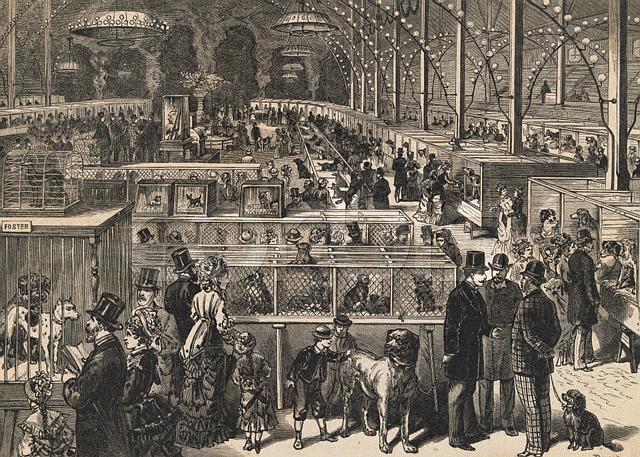
1877 dog show


In 1883, John Russell died at the age of 88. After his funeral, the few remaining dogs he had with him at Black Torrington (four very old terriers by the name of "Rags", "Sly", "Fuss" and "Tinker") were given away.

On the day of his funeral, his old sermons and other papers were found blowing around in the farm yard. Little or no self-authored record of Reverend John Russell survives to the present day.

In 1893, Rawdon Lee, Kennel Editor of "The Field" magazine, published Modern Dogs and noted the absence of Devon terriers on the show ring bench:


"There appears a semblance of strangeness that the wire-haired terriers from Devonshire have not been more used for show bench purposes, and by all accounts some of them were as good in looks as they had on many occasions proved in deeds. Those owned by the Rev. John Russell acquired a world-wide reputation, yet we look in vain for many remnants of the strain in the Stud Books, and the county of broad acres [the north] has once again distanced the southern one in the race for money. But, although the generous clerical sportsman occasionally consented to judge terriers at some of the local shows in the West, he was not much of a believer in such exhibitions. So far as dogs, and horses too, were concerned, with him it was 'handsome is that handsome does,' and so long as it did its work properly, one short leg and three long ones was no eye-sore in any terrier by the late Rev. John Russell."

Lee went on to note that the best working dogs, even in his day, were not found in the Kennel Club:


"As a matter of fact, those [terriers] best adapted for hard work either with foxhounds or otterhounds are cross-bred, hardy dogs, specially trained for the purpose, although many of the 'pedigree' animals will do similar duty to the best of their ability, but their 'pedigree' and no doubt inbreeding to a certain extent, has made them constitutionally and generally weaker than their less blue-blooded cousins."

Finally, to put a cap on it, Lee wrote:


"I have known a man act as a judge of fox terriers who had never bred one in his life, had never seen a fox in front of hounds, had never seen a terrier go to ground ... had not even seen a terrier chase a rabbit."

Only 20 years had passed since the founding of The Kennel Club, but already the death knell was being sounded for the fox terrier.

How was this possible? The short answer is that at the time Rawdon Lee was writing, The Kennel Club was undergoing a "terrier craze."

Why was this? One can only guess, but I would venture to say that terriers then, as now, fit both practical and psychological needs.

On the practical side, they are small, easy-to-keep dogs. On the psychological side, they are active dogs and not too "girly" for a man or active woman to own.

Fox terriers, in particular, have a pretension to field sports about them, and they particularly appealed to those that sought to associate themselves with the money, romance and aristocracy of the mounted hunts.

In fact, the first breed-specific publication was the Fox Terrier Chronicle, which tracked the comings and goings of Kennel Club shows as if they were High Society.

Special dog shows were started just to showcase terriers, and in 1886, a dog food salesman by the name of Charles Cruft took over the Allied Terrier Club Show at the Royal Aquarium at Westminster, with an eye towards making it a cash venture. This terrier show became the first formal Cruft's Show" when it was booked into the Royal Agricultural Hall, Islington in 1891.

In 1884, the American Kennel Club was started, and the terrier craze that had begun in the U.K. swept into the United States as well. Some small indication of this strength of this craze suggested by looking at the history of the Westminster Dog Show which awarded its first "best in show" award in 1907. The first winner was a fox terrier. A fox terrier won again in 1908, 1909, 1910, 1911, 1915, 1916, and 1917.

It was into this terrier-besotted world that Arthur Heinemann stepped -- a young man with an interest in badger digging. Heinemann was born in 1871, the year that John Russell gave up his hounds for the last time, and he was only 12 year old when the Reverend John Russell died.

Heinemann became interested in badger digging when he was in his 20s, and in 1894, he create the Devon and Somerset Badger Digging Club -- a small regional club composed of similar like-minded friends.

Where did Heinemann get his dogs? Not from John Russell.

As noted earlier, Russell gave up hunting the year Heinemann was born, and he died when Heinemann was only 12 years old. Heinemann and Russell never met.

Getting a working terrier was not much of a problem in any case. As noted earlier, white-bodied fox-working dogs were far from uncommon even in Russell's youth, and by the 1880s they were a fixture in the Kennel Club and cross-bred types were to be found all over the countryside.

As noted earlier, Russell himself did not keep a pure line of dogs, and was a bit of a dog dealer himself. By the time of Russell's death, almost anyone could have said they owned a dog descended from Russell's stock. Since Russell did not register his own dogs, and no pedigree charts survived his death (if they existed at all), who was to say otherwise? Anyone that wanted to make a claim that they had dogs descended from John Russell was free to do so -- and a few did so.

One of those people was Annie Rawl Harris, who was Kennelmaid to Squire Nicholas Snow of Oare and a relative of Will Rawl, John Russell's kennel man.

Did Annie Harris have direct descendants of John Russell's dogs? Of course. Who didn't?

As Dan Russell (the pen name of Exmoor hunt terrierman Gerald Jones) once observed in an interview with Eddie Chapman,


"John Russell was very much a dog dealer, as well as a breeder. He would buy or scrounge any terrier he thought looked like work, make it and sell it on. He always went each year to Scorrier House in Cornwall for a stay. They had their own strain of Fox Terrier there called the Scorrier terrier, which was reputed to be bred pure for over 200 years, and on leaving he would take on any terriers they didn't want."

And so we come to it: Not only were John Russell's type of dogs not unique to the Parson, he was not shy about selling them off and buying more terrier stock to breed back in. Any small white-bodied dog in the West Country could claim (perhaps legitimately) that it was descended from John Russell's own dogs.

Perhaps here is a good time to point out that Arthur Heinemann's terrier club was called the Devon and Somerset Badger Digging Club. His hound pack (acquired in 1902) was the Cheriton Otterhounds.

Badger. Otter.

The point here is that Heinemann was not chasing fox -- he was digging badger with terriers, and chasing otters with hounds and terriers. This is a point glossed over by some, but it is not insignificant, as chest size is far less of a concern when working badger and otter, than it is with fox.

In any case, in 1914 the Devon and Somerset Badger Digging Club changed its name to "The Parson Russell Terrier Club."

Why the name change? Well, to be blunt, and to use the words of his friend Dan Russell (aka Gerald Jones), Heinemann was a bit of a dog dealer who “sold a hell of a lot of dogs," both in the U.K. and overseas. He and his friend Annie Rawl Harris found that if they branded and sold their dogs as "Jack Russell Terriers" they sold better.

Why did they sell better? Well, to put it simply, no one wanted a Kennel Club Fox Terrier!

As Rawdon Lee had observed, the best working terriers were not Kennel Club dogs -- they were cross-bred dogs or dogs that were found far outside of the show ring. While the Reverend John Russell had called his own dogs fox terriers, and Rawdon Lee was still calling them fox terriers 10 years after Russell's death, by the turn of the Twentieth Century, a new name for working dogs was needed.

And that name was NOT the "Parson Russell" Terrier." It was the "Jack Russell" terrier. That was what Robert Leighton called them in his 1910 book, Dogs and All About Them, and it was the term increasingly being used in the working terrier community as well.

For evidence of this we need only turn to Jocelyn Lucas's Hunt and Working Terriers, written between 1927 and 1930, and published in 1931.

At the back of this book, Lucas lists more than 100 mounted hunts in the U.K. and details the types of terriers they themselves say they used in the field.

This was a period when the name of the dog was in transition. I say transition, because the word "fox terrier" is used in the list about as much as "Jack Russell," and other phrases appear as well, such as "white hunt terriers" and "Devonshire working terrier." In a listing of over 100 mounted hunts, however, not one claims to be working a "Parson Russell Terrier," and most of the time the word "fox terrier" is carefully proceeded by the words "cross," "cross bred," "non-pedigree," or even "mongrel."

In short, whatever a working terrier was been called in Heinemann's era, it was never called a "Parson Russell Terrier." The confusion arises, perhaps because Heinemann's badger digging Club was renamed, in 1912, the Parson Russell Terrier Badger Digging Club. The dog, however, was always called a Jack Russell Terrier. A club is not a dog.

Arthur Heinemann died in 1930 from pneumonia after coursing his lurchers in the rain (and falling through the ice on a pond), but Annie Rawl Harris continued selling Jack Russells and maintained the Parson Russell Terrier Club until it dissolved just before the Second World War.

Again, to quote Dan Russell from his own book Jack Russell and His Terriers:


"[Mrs. Harris] very quickly took the place of Heinemann as the arbiter of the Russell type terriers and she carried on breeding the type of terrier Heinemann had loved. In her heyday, she had some 50 puppies out to walk each year. She sent her stock all over the world. Her method of breeding was to use only dogs and bitches of proven gameness."

After War World War II, England seemed to get along perfectly fine without a Parson Russell Terrier Club. In fact, the 1950s, 60s and 70s were the Golden Age of terrier work in the U.K., as the weekend was invented (a product of the union movement), and it was now easier to get out to the countryside than ever before.


Add into the equation was the rise of distemper vaccines which prevented massive kennel loss, and the advent of antibiotics which helped prevent occassional gashes and wounds from getting infected, and it was truly the best of times.

Though myxomatosis arrived in the 1950s and devastated many ancient rabbit warrens throughout the U.K, the decline in rabbit populations was offset somewhat by a ban on the use of leghold traps (gins).

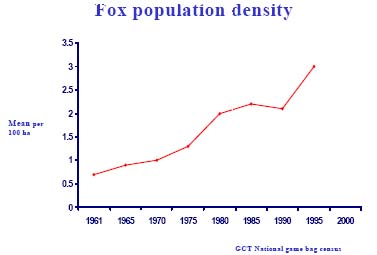
All through the 60s, 70s, and 80s, the fox population rose (see graph at left), and with it the chance of finding a bit of sport with the terriers in the countryside.

In 1974, the Jack Russell Terrier Club of Great Britain was founded "to promote and preserve the working terrier known as the Jack Russell".

In 1976, its U.S. analog was created -- the Jack Russell Terrier Club of America (JRTCA).

Both clubs have prospered and stuck to their original mission, and today the Jack Russell Terrier Club of America remains the largest Jack Russell terrier clubs in the world.

With an increase in the popularity of the Jack Russell terrier in Great Britain and the U.S., a push was initiated in 1983 to pull the Jack Russell into The Kennel Club. In 1990 this was finally done with representatives from several smaller Jack Russell Clubs meeting to draw up a conformation "standard" that called for a dog standing 12-15 inches at the withers.

It is claimed that this Kennel Club Standard was adopted from one originally written by Arthur Heinemann, but no evidence to support this claim has ever been presented so far as I know.

Dan Russell, who hunted with Heinemann and knew him well, says Heinemann did not value a large dog.


"As I remember it, and I am going back now sixty years or more, his main Badger dogs were about 12". He always said there was nothing a good fourteen inch terrier could do that a good eleven inch terrier couldn't do better. But it must be remembered he was referring to Badger digging in his own part of the West Country. His smaller terriers could manuever so much better in the large drawn out pipes of a badger set, they depended on their voice to keep the badger cornered for the diggers to hear, not brute force as some people seem to think. They were clever, game baying terriers, nothing more. Some of his best workers were no more than ten inches."

In his own book, "Jack Russell and His Terriers," written in 1979, before The Kennel Club controversty, Dan Russell quotes Heinemann directly:


"We are very much opposed to the modern show terrier and his type. Once you begin to breed it for show type, you lose the working qualities upon which you pride those terriers. I have been, I might say, the protagonist of the terrier bred for sport as against the terrier bred for show. I have no interest in cup hunting."

What Reverand John Russell or Arthur Heinemann wanted for the dogs, or what they actually used in the field, however, mattered not a whit to the Kennel Club.

In 1990 the Kennel Club admitted on to its roles a dog they called the "Parson Jack Russell Terrier," a name just invented for the occassion. In 1999 The Kennel Club changed the name to the "Parson Russell Terrier," another name invented wholecloth by Kennel Club theorists.

The American Kennel Club followed the U.K. Kennel Club in embracing both the 12-15 inch standard and in embracing the various inventeed names and name changes.

In 2005, The Kennel Club added a bit more confusion to the story by changing the standard for the dog they were now calling the Parson Russell Terrier, extending it to encompass dogs ranging from 10 to 15 inches tall at the shoulders.

The American Kennel Club has not followed the U.K Kennel Club in changing the standard, instead chosing to simply create another breed of dog (now in its Foundation Stock Service) called the "Russell Terrier."

The breed description of this dog claims it "originated" in the United Kingdom, but that it was "developed" in Australia -- a country which John Russell never so much as visited, which had no Jack Russells at all until the very late 1960s, and where the dog in question remains a pet and show dog that never sees a moment's work. The AKC "Russell terrier" standard calls for a dog standing 10-12 inches tall at the shoulder.

How to sort it all out then?

I think simplicity is best. In my opinion, there are only two types of terriers in the world: those that work, and those that don't. The white ones that work are called Jack Russell Terriers, and they are called that out of respect for the working standard that the Reverend John Russell himself honored throughout his life. Many of these white-bodied working terriers are not registered, but neither were any of the Reverend's own dogs.

What are we to make of the Kennel Club dogs? Simple: They are not Jack Russell terriers.

They are not Jack Russells in name, nor are they Jack Russell terriers in terms of performing regular honest work.

They are simply another white terrier being combed out, powdered, and fussed over by Kennel Club matrons.

So is there any place where the Parson Russell theorists and the practical working Jack Russell people might find common ground?

Oddly enough there is, though it is an area generally overlooked by the show ring crowd, and one they will no doubt surpress as time goes by.

The issue is chest size.

Barry Jones, a professional terrierman to the Cotswold Foxhounds in Andovers Ford, and a former Chairman and President of the Fell and Moorland Working Terrier Club, and the founding Chairman of the National Working Terrier Federation, was also a founding member of the Parson Russell Terrier Club. He warned the club to keep its eye on chest size, noting that:


"The chest is, without doubt, the determining factor as to whether a terrier may follow its intended quarry underground. Too large and he/she is of little use for underground work, for no matter how determined the terrier may be, this physical setback will not be overcome in the nearly-tight situations it will encounter in working foxes. It may be thought the fox is a large animal - to the casual observer it would appear so. However, the bone structure of the fox is finer than that of a terrier, plus it has a loose-fitting, profuse pelt which lends itself to flexibility.

I have not encountered a fox which could not be spanned at 14 inches circumference - this within a weight range of 10 lbs to 24 lbs, on average 300 foxes spanned a year. You may not wish to work your terrier. However, there is a Standard to be attained, and spannability is a must in the Parson Russell Terrier. "

Eddie Chapman, a working Devon hunt terrierman for more than 30 years, agrees that 14 inches is the maximum chest size for a fox. In The Working Jack Russell Terrier, he writes:


"I am a small man and have reasonably small hands, but in more than 20 years in which I have handled well over 1000 foxes, I have never handled a full grown fox which came anywhere near the span of my hands. The biggest I can remember was a South Hereford fox that was one and a half inches smaller than my hand span, and that without my squeezing him. It therefore follows that if I can pick up a dog and just span him with a squeeze, then the dog cannot get to the fox in a tight place and a dog that cannot get to a fox cannot be considered a Jack Russell. Either you are breeding a terrier suitable to work fox or, if he is too big to get to a fox, you are just breeding for looks. This is, of course, what happened to the pedigree Fox Terrier and look where that has got him!"

What is the future of the Jack Russell Terrier? The same as it has always been: as a working terrier in the hands of owners that will actually take it out to work it. Such people have always been rare. They were rare in John Russell's day, they were rare in Arthur Heinemann's day, and they are just as rare today.

As for the "Parson Russell" terrier and the "Russell" terrier they are completely interchangeable with every other terrier on the Kennel Club's roles. These dogs have no claim to history, and they have no future as honest workers. They stand as a complete rejection of every value ever held by John Russell and Arthur Heinemann, both of whom rejected Kennel Club registration and valued their own dogs based on performance in the field rather than Kennel Club points in the ring.

The good news is that with the name changes, no one will now confuse these Kennel Club dogs with the real Jack Russell Terrier.
.
_____________

Footnotes:


  • It should be said that Dan Russell (i.e. Gerald Jones) was himself terrierman for the Exmoor, Enfield Chace, and Old Berks hunts, and knew more than a bit about what was needed in a working dog.
  • Annie Rawl Harris was, for a time, housekeeper for Henry Williamson who wrote the book "Tarka the Otter."
  • The Scorrier terrier is associated with the Williams family and the Four Burrow Hunt.
  • The quotes in this piece come from the various books cited (and often pictured). For those that want a visual presentation of the history of working terriers, see A Pictorial History of Terriers; Their Politics & Their Place on the www.terrierman.com web site.
    .

Thursday, March 8, 2007

The Francis Galton Dog Show

The work of Francis Galton was important to the development of the breeding theories that underpin the closed registry system of The U.K. Kennel Club and its U.S. analog, the American Kennel Club.

As a diversion, I looked up Francis Galton's 1865 essay on "Hereditary Talent and Character," in which he suggests that the dogs that people like best are are the stupid ones that most readily make themselves available to us as "slaves."

"So far as I am aware, no animals have ever been bred for general intelligence. Special aptitudes are thoroughly controlled by the breeder. He breeds dogs that point that retrieve, that fondle, or that bite; but no one has ever yet attempted to breed for high general intellect, irrespective of all other qualities. It would be a most interesting subject for an attempt. We hear constantly of prodigies of dogs, whose very intelligence makes them of little value as slaves. When they are wanted, they are apt to be absent on their own errands. They are too critical of their master's conduct. For instance, an intelligent dog shows marked contempt for an unsuccessful sportsman. He will follow nobody along a road that leads on a well-known tedious errand. He does not readily forgive a man who wounds his self-esteem. He is often a dexterous thief and a sad hypocrite. For these reasons an over-intelligent dog is not an object of particular desire, and therefore, I suppose, no one has ever thought of encouraging a breed of wise dogs. But it would be a most interesting occupation for a country philosopher to pick up the cleverest dogs he could hear of, and mate them together, generation after generation -- breeding purely for intellectual power, and disregarding shape, size, and every other quality."

It's not too hard to see how H.G. Wells could imagine the human race evolving into a race of "Eloi" and Morlocks" is it?

Of course, the idea of controlled breeding of both humans and animals predates Galton.

Plato, for example, said that "The best men must have intercourse with the best women as frequently as possible, and the opposite is true of the very inferior."

As I note in American Working Terriers, Robert Bakewell is the person who popularized the control of sires to improve farm stock.

It was Galton's eugenics thesis, however, that set the intelligentsia of Victorian England on fire.

What the Kennel Club proposed in 1873 was simply a logical extension of Galton's work: to remove natural selection from the table completely. What better place to begin with than the dog? Dog breeds, after all, are not a product of natural selection, but of unnatural selection. A "natural" dog is a mongrel. A working dog, however, is a dog that has been selected for certain attributes. Since some selection for defined characteristics had already begun with working dogs, why not start with those breeds and see how they would work out with further "refinement" in a closed registry?

For more on the not-entirely-successful theories of Francis Galton (and for the ironic story of what happened to the Galton/Darwin gene pool), see my earlier post on Inbred Thinking.

.

Wednesday, February 7, 2007

"Better than a Dog Anyhow"

Darwin’s musing on marriage:


"Reasons for not marrying: freedom to go where one liked; choice of Society & little of it. - Conversation of clever men at clubs - Not forced to visit relatives, & to bend in every trifle. - to have the expense & anxiety of children - perhaps quarrelling - Loss of time. - cannot read in the Evenings - fatness & idleness - Anxiety & responsibility - less money for books.

"[Reasons for marrying:] Children - (if it Please God) - Constant companion, (& friend in old age) who will feel interested in one, - object to be beloved & played with. - better than a dog anyhow."

Of course, Darwin went on to marry his first cousin, Emma Wedgewood, the kind of "consolidation of superior blood lines" later advocated by another of Darwin's cousins, Sir Francis Galton, whose work advancing the field of eugenics served as the intellectual cornerstone of the modern Kennel Club.

And the rest, as they say, is history.

A very miserable history if you know the result of inbreeding within both the Darwin family and the Kennel Club.
.

Friday, May 26, 2006

Inbred Thinking


Working border collies depend on a performance standard and an open registry.

 When pressed about the poor genetic quality of today's "pure bred" dogs, most Kennel Club breeders parrot the Kennel Club apologia: "We only register dogs, we don't breed them."

In fact, the line is pure bunk. The Kennel Club does far more than register dogs -- it sets the rules that guarantee more and more dogs will suffer serious (and often painful) genetic problems.

The problem, in a nutshell, is the closed registry system. With all Kennel Club breeds, the "founding stock" has always been small in number, and often fairly inbred going in, since breed creation is a product of inbreeding and line breeding to "set" the look of a dog. Because a closed registry never adds new blood, it becomes progressively more inbred over time.

Genetic diversity is never increased in the Kennel Club -- it is only reduced. In practice, it is often reduced quite rapidly due to the fact that show-winning males are in great demand to "cover" as many bitches as possible -- the so-called "popular sire effect."

The result, to be clearly seen by simply comparing 10-generation pedigrees for most breeds, is that many dogs have common male ancestors.

After 25 generations, the genetic overlap within all members of a breed may be complete or nearly complete with every member of the breed traced back to the same root stock.

What is wrong with this? Simple: In the world of genetics, most health-related negative characteristics are recessive. This is true because most dominant negative characteristics result in quick mortality or culling. A negative recessive gene, however, remains hidden and only becomes expressed (i.e. self-evident) when both parents carry the negative gene.

When dog populations are relatively heterogeneous (i.e. genetically diverse) the chance that any two negative genes will combine is low. Result: a dog with a very high chance of being healthy.

In a dog population that is very homogeneous (i.e., not genetically diverse), the chance of two negative recessive genes combining rises in direct relationship to the degree of homogeneity.

The result of two negative recessive genes combining is a real health problem -- the kind of problems we are increasingly seeing in Kennel Club dogs: epilepsy, dysplasia, deafness, congenital skin conditions, heart murmurs, cataracts, polyarthritis, progressive renal atrophy, allergies, hypothyroidism, and Cushing's Syndrome, to name a few.

A closed registry with a small gene pool undergoing a further tightening due to sire selection and overuse guarantees inbreeding and a steady increase in the occurrence of negative genetic issues. There is no getting around this.

The graph, appended below, shows the slow but steady rise in the coefficient of inbreeding among shelties. Similar rising graphs could be produced for most AKC breeds.


Coefficient of inbreeding, 1930-1993, for Shelties, showing trend line.


No population of animals is entirely absent negative recessive genes. Every population of animals contains at least two or three -- bits of fatal code that are "hard wired" into the makeup of the animal. A population of animals that appears to be "clean" is simply one that is still diverse enough that negative genes are not yet combining very often. If a small population is inbred long enough, negative genes will begin to express themselves.

The results of inbreeding are not a closely-held secret. Deuteronomy 27:22 reads: "Cursed be he that lieth with his sister, the daughter of his father, or the daughter of this mother..." Leviticus offers a similar admonition.

Human history too is a guide. Pick up any book about European royalty, and you can read about the idiot King Charles II of Spain, the product of generations of inbreeding by the Hapsburg family. This is a man whose face and chin were so distorted by the "Hapsburg Lip" that he could not eat without assistance. If his picture (appended below) makes you think of a Bulldog, Pekingese, Pug or Boston Terrier, you are not alone.


King Charles II of Spain -- a product of inbreeding in the Hapsburg line.


And yet inbreeding is not an option with the Kennel Club -- it is required. The option of outcrossing a Lakeland Terrier to a Fox Terrier is not possible within the confines of a closed registry, nor is the crossing of a Curly-coated retriever to a Flat-coated Retriever, or a Greyhound to a Saluki.

Along with an increase in the incidence of serious genetic problems within a closed-registry population, you have other problems that may not be clear to an individual pet owner, but which become obvious to those studying canine demographics: increased neo-natal mortality, shortened lifespans, and increased infecundity (dogs that are sterile or barren). All of these characteristics are endemic to deeply inbred populations, and are showing up with increased frequency in the Kennel Club.


In sled dogs, performance is king, and an open registry has proven critical to preserving honest pulling dogs with stamina, good feet, and heart.


How did the Kennel Club come to embrace a closed registry, and why does it maintain this system?

The adoption of a "closed registry" by the Kennel Club is an artifact of its history, while the continuation of this practice is driven by the economics of dog breeding and the political construct of the Kennel Club.

The Kennel Club was created in Victorian England in 1873, at a time when new theories about genetics were being promulgated by learned men who did not yet have a very good idea of what was going on in the natural world.

As noted in American Working Terriers, the "speciation" of domestic breeds of livestock began with the work of Robert Bakewell in the 18th Century, and the control of sires. Bakewell's work helped speed the rise of the Enclosure Movement, which in turn led to large estates, fox hunting, and the rise of terrier work.

Bakewell had no real knowledge of scientific genetics, and his breeding program was largely limited to the control of sires (made easier by enclosures) and the admonition that "like begats like" and that success was to be found by "breeding the best to the best".

The first stud book to document the breeding of animals was the General Stud Book of 1791 which tracked a small pool of racing horses. A stud book for Shorthorn Cattle was produced in 1822.

As more and more farmers followed the tenets of Robert Bakewell, sire selection became increasingly prevalent and inbreeding and line breeding more common. By selecting the best beef and milk producers, and pairing them, rapid improvements in cattle breeds were made.

When Charles Darwin returned from his five-year voyage on the Beagle in 1836, he discovered new breeds of cattle, sheep and pigeons displayed at livestock bench shows.

Over the next 23 years, Darwin ruminated about the aggressive livestock breeding he saw going on around him, and what isolation (enclosure) and selection (the frequent use of popular sires) might mean if some natural version of this phenomenon were driving the diversity of wildlife he had seen on his travels.

In 1859, after more than two decades of thought on the subject, Darwin published The Origin of Species -- the very year the first formal dog show was held in England.

Formal dog shows grew out of the livestock bench shows held by Robert Bakewell and his followers to display their new stock. With dogs, as with farm animals, it was soon discovered that by selecting types of dogs and genetically isolating them in kennels, homes or yards, and then inbreeding and line breeding them, a great deal of variety could be expressed.

In 1800, there were only 15 designated breeds of dogs, but by 1865 that number had grown to more than 50 and over the next 40 years it tripled yet again.

The rapid speciation of dogs that began in 1859 occurred just as Darwin's cousin, Francis Galton, was taking Darwin's work and attempting to generalize it to man.

Both Darwin and Galton had noticed how many people in their own family were smart. Along with Charles Darwin and his biologist father, Erasmus Darwin, there was another grandfather who was a member of the Royal Society, and then there was Galton's own father, who was a banker. As for Galton, by the time he was four years old he could write, read any book in the English language, knew basic math (including the times tables), and had a passing hand in the basic rudiments of both Latin and French.

While at Cambridge, Galton noticed that intelligence seemed to run in other families as well. Students that did well at college had parents and sibling that also did well. From this observation Galton postulated that human intelligence was inherited, and he went to great lengths to test his theory, going so far as to invent important new statistical methods such as regression analysis and mathematical correlation.

Galton was an intellectual whirlwind responsible for advances in meteorology, psychology, and statistics (as well as inventing the silent dog whistle), but like all people he was fallible.

Galton's chief failure was that he did not understand that the elements used to create a breed could, if taken too far, lead to the breed's destruction. With an imperfect knowledge of genetics, Galton argued that "What nature does blindly, slowly, and ruthlessly, man may do providently, quickly, and kindly," by a system he called "eugenics".

Galton postulated that if novel organisms, or "sports of nature" could be found, these sports could be enlisted to create a new breed through genetic isolation and inbreeding.

By engaging in a "positive" system of eugenics, superior individuals could be encouraged to breed more, and by engaging in a system of "negative" eugenics, inferior types could be culled from the line.

This was, to put it simply, Darwin' theory of evolution put into hyper-drive. Surely the direction would be forward, and the road forward would be without end?

Galton's theory of improvement-without-end was embraced by the early Kennel Club. The patina of science -- and a short track record of success on the farm -- lent credibility to the idea of a closed registry of "pure" stock.

On the surface, there was no reason to suspect the seeds of destruction were contained in the closed registry system itself. The work of Gregor Mendel was still undiscovered, and even when it was discovered (around 1900) a true understanding of the nature of negative recessive genes was many decades away.


A winning greyhound is never a bad or boring color.


Conformation dog shows, of course, simply speeded up the drive to homogeneity.
The goal of the conformation show is conformity -- an entire class of cookie-cutter dogs that look as much alike as possible. This is most easily achieved by breeding champion to champion, culling the nonconforming, and then inbreeding and linebreeding to further distill the "type".

As a direct consequence of conformation shows, and the over-use of championship sires, the genetic bottleneck that began with the creation of every dog breed was further reduced.

In the beginning, it was hard for dog breeders to see what was going on. Breeders occasionally had a few health problems in their kennels, of course, but it was hard to see a pattern with so few animals tracked over a relatively few generations. If hip dysplasia, skin infections and cataracts "popped out," it was "just one of those things" and chalked up to a "bad cross" and bad luck.

The idea that the Kennel Club's closed registry system itself was to blame was a deeper thought than most folks were prepared to consider.

On the farm, things took a different turn. The inbreeding of farm stock began earlier than with dogs, but was no less intense.

Because farm herds are large and often kept by families for generations, farmers were able to "tease out" data indicating drops in production, increases in mortality, declining fecundity, and a steady rise in disease and illness.

Inbreeding, which had initially boosted production, now appeared to be reducing it.

Because farmers had a clear "steak and eggs" axis for evaluation of stock, they were ready and willing to outcross to achieve the best results for their needs and their land. Consumers, after all, do not much care what breed of chicken their eggs come from, or what "champion" bull sired their steak.

Through experimentation, farmers discovered that outcrosses and hybrids of two "pure" types produce as well or better, while remaining more disease resistant, more fecund, and longer-lived than deeply homogeneous stock.

What may appear to be a pure Angus (the most common breed of beef cattle in the world) is likely to have a wide variety of cattle genes coursing through its system. In fact, entire breeds of cattle are now kept solely for their outcross potential. On today's farms the cattle in the field may be Brangus (Brahman-Angus crosses), Braford (Brahmam-Hereford crosses), Beefmasters (a cross of Hereford, Shorthorn and Brahman), or any other combination or mix.

Farmers are not alone in favoring a certain degree of heterogeneity. In top winning race horses, a 5% coefficient of inbreeding is considered high. Though much is made of the stud fees paid for the services of retired winners, most of the offspring of these champion horses are not all that distinguished, and lighting is rarely caught twice in a bottle by the same breeder.


Genetic diversity is similarly valued by breeders of performance dogs such as racing greyhounds, working border collies, sled dogs, and working terriers. All of the working versions of these breeds, or types of dogs, are maintained with open registries. It is not an accident that Kennel Club greyhounds are not found at the track, that Kennel Club terriers are not found in the field, that Kennel Club sled dogs are not found on the Iditarod, or that Kennel Club border collies are not found on working sheep farms.

Ironically, it turns out that maintaining a breed and keeping it more-or-less heterogeneous is neither a contradiction nor a difficulty. The trick is simply to follow Mother Nature and to occasionally do true outcrosses to animals that are entirely outside of the gene pool being crossed into. In the case of cattle and chickens, this is commonly achieved by crossing in an animal of similar size and traits, but with a very different genetic history.

It surprises people to find out that Mother Nature does much the same thing. Most people assume a Mallard duck is a Mallard duck. Aren't all Mallards simply clones of each other?


Well, No. You see, ducks hybridize all the time. What appears to be a Mallard may, in fact, have a little Gadwall crossed into it, or a little Black Duck, or even a bit of Greenwinged duck tucked into its double-helix.

In the duck world, where success is defined in Darwinian terms, there are no closed registries. While animals within a species tend to mate with others of the species in the same area, new blood flies, walks or swims in all the time. In the case of ducks, it may even come from across the ocean -- or from an entirely different duck species.

The same effect occurs when young male fox, lions, and wolves are forced out of their natal territories, causing them to travel great distances to find unoccupied territories. A young male wolf sired in Wyoming may travel as far as Oregon before it "settles down" to rear its own family.

What is true for ducks is true for a lot of animals. Not only will individual animals often travel great distances to find unoccupied territories, they may also cross the species barrier as they do so. A wolf will mate with both a dog AND a coyote, while finches leap across the species barrier at the drop of a hat. A spotted owl will freely mate with a barred owl, while most amazon parrots freely cross breed. A lion can mate with a tiger and produce fertile offspring, and an African elephant can cross breed with an Asian elephant. A muskellunge will cross with a northern pike, and a sunfish will cross with a bluegill. Trout and salmon species readily hybridize. Many species of hawks and falcons will also cross the species line, while a buffalo will cross with a cow. Just last week a hunter in Alaska shot an animal that turned out to be a cross between a polar bear and a grizzly.

The point here is not that trans-species outcrosses are common, but that even between distinct species Mother Nature often runs her train "loose on the tracks," and a considerable amount of genetic wobble is allowed.

Mother Nature allows outcrosses because she values heterogeneous genes, while she punishes homogeneous genes by "culling" animals through a process of dwindling survivorship (neonatal mortality), shortened lifespans, and infecundity.


The facts outlined here are not closely held information and are supported by sound science. Why then has the Kennel Club not changed its policy?

The short answer is economics.

The Kennel Club is a huge money-making bureaucracy dependent upon selling people on the "exclusivity" of a closed registry and a scrap of paper that says a dog is a "pure breed". So long as people are willing to buy Kennel Club registered dogs that have predictably higher chances of serious physical impairments than cross-bred dogs, the Kennel Club (and Kennel Club breeders) have little motivation to change the way they do business.

Let me hasten to say that the Kennel Club is not filled with evil people intent on doing harm to dogs. It is, in fact, filled with regular people who are different from the rest of the world only in the degree (and the way) they seek ego-gratification and are status-seeking.

This last point is import: the Kennel Club is not primarily about dogs. Dogs do not care about ribbons, pedigrees, titles, and points. These are human obsessions. The reason a human will drive several hundred miles and stand around all day waiting for 10 minutes in the ring is not because of the dog, but because the human needs that ribbon, that title, and that little bit of extra status that comes from a win.

Each to his own, but let us be honest about what dog shows are about -- they are about ribbons for people. The dogs themselves could not give a damn.

It is unfair to fault individual breeders and breed clubs for the failures of the Kennel Club, as these smaller units are powerless to change the larger whole.

Breed clubs are small and largely impotent by design. Because the Kennel Club does not require breeders, pet owners, or even show ring ribbon-chasers to join a breed club as a condition of registration, these entities remain small, underfunded, and unrepresentative.

Breed clubs, like dog shows themselves, are also steeped in internecine politics and dominated by big breeders and people who over-value "conformation."

It is only by conforming to the AKC system for decades that anyone can hope to move up in the AKC hierarchy -- a situation that guarantees intellectual and bureaucratic inbreeding.


In the end, the AKC is a closed registry in every sense of that word. It continues to embrace the failed genetic theories of Victorian England because it is incapable of serious reform within the Club itself.

Is there a bright light anywhere? Yes and no.

Back in 1922, Sewell Wright, a famous early geneticist, devised a method of calculating a coefficient of inbreeding (COI). Under Wright's system, inbreeding coefficients ranging from 0% to 100% defined the percentage of a dog's genes that might be homozygous (note that this is a probability equation).


The equation was neat and discrete, as such things went, but incredibly complex and cumbersome in practice. Without mathematical training, an enormous stack of pedigrees, and at least a week's worth of hand calculation, a 10-generation coefficient of inbreeding was impossible to calculate. As a result, Wright's coefficient of inbreeding (COI) was not much used.

The good news is that in the modern era, thanks to the advent of the personal computer and the internet, it is now much easier to build a 10- or 20-generation pedigree using list-servs, email, and ready-made software.


Sadly, few breeders seem willing to do even this work -- and even fewer are willing to do what is right. Breeders hell-bent to make it in the show world continue to inbreed their dogs and consumers continue to buy their cast-offs, completely ignoring the fact that 25 percent of the time they are buying a heath care liability -- one that may cost them many thousands of dollars in veterinary care in a just a few years time.

On the positive side, more and more breeders are testing their dogs for hip dysplasia (OFA), eye problems (CERF), and deafness (BAER). Unfortunately, testing and culling alone are not a curative for genetic problems. In fact, culling large numbers of dogs from a gene pool only serves to further reduce the size of the gene pool. So long as you are operating within a closed registry, the engine of disaster is still on the tracks ... and only increasing its speed.


Within the Kennel Club, two breeds of dogs stand at polar opposites when coefficients of inbreeding are examined, and both of them are terriers [Marsha Eggleston, report on "Genetic Diversity" to the AKC's DNA Committee, 2002].

The Bull Terrier may be the most inbred of Kennel Club breeds, having first entered the Club with relatively few individual members and having, since then, been split into two color phases (colored and white) and two sizes (miniature and standard).


On the opposite end of the spectrum, we have the "Parson" Russell Terrier. The "Parson" is a new entry to the Kennel Club and has benefited greatly from the large and diverse gene pool (and open-registry) of the Jack Russell Terrier Club of America (JRTCA) from which most of the AKC dogs were only recently drawn.

The JRTCA remains the largest Jack Russell terrier club in the world.
The genetic diversity of the JRTCA is not an accident -- it is mandated. Under JRTCA rules, a dog cannot be registered if it has a Coefficient of Inbreeding of 16% or greater.

This is not a particularly low coefficient;


Out-crosses to non-Russells are quite rare in the JRTCA, but such outcrosses are technically possible -- a genetic parachute individual breeders can use if needs arise -- or if a particular cross may be salient in order to increase the working traits (size, nose, voice, gameness, tractability) in a particular line. The progeny of such an outcross may or may not be registered with the JRTCA, depending on the look of the dog.

Some controversy has arisen over whether the Parson Russell Terrier and the JRTCA dogs are, in fact, the same animal with different names. While some folks continue to quibble over the status of individual dogs that may have been dual-registered at the time of the split a few years back, there can be little doubt that there are now two distinct breeds. Not only are there two registries (one of which is closed and locked), but there are also two breed standards which only partly overlap. With the absence of small dogs, and an "ideal" AKC dog listed as 14" tall, the average Kennel Club animal is quickly getting larger, and as a consequence it is quickly losing utility in the field.

In closing, it is worth recounting where "race improvement," through eugenics, took Darwin and the rest of the world.


It seems Charles Darwin was interested in maintaining the 'genetic superiority' of his own bloodline and so he married his first cousin. From this marriage, Darwin produced ten children.

Of Darwin's four daughters, one girl, Mary, died shortly after birth; another girl, Anne, died at the age of ten years from Scarlet Fever; while his eldest daughter, Henrietta, had a serious and prolonged breakdown at age fifteen.

Of Darwin's six sons, three suffered such frequent illness that Darwin considered them semi-invalids, while his last son, Charles Jr., was born mentally retarded and died nineteen months after birth.

Of Darwin's adult children, neither William Darwin, Elizabeth Darwin, Leonard Darwin or Henrietta Darwin had children of their own -- a startling high incidence of infecundity.

Of the three children that grew up reasonably unafflicted physically and mentally, Leonard Darwin went on to serve as chairman of the Eugenics Society (serving from 1911 to 1928) where he used the value of his father's name to lecture the world about "good breeding."

He too married his first cousin.

It was the Eugenics Society, under Leonard Darwin, that popularized the "Great Idea" of improving man through selective breeding and encouraged a program of state-sponsored negative eugenics.

Model laws, popularized by the Eugenics Society, advocated the mandatory sterilization of the retarded and the feeble-minded. Within a few decades, Europe was rounding up of entire classes of "mongrel" people of "low breeding" and shipping them off to be disposed of in the ovens.

Through it all, the Kennel Club has held fast, never wavering from its closed registry system, and never doubting the value of an aggressive system of eugenics centered on looks and appearance alone.

Never mind that science, data, or experience has shown that a closed registry serves neither human utility nor canine health.

Never mind the dog.

The dog, after all, has never been what what the Kennel Club has been all about.
it is more than for first cousins (6.25%).