Showing posts with label roosevelt. Show all posts

Friday, July 2, 2010

Where the Buffalo Roam -- Again


A repost from this blog, circa December 2004.

Thanks to Teddy Roosevelt, Aldo Leopold, Gifford Pinchot, the American environmental movement, the Lacey Act, the Weeks Act, the Clean Water Act, the Endangered Species Act, the Pittman-Roberts Act, the Conservations Reserve Program, the Migratory Bird Conservation Act, and the Duck Stamp Act (to name just a few), America's wildlife is coming back.

All of this legislation has been supported by hunters who understood the value of the land and the wildlife on it. Environmentalists and hunter-anglers have worked hand-in-hand to bring back the wild turkey, to protect bear habitat, to preserve salmon spawning streams, and to shelter riparian areas.

For the terrier enthusiast, the result is plain to see in the hedgerow and forest: a record number of red fox, raccoon, possum and groundhogs spreading out into historically new territory.

Even species once pushed to the edge of extinction are now roaring back from the abyss -- alligators, bald eagles, beaver, Canada geese, wolves, and buffalo.

If the story of 19th Century America was about stripping the land and exterminating every species on it, the story of the 20th Century has been about bringing it all back.

Where the Buffalo Roam -- Again
San Francisco Chronicle, April 22, 2001

________________


Brian Meirs first noticed it a few years ago. The game was coming back.

It was subtle in the beginning - a few more sharp-tailed grouse along the section roads than usual, more deer peering from the margins of the hayfields at night. Then people started noticing there were larger numbers of pronghorn antelope than had ever been seen, and they were hanging around closer to town.

"Even 10 years ago, you never heard of mountain lion or elk around here," said Meirs, a state game warden who works the vast plains and mesa country around Buffalo. "Now they're pretty common. There are even occasional wolf sightings. It's like the wildlife was back there in the shadows, waiting for a change."

The change has been building for decades. The western Great Plains contain the country's greatest demographic anomaly: Its human population is emptying out. The trend, the 2000 census shows, has really gained force over the past decade with the drying up of the ranching economy.

But as people move away, wildlife is starting to fill the vacuum. In an unexpected way, a vision of the Great Plains as a wild commons is taking hold.

"It's funny - Buffalo Commons is really happening," Meirs said, as he sat in his truck on the main drag of Buffalo, a thoroughfare framed by abandoned storefronts. "Not like people thought it would. But it's happening."

The concept of the Buffalo Commons was floated by New Jersey sociologists Frank and Deborah Popper in 1988. The Poppers observed that agriculture had failed miserably on the Great Plains, and noted that the region would probably be almost wholly depopulated save for a few cities by the mid-21st century.


The highest and best use for the area, the Poppers argued, was in its pristine state: A restored prairie cleared of fences and abandoned ranches, reseeded with native bunchgrasses, teeming with wildlife. And foremost among these resurgent animals would be the emblematic beast of the Plains: the buffalo. Back by the tens, perhaps hundreds, of thousands. Plains residents, both white and Native American, would earn their money through ecotourism and franchise hunting, not punching cows and growing dryland wheat.

Because the Poppers' proposal was predicated in part on federal buyouts of private property, it kicked off a howling storm of protest from the Great Plains agricultural community. Ranchers saw it as the most sinister possible example of a federal land grab. Resistance was so great that the idea died aborning.


But that didn't change the reality of Plains demographics - a reality best apprehended from the air.

Fly in a puddle jumper from Denver to Bismarck, N.D., and look down. There are great tracts of Badlands and rolling prairie, huge expanses of "pothole country" spangled with ponds and marshes, entire square miles of dryland wheat and irrigated alfalfa, serpentine brown rivers lined with cottonwoods, the occasional road. Very few ranches, and fewer towns. No cities. The West and East coasts, the intermountain West, the Southwest, the Gulf Coast and the Deep South - they're exploding with development. Even the industrial Northeast, long a laggard in population growth,
is gaining new people.

But not out here where the buffalo once roamed. Nearly three-quarters of Plains counties - 322 of 443 - have lost population since 1930. According to the 2000 census, 272 of 443 of the Plains counties have experienced population declines since 1990.


Demographers estimate that rural counties of the Dakotas could lose an additional third of their population in the next 20 years. From eastern New Mexico through the Texas and Oklahoma panhandles, to large portions of Colorado, Kansas, Nebraska, the Dakotas and Montana, the story is the same.

The depopulation affecting the region is nothing more than the dying of a dream. Or a scheme, at least. At the turn of the century, the western Plains were considered the globe's most promising emerging breadbasket.

Cattle had thrived on the rich prairie bunchgrasses after the subjugation of the Plains Indians and the elimination of the buffalo.


Now, decided the pols in Washington, D.C., the rich black earth beneath the virgin sod would grow the nation's wheat.

The late 19th century and early 20th century were fairly wet on the prairie, reinforcing a popular idea of the time that "rain followed the plow." But years of drought followed, and homesteaders began washing out. The ruins of their farms are all over the Plains, ranging from abandoned dugout hovels to derelict three-story houses that are home to nothing but bats and owls.

"Agriculture around here is changing so fast you won't even recognize it in 10 years," said game warden Meirs as he sat in his truck listening to the wind whistle down Buffalo's main street. "The cattle and sheep are going by the wayside."

Buffalo Commons, it seems, is destined to occur - no matter what it's called, no matter who loves or hates it. But the forging of the Commons isn't a completely passive process.

True, the great federal investment envisioned by the Poppers didn't happen, nor is that likely. Given general public sentiment against extravagant government spending programs, it's inconceivable that Congress would loosen up the purse strings to fund the purchase of tens of millions of acres of bankrupt rangeland.

Instead, Buffalo Commons is becoming a private enterprise. And leading the movement is media mogul Ted Turner, who appears to have made the North American bison his private totem. Turner owns about 1.7 million acres divided among several ranches scattered across the Plains, and that figure is growing.

"I heard tell that Ted Turner wants to be able to ride all the way from Canada to Mexico on his own land," drawled one Nebraska rancher. "And the way he's going, it isn't going to be too long before he can do that." Turner looks for a certain kind of property: One that's in grass rather than croplands, with natural contours intact. He wants good biodiversity - country that supports substantial populations of wildlife of numerous species. And when he buys properties, he more or less follows the same formula: Tear out all the cross fencing and replant pastures with bunchgrasses and other native vegetation. Bring in the buffalo.

Turner believes that ranching can be profitable on the Plains - but not necessarily by raising cattle. He's promoting the sale of buffalo breeding stock and meat, luxury big game and bird hunts and ecotourism tours as the economic saviors of the region.

Unlike many celebrity landowners, Turner isn't gate-happy, and doesn't seem to mind rubberneckers as long as they don't stop to shoot his buffalo. And there are plenty of buffalo to see. Under a sky crowded with lowering gray cumulus, a couple of hundred of the shaggy beasts grazed near a roadside. About a mile away, on the same vast tract of rolling prairie, a similar number fed.

A Lakota hunter could have witnessed precisely this scene in this same place 150 years ago.

And buffalo aren't the only animals thriving on Turner's property. Big coveys of sharp-tailed grouse fly unhurriedly out of the way at the approach of a truck. White-tailed deer bolt from every coulee. Stop to watch scores of blue-winged teal bank and swoop around a pothole, and you catch the eerie, wild yapping of two coyotes singing in antiphony in the distance. Although he is operating on the most ambitious scale, Turner is by no means the only New Age buffalo rancher on the Plains. Many of Turner's compeers don't necessarily share his wildlife habitat goals. But the wildlife is nevertheless reaping the benefits of their bison husbandry.

Kirk Budd, the proprietor of Freshwater Ranch in Nebraska's Sand Hills, has lived the quintessential hardscrabble Plains life. He raised cattle until "they just about starved me out." He was a bush pilot in Canada for years, and was a crop duster until a pesticide accident almost killed him. Things, in short, were looking pretty grim for Budd. He was in danger of busting out, losing his ranch.


Then a few years ago, he bought some buffalo.

"They were cheap then," recalled Budd, crawling out from under an airplane he was repairing at his ranch. "About $400 for a cow. So I figured what the heck." Budd gradually expanded his herd, keeping the heifer calves, selling the bulls. He now owns several hundred buffalo on three ranches totaling 11,000 acres. Many are verging on coal black, and all are huge - much darker and far larger than Turner's brown-and-russet buffalo. His bred heifers sell for about $4,000.

Although Budd doesn't believe bison will utterly supplant cattle on the Plains, he feels buffalo ranching will continue to grow. "The National Buffalo Association says the country's herds are growing at 12 percent a year, but I know it's more than that. I know a lot of people in this business, and everyone is keeping all their heifers. I figure the real figure is more like 40 percent a year."

And compared with cattle, buffalo have been good to his land, Budd notes. Cattle like to wallow in water, tearing up creeks and ponds and trampling vegetation. But buffalo associate water with predators. They all go down at once to drink, then get out right away to higher ground. The creeks stay vegetated, and the water stays clean.

Indeed, the Freshwater Ranch looks markedly different from neighboring properties where cattle are grazed. The forage is in better condition, and the streams and ponds are far more vegetated. A creek that runs by the ranch house looks like prime trout water, and Budd confirms it is full of
large brown trout.

And the ranch burgeons with wildlife. "A lot of critters like being with buffalo," Budd said. "They evolved with them. Deer, elk, antelope, wild turkeys. We even have bighorn sheep on one of our ranches. You can ranch buffalo, maybe even tame some you raise from a bottle. But they're basically wildlife. And you can see that reflected in the condition of the range on any ranch where they're raised."

As bullish as he is on buffalo, Budd doesn't think much of Buffalo Commons. "That will never, never fly out here," he said. "As soon as you start talking big government involvement, people resist. Also, a lot of this land is still irrigated, particularly to the east of the Sand Hills. It's growing soybeans, wheat, corn and alfalfa. "As a general policy, I don't think you should take all that food land out of production for a wildlife park. That's just not good for the nation."

While Plains farmers resist government intervention, they do understand - and appreciate - government subsidies. Federal payouts have been part of America's ranching and farming culture for decades, and although they have diminished in recent years, they're still relied on to make ends meet. Since the mid-1980s, many of those subsidies have been paid to cattle ranchers to conserve wildlife habitat on their lands. In the Dakotas, almost 500,000 acres of upland and wetland habitat have been preserved under these conservation reserve programs, benefiting a variety of species, but particularly migratory waterfowl.

The coteau region - a vast, hilly stretch of glacially carved potholes and ponds in the Dakotas, eastern Montana, Saskatchewan and Alberta - is a duck factory, explained Scott McCleod, a biologist with the northern Plains regional office of Ducks Unlimited in Bismarck. Ducks Unlimited is a conservation organization composed of primarily hunters that preserve wetlands and grasslands prairie. So far, it has saved 8 million acres of habitat essential to waterfowl in the United States and Canada.

"Sixty to 70 percent of the continent's major duck species breed in the prairie pothole region," McCleod said. "During the winter and spring migrations, the potholes serve as critical resting and staging areas for the birds."

The historic temptation for farmers, McLeod said, has been to drain the potholes to increase tillable acreage and plow the grass for relatively profitable crops like wheat, corn and sunflowers. "That's why we like to work with cattle ranchers rather than farmers," said McCleod. "Ranchers are
interested in the same thing we are - preserving the grasslands."

The restoration under way is not necessarily a process that will proceed smoothly and steadily. Federal funds for conservation reserve programs could dry up; a prolonged recession could make the buying of megaranches by conservation-minded billionaires like Turner a thing of the past. But nothing, it seems, will change the bedrock reality of the western Plains: They are not well-suited for agriculture or year-round human habitation.

Native Americans knew how to live on them - by passing through, by following the buffalo that peregrinated from horizon to horizon. The record of permanent settlement on the Plains, on the other hand, has been dismal. One way or another, the Plains will devolve to their earlier condition: To a sea of grass, where people are the transient visitors, wildlife the enduring residents.

Bison are generally considered the emblematic animal of the Great Plains, and reintroduction efforts for the shaggy beasts are almost universally popular. But there's another keystone Plains species essential to grasslands restoration - and it's not nearly as esteemed as the buffalo. Prairie dogs were once the most common mammal in North America. In the late 19th century, about five billion prairie dogs of five species inhabited the Plains from Canada to Mexico. The vast majority were black-tailed prairie dogs, a stocky, buff-colored rodent that weighs between two to three pounds. Their vast towns comprised complete ecologies in their own right: One in Texas measured 100 miles wide, 250 miles long and contained an estimated 400 million dogs.

Prairie dogs shaped the Plains as much as the buffalo, and a considerable array of wild species depended on the rodents for shelter and food. The prairie dogs' various diggings provide
shelter for a great many animals: badgers, foxes, burrowing owls and a tremendous variety of reptiles, amphibians and insects.

The huge quantity of feces and urine produced by the dog towns was a gigantic fertilizing mechanism for the Plains. Today, prairie dogs only inhabit about 1 percent of their former range; the black-tailed prairie dog is a candidate for protection under the U.S. Endangered Species Act. Their decline began shortly after cattlemen moved to the Plains. Seen as competitors with cattle for forage, the dogs were poisoned and shot out.

A coalition of environmentalists is agitating for a return of the dog. "Prairie dogs are decreasing in numbers across their range," said Jonathan Proctor, a program associate with the Predator Coalition Alliance in Bozeman, Mont. Proctor's group was able to secure a temporary ban on poisoning on federal lands through a petition to list black-tailed prairie dogs under the U.S. Endangered Species Act.

But the dogs are still shot in large numbers, often for sport. Such activities are widely condoned by ranchers. "There's no shortage of prairie dogs," said South Dakota rancher Pat Clark, who said the animals compete with cattle for grass and endanger livestock with their burrows. "They're all over the place." But scattered families of prairie dogs are no indication of the general health of the five species, Proctor said. Despite the pressures facing prairie dogs, Proctor said he is guardedly optimistic about their future. Colorado recently banned sport hunting for black-tailed prairie dogs, and South Dakota and Montana are considering similar restrictions, said Proctor.

"Basically, they'll come back if we stop actively killing them," he said.


.

Friday, April 23, 2010

Sparrows with Wine-Colored Heads


House Finch (male) aka the "Hollywood Finch". This is a repost from August 2007.

The House Sparrow, (or "English Sparrow" as it is sometimes called) was first introduced to the U.S. in the 1850s and promoted to city officials across the East and Midwest as an effective form of pollution control -- sparrows were supposed to clean up the horse droppings littering America's streets.

Mayors, city councils and park officials heralded the release of sparrow colonies in much the same way they heralded the arrival of gas lights and indoor plumbing -- as a sign of America's coming of age. The House Sparrow was, quite literally, a kind of "equine catalytic converter" designed to make our increasingly crowded cities a cleaner place to live.

Within 20 years after its introduction, the booming population of House Sparrows in the U.S. was perceived to be having a negative impact on some native song bird populations, especially eastern bluebirds, tufted titmice, and various chickadees.

The friction between the immigrant and native birds was largely due to the aggressive nature of the House Sparrow which simply out-competed some native birds for housing and (to a lesser extent) food.

The rise of the House Sparrow created one of the more interesting environmental battles of the late 19th and early 20th Century. Dr. Thomas Mayo Brewer -- a great friend of John James Audubon and a co-author of the first modern catalog of American birds -- thought the House Sparrow was a wonderful and determined little bird and that, in time, it would prove to be one of America's favorites.


English Sparrow or House Sparrow, male and female

Opposing Dr. Brewer's love of the House Sparrow was Dr. Elliott Coues, whose "Key to North American Birds" remains one the most important works of American ornithology. Dr. Coues advocated an open war on House Sparrows, saying they were a peril to native birds. Dr. Coues described the House Sparrow as "sturdy little foreign vulgarians," and "animated manure machines ... without a redeeming quality."

This fray between naturalists was, believe it or not, a minor cause celebre, and was enjoined by the likes of Harriet Beecher Stowe (on the side of Brewer) and the very young Theodore Roosevelt (on the side of Coues).

In 1883, the American Ornithologists' Union (AOU), a newly formed organization made up of the most eminent men in the field of birding, resolved at their first meeting to decide "the eligibility or ineligibility of the European House Sparrow in America," i.e., should the sparrow be granted the right to be called a naturalized American bird?

In the end, the AOU concluded that the House Sparrow could not be admitted as an American species.

Despite this ruling, the House Sparrow eventually made its way into the AOU's "Check List of North American Birds," as an "introduced" species. By 1931 this distinction had evaporated, and the House Sparrow was added to the AOU check list without any quibbling or further notation.

The House Sparrow had, for all intents and purposes, been assimilated and was now a "North American Bird" (though, it should be said, it remains one of the few birds that can be trapped and exterminated without a license).

At about the same time that the American Ornithologists' Union was removing the asterisk next to the House Sparrow's name, House Sparrow populations began to decline as automobiles replaced horses in America's streets. Changes in farming practices further reduced the amount of grain spillage and horse manure available for avian gleaning. By the end of the 1940s, the first "house sparrow" reduction had occurred.

A second reduction in House Sparrow populations occurred in the 1970s and 1980s. The reason for this reduction was the rise of another bird in the eastern United States: the House Finch.

The House Finch is native to the American west. A pretty bird (it looks like a sparrow dipped up to its neck in red wine), House Finches were live-trapped in California after World War I and sold in eastern pet stores as "Hollywood Finches."

In 1940, however, the sale of domestic-caught wild songbirds was banned in the U.S. Caught with a small inventory of now illegal "Hollywood" Finches, a pet store in Long Island simply released them out the back door. From this modest and impromptu introduction sprang the millions of rose-headed finches we now have storming our bird feeders across the East.

The House Finch proved to be aggressive enough to "beat back" the House Sparrow, and a kind of detente now exists, with each bird helping to hold down the other's population.


Male and female House Finch

What about the birds that were once in decline due to competition with House Sparrows?

Ironically, they are doing fine and probably exist is numbers larger than they did in pre-Columbian time when the east was entirely in forest.

Edge-habitat-loving populations of Eastern Bluebirds, Tufted Titmice, and Chickadees are back up with the help of thousands of bluebird boxes constructed and placed in parks, on fence posts, and along nature trails by a generation of school children, boy scouts and dedicated birders.

As for Brewer -- the "winning" side of the house sparrow war -- "Brewer's Sparrow" is named after him. Ironically it is a native bird.

A bird is also named for Elliot Coues. Coues' Flycatcher, however, is mostly found in Mexico and Central America and can only be seen in the U.S. in the mountains of Arizona and New Mexico. Adding insult to injury, the AOU recently decided to change the name of Coues' Flycatcher to "Greater Peewee".

Clearly when you lose a war -- even a "sparrow war" -- your monuments do not last for long.
.

Saturday, April 10, 2010

Dubious Terrier Breeds


Only in America, the land of P.T. Barnum:
"Hairless Terrier" at left, "Tunnel Terrier" at right.


There is nothing new about the creation of terrier breeds, many of which have lasted just long enough to be named in a book before coming up "extinct" or renamed and then declared extinct.

The "Black and Tan" terrier, for example is nothing more than a Fell Terrier that the English tried to rename and claim as their own. The gambit failed and the breed "disappeared" in name, if not in fact. The Fell Terrier can be found in the Kennel Club ring as the Welsh Terrier, though the Kennel Club Welsh terrier has been "improved" to the point that few, if any, work in the field today.

The "English White" terrier was another attempt to create a breed, this time with a degenerated smooth Jack Russell that may have been cross-bred with a small lap dog. This breed also failed to catch on and disappeared shortly after it was created. Note this "English White" is not related, in any way, to the white molosser dog used for bull baiting two centuries earlier; same name, but an entirely different dog with different origins and histories.

The Glen of Imaal terrier is nothing more than a turn-spit dog given a fancy name and an invented history as a badger working dog. In fact the Kennel Club dog is totally unsuited to earth work due to its size and a propensity for muteness, though badger baiters tried to cobble together "trials" for this type of dog after badger baiting was banned. The dog all but disappeared before recently being given new life as a show dog -- admitted to the AKC on October 1, 2004.

The creation of new terrier breeds continues unabated. A few variations of existing terrier breeds occassionally catch on, but most do not.

The "Plummer Terrier" looks like it is here to stay and may, in fact, be getting a bit of a boost from the U.K. ban on fox hunting, as ratting moves a bit closer to center stage.

The Patterdale terrier is often described as being a black fell terrier, but in fact a Patterdale is visually quite distinct from a regular fell terrier. At this point, I think Patterdales Terriers stand as a breed apart.

Another terrier breed with a clear provenance in the 20th Century is the Norfolk Terrier which was popularized by a stable man and dog dealer by the name of Frank Jones right after World War I. Originally called a "Trumpington Terrier" and then a "Jones Terrier," the dog has since split into two breeds, the Norwich Terrier (ears up) and the Norfolk Terrier (ears down).

Most new terrier breeds do not catch on. Though a breed may flourish at the point of creation, most fade into obscurity rather quickly due to uglyness, uselessness, or failure to understand the politics, economics and genetics inherent to breed creation and maintenance.

  • American Hairless Terrier: This is simply a mutant rat terrier -- a genetic anomaly that was born hairless. Someone in Louisiana figured "yippe" I can sell this freak to people with allergies, and it was off to the races.

  • American Tunnel Terrier: This is nothing more than a cross between two non-working breeds, a Boston terrier and a Rat terrier. Despite the name, they are never found at artificial den trials, and despite the breeder hype of being a "verminator" they seem to have never done anything heavier than nailing a few rats and mice.

  • Capheaton Terrier: This is nothing more than a smooth red fell terrier renamed by a woman too silly or stupid to know the breed already existed -- and has for generations.

  • Atlas Terrier: This is nothing more than a Jack Russell terrier with a merle gene -- a gene most Jack Russell breeders breed away from since it is so often associated with deafness. The creator of this breed is waiting to go to trial on animal abuse charges in Philadelphia.

  • Lucas Terrier: First bred by Jocelyn Lucas, this is nothing more than a cross between a Sealyham female and a Norfolk male, and was produced because the show Sealyhams were getting too big to work. This dog proved to be unpopular with the show set and the working set, and has largely disappeared. The "Sporting Lucas" terrier has cropped up in recent years as an attempt to revive this breed, but it is doubtful that it will succeed considering the state of hunting with terriers in the UK.

  • Teddy Roosevelt Terrier: This is nothing more than a rat terrier with short legs, and is quite unlike the orginal rat terrier (Skip) owned by Teddy Roosevelt. The American Rat Terrier, of course, is nothing more than a degenerated version of the old working fox terrier, now known as the Jack Russell Terrier.

  • Tenterfield Terrier: This an Australian toy fox terrier of dubious linneage.

  • James Pocket Terrier: This is less than a breed and more like a chest measurement for a very small working Jack Russell terrier. There is no physical standard for this breed other than a dog with a very small chest (under 14 inches) and a desire to work.

  • Shelburne Terrier: This dog never really existed other than in someone's imagination and Jocelyn Lucas's book. Created by the Shelburne Hunt in Vermont, it was a cross between a Norfolk terrier and Sealyham-Jack Russell cross, and it does not seem to have existed beyond a few litters.
    .

Wednesday, June 17, 2009

Who Is the Man? Who is the Dog?


Who is this Man? Who is this dog?

And what does any of it have to do with hunting and fishing?

Answer: That's Teddy Roosevelt, one of three honorary terriermen on Mount Rushmore (Who are the other two?)

The dog is Skip, a mutt terrier cross (or feist) owned by legendary bear hunter John Goff. Goff gave Teddy the dog after Skip charged a bear, much to Teddy's delight.

As I note in a previous post entitled Rat Terrier Origins:

In 1905 Goff was hired as a bear hunting guide by President Theodore Roosevelt. During the trip Roosevelt was enchanted by the boisterous bravery of a small black and tan terrier that joined the bear-hunting fray. The dog was named "Skip," and for the remainder of the trip he managed to find himself in Roosevelt's lap or on his saddle.

Goff gave the terrier to Roosevelt at the end of his stay, and Roosevelt brought the dog back to the White House where it found work chasing rats in the basement and served as progenitor of the breed we know today as the American Rat Terrier.

Skip died the year before Roosevelt left the White House and was buried on the back lawn. The dog was so loved, however, that when Roosevelt left he had the dog exhumed and the body reinterred at Sagamore Hill, the family's New York estate.


I give a more detailed accounting of Skip and another terrier called Jack, noting the differences between the two and showing pictures of them each at the White House, in a longer post on Teddie Roosevelt's Terriers. Links are also given in this post to contemporaneous Roosevelt correspondence which showed that Skip was Archie's dog just as Jack Was Kermit's.

The importance of Teddy Roosevelt in the history of American hunting and fishing is not due to his legendary prowess in the field, or the fact that that this man left the Presidency to go on a year-long hunting trip in Africa. No, the importance of Roosevelt is in the fact that he helped establish America's land ethic (one later strengthened by Aldo Leopold) and did it by simply drawing boundaries on a map in order to create 150 new national forest areas in 21 states, four national game preserves, 51 federal bird sanctuaries, and 18 national monuments. No other President, before or since, has done as much to protect the heart and soul of America as Teddy Roosevelt did. For the back story here, read the post entitled Shooting Out the Land.

So who are the other honorary terriermen on Mount Rushmore? Read about one of them here >> Feists: From Washington to Lincoln to Faulkner. Yes, here at Terrierman, we give a hat tip to Old Abe if for no other reason than he wrote a long poem about bear hunting with terriers.

The other honorary terrierman on Mount Rushmore, of course, is George Washington, who helped win a war and forge a nation by a small kindness to a dog and its owner. I write a bit about that in the post entitled America's Founding Terrier.

Bottom Line: All that is great and good about this nation is connected to hunting with terriers. Let us never forget that!
.

Saturday, June 6, 2009

Shooting Out the Land


Ranger McEntire of the Malheur National Forest (Eastern Oregon), Winter 1912 - 1913

A repost from this blog circa 2005

In 1887, 14 years before he became President, Theodore Roosevelt joined with a distinguished group of sporting Americans -- including George Bird Grinnell, William Tecumseh Sherman, John Lacey, and Gifford Pinchot -- to form the Boone and Crockett Club. The men who created the Boone and Crockett Club were all dedicated hunters. Grinell was editor of Field and Stream magazine, a hunting and fishing journal, and as editor, he was shocked at the rapid depletion of America’s wildlife due to unregulated market hunting

Though by charter the Boone and Crockett Club numbered only 100 people, it was a very influential group. John Lacey eventually became a Member of Congress from Iowa and, in 1900, just before Roosevelt became President, he managed to get Congress to pass the Lacey Act which made it a federal crime to transport wild game across state lines if had been killed in violation of state laws — the first federal restriction on commercial market hunting in the United States.

Roosevelt, of course, became Vice President and then President upon the assassination of William McKinnley. An avid sport hunter, Roosevelt was also an accomplish naturalist, and counted among his friends John Muir, the founder of the Sierra Club, and best-selling wildlife author John Burroughs.

It is hard to overstate the importance of hunting in Roosevelt’s life. Suffice it to say that he chose not to run for President after his second term so that he could go to Africa on a year-long safari, hunting big game and collecting specimens for the Smithsonian Institution.

During his presidency (1901 to 1911), Roosevelt more than tripled the National Forest system to 148 million acres (and made Gifford Pinchot the first Chief of the U.S. Forest Service), oversaw the creation of 150 new national forest areas in 21 states, created four national game preserves, 51 federal bird sanctuaries, and established 18 national monuments. No president, before or since, has created such a sweeping public lands legacy.

In 1911, shortly after Roosevelt left office, Congress passed the Weeks Act to authorize the purchase of forest lands in the east. Much of this land later became part of the National Forest system in the eastern United States.

That same year the American Game Protective Association (AGPA) was founded and funded by gun and ammunition companies such as Winchester. This was the first sportsman-supported organization in the U.S. with a full-time professional staff, and it was later renamed the Wildlife Management Institute. In 1913, the shooting of migratory birds was regulated — the first step toward building back game bird populations deeply impacted by over-hunting.

America’s hunters lead the charge for wildlife habitat protection and the regulation of hunting seasons, providing an intellectual and moral framework now known as “hook and bullet conservation”.

Hook and bullet conservation has produced truly astounding results in the U.S. over the course of the last 100 years. Despite a three-fold increase in the U.S. population since 1900, we now have more bear, cougar, buffalo, turkey, elk, geese, duck, fox, raccoon, possum, alligator, groundhog, bald eagle, pronghorn, wolf, coyote, bobcat, and deer than at any time in the last 100 years. Beaver, turkey and river otter have been reintroduced into areas where they were wiped out, and wolf, elk and cougar are beginning to return to the east.

All of this has been made possible because the land and the forest -- otherwise voiceless -- has a voting constituency among American hunters and anglers. Not all hunters and anglers are good sportsmen who understand the need for conservation, but all good sportsmen are conservationists who understand the value of habitat and self-restraint.
.

Monday, February 18, 2008

Teddie Roosevelt's Terriers


In the picture, above, Skip is seated on Archie Roosevelt's lap at Sagamore Hill. At Sagamore Hill, when he wasn't making mischief around the house, Archie and Skip would go sailing in the Bay in a small boat called the "Why." Skip was Archie's dog, like Jack's was Kermit's. Roosevelt understood the value of dogs for boys, and boys for dogs; they kept each other out of trouble.


The "Patron Saint" of American working terriers has to be Teddy Roosevelt who more-or-less created the American Rat Terrier and worked rats in the basement of the White House.

Teddy Roosevelt was also one of America's greatest conservationists -- the creator of many of our largest National Parks, as well as the National Wildlife Refuge system and the National Forest system. Without Teddy Roosevelt's love of sport hunting -- and his firebrand opposition to market hunting -- we would not have the tremendous store of wild game we have in the U.S. today.

Teddy Roosevelt had many dogs, but one of his favorites was a small feist that adopted him while he was on a hunting trip in the West.

The dog was originally owned by John Goff and he crawled into Roosevelt's lap and heart while Roosevelt was on a 1905 Colorado bear hunt with Goff.

The dog, named "Skip," was a mongrel terrier that was black and tan in color and appears to have been of no particular breeding. Roosevelt himself described the dog
in a letter to his children (4/20/1905) as "an absurd little terrier" about half the size of Jack (a large Manchester terrier). Teddy later said "by little I mean a little of this, and a little of that.”

Roosevelt was impressed by the dog's ability to confront a bear head on, and later he taught the dog to ride on the saddle of a horse unaccompanied by a human.

In a September 1905 article in Outdoor Life magazine, Goff described his pack "in the order of efficiency" as "foxhounds, bloodhounds, crosses between these two, bull-terriers, fox-terriers, fox-terrier crosses with other terriers, and canines that can only be called just ‘dog’.”

Most bear packs of Goff's day included small
fiests who could work their way into brush and annoy a bear into bolting. In fact, such dogs are still used today to hunt bear, squirrel, raccoon, and possum in the south, and most are viritually indistintiguishable from the dogs known today as rat terriers.

Skip died the year prior to the president leaving office. The president sadly watched his burial behind the White House.

Roosevelt’s wife knew how much the dog meant to him, so after finishing his second term, she had Skip’s body exhumed. The dog was transported to the family’s estate in Sagamore Hill, and laid to rest.

As Mrs. Roosevelt explained to puzzled members of the press: Teddy couldn’t bear to leave him there "beneath the eyes of presidents who might care nothing for the little mutt dog."


The dog pictured above is Jack, with young Kermit Roosevelt.
Jack was a standard Machester terrier.
.

Thursday, February 14, 2008

A Short History of Dog Training


People tend to think the way things are done now is how they were done forever. Not entirely so, especially in the arena of dog training.

A few key dates in the history of canine communication show that while operant conditioning is pretty old stuff, the mix of methods has changed and become better understood over time:
_ _ _ _ _ _ __

1700s: Truffle hunters learn to give their dogs bread when they locate truffles, which turns out to be cheaper than using pigs which cannot be stopped from eating all the truffles they locate.

1885: S.T. Hammond, a writer for Forest and Stream magazine advocates in his columns and in a book entitled Practical Training, that dogs should be praised and rewarded with meat when they do something right.

1880s: Montague Stevens trains his New Mexico bear dogs by rewarding them with pieces of bread instead of beating and kicking them as others of that era were generally doing. Stevens is a famous bear hunter and friend of Teddy Roosevelt and the sculptor Frederic Remington.

1886: Edward Thorndike develops a theory of learning based on stimulus and response. Thorndike shows that "practice makes perfect" and that if reinforced with positive rewards, animals can learn quickly.

1899: The first canine school for police dogs is started in Ghent, Belgium using Belgian Shepherds, which had recently been established as a breed.

1903: Ivan Pavlov publishes his experiments with dogs and digestion, noting that animals can be trained to have a physical response to stimuli. Pavlov called this learning process "conditioning," and in 1904 he was awarded the Nobel Prize for his research.

1903: The Germans begin schutzhund work, a competition devoted to obedience, protection, tracking and attack work.

1907: Police begin patrolling New York City and South Orange, New Jersey with Belgian Shepherds and newly reconstructed Irish wolfhounds.

1915: Baltimore police begin using Airedales from England to patrol the streets. The police suspend use of Airedales in 1917 as the dogs had helped make no arrests. The police failed to notice that no robberies had occurred where the dogs were on patrol.

1915: Edwin Richardson trains dogs for the military during WWI using some positive reinforcement, and the dogs prove to be quick studies. Many dogs are used for communication and for guard duty.

1917: The Germans begin to formally use dogs to guide soliders blinded in mustard gas attacks. The French soon follow suit.

1918: U.S. Army Corporal Lee Duncans find an abandoned war dog station in Lorraine, France which has five young puppies in a kennel. Duncan takes one of the pups and names it "Rin Tin Tin" after the finger dolls that French children were giving to the soldiers at the time. The dog travels to California, proves easily trainable, and is soon employed making movies that are so successful it saves Warner Brothers studio from bankruptcy. The dog dies in 1932 in neighbor Jean Harlowe's arms, and is buried in Paris, but its descendents work in the movies throughout the 1950s, inspiring many people to try to train their own dogs to do simple tricks.

1925: One of the very first German-trained guide dogs for the blind is given to Helen Keller.

1926: Propelled in large part by the popularity of Rin Tin Tin, the German Shepherd population in the U.S. explodes, and by 1926 it accounts for 36 percent of all the dogs in the AKC -- 21,659 animals. Due to rapid inbreeding and poor selection, however, the American German shepherd quickly degenerates and is soon deemed inferior.

1929: Dorothy Harrison Eustis establishes the Seeing Eye Foundation to train guide dogs for the blind. Eustis goes to Switzerland to get a better stock of German Shepherds than she can find in America. This same year the AKC tries to ban the importation of foreign purebred dogs in order to protect domestic dog breeders, but the plan fails.

1930: About 400 dogs are employed as actors in Hollywood, the majority of them mongrel terriers which prove to be small enough for indoor scenes, rugged enough for outdoor scenes, and exceedingly smart.

1938: B.F. Skinner begins research into operant conditioning as a scientifically-based learning model for animals and humans. His special focus is on teaching pigeons.

1939: The AKC begins obedience competitions designed by Helen Whitehouse Walker who wants to prove that her standard poodles can do something other than eat food.

1942: The U.S. military says it needs 125,000 dogs for the war, and asks people to donate their large breeds. The military manages to train only 19,000 dogs between 1942 and 1945. The Germans reportedly had 200,000 dogs in service.

1943: In 1943, Marion Breland and her husband Keller Breland form a company called Animal Behavior Enterprises (ABE) to teach animals for shows. The Brelands had been students of B.F. Skinner (see 1938) and began teaching animals to peform tricks for shows and for commercial clients such as dog-food maker General Mills. They pioneer the use of a "clicker" to teach animals at a distance and to improve timing for affirmations and delayed rewards. The Brelands were the first people in the world to train dolphins and birds using operant conditioning.

1943: The movie "Lassie Comes Home" is filmed, featuring a purebred male collie playing the female staring role. Ironically, the U.S. military considered purebred (i.e., AKC ) collies so stupid that they were specifically excluded from military service in World War II, while herding farm collies were actively recruited.

1947: The Brelands (see 1943) begin using chickens as learning subjects with which to train other trainers, as they are cheap, readily available, and "you can't choke a chicken."

1953: Austrian animal behaviorist Konrad Lorenz writes "Man Bites Dog" and "King Solomon's Ring," books which popularize animal behaviorism.

1954: Baltimore reestablishes its police dog program, and today it remains the oldest police K-9 program in the country.

1960s: During the early part of the 1960s, Marian and Keller Breland (see 1943) were hired by the U.S. Navy to teach other animal trainers how to train dolphins. The Navy was interested in using dolphins to patrol harbors, retrieve lost gear, and guide bombs (i.e. "suicide bomber" dolphins). During their work with the Navy, the Breland's meet Bob Bailey, the Navy's first director of animal training, and they began a partnership with him. Keller Breland dies in 1965, and in 1976 Marian and Bob Bailey are married.

1962: William Koehler publishes "The Koehler Method of Dog Training" which becomes a staple of AKC obedience competitors. Though often criticized today, Koehler's methods are the core of a lot of effective dog training systems still in use.

1970s: The U.S. Customs Service begins to use dogs to detect drugs, and they are subsequently employed to sniff out explosives and fire-starting chemicals.

1978: Barbara Woodhouse publishes "No Bad Dogs" one of the first popular books on basic dog training. It relies heavily on proper use of a choke chain, and says most "bad dogs" have inexperienced owners who are not training their dogs properly by being consistent, firm and clear.

1984: The U.S. Dept. of Agriculture begins to use beagles to patrol airports for contraband food and other perishable items.

1985: Dolphin trainer Karen Pryor publishes Don't Shoot the Dog: the New Art of Teaching and Training which focuses on timing, positive reinforcements and shaping behavior, and draws heavily on the work of Marian Breland Bailey and Robert Bailey (see 1943 and 1960s). Her book promotes "clicker training" of dogs to improve timing and to allow trainers to communicate and "reward" their dogs from a distance.

1995: The U.S. Dept. of Agriculture begins using Jack Russell Terriers to locate and kill invasive brown tree snakes on the island of Guam.

2000 and beyond: Various cable television shows feature various dog training and rehabilitation methods. The notion that there are "new" and "old" dog training methods obscures the fact that ALL dog training methods involve some form of operant conditioning which is, in fact, pretty old stuff (as old as dogs). None of the dog training shows actually explain the core principles of operant conditioning or their relative worth in different training situations.
.

Monday, January 1, 2007

Ford and Nixon

The two pictures below, are of Gerald Ford, who died this week, and Richard Nixon, whom he replaced.

Terriers have often occupied the White House, from George W. Bush to FDR.

The Rat Terrier was named by Teddy Roosevelt who used to hunt rats in the White House basement with a small feist he picked up on his travels out west. For a litany of presidential dogs, see >> HERE

Other terriers owned by U.S. Presidents include JFK's welsh terrier, and Warren Harding's Airedale.


A very young Gerald Ford with a Boston Terrier, about 1916. In the White House, he owned a Golden Retriever named "Liberty".


Nixon on the beach with a Yorkshire Terrier jabbering at his side. This picture is all Nixon: a man wearing a suit at the beach, uncomfortable, the picture askew. Nixon's other two dogs were a French Poodle and "King Timahoe," a brain-befogged Irish setter.

Wednesday, September 20, 2006

Court Upholds Roadless Forest Protection


As a few people know, I spent a couple of years working on roadless forest protection
while working as Director of Communications for the Heritage Forests Campaign while it was housed at the National Audubon Society in Washington, D.C.

During that period, we delivered more than 2 million public comments to the U.S. Forest Service in favor of roadless forest protection -- seven times more public comments than had ever been received for any other federal regulatory initiative.

Of course, not everyone has been in favor of keeping the public in the debate about what should happen to our public forests. The Bush Administration, which received millions of dollars from timber operators, quickly moved to scuttle the roadless protection rule as soon as they came into office.

By their way of thinking, the real purpose of our National Forests is not to provide for hunting or recreational opportunities for average Americans -- it is to supply a steady stream of susidized timber to a handful of timber mill operators. Never mind that the American people actually lose well over a billion dollars a year by allowing clear-cutting in our National Forests. Never mind that National Forest land produces 15 times more recreational revenue than timber revenue. The Golden Rule in Washington has always been that those with the gold are allowed to make all the rules.

Now, I am happy to say, a court has overturned the Bush Administration and reinstated roadless forest protection. U.S. District Judge Elizabeth Laporte has ruled that the Bush administration failed to conduct necessary environmental studies before scuttling the roadless forest protection rule, and she has reinstated Clinton-era protections which prohibit logging, mining and other development on 58.5 million acres in 38 states and Puerto Rico. Judge Laporte sided with 20 environmental groups and four states - California, New Mexico, Oregon and Washington - that sued the U.S. Forest Service over the changes.

Judge Laporte's ruling does not affect about 9.3 million acres of Alaska's Tongass National Forest, which is covered by a separate rule on road construction and other development. The trees in the Tongass, many of them over 400 years old, are now being sold for a "stump price" of about $5 per tree -- less than the price of a McDonald's Happy Meal and a large milkshake.

This Tongass is your wild lands heritage. Once the Tongass is gone, it's gone forever. Let's protect the first National Forest set aside for protection by Teddy Roosevelt. It was first for a reason.


Sunday, August 7, 2005

Rat Terrier Origins


Terriers came to America long before there were "breeds" as we know them today, and across the South and in some parts of the West they were used as all-purpose hunting dogs, good for squirrel, possum, groundhog, raccoon, deer, fox and even bear. Grouped under the title "feist" (a term first coined by George Washington), the dogs were very loosely bred for looks but at times very closely bred for utility.

One of the most famous feists in American terrier history was originally owned by Colorado bear hunter John Goff.

In a September 1905 article in Outdoor Life magazine, Goff described his bear pack "in the order of efficiency" as "foxhounds, bloodhounds, crosses between these two, bull-terriers, fox-terriers, fox-terrier crosses with other terriers, and canines that can only be called just ‘dog’.”

In 1905 Goff was hired as a bear hunting guide by President Theodore Roosevelt. During the trip Roosevelt was enchanted by the boisterous bravery of a small black and tan terrier that joined the bear-hunting fray. The dog was named "Skip," and for the remainder of the trip he managed to find himself in Roosevelt's lap or on his saddle.

Goff gave the terrier to Roosevelt at the end of his stay, and Roosevelt brought the dog back to the White House where it found work chasing rats in the basement and served as progenitor of the breed we know today as the American Rat Terrier.

Skip died the year before Roosevelt left the White House and was buried on the back lawn. The dog was so loved, however, that when Roosevelt left he had the dog exhumed and the body reinterred at Sagamore Hill, the family's New York estate.

Thursday, March 31, 2005

Wildlife Fun in Your Pocket


The last time the buffalo appeared on the nickel, between 1913 and 1938, it became one of the most popular coins ever issued in the United States. That vintage started with an idea from Theodore Roosevelt - the greatest naturalist ever to inhabit the White House - but didn't become reality until the Wilson administration.

Now the Bush Administration has brought the buffalo nickel back, albeit with a difference; this buffalo is really glad to see us.

The picture above is from the U.S. Mint and shows viral American wildlife at its finest. John Ashcroft, who spent his tenure as Attorney General draping cloth over partially nude statues in federal buildings, must be having a fit.

-- "Is that a Nickel in your pocket, or are you just glad to see me?"

Friday, March 18, 2005

Open Fields Legislation Good for Hunters


Several states have developed programs that have opened millions of acres of private land to the public for hunting and fishing. Each state's program is a little different and is designed to meet the needs of a given state's sportsmen, but they all have one thing in common: serious lack of funding to compensate farmers and other land owners for extending hunting and fishing access to sportsmen.

Congress is looking to provide $50 million per year through 2007 from the Farm Bill to enable states to establish and improve private land access programs for hunting, fishing or other outdoor recreation. This is a great idea and deserves support from everyone who hunts and fishes in the United States.

"Open Fields" legislation will provide additional income to ranchers and farmers, while expanding opportunities to hunters and anglers. You can do your part by sending a letter to Congress at this site >> Theodore Roosevelt Conservation Partnership

Monday, November 1, 2004

The Economics and Politics of Hunting

.


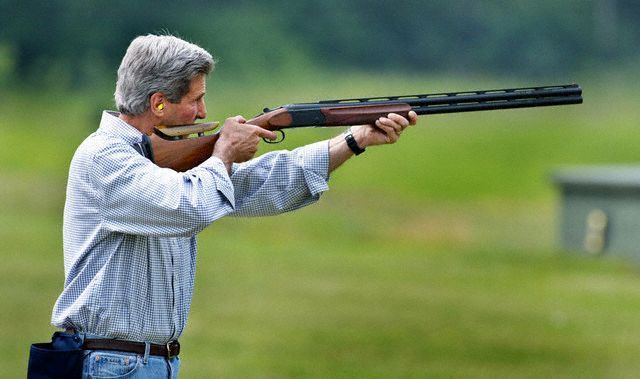
John Kerry goose hunting in Ohio. Kerry is an excellent and practiced marksman.

Election Day is TODAY November 2


You may have noticed that the politicians are working overtime to woo sportsmen and women of voting age. It's not hard to understand why:

  • There are more sportsmen than people who receive Social Security retirement benefits.


  • About 80% of all anglers and hunters vote.


  • Twice as many people hunt and fish as belong to labor unions.


  • If all sportsmen had voted in the 2000 presidential election, one-third of the people at the polls that year would have held a hunting or fishing license.


  • American sportsmen are among the most prominent and influential of all demographic and economic groups. Hunters are a very large and powerful economic interest group. For a mind-expanding look at the economics of hunting, see the PDF at this link >> Click Here


  • There are no vegans on Mount Rushmore -- but there is Teddy Roosevelt who hunted rats with his terriers in the basement of the White House.


  • Major on-the-rack magazine and TV shows are devoted to hunting.


  • Whoever ends up being President will be hunter and angler. Hunters and anglers also sit on the Supreme Court (and include female members of the Court!).


  • In Virginia, and in many other states, hunting, fishing and harvesting game is considered a right, and that right is written into the State Constitution.


  • The Congressional Sportsman's Foundation and Caucus is devoted to hunting and fishing, and land conservation for hunting and fishing. It is not just a large caucus -- it may be one of the most powerful caucus's on Capitol Hill. Check them out at http://www.sportsmenslink.org/caucus/index.asp


Friday, October 1, 2004

A Damn Good Shot


National Review

March 1, 2004, Monday


Hunting for Votes


Hunting and fishing may not be politically correct, but there are 47 million hunting and fishing enthusiasts in America. Add in some sympathetic family members, and suddenly the sportsmen's vote looks pretty significant.


Nearly all recent presidents have enjoyed either hunting or fishing, or both. President Bush went quail hunting with his father on New Year's Day, but his most often-publicized hunting trip came a few years ago, when he went dove hunting and mistakenly shot a killdeer--a protected species of shorebird that looks a lot like a dove. Bush reported himself to the local game warden and paid the fine with no qualms.


Late last year Bush showed his support for sportsmen at a one-hour meeting in the Theodore Roosevelt Room, where he sat down with representatives of twenty20 sportsmen's organizations. This is the first time in at least a decade that sportsmen's organizations have been invited to the White House.


At the meeting the president stated that the "spirit of the outdoors" was important to him and his administration. He felt that his was among the more outdoors-oriented administrations, which puts him in the company of Theodore Roosevelt and Dwight D. Eisenhower.


And he's backing up these words out in the field. Under the present administration, fifty U.S. Fish and Wildlife refuges have been opened to hunting or fishing, and last September the administration supported an initiative of the Congressional Sportsmen's Foundation to increase public access to federal lands. The president has also asked for $22.6 million more for Fish and Wildlife next year.


Yet while the president has the support of many sportsmen, he has also received criticism from a number of groups regarding the administration's plans for energy exploration and development in wild areas, including a plan to put new roads in roadless areas--especially the Tongass National Forest in Alaska.


More than 400 gun clubs across the nation object to the Forest Service's plans for development. A poll conducted by the Theodore Roosevelt Conservation Alliance found that 76 percent of Democrats, 66 percent of independents, and even 58 percent of Republicans support protecting these areas.


One might think that an overwhelming majority of hunters are Republicans, but that's not necessarily so. The three states with the largest numbers of hunters--Pennsylvania, Michigan, and Wisconsin--are where labor tends to support Democrats, and the south has a strong "conservative Democrat" constituency.


When he ran for president, Al Gore seemed to forget the popularity of hunting, fishing, and shooting, and many pundits have suggested that Gore's rejection of his roots (along with his anti-gun positions) figured very much into his loss of the election.


Democrats seem to have learned from Gore's mistake. But as John Lott and Grover Norquist have recently pointed out, the candidates also support some gun-control issues, such as assault-rifle bans and gun-show and concealed-carry restrictions. President Bush, however, also supports the assault-weapon ban.


Tom Daschle as well as nearly all the Democratic presidential candidates this year have come out as pro-Second Amendment. Daschle also supported S.659, the Protection of Lawful Commerce in Arms Act, which "prohibits any qualified civil liability action from being brought in any state or federal court, and ... requires the dismissal of pending actions." This earned him "thanks" from the NRA.


Before dropping out of the primaries, Gen. Wesley Clark claimed that he was a hunter, and Howard Dean talked about hunting and fishing as well as his support for sportsmen's issues in Vermont. Many of my neighbors in the liberal San Francisco area adore Ohio Rep. Dennis Kucinich, but even he has come out saying that while he's "sensitive to guns...[it's] possible to have gun laws that in no way interfere with hunters."


John Edwards has spoken of how he grew up in the rural South where hunting was common, and that he hunted as a boy and believes in Second Amendment rights (with limits). He's a member of the Congressional Sportsmen's Caucus, and says in his "Real Solutions for America" that he wants a moratorium on offshore oil drilling, supports National Parks, opposes "improper logging" in the Tongass National Forest, and would permanently ban development on the Arctic National Wildlife Refuge.


Edwards also answered a Humane Society of the U.S. questionnaire about his views on animals, saying that he supported a bill to prohibit the transporting or possession of exotic animals for canned hunts, a position most sportsmen would support.


John Kerry caught the attention of hunters when he invited the press to go along on a pheasant hunt in Iowa last November. On that hunt he killed two roosters with two shots. Personally, I think that hunt was a critical factor in his winning in Iowa, which began his long run of victories. By inviting the press along to photograph him as he bagged two birds with two shots, he proved that he was both a hunter and a damn good shot--and also that he's not afraid of any animal-rights backlash.


Some hunters also felt an instant kinship with Kerry. As Ryan McKinney, the Iowa farmer on whose property Kerry hunted, said, "It feels a little safer if your presidential hopeful isn't going to go after your typical normal shotgun."


Bush, Kerry, and Edwards all seem to recognize the power of the sportsmen's vote. As well they should: It's a diverse group that could help decide this fall's election.

_____________________


--James Swan is a contributing editor of ESPNOutdoors.com. He also writes for the Outdoor Channel's Engel's Outdoor Experience.


Tuesday, September 7, 2004

Economics & Politics of Hunting


With bird in hand.


"As a life-long hunter and fisherman, I am proud to be among the millions of American sportsmen and sportswomen who are dedicated to conserving fish and wildlife and passing along the American hunting and fishing heritage to the next generation." - Sen. John Kerry


There are no vegans on Mount Rushmore -- but there is Teddy Roosevelt who hunted rats with his terriers in the basement of the White House.


Major on-the-rack magazines and TV shows in the U.S. are devoted to hunting, and several members of the Supreme Court are either hunters or anglers (or both).


Both John Kerry and George W. Bush hunt, while the Congressional Sportsman's Caucus and Foundation are among the most powerful bipartisan groups on Capitol Hill.


Here in Virginia the public decided that hunting, fishing and harvesting game should be considered a right, and that right is now in the State Constitution -- similar language is being embraced in other states. Meanwhile, in West Virginia, the ACLU is suing so people can hunt on Sunday.


The most important part of the politics of hunting, however, is grounded in the economics of hunting.


Click here to read a well-written study on the economics of hunting packed with solid numbers you can use in debates, letters to the editor, and when teaching others about the economic value of hook-and-bullet conservation.


The simple truth is that hunting and wildlife viewing are worth more to the American economy than many major industries. In fact, economists now recognize that there is no amount of timber that can be extracted from our National Forests that comes close to equaling the value of those forests as recreational centers.


Yet, the U.S. Forest Service continues to LOSE over $1 billion a year selling our timber and our wildlife heritage to for-profit timber companies, even as we taxpayers foot the bill for ripping new roads into wilderness areas.


Why does this travesty continue? Simple: Payola politics. The current head of the U.S. Forest Service is a timber and paper company lobbyist who is setting policy because because a handful of big timber companies slipped over $4 million into the campaign coffers of George W. Bush during the year 2000 election cycle. As a direct result of this kind of "Crony Capitalism," a paper company lobbyist is now in charge of our National Forest system.


Republicans interested in moving beyond crony capitalism to embrace the land ethic of Teddy Roosevelt (who created the U.S. Forest Service, the National Wildlife Refuge Systsem, and the National Parks system) and the positive environmental record of Richard Nixon (who created the Environmental Protection Agency and signed into law the Endangered Species Act, the Clean Water Act, and the National Environmental Policy Act) are encouraged to see the web site of Republicans for Environmental Protection.