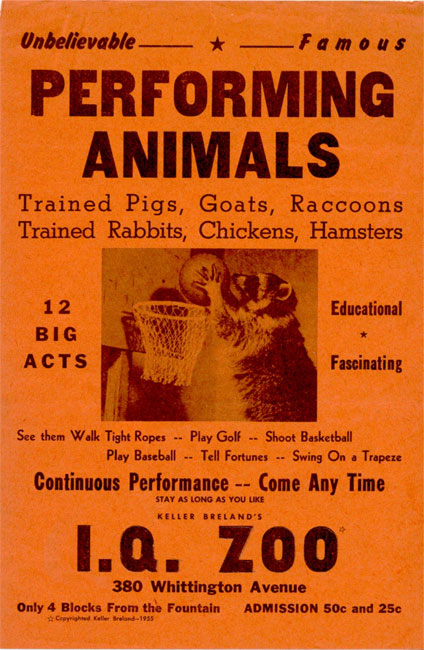
In an earlier post I dared to ask "Who invented animal training?" and went on to detail the work of Keller and Marian Breland who not only discovered "shaping" and bridging stimulus, but also invented clicker training.
Keller and Marian Breland trained animal acts featured in movies, circuses, museums, fairs, zoos and amusement parks across the nation, and also trained many of the trainers that worked in these facilities as well.
By 1951, the Brelands had trained thousands of animals from dozens of species, and in an article for American Psychologist, they said they thought rewards-based clicker training might work on any animal to train just about anything.
And then something happened.
They noticed that clicker training was, in certain circumstances, beginning to fail in ways that they could no longer overlook.
In a 1961 paper entitled, The Misbehavior of Organisms, Keller and Marian Breland described their first experience with the failure of reward-based operant conditioning.
It seems that when working with pigs, chickens and raccoons, the animals would often learn a trick, but then begin to drift away from the learned behavior and towards more instinctive, unreinforced, foraging actions.
What was going on?
Put simply, instinct was raising its inconvenient head.
Though Skinner and his disciples had always maintained that performance was driven by external rewards or punishments, here was clear evidence that there was an internal code that could not always be ignored.
The Brelands wrote:
These egregious failures came as a rather considerable shock to us, for there was nothing in our background in behaviorism to prepare us for such gross inabilities to predict and control the behavior of animals with which we had been working for years.... [T]he diagnosis of theory failure does not depend on subtle statistical interpretations or on semantic legerdemain - the animal simply does not do what he has been conditioned to do.
The Brelands did not overstate the problem, nor did they quantify it. They simply stated a fact: instinct existed, and sometimes it bubbled up and over-rode trained behaviors.
Clearly, every species had different instincts, and just as clearly, a great deal of animal training could be done without ever triggering overpowering instinct. Still, the Brelands noted,
After 14 years of continuous conditioning and observation of thousands of animals, it is our reluctant conclusion that the behavior of any species cannot be adequately understood, predicted, or controlled without knowledge of its instinctive patterns, evolutionary history, and ecological niche.
What does this have to do with dogs?
Quite a lot.
You see a small but vocal group of clicker trainers believe everything a dog does is learned by external rewards, and internal drives are nothing but "old school" fiction.
While the Brelands argued that a species could not be adequately controlled without “knowledge of its instinctive patterns, evolutionary history, and ecological niche," the most extreme militants in the world of clicker training now seek to minimize and disavow the very nature and history of dogs.
Of course, instinctive behaviors and drives do not disappear simply because they are inconvenient.
As Keller and Marian Breland put it,
[A]lthough it was easy to banish the Instinctivists from the science during the Behavioristic Revolution, it was not possible to banish instinct so easily.
Of course, one must be careful to qualify the role of instinct.
Yes, dogs have instincts, but the history of dog breeding has largely been about reducing instinctive drives. As a consequence, most breeds have instinctive drives that are sufficiently attenuated that they are not much of an impediment to basic rewards-based training.
That said, not all dog breeds are alike. Not every dog is a blank slate, as the owner of any herding dog or game-bred terrier will tell you. Prey drive does not disappear because you want it to. Many problematic behaviors in dogs -- especially behaviors in hard-wired working dogs that are being raised as pets -- are self-reinforcing behaviors that express themselves without any external reinforcement at all.
Clicker training, the Brelands remind us, cannot solve everything.
Is rewards-based training the most important tool in any trainer’s box of tricks and methods?
Absolutely. There is not much debate there.
But the Brelands remind us that dogs do not come to the trainer as a tabula rasa, nor should we think of all dog breeds as being more or less the same, or that all responses are equally conditionable to all stimuli.
Dogs and other animals, it turns out, are a bit more complicated that white rats, and the real world is not a laboratory.
In the wild and on the farm, animals have managed to learn, all by themselves, since the Dawn of Time and long before clickers came on the scene.
How did they do that? Does the real world have as much to teach us as the lab? Keller and Marian Breland thought it did.
Marian Breland and Keller Breland, March 15, 1955.Source
Who invented animal training?
The question is silly on its face. Animal training is older than the hills. For certain, it is as old as the dog.
That said, most of what we call animal training today is what the fancy talkers call "operant conditioning," a term first coined by psychologist B.F. Skinner in the early 1930s in an effort to dress up an even older concept -- learning from consequences.
B.F. Skinner did not invent operant conditioning any more than Newton invented gravity.
That said, Skinner DID codify the basic principals of operant conditioning, and he did invent mechanical-based operant conditioning, i.e. the "Skinner box" a mechanical device that awarded animals with food for pulling levers, pecking at spots, and doing other slightly more complicated learned behaviors.
Perhaps just as importantly, B.F. Skinner brought into the world of operant conditioning several people who helped shape the way we train animals today.
In fact, I do not think it is too much to say that two of his students -- Marian Ruth Kruse and Keller Breland -- invented modern animal training.
The story begins in the very early 1930s when B. F. Skinner was a researcher at Harvard working on something he called an "operant conditioning chamber" -- a device which measured the response of animals to stimulus. This later became the first "Skinner box" or animal teaching machine.
In 1936, Skinner left Harvard to teach at the University of Minnesota, where he began expanding on his earlier work.
In 1938, he took on his second student assistant, a young 18-year old girl by the name of Marian Ruth Kruse.
In 1940, Skinner added Keller Breland to his team of graduate student assistants.
Keller Breland and Marian Rught Kruse fell in love, and in 1941 they were married.
Marian and Keller Breland learned the basics of operant conditioning from B.F. Skinner, and helped him to train thousands of rats and pigeons used in various experiments and projects.
Once particularly important project began in 1941, when Skinner and his assistants were hired by the U.S. Navy to see if pigeons could be trained to guide bombs to their targets.
While pigeon-guided bombs never made it to the battle field, the operant conditioning techniques learned during this period of stable Navy funding suggested to Mariann and Keller Breland a possible business opportunity.
Was there a market for trained animals? They thought there might be.
When, in 1945, B.F. Skinner was lured away from Minnesota to teach at the University of Indiana, they Brelands decided to see if they could make a go of it on their own as commercial animal trainers and contract researchers and consultants.
It seemed an unlikely way to make a fortune.
Skinner had mostly trained rats and pigeons. If the Brelands were to support themselves as animal trainers, however, they would have to train higher animals than that!
Yes, the basic elements of operant conditioning had been used, off and on, and in a largely chaotic way, to train many species around the world over a thousand years. But most of this real-world experience was now lost to time and was little more than rumor or anecdote.
Could the basics of rat and pigeon training be scaled up and used across a wide variety of species? And if it could, would there be a market for such a thing? Would it be a large enough market to put food on the table, and gas in the car?
No one knew, least of all the Brelands. They took the plunge, nonetheless, buying a small farm in Mound, Minnesota and forming a company they called Animal Behavior Enterprises (ABE).
ABE's goals were three-fold and reflected their slightly tenuous business plan: to produce trained animals in profusion for an unknown commercial market, to engage in contract research if they could find anyone willing to underwrite that, and to consult on operant conditioning if they could find anyone willing to pay for their advice.
To say bravery was involved in this economic venture is an understatement. To those on the outside, including family and friends, it seemed sheer madness.
The Brelands had a secret, however: they were pretty good animal trainers, and they also had a growing body of evidence that suggested operant conditioning was a very robust training methodology.
In 1943, the Brelands, working with B.F. Skinner, had discovered the power of shaping behaviors by using a simple hand-held food-delivery switch. Now, instead of being rewarded for actually completeting the task, an animal could be rewarding for "approximating" the task -- a behavior that could be "shaped," by degrees, to the actual desired behavior.
A simple hand-held food delivery switch was, in effect, the first massive leap forward beyond the Skinner Box.
By 1945, the Brelands had gone even further. The mechanical construction of Skinner boxes had led the Brelands to a new idea; that small noises, such as those produced by the mechanical apparatus inside a Skinner box, or the noise made by a hand-held switch, might be an important part of the training process itself.
Experimenting with this idea, Keller and Marian Breland discovered that an acoustic secondary enforcer, such as a click or whistle, could communicate to an animal what precise action was being done that was actually resulting in a food reward.
Keller and Marian called this a "bridging stimulus," and found it dramatically sped up animal training by increasing the amount of information going to an animal. Most importantly of all, it seemed to work well with all animals. Important stuff!
In 1946, Animal Behavior Enterprise's got its first animal training contract with General Mills. The assignment was to train farm animals to appear in feed advertisements.
This first successful contract led to more contracts, first for in-store promotional animals, and then for animals to be used in movies, circuses, museums, and zoos.
In addition to providing trained animals, the Brelands were also asked to train workers and producers in how to work with those animals when they were sent on location.
From the beginning, "training the trainers" became an adjunct business to providing the trained animals themselves.
While the Brelands had worked almost exclusively with rats, pigeons and chickens when employed by Skinner, they now found themselves training everything: dogs, cats, pigs, cattle, chickens, goats, sheep, raccoons, rabbits, ducks, parrots, ravens, deer, and monkeys.
At one point, the Brelands had more than 1,000 animals under training at a single time. Over the course of a lifetime, scores of thousands of animals, representing more than 140 species, were trained by the Brelands.
Of course, it did not take too long for the Brelands to outgrow their small Minnesota farm, and it took even less time for them to realize that long, cold Minnesota winters were not too conducive to animal training outside of a laboratory setting.
In 1951 the Brelands moved to Hot Springs, Arkansas, a central location well-served by the railroads, where land was cheap and the weather was not too bad.
There they continued to train animals and animal trainers, and they also started a cash-concern they called the "IQ Zoo" which featured various animals doing amusing tricks, from basketball-playing raccoons and drum-playing ducks, to a printing press operated by reindeer and a chicken that would take on all comers in games of tick-tack-toe.
Though Keller and Marian Breland were equals at ABE, their division of labor suited their personalities and the flavor of the times.
Keller was the public face who traveled and did most of the show presentations and who promoted and expanded on the theory, while Marian was the engineer who made sure everything ran like a clock and actually operationalized everything at the level of fur, fin and feather.
Throughout the 1950s and 60's business was booming, with the Brelands signing contracts with Marineland of Florida, Parrot Jungle, and Six Flags.
In 1955, the Brelands produced the first trained dolphin show at Marine Studios in St. Augustine, Florida, and in 1957 they produced the first trained-whale shows at Marine Studios in Florida, and Marineland of the Pacific in Palos Verdes, California.
The work of the Brelands did not go unnoticed. Not only did the Brelands train other animal trainers who went on to places like Busch Gardens and Disney World, and Sea World, but they were also contracted with by the U.S. Navy to see if dolphins could be trained to do surveillance and salvage work.
It was during this time, that Keller and Marian Breland met Bob Bailey, who was the first Director of Training for the U. S. Navy Marine Mammal Program.
In 1965, Keller Breland died of a heart attack, leaving Marian with three semi-grown children, and Bob Bailey stepped up as as General Manager of ABE.
Marian and Bob continued on with ABE, signing a contract with the U.S. Navy to manage their Marine Mammal Facility in Key West, Florida from 1967 to 1969.
Along the way love blossomed between Bob Bailey and Marian Breland, and they married in 1976, adding Bob's six young children (three sets of twins!) to the now rapidly growing family.
In the 1980s, the Baileys began to phase out the commercial subdivisions of Animal Behavior Enterprises in order to simplify their life and devote more time to teaching. After a 1989 fire destroyed a lifetime of research, including thousands of hours of historical film, the Baileys decided to close ABE for good.
Marian Breland Bailey died on September 25, 2001, in Hot Springs Arkansas, and her ashes were taken to Bush Key, seventy miles west of Key West, Florida, where she had spent so much time training dolphins.
Bob Bailey continues to train teachers in the basics of operant conditioning, and his own contribution to animal and human training will be featured in a later post.
Suffice it to say that if you have heard of clicker training, it's due in no small part to Bob Bailey, whether you know that or not!
And if you have ever trained an animal in the last 40 years, you have stood on the shoulders of Marian and Keller Breland and Bob Bailey, whether you know that or not.
When the history of animal training is written let it be said that these three remarkable individuals invented or perfected so much of what we take for granted today.
The Druids were one of the most frequently photographed wolf packs in the Lamar Valley of the Yellowstone.
What happened to the Druids?
Life.
Life has a way of stepping in pretty frequently in the world of wolves, and in that tale lies a couple of lessons about dogs -- lessons about inbreeding and (yes) about dominance.
First, who were the wolves of the Druid Pack?
Like all wolf packs, the Druid pack was made up of a single dominant male, a single dominate female, and several satellite females, generally from previous whelps.
This architecture is not unique to wolves. Study red fox and African lions, and you will see the same thing -- a solitary mature male with one or more females, and only very young or adolescent males in attendance.
What happens to all the male wolves, fox, and lions that are born?
Simple: they are driven out.
In the case of a fox this usually occurs at around seven to nine months of age, and with a wolf anywhere from nine to 18 months of age, depending on the amount of food in the the area and the tolerance of the alpha male and the submissiveness of his get.
By then, the young males of these respective species are big enough to hunt on their own and yet they are also beginning to become potential rivals for females. The top male cannot have that.
Is the request to leave a good-natured "get along now?"
No.
Plain and simple, it is anything from harassing growlsand small bites to a full-scale ass-whipping by the big male.
However, it goes, in the end there will only be one mature male in the pack. Either the younger male will be driven off, or the old male will be dead or driven off himself.
You have heard of a "lone wolf"?
A lone wolf is almost always a young male driven out of his pack and traveling some distance to establish his own territory, and perhaps pick up a loose female or two along the way.
The same thing happens with fox and African lions, of course.
American Mountain Lions do not establish packs or prides like their African counterparts, but here too we find young males driven out to find their own territories in a distant country. When a mountain lion shows up in Minnesota, Wisconsin, Illinois, or Iowa, it is almost certain to be a young male driven out his natal home range to find a place for himself.
Now to be clear, what is going on here is dominance.
Anyone who says wolf packs are not governed by dominance has no idea what they are talking about.
Dominance creates wolf packs and dominance maintains wolf packs. The driving out of adolescent males is at the core of how wolf packs are created and maintained. This is dominance. And it is Wolf Pack 101.
What about females?
The female wolves in a wolf pack also have their dominance issues. You see with wolves, there may be many mature females in the pack, but there will almost always be only one female who will come into estrus, be mated, and whelp.
How is that "top female" determined?
Well, the male picks her, of course (or vice versa if the pack has lost its alpha male)
That said the individual picked is generally the healthiest and strongest female in the group - the one that all the other females are submissive to.
This is what Darwin was talking about when he refered to "survival of the fittest." The weakest genes are not just culled out of the gene pool due to disease, defect and predation. They are also selected out.
Why does Mother Nature drive all the young males out of the pack?
The answer is that Mother Nature demands a regular reshuffling of the genetic deck. The way that is done is by driving out the males to discourage inbreeding with sisters.
The sisters, of course, stick around to help bring down larger game and feed the alpha female's young. But the young males? They have to hit the road.
A strong and lucky male may hold a top slot for as long as a decade, but more often that not the top male will die from injuries or disease long before that. And with that male's death, a new male, from outside the pack, will be recruited and a complete outcross achieved.
Injuries? How do wolves get injured?
Wolves get injured all the time. A lone male wolf from another pack may show up and stand at the edge of a territory and try to "call off" a female or two in order to start his own pack. That may, in turn, be met with a challenge by the dominant male who wants to hold on to what he has. Injuries can occur!
The pick up artist.
More often injury and death will come from a jaw-shattering kickfrom an elk or deer, a trap, vehicle impact, a hunter or rancher's bullet, intentional or unintentional poisoning, a ripped ligament, an infected wound, or disease.
The hunt.
Disease is no small issue. Distemper routinely knocks down wild canid populations, and so too does rabies and mange. Add in worms and infections, and the bottom line is simple: Most male wolves do not live too far past age 7.
But, of course, the vagaries and savageries of life in the wild can befall the top female wolf in the pack, as well as the top male wolf. The hand of God shuffles red cards, same as black.
And so, in the real world, we tend to have a turnover every few years as either the alpha male or the alpha female rotates out of their respective top slots.
And with every turnover at the top, new dominance and submission issues are front and center.
No, there is not a constant battle in a wolf pack, but Mother Nature does abhor a power vacuum, and yes individuals do rush in to fill a power vacuum.
And yes, life-ending battles do occur in every Yellowstone pack every year.
In the video clip, at the very top of this post, cinematographer and wolf expert Bob Landis talks about conflicts he has seen between and within wolf packs, and he talks about Wolf 21, the Alpha male in the Druid pack.
How did 21 become the Alpha male?
It seems that in late December of 1998, the top male wolf in the Druid Pack was Wolf 38. The pack left the boundaries of Yellowstone Park to follow the elk, however, and just outside the park's boundaries, Wolf 38 was killed by a poacher.
With their alpha male dead the Druid Pack re-entered Yellowstone National Park where Wolf 21, a single "lone wolf" refugee expelled from the Rose Creek Pack, happened to be waiting.
If the old alpha male, Wolf 38, had still been alive, Wolf 21 would have been drive out or killed (as three other displaced Rose Creek Wolves had met their fate before 21's arrival). But with Wolf 38 now dead, Wolf 21 now had an unexpected opportunity to impress.
The Alpha Female of the pack, Wolf 40, realized she needed a mate, but 21 still had to spend 6 hours, bowing, flexing, strutting, sniffing, and facing down all the females in the Druid Pack before he was deemed to be big enough, strong enough, friendly enough, and smart enough to be the leader. Yes, this 21 wolf had skills! And in the end, the older, but still fertile, Wolf 40, was won over and gave 21 his slot in the pack as her new mate, the alpha male. with the task of fighting off all interlopers, as Wolf 38 had done before him.
I tell this story, because it's important to realize Landis does not just make stuff up. He films it all, and he gets lucky" because he spends 300 days a year in the field in heat and snow, bugs and rain, watching the wolves.
Only two months ago, there were 11 wolves in the pack. But after the alpha female was killed by another pack, the old alpha male wandered off rather than breed with one of the other female wolves that were his offspring. He also suffered from a bad case of mange. Mange is a skin infection caused by a mite, which leads to hair loss. In animals with weakened immune systems, it can be fatal. Seven other females in the pack also had mange, and all but one have died either from mange or been killed by other packs.
"They're down to one and that one probably won't make it through the winter," Smith said.
Killed by other packs? But I thought wolves were gentle!
You think a wolf killing a wolf might have something to do with dominance?
"This space is my space," "this food is my food," "this female is my female"?
Nah! No doubt they died in a religious war!
The Casper Wyoming Star Tribune article goes on to note that at one point the Druid pack had 37 members, making it the largest known wild wolf pack in the world.
In 2000, however, "an alliance of three subordinate females in the Druid pack is believed to have killed the pack's alpha female, the first such intra-pack kill documented in the park."
WHAT? Three other wolves ganged up to kill their mother or sister? And she was the alpha? Whoa! That's right out of Shakespeare! No aggression or dominance issues there! And she is the second alpha female to bite the dust in this one article?! Whoa! There are clearly no aggression, dominance, or pack pecking orders in a wolf pack! All sweetness and familial light.
Bob Landis and the Yellowstone wolf team, of course, have spent more time, watching wolves in the wild than anyone in the world, living or dead. And yes they have it all on video tape.
But you won't hear his name mentioned by the pure click and treat crowd who want to negate all hierarchies, all dominance, and all submission in wolf packs.
You see if the facts do not fit the frame, you throw out the facts!
And so they quote people like Tamar Geller, who says wolves and dogs are just like each other and she knows because she watched a few wolves for a month at a feeding station in the deserts of Israel.
Ms. Geller says wolves do not have pack hierarchies, have no aggression, and dominance is never an issue. With wolves, it's just play, play, play.
Or else they quote Ian Dunbar who, to the best of my knowledge has never had anything to do with wolves.
Or else they make extraordinary claims, such as that "there are no such things as packs of wild dogs."
Really? No packs of wild dogs?? How about the fellow that was killed and eaten by a pack of wild dogs right here in the U.S. just a few months back? That did not happen? No rural farmer has ever seen a pack of feral dogs hunting deer in the woods? Really? Who knew!?
To be clear, this paper is NOT the ground-breaking study, some have made it out to be.
In fact, is it a very weak and not too well written paper that simply says wolf packs are an extended family unit. No news there!
And what does Mr. Mech say about dominance?
Well actually, he says there is quite a LOT of it! For example, he writes:
We noted each time a wolf submitted posturally to another wolf. Usually this deference was characterized by "licking up" to the mouth of the dominant animal in the "active submission" posture similar to that described by Darwin (1877) for domestic dogs. Often this behavior took place as an animal returned to the den area after foraging, and sometimes the returning individual disgorged food to the soliciting wolf (Mech 1988; Mech et al. 1999). Other behavior noted included "pinning," or passive submission (Schenkel 1967), in which the dominant wolf threatened another, which then groveled, and "standing over," in which one wolf stands over another, which often lies nonchalantly but in a few cases sniffs the genitals of the other. I did not consider "standing over" a dominance behavior.
Eh? Mech does not consider one dog standing over another an act of dominance?
Oooooo-kaaaaaay. Let's not count those then.
But if it's not dominance, pray tell what is it?
Well actually, he does not say.
Like I said, the paper is not too well written !
Consider this paragraph:
The only consistent demonstration of rank in natural packs is the animals' postures during social interaction. Dominant wolves assume the classic canid standing posture with tail up at least horizontally, and subordinate or submissive individuals lower themselves and "cringe" (Darwin 1877). In fact, submission itself may be as important as dominance in terms of promoting friendly relations or reducing social distance.
WHAT??? Now one wolf standing over another IS dominance?
But just a few paragraphs earlier, Mech said it was not.
Pick a point of view and stick with it why don't cha?
Of course, that's the problem a lot of folks have in these wolf and dog debates.
One person says dogs are not wolves and then five minutes later they say they are great admirers of Tamara Geller who thinks dogs ARE wolves and that wolves are all about play, play, play.
Eh? Pick one.
Of course the same people claim Cesar Millan says dogs are wolves, but when challenged to cite a page, paragraph or episode where that claim is made, there is (so far) a failure to deliver.
We are similarly told that Cesar Millan says everything about dogs is related to dominance.
He does? I missed that! Citation please!
In fact, what Millan actually says is that everything is about loving your dog, exercising your dog, and not treating your dog like it's your child.
And he says, at the top of every show, what he actually does.
He does not train dogs.
He rehabilitates dogs. He trains people.
What he is saying here is pretty clear: Cesar Millan is NOT the person you go to if your goal is to get your dog to learn a decent "sit-stay" or agility routine.
Ian Dunbar or any of the college girls down at PetSmart can help you with that, and they prove it every week.
But if you have a dog that is phobic, or is routinely ripping into another dog (or your child or wife) then the girls at PetSmart might not be the right wrench for that nut.
Cesar Millan is, and he proves it every week.
The funny part of all this is that I have written many times that dogs are not wolves. Dogs are dogs.
So far as I can tell, Cesar Millan has never said dogs are wolves. Please give me a citation if you find him saying otherwise.
And, to put a point on it, I have never said a bad word about clicker training. Quite the opposite. It works well for training puppies, young dogs, and dogs with no serious issues.
So far as I can tell, Cesar Millan has never said a bad thing about clicker training either. Again, please give me a citation if you can find him saying otherwise.
So who is raising up all the wolf stuff?
Well, actually, it's the people who are opposed to any kind of aversives (no matter how mild) in any kind of situation.
They are not arguing that clicker training works (there is no opposing argument on the matter); they are arguing it is the ONLY solution to EVERY dog problem, and that NO other system works.
Yes, that's right, a clicker is a "one size fit all" wrench for every problem under the sun.
But instead of proving that by actually going on TV to "cure" a psychotic pit bull that lives to kill cats, they have decided to go off into the weeds to talk about wolves.
Wolves? I thought we were talking about training dogs?
But no, they want to talk about wolves.
Which would be fine, I suppose, but what they have to tell us about wolves is, in fact, contradicted by the very studies they cite!
But of course, if the facts do not fit the frame, then throw out the frame, right?
And what about the video tape?
Yeah, throw that out too. Especially the clip below, and the next one and the next one. Who cares if this is a story about dominance as riveting as anything penned By Shakespeare? This does not fit the frame, so out it must go.
The omega female is driven out by the alpha female.
Clicker training works great, but there is a small problem -- the clicker itself!
You see, if you have a clicker in one hand, it's more difficult to cue a dog with hand signals. And hand signals work.
In fact, hand signals work better than voice signals to initiate a behavior, as dogs are more wired for sight than sound.
Tie a spoken word or two with one or two hand signals, use a click as a well-timed marker for the exact behavior you are looking for, and reward with food, praise or play, and you can train a dog very fast.
So how do you get a strong clickwithout a clicker? Simple -- use your mouth.
I click in a manner that is not so very different from that used by the Bushmen (San or Khoisan) people of South Africa for one of their basic clicks. I press my tongue against the roof of my mouth until it makes a little vacuum, and when I pull it away (pushing forward sightly), it makes a loud popping sound almost identical to that of a store-bought clicker.
And here's the best part: I can never lose it!
Below is a video of the great Miriam Makeba doing the "Click Song" in 1966. The language here is Xhosa -- the second or third most common language in South Africa, and one which has embraced three types of Khoisan clicks as an integral part of its structure.
Here's another Cesar Millan episode to complement yesterday's offering.
The dog in question here is a Korean Jindo, which is a spitz-type hunting and guard dog.
You will note that the owner and rescuer is a pretty experienced person who seems to have had a lot of success settling, calming, training and rehoming damaged dogs.
Jonbee is the first dog he cannot tame. In trying to help Jonbee, he has already seen two other professional trainers, one of whom recommended putting the dog down, and the other who got himself chewed up.
Jonbee's would-be rescuer is clear:If Cesar Millan cannot fix this dog, he is going to have to be put down.
As you can see in the video, when Jonbee is touched towards the back, he explodes in a savage rage.
Millan remains calm as the dog tries to bite him. He always keeps the leash up, but he is not participating in the craziness at the other end of the leash.
If Jonbee wants to go nuts, that is his choice.
Jonbee explodes again and again trying to bite Millan, before finally relaxing and rolling over on his side, physically and emotionally spent.
What happened?
To reiterate a point made yesterday: No animal can sustain a temper tantrum or a fight forever.
A dog that explodes like this is a bit like a massive thunder storm -- it will blow itself out if it continues unabated. In fact, that is exactly what has happened here.
Why is Cesar Millan doing what he is doing, and why does it work?
The simple answer is that he is de-sensitizing the dog to touch, while at the same time removing the reward that the dog has gotten in the past from attacking anyone who touched it.
Strip it away, and what you have are two fundamental tools that can be used to rehabilitate a problem dog:
Habituation and;
Extinction.
Habituation is a type of non-associative learning. Simply put, it means the dog gets used to something to the point it no longer produces any kind of reaction at all.
Face the phobia. Stand in the river of life for so long that you no longer feel wet.
We have all become habituated to something irritating at one time or another.
If you move next door to an airport, for example, the airplane noise will drive you crazy for a few days, but after two weeks you will have stopped hearing it at all. Only when you are on the telephone will you be reminded that the airplanes are still there.
What Millan is doing with Jonbee is giving the dog the stimulus that sets it off (simply touching him) but he makes sure his response it as flat as possible so that the dog will eventually become nonreactive to it.
Constant stimulus that does not harm or reward is eventually treated by the body as "white noise."
Factory workers do not hear the factory, and oil refinery workers do not smell the chemicals.
If Jonbee gets neither reward nor punishment from being touched, and is touched often enough, he will eventually not pay the slightest mind.
Extinction is also going on in this film clip. While Jonbee is getting habituated to being touched, his violent outburst is also finding no reward.
Again, what is key here is that Millan is as flat, calm, and passive as a man can be while being attacked by a 40-pound dog hell-bent on ripping his throat out.
What happens in the end?
Three things: 1) Jonbee is exhausted and can no longer sustain the attack; 2) Jonbee is starting to get habituated to being touched (i.e. he is beginning to learn that touching is not a big deal or a threat), and; 3) Jonbee is starting to realize that the behavior that got him a reward in the past (i.e. no one touching him) no longer works now.
Watch the clip, above (part 2 of the same episode).
Notice that Jonbee, like Shadow (the dog shown in yesterday's post) is lying calm and exhausted on his side. He is breathing fine, his tongue is pink, and the leash is loose.
This is what a dog or small child looks like after it has blown off all its emotional and physical energy in a screaming and violent temper tantrum.
What Cesar Millan calls "negative energy" I simply call tension, anxiety and hyperactivity.
Whatever you call it, Millan wants people to get rid of it, and to be emotionally neutral and dispassionate.
By the the end, Cesar and the dog's owner can actually play bongos on Jonbee's side and back, and he loves it. Perfect!
Jonbee has, very quickly, become habituated to touch, and just as quickly he has allowed his violent outbursts to self-extinguish.
Why has Jonbee reformed so quickly?
Simple: He was not happy with his own response to the situation, but he was trapped in a cycle and did not know how to get out of it.
Terrified of being touched (especially within the confines of the house), he reacted out of fear, which made humans scared to touch him, which increased the tension, which further escalated the situation, and made the dog even more reactive and phobic.
Millan simply showed Jonbee a new way, and he did it by pairing habituation of touch with extinction of biting which no longer resulted in any kind of reward or reaction (thanks to excellent leash work on the part of Millan).
Getting Jonbee back together was a process, not an event. A relatively quick process, but not an instant miracle.
For example, watch the second clip and notice how Jonbee has his tail tucked in hard at 3:30. He is not yet comfortable, and he is still scared of this new way of doing business. He is trying to work through her fears, but .....
Looks at the owner too. He is also not yet comfortable.
Both of these actors are still remembering their old parts, even if Cesar has them both dressing up and reading for different roles.
And what happens in the end?
Trust.
Trust and then love.
Of all the dogs in all the world, Jonbee has found a home right here!
My favorite line towards the end is a simple declarative sentence by the owner:
"Dog's aren't throw away."
YES!
But how many dogs like Jonbeehave been thrown away? Millions.
Most dogs will do well under ANY training system that supplies exercise, consistent well-timed signals, and love.
But some dogs, like Jonbee, need more than that; they need someone who understands habituation, extinction, and pack dynamics. They need someone who has more tools and techniques up their sleeve than a mail order clicker and a cheese ball.
Yes, those are core tools in ANY dog training kit, but they are not the full kit.
And that is why you call Cesar Millan; because he knows a few things that the people down at PETCO do not. He know how to rehabilitate difficult dogs. And he is not too timid to do it.
Millan does not cluck and wring his hands. He is not confused. He does not think a dog thrashing at the end of a leash is a dog being choked. No aggression is shown to this dog; there is only the dog boxing with the wind, unable to connect, making the choices that, in the end, leave it exhausted and ready to try something else.
Millan uses habituation and extinction all the time to deal with fearful and phobic dogs, but it always seems to confuses the click-and-treat crowd who are a bit unclear as to how habituation, extinction and physical exhaustion can work together. What? You mean there might be something more than click and treat?
Yes. There might be.... Those are good tools. Those are core tools. But they are not the tools for this job. .
Dog training is not complex, and it does not require psychic abilities.
Of course some people think that must be the case! After all, if they have trained a dog to jump over a low fence, they must have a "gift" and a "special talent" for dog training, right?
Wouldn't that make them "special"?
One of these types wrote in yesterday to claim clicker training required "empathy, sensitivity, patience, excellent observational and mechanical skills, self-awareness, planning, appropriate utilization of canine ethology/canine body language and signals, and a knowledge of nutritional factors".
To which I can only say ..... Ri-i-i-i-ggght!
Clearly this poor soul does not know much about operant conditioning.
If she did, she would know that the best operant conditioners in the world have NO empathy, NO sensitivity, do NO planning, have NO knowledge of canine ethology or body language skills, and do not give a damn about nutritional factors.
And you know why these excellent animal trainers are so cold-hearted?
Because some of the bestoperant conditioners in the world are machines!
Machines are great at operant conditioning because they have infinite patience and perfect timing.
And here's a thought: they have infinite patience and perfect timing regardless of whether it is rewards-based training or aversion-based training.
This is Skinner 101.
The Skinner reference, of course, is to B.F. Skinner, the father of modern operant conditioning.
Watch the videos below, and you will Skinner's training machines in action.
And what is one of the best training machines for humans? Skinner points to the slot machine!
Of course, we have progressed beyond Skinner boxes and slot machines. Now we have online tests and even online universities. Click and treat!
I suppose, I should note that there is nothing wrong with empathy provided it is moderated somewhat.
You see, a good dog trainer is not overly emotional, while a bad dog trainer is one that is wearing a little too much on his or her sleeve.
The dog does not need the trainer's "concerns." The dog does not need the trainer's sympathy. The dog simply needs a clear, well-timed consequence or signal. And guess what? Well-designed machines are pretty good at delivering those, while "deeply concerned" arm-flapping humans who assume dog training is all about them, often are not! .
In the world of dog training, there are two camps that seem to be at war -- pure click-and-treat dog trainers and everyone else.
This last faction is sometimes reduced to "Cesar Millan" by clicker trainers who are new to dog training, but it in fact includes Barbara Woodhouse, William Koehler, and 2,000 years of successful dog trainers on six continents, including the two people who are most responsible for the creation of clicker training, B.F. Skinner and Bob Bailey.
Now here's the funny thing -- Cesar Millan and click-and-treat trainers are doing the same thing!
What? How can that be?
Millan never seems to use a clicker, while the clicker trainers never seem to talk about being "calm and assertive."
Right.
But have you noticed what a clicker actually DOES to a new trainer?
It makes them "calm and assertive!"
Let's start with Cesar Millan.
When Millan talks about being "calm and assertive," what he is really talking about is making fewer signals and making clearer ones.
The average dog owner that goes to Millan is the typical "American nervous wreck" who is perpetually trying to do five things at once -- pet the dog, change channels on the TV, instruct the kids in the next room, and eat a slice of pizza, all while "teaching" one dog not to squabble with the other.
For the dog, it's a bit like listening to five different radios on five different stations all at once. What the hell is going on?!
When Millan tells a dog owner to be "calm and assertive" the first thing that happens is that the owner becomes self-aware.
What? I am not being calm and assertive?I thought I was!
Suddenly the dog owner stands a little straighter and moves around a little less, and when they do move now it is with a little more purpose.
The owner starts watching Millan, who may instruct him or her to simply walk ahead with confidence while ignoring the dog.
Suddenly, for the first time in weeks, the dog's owner is not sending mixed signals to the dog. In fact, he is not sending any signals at all!
Peace at last!
What does Millan do next?
As a general rule, he takes the dog for a walk, and on that walk clear consistent signals are sent with the use of a leash. The owner is asked to not look at the dog and not to talk to the dog. If the dog starts to acts up, a corrective "leash pop" is sent down the leash, perhaps with a small "Tsssst," a neutral sound made with the mouth, but there is no looking at the dog or talking to the dog.
Only ONE simple signal is sent, and that signal says "we could use a little less of that."
If you watch Millan, you will notice that he has exquisite timing and can read most dogs like a book, often signaling "we need less of that" at the start of a dog getting wound up or acting out.
And what happens? Most of the time, a quick miracle!
Now, let's look at clicker training.
What does a clicker do when put in the hands of a new wanna-be trainer?
Think about it.
When a trainer has a clicker in hand, and is focused on getting the noise timed exactly right, is the trainer flailing around with his or her hands?
No.
Is he or she talking?
No.
In fact, they are not supposed to be moving at all.
And in clicker training, it is the clicker that does the talking, not the human.
Is the clicker assertive? You bet!
The clicker sends just ONE clear signal -- a signal that says "we could use a little more of that."
So what's the difference between the proper use of a clicker and a well timed and properly delivered leash pop?
Not much, other than the obvious --- one signal is saying "give me a little more of that," and the other signal is saying "give me a little less of that.
The main difference is when the two signals are used, and here we come to the REAL difference between Cesar Millan and pure click-and-treat trainers.
At the beginning of every show, Millan tells the audience exactly what he does for a living:
"I re-habilitate dogs, I train people."
Listen to that carefully. Millan RE-habilitates dogs.
In short, his job is to correct what is broken. He does not habilitate; he RE-habilitates.
You do not call Cesar Millan to train a new puppy.
You do not call Cesar Millan to train a young dog for basic obedience or agility.
You call Cesar Millan when your dog is a mess and is acting out in a dangerous or disruptive way.
Millan's specialty is not writing on a blank slate -- it's correcting the confused scribble that has been laid down -- often for years -- on dogs that have never been exercised, are poorly socialized, are phobic, and are deeply confused about their role in the household.
Read that last line again. Millan's jobs is CORRECTING.
You cannot correct with positive training.
To correct, you need to use a combination of extinguishing behavior (i.e. completely ignoring some actions and reactions) while sending a clear message that you want to see a little less of whatever bad behavior is being presented.
You can do a lot with extinguishing, but it can be slow, and it does not work in every situation.
Does Millan give positive rewards? Of course! Watch him! He loves dogs and he sends positive signals all the time, but they are not always food-based and they are never heaped on for no reason, and never given to an overly excited dog.
Millan may shift his body to put psychological pressure on a dog, or shift his body to take pressure off. Removing pressure is a reward.
Millan may pat a dog on the chest or head, offer it a little play time or a favorite toy, or even slip it a small piece of food. Millan is flexible.
Millan is a great believer in simply walking the dog. Exercise with the dog is a type of reward (time with owner), a type of remedy (activity soothes anxiety), and also a recapitulation of the pack hierarchy (the owner is reinforced as the pack leader who initiates, leads and ends activity).
What about the click and treat trainer? Here too rewards are flexible, though things tend to be a bit more rigid on the front end when the dog is just starting out and learning that the clicker is a marker and proxy for rewards to come.
As training progresses, however, a click-and-treat trainer will move from click-and-treat to click-and-sometimes treat. Rewards may shift from purely food to a pat on the head, a rub on the chest, or a toss of a favorite toy.
As a command or trick is learned, rewards become less frequent, with several clicks-and-no-treats followed by a "jackpot" of several pieces of kibble delivered all at once. As training progresses further, and the dog is making fewer and fewer mistakes, the period between jackpots may get longer and longer as the dog learns to "work for wages".
In essence the dog is "playing the game," the same as someone might play a slot machine. If you got a reward every time you pulled the lever at a casino, it would be boring. It's the surprise of the "jackpot" that makes the inveterate gambler keep coming back for more. The same is true for the dog.
Cesar Millan is a balanced trainer -- he uses all three parts of operant conditioning. As a consequence, I have very little doubt he could train almost any animal put before him.
Can a pure positive trainer do the same?
In most cases yes, but not in every case.
Why?
Simple: If you put a pure positive trainer in front of an adult African lion in full charge, that clicker is not going to help much!
It turns out that a clicker is a great tool if an animal is young, or if it is a blank slate and does not have mayhem on its mind. But it is not much use if you need to fend off a charging lion.
It is also not much use if you need your dog to stop common self-reinforcing negative behaviors such as chasing deer or chronic (i.e. not ameliorated by excercise) barking in the back yard.
For those kinds of problems, few things work as well as an e-collar in the hands of someone who has actually read the directions.
Which brings me to my final observation of the day:Training the trainer.
I always find it amusing to hear pure click-and-treat trainers act as if learning how to use a slip collar is so complex only a rocket scientist could figure it out.
"So many people use a choke chain wrong," they sniff, while never teaching the correct way, which takes all of 30 seconds.
How about e-collars?
Here too we hear a lot of tut-tutting. "Yes, they can be a lot of use in the hands of a professional, but ...." the voice trails off.
The suggestion is clear -- you are an idiot.
No one like you can ever be trusted to actually read the instructions that came with an e-collar, or watch the CD-Rom included in the package.
Run a chainsaw?Sure. Raise a kid? Absolutely! Cook your own food? Of course. But you are too stupid and sadistic to actually figure out how to use an e-collar or a slip collar without killing your dog.
But of course you can learn how to train a dog with a clicker! Absolutely! And never mind that you are going to have to read a lot to learn how to do it, and maybe even watch a CD-Rom or two.
Now isn't that funny? If you decide to clicker train your dog, you are suddenly deemed to be a reader. Pick another training system, however, and you are suddenly a knuckle-dragging illiterate who will never be able to do it right.
Now to be fair, a clicker in the hands of someone who does not read a manual is not going to harm the dog much. It might get fat, it might get confused, and it might not get trained at all, but it will probably not be harmed.
But was a dog ever harmed by someone who read Barbara Woodhouse's book on dog training? Not that I can find!
And so, to recap...
Rewards-based signaling is the core way of teaching young dogs or "blank slate" dogs that have no serious behavior issues, and it is the main way all dogs are trained to engage in new tricks.
Aversion-based signaling is the core way of teaching adult dogs that have embraced bad habits to cease those habits.
Both types of signaling require very good timing so that the signal (either a reward or an aversion) is delivered exactly when the activity occurs. The quality of the timing is the quality of the communication.
Regardless of what method of training is used (balance trainers use both methods), the success of the trainer will soar if he or she is calm, is not flailing around with voice, arms and legs, and is sending only ONE clear signal at a time. .
What we call "dog training" is also called "operant conditioning."
For all the mumbo-jumbo you hear about dog training, there are are only three basic parts to it: positive reinforcement, aversive reinforcement, and extinction.
Positive reinforcement is any kind of consequence that causes a behavior to occur more often. Examples include food, praise, and play. In some situations, positive reinforcement can be the removal of an aversive reinforcement.
Aversive reinforcement is a consequence that causes a behavior to occur less often. Examples include a leash pop, a harsh sound, or any kind of nonverbal aversive communication made through body movement or positioning. In some situations, punishment can also be the removal of a (positive) reinforcement.
Extinction is simply a complete lack of response. The nonresponse should be total -- no eye contact, no noise or sound triggered by the dog, and no responsive body movement. The dog is invisible.
Watch the short animated clip above, and you will note that the cartoon Cesar Millan uses all three methods to train South Park's Eric Cartman after "Super Nanny" collapses and goes insane in the face of the trials and tribulations of this spoiled-rotten child.
Step one in the Cesar Millan bag of tricks is to extinguish Cartman's negative behavior.
What Millan is doing by ignoring Cartman is signaling that a "new sheriff" is in town -- one that will not be overly reactive.
When Millan talks about "calm, assertive energy" what he is really saying is that the owners have to react less.
A calm owner is not sending a lot of signals, and an assertive owner is not sending tentative or confusing signals.
Send fewer signals. Send clearer signals. Do not be drawn into the dog or the child's drama in a kind of call-and-response situation.
By ignoring young Eric Cartman at the beginning, Millan is creating a "silence" which forces Cartman to pay attention. Suddenly he is not running the show, which means he now needs to pay attention to see how (and if) he can regain control. Cartman is used to running the show and he thinks that is his job. Millan is teaching him something else.
Cesar Millan puts up with a certain amount of nonsense from young Eric, and then he sends a negative signal. The signal has two components; one is tactile, and the other is oral (but not verbal).
Even as he sends the "punishment" of an unambiguous negative signal, Millan is also maintaining his control by ignoring Cartman.
Cartman is not able to "lead" the group by acting out. In fact, both Millan and Cartman's mom are ignoring him! He has gotten a negative reaction, but he has not gotten an empowering response that makes him the center of attention.
At the end of this clip, Millan is seen walking Cartman.
Walking does several things simultaneously-- it gives Cartman something physical to do, and it helps to drain off "the jitters" that both kids and dogs naturally have if they are kept cooped up for too long.
Taking Cartman for a walk also forces the Mother to spend "alone time" with Cartman -- a major reward for Cartman (attention-seeking is one reason he may have been acting out).
The act of taking Cartman for a walk also puts the Mother in the role of initiating, leading and ending the activity.
In short, walking the child or the dog is both a reward (time with mother), a remedy (activity soothes anxiety), and a recapitulation of the pack hierarchy (the Mother is reinforced as the pack leader).
Watch any episode of The Dog Whisperer, and you will see Millan use these same three techniques over and over again.
And to recap, he is using ALL of the tools of dog training:
Positive reinforcement (reward)
Aversive reinforcement (punishment)
Extinction (nonresponse to minor inappropriate behavior that is not self-reinforcing).
Is Cear Millan using dog treats and a clicker for positive reinforcement? No, not generally. But yes, that too is a way of giving positive reinforcement. Contrary to what some dog-training faddists might have you believe, however, click-and-treat is not the only way to give positive reinforcement.
Is the punishment harsh? No. Cartman is not being spanked, much less whipped with a telephone cord. What is happening here is simple communication. The goal is to get the child or the animal to understand what is not wanted, as well as what is wanted. Aversives do not need to be harsh for either a human or an animal to want to avoid them.
You will note that Millan does not always use a leash to train. It shocks people that Millan actually touches a dog! Oh. My. God.
But Millan is no fool -- he knows dogs in houses do not (and cannot) spend their life on a leash, but mild corrections are still needed. The answer: a simple tap with his fingers and a harsh (but not loud or overly threatening) sound serves as a warning that the immediate behavior is improper.
Millan's timing is excellent. He generally corrects dogs in mid-action, and so there is no ambiguity as to what is being said. Sometimes he will "body block" by squaring up his body with the dog -- a way of punctuating his message.
For the record, your life is a product of the same kind of operant conditioning that is being practiced by Cesar Millan.
You get to work on time because of the prospect of positive reinforcement (praise, pay and promotion) and negative reinforcement (criticism, demotion or termination).
If you tell a racist joke at the water cooler, and your coworkers turn away and act as if you are invisible, your bad behavior will be extinguished pretty quickly.
Here's a question: Do you think people would stop at a red light if they did not get traffic tickets for running through them?
Should a store owner praise you and tell you what a wonderful person you are when you pay for your goods, but simply look the other way if you steal them? If you steal from the store, should the limit of the store owner's displeasure be to tell you "no" and not praise you?
How do you think society would work if there was only praise and no punishment?
How do you think society would work if there was only punishment and no praise?
Think both of those questions over.
You see, the world needs balance. And it needs balanced trainers who come at the job with a complete set of tools.
As I have noted in the past, I can build a house with only six tools, but I need every one of them to do a credible job.
The fact that I do not use a level and a square as often as a saw and hammer does not make these two tools expendable.
And so it is with dog training.
I can train a dog with only three tools, but I need all three do to a credible job.
I would no more salute a dog trainer who never used aversive reinforcement than I would hire a builder who never used a level and a square, and for much the same reason -- lining things up and keeping them tight makes the entire structure more durable under stress and in bad weather.
And really, isn't that when we need a good house most?
As for Eric Cartman, how did the rest of his training go? Well, let's see:
Notice that young Eric Cartman had settled down pretty quickly.
Is he happy that he is not the center of attention and leading everyone around? Not yet! But Mrs. Cartman is not at her wit's end here -- a glimmer of hope is revealed because for the first time ever, Cartman is getting clear and consistent communication. Part of that communication is that bad behavior has consequences, and that the agenda is no longer being set by the small annoyance at the end of the leash.
In the end, Eric Cartman is completely transformed. No longer angry and out of control, he is getting regular positive feedback for engaging in model behavior.
He has learned the most important rule of society: Do good, get good; do bad, get bad.
But of course, it turns out that young Cartman's needs are easier to fill than his mother's!
When Cesar Millan leaves, Mrs. Cartman find that she is lonely again, and she reverts back to her old ways of making Eric the center of the house, sending the wrong signals, and relinquishing all power to "the little monster".
Any question as to how that ends?
Now to restate a point I have made before: Cesar Millan's way is not the only way to train dogs.
That said, all successful training methods are based on only three components: positive reinforcement, aversive reinforcement, and extinction. Almost everything else else is chaining, shaping, timing and repetition -- methods to put a point on the pencil.
Different trainers will have different mixes of positive to negative reinforcement, and some will use extinction to better effect than others.
Some trainers are better at timing and nonverbal communication than others.
Different trainers will have different preferences in terms of rewards and aversives, and most good trainers will change those rewards and aversives based on the type, temperament and preference of the animal.
That said, if a trainer does not ever use extinction and does not ever use aversives in training, you do not have a complete trainer or a complete training system.
Can a man with just a hammer and a saw build a house?
Sure.
But remember that the house will be slower to build, will leak when it rains, and will be hot in summer and cold in winter.
Some people are fine with that -- "Hey, it's just a little cabin in the woods. I'm almost never there."
Other folks demand a higher standard. They want a carpenter with a tape measure, a square and a level as well a hammer, a saw, and a glass cutter.
Not only will the house that carpenter builds go up faster, it will also do the job better in the long term.
Yes, both carpenters will be working with just saw and a hammer most of the time, but those four other tools, properly used, actually do make a world of difference. .
On television later today, Cesar Millan is scheduled to take on psycho chihuahuas.
This should be amusing, not because the dogs have such terrible issues (although many do), but because the owners are often so terribly confused about who they are, what the dog is, and how to establish a caring, clear, consistent and coherent relationship between themselves and their animal.
Cesar Millan is generally working with dogs that have been seriously messed up by their owners.
I have very little time for folks who criticize his techniques because they themselves have managed to clicker train a labrador retriever puppy that they got at eight weeks of age and so, by extension, they assume they are experts on every aspect of canine training.
You will pardon me if I think I know one small thing about dangerous dogs and dangerous animals in general: popping a clicker while your neck bone is being chewed on is a sure-fire program for failure.
If you have never seen or worked with a truly dangerous dog (and Millan does it all the time), then please drink a nice warm cup of shut-the-fuck-up, and go play with your labrador retriever.
Ditto if you have never been seriously bitten by a dog, have never broken up a dog fight without being bitten yourself, or are an expert in primate and corvid behavior and assume -- by extension -- that you are an expert in canine behavior as well. You aren't.
The simple truth is that when most clicker trainers are faced with a really violent adult dog (big or little), they say the same thing: Put it to sleep.
To his credit, Cesar Millan does not. Instead, he has taken in hundreds of violent dogs over the years, and he has turned their lives around.
No, it's not pure-positive clicker training.
It's something much older than that -- something that has always worked and will always be in the repertoire of a true animal trainer: Calm assertive power, simple and consistent direction, a coherent message said in the language of the dog, and a level of caring that goes beyond click-and-treat and kill-it-if-it-ever-bites.
Millan is willing and able to do something few other wanna-be dog trainers are willing and able to do: take aggressive basket-case dogs, and prove most of them can be turned around and rehabilitated.
And yes he believes in the sensible use of choke chains, lots of excercise, and establishing a pecking order in the pack, in which he is the alpha.
For the record, he is also all for treats, cuddles, and scratches behind the ears. He's just not interested in doing that while the dog is gnawing on his bones and attacking the house guests.
For those interested in reading an earlier and longer post about what Cesar Millan does, why it works, and where most of the "clients" in these dog-training shows have gone wrong with their dogs, read >> A Balanced Trainer for Unbalanced Dogs.
And if you think you can do a better job with violent dogs than Cesar Millan is doing, then be sure to call up National Geographic. I am sure they can find a few red-zone Pit Bulls and Jack Russells for you to work with while their cameras are rolling.
People tend to think the way things are done now is how they were done forever. Not entirely so, especially in the arena of dog training.
A few key dates in the history of canine communication show that while operant conditioning is pretty old stuff, the mix of methods has changed and become better understood over time:
_ _ _ _ _ _ __
1700s: Truffle hunters learn to give their dogs bread when they locate truffles, which turns out to be cheaper than using pigs which cannot be stopped from eating all the truffles they locate.
1885: S.T. Hammond, a writer for Forest and Stream magazine advocates in his columns and in a book entitled Practical Training, that dogs should be praised and rewarded with meat when they do something right.
1880s: Montague Stevens trains his New Mexico bear dogs by rewarding them with pieces of bread instead of beating and kicking them as others of that era were generally doing. Stevens is a famous bear hunter and friend of Teddy Roosevelt and the sculptor Frederic Remington.
1886: Edward Thorndike develops a theory of learning based on stimulus and response. Thorndike shows that "practice makes perfect" and that if reinforced with positive rewards, animals can learn quickly.
1899: The first canine school for police dogs is started in Ghent, Belgium using Belgian Shepherds, which had recently been established as a breed.
1903: Ivan Pavlov publishes his experiments with dogs and digestion, noting that animals can be trained to have a physical response to stimuli. Pavlov called this learning process "conditioning," and in 1904 he was awarded the Nobel Prize for his research.
1903: The Germans begin schutzhund work, a competition devoted to obedience, protection, tracking and attack work.
1907: Police begin patrolling New York City and South Orange, New Jersey with Belgian Shepherds and newly reconstructed Irish wolfhounds.
1915: Baltimore police begin using Airedales from England to patrol the streets. The police suspend use of Airedales in 1917 as the dogs had helped make no arrests. The police failed to notice that no robberies had occurred where the dogs were on patrol.
1915: Edwin Richardson trains dogs for the military during WWI using some positive reinforcement, and the dogs prove to be quick studies. Many dogs are used for communication and for guard duty.
1917: The Germans begin to formally use dogs to guide soliders blinded in mustard gas attacks. The French soon follow suit.
1918: U.S. Army Corporal Lee Duncans find an abandoned war dog station in Lorraine, France which has five young puppies in a kennel. Duncan takes one of the pups and names it "Rin Tin Tin" after the finger dolls that French children were giving to the soldiers at the time. The dog travels to California, proves easily trainable, and is soon employed making movies that are so successful it saves Warner Brothers studio from bankruptcy. The dog dies in 1932 in neighbor Jean Harlowe's arms, and is buried in Paris, but its descendents work in the movies throughout the 1950s, inspiring many people to try to train their own dogs to do simple tricks.
1925: One of the very first German-trained guide dogs for the blind is given to Helen Keller.
1926: Propelled in large part by the popularity of Rin Tin Tin, the German Shepherd population in the U.S. explodes, and by 1926 it accounts for 36 percent of all the dogs in the AKC -- 21,659 animals. Due to rapid inbreeding and poor selection, however, the American German shepherd quickly degenerates and is soon deemed inferior.
1929: Dorothy Harrison Eustis establishes the Seeing Eye Foundation to train guide dogs for the blind. Eustis goes to Switzerland to get a better stock of German Shepherds than she can find in America. This same year the AKC tries to ban the importation of foreign purebred dogs in order to protect domestic dog breeders, but the plan fails.
1930: About 400 dogs are employed as actors in Hollywood, the majority of them mongrel terriers which prove to be small enough for indoor scenes, rugged enough for outdoor scenes, and exceedingly smart.
1938: B.F. Skinner begins research into operant conditioning as a scientifically-based learning model for animals and humans. His special focus is on teaching pigeons.
1939: The AKC begins obedience competitions designed by Helen Whitehouse Walker who wants to prove that her standard poodles can do something other than eat food.
1942: The U.S. military says it needs 125,000 dogs for the war, and asks people to donate their large breeds. The military manages to train only 19,000 dogs between 1942 and 1945. The Germans reportedly had 200,000 dogs in service.
1943: In 1943, Marion Breland and her husband Keller Breland form a company called Animal Behavior Enterprises (ABE) to teach animals for shows. The Brelands had been students of B.F. Skinner (see 1938) and began teaching animals to peform tricks for shows and for commercial clients such as dog-food maker General Mills. They pioneer the use of a "clicker" to teach animals at a distance and to improve timing for affirmations and delayed rewards. The Brelands were the first people in the world to train dolphins and birds using operant conditioning.
1943: The movie "Lassie Comes Home" is filmed, featuring a purebred male collie playing the female staring role. Ironically, the U.S. military considered purebred (i.e., AKC ) collies so stupid that they were specifically excluded from military service in World War II, while herding farm collies were actively recruited.
1947: The Brelands (see 1943) begin using chickens as learning subjects with which to train other trainers, as they are cheap, readily available, and "you can't choke a chicken."
1953: Austrian animal behaviorist Konrad Lorenz writes "Man Bites Dog" and "King Solomon's Ring," books which popularize animal behaviorism.
1954: Baltimore reestablishes its police dog program, and today it remains the oldest police K-9 program in the country.
1960s: During the early part of the 1960s, Marian and Keller Breland (see 1943) were hired by the U.S. Navy to teach other animal trainers how to train dolphins. The Navy was interested in using dolphins to patrol harbors, retrieve lost gear, and guide bombs (i.e. "suicide bomber" dolphins). During their work with the Navy, the Breland's meet Bob Bailey, the Navy's first director of animal training, and they began a partnership with him. Keller Breland dies in 1965, and in 1976 Marian and Bob Bailey are married.
1962: William Koehler publishes "The Koehler Method of Dog Training" which becomes a staple of AKC obedience competitors. Though often criticized today, Koehler's methods are the core of a lot of effective dog training systems still in use.
1970s: The U.S. Customs Service begins to use dogs to detect drugs, and they are subsequently employed to sniff out explosives and fire-starting chemicals.
1978: Barbara Woodhouse publishes "No Bad Dogs" one of the first popular books on basic dog training. It relies heavily on proper use of a choke chain, and says most "bad dogs" have inexperienced owners who are not training their dogs properly by being consistent, firm and clear.
1984: The U.S. Dept. of Agriculture begins to use beagles to patrol airports for contraband food and other perishable items.
1985: Dolphin trainer Karen Pryor publishes Don't Shoot the Dog: the New Art of Teaching and Training which focuses on timing, positive reinforcements and shaping behavior, and draws heavily on the work of Marian Breland Bailey and Robert Bailey (see 1943 and 1960s). Her book promotes "clicker training" of dogs to improve timing and to allow trainers to communicate and "reward" their dogs from a distance.
1995: The U.S. Dept. of Agriculture begins using Jack Russell Terriers to locate and kill invasive brown tree snakes on the island of Guam.
2000 and beyond: Various cable television shows feature various dog training and rehabilitation methods. The notion that there are "new" and "old" dog training methods obscures the fact that ALL dog training methods involve some form of operant conditioning which is, in fact, pretty old stuff (as old as dogs). None of the dog training shows actually explain the core principles of operant conditioning or their relative worth in different training situations. .