Showing posts with label canned hunt. Show all posts

Friday, March 12, 2010

How to Train a Scent Hound


Gone to Earth by Thomas Woodward.


Over at Field & Stream's excellent Field Notes blog, Chad Love put up a post about South Carolina "fox pens" which are large multi-acre enclosures where fox and coyote are released in order to (supposedly) train hounds.

Chad is a little uneasy about fox pens, but he readily admits he is not a houndsman, and he wonders where to draw the line on using live critters for training purposes.

Where I’m stuck is this: Is it inherently more "cruel" to use live coyotes to train a coyote dog than it is to use live birds to train bird dogs? Rabbits for beagles? Coons for coon hounds? Where do you draw the line?


There was some palaver from people who do not hunt fox or coyotes with dogs, and who were trying to fit the fox pen question into some sort of "us versus them" hunters-versus-animal-rights-lunatics frame.

Then I weighed in, noting that while I hunted fox with dogs:

Surely we can say no to canned hunts of a predator in a fenced enclosure? Surely American sportsmen have not come down to this.

Has it ever been easier to hunt in the last 100 years? We have better cars and trucks, more free time, better weapons, and more game than our fathers, grandfathers or great grandfathers did. More public lands too, thanks to Pittman- Robertson.

And yet we still have folks who think we need PENS to "teach" a hound to hunt? We do not! They do not use such nonsense in the crowded U.K. or in France or anywhere else in the world where they hunt with hounds, and that includes most of America. And NO we do not need them here in Virginia, North Carolina or South Carolina.


Of course there was a bit more palaver.

Some folks did not seem to know that most of these "training" facilities operate as canned hunts at least some of the time.

Some folks too quickly embraced the notion that "a-pigeon is-a-rabbit-is-a-fox-is-a-coyote," seemingly unaware that this is the same "a chicken-is-a-pig-is-a-dog-is-a-child" line warmly embraced by Ingrid Newkirk of PeTA.

Mostly, however, folks seemed flummoxed. If you did not have a fox or a coyote in a pen, how would you train a dog?

And then it occurred to me: No one reading this fox pen story actually knew how to train a scent hound! They think this is how it is done.

No problem. I do know how to train a scent hound. And this is NOT how it's done. So let me set it right.

To start with, let me point out that working terriers operate as diminutive scent hounds.

In fact, the work of a terrier is indistinguishable in the field from that of a dachshund (a true scent hound).

Both dogs find their quarry by sniffing the air and the ground until they happen to cut across a "hot" trail leading to a hot hole.

Most folks who work terriers find they do not have to do too much to actually get their dogs operational.

The same is true for most scent hound hunters. Scent is a powerful stimulus for dogs, and they will naturally follow a "sweet" scent out of curiosity, or some small hope of food, sex, or excitement.

So how do you amplify and channel this natural trait?

For starters, get a bottle of fox, raccoon or coyote pee from a mail-order vendor like Bill Boatman Supply or Mark Junes' Lures & Trapping Supplies. Most hunting stores also carry fox, raccoon and coyote pee -- ask a salesman.

Next you need to make a drag out of an 18" inch square piece of heavy cloth or leather chamois (available at any auto-supply store).

Tie a 15-foot piece of cord to your scent drag, and slide a small stack of metal washers or fishing weights down the cord so the drag now has a small amount of weight attached to it.

Now load some of your store-bought critter pee into a cheap spray bottle, being sure not to get any on your hands.

Finally, obtain a package of hot dogs.

Got it all?

Good. Now we are almost ready to go train the dog!

Before we do that, however we want to get your dog well-motivated, and the secret here is to not feed the dog for a full 24 hours. You want that dog sharp! A hungry dog is a brilliant dog.

Now load everything into your truck or car and go out to a farm area where a grassy field or meadows borders a forest.

Leave your dog crated up in the car or truck while you walk down the edge. You should have the leather drag with you, along with the hot dogs, and the spray bottle with the critter pee in it.

About 200 feet from the vehicle, stop and spray the leather drag with critter pee, coating it well, but not getting any on yourself.

Now drop the drag in the middle of the trail (you can spritz the trail itself if you want) and walk perpendicular to the edge habitat, heading up into the grassy field.

As much as possible, you want to make an obvious trail in the grass, dragging the pee-scented leather or cloth behind you.

At the end of a straight 30-foot drag, stop and leave half a hot dog right in the middle, where it is quite clearly visible.

Pick up the drag and walk back the way you came to the exact spot where you took off perpendicular to the path.

From this spot, continue down the edge another 150 feet and then drop the drag and cut across the trail again, this time going 40 feet going into the woods side, dragging the pee-scented leather or cloth behind you as before.

Scuff logs and break a little brush as you go. An easily visible trail with a lot of scent is not a bad thing to have early on in the training process.


At the end of this straight 40-foot drag, leave the other half of the hot dog in plain site.

Continue down this math, making scent trails this until you have run out of hot dogs, each time making the distance to the hot dog a little longer, curving the trail, and perhaps making the trail a little less obvious.

Now take the dog out on a leash and walk down the path you started. You can slow down a little at the spot where the first "trail" goes off into the grass. Give the dog a chance to succeed, but do not shove the dog or make suggestions. Be calm and mellow. The scent is supposed to do the work, not you.

Once the dog starts down the path (you will wait at this spot until it does), quietly encourage the dog. When the hot dog has been found, and after it has been gobbled up, make a big happy production out of it with a little play and a scratch behind the ears. Good dog!

Now let's see if we can do that again another 150 feet down the hedge.

Repeat this process a dozen times an outing over the next few weeks, extending the trail, curving the trail and even cutting off at sharp angles.

Instead of a hot dog, you can also use a favorite toy, such as a ball, or even a piece of fur.

In only a few outings, your dog will quickly "get it." The smell of a critter means hot dogs and play! Critter smells are FUN to follow.

Now you have a dog that follows scent trails. Be aware, however, that your dog may not be too discerning and may end up following any type of animal scent they find in the woods. In fact that is not a problem for a working terrier, and most fox hounds are not trained beyond this point either. But they can be.

To do that you need to get the dog to follow fox and never follow raccoon. The instruction here is simple: one type of smell is "good" and the other type of smell is "bad".

How do you do that?

With several kinds of pee. After your dog is following fox pee well, start making some "false trails" with raccon pee. Make sure your dog never finds food when it follows a raccoon scent, but always finds food at the end of a fox scent.

Do that often enough, and your dog may stop responding to raccoon scent at all, choosing instead to only follow fox. This is what is called "extinguishing" a behavior in operant conditioning.

A note of caution here, however. Is a few rounds of extinguishing going to stop a dog from having all interest in the smell of raccoons?

No, probably not.

The reason for this is that animal scent reaches deep into the hidden recesses of the canine brain. Scent is one of the most powerful of canine stimuli.

Because scents are such a powerful stimulus for a dog, there is a very real chance that even if there is no known "payoff" at the end, your dog will still want to follow a raccoon scent at least some of the time. If your dog does that often enough, he or she will eventually find a live raccoon at the other end of the trail, and a live raccoon is a massive "jackpot" reward for any dog. It is the very definition of FUN on four legs. Big problem.

So what can you do, right at the start, to make sure your dog never follows raccoon scent?

The answer is that you get the dog to associate raccoon smell with a negative consequence -- a hard "whoa" on a check cord, or a small tap on an e-collar.

If either correction is used on a dog that has previously learned that raccoon scent never means food at the end of the trail, the dog is very likely to stay on the straight and narrow rather quickly, and you will end up with a dedicated fox hound.

Now, are you looking for a simple summary of what I have presented here?

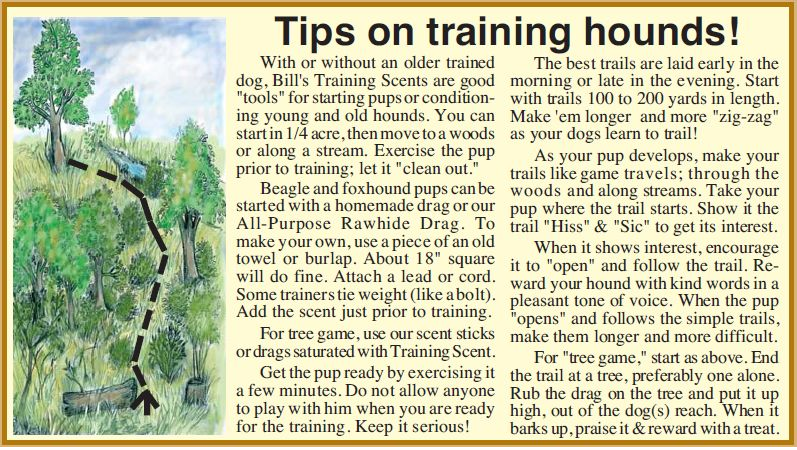
If so, the good news is that the 2010 Bill Boatman catalogue has a nice short training summary, which I have clipped out just for you. Enjoy!

Of course, none of this will stop the lazy and incompetent from wanting their fox pens. These are the guys with one or two dogs, who have no horse, and who have no access to land because they have never gone out and gone door to door at farms.

They have not trained their dogs at all -- they keep them in a kennel behind the house and pretty much ignore them 50 weeks out of the year.

In short these folks are just like the pay-and-shoot bird gunners who take their shotgun and barely trained birds dog out to some place where a fellow releases a few chickens pheasant out into a field to be blasted by the pay-to-shoot guy an hour or two later. We're hunting now! Look at my excellent bird dog.

Of course this is how they hunt birds in England, isn't it? If you are going to import a non-native tropical bird to hunt, like a pheasant, then you are going to have to stock them. You cannot release them into the wild to thrive on their own, any more than you can let a chicken "return to the wild".

But a fox? No, not even in England would they think to put a fox in a big pen with a hound and call it hunting. Or training. Or anything but a fat slob, without the proper tools, trying to do a job on the cheap that he should not have started to begin with.


.

Thursday, July 2, 2009

Badger Baiting Is Not Badger Hunting


Back in March of this year, I wrote a piece on this blog entitled Lie Down With Dogs, Get Up With Fleas in which I bemoaned the inevitable ruin that comes when the world of working terriers is invaded by wannabe dog fighters and and badger baiters.

That post noted that some 17 months earlier I had written a piece entitled Honey Pots and Trolls in the Land of Eire in which I had noted that someone in Ireland had gotten on the boards to bash a piece I had written two years earlier (now more than four years ago) about the old Irish "strong dog" tests and the potted histories that you commonly find for all Kennel Club dogs, including the Glen of Imaal terrier.

I warned what I suspected: a "honey pot" operation was in operation, and it was designed to harm the legitimate world of the working terrier by trying to associate it with dog fighting and badger baiting.

Sadly, I was right, and the result has not only been busts in Ireland, but also bad press on the international front as well.

Perhaps now is a good time to review my original March 2005 post, in which I quite succinctly noted that Baiting Dogs Are Not Hunting Dogs.

It seems this is a point that still needs to be stressed and underlined.

The confusion in some minds stems from the fact that shortly after the turn of the 20th Century, some show-ring pretenders in Ireland tried to suggest that Ireland's overlarge turnspit, fighting, and cart-guarding dogs were once used for genuine field work.

That's not quite true, is it?

Those Irish Kennel Club dogs were always far too large to actually go to ground, and so "artificial" work had to be cocked up for them.

And the work, to put a point on it, was a joke.

But don't take my word for it: You can see for yourself by watching this 1923 video clip. Here is the famous (or infamous) Teastas Beg and Teastas Mor in action!

At the "minor trial," we see a couple of rabbits released, and a bunch of confused dogs sniffing around on the ground. Some terrier trial!

At the "major trial," we see the true "work" of these over-large Irish dogs: Badger baiting with a live badger in a smooth wooden den liner or barrel.

This is pretty far from genuine terrier work, isn't it?

And what does genuine terrier work of that era look like?

The good news here is that we do not have to guess, as here too we have a film clip, also from 1923, this time of properly-sized working terriers going to ground.

The dogs go in, the badger is dug to, and in the end it is bagged to be moved to a new location where it can do no harm.

Are the dogs wrecked? No.

Is the badger maimed? No.

Is their confusion and chaos at the dig? No.

This is real terrier work, and you will notice there is no "strong dog," "pull dog" or "hard dog" nonsense in evidence.

These men are not show-ring pretenders, get-rich-quick dog dealers, or wanna be tough guys displaced from the world of fighting dogs. These are real terriermen, and this is what real terrier work looked like in 1923 -- and what it still looks like today, albeit with a much smaller entourage and clothes that are not quite so fancy.

Thursday, May 31, 2007

The Incredible Shrinking Hogzilla II Is a Pet Pig


Is Hogzilla II a hoax, a tall tale gone out of control, or simple wishful thinking?
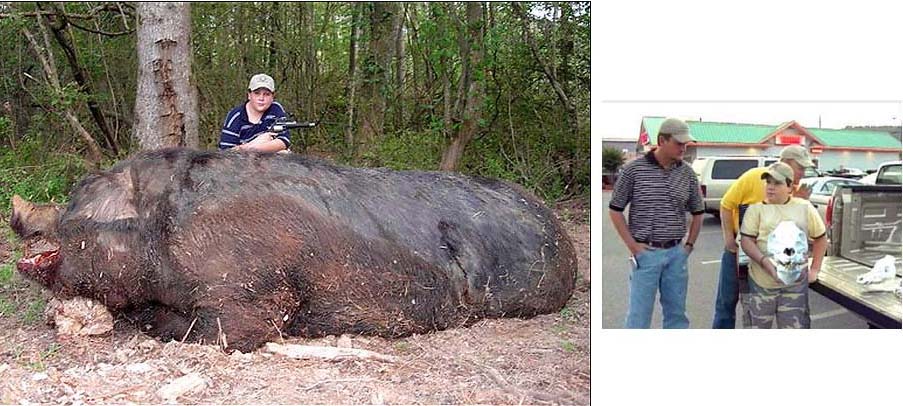
To see a larger version of the top two pictures >>
Click Here


The folks at NBC News in Oxford, Alabama put up a slide show of what the Stone family says is the skull of their "giant hog."

The last photo in the series shows young Jamison Stone holding the giant pig skull. By clipping that picture and pasting it on another photo of Jamison (wearing the same shirt) that can be found earlier in the series, we can get some sense of scale for the skull.

By comparing the much-circulated picture of Jamison and the "giant hog" with a picture of Jamison holding the hog's skull, we can get some idea of how much "forced perspective" was at work in the original hog photo widely circulated on the internet. The folks at
StinkyJournalism.com are clearly right -- this is some type of photographic hoax.

One way to look at the photo is to simply move the pig skull from the right photo to the left and then move it up close to the top of the pig's head (since no animal has very much flesh over the top of its cranium due to the need to cool off the brain quickly when overheated). The gap below the bottom of the jaw bone and the bottom of the photo of the pig's head gives some some idea of the degree of artifice in the photograph.


Photo shows real skull of hog properly sized (facing forward) next to pig.
The pig looks so large because the boy is standing many feet
behind the pig -- a type of photographic forced perspective.


Bottom line:
This was a big hog, but it was no bigger than any really large farm pig of the type commonly made available (for a price) at other canned hunts. And let's note, once again, that this WAS a canned hunt. The pig, it turns out, was penned in a 150-acre fenced enclosure and it had been trucked in from somewhere else in the not-too-distant past.


Quote of Note from The Los Angeles Times:

Eddy Borden, owner of the spread where the hunt occurred, declined to comment on how the hog got into the 150-acre area where it was killed by Jamison Stone of Pickensville, Ala.

Borden said he was getting tired of questions about the hog, which Jamison's father said weighed 1,051 pounds and measured 9 feet, 4 inches from the tip of its snout to the base of its tail. The kill drew international attention.

"I didn't ask for the publicity. I just want it to all go away," said Borden, whose Lost Creek Plantation is in eastern Alabama.


Woops! A public relations stunt gone bad. Ouch. One thing is for sure: Mr. Borden knows how much he paid for that hog, and that price was based on weight, and there is probably a receipt of sale somewhere. Another thing for sure: that hog was not in that 150-acre pen for very long, as a big hog can wreck a lot of ground pretty quickly. This hog was taken out of this kill pen dead at about the weight he was put in alive.

Hogzilla Update:

OK, it's all over. This was a pet pig, and a hat tip to the always-readable J.R. Absher over at the Outdoor Life Newshound blog who has the full story gleaned from the Anniston Star, the local Alabama newspaper. The long and short of it is that "Fred" was a pet pig and a gentle swine that played with the previous owner's grandchildren. I hate it when I'm right. Honestly, it's a burden.
  • For those who are interested in reading about the limits of ethical hunting (and why this kind of "Hogzilla" nonsense is very bad for real hunting, see a blog post from last year entitled (all too appropriately) : "Hunting and Fishing Like Adults."
.

Wednesday, May 30, 2007

Hogzilla II: Terrific Hunting Story or Sad Artifice?


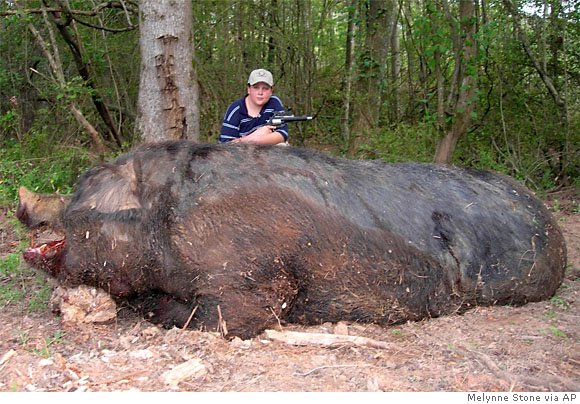
The "pig in a poke" story that is circulating on the internet is that on May 3, 2007, an 11-year old boy by the name of Jamison Stone killed an 1,051 lb. wild feral hog. The pig was supposedly over 10' 7" long and was shot with a .50 caliber Smith & Wesson revolver shooting 350 grain bullets. Killing the hog, we are told, took 3 hours and 8 bullets.

A lot of skepticism was expressed right from the beginning. First of all, the pictures were clearly staged to make the pig look as large as possible -- a common trick done by all hunters and anglers.

Adding fuel to the fire, it turns out no one in authority was actually there when the pig was weighed. You would think that would be required if you were claiming a world record feral hog. Yet, it seems no one thought of that. Hmmm. . . .

Another oddity to the story is that the scale to which the pig was hitched does not actually weigh things by the pound -- it is marked off in 10-pound increments. A weight of 1,051 pounds was technically not possible. The boy's father now says the pig was over 1,050 pounds, and they assumed the little mark above that was for 1 pound. He now says the pig must have weighed 1,060 pounds. OK, but in truth this man aparently had no idea how that scale worked, and neither did anyone else at the weigh-in with him.

That's not a small problem.

Another wrinkle in the story is the gun itself. Who the hell gives a .50 caliber handgun to an 11-year old kid? And does anyone think an 11-year old boy is going to be able to fire off 8 rounds from a .50 caliber and still have a wrist that can work? It might be true, but one wonders . . . .

Here's the most interesting bit: this pig was shot at a pay-to-shoot game farm. If you look at the price list at the entirely fenced Lost Creek Plantation, you find that large boars are priced at $2 a pound on the hoof, while commercially-sold farm hogs are normally sold for about $50 per cwt (i.e. per 100 pounds of pig on the hoof). That means this pig cost about $500 to buy (assuming no major premium was paid for its size) and could be sold for over $2,000 at a canned hunt. So there's the business math for you business majors.

But wait, there's more. Lost Creek Plantation was opened up just one-year ago. Hmmm . . . . Yep, I'm thinking the same thing too. This is a simple artifice. What we might call a "stock and shoot public relations" stunt.

Here's how you do it: Go out and get the biggest dam pig (or deer or elk) you can from a commercial breeder of such things. Raise it up in a pen a little bit more (and maybe feed it steroids), and then release into "the wild" of a large fenced compound. Get the animal used to coming to a scatter-feed bucket so you can be sure where it will be at least twice a day.

A few months after you have placed the pig in the wild, get the animal killed in the most sensationalistic way possible. A kid with a .50 caliber handgun would be great. So too would be a woman archer, or a guy with nothing but a spear and a dog. Ooga-Ooga. The Walter Mitty crowd will go ape-shit on this story, and bingo: Instant clients for your canned-hunt franchise.

Want to bet that this is exactly what happened? There's a reason this pig was not frozen or properly weighed -- it would put a crimp in the story. An examination of the ears and the hide might reveal the absence of the type of rips and gashes you would expect to find on a feral hog that had fought its way to the top in the woods among other wild pigs. An examination of the skull might reveal this "feral hog" to be nothing more than a domestic pig of the type to be found in any slaughter house. A look at the hooves might tell you if this pig once spent a lot of time on concrete. A look at the tusks and teeth might tell you how much of its food came out of the forest, and how much came out of a bucket.

So was this pig over 1,000 pounds? Who knows, and more importantly who cares?

The largest pig ever raised was not 1,000 pounds, but a 2,552 pound China Poland monster by the name of "Big Bill." A 1,000 pound pig is a very big pig, but it's not a world record by any stretch.

Bottom line: What you have here is a very nice "pig-in-a-poke" story concocted by a brand new "pay-to-shoot" game farm that (surprise, surprise) managed to get an 11-year old kid to shoot the stocked animal.

Did the kid shoot the pig all by himself? Maybe. But again, who cares? This not a "wild" pig, and this was not hunting.

As for the hog's size, no one will ever know as the photos are designed to obscure the truth, and the pig was never properly measured.

Was it a very big pig? For sure. But if you have the money, you can shoot a pig just as big or even bigger, and you can even call it "Hogzilla III" if you want -- just put your money down, and try to forget that that giant animal now running between the fences was called "Rosie" just 6 months ago and was trained to come to a slop bucket.
_ _ _ _ _ _ _ _ _ _ _ _ _

Hogzilla II Update #1:
It seems that Alabama Fish and Game officials have a few questions about that monster pig as well. They want to know how this huge hog miraculously got into a 150-acre fenced pay-to-shoot hunting place (of all the places for a giant pig to show up on its own), and whether anyone broke Alabama state law prohibiting the transportation and release of live feral swine. They also want to know if the hunt complied with the state's "fair chase" law which requires that animals on hunting plantations have a reasonable chance of escape. I'm sure some interesting stuff is going to reveal itself. So far we've learned this pig was in a 150-acre pen. Hmmm. . . .

Hogzilla Update #2:

It looks like Hogzilla was not that large. See my analysis based on the pictures of the skull and photos of Jamison Stone holding the same.

Hogzilla Update #3:
OK, it's all over. This was a pet pig, and a hat tip to the always-readable J.R. Absher over at the Outdoor Life Newshound blog who has the story gleaned from The Anniston Star (a pretty good Alabama newspaper). The long and short of it is that "Fred" the pig was a gentle swine that played with the previous owner's grandchildren. Now the story has slid into sick. I hate it when I'm right. Honestly, it's a burden.

  • For more on the limits of ethical hunting, see >> Hunting and Fishing Like Adults, an essay sparked by another pathetic and stupid canned hunt, this time by a country-music star.

Tuesday, October 5, 2004

Cheney's Canned Hunt


I have always considered "shoots" to be little more than canned hunts. Tame, pen-raised birds are released at first light, often tossed into the air by hired hands, where they may spend as much as 15 minutes "in the wild" before they are blasted out of the air by rich smug men who kid themselves that they are "hunting". No one gets dirty, and the rich do not even gut and pluck their birds -- the hired hands do that.


This is to hunting what "chicken-hawk" draft dodgers are to true warriors that voluntarily put themselves in harms way.


This is skeet-shooting with chickens. This is chicken-sh**.


Angus Phillips, the outdoor writer for The Washington Post writes of these hunts: "[Y]ou have to wonder what kind of hunter takes delight in shooting 70 tame pheasants in a morning. What's the point? I like eggplant parmesan sandwiches; nothing makes me happier than having one for lunch. But you wouldn't try to eat a dozen of them. All states have limits on the number of wild game birds hunters can take in a day. Even in states where pheasants are abundant the limits are fairly strict. In pheasant-rich South Dakota the bag limit is three a day; on farms there where pen-raised birds are added to the wild population, the limit is six, which sounds like plenty of birds to me. But on toney Eastern preserves like Rolling Rock, where all the birds are pen-raised, you can shoot till your arm falls off. Evidently there's still a market for that sort of thing among supposedly responsible adults. Who knew?"


The article below recounts Dick Cheney blasting away 70 pen-raised pheasants in a morning, and presumably the same number of ducks in the afternoon. That's almost continuous firing at domesticated poultry, with your tax dollars idling on the runway.


From the Pittsburgh Post-Gazette, Tuesday, December 09, 2003


Cheney in region for small-game hunting

By Rebekah Scott, Pittsburgh Post-Gazette


One of Washington's big guns came to Westmoreland County yesterday for a day's shooting at the Rolling Rock Club in Ligonier Township.


For the second time in two years, Vice President Dick Cheney arrived at daybreak at Arnold Palmer Airport in Latrobe. Air traffic was halted briefly at about 7 a.m. as Air Force Two landed and Cheney's security detail loaded him and his favorite shotgun into a Humvee and drove up U.S. Route 30 to the exclusive country club.


"All I'm allowed to say is there's a big military plane on the ramp, and it's not the first time I've seen it there," said airport manager Gabe Monzo. Cheney shot more than 70 ringneck pheasants and an unknown number of mallard ducks. The birds were plucked and vacuum-packed in time for Cheney's afternoon flight to Washington, D.C.


John Smith, law enforcement supervisor for the Pennsylvania Game Commission, said he was alerted to Cheney's day-trip. Rolling Rock has a game-raising program worthy of a second-in-command, he said, and unlicensed bird hunting is legal this time of year for guests at private clubs.


Scott Wakefield, a dog handler at the club, said about 500 farm-raised pheasants were released from nets for the morning hunt. The 10-man hunting party that included Cheney shot 417 pheasants. The vice president was set to hunt ducks in the afternoon.


Cheney followed a similar hunting schedule in November 2002, when he last visited the Ligonier Township landmark.


Cheney's Washington staff would not confirm his whereabouts yesterday, saying: "Today is his day off and he can spend it where he likes." Spokesman Kevin Kellems said Cheney is expected back in Washington today for a full day's work.


Southwestern Pennsylvania is a quick flight from Washington, D.C., a good alternative to Cheney's favorite South Dakota hunting ground.

Friday, October 1, 2004

A Damn Good Shot


National Review

March 1, 2004, Monday


Hunting for Votes


Hunting and fishing may not be politically correct, but there are 47 million hunting and fishing enthusiasts in America. Add in some sympathetic family members, and suddenly the sportsmen's vote looks pretty significant.


Nearly all recent presidents have enjoyed either hunting or fishing, or both. President Bush went quail hunting with his father on New Year's Day, but his most often-publicized hunting trip came a few years ago, when he went dove hunting and mistakenly shot a killdeer--a protected species of shorebird that looks a lot like a dove. Bush reported himself to the local game warden and paid the fine with no qualms.


Late last year Bush showed his support for sportsmen at a one-hour meeting in the Theodore Roosevelt Room, where he sat down with representatives of twenty20 sportsmen's organizations. This is the first time in at least a decade that sportsmen's organizations have been invited to the White House.


At the meeting the president stated that the "spirit of the outdoors" was important to him and his administration. He felt that his was among the more outdoors-oriented administrations, which puts him in the company of Theodore Roosevelt and Dwight D. Eisenhower.


And he's backing up these words out in the field. Under the present administration, fifty U.S. Fish and Wildlife refuges have been opened to hunting or fishing, and last September the administration supported an initiative of the Congressional Sportsmen's Foundation to increase public access to federal lands. The president has also asked for $22.6 million more for Fish and Wildlife next year.


Yet while the president has the support of many sportsmen, he has also received criticism from a number of groups regarding the administration's plans for energy exploration and development in wild areas, including a plan to put new roads in roadless areas--especially the Tongass National Forest in Alaska.


More than 400 gun clubs across the nation object to the Forest Service's plans for development. A poll conducted by the Theodore Roosevelt Conservation Alliance found that 76 percent of Democrats, 66 percent of independents, and even 58 percent of Republicans support protecting these areas.


One might think that an overwhelming majority of hunters are Republicans, but that's not necessarily so. The three states with the largest numbers of hunters--Pennsylvania, Michigan, and Wisconsin--are where labor tends to support Democrats, and the south has a strong "conservative Democrat" constituency.


When he ran for president, Al Gore seemed to forget the popularity of hunting, fishing, and shooting, and many pundits have suggested that Gore's rejection of his roots (along with his anti-gun positions) figured very much into his loss of the election.


Democrats seem to have learned from Gore's mistake. But as John Lott and Grover Norquist have recently pointed out, the candidates also support some gun-control issues, such as assault-rifle bans and gun-show and concealed-carry restrictions. President Bush, however, also supports the assault-weapon ban.


Tom Daschle as well as nearly all the Democratic presidential candidates this year have come out as pro-Second Amendment. Daschle also supported S.659, the Protection of Lawful Commerce in Arms Act, which "prohibits any qualified civil liability action from being brought in any state or federal court, and ... requires the dismissal of pending actions." This earned him "thanks" from the NRA.


Before dropping out of the primaries, Gen. Wesley Clark claimed that he was a hunter, and Howard Dean talked about hunting and fishing as well as his support for sportsmen's issues in Vermont. Many of my neighbors in the liberal San Francisco area adore Ohio Rep. Dennis Kucinich, but even he has come out saying that while he's "sensitive to guns...[it's] possible to have gun laws that in no way interfere with hunters."


John Edwards has spoken of how he grew up in the rural South where hunting was common, and that he hunted as a boy and believes in Second Amendment rights (with limits). He's a member of the Congressional Sportsmen's Caucus, and says in his "Real Solutions for America" that he wants a moratorium on offshore oil drilling, supports National Parks, opposes "improper logging" in the Tongass National Forest, and would permanently ban development on the Arctic National Wildlife Refuge.


Edwards also answered a Humane Society of the U.S. questionnaire about his views on animals, saying that he supported a bill to prohibit the transporting or possession of exotic animals for canned hunts, a position most sportsmen would support.


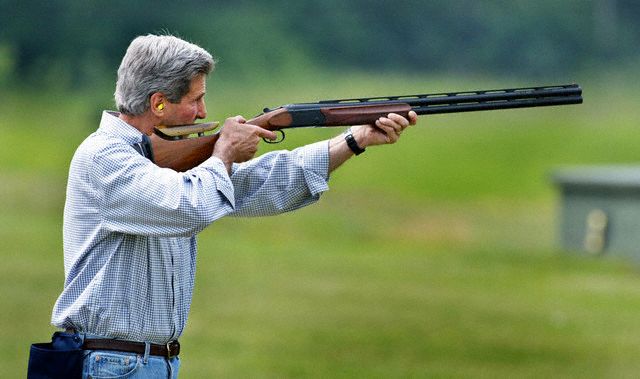
John Kerry caught the attention of hunters when he invited the press to go along on a pheasant hunt in Iowa last November. On that hunt he killed two roosters with two shots. Personally, I think that hunt was a critical factor in his winning in Iowa, which began his long run of victories. By inviting the press along to photograph him as he bagged two birds with two shots, he proved that he was both a hunter and a damn good shot--and also that he's not afraid of any animal-rights backlash.


Some hunters also felt an instant kinship with Kerry. As Ryan McKinney, the Iowa farmer on whose property Kerry hunted, said, "It feels a little safer if your presidential hopeful isn't going to go after your typical normal shotgun."


Bush, Kerry, and Edwards all seem to recognize the power of the sportsmen's vote. As well they should: It's a diverse group that could help decide this fall's election.

_____________________


--James Swan is a contributing editor of ESPNOutdoors.com. He also writes for the Outdoor Channel's Engel's Outdoor Experience.