Showing posts with label skunk. Show all posts

Thursday, June 24, 2010

Underground Skunk Spray and Its Aftermath


If your dog is hit by skunk spray underground you may be in very serious trouble! Get your dog out of the ground as fast as possible. If the dog is not breathing when you get it out of the ground, do mouth-to-snout CPR as explained here.

Even if your dog recovers, he or she may still end up having issues. The reason for this is that skunk spray explodes red blood cells, and can cause serious persistent anemia in your dog.

Skunk toxic shock seems, in part, to be genetic, with certain lines more susceptible to this problem than others, perhaps due to overally weaker kidney or liver function. If your dog has been skunked several times underground and lived to tell the tale (all my dogs) count yourself lucky!

After your dog has been sprayed underground, check your dog's gums regularly for at least a two or three hours. If the dog's gums become very pale (almost white), rush your dog to a vet. A pale pink gum is normal, but white is not.

Most dogs that are skunked underground get out of the ground on their own or with help, and most dogs recover from an underground skunking provided they get out quickly. Time is of the essence, however, and a dog can lapse into a comma after only a few minutes if it is unable to exit a tight earth.

If your dog has pale gums or seems to be in shock, rush it to a vet and make sure your dog is seen immediately. Explain that the problem is MORE than stink: skunk-related shock and anemia can kill a dog.

The best course of therapy for a dog suffering from skunk toxic shick is to fully hydrate the dog (an IV will be needed) to speed the flushing of toxins, as well as to dose the dog with Acetycistein (sold as Mucomyst, Fluimucil, Mucolator, or Tixair).

Acetycistein seems to help the dog cough mucous out of the lungs, and it also strengthens blood cells and the vascular system in general, while working to maintain renal function -- a big issue with skunk toxic shock syndrome.

Since acetylcystein is cheap, easily available, and a well-tolerated drug, starting a dog on this drug is always a good idea if skunk toxic shock seems to be setting in.

If your dogs gets out from underground and skunk toxic shock does not seem to be an issue (this is the situation most of the time), your next issue is the stench. What to do about it?

The short story here is that nothing will completely get rid of the smell of skunk spray except time. And yes, I have tried it all.

"Nature's Miracle Skunk Odor Remover" is a commercial product that works well for a few days at a time. I have tried other commercial skunk-odor removers (such as Skunk Off), and I do not think they work quite as well as Nature's Miracle.

You will need a quart of Nature's Miracle Skunk Odor Remover to dose a 12-pound terrier, but buy two quarts (about $10 a bottle) and keep a spare quart in the wheel well of your car or truck for emergenices. The main ingredient in this stuff appears to be alcohol, but the important ingredients are various enzymes that break down the stink.

What about masengill douche, tomato juice, and vinegar? I have tried them all -- forget it.

What about home-made skunk-odor reduction recipies?

The good news is that they work and they will save you a few dollars over time, as you are going to have to wash your dog every four or five days for a month as the skunk stink leaches out.

Here's the recipie for home-made skunk stink remover:

  • 1 Quart of 3% Hydrogen Peroxide

  • 1/4 cup of Baking Soda

  • 1 teaspoon of Liquid Soap

    Mix it all together in a pan, and wash the dog in in while the mixture is bubbling... let is sit for a few minutes, and then rinse off with tap water.

    Do not get the mixture in the dog's eyes!!

    The quantities described here are for a small Jack Russell. Scale up as necessary.

    Be sure to use FRESH Hydrogen Peroxide... H2O2 will eventually turn into water.


Why does this hydrogen-peroxide, baking soda, and squirt-soap recipie work, and why will your dog have to be rewashed in four or five days all over again?

The short story is that skunk spray contains several kinds of thiols.

The oxygen in the Hydrogen Peroxide releases the Thiols (the odor part) as it foams up, and the detergent removes the oily part that holds the odor in the animal's fur. The baking soda provides a little texture against the fur (thiols are sticky) and also helps deodorize the dog a bit.

The reason that the skunk spray keeps coming back is that the thioacetates absorbed in the skin and fur of the dog, continue to break down over time, turning into stinky thiols. This process is speeded up a bit if your dog gets wet again, but NO, you cannot speed it up too much as it is partially time-released.

If your dog is hit straight-on with skunk spray, either underground or above ground, your dog may get some small blistering around the muzzle and may get some caustic burning of the cornea as well. This occurs because one of the ingredients of skunk spray is hydrochloric acid, created when different skunks two glands mix chemicals together as they exit the skunk's rear end.

It is a myth that skunk spray can cause permanent blindness. When gotten into the eyes the spray often causes temporary blindness, and burns like crazy, but there are no documented cases of skunk spray causing permanent blindness in a dog.

If you dog does end up with ulcerations of the cornea, crate the dog for several days and load it up on antibiotics (cephalexin is fine). The only thing to fear is infection. The important thing is to let the eye rest and heal.

Feed and water your dog well and keep it warm and rested for at least a week after a skunk encounter.

Road flares placed in a skunk den are said to kill the animal, but if your dog has just been sprayed, and stink is pouring out of the hole, you may just want to get the hell out of there and take care of your dog. First thing's first!


Sunday, February 24, 2008

The Geography of American Working Terriers

.
This is a repost. Originally from August 2004.

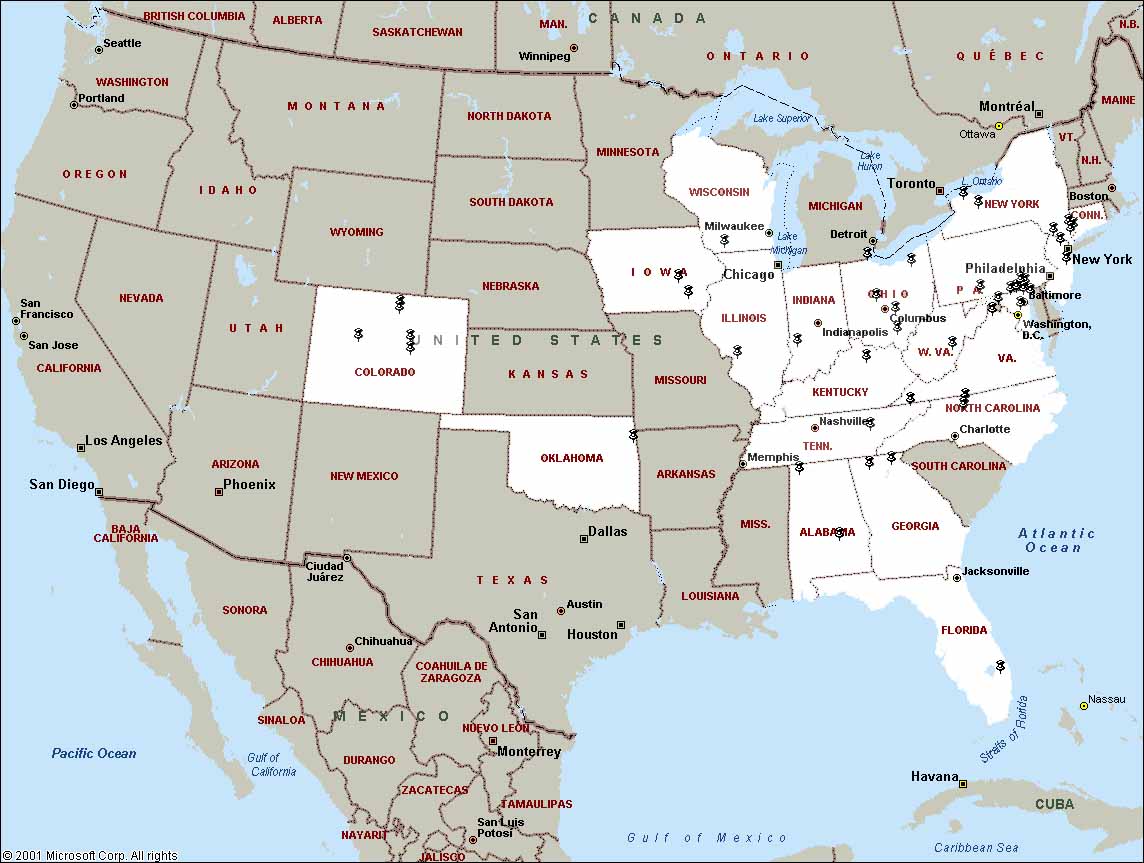
The map, above, is fairly illuminating, as it graphically represents where working judges sanctioned by the Jack Russell Terrier Club of America live.

The states in white are those that have any JRTCA working judges at all. The states that are muddy-grey colored have no JRTCA working judges. A pin (see a larger version of the map by clicking on it) represents the zip code of every JRTCA working judge in the U.S. in the current edition of True Grit magazine.

To get a "bronze medallion" for special merit in the field from the JRTCA, a dog has to work at least three types of quarry underground (fox, raccoon, groundhog, badger or an aggressive possum) operating as if it were out alone, and with the owner doing the digging, and a JRTCA judge has to be in attendance as witness the work. To get a certificate, a dog cannot work quarry in a barn, brush pile, artificial earth or man-made location (such as the crawlspace of an outbuilding).

Jack Russell Terriers are, far and away, the most commonly worked terrier in America. There are very few Fell Terriers in this country, and almost no working Border Terriers at all. Patterdale terriers in the U.S. are still relatively rare, and though some very good dogs are being bred by a handful of reputable breeders, too many over-large dogs are being produced -- many of them cross-bred in the not-too-distant past with small pit bulls in order to get a larger dog that can work game above-ground game -- barn raccoons and feral hogs in particular. There are some excellent Patterdales and a few good Fells in the US, but most of these seem to be owned by people that have had Jack Russell terriers at one time or another -- the dogs they started with before there were any Patterdales or Fells in the U.S.

In short, most working terriers in the U.S. are Jack Russell Terriers, and the map above tells a story.

Why does this JRTCA map look this way?

Some of it has to do with a population bias -- there are more people per square mile in the East and Midwest, and as a consequence associations are easier to maintain.

Another factor is that there are only about 50 pins on the map at all. This paucity of pins is partly a reflection of how few people actually work terriers in the U.S. beyond two-or-three time a year digs, and in part a reflection of the fact that being a working judge is truly a thankless task.

Of course there are more than 50 serious diggers in the U.S. Some of these diggers are ex-JRTCA working judges, some are people that dig a lot but have no desire to sign up for the thankless job of being a working judge, a very few diggers have Kennel Club registered dogs, some folks dig their dogs but have no club affiliation at all. And of course there are the patterdale-only owners, some of whom have joined the new UKC working terrier program or are members of the Patterdale Terrier Club of America.

That said, while this map is clearly not inclusive of everyone that digs their terriers, it is more-or-less geographically representative of the broad TREND of those that that do -- they tend to be in the East and in the Midwest, rather than in the Western United States. For example, of the 15 UKC working judges, as of August 2004, six are not in America, two are in California and come East to hunt, and the rest are in New Jersey, Kentucky, Virginia or Georgia -- states well-represented on the map above.

One of the reasons the map is skewed has to do with quarry availability. In the U.S., the bread-and-butter quarry of the working terrier is the groundhog. Raccoons cannot dig their own dens, and neither can possums. If dirt dens are not available, they will seek other alternatives -- hay lofts, brush piles, hollow trees, farm outbuildings, hay stacks, rock crevices, or old squirrel nests. With the exception of rock dens, these are not locations where a small dog follows quarry to ground and is then dug to. In short, it is not earthwork.

Red fox will dig dens on their own, of course, but in the American west they face real on-the-ground competition in the form of the coyote. A coyote will generally kill a red fox if given half a chance, and they directly compete with red fox for food.

In addition, the red fox is not native to most of the U.S., and its dispersal in the West is uneven as a consequence. While red fox are common in some areas (such as the prairie pothole region) they are quite rare in other areas (such as western Oklahoma).

Weather and time are another important reason fewer people hunt in the West. Fox will not den in warm weather unless they have kits, and in the U.S. we will not put a dog on a vixen with young. Without hounds to drive fox to ground, our fox-digging season is very short -- generally only 10 weeks long, and for most people with jobs this presents a very short period of time to get out into the field.

When people do get out into the field, of course, they have to find your fox! This is easier said than done, and is very hard job for a novice hunter with a novice dog. Red fox densities are variable, but settlement is generally much thinner in the West where there is less food than in the East, and where the fox faces direct competition with coyotes for food and den sites.

Raccoons are not native to the West, though they have spread with humans during the last 50 years, helped immeasurably by the creation of denning shelters in the form of barns, out buildings, road culverts, abandoned cars, and brush piles. A raccoon can expand a ground den a little bit, but it is not really made for digging. A skunk can and will dig its own hole, which is suitable for possum, but too small for anything but the smallest of adolescent raccoons.

Due to the absence of natural forage, raccoons are rarely found above 5,000 feet in the Rocky Mountain, unless they are living in close proximity to humans, though they have been reported at elevations as high as 10,000 feet if a steady food source is available.

Marmots and prairie dogs are found in some locations in the West, but the prairie dog is far too small for a dog to work, while the various species of rock marmots tend to gravitate towards areas with large boulders and talus slopes -- areas very hard to dig. Marmots are also absent from larger parts of the West outside of the Rockie Mountains. That said, if found in the right location, marmots are excellent quarry for working terriers in the Mountain States.

Some states -- notably California -- have very diverse geography and wildlife but also have very restrictive game laws which make working terriers difficult.

The American badger is common in some parts of the West, but more often than not its population is numerically thin on the ground. Badger are also hard to locate, as they will move every few days or so as they eat out, or chase out, a local rodent population (rats, mice, ground squirrels, and prairie dogs). Once the food is gone, so too is the badger. Unlike in Europe, the presence of a badger hole in the U.S. does not mean you have actually found a badger. More likely you have found a blank hole or, in some areas, worse -- a skunk, porcupine or snake.

Porcupines, rattlesnakes and skunks are fairly common in many parts of the West, and all three animals are a very serious threat to a dog. A dog sprayed underground by a skunk can be overpowered and die from anemia if not gotten out of the ground in pretty short order. A porcupine's defense system are barbed quills which can leave a dog wrecked in short order (and the owner's wallet drained after a visit to the vet). A dog bitten by a rattlesnake rarely lives, as the venom from even a small rattler is more than enough to kill a terrier.

In the South there are tens of millions of nutria, but they do not seem to be worked very often. In part this is due to the fact that in many Southern locations where nutria are numerous alligators also tend to be present. Another factor is that neither the American Working Terrier Association nor the JRTCA will give a working certificate to nutria as the holes are too big and shallow to qualify as real earth work. In addition the nutria, like the possum, is an animal whose primary defensive mechanism is bluffing. While AWTA will not give a certificate to possum, and the JRTCA will provided it is an "aggressive" possum, both seem to think the nutria is less than fomidable quarry for a working terrier.

A final obstacle to terrier work in the West is experienced people to show newcomers where to start. While the basics of terrier work are not overly complex, there are things to learn about locating quarry, digging, dispatch, and healthcare. To work any terrier in a safe manner requires several hundred dollars worth of equipment, as well as permissions from land owners. And then, of course, you have to have the desire to hunt, be in relatively sound physical shape, and be willing to devote the time to get out in the field in all kinds of wearther. It turns out all of this is a rare combination.

All of the factors above combine to create a "tipping effect" in much of the West where the chance of finding quarry is lower than in the East, and the chance of getting a dog injured is higher. When combined with a paucity of other working terrier owners, a very short working season, and the abundance of other kind of hunting opportunities, it is not surprising to find fewer working terriers in the Western United States than in the East and Midwest

Many of the western diggers that do exist actually come East to work their dogs, going to the trouble of loading themselves and their dogs into airplanes, trucks and cars for a week or two of hunting where quarry can be found on the ground.

This clearly takes a great deal of work and commitment, making these folks among the most dedicated working terrier enthusiasts in the U.S. A special hats off to them!
.

Monday, November 26, 2007

Predators and Duck Demographics


The October-November issue of National Wildlife magazine, the house organ of the National Wildlife Federation, has a piece on it about skunks which notes that a research project on Mephistus mephistus being conducted by Travis Quirk, and funded by Delta Waterfowl, is being done in a 30-square mile area of Manitoba "that once was one of the most productive duck-breeding regions in the province. '

However, as the article notes,

"Nest success has fallen well below the population maintenance levels in recent decades and the main culprits are the growing numbers of nest-raiding skunks, raccoons, foxes and mink. 'There are a lot of animals out there that eat duck eggs,' Quirk says, 'even white-tailed deer and ground squirrels.'


"Waterfowl managers estimate that predators typically destroy 90 percent of upland duck nests across the northern prairie breeding grounds, along with countless songbird nests. When predator numbers climb, nest success declines in lockstep. On a smaller research plot within Quirk's study area, only 1 percent of the mallard nests produced ducklings when his skunk population peaked at four per square mile, more than double the number when he began the study.'

.

Saturday, October 20, 2007

Digging on the Dogs


Char came down from Illinois to attend the JRTCA's 25th Annual Nationals trial, and I took the day off to go digging with her. The weather called for rain, but I told Char the weather reports did not mean too much around here, and that we'd probably get by with an overcast day before a good evening thunderstorm, which is exactly how it went.

We met up at Stups Market, and then headed a few hundred yards up the road to a little farm where I have been digging in recent months. Pearl is still knitting up from a dig two weeks ago, so I left her in the truck (Char bred her, and she's been a great dog for me), and we took Mountain and Char's Rue up a hedgerow to see what we could see.

Within the first five minutes Rue bolted a nice groundhog up a tree, and Char got a picture. Excellent!

We found the next groundhog where I thought we would -- in a trash-strewn hedgerow in the middle of two recently cut-over bean fields. The dogs bolted this one too (a very BIG groundhog!), and it dashed out and slid under a half dozen coils of old rusty barbed wire and into a cascade of steel and iron car parts, rotting fence posts, old tires, and broken bottles.

Mountain located this groundhog again, but after moving a couple of big rusty barbed wire coils, and seeing what was below that, we decided to give this groundhog best and move on. Why put a dog out of action working barbed wire, broken glass and trash when the day was still so young?

We rolled on across the top of the field, and down the middle. I swear, if we had a dollar for every piece of fox and raccoon crap we saw, Char and I both would have had gas money for a week.

The fox and raccoon are definitely marking every scrap of territory on this farm. And who can blame them with such nice fields of soy and corn bordering a narrow meadow with a stream running down the center? The soil here is pretty friable, and the drainage is very good. There are not too many trees, but the ones standing are often huge. This is about as good a farm as I have found for fox and raccoon. And the groundhogs are thick on the ground too.

We headed down to the edge of the soy field after banging around another recently occupied sette that had a slightly skunky smell to it.

Mountain located in another nice big sette along the fence line. She bayed it up and we downed tools, located, and dug to her. To make a long story short, this sette had two nice groundhogs in it, and both were accounted for, one by Rue and the other by Mountain. Rue did an excellent job of holding her hog while we finished up with Mountain's and could devote our full attention to her end of the pipe. Both dogs came away from this dig without so much as a nick for their efforts.

After the dig, I walked down field for a quick bathroom break, when I saw something white ambling my way -- a skunk. "Lace up the dogs Char," I yelled back to her "We have a skunk coming down the fence line. " The skunk hardly seemed to care about me. I ran back for the camera and took a few quick shots, as this skunk was almost completely white on top. A nice little freak of nature -- the kind of thing that awakes the raging 10-year old bug-collector inside of me.

We repaired the den we had dug up, and had just finished gathering up the tools, when Mountain began poking around a sette about 12 feet away. She slipped underground, and from the sound of it she began to dig on a bit.

No worries. We relaxed, waiting for her to find and open up if she did. In the interim, we took a few pictures of the two hogs, gabbed, and rested a bit.

It was then that Char noticed the white skunk coming back down the fence line, and so I grabbed a heavy board-like piece of bark with the idea of either changing the skunk's trajectory or its perspective on life. I was tossing the chunk of wood at the skunk's head (and missing by about three inches), when Char yelled back to me, "SKUNK in the ground with Mountain."

Oh crap!

I jogged back to the hole, and sure enough there was the faint smell of skunk coming out. Mountain was baying a bit, but then she fell silent.

Oh damn!

We boxed, but the collar seemed to be working intermittently, and so while Char cut away at the entrance hole which seemed to have the most sound coming out of it, I barred down to where I thought the den pipe was.

I think the bar had just popped into the den pipe, but I was not absolutely certain, and was about to bar again three inches over when Mountain began to bay a bit closer to the hole where Char had been cutting away.

Excellent. A baying dog is a living dog with some oyygen.

I ran over to where the sound had been coming out, and Char and I both cut back on the pipe entrance until Char said she could see the skunk, trying to exit, head out.

Mountain was baying a bit more now. I relaxed. No worries. If you can see the skunk and hear the dog, it's probably not going to end bad. This was going to be a bolt.

Char backed away from the hole, and I waited for the skunk to clear the pipe before I tried to nail it with the digging bar. I missed, and the skunk bolted for another pipe with Mountain chasing on after her. Char just managed to grab Mountain before she went to ground a second time, and we collared her up and checked her over for damage. She was stinky, but otherwise fine.

Mountain has been skunked a few times before, and does not seem to be overly sensitive as some dogs are. I checked her over, and she did not have the yellow spray marks on her chest or head that would suggest she got a full-on hit at very close range. I suspect the skunk was three feet ahead of her when it blew its load -- a good thing, I can tell you, as a full load to the skin is a lot of toxin (skunk spray is almost pure sulphuric acid) and stink. I collared her up and tied her to the fence twenty feet away, and in a few minutes she was rolling in the grass trying to get the stink off. She was going to be fine.

We filled in the skunk hole, checked Mountain again (no burning of the corneas), and decided to hit the trucks to swap out dogs and get a cold drink or two for ourselves.

At the truck we ran into the farm owners, and after a nice visit with all the dogs, we left them to hit the other side of the creek with Smudge and Sassy.

Smudge is an older dog that has had the good fortune of finding a home with Char, while Sassy is the one-year old full sister (out of a different litter) to my Pearl.

We walked down the creek bank, and there were a lot of holes over the space of 500 yards, but all of them were blank. I have taken about 30-35 groundhogs out of this creek bed over the last few months, and it seems I have made a some small dent in the population. Still, the stream bank is not completely blank, as I have bolted a few that got away as recently as last week, and the week before that.

From our side of the creek we could see some of the exit holes on the other bank, and so when we saw a really nice sette under a huge old elm tree on the other side, we decided to cross over and check it out.

Smudge waded over ahead of us and noodled up the bank through the thick maze of roots. Char followed directly behind, while I rounded and went up the bank a few yards upstream. By the time I got top side, Smudge was in the ground and baying up a storm.

When I say this was a big elm tree, I'm not kidding -- it was six or seven feet through the middle, with the top broken off about 25 feet up. Smudge sounded like he was inside the trunk . I circled the tree looking for a way in. There was a small soft-looking spot at the back base of the tree, and I started to pull away some matted leaves to see if I could find a hole when a large raccoon stuck its nose out. Yow!

I don't know which of us was more freaked out by what we found on the other side of that thick plug of leaves. The raccoon, of course, was not expecting to see a 200-pound human. On my end, I am hyper-aware that we have a lot of rabid raccoons in our area, so I try to stay away from the business end of raccoon with my bare hands. Yes, yes, any mammal can get rabies, but raccoon are positively dizzy with the stuff around here.

Anyway, the raccoon darted back in the tree, and I now knew what we had inside. I reached into the hollow with Char's scraper and pulled out some dirt and a chunk of rotted wood. The pipe did not appear to be very big and it seemed to jog to the left.

I boxed to locate the dog and the locator said Smudge was about two feet inside the trunk from the left side, but it sounded like he was also a foot or two down in the ground below that. Maybe more.

I barred on the left side of the tree, and cut through some smaller roots until hitting hard massive trunk wood. I tore off some pretty decent chunks of wood, but there did not seem to be any weakness to this side of the tree.

While I was slamming the posthole digger and bar into the roots and trunk with almost total futility (and doing some sawing too, it should be said), Char had stuck her spade into the hole where I had seen the coon nose, and pulled out quite a bit of dirt. After looking into the hollow of the hole, however, she decided she had probably blocked off the pipe as she could not tell which way it went. I checked it out and she was right. Where DID the pipe go? I could not tell either, and poking around inside the trunk, everything felt pretty solid. The coon had tried to exit from here, but where it had gone to was a complete mystery.

About an hour had gone by, and Smudge was still baying up a storm, especially when we banged on the trunk a lot. Smudge clearly had the raccoon cornered, he was not backing off, and the raccoon was business-end out. Air was apparently not a problem, and it sounded like Smudge had a good location to work from. What to do?

I suggested to Char that we pull off about 80 feet, sit down, and see if the dog would come out on his own if he didn't hear us banging about on top with our tools. Some dogs will exit after a while if they do not hear humans digging or talking.

Thirty minutes later, Smudge had not moved and he was still baying up a storm. Hmmmm. We seem to have a dedicated working dog here! A new plan of attack was clearly needed.

I went back to the original hole at the base of the tree, and moved a large trunk and branch that had been serving as a porch over the hole. With the branch and trunk out of the way, I had a better purchase on the hole, and I used Char's scrapper to pull out a big piece of old rotten wood and dirt. I dug a bit more, my arm all the way in, and banged out pieces of old rotten wood that were large enough to make an apple crate out of. I put in the shovel and brought out a lot more dirt too. I was digging and banging around inside the trunk blindly, but I was definitely removing material. If nothing else, I was creating more air space inside, and that could only be good. Plus, I was doing something.

Char got a light, and I shined it up into the pipe, and now I could finally see the top of Smudge's wagging tail peeking out over a piece of rotten timber. He was clearly doing fine.

I pulled out a little more dirt and wood, and shone the light about some more. Now I could see that there was a wall of rotten wood and dirt between the dog and us. I explained the situation to Char, who scooted in to take a look. While she sussed out the situation, I explained our plan of attack in my best Ronald Reagan voice: "Mr Gorbachev, tear down this wall."

And so we did.

More wood and dirt came out of the hole, and in the end it was clear Smudge had the raccoon, still unseen, pinned down in a hole somewhere near his feet.

I reached in with the snare pole to pull Smudge out (he was farther in than I could reach), and he got the idea that I was not happy with where he was ensconced, and so he bolted out of the pipe, very hard and very fast.

In truth, when Smudge exploded out of the trunk, I was not sure if it was the dog or the raccoon coming out. And believe me when I say it mattered to me quite a lot at that moment!

When my heart stopped skipping, we got Smudge leashed up, packed up the tools, and decided to leave the raccoon for another day's sport. As a general rule, raccoon and fox do no harm on our farms, and I find it best to let them go. A living fox and raccoon is the promise of another day.

Smudge looked fine coming out of the hole, but in fact he was ripped up a bit at the gum line, and he started to swell up on the walk back to the truck.

Char cleaned him up and loaded him up with Clavamox, but when I saw him at JRTCA Nationals the next day, he was still swollen and tender. None-the-less, he picked up his Bronze Medallion for all of his previous work in the field, and I will say that no one could question that he was a true working dog!

A permanent hat tip to Char who has beautiful small workers, and knows what to do with them! Come down when it's cold, lady, and we'll see if we can put something up.

.

Strange Wildlife


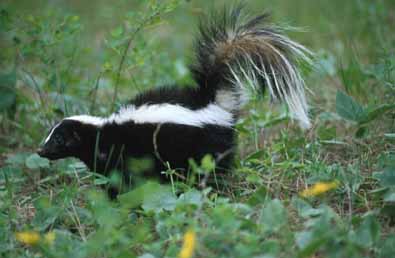
This little stinker was walking down the fence line while we were digging, and I took this picture with my crappy old point-and-shoot no-telephoto lens digital (the only thing that can survive a dig), which means I was pretty close to her.

The notable thing about this skunk is that she had so much white -- almost entirely white along the top. She hardly cared about me; she knew she had the ultimate defense, and unless I had a gun, she was going to be all right.

More about yesterday's digging later, but suffice it to say we also saw her mate -- a bit larger and with a normal skunk pattern.


The other odd creature we found yesterday was this very large orange ant-looking thing. It's the size of a bullet ant, with a pumpkin-orange and black-banded body, and a slightly fuzzy skin tone as I recall. It was completely solitary, which made me think it might be a wingless-wasp ant mimic, but whatever it is, I have never seen one before.

Monday, October 8, 2007

Digging on the Dogs


First one of the day, quickly and humanely dispatched.


There was a fog out early this morning, and on the back roads I notice that both the Poison Ivy and the Sumac are starting to turn red. Fall in not quite here yet, but it's coming.

I do not expect this will be much of a year for leaf color -- the drought has been too fierce. When it gets this bad, the leaves just give up the ghost and come down in great brown drifts.

In drought, there is never much of a color guard to welcome in winter.

Things are beyond dry. The Potomac River is so low that the rocky gorge at Great Falls look like a foreign river. In the smaller creeks you can find dust on the stones where a pool should be. Not good.

The corn is all burned up, but still standing, while the soybeans have already come off, or are in the process.

I visited Nick's Farm last weekend, but the dogs found nothing in two hours of walking around. I have hunted this farm for a long time, and taken several hundred groundhogs off of this 250-acres, but I think Dave's aggressive plowing and ripping of dens has been what has really pushed things to a low level.

Dave has a number of free-range chickens, and he tells me he has just added a pen of turkeys. He says he lost 30 chickens to a raccoon which he trapped and shot, and I told him about two raccoons I had taken out of an old feed bunk some time back. Raccoons up near the house and the chicken pens will not last long with Dave's traps in action. He says he also took out a skunk with 6 babies. I tell him next time to drown them rather than shoot through the trap. Less stink that way. There are a few small things I know about.

Dave gave my name to a farm owner up the road (Call him, he'll get rid of your groundhogs), and I really like this new farm and appreciate the referral. I notice that the soybeans have already come off. A harvest transport truck is still in the fields, and it looks like there might still be some standing beans above the ridge, but with the fog we had, it's still too early for anyone to be cranking up the machine.

I tape up the locator collars really well, as the dogs will be in and out of water today. We check out a few dens in the bean fields, but the groundhogs have left. Who can blame them? There is not much left to eat in these fields. These dens might hold fox in a few months, however, and I will make their acquittance now.

The dogs and I go down to the creek, where it is still green, and the dogs are in and out of a den, but it's hard to tell if they are interested or just playing grab-ass, when -- BAM-- a groundhog bolts out of one of the holes and runs up a tree. Man that was a fast bolt! Smart groundhog. Good for him -- we'll be back later and see how he fares next time.

The dogs settle down and start working, and a bit later they locate again. It's a pretty shallow dig in a tough thicket of tree roots. After a bit of a saw job, we catch up to the groundhog who is not too enormous. He is quickly terminated and recycled for fox food. That's the deal on this farm -- clean out all the groundhogs along the creek where they are wrecking the stream banks. "Yes, ma'am right on it."

Mountain finds another occupied sette and bays it up good, and it sounds like a raccoon. I try to locate. From the sound, Mountain is staying and baying in one location, but the locator is a little shy about exactly where that location is. The box seems to read equally well in a four foot radius. Not good. I bar down to locate a pipe, and hit one, but after digging down to it, I realize it's the wrong one. Or the wrong bit of the right one. As it turns out, there are several den pipes here that are very close together thanks to the intersecting tree roots which keep the ground solid despite all the tunneling.

I eventually hit the right pipe, pull Mountain, and swap Pearl in. Pearl skits up the tube, digs through some dirt and starts to bay. The critter is making a noise that can best be described as "furniture-being-dragged-across-the-floor." I am pretty sure it is a raccoon, as this is the sound I expect from them. I posthole down between the roots for a foot or two, but hit an obstruction and cannot get in enough to figure out what it is. There's not enough room to cut it or remove it. Lots and lots of roots -- always a problem when digging alone.

I cut another hole in the wrong location, but at least I can get into the pipe here, and I reach in and grab Pearl who has a cut lip. I tie her up, and I am turning around to snare whatever's in the den pipe when a large, dark-colored groundhog crowns out of the den entrance. A groundhog? It tries to bolt, but it doesn't make it very far despite my considerable surprise. Damn if I have ever heard a groundhog make the sounds this one did!


Two down (and one bolted), but I am dead from the heat, and the dogs and I head back to the truck.

The day started off with a promise of Fall, but shook that off pretty quickly. Now it's 90 degrees in the shade -- not that we found any shade.

I am cooked, but we'll be back. Hopefully, it will be a little cooler.

.

Thursday, July 19, 2007

Stain, Stain Go Away

Sooner or later you are likely to get some blood on your clothes, coat or pack, and in all likelihood these stains will be long-dry by the time you get home and are tough to launder out.

One old trick is to presoak anything that is bloodstained in a solution of water with two tablespoons of unseasoned (plain) Adolph's Meat Tenderizer per gallon of water. Presoak for about four hours prior to laundering, and there will be no trace of blood stains remaining when you launder the clothes. This treatment is not harsh to fabrics or colors, and works every time.

Another trick that works with many other stains is to apply a combination of hydrogen peroxide and squirt hand soap -- the same mix used to get rid of skunk odor on a dog. It is almost miraculous on red wine stains.

Tuesday, January 2, 2007

Hunting Wide

Saturday morning started out with the kind of fog they write about in Sherlock Holmes novels, which I suppose, is just a small reflection of how warm it has been. Before the day was out, it would almost hit 60 degrees -- far too warm to find fox to ground.

Since the area I had scoped out by aerial map had a lot of trees on the edges of larger fields, I did not expect to find too many raccoon to ground, and it was unlikely we would find a groundhog out and about despite the warm weather -- their cycles are driven by daylight more than temperature. Bottom line: If we were going to find anything on this new land in this part of the season and on this warm a day, it was most likely going to be possum. The fox would come later.

By the time Chris arrived, I had taped up both collars and gotten the tools out, and switched from David Crosby to Tanya Tucker. Pearl had just finished her first heat cycle, so she was ready to be out.

My goal today was to scout some new fields along the Monocacy River. Chris and I followed the river bank, and found plenty of holes, but no one home. This was going to be fertile ground in the Spring, however.

A very long island was just off shore from the river bank, and at the very end of it were a couple of duck hunters in a blind working a mechanical robo-decoy. I am not much for these contraptions -- it's just a hop and a jump to mechancial callers, and it seems too much like cheating to me. There's nothing wrong with hunting and coming up with a blank day once in a while. There is a place where technology should end, and it's a bit short of mechanical decoys with flapping wings if you ask me.

We passed the long-gone remains of a gutted deer hanging from a tree. It was perhaps several weeks old, and it did not look like much was taken other than the head and the back loins. The carcass would provide food for fox, but it looked like quite a bit of meat had been left in the forest.

A short distance from the deer, and on the slope up from the river to the fields, I realized Mountain was not with us. We stopped and waited, but she did not emerge, and I was pretty sure she had found. Chris moved down the slope, and I moved up towards the fields. where I found her just outside a beautiful sette. She had gone to ground and extracted, and killed on her own, a mid-sized possum. It was a bit anti-climactic, as Mountain had not bayed, and there was no dig.

Mountain has always had a problem with self-hunting and staying close. I think when Sailor was alive she ventured farther out than Sailor did just so should could find something in the ground for herself. Unfortunately, that practice has not ended with Sailor's passing. I guess finding quarry is the ultimate reward for the bad behavior, and that makes it particularly difficult to end.

I would not care except that it wastes time, the noise of calling for her scares quarry away, and it is very dangerous should Mountain find a skunk in the ground without me knowing exactly where she was. That said, it was a beautiful sette, and it looked like the kind of thing a fox or raccoon would use when the weather turned colder. I put this one in my memory book.

We headed up the slope into the fields, and I was thrilled to find a beautiful rolling field with a short grass winter cover, and a long hedgerow at the top, followed by an even larger field, also in a short grass winter cover, and another nice hedgerow beyond that, and another beyond that. Excellent. When it gets colder, I am sure we will find fox here.

As we walked up the fields, we found groundhog hole after groundhog hole. Some of the larger settes had eroded into large funnels at the entrance. This was clearly good friable dirt. I was pretty sure these fields had been in soybeans or alfalfa for at least two or three years -- you generally don't get this kind of groundhog density without those cover crops.

We walked up the fields a pretty long way, coming to a section parallel to an area we had hunted in the past. The new fields were separated from the other area we had hunted by an upland area of forest a few hundred yards wide. That may not sound like much distance, but in this part of Maryland the soil can change dramatically from one area to another over a couple of hundred yards. That upland piece of forest land was not an accident -- it was the remains of a rock and shale uplift, and it had existed here since the time of dinosaurs. The bend in the river had existed here just as long, and my theory -- based solely at looking at the maps -- was that the soil on the other side of that uplift and closer to the river would be deeper and richer due to river deposits and down wash. It looked like I was right.

Despite all the dens, the dogs failed to locate. Groundhogs move out of their field settes in the winter to seek harbor inside the tree line; very few winter over in field settes. We headed back down the fields along the edge of the trees. A deer hunter fired very close to us when we were inside the tree line, and I was reminded, once again, that hunting on Sunday is always the best plan, especially in deer season.

We headed back down the edge of the river, and then up again into the end of a large field. We had worked the other end of this field before, and as we approached that end, Mountain suddenly began baying furiously as if he had caught something above ground. Game on! I ran down the field with pack, shovel, bar and posthole digger, but was brought up short by a downed tree in the hedge. By the time I had gotten through that, the dogs were quiet. I called for Chris and found him on the other side of the hedge, looking a bit perplexed. What happened? Apparently Mountain had caught a very large deer sleeping or resting in the hedge, and the deer had as hard a time getting through that downed tree as I did. Mountain and Moxie had been right on the deer, and had chased it out of the hedge. The two dogs and the deer had bolted in directions unknown.

Chris and I whistled, and we took turns walking a large circle. It was about an hour before I found the dogs on a farm path not very far from where we had lost them. Mountain was unscarthed, but Moxie had a line shaved into her fur where a deer hoof had grazed her. The skin was not broken, but a thin line of fur was gone, as neatly trimmed as if it had been done with a Wahl shear. That was close.

All's well that ends well, but it's clear to me that I am going to have to do something about Mountain's self-hunting. I have never had a dog riot on deer before, and I have never had a dog hunt as wide as Mountain does. Time to end it.

That night, I ordered an electronic collar from Innotek to help me break Mountain of bad habits and to help train in new ones. The problem is that Mountain is smart, and she knows that off the leash there is no "correction." It does not help, of course, that she also gets a maximum reward for hunting wide -- she finds quarry more often than most. At this point, my natural aversion to electronic collars has to take a back seat to safety. The collar is cheap compared to the price of a new dog -- or losing an old one. One thing I am sure -- it will not take Mountain long to figure out that she can no longer hunt wide.

Saturday, December 9, 2006

Over-the-Counter Skunk Treatments


I am pro-frugality and pro-foresight, which is a nice way of saying that I try to keep my dogs alive and I also try to avoid paying a veterinarian $80 for a well-puppy visit. I give my dogs their vaccine shots (and you can too), micro-chip my own dogs (and you can too), and take care of basic health care problems ranging from small hunting-related injuries to ear and urinary tract infections, ringworm, and even Lyme Disease treatment (and you can too).

If you have already bought a copy of American Working Terriers, you know this book is a practical guide to saving money on canine health care, as well as a practical guide to working terriers (with a chapter or two on canine history and wildlife thrown in). The notes on antibiotics, SuperGlue and 15-cent Deben locator collar batteries alone make this book a bargain.

So is there anything I left out? Well sure. I left out where to get epinephrine and acetylcysteine for less. Both of these drugs are very useful things to have in your kit if your dog is skunked underground and does not appear to be shaking it off very quickly.

Needless to say, being skunked above ground is no big deal, except for the smell. Underground, however, a dog can easily be overcome by fumes and undergo skunk toxic shock, a kind of Heinz Body Anemia. The most important thing you need to know if your dog is skunked undergound, and is not breathing when you get to it, is how to administer CPR to a dog.

If a dog is gotten out of the ground breathing, it is probably going to be all right. In some rare cases, however, a dog's airway can swell up, constricting breathing. In addition, a dog's lungs, liver and kidneys can have a hard time clearing the toxin from the dog's system. In such a situation, a dog can die from skunk toxic shock, which is why having a couple of good off-the-shelf medications in your vet kit is a good idea.

If your dog's throat is constricting, and it is having trouble breathing, epinephrine can help. Epinephrine (also called adrenaline) is the primary ingredient in over-the-counter Primatene Mist. This stuff is used to decrease the swelling and clear the airtract of folks suffering from asthma attacks, and it has the same effect on a dog that has been skunked underground. A good thing to have in your kit.

Acetylcysteine, or mucomyst, is a kind of expectorant that helps clear the lungs and also strengthens liver functions, especially in cases of toxicosis. N-acetylcysteine is commonly sold in health food stores and online without a prescription. Try Google and Froogle (search: n-acetyl-cysteine) if you cannot get it at your local health food, vitamin, or drug store. When administering acetylcysteine to a dog, give a 140 mg loading dose for every kilogram of body weight. Since the average working terrier weighs about 6 kilos, a 900-mg initial dose should be about right.
.

Monday, November 27, 2006

A Change of Season and Quarry


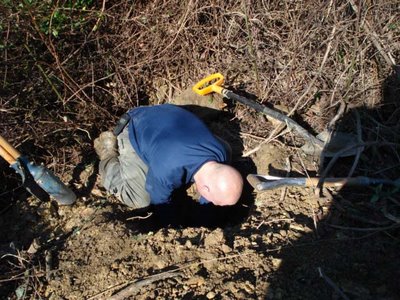
Chris peers into the hole.


On the drive out to the farms this morning, the truck thermometer said it was 33 degrees out, and the first frost of the season was evident on the grass. The temperature would climb at least 20 degrees today -- maybe 25 -- but the groundhog season was over, as groundhog hibernation is driven by light, not by temperature. This is true for bird migrations too -- an unseasonal period of warm weather in the Fall does not fool the birds.

Beginning with Thanksgiving and continuing to Christmas -- a period of about a month -- it's hit or miss with quarry, with a very high liklihood of getting hit by skunk, and a better than-average chance of finding possum and raccoon. After Christmas, the raccoon and skunk are generally hibernating (the male raccoon will begin moving around again in early February as they beging looking for mates), and groundhogs will very occassionally exit to defecate and then trundle back down to sleep for a few more weeks. Possum are active all year long, though they will lay up for long periods of really cold weather. After Christmas until the first of March it's fox season, with the peak in late January and running through February.

Chris and I met at the Flint Hill store. I had in mind pulling into a new parking spot close to a creek bed we could walk looking for game, but as I drove by I noticed two SUVs parked right where I wanted to pull in. Deer hunters. It turns out it's the first day of shotgun season. Oh goodie. How many first days of the season are there? First day of early black powder, first day of shot gun, first day of rifle, first day of bow, first day of regular black powder .... No worries -- off to another farm.

I turned around, and Chris followed me back up the road, and we pulled into a nice big place that has a nice creek and a small bog on it. It was going to be a nice clear day -- not too cold or windy -- and I had high hopes. Or should I say I had high hopes until I got out of the truck and walked 100 feet. The fields were soaked. Where did all this water come from? I did not remember too much rain from the week before, but it had clearly come down very hard here just 25 minutes up the road.

We hunted the dogs up the hedge, busting out a fair sized doe and a black-and-white feral cat which managed to get away with its life. We crossed above a boggy area and hunted down the top of a field where there were quite a few holes in a more-or-less dry hedge row. A large new push-pile has been bulldozed up, but nothing was home.

We crossed down the field to a creek bottom and began walking up the high side of the creek. Mountain gave voice for a second, and the dogs and I followed into the hedge, but nothing could be found, and Mountain trotted up from behind us as if she had bolted something into the field. Whatever it was, it was lost now.

We continued down the hedgerow on the high bank above the creek. In the distance I could hear guns blasting away. There was a large metal tree stand -- the type large enough to hold four hunters and a propane grill -- overlooking this field. No one was in it, but I still found myself routinely looking up the hill to make sure I was not being scoped in on.

At the end of the hedge, we crossed over the creek and begn walking up the hill to another long hedge about 100 yards above the water, but Mountain was nowhere to be found. We waited a bit, and I whistled, but after another minute it was pretty clear Mountain had found.

I crossed back over the creek and began boxing some likely settes, but she was not in them. Chris crossed over too and walked up the hill towards the big deer stand but did not find anything. He then crossed back over the creek and began walking down the high hedge where we had been headed, while I continued to call and box a few more possible settes. Chris whistled and said he had found her -- he was walking down the field and pointing to the same hedge I was in, but about halfway back down the course we had just come up. He could hear herfrom up on top, but the acoustics were such that even though I was closer, I could hear nothing.

I gathered up my tools, and Chris did the same, and we headed over to see what Mountain had in the ground. I doubted it was a groundhog -- it would have dug away by now. Probably a possum, maybe a coon. Or a cat. Too warm for fox yet.

Mountain was on the other side of the creek, and we waded over to find her in the middle of a very old and thick multiflora rose jumble. Time to break out the machetes.

This sette had about five eyes, and a quick boxing showed Mountain about three feet down in a mess of old roots and brambles. We hacked away at the vegetation, and then worked with machete and saw on the thick roots twising along the ground. After we had it cleared it out pretty well, I reboxed to locate the dog, found Mountain to be exactly where she had been before, and we began to dig.

This was not a particularly hard dig, but we did pull out some big rocks -- one the size of my upper torso, and the other the size of a small turkey. At one point Mountain came out -- she had been underground working this critter for about an hour, and whatever it was could not go anywhere or dig away.

With Mountain out, Pearl slid in and bayed it up nicely -- a nice deep voice. Mountain, hearing Pearl give voice, turned back around and pushed her way back in down another hole. She winkled past Pearl somehow, and Pearl came out. Pearl's a very young and inexperienced dog yet, but I am very pleased with how readily she is entering and working. This is only her third dig.

Pearl had riled up the critter in the hole, and Mountain was winding it up a little more, and by now, from the sound in the pipe, I was pretty sure we had a raccoon.

At about two and a half feet down we hit dry dirt, and I was pretty sure the dog was only ahout 6 inches deeper. Chris scraped the loose dirt out of the hole, and I carefuly barred and broke through into the den only 6 or 7 inches below. Excellent. Time for the posthole digger.

This last six inches was very dry and seemed to be made up of mostly degraded rock, but the posthole digger is a tough instrument, and it punched through in short order.

We pulled Mountain and tied up the dogs while we opened up the hole to see what we had. Chris dropped Moxie in hole, and she shot up the pipe and engaged -- there was small a roar in the hole and now I was sure it was either a coon or a very loud possum. Moxie has a habit of going for a head grab, but this time she was working in the dark, and I told Chris to let her work it a bit as I doubted she was going to be so brave and foolish wihtout light. After a while, we pulled Moxie, and she seemed to be no worse for the wear. A little dark tunnel work is all Moxie needs. She's a great little dog.

Chris went to tie Moxie up, and I looked in the hole to see the top of a raccoon head poking out. Hello!
The raccoon took one look at my ugly face, turned around, and pushed in as deep as it could. I postholed the pipe a bit to cut away the overhang, and I could see the raccoon's tail now. After a brief pause to see if she would relax, turn around, and bolt out on her own, we brought Mountain back over, and she turned the raccoon in short order.

With the coon turned around, we pulled Mountain and I got a snare over the coon and pulled it tight. We had decided to take picture and let this one go, but as the cable tightened up the coon pulled backwards very quickly and the cable came down on top of its head rather than over its neck. Not good. I tightened up the cable, but the raccoon squirmed free and then bolted. I told Chris to release Mountain, and he did. After a second or two of confusion (What do you mean it's not in the hole?) Mountain was off down the bank, through the water, and up the other creek bank. We let off the other dogs, and they too took to the water. A commotion with a lot of barking and snarling told me Mountain had caught the coon in a brushy jumble on the other side, and I leaped over to sort it you, which was done in short order. This was a female raccoon with an enormous posterior and she weighed 16 pounds.

We tied up the dogs, repaired the sette, and took a few pictures of the raccoon before heading back to work along the hedge. The dogs located nothing more on this farm, and we headed off to Nick's to see if we could find something there.

At Nicks the dogs had a nice run around before we headed over to a high bank above a creek. This is a fairly bad area, as a lot of rubbish has been tipped down this bank -- old pieces of plywood, bits of metal farm equipment, spoiled straw bales, spoiled soybeans, some old rugs, part of a small outbuilding -- but it is riddled with groundhog holes and is a likely spot for possums. We did not go fast through this section -- there were a lot of holes, and it would take the dogs a bit of time to find them.

Mountain was ahead of us down the creek, when Moxie showed interest in a hole. I downed tools and descended the embankment and pulled a few leaves out of the hole and encouraged Moxie to give it another sniff. In she went. Excellent. Chris came down the bank, and I tied up Pearl, and broke out the shovel. Chris was at the hole when he suddenly said, "Oh sh--; it's a skunk." We both began moving very quickly now. Chris began locating and it was not good news. Due to the steepness of the bank, the dog was about 6 feet down. The good news was that the ground was very soft -- wash down loam from the fields above. The diggin would not be hard, but it would not be quick either.

Chris started opening up the entrance hole and calling for Moxie, while I began to dig a hole from the top. I did not think she was as deep as the box said -- or at least I hoped she wasn't.

There was no sound coming from the hole. Minutes went by, and both Chris and I got a very bad feeling. Chris and I switched positions, with him digging on top and me clearing out dirt from the side hole. Suddenly I saw movement -- a white dog coming out. What the hell? It was Mountain. She must have gone to earth here without either of us seeing her. I could have sworn she was up the bank.

Mountain was out now, and she was reeking of skunk but seemed entirely fine from the experience. As I was tying her up, Chris called over -- "Here's Moxie". She had exited from another hole up on top -- a very small hole a few feet behind where Chris was digging. Lucky for us this sette had three or four eyes.

The dogs were fine -- Mountain got the heaviest part of the skunk blast, but Moxie was nailed as well. We gathered up the tools as the stench rolled out of the hole and down into the creek bed. It was pretty bad.

We crossed the creek on a plank bridge and headed up and over to the other side of the forested hill to hunt in the woods. We were not likely to find here, but that was OK -- the dogs needed a bit of time to let the stink drain off of them.

Chris busted a buck -- maybe four or six points -- and we bolted another three does while we were just on the other side of the steep hill that descended down to the Mononcacy River. There were several large brush piles here, but they were empty.

Later on, as we headed back to the cars, Mountain headed up into a field to check a large old sette. She went to ground and stayed, but she did not bay. I think she could smell the groundhog, but it was dug in for winter and it was not moving and there was no way to find it.

We headed back to the trucks where I had a brand-new bottle of Skunk Off (a seasonal precaution). I dosed Pearl first, even though she did not have much (if anything) on her, and then I washed Mountain with Herbal Essence shampoo to get off the dried black mud from the last hole of the day. Now that she was back to almost-white, I dosed her with Skunk Off and crated her.

Chris I worked over Moxie next, rubbing Skunk Off into her coat and paying as much attention as possible to her muzzle, front legs and chest where the spray was most likely to have been concentrated.

As we finished up with Moxie, a couple of deer hunters showed up for twilight shooting -- a father and son. The father looked stoned, and his shotgun had a scope which always looks like an odd fit to me, but is increasingly common. They asked about deer, and we told them that we had seen a few. As we pulled off the farm we stopped to talk to Nick, and Dave the farm manager who were repairing a bailer.

The dogs were a bit stinky, but otherwise this had been a fine day in the field with a bit more experience given to the two young dogs. All in all, not a bad day, but next time we may need to leave Mountain crated to give the young dogs a little more experience on their own.
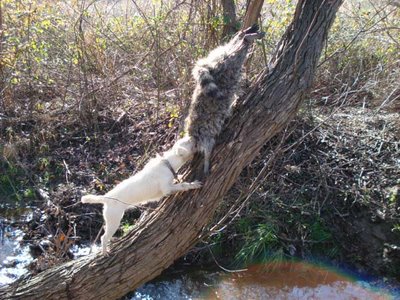


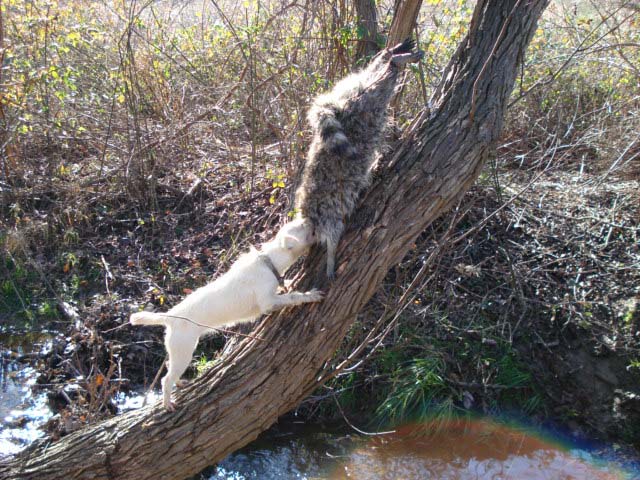
Pearl climbs a tree to grab a very dead raccoon. She got to work this one a little, as did Moxie.

Wednesday, November 22, 2006

Skunked On Sunday


Mountain got skunked pretty good on Sunday, and Pearl caught the edge of it too, as she was right there at the hole.

Mountain came out OK, and was a bit dazed for a few minutes, walking around with her tail down, but she was back to her old self within a half hour. She had no burning of the eyes or blisters on her face (skunk spray is almost pure sulphuric acid), and was hunting again in short order.

The bad news, of course, is that the skunk stink lasts and lasts and last.

Skunk spray is a mixture of thioacetates and thiols (the stuff that stinks), mercaptans, and almost pure sulphuric acid. Bonded sulfur and hydrogen atoms in thiols attach to the same nose receptors that sniff out hydrogen sulfide ("swamp gas"). Human noses are highly sensitive to thiols and can detect the smell at just 10 parts per billion.

Skunk spray also contains compounds called thioacetates, which slowly break down into thiols. When a skunk sprays a terrier, thioacetates in the spray are absorbed into the skin of the terrier, and these thiocetates slowly break down into new thiols, resulting in the skunk odor reappearing on the dog a day or two or three after it has been well-washed in "Skunk Off".

Water seems to speed the process of thioacetates breaking down into thiols -- one reason that dogs smell skunky after they get wet. Getting a dog wet repeatedly over several days will not "drain off" all the thioacetates, however -- some part of the release is purely time-sensitive.

No matter what you do, it will take about a month or even 6 weeks before skunk odor completely disappears off a well-dosed dog. The best you can do is to invest in a lot of "Skunk Off" or make up your own using a box of baking soda, a quart of hydrogen peroxide (dilute 3%), and a squirt of hand soap.


Pearl at the edge of a skunk den located under fallen branches.


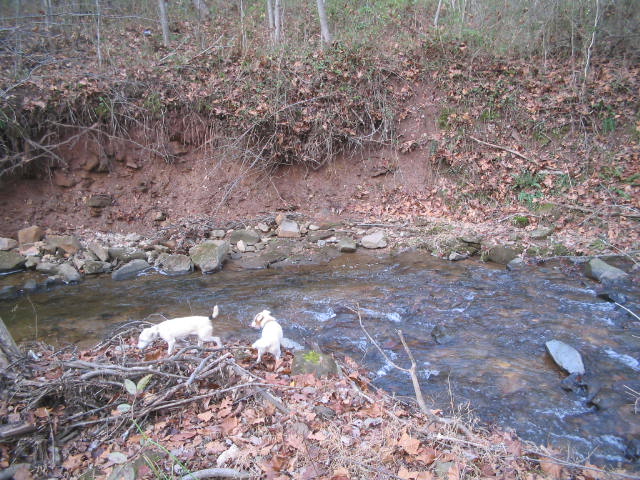
The dogs hunt up a creek bottom a little while later.

Saturday, October 21, 2006

JRTCA Selling American Working Terriers

The JRTCA is also selling American Working Terriers for those that have not yet acquired a copy through this blog, Read Country Books, Amazon.com, Tideline Books, or www.terrierman.com. The book offers practical, common sense information on terrier work for the beginner, laid out in a clear no-nonsense style with chapters on the history of working terriers in Europe and America, along with sections on introducing young dogs to work, tools, technique, American terrier quarry, hazards, and veterinary care for working dogs. The sections on veterinary care and tools alone will save most people more money than the cost of this book, while the tips on digging, locator collars, skunk toxic shock, and handling quarry at the end of a dig, may save you more than money. >> To order from the JRTCA

Tuesday, October 3, 2006

Rabid Coyote Found in Pennsylvania

Rabies is sufficiently common in the Eastern United States that the handling of live raccoon, fox, groundhog, skunk or feral cat has to be treated with a great deal of caution.

If it is a mammal, it can get rabies. For some reason, probably low body temperature, possums almost never have rabies.

How common is rabies? Every once in a while, simply go to Google News and type in the word "rabies" and see how many states -- and which ones -- are reporting that week. It's generally pretty sobering.

As the coyote has come east, rabies has begun to infect this animal too. Though rabid coyote attacks on people are still very uncommon, this qualifies as a true wildlife nightmare.

The good news is that rabies infection rates are likely to spiral down in the new few years due to aerial innoculation (through bait) of wildlife populations. Though the effectiveness of oral vaccine is not nearly as high as that administered via a shot or jab, it is high enough that it is expected to break the back (at least for a while) of the widespread rabies pandemics we have had sweep through the eastern U.S. especially among raccoon populations.

Woman Slams Door on Aggressive Coyote -- from the Associated Press, Sep 29, 2006

SINKING SPRINGS, Pa. - When a man and his dog dashed into the house with a rabid coyote on their heels, his wife slammed the door on the coyote's neck.

Craig S. Luckenbill said Thursday that he ran to get his 12-gauge shotgun, and his wife managed to close the door, but the coyote continued biting at the door and the front of the house.

The coyote was in the front yard when Luckenbill went out and killed it with the shotgun, he said. "I'm a hunter but I've never seen anything like that."

The Pennsylvania Game Commission confirmed Wednesday that the 40-pound eastern coyote Luckenbill shot on Sept. 21 had rabies, the first coyote to test positive for rabies in the state.

Luckenbill said he had heard one of his dogs barking, found it fighting with the coyote near his patio and tried to pull the dog away, but the coyote followed until his wife trapped it in the door. "When it tried to come into the house, my other dog Annie got involved to protect my wife," he said.

Both dogs had been immunized for rabies and received booster shots after the attack, he said.