Showing posts with label Pearl. Show all posts

Monday, April 6, 2009

Digging on the Dogs


Yesterday was a nice day in the field with perfect weather, and three kinds of quarry dug to -- raccoon, groundhog and possum.


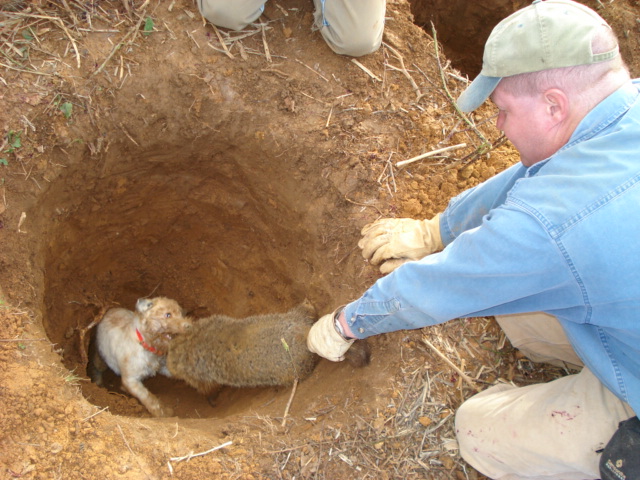
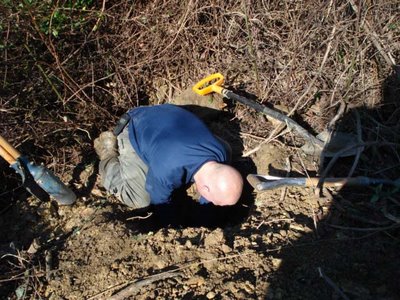
Mountain located a raccoon
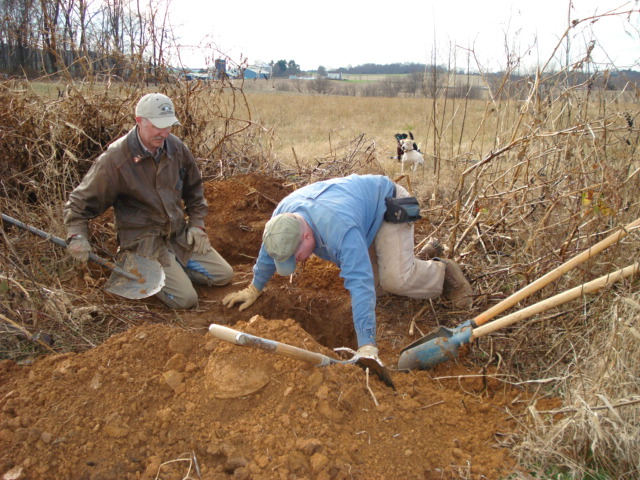
in a dirt den underneath a massive brush pile. I will spare you the details, but suffice it to say I managed to burrow down into the brush pile and sink a bore hole between mountain and the raccoon. I then twisted the post hole diggers so they blocked Mountain from reaching the raccoon, and she got the idea and finally came out. Good thing too, as there was no digging her out, and she was not coming off that raccoon any other way!

I leashed up Mountain and we drove to another farm a short way up the road, where we quickly located a groundhog and dispatched it at the farm manager's request.


I estimate I have taken 200 groundhog off of this particular farm, and there are not many left, though the farm manager says he has lost a few turkeys to a coyote, and the farm across the road took an enormous coyote last month -- the largest in the County so far.


The dogs checked a few more holes, and Mountain located a pretty tough-acting possum, which I pulled before Mountain decided to teach it respect. Possums are pretty harmless creatures, and though Dave the farm manager has chickens this fellow was toward the back of the farm, so I released him with nothing more than a stern warning.


This possum was released unharmed.

.

Tuesday, November 20, 2007

Stray Pictures From a Very Small Sunday


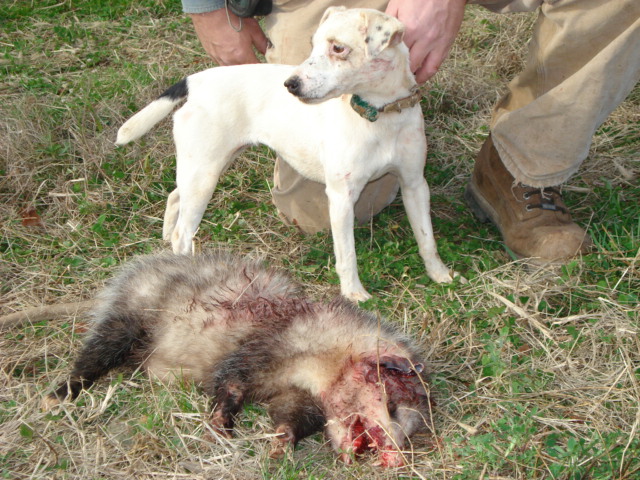
Pearl found this possum in a hedgerow dump full of old pieces of metal
, tires, boards, barbed wire and even an old chicken coop. This was an undiggable sette, with a huge roll of steel fencing pinned to the top of the earth by a tree that was growing through it. No matter; Pearl had fun, and I was happy she found before Mountain did -- a rare win for her.


Mountain found in this sette
which was in the middle of an enormous old Sycamore tree -- another undiggable sette. The side of the tree trunk was covered over with huge rounds of wood cut from the top of the tree which had blown over some years earlier.

At the end of this last day of the groundhog season (they are starting to hibernate), two were found, none were dug, and there was no regret. The dogs came away healthy, and we all had a happy day in the field.

Fox season will start in January.

Monday, October 8, 2007

Digging on the Dogs


First one of the day, quickly and humanely dispatched.


There was a fog out early this morning, and on the back roads I notice that both the Poison Ivy and the Sumac are starting to turn red. Fall in not quite here yet, but it's coming.

I do not expect this will be much of a year for leaf color -- the drought has been too fierce. When it gets this bad, the leaves just give up the ghost and come down in great brown drifts.

In drought, there is never much of a color guard to welcome in winter.

Things are beyond dry. The Potomac River is so low that the rocky gorge at Great Falls look like a foreign river. In the smaller creeks you can find dust on the stones where a pool should be. Not good.

The corn is all burned up, but still standing, while the soybeans have already come off, or are in the process.

I visited Nick's Farm last weekend, but the dogs found nothing in two hours of walking around. I have hunted this farm for a long time, and taken several hundred groundhogs off of this 250-acres, but I think Dave's aggressive plowing and ripping of dens has been what has really pushed things to a low level.

Dave has a number of free-range chickens, and he tells me he has just added a pen of turkeys. He says he lost 30 chickens to a raccoon which he trapped and shot, and I told him about two raccoons I had taken out of an old feed bunk some time back. Raccoons up near the house and the chicken pens will not last long with Dave's traps in action. He says he also took out a skunk with 6 babies. I tell him next time to drown them rather than shoot through the trap. Less stink that way. There are a few small things I know about.

Dave gave my name to a farm owner up the road (Call him, he'll get rid of your groundhogs), and I really like this new farm and appreciate the referral. I notice that the soybeans have already come off. A harvest transport truck is still in the fields, and it looks like there might still be some standing beans above the ridge, but with the fog we had, it's still too early for anyone to be cranking up the machine.

I tape up the locator collars really well, as the dogs will be in and out of water today. We check out a few dens in the bean fields, but the groundhogs have left. Who can blame them? There is not much left to eat in these fields. These dens might hold fox in a few months, however, and I will make their acquittance now.

The dogs and I go down to the creek, where it is still green, and the dogs are in and out of a den, but it's hard to tell if they are interested or just playing grab-ass, when -- BAM-- a groundhog bolts out of one of the holes and runs up a tree. Man that was a fast bolt! Smart groundhog. Good for him -- we'll be back later and see how he fares next time.

The dogs settle down and start working, and a bit later they locate again. It's a pretty shallow dig in a tough thicket of tree roots. After a bit of a saw job, we catch up to the groundhog who is not too enormous. He is quickly terminated and recycled for fox food. That's the deal on this farm -- clean out all the groundhogs along the creek where they are wrecking the stream banks. "Yes, ma'am right on it."

Mountain finds another occupied sette and bays it up good, and it sounds like a raccoon. I try to locate. From the sound, Mountain is staying and baying in one location, but the locator is a little shy about exactly where that location is. The box seems to read equally well in a four foot radius. Not good. I bar down to locate a pipe, and hit one, but after digging down to it, I realize it's the wrong one. Or the wrong bit of the right one. As it turns out, there are several den pipes here that are very close together thanks to the intersecting tree roots which keep the ground solid despite all the tunneling.

I eventually hit the right pipe, pull Mountain, and swap Pearl in. Pearl skits up the tube, digs through some dirt and starts to bay. The critter is making a noise that can best be described as "furniture-being-dragged-across-the-floor." I am pretty sure it is a raccoon, as this is the sound I expect from them. I posthole down between the roots for a foot or two, but hit an obstruction and cannot get in enough to figure out what it is. There's not enough room to cut it or remove it. Lots and lots of roots -- always a problem when digging alone.

I cut another hole in the wrong location, but at least I can get into the pipe here, and I reach in and grab Pearl who has a cut lip. I tie her up, and I am turning around to snare whatever's in the den pipe when a large, dark-colored groundhog crowns out of the den entrance. A groundhog? It tries to bolt, but it doesn't make it very far despite my considerable surprise. Damn if I have ever heard a groundhog make the sounds this one did!


Two down (and one bolted), but I am dead from the heat, and the dogs and I head back to the truck.

The day started off with a promise of Fall, but shook that off pretty quickly. Now it's 90 degrees in the shade -- not that we found any shade.

I am cooked, but we'll be back. Hopefully, it will be a little cooler.

.

Wednesday, July 25, 2007

Root of the Problem


The bar is six feet long, the roots were 12 feet wide and over five feet high.


I met up with Chris at a general store in Adamstown, and he had Brick with him, a red fell terrier. I had Mountain and Pearl with me, both in fine shape and anxious for a day in the field.

We crossed the small bridge spanning the creek, and parked behind one of the outbuildings on the farm.

This farm used to raise calfs, but now it's corn on one side of a creek and soybeans on the other, with a narrow pasture down the middle on either side of the creek, and good soil almost everywhere. If there is a more ideal habitat for terrier work, I have not found it.

I did a thorough job of taping up the locator collars, as the dogs would likely be in and out of the water.

Finding holes was not going to be a problem. When the owner of this place first called me, she said she was anxious to reduce the number of groundhog settes along the creek, as they were undermining the bank. I was skeptical of this assertion until I saw the problem, but she did not exagerate or get it wrong; it is groundhogs causing the damage, not muskrats. And there are a lot of holes. Yahoo!

The dogs and I have been doing some abatement work on this farm for the last couple of weeks, and perhaps as a consequence we did not find anything for the first 200 yards or so. At a spot where I had found raccoons on a previous dig, however, Pearl slid into the earth and began baying.

I was surprised this sette was already reoccupied, but not dipleased; I had done a good job rebuilding the den, and I could not tell where I had cut into it before.

Pearl continued to bay, and I collared up Mountain, and then Brick was in another hole and baying, and Pearl came out and I quickly grabbed her and collared her up before she could try another entrance.

Brick was clearly on it, and baying. We boxed her, and then began to bar and dig, but then she stopped baying and came out and tried to get into another hole. I went over and undid Pearl, a more experienced dog, but she too seemed suddenly confused by the sette.

After a few minutes, it became clear that whatever had been there had either bolted off or dug in and bottled itself off with dirt. A bolt was my bet. This sette has an exit over in the ditch somewhere -- one of the coons had bolted out of there a few weeks earlier. I had not bothered to locate the exit then, and now I gave a half-hearted look for it, but still could not locate it. It was not an obvious exit. No mind; there would be other holes this day.

But luck was not waiting for us at the next hole.

We walked down the side of the creek, checking a few settes in the grass, and then Mountain began baying up a storm just slightly behind us. She was in the hedge along the creek, and as we approached a very large Sycamore tree, we heard Pearl open up as well.

Both dogs were in on it, wherever it was.

Coming up to the tree, I realized that what I had initially thought were stones were actually roots (click on pictures to enlarge). These massive roots had fused into each other, creating a solid floor of wood; you could not get a bar into a crack, much less a shovel or post hole digger.

There were two good-sized den holes at the top, rimmed by tree roots as thick as my calf and thigh. This was clearly an ancient sette that had been dug when the tree was young. How long had it been here? A hundred years was not out of the question.

The roots spread across the top of the bank about 10 feet long and four feet wide. Wow! This place was a fortress.

I slid down the bank to see if I could locate another entry hole, or at least get nearer to the location where the dogs were in and baying

As I came down the bank, I realized the roots of this massive tree went straight into the water.

For a second or two I was confused. Were the dogs on this bank or the other? The baying sounded like it was coming from the middle of the water.

I looked at the bank I had just come down. There was a solid wall of fused roots that stretched to my left, forming a solid wall 12 feet long and five feet high. Wow. It looked like something out of Angkor Watt.

I listened carefully, and now I could tell the dogs were clearly baying from within the mass of roots -- the water had been reflecting the sound off the opposite bank.

I listened and it appeared the dogs were baying right at the water line. I felt along the root structure at the water line, and found a very small hole on the far left side that looked like it might have been large enough for a rat to get into. I figured that might have been where Mountain entered. Or perhaps she entered from one of the holes on top. Who knows?

I listened with my ear next to the root mass, and it was clear Mountain was just on the other side, on the far right, but there was a lot of solid wood between us. A felt along the water line where the roots met the water, and there was a small slit there, about as wide as a pencil. I could feel a larger passage behind that slit. That was where Mountain and Pearl were located. Not knowing what kind of critter was up in there -- or exactly where -- I was not anxious to wiggle my finger around in the dark. The slit was too small to get the dogs out of, and rabies is a serious thing and far from uncommon in my part of America. The dogs are innoculated for rabies, but I am not.

Chris and I poked around for about 40 minutes, looking for any way at all into this sette, but there was no place to even start. We each had key-hole pruning saws, but you cannot saw into the middle of a 10-inch thick wall of wood that is backed by dirt if there is not even a starter hole to stick a blade into.

Poking around right at the water line, I located a small chink, in the otherwise impermeable mass of roots, and we managed to open it up to a fist-sized hole by alternatively smashing it with a shovel blade, slamming the cutter head of the bar into it, and sawing. If I lowered myself right into the water, I could just look up and see a bit of Pearl through the hole. She was above the hole and seemed to have plenty of oxygen and she was not anxious to come out. The action was inside! Though she was a bit shy of dry, she was in no danger of drowning.

Mountain was up the pipe in front of her, and though I could not see her, she was clearly face-to-face with the critter and going at it with voice and teeth. Pearl was behind Mountain and waiting her turn. From the sound of it, I was pretty sure the critter was a raccoon.

What to do?

There was no digging this sette, and after about 40 minutes looking for another alternative, I told Chris we should pull off and hunt Brick up the creek. If the dogs could no longer hear us, there was a chance they might come out on their own. Short of an 18-inch chainsaw (Chris suggested a 24-inch chainsaw would be a better idea) we were not going to get these dogs out through our efforts alone. Even if I had a chainsaw, I would be loathe to use it as I would be working blind and with no assurance I could avoid cutting a dog.

We walked up the creek with Brick and found many more holes, but Brick never pinged on a location.

We went quite a ways up the creek, but my terriers did not follow on after us. They were still that damn root sette.

After about a half hour, we crossed the creek at a low spot, and came back down the other bank towards the dogs. It was here that we located the Black Rat snake and a little farther on that we bolted a nice red fox from the brush. Excellent!

Brick followed the fox into the corn a ways, and I continued on, focusing on the opposite bank, and trying to remember exactly where the dogs had gone in.

And then I heard them -- still baying up a storm.

I stood on the creek bank opposite the enormous wall of roots and listened. Mountain and Pearl had swapped out positions, and now it was Pearl baying. Not knowing what else to do, I took out my camera and took a short video of barking roots (and an expectorating Chris). The dogs had already been in the ground about an hour and a half.


Chris and I waded across the creek and tried a new tack. I found a spot on the edge of the root mass about four feet up the bank. I could just get in a post hole digger -- a simple bore straight down, with no possibility of expanding the hole due to the roots. I got down about three feet, and then Chris spelled me and he dropped down another foot or so with a little help from the bar. In the end, he got down as deep as the water and gravel sand of the creek, but we were too far back from the hole and there was no way to improve the angle or expand the pipe due to the enormous roots.

We had bored a hole to nowhere. That said, the hole was not for naught. The pounding on the ground seemed to amp things up down in the root mass, and the critter and the dogs seemed to reach for a resolution beyond a stalemate.

At some point something happened, as Mountain was now suddenly baying higher up the bank and on the opposite side of the tree, while Pearl was still going at it in the location she had always been. This was not one raccoon, but two! Or maybe it was a pair of fox.

Chris and I discussed the possibilities. I did not think groundhogs would be paired up this late in July, and I did not think they were ever going to go into a sette this wet. Groundhogs want a dry sette if they can get it, and with the drought we have been experiencing, there was no reason for them to settle for anything else. But who knows?

A pair of young fox was a very real possibility, but it was a pretty wet sette for them too. Raccoons made all the sense in the world, and nothing else fit this location quite as well.

While Chris continued to plumb our hole to nowhere, I went up top to see if we had missed something where Mountain was now baying. We hadn't. The locator now said Mountain was only two feet down, but she was under at least 18 inches of solid root, and there was not even a crack in which to slip a saw blade.

I leaned back against the trunk of the Sycamore and tried to slow down my breathing. This was going to have to be a waiting game. At my age, you learn to wait things out. This too will pass. The dogs were not in distress, Mountain was a very experienced dog, and Pearl was pretty soft and would probably be fine despite her youth. The dogs could get out if they wanted to, and they would get out in time, of that I had no doubt. This was not a skunk, so no worries there. Except, of course, that I did worry because after a long time underground with two raccoons there was likely to be some damage to the dogs.

An odd noise came from over head, and I looked up to see a blue heron flying overhead squawking, legs trailing out the back. A nice bird, and very common in this area. I noticed a corn cob on the ground -- more sign that this was a raccoon, especially since the corn field was about 100 yards away. I leaned back against the tree trunk, closed my eyes, and tried to focus on my breathing. Time more or less stopped.

I do not know what made me open my eyes, or how long they had been closed, but when I cracked them open, Mountain was just slidding out of the pipe at the top of the sette about four feet in front of me. She was crouched low, trying to sneak out in order to find a new and different way back in, but a word from me and she knew she was busted.

I scooped her up. She was very muddy, and bleeding from her muzzle, but she did not look too bad. When I got her down to the creek and washed her off, I could see she had a good puncture on top of her muzzle, and a smaller one below; a classic raccoon or fox bite. With the cold water on her wound, Mountain began to bleed, but I knew it was mostly colored water, and nothing serious. The bleeding brought on by the cold water would help clean out the wound. I tied out Mountain on the opposite bank, and waited.

Pearl had stopped baying now, and I was pretty sure she would come out soon. And she did -- Chris scooped her up as she exited up top.

Pearl was in considerably worse shape that Mountain, with the right side of her muzzle pretty knackered. I got her down to the creek and checked her out; she was skinned up pretty badly on the right side of her muzzle, and there was at least one decent rip under her right lip. All in all, however, my first impression was that her injuries might look worse than they actually were. There did not appear to be any huge wounds, though it was a mess and a bit hard to tell with all the mud and blood on her. I would have to check her over more carefully at the car.

We packed up the tools and headed back to the vehicles, where I flushed Mountain's puncture with ProvIodine. I decided to glue her puncture shut, since it had been self-cleaning so well. I loaded her up on 500 mg of cephelaxin to obviate any chance of infection.

We washed off Pearl, and I looked her over as best I could, but there was nothing to be done with her wounds but to let time sort them out. There was some damage inside her right lip, and there was going to be a lot of swelling, but there did not appear to be any really deep damage. I pressured 500 mg. of cephelaxin into the back of her throat to obviate any start of infection.

At home, while washing Pearl, I found one good deep canine muzzle gash on the top of her muzzle, which sealed the deal that this was a pair of raccoons. A little ProvIodione, and then a crate was what she needed. And time.

Now, two days later, all seems to be moving forward to a place called fine. Mountain already looks and acts as if nothing happened to her. Glue is a wonder.

Pearl still looks pretty knackered if you look closely at the right side of her face, but you would not know there was a problem from her body language alone. There is still a lot of swelling on the right side of her muzzle, and there is a very large scab over the debraided parts on that side, but it appears to be healing well, and I have continued to load her up on antibiotics as a precaution. She is eating well, if a bit carefully. In fact right now she is in her little bed next to my computer, licking her paw and looking up at me in expectation of a possible Cheerio. Come on Dad, I'm an invalid!

I figure it will be at least three weeks off before Pearl sees the field again, but August is not a bad month for a vacation, even if you are a dog. Mountain can fill in the slack in the interim.

All in all, the dogs did three hours underground and never stopped working the whole time. For a small and young dog, Pearl did well. If we humans could have gotten to them, it would have been a 15-minute thing, but sometimes God tests humans as well as dogs. No one panicked, and each side of the team did his job as it could be done that day. All is well that ends well. More or less.
.

Monday, July 2, 2007

A Nice Day on the Creek

No pictures this time, as I gave my ancient digital camera (an eBay cheapo) to my son for his Utah rafting trip. If it dies, it had a good life.

My idea was that I would get a new camera, but I haven't done that yet as I had to order a new computer this weekened as this piece of ... Microsoft ... is about to die. On the upside, I managed to keep Windows ME (that used to stand for "Millenium" back when everything was being named after The Millennium). The new machine should arrive at the end of the week with Microsoft "Vista" on it, and I am sure it will be a total disaster. In the meantime, I am using dial up. Welcome to the 20th Century.

The good new is that out in the field I use the kind of medievel equipment that Jacques de Fouilloux would recognize, and I know how to maintain it.

The first groundhog of the day was almost a "gimme," as there had been two young ones in this sette last weekend, and Mountain nailed one while the other bolted. This time Mountain entered the same eye as before, and Pearl grabbed the remaining little bolter as it exited.

The rest of the day was nice, with another small one accounted for along a fenceline sette, and a larger hog bolted out to ... well, my posthole diggers.

That one was a little odd.

The groundhog bolted, I yelled, Pearl ran ahead of it, and then the groundhog froze on the other side of the fence, right in front of me, not moving a muscle and trying to blend in to the dirt pile. Pearl did not seem to see it, and was nosing around about 15 feet ahead. Mountain was still in the ground.

Thinking quick, I reached over the fence with the posthole digger, and clam-shelled the little bugger up over the fence like it was a piece of Dim Sum caught in giant pair of chopsticks. A quick tap, and it was all over.

The dogs located a fourth groundhog, and it whistled quite a lot underground and then it disappeared. Seriously -- presto, change-o, gone. My guess is that it bolted from an unseen hole, but with groundhogs you never really know; it could have dug away in the soft earth. No problem; we'll be back soon enough.

.

Tuesday, April 24, 2007

Sunny Sunday Dig


The dogs and I dug two on a picture-perfect day marred only by the fact that I was a bit tired from yard work the day before, and the fact that Pearl got her lip gashed on the second groundhog of the day.

Back home I loaded Pearl up on Cephalexin and flushed the puncture with proviodine, and it's already starting to abrade up as it should. She's out of work for the next weekend, but she should be back in the field the weekend after that. She did fine underground, baying up a storm and following on into a very tight pipe. She will learn butt from breath soon enough, as she is not a stupid dog.

Monday, April 2, 2007

First Hog of the Day


Pearl says she's not quite finished with this one, but she is wrong. This little fellow was let go, as were the other groundhogs we worked this day. This was the first hog of the day - a tight pipe, but otherwise unremarkable.

Monday, March 5, 2007

A Change of Season


Pearl on a thick root on the edge of a creek bank.

After three days of wind, I figured the ground was dry enough to work and headed out to see what the dogs could find. Since there was no telling how far I would have to walk before finding something, I decided to leave the post hole digger and bar in the truck and just go with a shovel and a pack -- a small risk, but since there was very little rock on this farm, and only a few deep settes -- both of which I would stay away from-- I figured I would be OK.

Up in the fields, a strong whipping wind burned my cheeks and made my eyes water. I pulled my orange cowl out of my pack -- it was going to be a tough day if that wind did not die down a little.

I found solid ice in the first 10 holes -- not a good sign. The dogs checked quite a few more holes before they found one without an ice plug. Mountain slid in to check this clear hole out, but no one was home.

We headed over to the edge of a wide stream bottom and walked the tall forested bank above it. I was confident that the soft dry ground here would hold something.

About 100 feet along the bank, both Mountain and Pearl pinged on three small holes that appeared to be connected to a single sette. Mountain began digging furiously at one of the holes, spending a lot of energy biting at roots. I pulled her out of the hole, and tried to cut the root with the shovel blade, but Mountain was too impatient to let me have at it. I would have to stake her out if I wanted to do any digging.

Pearl stood at one of the other holes for a bit, got bored, and tried to push past Mountain into the hole she was working. Failing that, she walked ahead of Mountain about 10 feet to a small hummock of brambles and leaves. She aggressively nosed around in the brambles, and I wondered whether she had found a bolt hole. I pulled away the brush, but there was nothing there.

I went back to Mountain to see if I could move a little dirt for her. I opened up her hole a little bit, and then stood back to see if she was going to be able to get into the pipe.

Meanwhile, Pearl had gone back to the spot under the brambles. On a hunch, I walked over to where she was pinging, and sunk the shovel into the ground. A few scoop of earth, and I was into the pipe. Good ears Pearl!

Pearl went into the pipe, and in a second she was hard on it and was trying to pull it out of the pipe. Mountain came over and squeezed in next to her, and soon the two of them had a small Spring groundhog out of the hole far enough that I could dispatch it. Count this one for Pearl!


A small and very dead Spring groundhog placed high up in a tree so the dogs will stop ragging it while I pack the tools.


I filled in the holes, and we headed across a small bit of marshy ground
and up through a small neck of woods to a couple of narrow fields that have small patches of woods between them. This was nice ground -- part of this 2,000 acre farm I have never worked before. I followed the dogs down the fields and into the woods where we found a nice stream that was a bit too wide for us to cross. We double-backed up through the woods, and the dogs found again. Once again Mountain worked the front of the hole and Pearl located the groundhog by listening for it to dig away. A few scoops of earth, and it was all over for groundhog #2.


The second small Spring groundhog of the day.

It was only noon, but I decided to call it a day
and head back home so I could have coffee with the wife. Two groundhogs this early in the season was a nice quick take, and the dogs had done well and were in fine fettle to boot. This was a small relaxed day without any drama and I did not want to spoil it. Plus, there's always next weekend!


Pearl slides into the ice to check a pipe.

Monday, February 5, 2007

Cold Enough to Freeze the Balls off a Brass Monkey


.
On Sunday, it was cold enough to freeze the balls off a brass monkey.

For those of you who are wondering, a "brass monkey" is (supposedly) a lipped plate that was screwed to the deck of a battleship while in port. Four iron cannon balls were then racked up in the plate, with three on the bottom and one on the top to form a pyramid. When it got really cold, the thin brass plate would contract far more than the iron cannon balls. The result: canon balls rolling aound loose on deck .. a very bad thing. Or at least that's the way to the story goes.... it apparently is not true.

Nonetheless the phrase feels right, if you know what I mean. Without a doubt it was brass monkey weather on Sunday, with 20 mile-per-hour winds too, which I why I left so little of my face exposed to the elements.

The good news is that with weather this cold, I could drive the truck straight out on to fields, barely leaving a track in dusted white powder.

Driving down the fields to get closer to the holes was definitely the right idea on this trip, as I was digging alone and the ground was frozen solid. I would need the big Bertha spoon to cut through the first 10 inches of ice, and it's a tool that weighs so much, I would just as soon not carry it very far.

I was a bit surprised to find a couple of best-prospect fox-den locations empty or even filled in. A long walk down a likely creek bed found a lot of scent (according to Mountain), but no one home. Bummer.

I headed to another location on the farm and drove right up to a copse of woods where I knew a couple of likely settes were located.

Bingo -- the first sette out of the truck I found a nice fox crap at the entrance. Mountain wasted no time and headed in, while I went to get the Bertha, pack, posthole digger, and Pearl.


Pearl wanted into the sette too, but neither dog could get in very far, and I quickly figured out why -- the pipe double-backed at an impossible angle. If the fox had managed to get in to this sette through this enterance, it was a true Houdini.


I tied up Pearl far enough away that her collar would not read on the Deben box, and I used the heavy bertha bar and blade to break up the frozen ground enough for a spade to finally be of use.

By the time I had finished opening up the pipe
, however, Pearl was clearly freezing, and so I carried her 40 feet to the truck in order to get warmed up. On the way back to the hole, I saw Mountain racing off into the woods following a blur of red fur -- the fox had bolted just that quick. Ah well, you can't get them all on film, I suppose.

I grabbed my shovel and pack and headed off to find Mountain about 80 feet away trying to get into another sette. I knew this sette -- it was 12 feet deep (Sailor had gone to ground here), and in the middle of thick roots from surrounding trees. I had given this pipe a pass when other folks were with me to help, and it was going to be impossible digging solo in ground this frozen.

I grabbed Mountain before she got fully underground, and leashed her up. I drive to another section of the farm and we patrolled another creek bed together, but found nothing and I decided to call it a day.

Tuesday, January 30, 2007

Not Dead Yet

It's been a couple of weeks since I posted, which is not like me, but I have been very busy with other things that have kept me out of the house, if not exactly productive. No, I am not dead yet.

On the up side, in the last two weeks I have driven the entire length of the Shenandoah Valley of Virginia, and I am here to day that the valley's beauty is not over-stated. Another upside is that I understand the geology of the area a little better, due to simply looking a little longer at a large scale map. The Appalachians are some of the oldest mountains in the world, and though I have walked more than a 1,000 miles of their length, you do not learn much about geology walking ridge lines in the woods. A good large-sale map, well-studied, can tell you more about geology than a thousand miles of road or trail.

It has been incredibly warm -- as high as 72 degrees some days (in January) and never falling below 50 degrees until this Sunday when Chris and I went out for a short dig on a raccoon, which we let bolt off. Mountain found something again, just as we were leaving, but I pulled her from the den pipe and gave that critter (probably a possum) good leave. Hopefully it will be colder this weekend coming up -- we shall see.

The two Russells have been squabbling a bit, sorting out the pecking order, and it looks like Pearl has come out on top, as unbelievable as that sounds. She is about a half inch shorter than Mountain, and lighter too, but I think she wanted the slot more. I could care less who is top bitch, so long as it is settled and understood . Trooper, of course, is top dog and no one seems anxious to contest that (not that Trooper himself seems to care too much).

On the book front, I've been reading "1491" by Charles Mann which is both well-written and completely mind-expanding. It's about the Western Hemisphere before Columbus landed, but it's also about lost history and a lot more. This is one of those books that fundamentally changes the way you think, and though I am only 80 pages in to it, it gets my highest recommendation. Best of all, it is now available in paperback for only $15, which strikes me as bargain of a lifetime. Do yourself a favor and get this one.

Tuesday, January 2, 2007

Hunting Wide

Saturday morning started out with the kind of fog they write about in Sherlock Holmes novels, which I suppose, is just a small reflection of how warm it has been. Before the day was out, it would almost hit 60 degrees -- far too warm to find fox to ground.

Since the area I had scoped out by aerial map had a lot of trees on the edges of larger fields, I did not expect to find too many raccoon to ground, and it was unlikely we would find a groundhog out and about despite the warm weather -- their cycles are driven by daylight more than temperature. Bottom line: If we were going to find anything on this new land in this part of the season and on this warm a day, it was most likely going to be possum. The fox would come later.

By the time Chris arrived, I had taped up both collars and gotten the tools out, and switched from David Crosby to Tanya Tucker. Pearl had just finished her first heat cycle, so she was ready to be out.

My goal today was to scout some new fields along the Monocacy River. Chris and I followed the river bank, and found plenty of holes, but no one home. This was going to be fertile ground in the Spring, however.

A very long island was just off shore from the river bank, and at the very end of it were a couple of duck hunters in a blind working a mechanical robo-decoy. I am not much for these contraptions -- it's just a hop and a jump to mechancial callers, and it seems too much like cheating to me. There's nothing wrong with hunting and coming up with a blank day once in a while. There is a place where technology should end, and it's a bit short of mechanical decoys with flapping wings if you ask me.

We passed the long-gone remains of a gutted deer hanging from a tree. It was perhaps several weeks old, and it did not look like much was taken other than the head and the back loins. The carcass would provide food for fox, but it looked like quite a bit of meat had been left in the forest.

A short distance from the deer, and on the slope up from the river to the fields, I realized Mountain was not with us. We stopped and waited, but she did not emerge, and I was pretty sure she had found. Chris moved down the slope, and I moved up towards the fields. where I found her just outside a beautiful sette. She had gone to ground and extracted, and killed on her own, a mid-sized possum. It was a bit anti-climactic, as Mountain had not bayed, and there was no dig.

Mountain has always had a problem with self-hunting and staying close. I think when Sailor was alive she ventured farther out than Sailor did just so should could find something in the ground for herself. Unfortunately, that practice has not ended with Sailor's passing. I guess finding quarry is the ultimate reward for the bad behavior, and that makes it particularly difficult to end.

I would not care except that it wastes time, the noise of calling for her scares quarry away, and it is very dangerous should Mountain find a skunk in the ground without me knowing exactly where she was. That said, it was a beautiful sette, and it looked like the kind of thing a fox or raccoon would use when the weather turned colder. I put this one in my memory book.

We headed up the slope into the fields, and I was thrilled to find a beautiful rolling field with a short grass winter cover, and a long hedgerow at the top, followed by an even larger field, also in a short grass winter cover, and another nice hedgerow beyond that, and another beyond that. Excellent. When it gets colder, I am sure we will find fox here.

As we walked up the fields, we found groundhog hole after groundhog hole. Some of the larger settes had eroded into large funnels at the entrance. This was clearly good friable dirt. I was pretty sure these fields had been in soybeans or alfalfa for at least two or three years -- you generally don't get this kind of groundhog density without those cover crops.

We walked up the fields a pretty long way, coming to a section parallel to an area we had hunted in the past. The new fields were separated from the other area we had hunted by an upland area of forest a few hundred yards wide. That may not sound like much distance, but in this part of Maryland the soil can change dramatically from one area to another over a couple of hundred yards. That upland piece of forest land was not an accident -- it was the remains of a rock and shale uplift, and it had existed here since the time of dinosaurs. The bend in the river had existed here just as long, and my theory -- based solely at looking at the maps -- was that the soil on the other side of that uplift and closer to the river would be deeper and richer due to river deposits and down wash. It looked like I was right.

Despite all the dens, the dogs failed to locate. Groundhogs move out of their field settes in the winter to seek harbor inside the tree line; very few winter over in field settes. We headed back down the fields along the edge of the trees. A deer hunter fired very close to us when we were inside the tree line, and I was reminded, once again, that hunting on Sunday is always the best plan, especially in deer season.

We headed back down the edge of the river, and then up again into the end of a large field. We had worked the other end of this field before, and as we approached that end, Mountain suddenly began baying furiously as if he had caught something above ground. Game on! I ran down the field with pack, shovel, bar and posthole digger, but was brought up short by a downed tree in the hedge. By the time I had gotten through that, the dogs were quiet. I called for Chris and found him on the other side of the hedge, looking a bit perplexed. What happened? Apparently Mountain had caught a very large deer sleeping or resting in the hedge, and the deer had as hard a time getting through that downed tree as I did. Mountain and Moxie had been right on the deer, and had chased it out of the hedge. The two dogs and the deer had bolted in directions unknown.

Chris and I whistled, and we took turns walking a large circle. It was about an hour before I found the dogs on a farm path not very far from where we had lost them. Mountain was unscarthed, but Moxie had a line shaved into her fur where a deer hoof had grazed her. The skin was not broken, but a thin line of fur was gone, as neatly trimmed as if it had been done with a Wahl shear. That was close.

All's well that ends well, but it's clear to me that I am going to have to do something about Mountain's self-hunting. I have never had a dog riot on deer before, and I have never had a dog hunt as wide as Mountain does. Time to end it.

That night, I ordered an electronic collar from Innotek to help me break Mountain of bad habits and to help train in new ones. The problem is that Mountain is smart, and she knows that off the leash there is no "correction." It does not help, of course, that she also gets a maximum reward for hunting wide -- she finds quarry more often than most. At this point, my natural aversion to electronic collars has to take a back seat to safety. The collar is cheap compared to the price of a new dog -- or losing an old one. One thing I am sure -- it will not take Mountain long to figure out that she can no longer hunt wide.

Wednesday, December 27, 2006

Suicide Raccoon


My dogs have free run of the back yard, and can enter the garage down a simple wooden staircase that is connected to a dog door that comes through a ground-level window at the back of the garage.

The staircase is penned in such a way that at the base of the stairs there is a small area of blank floor -- about two feet by four feet -- and under the stairs are three dog crates with heating pads in them.

The situation is a bit unconventional, but pretty close to ideal, as the dogs have free run of the yard, and can tuck in to stay warm and dry whenever they want. This set up has worked very well, and without a hitch, for about 10 years. And then there was last night.

Last night, I was in my study doing a little bit of reading when a terrific commotion came from the dogs out in the garage. At first I thought the dogs were fighting, and then I thought maybe one of them had gotten his leg caught in a crate somehow. When I got outside, however, it turned out that the dogs had a raccoon down inside their little area inside the garage. The raccoon must have entered the garage through the dog door, and then come down the stairs. The raccoon's bad luck was that Trooper, Mountain and Pearl were asleep, each asleep in their heated crates, doors off, at the bottom of that staircase.

I did not have any shoes on and I was not getting into that pen to sort thing out before I got them on! With that done, I opened the top of the half door into the pen, and got it sorted out in short order. I am happy to say the dogs came out without a nick and Trooper, long retired, proved that he still ranks as the World Hardest Dog.

This suicidal raccoon tipped the scale at 18 pounds. I would have let him go if there had been any other option, but inside the garage, in such a narrow space, and with three dogs on him, there was no other option but the one I took.


Monday, December 4, 2006

A Trifecta in the Field


Static pushes into a tight pipe.


Mike B. was down from Colorado, and he and his Jack Russell, Static, joined up with Chris and I for a little action on a farm up near Baltimore. It was 29 degrees when I started out in Arlington at about 7:00, but it climbed to about 50 degrees during the day. Pearl stayed home this outing -- she came into her first heat on Saturday.

The first "find" of the day was a raccoon, found by Mountain and Moxie. Moxie worked it well and with a lot of grit, while Mountain perched at a bolt hole. The coon bolted for an exit with Moxie hard on it's butt, but Mountain was at the exit and sorted it out pretty quickly, with a little dispatch help from Chris. Moxie worked this coon well and came out with only a small nick -- a nice outcome and good work from this young dog.


Mike with Moxie (Patterdale) and Mountain (Jack Russell), and Chris with raccoon.


We crossed the road to the other side of the farm and worked down a creek bed. Mountain went to ground in a really nice eight-eyed sette in a mound of soft earth, but she never opened up. Mountain stayed underground for a long time, and it was only after we left, came back, and then dug a bit that she finally came out at all. I leashed her up. There was clearly a groundhog down there, but it was down for the count and walled in behind dirt. There was going to be no finding it in a sette this large and complex. Nice try Mountain Girl.

As we moved up the creek bed, a red fox bolted out of the hedge and ran up the field. It's still too warm and too early in the season for fox to be denning. Give it a month. This farm holds fox -- Chris and I had located here last March, and I have dug a few here in years past. January and February will come soon enough.

Mountain opened up in a hedge a little ways up, and when we reached her she was under a dry mound of sticks, with her tail wagging furiously in the hole. A bit of brush clearing, and a quick hole punched in the top of a shallow pipe, and we located a large male possum. Mountain pulled it out with the help of Static, and we terminated it. An 11.5 pounder -- not bad for a possum.


Mountain with possum.


We headed up the field, past five dead cows. This is a dairy, and diseased cows are generally shot and left to rot at the back of the farm, providing ready food for fox, possum, raccoon and coyote.


A little digging combined with a little watching of the dogs at work.


We decided to work a small copse of woods in the middle of field. This little patch is riddled with holes, but before we got to our destination, all three of the dogs opened up on a sette located in the middle of a jumble of old poke berries.

I tied up Mountain, and both Moxie and Static pinged on a small mouse hole at the bottom of a stopped pipe. Both dogs were too gung-ho for something not to be there, so we postholed past the blockage and found a den pipe. A bit more digging and locating, and we had a nice end-of-year groundhog. Yahoo -- a three-quarry day. Excellent!


Getting Static out of the hole was achived by pulling out the terminated groundhog.


Tired, we called it a day just in time for Mike to change clothes, wash off Static, and high-tail it to the airport for his flight back to Denver. My bet is that both Mike and the dog slept all the way back. It had been a fine day in the field with good company and three working dogs.

Is this a great country, or what?

Monday, November 27, 2006

A Change of Season and Quarry


Chris peers into the hole.


On the drive out to the farms this morning, the truck thermometer said it was 33 degrees out, and the first frost of the season was evident on the grass. The temperature would climb at least 20 degrees today -- maybe 25 -- but the groundhog season was over, as groundhog hibernation is driven by light, not by temperature. This is true for bird migrations too -- an unseasonal period of warm weather in the Fall does not fool the birds.

Beginning with Thanksgiving and continuing to Christmas -- a period of about a month -- it's hit or miss with quarry, with a very high liklihood of getting hit by skunk, and a better than-average chance of finding possum and raccoon. After Christmas, the raccoon and skunk are generally hibernating (the male raccoon will begin moving around again in early February as they beging looking for mates), and groundhogs will very occassionally exit to defecate and then trundle back down to sleep for a few more weeks. Possum are active all year long, though they will lay up for long periods of really cold weather. After Christmas until the first of March it's fox season, with the peak in late January and running through February.

Chris and I met at the Flint Hill store. I had in mind pulling into a new parking spot close to a creek bed we could walk looking for game, but as I drove by I noticed two SUVs parked right where I wanted to pull in. Deer hunters. It turns out it's the first day of shotgun season. Oh goodie. How many first days of the season are there? First day of early black powder, first day of shot gun, first day of rifle, first day of bow, first day of regular black powder .... No worries -- off to another farm.

I turned around, and Chris followed me back up the road, and we pulled into a nice big place that has a nice creek and a small bog on it. It was going to be a nice clear day -- not too cold or windy -- and I had high hopes. Or should I say I had high hopes until I got out of the truck and walked 100 feet. The fields were soaked. Where did all this water come from? I did not remember too much rain from the week before, but it had clearly come down very hard here just 25 minutes up the road.

We hunted the dogs up the hedge, busting out a fair sized doe and a black-and-white feral cat which managed to get away with its life. We crossed above a boggy area and hunted down the top of a field where there were quite a few holes in a more-or-less dry hedge row. A large new push-pile has been bulldozed up, but nothing was home.

We crossed down the field to a creek bottom and began walking up the high side of the creek. Mountain gave voice for a second, and the dogs and I followed into the hedge, but nothing could be found, and Mountain trotted up from behind us as if she had bolted something into the field. Whatever it was, it was lost now.

We continued down the hedgerow on the high bank above the creek. In the distance I could hear guns blasting away. There was a large metal tree stand -- the type large enough to hold four hunters and a propane grill -- overlooking this field. No one was in it, but I still found myself routinely looking up the hill to make sure I was not being scoped in on.

At the end of the hedge, we crossed over the creek and begn walking up the hill to another long hedge about 100 yards above the water, but Mountain was nowhere to be found. We waited a bit, and I whistled, but after another minute it was pretty clear Mountain had found.

I crossed back over the creek and began boxing some likely settes, but she was not in them. Chris crossed over too and walked up the hill towards the big deer stand but did not find anything. He then crossed back over the creek and began walking down the high hedge where we had been headed, while I continued to call and box a few more possible settes. Chris whistled and said he had found her -- he was walking down the field and pointing to the same hedge I was in, but about halfway back down the course we had just come up. He could hear herfrom up on top, but the acoustics were such that even though I was closer, I could hear nothing.

I gathered up my tools, and Chris did the same, and we headed over to see what Mountain had in the ground. I doubted it was a groundhog -- it would have dug away by now. Probably a possum, maybe a coon. Or a cat. Too warm for fox yet.

Mountain was on the other side of the creek, and we waded over to find her in the middle of a very old and thick multiflora rose jumble. Time to break out the machetes.

This sette had about five eyes, and a quick boxing showed Mountain about three feet down in a mess of old roots and brambles. We hacked away at the vegetation, and then worked with machete and saw on the thick roots twising along the ground. After we had it cleared it out pretty well, I reboxed to locate the dog, found Mountain to be exactly where she had been before, and we began to dig.

This was not a particularly hard dig, but we did pull out some big rocks -- one the size of my upper torso, and the other the size of a small turkey. At one point Mountain came out -- she had been underground working this critter for about an hour, and whatever it was could not go anywhere or dig away.

With Mountain out, Pearl slid in and bayed it up nicely -- a nice deep voice. Mountain, hearing Pearl give voice, turned back around and pushed her way back in down another hole. She winkled past Pearl somehow, and Pearl came out. Pearl's a very young and inexperienced dog yet, but I am very pleased with how readily she is entering and working. This is only her third dig.

Pearl had riled up the critter in the hole, and Mountain was winding it up a little more, and by now, from the sound in the pipe, I was pretty sure we had a raccoon.

At about two and a half feet down we hit dry dirt, and I was pretty sure the dog was only ahout 6 inches deeper. Chris scraped the loose dirt out of the hole, and I carefuly barred and broke through into the den only 6 or 7 inches below. Excellent. Time for the posthole digger.

This last six inches was very dry and seemed to be made up of mostly degraded rock, but the posthole digger is a tough instrument, and it punched through in short order.

We pulled Mountain and tied up the dogs while we opened up the hole to see what we had. Chris dropped Moxie in hole, and she shot up the pipe and engaged -- there was small a roar in the hole and now I was sure it was either a coon or a very loud possum. Moxie has a habit of going for a head grab, but this time she was working in the dark, and I told Chris to let her work it a bit as I doubted she was going to be so brave and foolish wihtout light. After a while, we pulled Moxie, and she seemed to be no worse for the wear. A little dark tunnel work is all Moxie needs. She's a great little dog.

Chris went to tie Moxie up, and I looked in the hole to see the top of a raccoon head poking out. Hello!
The raccoon took one look at my ugly face, turned around, and pushed in as deep as it could. I postholed the pipe a bit to cut away the overhang, and I could see the raccoon's tail now. After a brief pause to see if she would relax, turn around, and bolt out on her own, we brought Mountain back over, and she turned the raccoon in short order.

With the coon turned around, we pulled Mountain and I got a snare over the coon and pulled it tight. We had decided to take picture and let this one go, but as the cable tightened up the coon pulled backwards very quickly and the cable came down on top of its head rather than over its neck. Not good. I tightened up the cable, but the raccoon squirmed free and then bolted. I told Chris to release Mountain, and he did. After a second or two of confusion (What do you mean it's not in the hole?) Mountain was off down the bank, through the water, and up the other creek bank. We let off the other dogs, and they too took to the water. A commotion with a lot of barking and snarling told me Mountain had caught the coon in a brushy jumble on the other side, and I leaped over to sort it you, which was done in short order. This was a female raccoon with an enormous posterior and she weighed 16 pounds.

We tied up the dogs, repaired the sette, and took a few pictures of the raccoon before heading back to work along the hedge. The dogs located nothing more on this farm, and we headed off to Nick's to see if we could find something there.

At Nicks the dogs had a nice run around before we headed over to a high bank above a creek. This is a fairly bad area, as a lot of rubbish has been tipped down this bank -- old pieces of plywood, bits of metal farm equipment, spoiled straw bales, spoiled soybeans, some old rugs, part of a small outbuilding -- but it is riddled with groundhog holes and is a likely spot for possums. We did not go fast through this section -- there were a lot of holes, and it would take the dogs a bit of time to find them.

Mountain was ahead of us down the creek, when Moxie showed interest in a hole. I downed tools and descended the embankment and pulled a few leaves out of the hole and encouraged Moxie to give it another sniff. In she went. Excellent. Chris came down the bank, and I tied up Pearl, and broke out the shovel. Chris was at the hole when he suddenly said, "Oh sh--; it's a skunk." We both began moving very quickly now. Chris began locating and it was not good news. Due to the steepness of the bank, the dog was about 6 feet down. The good news was that the ground was very soft -- wash down loam from the fields above. The diggin would not be hard, but it would not be quick either.

Chris started opening up the entrance hole and calling for Moxie, while I began to dig a hole from the top. I did not think she was as deep as the box said -- or at least I hoped she wasn't.

There was no sound coming from the hole. Minutes went by, and both Chris and I got a very bad feeling. Chris and I switched positions, with him digging on top and me clearing out dirt from the side hole. Suddenly I saw movement -- a white dog coming out. What the hell? It was Mountain. She must have gone to earth here without either of us seeing her. I could have sworn she was up the bank.

Mountain was out now, and she was reeking of skunk but seemed entirely fine from the experience. As I was tying her up, Chris called over -- "Here's Moxie". She had exited from another hole up on top -- a very small hole a few feet behind where Chris was digging. Lucky for us this sette had three or four eyes.

The dogs were fine -- Mountain got the heaviest part of the skunk blast, but Moxie was nailed as well. We gathered up the tools as the stench rolled out of the hole and down into the creek bed. It was pretty bad.

We crossed the creek on a plank bridge and headed up and over to the other side of the forested hill to hunt in the woods. We were not likely to find here, but that was OK -- the dogs needed a bit of time to let the stink drain off of them.

Chris busted a buck -- maybe four or six points -- and we bolted another three does while we were just on the other side of the steep hill that descended down to the Mononcacy River. There were several large brush piles here, but they were empty.

Later on, as we headed back to the cars, Mountain headed up into a field to check a large old sette. She went to ground and stayed, but she did not bay. I think she could smell the groundhog, but it was dug in for winter and it was not moving and there was no way to find it.

We headed back to the trucks where I had a brand-new bottle of Skunk Off (a seasonal precaution). I dosed Pearl first, even though she did not have much (if anything) on her, and then I washed Mountain with Herbal Essence shampoo to get off the dried black mud from the last hole of the day. Now that she was back to almost-white, I dosed her with Skunk Off and crated her.

Chris I worked over Moxie next, rubbing Skunk Off into her coat and paying as much attention as possible to her muzzle, front legs and chest where the spray was most likely to have been concentrated.

As we finished up with Moxie, a couple of deer hunters showed up for twilight shooting -- a father and son. The father looked stoned, and his shotgun had a scope which always looks like an odd fit to me, but is increasingly common. They asked about deer, and we told them that we had seen a few. As we pulled off the farm we stopped to talk to Nick, and Dave the farm manager who were repairing a bailer.

The dogs were a bit stinky, but otherwise this had been a fine day in the field with a bit more experience given to the two young dogs. All in all, not a bad day, but next time we may need to leave Mountain crated to give the young dogs a little more experience on their own.
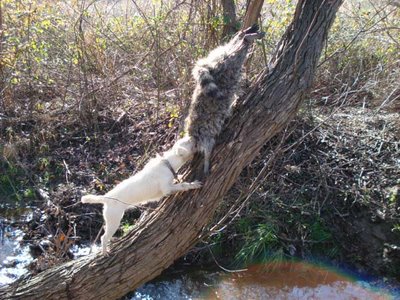


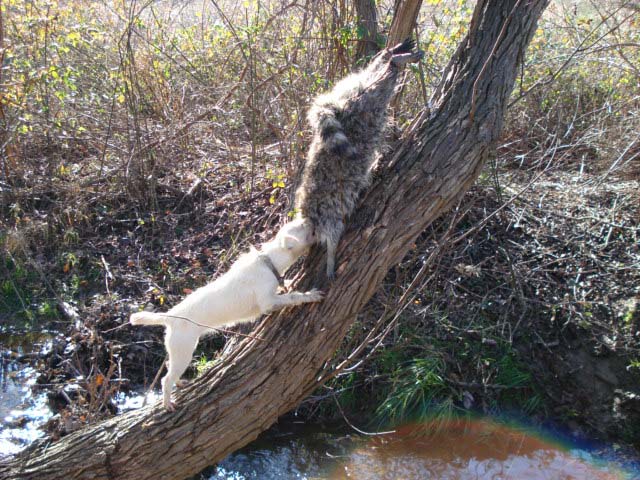
Pearl climbs a tree to grab a very dead raccoon. She got to work this one a little, as did Moxie.

Wednesday, November 22, 2006

Skunked On Sunday


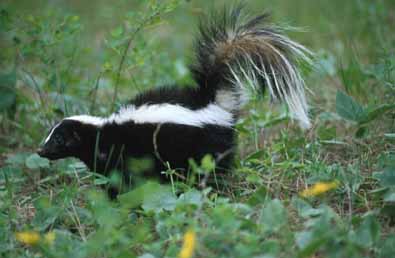
Mountain got skunked pretty good on Sunday, and Pearl caught the edge of it too, as she was right there at the hole.
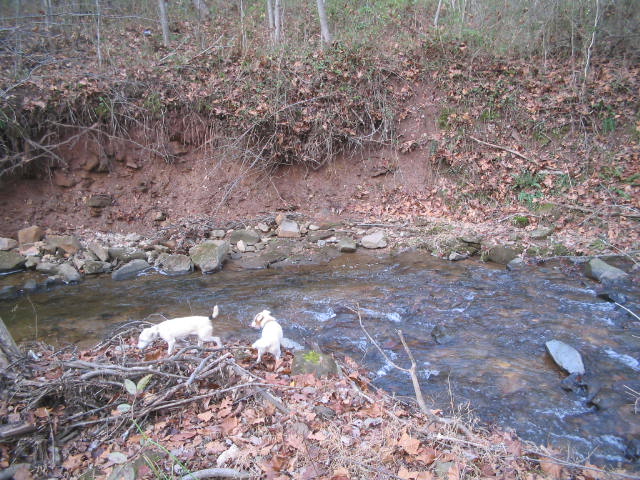
Mountain came out OK, and was a bit dazed for a few minutes, walking around with her tail down, but she was back to her old self within a half hour. She had no burning of the eyes or blisters on her face (skunk spray is almost pure sulphuric acid), and was hunting again in short order.
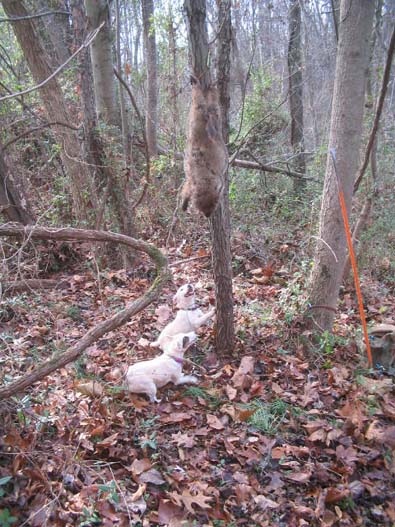
The bad news, of course, is that the skunk stink lasts and lasts and last.

Skunk spray is a mixture of thioacetates and thiols (the stuff that stinks), mercaptans, and almost pure sulphuric acid. Bonded sulfur and hydrogen atoms in thiols attach to the same nose receptors that sniff out hydrogen sulfide ("swamp gas"). Human noses are highly sensitive to thiols and can detect the smell at just 10 parts per billion.

Skunk spray also contains compounds called thioacetates, which slowly break down into thiols. When a skunk sprays a terrier, thioacetates in the spray are absorbed into the skin of the terrier, and these thiocetates slowly break down into new thiols, resulting in the skunk odor reappearing on the dog a day or two or three after it has been well-washed in "Skunk Off".

Water seems to speed the process of thioacetates breaking down into thiols -- one reason that dogs smell skunky after they get wet. Getting a dog wet repeatedly over several days will not "drain off" all the thioacetates, however -- some part of the release is purely time-sensitive.

No matter what you do, it will take about a month or even 6 weeks before skunk odor completely disappears off a well-dosed dog. The best you can do is to invest in a lot of "Skunk Off" or make up your own using a box of baking soda, a quart of hydrogen peroxide (dilute 3%), and a squirt of hand soap.


Pearl at the edge of a skunk den located under fallen branches.


The dogs hunt up a creek bottom a little while later.

Monday, November 20, 2006

The Dogs Practice Their Vertical Hold


Mountain and Pearl gather ....


... and leap for a very dead groundhog. A little fun in the woods on Sunday.

Friday, November 10, 2006

Pearl With Another Groundhog from Sunday


Pearl kept this one bottled at the bolt hole, but Mountain located it. That said, the penny has clearly dropped for Pearl. She says this is fun!

Wednesday, November 8, 2006

Chupacabra Hunting With Terriers


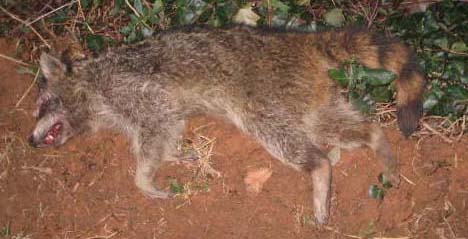
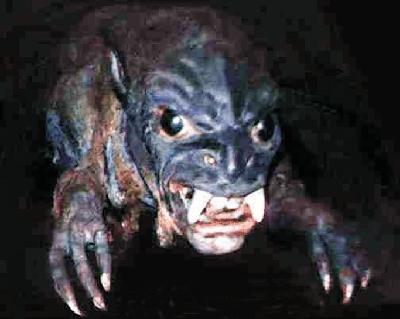
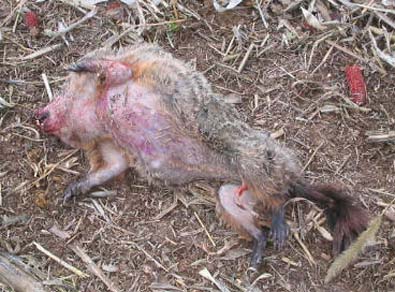
This is a picture of a fake Chupacabra. The dogs caught a REAL one!


The photo, above, is a not-very-good model of a Chupacabra. We sometimes hear of El Chupacabra, but it's very rare to know anyone who has actually seen one in the field, much less been lucky enough to bag one. But that is what the dogs and I did on Sunday, and I have the pictures to prove it.

But I am getting ahead of myself. What, you may ask, is a Chupacabra?

El Chupacabra is an animal that is known to inhabit rural areas of Mexico and parts of Central America. Its name, translated literally from the Portuguese and the Spanish, means "goat-sucker" for its habit of attacking and killing lifestock and draining them of all their blood.

It is not clear when the Mexican Chupacabra first came north to the United States, but by the mid 1990s, it was here. Mexican farmhands in such diverse places as Kentucky, Oklahoma, and Tennessee, would periodically come across dead livestock in the fields with torn windpipes and every ounce of blood drained from their carcases. "El Chupacabra," the migrant workers would whisper. "It has come El Norte with us."

It is easy to write such things off, and, in truth I have always done so myself. Where are the pictures of El Chupacabra? Where does it live during the day? Why does it only come out at night? Where is the proof? There were never any answers. Until now.

On Sunday, I was walking the edges of a cut-over corn field with the dogs in tow, when Mountain slid into a hole and opened up to a full bay. A few minutes later, this thing came barreling out of the ground.

Mountain followed it out of the hole and gave chase, and soon caught it by the rear leg. Pearl, still young and full of herself, piled into the scrap too. Both dogs had it above ground and on its back. I ran over and put my boot on the creature so it could not bite the dogs. But ... what the hell was it?

And then, I knew. It was El Chupacabra -- the infamous Mexican goat-sucking blood beast of legend.

By God I had one, and it was not going to get away. And it didn't.

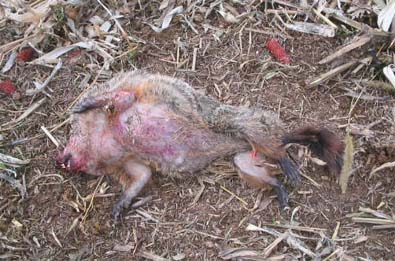
Now there are some who may doubt my story, but I have appended pictures of the Chupacabra below, for anyone to see the horror of this thing.

Clearly, this is not an animal found on earth. This animal is the work of the Devil. This is El Chupacabra.


Monday, November 6, 2006

Pearl's First Day in the Field

After a bit of trying to work with it, we have decided to change Spice's name to Pearl. It's still girly, but sounds a little less odd coming off my lips and yet it also still fits her -- a small white treasure. Pearl is a clever little dog and is already coming to her new name.

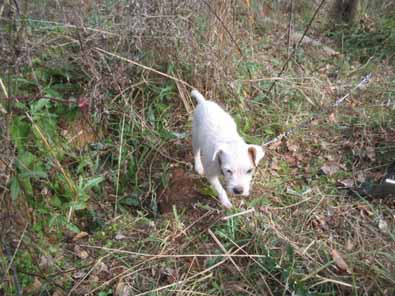
Sunday was Pearl's first day out in the field, and she did very well, going down a den pipe, digging to scent, holding a bolting groundhog at bay, and otherwise getting the lay of the land while coming to no harm whatsoever. I was pretty thrilled to see her slide into a pipe without a moment's hesitation, and to hear her bay up a storm as well. She has a bit of fire in her, I think, and she should have a lot of fun in the year ahead..


Part of the farm I was hunting, with the edge of a small mountain in the distance.


Pearl, Deben collar on, staked at a bolt hole.


Pearl, hearing Mountain below ground, strains to get down the bolt hole.


After the dig, Pearl is let in to the hole, and she digs into a small side pipe following the scent.


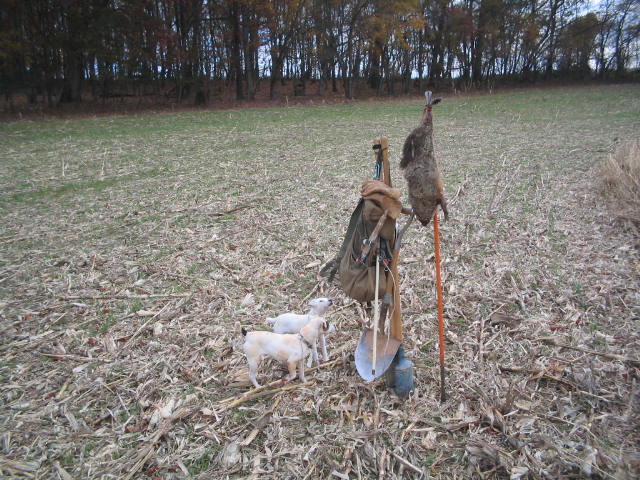
Dogs, tools, and groundhog in a corn field that has been put away for winter.

Saturday, October 14, 2006

Oberlin

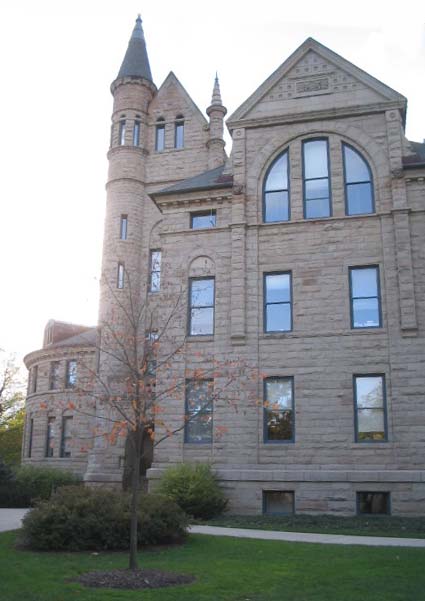
I stopped off at Oberlin, Ohio on the way back from picking up the dog. Oberlin College is a small school for common-as-ditchwater kids that are pretty smart and a little odd. The school boasts an impressive conservatory and a history of leftist social activism that is a source of pride for both the school and the alumni.

Oberlin was the first school in the country to admit women and also the first school in the country to admit blacks. It's motto is "Learning and Labor," and the typical Obie (if there is such a thing) grows up in the spirit of service and with an eye to changing the world just a little bit for the better.

All of this is theory, of course. Diversity at Oberlin includes every odd thing imaginable, but it does not often stretch to having a conservative born-again Christian in the classroom. It's not that Oberlin would not welcome such people (they would), but that such people tend to get uncomfortable around blue-haired girls with nose piercings, and inter-racial lesbian couples, and people who talk passionately about the evil that was (and is) the KKK.

Their loss, if you ask me -- there are some fascinating creatures at Oberlin. You do not have to actually wrestle with the bears to watch them and even admire them for their struggle to exist. In fact, most of the people at the school pass for entirely normal; it takes only 50 truely odd people out of 3,000 for it to feel like a parade.

The college and the town have not changed too much in 25 years. A few new buildings, a few new stores in old buildings, one old store in a new building, etc. There was one very odd sign that made even this alumnus pause, scratch his head, and reconsider annual giving. Such is the march of progress.

Tappan Square is a 14-acre park on the edge of campus and it looked pretty much the same, except that the Oberlin Rocks seemed to have grown smaller.
Barney, my late great terrier, was painted on to the side of one of the Rocks for a while, when he was "lost." It turned out he was not lost, but instead had been stolen by the dispatcher for the local Police Department. I marched right over, picked up my dog, and committed no bodily harm only because the police and I had met before.

Let it be said that somewhere in my files at Oberlin is a notation about me and the dog. "The dog is very well behaved, but Mr. Burns is not. It is best to ignore the dog and act as if it is invisible." I have not actually seen this note, but I was told it was there by someone who managed Wilder Hall. In those days, my terrier was (in theory) persona non grata on campus, but I am not one for authority if it makes no sense. At Oberlin, you learn to push back against oppression in any form.

I was, at times, strapped for cash in College, and I well-remember a month when I figured I would save a little money and buy Barney generic dog food. He would not touch the stuff, but I figured that would change when he got hungry enough. At the time I was pinching pennies myself and living off of raw rye (from a feed store bag in the lab) and yeast (also from the lab), and washing it down with a pitcher of beer an evening at the Celler in the basement of Wilder (I was broke, but beer was a prioity). While I was in the Cellar, Barney was tied to a bench in the hall. Generally he slept there and no one paid him a mind.

Weeks went buy and Barney did not seem to be losing weight, but he was not eating that generic dog food either.

All was explained one evening, when I came out to find one of the older woman who worked the grill stroking Barney's head. "Is this your dog?," she asked. "I give him a T-bone steak every night."

Barney just looked up at me and laughed, comfortable in the old lady's lap. I tried to give the dog a reproachful look, but I suspect it came out as grin. Barney and I always admired anything that got by on grace and cleverness alone. I certainly admired that smart little dog.

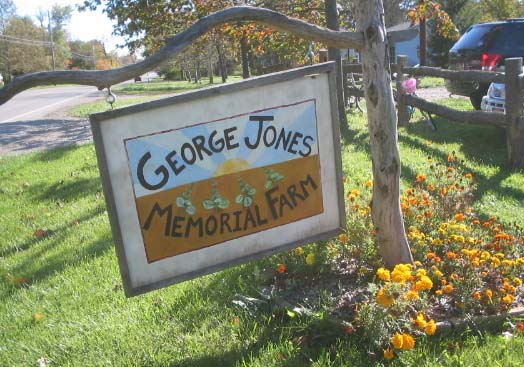
While going to the book store to look for a few things on my little excursion back to college, I noticed that a huge old tree on Tappan Square was gone, replaced by a small grouping of low shrubs. The tree had been planted by Professor George Jones' kindergarten class -- a fact that Professor Jones himself had told me when he was 92 years old.

George Jones was introduced to me by David Miller, another biology professor, and I remember well the day that Professor Jones and I went mushrooming for morels. This was a big day for me, not only because I was in the hands of an expert (though I was not a complete slouch, which is why Professor Milller had introduced me to Professor Jones), but because mushroom hunters are not ones to show others where the best ones lie, lest they might poach the best grounds. Going out with George Jones was like getting 70 years of local mushroom lore dumped in my lap. Only later did it occur to me that a 92-year old might not worry too much that others might steal his mushroom grounds in future years. At 92, you should be so lucky to live that long. But George Jones was lucky -- he lived to the age of 101.

I walked around Campus and stopped by a couple of places where I used to live. I even went inside Wilder, which seemed more-or-less the same. I drove out to the reservoir, and Spice -- the new dog -- and I walked around it together.

I walked this reservoir I lot when I was in college, as it was just a short walk from Johnson House where I lived my last year -- a huge pink, Queen Anne Style house with an attached farm with land that ran clear to the reservoir. How good was that? I even had an original Picasso in my room that year -- a loaner from Allen Memorial Art Museum. It was not a great and important piece (Picasso sometimes did 75 drawings in a day), but it was a Picasso all the same.

I remembered Reefer -- the large Pit Bull Alan G. had adopted off the streets of Oberlin, just as I had adopted Barney, my little terrier. One cold winter day, Alan and the dogs and I walked the reservoir, which had been frozen for weeks, but had begun to thaw a little after three or four days of warm weather. Water stood on top of the ice, and in the middle of the reservoir someone had hacked a hole for a couple of ducks to bob around in and feed. Reefer took off after those ducks, and in the darkness and moonlight, it was a truely surreal moment, as the massive dog seemed to be walking on water, busting the ducks into flight out over the ice and the bright white snow. More than 25 years later, I remember it like it was yesterday.

At the Ben Franklin, where they sell a better selection of used books than any you will find in most big city book stores, I mentioned that the large organic garden that we used to have at Johnson House was no longer there, and that I found that a little odd considering the huge new Environmental Science building that had been constructed since I left.

"Oh, all the farmers are out at the George Jones Memorial Farm," said the cashier.

Ah! So the giant tree is gone, but Professor Jones lives on in the land forever. All is good and right with the world.