Showing posts with label Ohio. Show all posts

Monday, March 31, 2008

Otter Ironies


One of the ironies of wildlife management is that the very devices that pushed so much wildlife to the edge of extinction -- guns and traps -- are the very things that are now working to bring wildlife back.

The difference between today and 120-years ago is the rise of hunter-conservationists who understand the value of hunting seasons, the need for limits, and the necessity of wildlife habitat conservation and reclamation.

In earlier posts, I have detailed the history behind the return of the wild turkey which, in the space of 50 years, went from teetering on the edge of extinction to a population of 5.5 million birds distributed over a greater range than occurred even in pre-Columbian times.

Wild turkey hunting is now a billion-dollar-a-year industry, with 2.6 million hunters harvesting about 700,000 birds a year.

The article below is about the return of the river otter to Middle America. As Audubon magazine noted just a few years ago, "More than 2,000 river otters have been caught in legholds in the South and released virtually unscathed in Midwestern states where the species had been extirpated."

Back in the 1990s, when the river otter was being reintroduced in Ohio, Audubon was not only defending the use of leghold traps as necessary for the reintroduction of species like the river otter, but also for management of such species as the wolf and nuisance abatement of other species such as beaver, raccoon, and red fox.

For those interested in the foundation history of wildlife management in America, Aldo Leopold's book on Game Management is still in print more than 70 years after its first publication. Chapter 10 is on predator control. >> Click here to buy


January 21, 2005

Ohio wildlife officials consider allowing otter trapping after success of reintroduction programs

By: Carrie Spencer, Associated Press

_____________________

The wily and playful river otter was once on the verge of extinction in Ohio. Now they're thriving - and causing so much damage that wildlife officials are considering allowing hunters to trap them.

It's a situation other states have had with other animals. In Florida and New Jersey, it's the black bear. The Rockies and Alaska have the gray wolf. Nearly everywhere else, it's the white-tailed deer and Canada goose.

"In a human-dominated landscape, it's really tough to keep wildlife in the numbers we feel are appropriate," said Greg Butcher, a zoologist with the Washington-based National Audubon Society. "We have affected the environment so much that a lot of natural checks and balances are gone."

The otter's numbers have soared in just two decades - from 123 to about 4,300 - and Ohio wildlife officials are proposing a permit-only two-month trapping season. The Ohio Wildlife Council will vote on the proposal in April.

The U.S. Department of Agriculture estimates that wildlife causes US$1 billion ([euro]770 million) in crop and livestock damage each year, while deer collisions injure about 29,000 motorists a year and cost another $1 billion ([euro]770 million). Bird collisions cost the aviation industry $740 million ([euro]572 million) annually.

The otter's story is familiar. Fur trapping drove the native species from Ohio by the early 1900s, but their reintroduction - starting in 1986 and lasting seven years - has been so successful that farmers are starting to complain. A family of otters can eat half the fish in a privately stocked pond before the owner gets wind of their visits.

"If they find a nice trout farm, they're pretty happy with that," said C. Greg Anderson, assistant biology professor at the University of the Pacific in Stockton, Calif.

Otters used to be in every U.S. state except Hawaii but were wiped out over 70 percent of their range, Anderson said. Reintroduction programs began in the 1980s in 21 states, all successes. Missouri, one of the first with 19 otters released in 1982, now has more than 10,000 and allows trapping, he said. Kentucky began its first otter season this winter, running through February.

Government-sanctioned hunting of all kinds of animals is proliferating across the country.

Starting in February, private landowners in Montana and Idaho won't need written approval to kill gray wolves harassing livestock, while Wyoming is suing the federal government to get its wolf management plan approved. From about 30 wolves introduced 10 years ago, 825 or more now live in the three states.

Florida wildlife officials reported a record number of sightings of threatened black bears in 2004 because of sprawling development and busier roads. The state is studying the bear population and could lift its protected status this year.

New Jersey's second annual bear hunt was called off this year amid a dispute over the state's management plan. New Jersey has more than 3,000 bears, up from fewer than 100 in the 1970s.

Hunting groups once feared the disappearance of white-tailed deer, but management encouraging reproduction worked too well. Last fall, the Cleveland suburb of Solon became the latest Ohio community to hire sharpshooters to cull the prolific landscape munchers.

Few success stories compare with that of the giant strain of Canada goose, which was nearly extinct in the 1960s because of hunting and lack of their preferred grassland habitat.

In the Midwest, restrictions on hunting coincided with the explosion of office parks with manicured lawns and lush golf courses. The birds, with their 6-foot wingspans, are now fouling picnic spots and hissing and nipping at golfers. States from North Dakota to Pennsylvania have expanded hunting allowances.

While some see overpopulation as triumph over extinction, the Animal Protection Institute sees it as failure on the part of wildlife officials. Reintroduction of a native animal requires planning to prevent an overrun, said Barbara Schmitz of the Sacramento, California-based institute.

"A lot of times, lethal solutions are looked at first," Schmitz said. "It is possible for them to become part of the balance of nature again."
.

Tuesday, March 20, 2007

Glass Middens

There are odd things you find again and again in the woods, and one of them you stumble across every once in a while is an area replete with lot of broken glass -- old bottles and jars mostly, with the occasional small piece of scrap metal or iron. Who the hell is dumping all this broken glass in the woods?

It took me some time to recognize what I was looking at: a midden. A midden is a term an archaeologist would use to describe an ancient trash pile. About a quarter mile up the road there is an ancient shell midden left by pre-Columbian Indians who gathered mussels from the Potomac River just down the hill. Today no one gathers mussels from the river -- groceries come in cans and bottles, and these are what fill our modern middens.

The glass middens in our woods are not very old, of course. Most of them represent that period between 1900 and 1950, when the country was fairly affluent, lots of goods were being bought in packages and bottles, and settlement was getting denser but rural trash collection services did not yet exist in many areas. Back then folks would toss their trash into a heap at the the edge of their property, burning it every once in a while in order to reduce mass and speed decomposition. This was a period before plastic, and anything made of paper or wood rotted, and a surprising amount of metal also atomized down to rust. Glass bottles might break, but otherwise they are as enduring as stone -- virtually untouched by rain, snow, mold or rot. If the broken glass is not plowed under or buried, it will stand proud on the ground or protrude a bit after being partially sunk in thanks to the heaving action of worms.

The trash you find in the woods is often some indication of how old the trash is -- the secondary growth around you represents the time passed since the trash was initially dumped on the edge of a field or hedge.

About 25 years ago, I came across a glass-filled midden in Ohio that consisted of many hundreds of shattered Ball canning jars, and in between were bits of broken glass tubing. I walked around collecting unbroken Ball jars and old zinc canning lids, but the glass tubing flummoxed me. What was that? And then I realized what the spot had been: an old moonshiners still. The tubing had been part of the coil, and the jars were the retail end of the operation. The big heavy pieces of glass represented the remains of the 5 gallon storage bottles. The zinc canning lids put this operation sometime before World War II -- probably in the middle of Prohibition.

Monday, December 18, 2006

Chesapeake & Ohio Canal


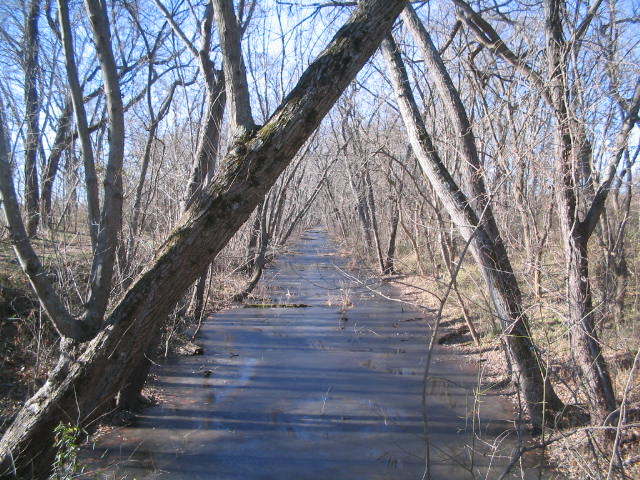
The picture, above, was taken on a little bridge over the The Chesapeake & Ohio Canal. The Canal runs 184.5 miles long from a point on the other side of the river just below my house, out into the foothills of Maryland. Originally built to bring coal to Washington, the C&O Canal was completed in 1850, and for about 70 years was a lifeline for communities and businesses along the Potomac River, allowing coal, lumber, grain and other agricultural products to float around Great and Little Falls.

At the spot where this picture was taken, the Canal runs next to about 3,200 acres of hunting land that stretches through swamp, forest, mixed fields of corn and soy, and occassional plots of sunflower and waste land above Great Falls.

Saturday, October 14, 2006

Oberlin

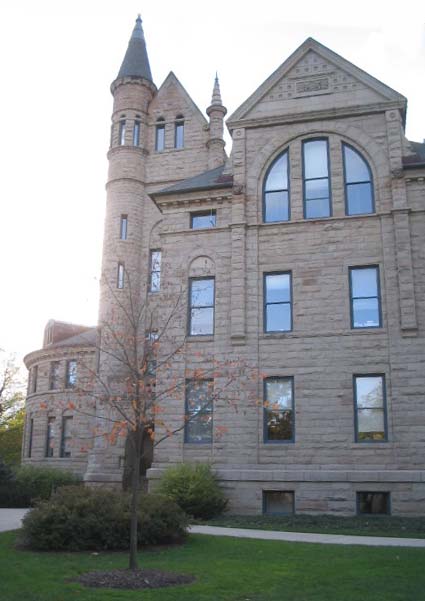
I stopped off at Oberlin, Ohio on the way back from picking up the dog. Oberlin College is a small school for common-as-ditchwater kids that are pretty smart and a little odd. The school boasts an impressive conservatory and a history of leftist social activism that is a source of pride for both the school and the alumni.

Oberlin was the first school in the country to admit women and also the first school in the country to admit blacks. It's motto is "Learning and Labor," and the typical Obie (if there is such a thing) grows up in the spirit of service and with an eye to changing the world just a little bit for the better.

All of this is theory, of course. Diversity at Oberlin includes every odd thing imaginable, but it does not often stretch to having a conservative born-again Christian in the classroom. It's not that Oberlin would not welcome such people (they would), but that such people tend to get uncomfortable around blue-haired girls with nose piercings, and inter-racial lesbian couples, and people who talk passionately about the evil that was (and is) the KKK.

Their loss, if you ask me -- there are some fascinating creatures at Oberlin. You do not have to actually wrestle with the bears to watch them and even admire them for their struggle to exist. In fact, most of the people at the school pass for entirely normal; it takes only 50 truely odd people out of 3,000 for it to feel like a parade.

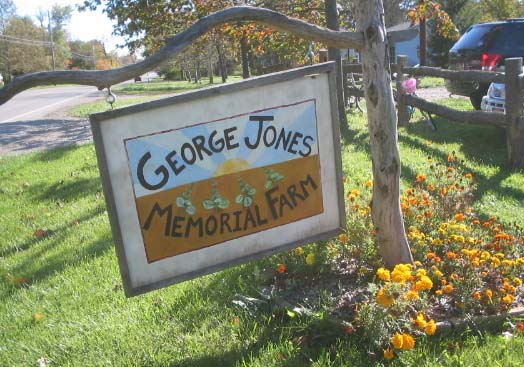
The college and the town have not changed too much in 25 years. A few new buildings, a few new stores in old buildings, one old store in a new building, etc. There was one very odd sign that made even this alumnus pause, scratch his head, and reconsider annual giving. Such is the march of progress.

Tappan Square is a 14-acre park on the edge of campus and it looked pretty much the same, except that the Oberlin Rocks seemed to have grown smaller.
Barney, my late great terrier, was painted on to the side of one of the Rocks for a while, when he was "lost." It turned out he was not lost, but instead had been stolen by the dispatcher for the local Police Department. I marched right over, picked up my dog, and committed no bodily harm only because the police and I had met before.

Let it be said that somewhere in my files at Oberlin is a notation about me and the dog. "The dog is very well behaved, but Mr. Burns is not. It is best to ignore the dog and act as if it is invisible." I have not actually seen this note, but I was told it was there by someone who managed Wilder Hall. In those days, my terrier was (in theory) persona non grata on campus, but I am not one for authority if it makes no sense. At Oberlin, you learn to push back against oppression in any form.

I was, at times, strapped for cash in College, and I well-remember a month when I figured I would save a little money and buy Barney generic dog food. He would not touch the stuff, but I figured that would change when he got hungry enough. At the time I was pinching pennies myself and living off of raw rye (from a feed store bag in the lab) and yeast (also from the lab), and washing it down with a pitcher of beer an evening at the Celler in the basement of Wilder (I was broke, but beer was a prioity). While I was in the Cellar, Barney was tied to a bench in the hall. Generally he slept there and no one paid him a mind.

Weeks went buy and Barney did not seem to be losing weight, but he was not eating that generic dog food either.

All was explained one evening, when I came out to find one of the older woman who worked the grill stroking Barney's head. "Is this your dog?," she asked. "I give him a T-bone steak every night."

Barney just looked up at me and laughed, comfortable in the old lady's lap. I tried to give the dog a reproachful look, but I suspect it came out as grin. Barney and I always admired anything that got by on grace and cleverness alone. I certainly admired that smart little dog.

While going to the book store to look for a few things on my little excursion back to college, I noticed that a huge old tree on Tappan Square was gone, replaced by a small grouping of low shrubs. The tree had been planted by Professor George Jones' kindergarten class -- a fact that Professor Jones himself had told me when he was 92 years old.

George Jones was introduced to me by David Miller, another biology professor, and I remember well the day that Professor Jones and I went mushrooming for morels. This was a big day for me, not only because I was in the hands of an expert (though I was not a complete slouch, which is why Professor Milller had introduced me to Professor Jones), but because mushroom hunters are not ones to show others where the best ones lie, lest they might poach the best grounds. Going out with George Jones was like getting 70 years of local mushroom lore dumped in my lap. Only later did it occur to me that a 92-year old might not worry too much that others might steal his mushroom grounds in future years. At 92, you should be so lucky to live that long. But George Jones was lucky -- he lived to the age of 101.

I walked around Campus and stopped by a couple of places where I used to live. I even went inside Wilder, which seemed more-or-less the same. I drove out to the reservoir, and Spice -- the new dog -- and I walked around it together.

I walked this reservoir I lot when I was in college, as it was just a short walk from Johnson House where I lived my last year -- a huge pink, Queen Anne Style house with an attached farm with land that ran clear to the reservoir. How good was that? I even had an original Picasso in my room that year -- a loaner from Allen Memorial Art Museum. It was not a great and important piece (Picasso sometimes did 75 drawings in a day), but it was a Picasso all the same.

I remembered Reefer -- the large Pit Bull Alan G. had adopted off the streets of Oberlin, just as I had adopted Barney, my little terrier. One cold winter day, Alan and the dogs and I walked the reservoir, which had been frozen for weeks, but had begun to thaw a little after three or four days of warm weather. Water stood on top of the ice, and in the middle of the reservoir someone had hacked a hole for a couple of ducks to bob around in and feed. Reefer took off after those ducks, and in the darkness and moonlight, it was a truely surreal moment, as the massive dog seemed to be walking on water, busting the ducks into flight out over the ice and the bright white snow. More than 25 years later, I remember it like it was yesterday.

At the Ben Franklin, where they sell a better selection of used books than any you will find in most big city book stores, I mentioned that the large organic garden that we used to have at Johnson House was no longer there, and that I found that a little odd considering the huge new Environmental Science building that had been constructed since I left.

"Oh, all the farmers are out at the George Jones Memorial Farm," said the cashier.

Ah! So the giant tree is gone, but Professor Jones lives on in the land forever. All is good and right with the world.