Showing posts with label hedge. Show all posts

Sunday, June 14, 2009

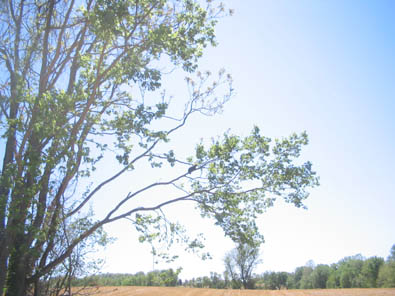
Ghetto Palms In the Hedge


A repost from this blog, ciric May 9, 2006

On Sunday Chris J. pointed to a weedy-looking plant and asked me it's name. "Ghetto Palm," I replied. "The real name is something that has two A's in its name, but I cannot remember it."

Feeling a bit sheepish for forgetting something once again (I spent the day trying to remember the word "locust") I fell back to quoting a pithy phrase from that great urban philosopher, Mr. T: "Don't do drugs -- stay in school."

In truth, my memory is getting as leaky as spaghetti colander (worse on days without too much sleep), and my eyesight is no longer too great. As for my hair, I miss it terribly, especially on cold days.

Back at the house I looked up "Ghetto Palm" and there it was -- Ailanthus altissima -- also called the "Tree of Heaven".

It's a long way from "Tree of Heaven" to "Ghetto Palm," but that's the linguistic path this plant has taken in this country.

Like so many invasive weeds, such as kudzu and multiflora rose, the Tree of Heaven was first imported as an ornamental. A small easy-to-grow tree, it lent a slightly tropical-air to 19th Century American gardens.

Of course it soon got out of the garden, and has been spreading malevolence across the world ever since. About like Adam and Eve, truth be told.

A mature ailanthus tree will produce several hundred thousand seeds a year. This little tree is truely invasive -- not only along the edges of fields, but also on median strips, driveways and even the cracks of sidewalks.

The Ailanthus can grow in almost any kind of soil, from clay to hardpan, from swamp to sandy rock, and it is not fazed in the least by thick, oily smoke from the exhaust of a passing bus. This is a tree that thrives on neglect, lack of water, and even physical abuse. They don't call it a "Ghetto Palm" for nothing.

This tree is a living monument to the tenacity of life in a harsh urban environment, and is, in fact, the star of the children's book, A Tree Grows in Brooklyn.

That said, its hardiness is its only redeeming value. Ailanthus produces no wildlife value at all. Deer will not eat it, and unlike the Staghorn Sumac and Black Walnut, both of which it resembles in appearance, it produces no seeds or nuts of any interest to even the smallest creature, not even a mouse.

The Ailanthus, Staghorn Sumac and Black Walnut have long, palm-like compound leaves but the Ailanthus has little white dots on its new branches and a vertical white stripe or ridge on older trunks, while the dots on a Sumac's young trunk and branches are darker. Sumac leaves are light-colored underneath, and this little tree rarely grows much taller than about 25 feet. In winter, the new buds of Sumac look like they are covered in velvet, a little like a deer antler (hence the name), while Ailantus are simple hard points. Ailanthus branches are arrayed in whorled tiers, while a Sumac has Y-shaped crotches. While Ailanthus leaves turn brown or tan in the fall, Sumac leaves turn bright red -- a very nice display. A Black Walnut tree is easy to identify if it has nuts, of course, but also because this tree develops a very rough and dark craggy bark at a young age-- the easiest way to differentiate it from the other two species of tree.

Though an Ailanthus tree can grow to 80 feet in 10 years, the wood is terribly weak, and so light in weight it burns away in minutes. The branches are spaced in such a way they cannot hold up a bird's nest.

While averse to deep forest shade, Ailanthus commonly dominates forest edges and field hedgerows where it formes a weedy understory when mixed with pokeweed and multiflora rose.

A particular problen with Ailanthus is that the roots can run deep and wreck water and sewage pipes. And while a Tree of Heaven in the side yard may looks pretty in summer, in the dead of winter its trunk is stick-like, and only accents the dreariness of the season.

In Virginia, where I live, some folks call the Ailanthus a "stink tree," because if you crush almost any part of the plant, it has an off-putting odor. The scent is not just offensive to the nose -- the plant is a proven allelopath as well, which is just a fancy way of saying the plant seeps chemicals into the dirt that discourage other plants from taking root. Black walnuts and rhodedendrons do the same thing, of course, but they have at least a few noble properties to serve as a counter-weight, such as nuts and flowers and wood. The Ailanthus, truth be told, is good for nothing but sheer tenacity. This is a tree that cannot be killed by merely hacking it to the ground and plowing it under-- you have to put Round-Up on it,and probably do it more than once.

After everything else on this earth is gone, the Ailanthus (I am quite sure) will be thriving. The weedy will inherit the earth.
.

Monday, March 16, 2009

If You Come Across a Fox Sette This Time of Year


You can never be too careful this time of year, as fox can sometimes be found in groundhog settes that otherwise have little or no evidence of fox occupation.

While a fox in estrus will emit a stink, natal dens often barely smell at all -- a chemical change in the fox, and a natural protective defense after she whelps.

If you do come across a natal den, handle the kits as little as possible and put them back in the den. The mother fox will return very soon and move them, provided you clear out.

You can rest assured she has dug several dens close by, as fox will often move their litters two or three times even if undisturbed -- a way to lose flea and parasite infestations, and also to reduce run marks that might lead a dog, coyote, bobcat or human to the site of the den.

If a kit is harmed by a dog, humanely dispatch it and remove it from the area of the den after returning the unharmed kits to the den. Fox mortality is naturally higher than 50% in the first year, and the loss of one kit, while regrettable, will actually improve the odds of the remainder.

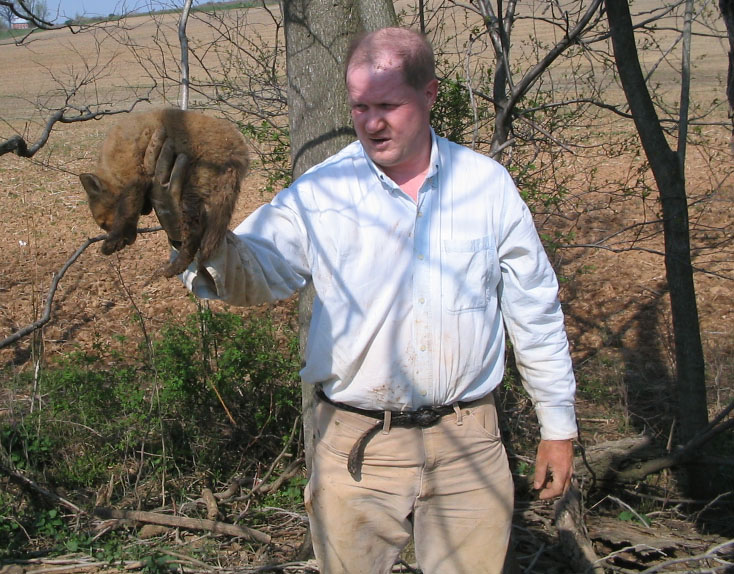
The kit, above, was an accidental run-in at a groundhog sette a few years back. There were five kits inside, and this one was removed unharmed by the dog. She was scooted back inside the sette without a mark on her, and she tumbled back down the pipe. The sette was carefully repaired with a bit of scrap rug found in the hedge, and the cubs were later spotted several weeks later and just one field over.
.

Tuesday, April 22, 2008

Winged Weapons of Mouse Destruction


A young Falco sparverius. The American Kestrel or Sparrow Hawk, sometimes called a "spar", is actually a small falcon.


Humans like to think that we see well -- a vanity we cultivate by comparing ourselves to dogs, rats and other mammals that mostly see in black and white, grays, light yellows, and blues.

In fact, most mammals have a sharply reduced visual spectrum because early mammals went through a very long period when almost all of them lived an entirely nocturnal existence.

Most mammals are still nocturnal. If you wonder where the raccoons, possum, deer and fox are in your area, the answer is that most move about only at night. The rest of the time they are resting up in thick tangles of growth, tucked up into underground dens or hollow trees, slumped into small depressions and wallows, and otherwise "loafing on the couch," just out of eyesight.

Since most humans never stray far from car or path -- and almost never venture into dense tangle or on to even slightly swampy ground -- the critters remain undiscovered.

Animals that are mostly nocturnal do well with eyes that see very little color.

The canine eye is a good example. Though your dog may sleep all night (and half the day too!) it is still only a few thousand years removed from its wolf or proto-wolf progenitor; not enough time for physical evolution of the canine eye to have occurred.

The bottom line is that dogs do not see very well -- not even sight hounds or seeing eye dogs. In fact, dogs seem to see only about one-sixth as well as humans.

Not all mammals see in a reduced spectrum, however. The progenitors of old-world apes experienced a mutation millions of years ago that resulted in more cones and rods being added to their eyes. The result is a wide range of color vision among old-world apes (chimps, gorillas, orangutans) and their cousins, we humans.

Surprisingly, some of the oldest and most primitive animals on the planet have a wider spectral rangethan humans and chimps. This includes reptiles and the likely descendants of dinosaurs -- birds.

Anyone who has tried to stalk a wild turkey knows how incredibly sharp their eyes are. In fact, all birds have remarkable eyesight. It's been estimated that a common sparrow hawk, for example, could read a newspaper from 25 yards away, while an eagle can spot the twitching ears of a rabbit from a distance of two miles.

The reason avian acuity is so high is that a bird's eye is built entirely differently from that of a human or a dog. For one thing, the retina of a bird is enormous.

The retina is the screen at the back of the eye on which an image, coming through the lens, is focused. This screen is composed of light-sensitive rods and cones, with the rods registering shapes and the cones differentiating colors.

On rods alone, the avian eye far eclipses that of the dog or the human. A human eye, for example, has about 200,000 rods, while an eagle has about a million -- five times more.

The true knockout blow for birds, however, is in the cone department. It turns out that many birds, and especially birds of prey, have cones in their eyes that enable them to see a much wider spectrum than we can, and for some birds -- such as the American Kestrel or sparrow hawk (actually a kind of small falcon) -- this spectrum includes ultraviolet light.

What's the benefit of being able to see in the ultraviolet spectrum? Simple: mouse urine glows purple in ultraviolet light (one reason "black light" is used to find old pet urine stains on wooden floors).

When a sparrow hawk hunts along a hedge, it is able to look for urine stains that mark mouse holes, runways and nests.

Mice and rats mark their burrows and runways with urine scent trails because, like most mammals, they do not have very good eyesight. Scent cues help rats and mice orient themselves in the complex world of hedge, forest, field and barn. The result is that a rat or mouse can "run" a scent trail very fast without spending time in the open trying to figure things out.

Experienced human ratters know this about rodents, and so they will drag their boot across the middle of a shed and spin long boards perpendicular to where they have been lying, all in an attempt to break up or disturb invisible scent trails. A few seconds hesitation by a confused and disoriented rat is just the edge a terrier needs to even the odds on the farm.

For a sparrow hawk, visible urine trails enable it to focus on areas where small rodent activity is heaviest. By simply flying over a hedge or field, and then lighting on a fence post, telephone pole, or dead tree near visible urine marks, a sparrow hawk can dramatically increase its chance of finding lunch.

Once activity in the grass is spotted, a sparrow hawk will face into the wind and hover low over a grassy area -- a tactic that earned it the name "windhover" or "wind fucker" in 17th Century Holland, when the terminology was considered a little less offensive that it is today.

As for ultraviolet vision, it's not all about food -- it's about sex too. It seems that all those rather drab-looking birds we see in the hedge look a lot prettier when they are seen through the lens of an ultraviolet-sensitive eye.

Birds species in which male and females look very much alike to us look very different to the birds themselves, as they have twice as many cones in their eyes and so can see shade and colors we miss altogether.

.

Sunday, May 6, 2007

Happy in the Hedge


Mountain fresh from the hole.


Today was nice and cool -- actually a little cold with the wind howling over the flat fields, but sunny all the same, and it was nice if you could get out of the wind. The ground was in good shape too; not the sloppy mud it had been a few weeks ago, or the hardpan it is going to be by mid-summer. In short, a day to be grateful.

Pearl got left behind on this trip as her lip is still knitting up, and so it was just Mountain and me. I could tell Mountain was pretty happy to have me all by herself, and I kind of liked the setup too. One man, one dog, a sunny day, and not too many worries. What else could you ask for?

The day was generally uneventful, with Mountain sniffing at a few blank holes and then spending a lot of time in and out of a complicated ten-hole sette. She never found there, but she was not giving up either, so I finally picked her up and moved her on.

A little way down the field Mountain bolted a groundhog from a brushy sette at the base of a tree, and the groundhog took off up the trunk, whistling the whole way. This was a Spring-skinny groundhog and should be fatter by the Fall.


Yes, they can climb trees.


On the way back to the truck, Mountain found again in a nice dirt sette, and I dug down three feet, put in the shovel, and let it bolt to freedom. I was pretty hungry, so we headed back to the truck for a snack and a little water.

It was still early in the day, so I swung by Nick's to check out the fields. I'm glad I left Mountain in the truck while I checked the old groundhog sette under the chicken coop, as one of the hens came up behind me and pecked me on my leg while I was otherwise occupied. A bit of a suprise! This is the first time I have seen the hens out on their own, and they were as curious as cows, and about as unafraid. While Mountain is pretty good with large stock, I make no promises with chickens, so she stayed in the truck.

The fields were newly disked, and so I will remember to come back in June to look for groundhog holes. In the interim, I notice that the Barn Swallows have returned from Brazil, which is always a nice thing to see. They are amazing flyers, zipping and falling in figure-eight patterns over the fields, scarfing up unseen insects.

On the way home, I stopped for a few minutes at Lilypons to scope a few birds and see if the frogs were out yet. The Redwing Blackbirds are back and easy to spot on the cattails, and both Purple Martin houses looked packed. Lots of Barn Swallows here too, and a Meadow Lark at the edge of the Koi Pond, along with the ever-present Canada Geeese, Blue Herons and Cattle Egrets. No frogs yet. I know the turtles are out and about, but they will not be on land on such a cold windy day. Another time for them.


Shaking off while exiting.

Wednesday, April 25, 2007

Cruel Spring


On the way to a farm on Sunday, I passed a small yellow-coated vixen that had been struck on the highway and killed within the last 30 minutes, its body not yet locked in rigor mortis.

I thought about tailing the carcass, but I have no need for a fox tail, and so I merely pulled it off the road and onto the shoulder, a bit sad at the waste and also for the young fox kits that were probably starving in a nearby den.

Because I have hunted the hedges along this stretch of highway before I had some idea of where the young fox pups might be located, but even if I found them over the next few hours, what was I to do? I cannot raise up a litter of young fox, even if it were legal to do so. And if I did find a den filled with fox pups, how could I be sure they belonged to this particular vixen? Perhaps this young vixen is a satellite vixen helping its mother raise up this year's litter. It happens all the time.

In the end, there was nothing to be done but to drive on and let nature take its course.

This is the story Animal Planet and the anthropomorphic romantics never mention -- the number of young animals that die every Spring for one reason or another.

We are supposed to thrill at all the procreation going on in forest and field, but the realist within me knows that both the fox and the the fawn are, as likely as not, going to be dead within three months of being born -- such is the natural mortality of most wildlife.

Tennyson noted that "nature is red in tooth and claw," but in truth he was an optimist. A great deal of wildlife never lives long enough to see a predator.

More often than not young wildlife simply dies alone, sick and shattered in the hedge, tree den or burrow, the victim of starvation or vehicle impact, disease or parasite, poor parenting or exposure to the elements.

Rudyard Kipling got it about right when he noted that in the modern world the most common Blood Sport is not the ancient art of the chase, but haphazard driving by people almost totally unaware of what they have done. As he notes in that great poem, "The Fox Meditates":


When men grew shy of hunting stag, for fear the Law might try 'em,
The Car put up an average bag of twenty dead per diem.
Then every road was made a rink for coroners to sit on;
And so began, in skid and stink, the real blood-sport of Britain!


Three days after driving past a road kill vixen I am still thinking about those fox kits starving in a burrow, their slate-gray fur just turning to russet. Spring is always a cruel season.
.

Thursday, March 29, 2007

Record Numbers in the Hedge


See side bar to this blog to order this, and other designs, on T-shirts, etc.
All money goes to support terrier rescue.


AMERICA IS BLESSED with many kinds of quarry
that can be worked by terriers year round: groundhog, raccoon, red fox, possum, gray fox, and badger.

Most terrier quarry is at record levels of abundance, and most folks in the Eastern U.S. and Midwest live within a half hour of excellent hunting opportunities.

Groundhog populations, for example, are much higher now than they were in Colonial times when most of the Eastern U.S. and Midwest was forested. Red fox, of course, is an import, while raccoon populations today are 15 to 20 times larger than they were in the 1930s.

In the U.K. wildlife in the hedge is also doing remarkably well and is at record levels.

Red fox populations, for example, now appear to be at the limits of biological density, with the Mammal Society estimating the late-December fox population to be stable at about 250,000, with about 14% of this population in urban locations.

In the Spring, of course, the fox population of the U.K. soars, with the addition of about 425,000 fox kits, but large numbers of these cubs subsequently die from disease or starvation, while later in the year fox numbers are also thinned by vehicle impact (estimated at 100,000 a year), shooting (estimated at 80,000 a year) and hunting with dogs (estimated at about 20,000 a year in 2004 before the so-called "ban" went into effect). In his excellent book "Running with the Foxes," wildlife biologist David MacDonald has noted that "foxhunting is of minor significance to foxes in particular, or amongst wildlife issues generally."


Red fox population growth, U.K., 1961-2000


As for badger, the Mammal Society reports that there are now more badger in the U.K. than red fox -- an astounding thing considering that red fox are now so common as to be seen as a bit of an urban plague in the U.K.

British badger populations also appears to be at their biological limits, with little or no growth in numbers in recent years, and mortality accomplished chiefly by disease, starvation, vehicle impacts. In addition, DEFRA -- the Department of Environment, Farms and Rural Affairs -- routinely gasses thousands of badgers a year (and has been doing so for more than 30 years) in an effort to eradicate the animals from from areas where brucollosis (a kind of bovine tuberculosis) is a worry.

For more information, see:
>> Mammal Society release (2005)
>> Vet Wildlife Management (PDF)

Saturday, March 24, 2007

Hazards in the Hedge


Teddy Moritz with Harris hawk, dachshund and rabbits. Teddy has worked dogs for 40 years, starting with a bull terrier and then moving to Russells before finding true happiness with working dachshunds.


The post about "glass middens" a couple of days ago got Teddy Moritz to reminiscing about some of the odd things she has dug into over the years.


"Living and mouching about for varmints in northern NJ has shown me many 'middens', aka trash heaps. One county where I lived was the bottom of an ancient lake therefore much of it is wetlands. However, before legislation to stop development many sites were filled with debris of great variety. An archeological dig in many parts of this county would probably yield trash further back than the early 1900's. Maybe Jimmy Hoffa is out there too. I did find a set of false teeth once...

"Groundhogs being the resourceful prey species they are, my dachshunds once cornered one in a damaged glass cider jug. The neck of the bottle had been broken and the chuck was harboring in the main part of the bottle. Pretty efficient for awhile. Another time a chuck was backed up under the roots of our favorite dump-site tree, a young Ailanthus. The dogs would go in, bay, then back out. I would jab my small trowel in and the chuck would bite it. I would send the dogs in and they acted as if they were blocked off. When I eventually opened the den I found an old license plate. The chuck had been pushing it up in front of the dogs when they went in. Clever rodent. The dachshunds often found chucks harboring inside old buried cars. Tough to get them out when they are in the drive shaft. One chuck was up inside a car door. When I tried to pry the door apart with my shovel the shovel handle broke, hit me on the eyebrow and knocked me out briefly. When I got the bleeding stopped I continued and we got the rascal. Half-buried old truck beds are also good places to find varmint. I once lost a red fox because he was tight up inside a bulldozed mound of old cars. Just could not get to him. Most of our groundhogs use plastic as bedding and it's not uncommon to find many yards of plastic sheeting jammed into dens. And on and on. Old farm dumps are great places to find varmints, as you've found. The broken glass can be a problem...I've got scars on my fingers where I've tried to pull dirt out and found shards of glass. The dogs often yank at old mattresses, balls of twine, old clothing, etc. when trying to get to a chuck. Good times in skanky places. Cops asked me to leave one of my best spots after it was declared a Super Fund site. There was every kind of ground game imaginable on that old landfill. Kind of spooky working a place where the ground was burning, especially in winter when the warm places were devoid of snow. The access to this spot was over an old bridge. Had to 'walk the plank' to get to the good area. The dump was an island in an old river bed, ah the memories. My big male bull terrier couldn't swim and he chased a coon into that water. About half way across the chocolate-colored water his body reminded him he had no floatation and he started to go under. I swam out to him to rescue him, grabbing sixty pounds of hard muscle and light brains. The dachshunds of course thought the bull and I had something, so they swam out too, trying to ride my shoulders. The coon got away across the river. Another swim occurred while ratting in a big landfill. The rats would run across the debris floating in the water but the dogs would have to swim. Again the bull had to be rescued. Sometimes I am amazed I had normal children, after those drenchings."

Tuesday, March 20, 2007

Glass Middens

There are odd things you find again and again in the woods, and one of them you stumble across every once in a while is an area replete with lot of broken glass -- old bottles and jars mostly, with the occasional small piece of scrap metal or iron. Who the hell is dumping all this broken glass in the woods?

It took me some time to recognize what I was looking at: a midden. A midden is a term an archaeologist would use to describe an ancient trash pile. About a quarter mile up the road there is an ancient shell midden left by pre-Columbian Indians who gathered mussels from the Potomac River just down the hill. Today no one gathers mussels from the river -- groceries come in cans and bottles, and these are what fill our modern middens.

The glass middens in our woods are not very old, of course. Most of them represent that period between 1900 and 1950, when the country was fairly affluent, lots of goods were being bought in packages and bottles, and settlement was getting denser but rural trash collection services did not yet exist in many areas. Back then folks would toss their trash into a heap at the the edge of their property, burning it every once in a while in order to reduce mass and speed decomposition. This was a period before plastic, and anything made of paper or wood rotted, and a surprising amount of metal also atomized down to rust. Glass bottles might break, but otherwise they are as enduring as stone -- virtually untouched by rain, snow, mold or rot. If the broken glass is not plowed under or buried, it will stand proud on the ground or protrude a bit after being partially sunk in thanks to the heaving action of worms.

The trash you find in the woods is often some indication of how old the trash is -- the secondary growth around you represents the time passed since the trash was initially dumped on the edge of a field or hedge.

About 25 years ago, I came across a glass-filled midden in Ohio that consisted of many hundreds of shattered Ball canning jars, and in between were bits of broken glass tubing. I walked around collecting unbroken Ball jars and old zinc canning lids, but the glass tubing flummoxed me. What was that? And then I realized what the spot had been: an old moonshiners still. The tubing had been part of the coil, and the jars were the retail end of the operation. The big heavy pieces of glass represented the remains of the 5 gallon storage bottles. The zinc canning lids put this operation sometime before World War II -- probably in the middle of Prohibition.

Thursday, October 5, 2006

Virginia is Just Like Shropshire?

The Fauquier Times Democrat (Virginia) has a piece on the huntsman for the Piedmont Foxhounds who compares Fauquier County, Virginia to Shropshire in the English Midlands on the Welsh border.

One of the most famous terriermen of all times was from Shropshire of course -- the late great Bert Gripton.

The Masters of Foxhounds Association of America is located in Millwood, Virginia.


New to ... Piedmont Foxhounds by: Betsy Parker, 10/03/2006

UPPERVILLE - Richard Roberts steps atop a low flat rock at the center of the grassy pasture. A perfect perch. Relaxing in the warm September sun, he lets the long leather thong of his hunt whip flop casually: curled around his right fist that lightly holds a sturdy hunt crop, the whip beats a rhythm: "flap, flap, flap" against one thigh as he gazes at the three dozen cavorting foxhounds below. They gambol about the meadow, bowling each other over in their enthusiasm, occasionally stopping to lift their eyes to Roberts for approval - and their legs on the fenceposts - before pawing in the lush grass, others flopping in a nearby puddle for a morning splash.

"C'mon-n-n-n-n, boy-y-y-y-s-s-s-s." Roberts draws out both words, pitch rising at the end, thick English accent tucked deftly under the universal language of the dog. "C'me along. C'mon-n-n-n-n." Flap, flap. Roberts taps his thigh to get everybody's attention as he turns to walk up the hill. The pulsing group of hounds bounds ahead. Roberts smiles.

Though he's been in America barely two years, 33-year-old Roberts says he feels strangely at home in Virginia's Piedmont. He says he felt it from the start.

"It's a lot like home," Roberts said, comparing his native Shropshire in the English Midlands on the Welsh border. Growing up hunting the rural, rolling farmland gave him a taste for open country and sport with horse and hound. As new huntsman for the Piedmont Foxhounds, Roberts says he finds Virginia's hunt country - in particular Piedmont's of northern Fauquier and southwest Loudoun - much like England.

"Look, over there. See that hedgerow?" He waves toward a honeysuckle-covered fencerow - probably a rusted American wire to pped with sagging barbed wire holding up the tangle of weedy growth - lining the field where the hounds frolic "at walk," Roberts' term for morning exercise. "I call that 'Piedmont hedge.' All bramble and briar. Just like at home. Those type hedges are all over."

Roberts takes the reins from outgoing Piedmont huntsman Butch Gray, who he whipped in to last season. "The hounds had to get used to me not being a whip," Roberts said, explaining that a pack of highly trained hunting hounds looks to the whip, or assistant to the huntsman, for guidance and direction when out hunting, but that they see the huntsman as their true master. "They had to learn to look at me as huntsman. But the transition was pretty seamless."

New Piedmont whipper-in Spencer Allen feels that Roberts' voice has a lot to do with the easy switch. "Hunting behind Richard has shown me a lot of the particulars and finesse" of handling a forward thrusting, highly tuned pack of hounds. Allen filled the vac ant whip's position left open when Roberts stepped into Gray's shoes for the 2006-'07 season. "I love working in an 'English-run' kennels. I want to be a huntsman someday, and I really like learning from Richard. The hounds respect him. You can see he knows their language."

Lifelong passion

Roberts learned the language of hounds and hunting growing up on the family farm in rural Shropshire, England. When not following hounds, he, along with four sisters (three older, one younger) helped their father tend the family's cattle and sheep and "a bit of arable" cropland. In addition to farming, the senior Roberts trained a few hunter 'chasers and occasionally whipped in to the local South Shropshire Hunt.

"All I wanted to do was go hunting," Roberts said, smiling as he recalled his youth. "I remember being a little squat of a kid, doting on (South Shropshire huntsman) Michael Rowson when he'd come into our house after a day's hunting. He was a grand old chara cter, with an old-fashioned huntsman's voice. A booming voice. He always promoted kids' hunting, though, and he sometimes invited me to come up front with him.

"I remember one day he sent me to the far side of a covert to holler if the fox went away. Dammit if Charlie didn't pop out right there! Well, I pushed the fox back in (accidentally) and of course Michael wasn't very happy and gave me a dressing down. I was meant to let the fox go on. That was my first telling off by a huntsman. Oh, golly, I still remember it."

Steeplechasing evolved as another of Roberts' passions. Even when his father died when he was just 15 and they sold the family farm, Roberts continued to pursue a life in racing.

He earned an equine degree from Walford College of Agriculture in Shropshire, and exercised jumpers, hoping to make race riding a career.

"I had a schoolmaster," Roberts said, recalling the talented and experienced hunter 'chaser he point-to-pointed. "But it was al ways a struggle with weight." Featherweights assigned to young or inexperienced horses beginning jockeys are often assigned to ride did not suit Roberts' 5 foot, 8 inch frame. Reluctantly, he gave up the jockey dream.

After a brief stint in forestry, Roberts found his way back into horses via the bloodstock industry, prepping yearlings for the blue-blooded Doncaster and Newmarket sales while learning from fellow foxhunter and bloodstock agent Robert Purcellville.

"He told me that was the road I should take," selling bloodstock, Roberts said.

Fate intervened.

Breeding sales were over for the year, 1996, and one day Roberts was casually flipping through "Horse and Hound" - a weekly magazine that is the English standard for equestrian news. "I saw an ad for kennelman-second whip for a hunt in Cheshire."

And, just like that, he was off and running.

After three seasons with the Sir Watkin William Wyn Hunt, Roberts moved to the Oakley Foxhounds i n Bedfordshire, hunting two seasons as first whip to huntsman Paul Bellamy. Next he went to the Berkeley Hunt in Gloucestershire near Bristol, where he rode as first whip to huntsman Chris Maiden.

"I loved it," Roberts said of the open, galloping terrain of the Berkeley. There, small farm holdings were criss-crossed with hedgerows much like established Piedmont farmland. "It was lovely grass country."

After five years, Roberts said he was ready to move on, but his wanderlust collided with the "hunting with hounds" ban in Britain. Parliament outlawed all hunting with hounds, including, naturally, foxhunting, in 2004; the ban took effect in February, 2005.

"I was at the point that I wanted to move up to huntsman, but I wanted to fox hunt, not drag hunt," one of few forms of hunting - one without live quarry -- that remained legal under the new code.

"People had said 'what about the U.S.?" Roberts said. "So I rang up a few people and was on a plane to Virgi nia" to take an open slot as first whip to the Piedmont.

Roberts hunted behind Gray last season, fall 2005 through spring 2006, taking over the huntsman's position when Gray decided to retire from hunt service to work with show hunters.

"Butch built a nice pack of hounds" at Piedmont, one of Virginia's oldest packs, Roberts said. "I hope I can carry it on."

Assisting Roberts are Spencer Allen as first whip and yard manager, and Molly Forlano as second whip and horse trainer. Don Yovanovich occasionally whips, as does Sarah Waterman, daughter of longtime Piedmont master and huntsman Randy Waterman.

"There's a ton of tradition here," Roberts said. "It's a lot like hunting at home, but with an American flavor. At home in England we catch more foxes, but the countryside and the sport is the same. Even the hounds are the same." Piedmont hunts a primarily Crossbred pack, with a few pure English hounds mixed in. "I've got to adapt to the American way, but hones tly, we provide the same sport."

Part of the English way Roberts has brought to Piedmont is the distinctive use of voice when cheering his hounds. Many huntsman rely more on the small, brass hunting horn to communicate to the hounds; others use primarily voice. Others combine the two.

"It's different hunting with an English huntsman," said whipper-in Spencer Allen, who previously worked for American-born Greg Schwartz and Billy Frederick at Bull Run. "Richard brings a lot of the English formality with him. It's all in his voice."

For his part, Roberts does not claim ownership of the low-toned, drawn-out voice he uses to direct his hounds, words and commands that to the human ear sound muddled and sing-song but to a hunting hound are clear.

"Even today hunting I remember (South Shropshire huntsman) Michael Rowson's voice," Roberts said, again flapping his hunt whip on his thigh, peering through time as he gazes across the foreign yet familiar Virginia hil ls. Across decades, he said, "I can still hear him. It gives me a tingle to just talk about it."
_ _ _ _ _ _ _

More on the Piedmont

* Established: 1840
* Recognized: 1899
* Kennels: Upperville
* Country: 20 by 12 miles in northern Fauquier and southwest Loudoun
* Hounds: Primarily Crossbred

Saturday, July 15, 2006

Box Turtle Days


Last week Chris and I found a box turtle cruising down a row of recently mowed barley. He seemed no worse the wear for having had a combine just pass over him.

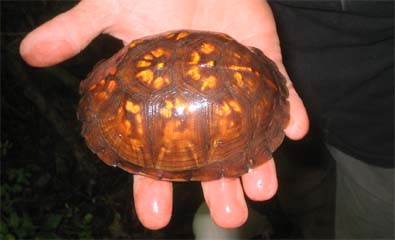
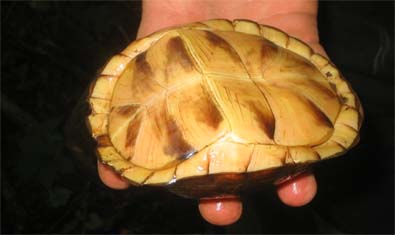
This week we found two small box turtles, the first in a thick hedge as we were looking for groundhog holes (picture of that turtle above and below) and another on a path by a creek after we had put the dogs up for the day (it was very hot!).

Eastern box turtle shell patterns are quite variable, and the one pictured above is called a "sunburst" pattern.

The second turtle, the one we found on the forest path, was very yellow and had lost a small part of his carapace at the front. He had the more traditional "crown" pattern.

For more on box turtles, and their steep decline across the Eastern United States, >> see here


Wednesday, July 12, 2006

The Mammoth in the Hedge


Mammoths roamed the Eastern United States, just 9,000 year ago.


Unbelievably, Steve and I were beat out by actor Ted Danson. Danson beat us with simple logic, arguing in his "long bet" with Mike Elliot (editor-at-large of Time magazine) that the Red Sox would win the World Series before the US men's soccer team would win the World Cup. As Mr. Danson explained:


"The Red Sox have had such bad luck in the 20th century, I have to believe that in the new millennium it can only get better. Besides, statistically, scoring goals is harder than hitting a home run, and in the World Cup, you have the whole WORLD against you, but in baseball, the Red Sox only really have to beat the Yankees."


Danson was right. As a consequence, Steven and I will forever be minor footnotes in the history of Long Bets. Damn that Ted Danson!

But I get ahead of myself. Let us start at the beginning.

But which beginning?

That's always a puzzler for me. When in doubt, I generally start chronologically, so I guess I will do that this time too.

We will start 10,000 years ago.

Ten thousand years ago we had mammoths roaming around my back yard. As far as anyone knows, humans had no written language. Humans had just arrived in North America. No one knew who Bill Gates was.

It was a long time ago.

About 10,000 years ago humans came and spread across this hemisphere. The result was a massive die-off of many large animal species, including the mammoth.

It was more than simply the arrival of the Clovis Point; it was also that humans, with limited ability to store knowledge or record history, had no foresight and no communication. Humans had no past and no future. All we had was a short "now."

Let's jump ahead a few years -- to 1996. That's the year Brian Eno, Stewart Brand and Danny Hillis began an extended conversation about the future. Back in the 1970s and 1980s, when folks were talking about energy, water, population, and economics, everyone was keying their predictions to the year 2000.

But it was 1996 now, and the year 2000 was right around the corner. What was the "Next Future" going to be?

The obvious thing to do was to simply set a new "future point" 20 or 50 years ahead. The obvious thing to do, however, is not necessarily the genius thing to do. The genius looks at the question upside down and sideways, challenges the base line, and thinks in four and five dimensions (time and space), not just three. And so Brian Eno, Stewart Brand and Danny Hillis (true geniuses all), leaped the fence of convention and began to think about 10,000 years.


  • 10,000 years is about the age of the oldest living thing on earth -- the bristle cone pine.

  • 10,000 years is about the time that man first began to turn the wolf into the dog and when the first clay pots were made.

  • 10,000 years ago is about the time that man first began to irreperably hammer-damage the planet.


The human ability to wreck things has expanded exponentially faster than our ability to consider the future.

Clovis points have been replaced by "Daisy Cutter" bombs, dams large enough to flood entire civilizations, and mountaintop removal.

And yet most people still have not planned for their own retirement, much less considered the ramifications of genetic engineering, or the building of entire cities on rapidly dwindling reservoirs of fossil water.

And so, in order to try to shift the time paradigm, Steward Brand, Danny Hillis and Brian Eno decided to build a clock -- a physical, visible thing that would run for 10,000 years. The clock would chime once every 1,000 years, and its very presence would require a different kind of thinking about the future.

What would power the clock? Solar power needs too much maintenance and so too does nuclear power. Could geothermal energy do the job? What power source would never run down and would never submit a bill? And thus was born the beginning of the struggle to answer the first great design question: what would power the clock?

Who would maintain the clock? Clearly not one person, so there would have to be an organizational structure -- and thus was born the Long Now Foundation.

Where would the clock be located? It had to be some spot free from destruction for 10,000 years. And so the Long Now Foundation purchased part of a mountain in Nevada where the clock will be situated deep inside a limetone cliff.

Who would explain the clock? Ten thousand years from now people will not be using any language we know today. And so was born the Rosetta Disk to serve as a translation tool for the future.


The 10,000 year clock being built by the Long Now Foundation.


Changing a paradigm is not easy.
In fact, it is so hard, and so rarely done, that the very idea of it seems more than a little Quixotic.

And yet all important change comes from paradigm shifts, and a paradigm shift about time is, I think, exactly what humans need. Or, as Stewart Brand has put it, "we need to think slower and deeper, not faster."

But to tell the truth, a 10,000 year clock is a little abstract for most people. Never mind that it is physical and visible and magically corrects itself for the long-term global wobble that will result in a deviation in solar time.

People are simply unable to grasp 10,000 years. They have more immediate concerns. Like lunch.

In any case, the future is not built in a 10,000 year lump any more than a cathedral is forged from a single block of stone.

The future will be built like a cathedral, made up of thousands of blocks of action and consequence, each carefully cut and interlocked into place.

And so was born "Long Bets," to promote more robust short-term thinking. Better building blocks to make a better cathedral.

The Long Bets idea was forged when Paul Ehrlich said he would give even odds as to whether Great Britain existed in 2000. Ehrlich was prone to making such provocative apocalyptic statements. His most famous book, "The Population Bomb," predicted massive die-offs in the developing world due to a shortage of food and a "longage" of people.

In fact, such predictions started with Malthus who postulated that population grew exponentially and food arithmatically, and for that reason doom was inevitable and that aiding the poor was foolish and would only abet more misery.

Malthus's tract on population was written to justify land clearances for the Enclosure Movement. Without writing a long essay on Malthus, it is enough to say that he was quite wrong. Since Malthus' time, global food production has outpaced human population growth, life expectancy at birth has increased, and literacy has spread.

Those facts, of course, have not stopped a small parade of apocalyptic predictors from following Malthus, from William Vogt to Paul Ehrlich, Garrett Hardin and William Paddock.

On the other side of the coin have been a few people like Julian Simon -- a University of Maryland economics professor who claimed human ingenuity could solve ALL problems. I will not delve into Simon's intellectual mistakes, but they are as legion as any of those on the opposite side of the coin. My aim here is not to get trapped in the quagmore of Ehrlich and Simon. What we are talking about here is Long Bets -- let's get back to the Long Bet that was made.

Simon challenged Ehrlich to bet on the future price of any 10 commodities. The bet would last 10 years, and the winner would pocket the price differential in the commodities.

Ehrlich quickly accepted the challenge, picked a portfolio of 10 metals, and crowed that he would make out like a bandit.

Ten years later, however, when the value of the portfolio was added up, it turned out that every single metal had declined in value.

Simon pocketed Ehrlich's check with a wink and a nod.

Much has been written about this bet in the past, (google Simon Ehrlich bet). I will not delve into it too deeply other than to say that both men were overly simplistic in their analysis of both resource use, pricing and population.

That said, the idea of a financial bet between two parties intrigued Stewart Brand and his small band of talented brethren.

In their quest to promote "slower and better" thinking, a "Long Bet" seemed like an excellent mechanism to encourage both increased participation and better prognostication.

Money has a way of focusing the mind.

And so was born LongBets.org.

I came across this web site five years ago when I was looking into what Stewart Brand was now up to. Brand had been the creater of The Whole Earth Catalogue -- a series of simple catalogue-like publications, assembled by a merry band of hippies, that were so sweeping in their interests that Steve Jobs (of Apple Computer fame) has credited Brand with creating the paper-and-print conceptual forerunner of the World Wide Web.

All I know is that The Last Whole Earth Catalogue is still worth reading -- again and again -- even today.

When I checked out the Long Bets web site I found some real brainiacs making serious bets -- people like physicist Freeman Dyson, voice-synthesizer guru Ray Kurzweil, Vint Cerf (father of the internet) and Mitchell Kapor (inventor of Lotus software), to say nothing of Stewart Brand, Brian Eno and Danny Hillis themselves.

Very cool, but the bets were too steep for a nonprofit wage-slave like me. Two thousand dollars was the minimum bet, and all "winnings" were to go to charity. That was more than I could give away in a single stroke.

A while later, however, I was on a list-serv in which people were talking rather broadly about the energy crisis. I tried to explain the limits of M. King Hubbert's oil data, a well as the fungibility of energy types and other such thoughts.

As usual no one was convinced of the other person's point of view, and after a point the list drifted off to other topics.

A few months later, on the same list, I mentioned that Stewart Brand had sharply reduced the money limit on a "Long Bet," and that now it was just $200 on each side. Almost immediately, Steven B. Kurtz -- one of the previous energy debaters -- asked me if I wanted to make a "Long Bet" on future energy costs.

Sure, I said. Let's make it the price of a kilowatt hour of electrical power, and let's park the bet two years into the future.

In truth, I had in mind winning the first Long Bet. I bet Steve did too.

Steve took the bet. Now, three year later, it appears he has won it, though not before a serious bit of confusion occured over at the U.S. Department of Energy which initially published data suggesting the price of electrical energy had declined.

Apparently DOE had at least two or three years worth of data wrong (including the initial price of energy at the start of our bet) due to lies, deception and data confusion that grew out of the Enron energy fiasco. In the end, looking at the re-published data, it appears the price of electrial power has gone up very slightly due to the disastrous Middle East policy of George Bush which has (among other things) resulted in a very significant decline in Iraqi oil production. Score one for Steve!

Steve and I actually have a longer, more serious bet on the human condition, in which I argue that "Over the next ten years, we will make measurable global progress in all five areas of the human condition: food, access to clean water, health, education, and the price of energy."

I let Steve pick five data sets from a closed list of about 20 options, all of which are kept by the United Nations, and which therefore have (hopefully) some continuity of collection methodology. If Steve wins on any single point, he wins the entire bet. So far, I think he is losing on all points, but the wager is still young, and we shall see.

That said, I think both Steve and I thought we really would beat Ted Danson. What was the chance that the Boston Red Sox would win the World Series in the next three years?

And yet Danson won. Though the Danson-Elliot bet seems a trifle lightweight on the surface, it's actually a wager about probability and risk, and not mere sports.

With the World Cup played only once every four years, and with far fewer Major League Baseball teams than World Cup soccer teams, Ted Danson had about a 20:1 chance of winning over Mike Elliot.

But I figured I had at least 8:1 odds of beating Ted Danson to win the first Long Bet. After all, the Sox had been losers a long time, and the window for my success was a mere two and a half years.

Of course, luck does play a hand in all things, and on this roll of the dice I lost -- twice.

Such is life.

What does all this have to do with hunting and dogs? Well, not a lot, to tell the truth. But maybe a little. I did manage to work hunting and dogs into the beginning of this piece. Now let's see if I can work it in at the end as well.

There is the small point that Thomas Malthus had quite a lot to do with the Enclosure Movement, which in turn laid the foundation for the fox and terrier work that followed, as well as the speciation of terriers following Robert Bakewell's use of enclosures to improve livestock. To read more about that see this >> illustrated history of working terriers.

Finally, for those who dig in the Eastern and Midwestern United States, the legacy of the mammoth can be found in our hedges and forests. If you are in the right thicket you may find Osage Orange, Honey Locust or Kentucky Coffeetrees.

All three of these trees have large fruits and seed pods with thick protective coatings or thorns -- natural defenses designed to help protect them from over-grazing by mammoths that roamed through this area just 10,000 years ago. The mammoths are gone, but their ghosts remain in the form of these tough and defiant trees.

Hopefully, all this will make you think, just a little, about how fragile this earth is ... about how much damage humans can do if they do not plan ... about the mammoth responsibility that comes with the powers we now have to shape the natural world.

Let's not screw it up this time .... We cannot afford to bet the farm again.

____________________________

  • Note: Of the famous and smart people named in this piece, I personally know only Julian Simon and Garrett Hardin, both of whom are now dead, and Bill Paddock, who is very much alive. Steven Kurtz and I know each other only through the internet. The rest of the folks mentioned are waaaay too smart to even know I am alive. Hats off to Stewart Brand though -- he continues to nudge the world along in the right direction. Amazing. As for Danny Hillis -- he is straight off the planet. Read about him (and the mechanics of the clock) >> here


The last mammoth, a dwarf species, was killed on Wrangle Island about 3,800 years ago -- about the time the pyramids were being made.

Sunday, June 11, 2006

A Few Hours in the Hedge


A large plume of kickout, and the size of this hole, makes me think this is a fox sette. No one was home on this fine day (no surpise in June) , but I will remember this location and check back in winter. The cap to the right is there just to show scale.


It was beautiful day -- cool and sunny, with everything green. The corn is up about 18 inches or so, and the first cut of hay is coming off of the fields. The barley is ready to be cut, and the first water lillies are staring to bloom.

I counted four dead deer on the highway this morning -- that's a fair amount of carnage for late Spring. Normally, I don't see that many deer strikes this time of year -- most of them seem to occur in the Fall.

At the gas station I watched a mocking bird chase a squirrel across the road and into the bushes -- her maternal juices were flowing, and her attack on the squirrel was absolutely unbridled.

I left Mountain at home today -- her nose is about healed, but one more week at the house will not do her any harm. With just Sailor and I in the field today, I decided to work the short hedge bordering the field across from the Country Club. This used to be a very productive little hedge for me, but I worked it too hard a few years back, and so I have left it alone for the last 18 months -- a chance to recover.

Sailor and I raised a deer bedding in the hedge, and we also come across the remains of another -- most likely an escaped gut-shot, or perhaps a vehicle-impact victim from the nearby road.

At the back of a small woods we located a nice large sette that looked pretty foxy. With corn coming up on either side, and thick stands of raspberries all around, it's a likely this spot will hold fox and coon when the weather gets cold again. I will remember this sette and leave it alone until then.

Sailor and I turned the corner at the back of the field, and checked a few blank holes before locating in a four-eyed groundhog sette that straddled an old fence line.

Sailor got it bottled pretty quickly, and neither one of us was too rushed. It wasn't going anywhere. This was a simple dig in pretty soft ground to an average-sized groundhog. Nothing spectacular, and Sailor came away without a scratch.

A fine way to start the day!


A very dead groundhog tied to a nice wobbly fence post made a fun set up for Sailor.

Tuesday, May 23, 2006

The Multiflora Rose Is In Bloom


When out digging the dogs, it is not uncommon to find a sette under a thick break of multiflora rose, with perhaps a few broken strands of barbed wire snaking along the ground right next to the hole.

In that little picture is a story.

Multiflora rose originated in Japan
and was imported to Europe around 1862 to serve as a root stock for "rambling" roses.

Rambling roses became a craze with the creation of "Turners Crimson Rambler" in 1893, and this craze lasted for about 30 years until the modern, repeat blooming, large-flowered climbing roses were created.

The first multiflora roses to "go native" in the U.S. were rambling roses that originate during the rose craze of the very early 20th Century. In truth, these feral roses were not much of a problem.

The problem started in the 1930s and extended into the early 1960s as the U.S. Department of Agriculture and various State highway departments promoted multiflora rose as a "cure-all" for many public and farm landscaping problems.

In truth, multiflora rose did seem to be a good solution for a lot of difficult areas. Multiflora was cheap, easy to propogate from cuttings, and was rampant with vigor. Long, arching and pliable canes with thorns were perfect for shielding car lights from oncoming traffic, discouraging humans from entering fields or crossing roadways, and keeping cattle out of riparian areas.

Rose roots seemed to thrive in a large variety of soils, tolerated both drought and wet reasonably well, and they did a commendable job of stablizing creek banks and slowing erosion on slopes. Rose hips were also eaten by a wide variety of song birds and animals, providing a needed food source in winter.

The U.S. Department of Agriculture and its various state analogues vigorously promoted multiflora rose as a low-cost alternative to barbed wire. Barbed wire had made its way East several generations earlier after first being established in the West.

Unlike western wire, which was typically strung from post to post, easten wire was often strung from existing trees around the edges of woods, creeks and fields. In time, these the trees grew and absorbed the wire into their trunk. Imbedded wire was difficult to remove and made the trees worthless as timber since wire and nails wrecked commerical saw blades and had the potential of turning a chainsaw into a lethal weapon.

Like so many good ideas, the promotion of multiflora rose has unintended consequences. A mature multiflora rose bush can put out half a million seeds a year, and these seeds are easily spread by birds and can live in the soil for 10 years or more.

Farmers found that getting rid of a rose hedge required riping it out with a bulldozer and then plowing and mowing the areas multiple times a year for several years in order to destroy the existing root and seed stock in the soil.

The good news with multiflora rose is that has truly been a boon to wildlife. Rose hips are consumed by robins, grouse, cedar wax wings, pheasants, wild turkeys, fox, chipmunks, white-tailed deer, possums, coyotes, black bears, beavers, rabbits and raccoons. Thick rose breaks provide shelter for deer and bear, as well as groundhogs, possums, fox, rabbits, and raccoons. Rose hedges along stream banks have worked to keep cattle and horses out of riparian areas, resulting in less erosion, cleaner water, and excellent denning sites for raccoons.

Next time you find yourself digging a hole in the middle of a multiflora rose bush with broken barbed wire snaking along the ground, remember that these stabbing obstacles are, in a very real sense, a significant player in the vigorous return of wildlife we see in in the Eastern U.S. today. Though they may be the enemy of the moment, they are the long-term friends of terrier work.