Sunday, October 16, 2011
Little Sailor Girl
Monday, July 26, 2010
A 15-inch Border and an 11-Inch Russell
Thursday, July 22, 2010
My Teachers: Mountain, Sailor and Trooper

Two true workers.
Mountain and Sailor. Mountain, at left, is 12" tall. Sailor, at right, 11" tall.
You would not think a one inch difference in height (and about the same in chest size) would make a lot of difference in the field, but it does in our very tight earths.
On this day, these two dogs had worked raccoon, groundhog and possum. Once washed off, they were as good as new.
Sailor taught me most of what I know. She will never be forgotten.
Below is a picture, taken from above, of Trooper my 15" tall Border Terrier who recently went to the Great Kennel in the Sky, and Sailor, my 11" tall Jack Russell who preceeded him by a few years.
Both dogs are dead now, but in this picture they can still do a bit of teaching. Size is fundamental, and with true working terriers bigger is not better.
.
Monday, September 10, 2007
Sailor, A Working Terrier, Has Gone to Earth
And yet, this was a good death by any measure -- standing up, boots on, doing what she loved best.
The post below was her obituary from this blog, one year ago. Words cannot express how much I loved this small, self-effacing little dog. We had a happy life together.
____________________________
Sailor, the love of my life, has gone to earth for the last time.
Her last day was a beautiful sunny morning in September.
She worked a groundhog at the first hole of the day, only 200 feet from the truck, and she then found again, 10 feet deep, in a rocky sette under an ancient and shattered oak at the edge of the farm.
We moved on, confident that she would exit in a bit, and she did, following us up a slope to a large field sette where she located again and bolted a large groundhog, which was nailed by Mountain as it tried to slip back to ground.
Two groundhogs down, and it was not yet 9:30. It was already a good day.
The dogs noodled around the edge of a steeply sloped and forested creek bed, and Sailor found again in a mess of old iron, discarded rugs, and wood that had been topped over with dirt. This earth was undiggable, and we moved on, confident that Sailor would sense the silence and realize we were not interested.
At the bottom of the slope, I began to pound the posthole digger into the ground like I was digging, and down came Sailor, trotting to where the action was.
Fooled you, I thought, but she did not seem to mind. She traipsed along behind me as we went up the wooded slope to the fields on the other side.
We worked the edge of the fields, looking for settes. All three of the dogs pinged on a rocky set of holes just 100 yards up the edge. Excellent!
Once again, Sailor was in the ground first, moving around and trying to locate. This sette was very tight, and after forty-five minutes of chasing around through rocks, roots and rumble, Sailor came out, walked off a little ways into the woods, and sat down. She was tired.
Sailor giving up in the middle of a dig is a very odd thing, but I reminded myself she was a little dog and she was no longer young. Plus she had worked four settes already. And then, of course, this sette was impossible. Maybe she had the right idea -- move on.
I let Sailor rest for a few minutes, and then picked her up and carried her to the creek for water. She was not interested, so back we went to the hole.
While I was in the creek, Chris had been digging up a storm, and his young dog, Moxie, had at last found a small groundhog squeezed in among the broken slates. I helped Chris move a little more dirt to get to it, and then we dispatched it and decided to call it a day.
I picked up Sailor and a full load of tools and carried her back to the truck in my arms. She looked fine, but she was very tired.
We were about 100 yards from the truck, when Sailor suddenly squirmed and jumped out of my arms.
She hit the ground running, flying down the fresh-mowed hay field like a six-month old puppy. What the hell? Had she seen a rat? A cat? A groundhog? A fox? There was no telling.
Sailor disappeared over a slight curve of the earth, headed straight for the trucks. I was sure she was headed for the vehicles.
When I arrived at the trucks a minute or two later, Sailor was nowhere to be seen. I assumed she had slid under the vehicles to get cool, and so I loaded up the tools and poured her some water.
I looked under the truck, but the grass was too high to see anything. I looked under Chris' vehicle, but she was not there.
Chris walked up with Moxie and the rest of the tools, and Dave, the farm manager pulled up in his truck at exactly the same time.
Chris and I showed Dave the three groundhogs on the hood of my vehicle, and we talked a bit about Dave's chickens and the terrific quality of the eggs you get from pasture-raised hens.
While Dave was still there, I rolled my truck forward, very slowly, looking for Sailor. She was nowhere to be seen, and I began to get worried. She never wandered off. Ever...
Chris and I said goodbye to Dave, and then we headed off with Moxie and Mountain to find Sailor.
We walked the length of the hayfield, which Dave had cut as smooth as a suburban lawn the day before. We saw nothing.
Then, just as we neared the very end of the hayfield, Chris saw something white on the ground in the distance. He began to walk to it and then, as he got closer, he started to run. That was when I knew something was terribly wrong. I did not run.
It was Sailor. She was dead in the field, her eyes open, rigor just starting to set in to her legs. There was nothing at all around her. It was as if someone had put a stuffed toy out onto the lawn. But, of course, it was not a stuffed animal. It was Sailor.
Sailor must have been dead within a minute of when I last saw her. She had continued running past the trucks, taking a sharp right up the hayfield and then straight on to where she had expired.
Chris left me alone with Sailor, and I sat in the field, craddling the greatest little dog I have ever known, completely heart broken and dumbfounded.
There is no explaining it. Perhaps Sailor died of a massive heart attack or a stroke or an embolism. Perhaps the Black Widow Spider bite that she survived in June weakened her heart or brain, and something finally ruptured within. Perhaps she got stung by a bee or a hornet while she was in my arms, and that's what made her jump off and run, with anaphylactic shock setting in a few hundred yards later. Perhaps a Black Widow Spider got her, but this time it caused a very different reaction from the one before.
It hardly matters what killed her. Either way she is dead and gone, and now I have a hole in my life that seems unfathomable. I loved this little dog.
Sailor was wonderful on every level. She was like a cat in the house -- curling up in her bed, and mugging for my wife who adored her. No other dog was allowed on the bed, but Sailor was. It is an unequal world, and Sailor was an unequaled dog, and everyone knew it. She was treated like a queen.
Sailor began her working career at nine months, and got her first working terrier certificate at 10 months, to a groundhog, only an hour or so after being skunked undergound. From Day One, there was no stopping this dog.
Larry Morrison once told me I would die of old age before I ever saw a dog the likes of Sailor again, and I am afraid -- very afraid -- that he might be right.
Over her life, Sailor worked it all -- groundhogs, red fox, raccoon, and possum. We mostly worked groundhogs of course -- they account for better than 90 percent of the terrier work in my area.
It's impossible for me to tally up all the critters Sailor worked, but the number is well over 400 -- a fairly impressive tally for a dog that weighed just 10 pounds with a full belly, and who stood only 11 inches tall.
Sailor was not a perfect dog in terms of conformation. She was a little short in the back, and had almost no coat at all on her belly. Winter fox hunting was hard on her. That said, I have never seen a dog that could equal her in the field. She had a great nose, and could get anywhere, and she never got hurt. Sailor not only knew butt from breath, she knew the power of voice and used it. She also knew when to put in her teeth. On more than one occassion people have gone out with me and exclaimed, after watching Sailor in action, "I thought you said she was a soft dog." Well she is. But mostly she's a smart dog.
Sailor did not know one way to work a critter in the hole, she knew a half dozen. And she changed tactics when needed, depending on the quarry and its temperament.
When Sailor was underground, I almost never worried about her. She was small enough to get anywhere and she was not foolish. She protected herself from real harm, and her only serious injury was caused by a freak accident when a falling piece of steel roofing nearly cut her in half. I scooped her up in my arms that day last winter, stuffed her intestines back in, and sped to an emergency vet who stapled her back together. Miraculously, she rallied and was back in the field again a few months later.
Sailor, you have gone to ground for the last time. I know you are happy down there, because it was your favorite place. Until we meet again.
REQUIEM
Under the wide and starry sky,
Dig the grave and let me lie.
Glad did I live and gladly die,
And I laid me down with a will.
This be the verse you grave for me:
Here he lies where he longed to be;
Home is the sailor, home from sea,
And the hunter home from the hill.~ Robert Louis Stephenson ~
Tuesday, January 2, 2007
Hunting Wide
Since the area I had scoped out by aerial map had a lot of trees on the edges of larger fields, I did not expect to find too many raccoon to ground, and it was unlikely we would find a groundhog out and about despite the warm weather -- their cycles are driven by daylight more than temperature. Bottom line: If we were going to find anything on this new land in this part of the season and on this warm a day, it was most likely going to be possum. The fox would come later.
By the time Chris arrived, I had taped up both collars and gotten the tools out, and switched from David Crosby to Tanya Tucker. Pearl had just finished her first heat cycle, so she was ready to be out.
My goal today was to scout some new fields along the Monocacy River. Chris and I followed the river bank, and found plenty of holes, but no one home. This was going to be fertile ground in the Spring, however.
A very long island was just off shore from the river bank, and at the very end of it were a couple of duck hunters in a blind working a mechanical robo-decoy. I am not much for these contraptions -- it's just a hop and a jump to mechancial callers, and it seems too much like cheating to me. There's nothing wrong with hunting and coming up with a blank day once in a while. There is a place where technology should end, and it's a bit short of mechanical decoys with flapping wings if you ask me.
We passed the long-gone remains of a gutted deer hanging from a tree. It was perhaps several weeks old, and it did not look like much was taken other than the head and the back loins. The carcass would provide food for fox, but it looked like quite a bit of meat had been left in the forest.
A short distance from the deer, and on the slope up from the river to the fields, I realized Mountain was not with us. We stopped and waited, but she did not emerge, and I was pretty sure she had found. Chris moved down the slope, and I moved up towards the fields. where I found her just outside a beautiful sette. She had gone to ground and extracted, and killed on her own, a mid-sized possum. It was a bit anti-climactic, as Mountain had not bayed, and there was no dig.
Mountain has always had a problem with self-hunting and staying close. I think when Sailor was alive she ventured farther out than Sailor did just so should could find something in the ground for herself. Unfortunately, that practice has not ended with Sailor's passing. I guess finding quarry is the ultimate reward for the bad behavior, and that makes it particularly difficult to end.
I would not care except that it wastes time, the noise of calling for her scares quarry away, and it is very dangerous should Mountain find a skunk in the ground without me knowing exactly where she was. That said, it was a beautiful sette, and it looked like the kind of thing a fox or raccoon would use when the weather turned colder. I put this one in my memory book.
We headed up the slope into the fields, and I was thrilled to find a beautiful rolling field with a short grass winter cover, and a long hedgerow at the top, followed by an even larger field, also in a short grass winter cover, and another nice hedgerow beyond that, and another beyond that. Excellent. When it gets colder, I am sure we will find fox here.
As we walked up the fields, we found groundhog hole after groundhog hole. Some of the larger settes had eroded into large funnels at the entrance. This was clearly good friable dirt. I was pretty sure these fields had been in soybeans or alfalfa for at least two or three years -- you generally don't get this kind of groundhog density without those cover crops.
We walked up the fields a pretty long way, coming to a section parallel to an area we had hunted in the past. The new fields were separated from the other area we had hunted by an upland area of forest a few hundred yards wide. That may not sound like much distance, but in this part of Maryland the soil can change dramatically from one area to another over a couple of hundred yards. That upland piece of forest land was not an accident -- it was the remains of a rock and shale uplift, and it had existed here since the time of dinosaurs. The bend in the river had existed here just as long, and my theory -- based solely at looking at the maps -- was that the soil on the other side of that uplift and closer to the river would be deeper and richer due to river deposits and down wash. It looked like I was right.
Despite all the dens, the dogs failed to locate. Groundhogs move out of their field settes in the winter to seek harbor inside the tree line; very few winter over in field settes. We headed back down the fields along the edge of the trees. A deer hunter fired very close to us when we were inside the tree line, and I was reminded, once again, that hunting on Sunday is always the best plan, especially in deer season.
We headed back down the edge of the river, and then up again into the end of a large field. We had worked the other end of this field before, and as we approached that end, Mountain suddenly began baying furiously as if he had caught something above ground. Game on! I ran down the field with pack, shovel, bar and posthole digger, but was brought up short by a downed tree in the hedge. By the time I had gotten through that, the dogs were quiet. I called for Chris and found him on the other side of the hedge, looking a bit perplexed. What happened? Apparently Mountain had caught a very large deer sleeping or resting in the hedge, and the deer had as hard a time getting through that downed tree as I did. Mountain and Moxie had been right on the deer, and had chased it out of the hedge. The two dogs and the deer had bolted in directions unknown.
Chris and I whistled, and we took turns walking a large circle. It was about an hour before I found the dogs on a farm path not very far from where we had lost them. Mountain was unscarthed, but Moxie had a line shaved into her fur where a deer hoof had grazed her. The skin was not broken, but a thin line of fur was gone, as neatly trimmed as if it had been done with a Wahl shear. That was close.
All's well that ends well, but it's clear to me that I am going to have to do something about Mountain's self-hunting. I have never had a dog riot on deer before, and I have never had a dog hunt as wide as Mountain does. Time to end it.
That night, I ordered an electronic collar from Innotek to help me break Mountain of bad habits and to help train in new ones. The problem is that Mountain is smart, and she knows that off the leash there is no "correction." It does not help, of course, that she also gets a maximum reward for hunting wide -- she finds quarry more often than most. At this point, my natural aversion to electronic collars has to take a back seat to safety. The collar is cheap compared to the price of a new dog -- or losing an old one. One thing I am sure -- it will not take Mountain long to figure out that she can no longer hunt wide.
Monday, October 23, 2006
JRTCA Nationals

People waiting for a judge in the ring. There are no professional handlers at the JRTCA, and there is no dress up -- a welcome thing in my opinion. It is supposed to be about the dogs, right?

John Broadhurst judges in one of the rings -- a long day of spanning terriers and checking bites. With over 1,200 dogs at the trial, some of the classes were quite large, but John did a nice job of keeping his end of it moving. He kept his sense of humor too!

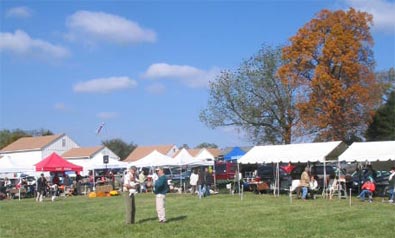
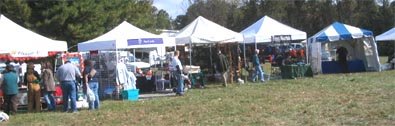
A few vendor tents selling everything from high-quality leather leashes and custom embroidery to books, sweaters, fox nets, and jack russell-themed crafts.
I stopped by JRTCA Nationals on Saturday -- the one dog show I attend these days.
This was the 30th Anniversary of the JRTCA, and Alisia Crawford was there in honor of that -- she founded the JRTCA and was the guiding force behind the JRTCA's focus on registering dogs, not litters, and giving the highest awards in the Club for field work.
The weather was very good, but it had been windy the day before and I am told that a couple of pop tents took off flying in the 30-mile-per-hour winds, some only wrecking themselves, while others wrecked a car or two. That's what we have home-and-auto insurance for, right? Or let's hope. . . .
I saw a lot of very nice dogs. I also saw some enormous dogs, some odd looking dogs, and some dogs without tails. All in all, however, the quality of the dogs was very high, and there were some real stunners among the more than 1,200 Jack Russells that attended.
JRTCA nationals is a pretty impressive single-breed show.
On the working side, it was nice to see a rather lengthy parade of Bronze Medallion dogs -- dogs that have worked at least three of the six kinds of terrier quarry we have here in the U.S. -- Raccoon, Groundhog, Red Fox, Gray Fox, Badger, Possum -- before a JRTCA field judge.
I think about 50 veteran Bronze Medallion dogs were at Nationals, and 27 new ones were ushered into the ranks of the hundreds that have come before. Such stuff is the tip of the iceberg, of course, There are the dogs like Mountain, who have worked it all and who do not have scrap of paper to show for it, and the dogs like Sailor who got their bronze, and went on to work 400 more critters for the pure fun of it. And then, of course, there are the many people who are unwilling to take off a week from work to drive clear across the country for a dog show -- to say nothing of the many hundreds of wonderful old working dogs that have gone on to the Other Side to meet their maker. Without a doubt, more Jack Russells are being dug to in America -- and around the world -- than any other breed.
Events like JRTCA Nationals are a brain-defying amount of work. For starters, there are the registrations, collecting the trophies, and recruiting the judges. Then you have to make sure the field is mowed before any of the setup begins, you have to stake out the parking rows, assemble the intercom system, and put up the larger tents for awards, rescue, electronic equipment, etc. Then you have to find someone to bring in all the agility equipment and the go-to-ground tunnels, and do the set up for all of the same (to say nothing of taking it all down, taking it home, and putting it all away). On top of all this, you have to network with the small-business vendors, the food concession folks, the port-a-potty people, the folks running the BAER clinic, the Super Earth setup, and the folks that run and maintain Stepping Stone Park. You have to make sure the racing and agiltiy sections are well fenced, and that the show rings are properly measured, staked, and roped. You have to put up signs up for reserved spots, and you have to collect, organize, price, and lay out all the stuff -- shirts, hats, fox nets, locator collars, books, etc. that are to be sold. The work goes on and on and on .... made possible by a small cadre of volunteers who are never thanked enough. I do not know who they all are, but a tip of the hat to each and every one of them. There is a special spot in heaven for those who do thankless work.
And so what is the result of all this?
Well, Nationals seemed to go swimmingly as far as I could tell. Of course, there will always be a few whiners, pouters, ingrates, and misanthropes in any crowd. There is always someone with a Unified Field Theory about How Everything Should Work. For my part, I give simple applause. Nice work, all you nameless, faceless people toiling in private for the common good. And a nod to the front office too -- they make it all possible, and are the main difference between success and failure. Don't believe it? Fine -- look at how the other Clubs and organizations are doing. Compare and contrast. The JRTCA is simply better, and the management and the volunteers are the reason.
Friday, October 13, 2006
New Dog at the House

This is the new dog that has just arrived home. Her name is Spice, and she came from Char Smith of Thornbush Working Jack Russell Terriers who, very kindly, drove all the way down from Illinois to meet me in Ohio. I feel very lucky to get this dog, and consider it an act of kindness from Char to have offered her to me.
We picked a random bakery and coffee shop in Perrysburg to meet in, and it turned out to be a great little place with fresh pies and muffins and a very active clientele that consisted mostly of active senior citizens. For a blind toss, we did well.
Char and I hung out for about 4 hours, eating, talking, and just goofing off. When we let the dogs go out to pee, they came within a hair's breath of nailing a rat that was housed in a small bush in a parking lot about a hundred yards from the bakery. Nailing a rat at the hand-off of a working dog would be about perfect.
For the record, the building in the picture, above, is not my house -- it's a building at Oberlin College, where I stopped off on the way back. More about that later.
The wife met me at a local fenced tennis court so the dogs could be introduced to each other on neutral ground. Mountain quickly asserted dominance with two low growls, and the new dog accepted her Omega status immediately. All good, and as planned. I made a big fuss over Mountain and ignored the new dog. Then I fed them both, making sure Mountain was fed first and that she got the most. Both dogs are now playing on the rug behind me as I type, so things appear to be going swimmingly. Was all this necessary? Perhaps not, but first impressions are important, and that is true in the dog world as well as ours. There was going to be a pack order, and the quicker that was sorted out and recognized by me, the better.
Visually, Mountain and Spice make quite a pair, each with one patch eye and bright white bodies. They are a matched set, with Spice about a 1/2 or 3/4 of an inch smaller than Mountain -- a situation that will remain forever, as Spice will be one year old in just 10 days.
The new dog is about a half inch taller than the late great Sailor, but truthfully Sailor was very small, and on cold foxing days and in the staggering heat I sometimes wished for a dog that had just little bit more mass.
The new dog has a true harsh broken coat that should do well in cold and heat. The new pup is also longer in the back than Sailor and is well-furred all over -- a trait Sailor could not claim. I have not measured the new dog's chest yet (no tape meaure in the truck), but when I touch my thumbs under her chest, my fingers interlace over the top well past the second joint, so my guess is that she has a span of a little less than 14 inches.
It is exciting to have a new dog in the house. I will spend the next two weeks assimilating her into the house, the family, and the routine. First stop tomorrow morning is the yard!
Monday, October 9, 2006
Two In One

Two hole dogs. Chris tries to open up the pipe while Mountain tries another way in.
It rained hard all day Friday and drizzled on and off Saturday, but on Sunday Chris and I hit the fields anyway.
The corn is starting to come off now, but the fields are too wet to work with heavy machinery. A corn harvester was stopped dead in its tracks on the edge of a half cut field. It will be at least three days before that machine moves again.
A quick eyeballing of a couple of holes confirmed what I feared on the drive up -- the groundhogs had not moved for a couple of days due to the rain.
Scent was not going to be strong and the ground was going to be very soft and moist. The den pipes would have settled and gotten tighter, while the groundhogs would have an even easier time than normal digging away.
I had a plan, however. Sailor had located a big sette just as I was fixing to leave this farm about a month ago. The sette was pretty deep and it was in the middle of a thick hedge. If that groundhog (or possom or raccoon) was still home, it would be a good dig, and at better than five feet deep in a forested berm, it would likely be dry.
Of course, we make plans and God laughs. When Chris and I got to the hole, the dogs sniffed it twice and let us know nothing was home. Too bad -- now we'd have to hit any hole we could find.
We walked through the hedge to the harvested soybean field on the other side. Mountain pinged on a sette at the edge of the field, but she could not get in very far due to the small size of the muddy pipe. Neither could Moxie, and Moxie is a tiny dog.
The dogs acted like there was something there, however, and so we sunk two quick holes. All we could locate, however, was an underground mouse nest with five baby white-footed deer mice inside. We moved on.
We had not gone far when I looked around for Mountain. She had darted a little way ahead of us, but we were now a little bit farther on than I had last seen her. I whistled and waited for a few minutes, while Chris explored an area a bit farther up that had been bladed clear by the farmer.
"She's found," I said, and turned around and walked back the way I had come about 70 feet.
I listened. Geese honked in the distance, sounding for all the world like a pack of hounds.
And then I heard it -- a short baying somewhere to the right in a dense thicket.
I walked around the corner and tried to enter the thicket, but it was thick stuff, jammed with a mixture of multiflora rose, poke berry and downed timber. I backed out, dropped my tools, and pushed forward again, but there was no going forward through this stuff. I slipped back out and got a machete, and hacked my way up to a hole.
Mountain and Moxie were both there, going in and out of a six-eyed sette like they were model trains running the tunnels for an 8-year old on Christmas morning.
Chris pushed through the thicket behind me, and looked ahead to where the holes were. "You know," he said, "we could have just come in from the other side." Point well taken. We had definitely taken the long and wrong way in.
Mountain was in the ground now, and we grabbed Moxie and staked her far enough away from the hole that I could not pick up her collar. Mountain was baying a little, but she was clearly not up to it yet.
I boxed for location, and we sank a hole about three and a half feet deep. We came into the side of the pipe and found Mountain trying to push past a narrowing constriction point where the pipe took a sharp turn and also plunged downward.
We pulled Mountain and fussed around trying to scrape out the pipe, but we could not manage it due to the turn and the descent. Eventually Chris banged a new bottom into the hole, expanding the walls of the hole and cutting it deeper to about five feet.
We had more of the pipe to work with now. We had staked both dogs while we opend up the hole, and now we decided to probe the hole and see where the critter might be located. I cut a switch, and pushed it up the hole where it was promptly grabbed by a groundhog about 12 inches in. I tried to pull the stick out, but the groundhog was holding on.
"OK," I thought, "I've got a pretty good idea where you are now."
The groundhog was in a deep stop end, in a tight pipe, in very solid earth. These are actually tough locations to extract a groundhog from, as a dog cannot pull a groundhog from such a spot, and any dog that tries to do so is going to get its face chewed up for the effort. On the other hand, at five feet you are deeper than you can reach with your arms, so whatever you do to the groundhog has to be done while hanging head down in the hole. This is not much of a problem if you have a gun at hand, but since I eschew firearms for this kind of work, we were going to have to do this the hard way unless I could get lucky with a small trick.
I pulled a shoelace from my pocket, knotted it into a small snare, and put the bite of the shoe lace snare in a split cut into the end of the same switch I had pushed up the pipe a minute earlier. I pushed the stick and three-inch snare up the pipe, and the groundhog bit the noose. I caught him twice this way, and pulled back hard, but both times he eventually pulled out of the snare as there was nothing for the snare to grab on to but teeth and a smooth nose. A groundhog in a solid and tight pipe like this can easily withstand 70 or 80 pounds of pulling force. If you can get a snare over a leg, you have it done, but in this case pipe was simply too tight to get the noose past the head, and it did not help at all that I was working blind.
Chris tried to snare the groundhog a couple of more times with a length of cable he had in his pack, but he too failed to get the snare past the nose and teeth of the groundhog. A new plan of attack was needed.
We decided to cut back the hole a foot or so in order to snare the groundhog. Now this sounds like an easy thing to do, and something we should have done right off, but in fact the ground was very hard and we needed to cut down the side of the hole about five feet.
I am happy to report that Chris is an enthusiastic digger, and with only a
little assistance from me, he soon had the the job done. Excellent. God bless enthusiasm. In my defense, let it be noted that I carried the bar and posthole digger all day long.With the hole cut back, we could now see the groundhog, and he was not big. Chris snared him, and we quickly dispatched it. He was a small one -- this year's litter for sure.
We let Moxie rag the carcass for a few minutes while we watched a red tail hawk get mobbed by a flock of crows, the hawk screaming out its frustration right over our head. Is this a great country or what?
We pulled Moxie off the groundhog and put it in the fork of a small tree so we could turn our attention to repairing the sette.
I was gathering large sticks and breaking up a rotten stump to help repair the den pipe when Chris said, "Oh Jeez" and I turned around to see Moxie, whom we had let run loose, working a second groundhog in the hole.
Two in a hole and this late in the season? Unheard of. But there it was as plain as day.
We eventually got Moxie off the groundhog, though she had some cuts to her lips for her troubles.
We snared this second groundhog and repaired the sette well before deciding to call it a day and go back to the truck to glue up Moxie.
We had not wanted to use Moxie in an open-to-daylight pipe as she has a habit of grabbing groundhogs head first, which causes more lip damage than is necessary. In the dark, she seems to bay and work with courage tempered with discretion, but in daylight at the end of a dig, she gets as wound up as a drunken Irishman. Chris and I had discussed it, and we had decided to only use her in a dark pipe and put in the shovel and pull her after we had broken through. You have to do this with some dogs, and it was a good plan. ... but aren't they all?
This plan was jacknifed into the ditch by a second groundhog found in a sette in October. You cannot plan for the entirely unexpected. No serious harm done, in any case. A week or two of rest, and Moxie will be at it again -- hopefully joined by another small white dog in the field.
More on that last point later.
Sunday, October 1, 2006
Words Not Enough
Sunday, September 17, 2006
Seeking a Small Worker
WANTED: 11 inch, smooth or lightly broken-coated Jack Russell out of working lines. Prefer young adult (under 18 months) or older puppy (over 7 months).
I have begun the hunt for a small Jack Russell Terrier out of working lines. This is never easy, and my needs are pretty narrow. There are a lot of pups out there, but most dogs end up a bit bigger than I want. On the other hand, it's not fair for me to take too small a dog.
A very nice-looking 10 inch dog (7 pounds!) is available, and if I hunted only a few times a year she would be ideal but since I am out a lot, and in all kinds of weather, I am afraid I would wear her down before her time. A few pounds can make a world of difference in terms of stamina if you are hunting week-after-week.
A very nice looking 11.25 inch dog with a tiny chest is available, and she's a real looker. If she does not grow over the next month, she would be ideal, but genetics and time may be against her. Sailor stopped growing at 4 months, but I do not know if that is very common. Let's see what the next month holds in terms of growth. She is certainly a very pretty dog.
Some very nice litters are due soon or are on the ground, but with terriers you are always buying a pig in a poke when it comes to size. To get what I want I may need to have a small male cover a small female, and there are not too many small males. A puppy may be too much risk.
Monday, August 14, 2006
Moxie in the Hole

Went out with Chris on Sunday for a short day in the field.
Lots of blank holes with no one home, until we spied this large sette in the middle of a soybean field. A little of the eat-out around the sette can be seen -- one reason farmers hate groundhogs.
This groundhog was worked to a stop end, and it was a very shallow dig. Moxie took a few hard hits before we got the 'hog tailed out and dispatched. This was a nice pot-bellied groundhog which tipped the scale at a little past 13 pounds.
We scouted around a bit more, and then Chris had to call it day. Mountain, of course, got lost in the forest on the way back, and I turned around short of the car to see if I can find her, thinking she had gone to ground. Meanwhile, while I was out looking for Mountain, Chris found her at the truck and walked her back to stake her next to the pile of tools I had dropped on the path.

A nice deep hedgerow sette showing wear at the spoil pile.
Sailor and I headed back down to where we had last seen Mountain and, as luck would have it, Sailor found in a nice hedgerow sette. I stayed with her long enough to make sure it was not a skunk, and then left her while I went back for the tools (and Mountain).
When I got back to the hole, Sailor was still hayin hup a storm, and the box said 7 feet down so I sat on a root and let her move it around some more. No way was I going to solo dig a 7 foot hole unless Sailor got into trouble, which seemed unlikely at this point. After another half hour Sailor came out, saw me, slipped back in, and bolted it out in short order. She no doubt had it bottled in a stop end. When she came off of it to look for me, it no doubt moved out to a bolting position.
All good, and as hoped. Only a mad man wants to solo dig a 7-foot hole when the temperature is 90 degrees!
Monday, August 7, 2006
Traitors, Spies and Beagles

It was a simple plan: Get out early in order to dig on the dogs before the heat of August crushed me. My goal was to be digging by 8 am.
I packed up the tools and gassed up the truck. I loaded a milk jug with water and froze it so the cooler would have ice. I packed Mountain Dews and water. I charged the cell phone and the camera batteries.
In the driveway, I paused. Did I have everything? Shovel, bar, collars, batteries, dogs? Gloves, camera, hat, sunscreen, cooler, veterinary box, posthole digger, betha? Check, check, check.
I drove the vehicle all of six blocks before getting derailed. Sometimes our plans make God laugh. This was one of those days.
Zipping down Military Road a beagle ran right in front of the car. I missed it, but just barely, and a car in the other lane screeched to a halt, just missing a second beagle darting across the road. A third beagle sniffed a lawn 10 yards up on my side of the road.
The lady in the other car pulled over, and I did too. She was surprised I had three leashes and three choke chains in the car with me. I am always full of surprises.
We spent a few minutes rounding up the dogs. They were not too skittish, thank goodness.
These were very nice looking beagles; not fat, very clean and quite friendly.
Now who did they belong to?
One dog had no collar at all, another had a collar on but no tag, and the third dog had on both a collar and a tag, but the tag had only a name and phone number -- there was no street address.
I called the phone number on the tag and got a mechanical voice that said there was no one to take my call. This was a phone service -- there was no message machine at all. The service message was cryptic; the phone might have been disconnected.
With the help of a neighbor in a nearby house, we got a street address that corresponded to the last name on the dog tag. It was an uncommon German name, and lucky for me there was only one other person with that name in the County. That house was only a couple of blocks away -- another good sign. Though the house had the same 3-digit phone exchange as the telephone number on the dog collar, the last 4-digits of the phone number were different.
It was a lead, and I would take what I could get. I loaded all three beagles into my Explorer, and went to the address. It turned out to be Aldrich Ames' old house.
Aldrich Ames was the CIA-spy turned traitor that fingered over 100 agents to the Russians. At least 10 of those agents were later executed. Untold intelligence operations were compromised and imporant secrets were given away. It was, without a doubt, the greatest act of treachery and treason in the history of the CIA. Ames went to jail (he should have been executed) and his wife left to go back to her home country of Colombia. The house was sold and Ames's other assets were seized. Ames had collected over $4.5 million from the Soviets -- real blood money. This was in 1994.
Going up the short driveway to Ames' old house, it was quickly apparent that something was again off-kilter at this residence. Though everything looked fine on the surface (mowed lawn, trimmed bushes, good paint on the house, cars in the driveway, no newspapers stacked up), a large "Do Not Move" sticker was on a car in the driveway, notifying anyone that cared to look that the vehicle was being seized by the County over a tax dispute. That was odd.
The house looked empty and there was a lot of stuff in the garage. The backyard had a short fence, and wire mesh ran around the base. Perhaps this backyard had held these beagles, but there was no way to be sure. The fence looked too short -- just four feet. With no one home, and some signs of financial distress at the house, I was not leaving them in a yard I was pretty sure was not dog secure.
I happened to know a family five doors down, and I rang the door bell there. Everyone was asleep (it was early Sunday morning) except their young daughter who is now age 9 or 10. No, she did not know if anyone up the street had beagles.
In the end, there was no alternative but to take the dogs to the County animal shelter. I did not feel guilty doing it -- it is a very clean, well-lighted and antiseptic place and the dogs would be well treated. If a dog is not violent and healthy, it will be adopted out of this shelter within a day or two of being made available -- especially if it is a small to medium-size and gentle dog, as these beagles certainly were.
These really were nice and well-behaved dogs, and they were in the pink of health. I imagine they will be retrieved by their owner soon enough. If not, I am willing to bet they will be adopted into a life of luxury. If you are going to be a stray dog, this is not a bad County to live in.
The Arlington County Animal Shelter could be an up-scale veterinarian's office. It has nice art on the walls, and dog toys and dog collars for sale. The people that work there are a little odd, however. Based on visual evidence alone, it seems you have to have several parts of your face pierced to qualify for employment. One girl had 10 studs going up around one ear, and a friendly young man had long metal studs (at least two inches!) going through both ears and through both his top and bottom lips. How could he eat like that?
I suppose a dog does not mind the pierced look, but it's an odd thing to see at an animal shelter. These young people would cringe at the idea of hunting or fishing ("You kill animals?"), but here they were mutilating their own bodies and working at a shelter that occassionally euthenized perfectly fine pit bulls.
Without a doubt, humans are odd creatures. They make loons look like smart birds.
Free of the beagles, I headed out with my own dogs. It was now too late in the day (and too hot) to start digging solo. No matter. I went out anyway, and scouted new farm land with Sailor.
Though this new land looked terrific (soybeans, corn, fallow fields, wooded and brushy hedgerows, small patches of woods, many acres of sunflowers), I did not find any dens. Not a one.
I am not sure why, but I have an idea. There are some vegetative signs that suggest this area has a very high water table. Without a doubt some areas flood in early spring. If the entire area gets super-saturated in the spring and winter, that might account for the lack of den pipes. Things that den in the ground value dryness above all things. A dry house is more important than food.
A winter walk will no doubt reveal more, and I will return in the Fall as well, as some of the overgrown fields may be cut down by then, perhaps revealing some settes unseen. With hundreds of acres to explore, I am sure something will turn up, as there have to be a few bone-dry ridges and high spots.
As for the beagles, I will check up on them on Tuesday.
I think they will be picked up, but it would be nice to know for sure. I have called both the tag number and the Aldrich Ames-house number several times, but have yet to get anyone to pick up -- not even a machine on which to leave a message.
Some things are destined to be a mystery.
Monday, July 24, 2006
East Meets West For a Day in the Field

Mike and a happy Knotty with a nice pot-bellied groundhog.
Mike B. came East from Colorado for a meeting, and brought a small dog with him by the name of Knotty, and we met up for a day in the field.
It was going to be hot, so we started early in the hope of catching a little break, which we more-or-less did, as it stayed overcast until noon.
The first hole was far and away the deepest at about five feet, and it was an amusing hole too. When we go to the end of it, I tailed out Knotty, and she was attached to a very young groundhog. Mike pronounced it a gopher, and in truth it was not much bigger than a Richardson's Ground Squirrel, the gophers of the American west.
We got Knotty separated from this very young groundhog, and I walked away a short distance and then tossed it into some soft weeds so that it could scurry away without the dogs following the scent trail. I was hoping the next few holes would not be that deep, or the critters that small.
The next hole was located in the woods (we were looking for a little shade) and on a steep bank down to a creek. Steep banks can be a problem, but the ground here was very soft, indicating it was wash-down dirt and not settled rock and clay. After I got a general impression of the sette, I decided it was not very deep despite the muffled acoustics (Sailor was in the ground and Mountain was guarding a bolt hole). For once I was right, and we broke through in short order, less than two feet down. At the very end of the dig, we swapped out Sailor and put in Mountain to do a little pulling.
After repairing the sette, we headed back to the vehicles for water. Because the sun was getting hot, I decided we should try some deep shade in some looser forest near by. As we pulled up to where we were going to park, a large groundhog ran over the grass. This one was going to be easy to locate!
Knotty found the sette, went to ground and bayed up a storm while I grabbed the tools and hauled them less than 100 feet to where we would be digging. Knotty stayed on this groundhog with a nice strong bay, and we were fortunate that the sette was less than two feet deep. We accounted for the third groundhog of the day pretty quickly, rebuilt the sette, and headed off on our way.
The dogs checked a number of holes on the path through the woods, but no one was home. As we got to a dry dreek bed, however, I noticed that Mountain had disappeared in the last few minutes. We called and waited, but it was soon clear she had found something nearby and had gone to ground.
Mike and I circled around through the woods looking for Mountain, and I showed Mike a terrific fortress of a fox sette that I had located last winter. Mountain had bolted a fox out of another sette nearby, and the fox had fled into this beatiful sette which I was reluctant to dig on.
Mike and Knotty found Mountain underground, up the creek bed and on a high bank. I grabbed both packs and all the tools and met up with them. Mountain was out of the ground now, and clearly confused. My guess was that the groundhog had bolted, and sure enough Sailor found it on the opposite bank in a parallel hole.
Mike and I crossed the stream bed, climbed the bank, located Sailor underground, and began to dig. This too was a shallow sette, but it was a little more complicated than it looked. In the end we sank three holes before we got it bottled.
Mountain missed her grab as it exited, however, and a fairly large groundhog zipped out and down across the creek bed back to the first sette where it had been located earlier. Good job, Mr. Groundhog!
We gave this one best, repaired the sette, and headed back to the vehicles to call it a day.
It was a nice day, with no dogs injured, four groundhogs dug to, with one bolted and one released.
Mike left me his Deben Mark III to play with, and since Chris just got a Deben Long-Range Terrier finder in the mail this week (ordered on Monday, arrived from the UK on Friday -- great service!), I should be able to report out on all the locator systems soon.
In the Fall, when Mike comes back this way again, that little fellow we let go at the very first hole of the day is likely to be a bit bigger. It's amazing how fast the kids grow up!
Monday, July 17, 2006
A Short Hot Day in the Field

A groundhog, with its body barricaded in the hole by dirt and stone, and with it teeth facing out at the dog, is well-positioned to defend itelf.
Against all common sense and better judgement, Chris and I hit a farm today in order to do a bit of digging. We started at 8 am, but it was already approaching 80 degrees. By noon (when we quit) it was past 90 in the shade and very humid.
Mountain located in a very difficult-to-find sette underneath a jumble of trunks in a small plot of forest in the middle of a field. It took some effort to cut a clearing around this sette, but with machete and folding saw we finally managed to clear out enough room to stand.
The sette had two eyes going into one pipe. The eyes went in from the left and the right under a giant stone, and then joined a center pipe that ran perpendicular to the entrace holes.
The enormous slab of stone at the entrace to this sette was about 9 inches thick and looked like the kind of thing a biblical Abraham might have used to sacrifice a sheep or goat. There was no moving this stone since tree trunks on either side of the slab had grown up over the edge, effectively pinning the stone to the ground.
Smart groundhog -- this one found a fortress.
Mountain came out of the pipe -- it was too tight for her -- and Sailor went in and took the corner and began to bay. Along with rocks, we had a lot of roots to contend with, and not much room to maneuver. With the help of the bar, we managed to bore a hole near the rooty base of a tree, and smash our way through a layer of stone just underneath. Though this dig was no more than two feet deep, it was some tough stuff.
The pipe was a decent size, once we got into it, and Sailor was baying it up. We pulled Sailor, and used the posthole digger and bar to expand the hole so we could get a better idea of what was what.
The groundhog was right there (a shallow pipe and not long), so we tied up Sailor in order to let Chris's young dog Moxie have a turn "schooling" on the groundhog. Moxied bayed a little, but was a little too quick to grab hold. I was worried she was going to get drilled by the groundhog, but we managed to dispatch the groundhog while Moxie was still in the hole working it (a well-placed bar and two men applying pressure). When Moxie came out, she was fine, and she spent the next few minutes pulling the dead groundhog out of the hole. The groundhog kept sliding back into the hole due to effects of gravity, so all in all, it was a pretty good work out for her. We will have to be carefull with her -- she is very eager. She may be a little more reticent in the pitch dark of an unopened hole -- I hope so. This Moxie dog is well-named.

Moxie pulls a dead one out of a hole.
After repairing the sette, we noodled around looking for another hole and then called it a day, as the heat was making our legs a bit rubbery.
A short day out, but no day in the field with the dogs is ever wasted.
Thursday, July 13, 2006
A Pound of Pennies

Rocks and roots at the second hole of the day. Not the large uplift rock to the right that has been partially obscured by the sette repair.
On Sunday Chris and I met up at the Buckeystown General Store, before heading off to some nearby farm land.
It was just two weeks ago that Sailor was bitten by a black widow spider bite. Other than two shaved spots on her front legs, where blood had been drawn and fluids administered, she seemed fit as a fiddle.
The neurotoxins that had left her paralyzed for over six hours, seem to have left no lasting damage.
Mountain, of course, is always "ready for Freddy".
As for Chris' new pup -- eight-month-old Moxie -- this was her second time in the field. As we headed out of the woods and over a freshly cut barley field, she seemed to relax around the two older dogs and began running around, clearly enamored with Mountain who she decided was the leader of the pack.
It was 9 am, but it was already hot. Lucky for us Sailor and Mountain found pretty quickly in a nice shady hedge. The hole was very tight, however -- so tight Sailor could not even get in. We opened up the hole a little, but it still took 20 minutes of digging before Sailor managed to turn the corner and disappear. Once inside, however, she seemed to find quickly and began a furious baying. She was clearly hard against it.
The ground here was rooty, but the soil was OK for the first two feet. After that it was a mass of cobble stone.
These large stones had been gleaned from the fields and pushed to the edge more than 200 years ago when this land was first cleared for agriculture. Since that time, the hedge had grown up among the stones, and leaf litter and tree roots had drifted in over the top.
Digging was hard, but the pipe was not deep. About three and a half feet down we broke into the tunnel. I started a second hole a few feet over, but had not gotten very far before the groundhog managed to bolt out of a small den hole we had left unblocked.
The groundhog ran about 40 feet across the forest with Chris in hot pursuit, shovel in hand. That groundhog flew up the trunk of a tree and was 40-feet up in a matter of seconds.
Chris was pissed, but I was amused. Good for the groundhog. If we won every game, it would not be sport. We could hunt this one another day. He was a smart one.
While we were variously frustrated and amused, Sailor was still underground -- she was having a difficult time squeezing through the impossibly tight pipe that the groundhog had bolted out from. With a little assistance from Chris, however, she managed to pop out. First thing out of the pipe, she followed the groundhog's scent trail over to the tree and looked up. There it was. If only she could fly!
Moxie, Chris' little black dog, followed Sailor and was clearly cranked up from the scent she was now smelling . I think Moxie missed the bolt itself, but now that she could smell the groundhog and watch Sailor, she knew the game was afoot. Moxie paced back and forth from bolt hole to tree, and made an odd high-pitched whining sound as she looked up the trunk in the general direction Mountain was looking. Moxie was learning.
"That little one is putting it all together Chris," I said. "The penny has not quite dropped, but it's hanging there in the slot. She's right on the edge." Chris mentioned he had been doing a little tunnel work with Moxie, and she was already going down the wooden den liner and taking the corner to retrieve her squeeker toy.
Excellent. That's the idea!
We repaired the sette and moved up the field to the forest edge. The forest here sloped down to a creek bed, and on the other side of the creek was a high bank. I said I thought we would find up on that bank, and sure enough, we did.
No sooner had we crossed over than Mountain was doing his "Come here, Timmy" routine.
"Come here Timmy" is a reference to the old Lassie movies, when Lassie would run over to Timmy and bark. It always meant something complicated like, "Come here Timmy, Mr. McPherson has fallen down the well and has a fractured leg."
And Timmy always seemed to understand the whole story.
Now I have Mountain, and she does a "Come here, Timmy," especially if she finds something in a very tight hole she cannot quite enter herself. Now she stood at the edge of a rock-rimmed hole, looked over at me as I came down the creek bank, wagged her tail, and then looked back at the hole grinning.
"Come here, Timmy! Mr. Groundhog is down the hole, and I want to break its leg." Easy dog, I'm coming.
As is always the case if Mountain cannot enter on her own, this sette was very tight. It was located in the middle of four or five trees that seemed to spring from a jumble of boulders. I paused a bit, but decided it was probably doable as it was likely to be a shallow sette. Thankfully, it was.
After a bit of a struggle to get in, Sailor, the smaller dog, opened up to a nice solid bay. She was hard up against it, and the critter was not deep.
The bad news was that there was rock everywhere.
We located Sailor and began to pry up the large stones as we came to them. A little dirt was moved with a shovel, but this dig was mostly about cutting through roots, moving a few handfuls of soil, and then prying up more rock.
I shattered a few stones with the bar -- one of them pefectly round and bigger than my head. It was cleaved into two perfect half-spheres. Amazing.
When we got down to the pipe, we found Sailor hard on the groundhog's front end, and trying to pull it out of the hole face-first.
Sailor is a little thing -- just 10 pounds -- and not very hard, but she was going at this one hammer and tongs.
Enough of that -- time to get the right tool for the right job.
With a bit of a struggle we got Sailor off the groundhog, and swapped her out for Mountain. Mountain is a bit bigger and quite a bit stronger and younger. She gripped on and quickly pulled out a small groundhog of about 8 or 9 pounds.
I dispatched this one pretty quickly, and then we tied up Sailor and Mountain in order to let Moxie rag the carcas a bit. A little work with dead quarry can teach a young dog about scent, and is a small reward for paying attention while the older dogs work
Moxie chased the dead groundhog a bit as we pulled it around on the ground, and then we let her chew on it while we repaired the sette. When we finally placed the groundhog high up in the fork of a tree, Moxie was tongue-out and happy.
For her end of the bargain, Sailor was too tuckered to pucker, and we decided to stake her out under some heavy shade so she could rest. She had worked two good holes solo and in some pretty fierce heat. Mountain would have to find and work the next one.
We headed out of the forest and into an area of tall grassand small trees, with Moxie hard on our heels.
We had not gone more than 50 feet before we hit a big sette. Mountain was off looking for just such a hole. We paused, waiting for Mountain to circle back.
Moxie, however, seemed a little interested in the hole. I slid of my pack and put down the tools. This might be interesting.
Moxie stuck her head into the hole and slunk dowm low to the dirt like she was stalking.
"Look at that Chris, the penny is beginning to drop."
And drop it did. Moxie stuck her head in to the hole, pulled it out, put her head back in a little deeper, and then went in all the way up to the tip of her tail.
She came out again, looked at us, and then slid back down the pipe. Chris and I silently high-fived each other. Excellent! She was out of sight!
If that was all there was, this would have been a great day. But now, rather miraculously, Moxie began a deep rhythmic baying. Hot damn -- she had found!
This sette was big soft-earth pipe,and Moxie had a lot of room to move around down there. The pipe itself seemed to go straight back -- a nice simple sette. This was excellent.
We let Moxie bay it up for a while ("Let's not move too quick here, give her some time to learn a little something. She's in a nice safe sette"). Chris was ecstatic, and so was I. Waiting for the penny to drop? Hell, this dog had just hit the trifecta on the nickel slots.
We barred for the hole and found it two feet down. This dirt was easy digging -- no root and no rock. As luck would have it, we came into the side of the hole. There we found Moxie baying up the groundhog, and the groundhog -- aggressive as hell -- charging her from the stop end of the pipe.
Perfect!
In her excitement, Moxie had bitten her own tongue, but her tail was going like a metronome. She was clearly having a ball, and her deep baying was as solid as a dance hall beat.
This was about as good a first experience as a young dog could ever have.
After a few more minutes of letting Moxie work her stuff, we slipped in the shovel and I snared out the groundhog and dispatched it. This was a small Spring groundhog, but it was just what the doctor had ordered for a young dog like Moxie.
As I said to Chris as we filled in this third hole of the day, "We started off with two working dogs, but we're leaving with three." Yahoo!
Moxie is going to be terrific. The task ahead is to simply go slow. There is no rush now -- we know this little dog has the right stuff in her. She is not even 9 months old yet -- the best game plan now is to reign in the horses a bit and let her grow a little judgement and discretion.
A young dog with a little success is like a young motorcycle rider with his first 60 miles of road under his belt -- an accident waiting to happen due to over confidence.
Moxie rags her first one -- worked solo, front door to back
There will be a lot more digs between now and the first of October. The goal for the next two or three months should be to make sure Moxie only has positive experiences. That means reserving her for larger simple holes without too many complicatations for her to negotiate.
If a young dog is over-matched and jibes, it's hard to get her back in the groove again.
With a young dog so quick to start, the faster way to success is going to be found in the slow lane. Avoiding mistakes now needs to be Job One.
Chris and I were both hot and tired, and we decided to call it a day. We headed back to the vehicles, losing Mountain along the way. After a bit of looking we found her about 75 feet from where we had last seen her. She was in the middle of a thicket of weeds and broken timber doing her very best "Come here, Timmy" routine. She had found again, but in the 92 degree heat, we were too pooped to party.
Give it up dog, there's always next weekend!
An escapee from J-Unit with his fine young dog and its very first 'hog. There will be many more.
Wednesday, June 28, 2006
Acts of God
Young Moxie rests in a dry creek bed. A very nice looking little dog.
In theory, June 21st is the longest day of the year. But, as Einstein so famously said, some things are relative and not everything unwinds according to theory.
June 24th had hours that seemed to last for weeks.
The day started out like any other, except that I had gone out for dinner with my wife and daughter the night before, and we had blown a tire on the Ford Expedition. Due to lack of a working jack, this proved to be a bigger problem than it should have been.
All of this is to say, I was a bit discombobulated that evening when I loaded the tools; one possible reason I showed up at the Flint Hill General Store the next morning with everything I needed except the locator collars.
A small problem, but not insurmountable. I have dug on the dogs without a collar before, and with the heat we were unlikely to find a skunk to ground. We would do it "old school" as best we could.
I was anxious to see Chris J., as he had picked up his first working terrier the week before from Tim J. who, in turn, had acquired the dog from an Amish fellow who had a small kennel of patterdales. The young Amish lad had subsequently come down with cancer and had to disperse his dogs.
Out of this tragedy came Moxie, an eight-month old female patterdale of wonderful proportions, a roughish coat, and a very calm disposition. I liked her straight out of the box, admiring her size and general diposition. A wonderful little dog.
I had brought Chris a short go-to-ground tunnel and a new six-foot digging bar, and we transfered both of these to his truck -- my gift to the new pup to get her started off right.
We set off with the dogs, headed down the edge of a rapidly growing cornfield on a narrow path just inside the wood line.
It was amazing what a few months had done to this section of land. Winter sticks and barren trees had fallen away to walls of thick vegetation. It was as if we were traveling down a green hallway, with Mountain ranging ahead (a greedy little dog that likes to find the hole first) with Sailor and Moxie padding along behind us.
We did not hunt the trail, as I had an idea of where we would locate quickly, and for once I was right. Sailor entered a nice one-eyed sette in a waste area with high vegetation, and began to bay. Bingo!
From the sound, I could tell Sailor was pretty deep. We stuck a stick into the sette to gauge direction and depth, and began to dig, but the ground was criss-crossed with shattered quartz mixed with hard pan, and it was very tough digging.
We dropped a four foot hole and barred, but could not locate the pipe.
Sailor came out and Mountain went in. This was a one-eyed sette, and with ground this hard the groundhog was not going to be able to dig away.
But there was some question as to whether we could dig in. We had no collar on the dogs, the ground was as case-hardened as a strong box, and I was not anxious to dig another four- or five-foot exploratory hole.
I suggested we pack it in, give this groundhog law, and see if we could find a shallower sette.
Which we did.
In the next hedgerow the blackberries were just beginning to turn, and there were quite a few holes. Sailor opened up in a large eight-eyed sette and either lost the groundhog or bolted it. Considering the thickness of the vegetation and the intensity of her barking very close to the surface, it was most likely a bolt.
We moved on.
At the base of a cluster of shattered trees on the edge of a scrub field Sailor slid in and opened up. A quick check confirmed that this too was a one-eyed sette. Chris and I moved some of the broken and barkless tree trunks, and cut away the brush.
A pileated woodpecker shattered the quiet, and Chris chuckled a little because he knows I like these big red-headed birds.
Sailor was still in the hole and baying full bore. We eye-balled the pipe, probed the hole, and then cut a few feet of rocky soil off the top.
A little barring, and we soon found the pipe and opened it up to the tube. Bingo.
Sailor slides into a den pipe among the shattered trees.
Sailor had moved back when we were digging, and now she tried to press forward past us. We pulled her for a minute and cleared away the rubble, and then she was hard on it again, baying up a storm and clearly making contact.
We were a bit behind the dog now, and about three feet behind the groundhog, so we started another hole. The dirt was mostly rock, but the pipe was shallow.
As we cut into the pipe again, Chris pointed out a large spider dragging an egg case behind her. It was that time of year. A quick scoop and spider, egg case, and dirt went sailing on to the spoil pile. Happy trails, Mrs. Spider.
At this second hole, we broke through at a little past three feet. We were just behind the groundhog now, and Sailor was grabbing one end through the old hole, and Mountain was grabbing the other end through the new hole.
Enough of that.
We pulled Mountain out of the second hole and allowed Sailor to press the groundhog, which soon bolted to a pole snare and a quick dispatch. This was a young groundhog and I intended to skin it and grill it that evening.
While I was dispatching the first groundhog and placing it in the fork of a tree prior to tying up the dogs, Chris called over to say there was another one in the pipe.
Sure enough, there was. Excellent.
I staked Sailor a few feet away from the hole to allow Mountain her chance to bolt or pull this second groundhog. Mountain grabbed it and pulled it out, and we dispatched it without ceremony. While I was doing that, Chris poured some water for Moxie and Sailor, but Sailor was not interested. She knew I had a groundhog in hand.
Mountain pulls the second groundhog.
The second groundhog was a little dog-worried, so we decided to use it to give Moxie a little training. I slipped the pole snare over the groundhog's body and swung it around for the dog to chase through the grass -- a little action and smell training without danger or darkness.
Moxie had a ball and used her voice a few times too -- a nice deep-timbered bark. I was growing covetous of this little dog.
I handed the snare over to Chris and he swung the groundhog a little more for Moxie while I packed up the small tools, and then we both stopped playing with the pup to repair the sette. Man it was hot!
After we had filled in the holes and moved some sticks and brush around to disguise the dig, I began to pack up the larger tools and Chris went to check on Moxie and Sailor who were off in the tall grass under the shade of a large bush. Moxie was loose, but Sailor was staked.
"Pat. I think Sailor is dead." It was Chris' voice, but it seemed to come from a long way off. I thought it was a joke, but immediately I saw it was not. Chris was unhooking Sailor from the tie-out, and she was limp in his hands.
I ran over, and her eyes were open. I lightly touched her cornea, and she did not blink. Oh Shit. This was unbelievable.
I immediatly gave Sailor mouth-to-mouth resuscitation, putting my mouth over her entire snout and puffing into her chest and squeezing her rib cage as I let away for another breath.
One breath every five seconds, and I then could see she was breathing, but very, very shallowly.
"It's heat stroke," said Chris, and I knew he was right. I grabbed the dog and busted through the thick undergrowth to a creek bed I knew was located two fields over. "What should I do?" Chris yelled. "Take the dogs and leave the tools," I hollered back, and then I was gone, running through the brambles, trying to keep the dog's eyes from being poked out by a branch, but also trying to get her into shade and water as quickly as possible.
Sailor was totally lifeless. I stopped twice in the middle of the first field in order to give her more mouth-to-mouth resuscitation, but the third time I stopped, she did not seem to be breathing at all.
My mind reeled. How could this happen? She had been fine just 20 minutes earlier. How could this .... Oh Jesus, there was another field to go after this one. Please God, keep this dog alive.
But with a shuddering sickness I knew she was dead.
I blew through the second field and came to the last hedge before the creek, and I crashed through it. Now we were in the creek bed, but there was no water. The damn thing was dry.
I placed Sailor on the cool bank, and was amazed to see she was still breathing -- very shallowly, but still breathing.
I touched her pupils again, but she did not blink. Her tongue hung out of her mouth like a slaugherhouse calf. A dry leaf was on it. I plucked it off, and gave her more mouth-to-mouth, but nothing changed.
I broke off two short sticks to prop up under her legs so air could circulate around her body and cool her off, and I ran up the creek bed looking for water, but there was nothing. I needed to cool her off fast, and so I did all that was left: I fanned her.
I was still fanning a half hour later when Chris crashed through to the stream bed. He had carried everything -- all the tools and both packs -- half way, and then left the bar and posthole digger at the midpoint. He had both packs, his shovel, and both dogs with him.
Sailor was clearly not better, but she was still alive. Her breathing was very shallow and her jaw was getting very rigid and locked up.
We went over the possibilities. Could it be a regular stroke? A copperhead snake? A black widow spider?
A copperhead or a regular stroke sounded possible. The edge of a field in the tall grass would be about perfect for a copperhead. A black widow seemed unlikely, as we were in the full sun and it was dry. Black widows liked moist outhouses and porch crawl spaces.
Whatever it was, it had hit Sailor very fast -- she had been fine just 15 minutes earlier. It had to be heat stroke.
We needed to get this dog to water in order to cool her off.
Chris volunteered to run to the truck and get a gallon of distilled water I had there. I gave him my keys and he was gone down the path.
Moxie and Mountain were in the dry creek bed, tied to a pack. I moved Mountain farther away so she would be in the middle of the path. If Chris came down the path fast, he could easily overshoot my location. The dog would be a stop to prevent that.
I remembered I had two small eye wash bottles in my pack, and I got one out and emptied it onto Sailor's flank, head and genitals, hoping it would help cool her off.
I did the same with the next bottle, but saved a shot glass of water for her eyes. It had been at least two hours since she had blinked.
I fanned her, first with my hat and then with a clump of branches I cut for that purpose. I saw her blink once when the branch came very close to her head. Her breathing might have been a little better. I gave her more mouth-to-mouth, and fanned her almost continuouly.
In about half an hour Chris was back with a gallon of water. I slowly poured it over Sailor's body, but it did not seem to matter.
I told Chris to go back and get the remaining tools, and I would stay and fan Sailor. In truth I was afraid to move her. She had stopped breathing entirely the last time I carried her across a field. I worried now about whether she was already brain-damaged.
A soaked Sailor remains unresponsive and paralyzed.
Chris returned with the posthole digger and the bar, and we decided to bust back to the truck. I would carry my pack, my shovel, the six-foot digging bar, and Sailor. Chris would follow with the two dogs, his pack, his shovel and the posthole digger.
I went down the trail fast, determined to be very smooth and very rapid. I slid up the hill and down the path with the walls of green towering up on either side. Please God, please God . . . .
Suddenly there was an explosion just in front of me, and for a second I though it was a horse, but instead it was a wild turkey, as large as sofa cushion, flying up and into the trees. I immediately thought of the Emily Dickinson poem, "Hope is the thing with feathers."
Hope. Was a wild turkey a good sign? I decided it was. "Hope is the thing with feathers, that perches in the soul." Was that how it went?
I said a prayer -- the fourth or fifth full-blown prayer of the day. It is said there are no aetheists in fox holes. I do not know about that. I do know that there are no practiced diggers who have not said a prayer. It is not an accident that John Russell was a minister. A dog will put you in tocuh with God.
As I turned the corner at the bridge abutment, I realized I did not have my truck keys. Chris still had them.
Keep it together. I plotted the next 200 yards. I would wade into the Monocacy River with Sailor -- Chris had suggested it earlier, and now it seemd like a very good idea to bring down her temperature.
I ditched shovel, pack and bar, and remembered to take off my camera pouch, and remove my phone, wallet, and hunting license.
And then Sailor and I were in the river. I was holding up Sailor's head but trying to keep her body under the cool water.
Chris was about 10 minutes behind me. He went directly to the truck and put away the dogs and started the air conditioner (smart man!).
I came out of the water and saw Sailor was now worse off than before I had entered. Now I was not sure she was breathing at all.
At the truck I gave her more mouth-to-mouth again, squeezing her ribs at the exhale.
She was breathing now, but just barely. I touched her eyeballs, but she did not blink. Her jaw was locked in rictus.
I picked her up, along with a towel, and bundled her onto the floor of the front passenger side.
And then I was off.
Chris had suggested a vet, but I had hesitated. What could they do now that I had not? If it was a copperhead bite, the dog would live or die; there was no antivenin at most vets, and besides it was pretty late in the day for that; three and a half hours after the event.
But Chris was right, of course. I wheeled on to the freeway, the air conditioner blasting, my pants dripping with water and mud from the river. Sailor was all but dead on the floor boards next to me.
I realized I had to keep my head on the road for this next part to pay off. A wreck and we were both done.
I drove fast and without mistakes, trying not to look at the dog except for the one time I reached over to put two baseball caps over her body so cold air would not blow straight on her. The air conditioner was cranking full bore.
I braked hard once, and Sailor seemed to lift her head. I called Chris on my cell phone. He had been talking to a vet tech somewhere. "Get her to a vet," he admonished, and I assured him that was exactly where I was going.
I went over the possibilities again.
It was now three and a half hours since the event -- whatever it was -- and she was still not any better. If she was still alive when I got to the vet, four hours would have passed. She had gotten worse after the run to the car, and then she had gotten worse after the river immersion. This was not feeling like heat stroke.
A dog will generally bounce back if cooled after a heat collapse. Could it be a plain stroke? That seemed increasingly possible. I thought about the location where she had been -- in the tall grass, under a bush, near dead trees and logs. It seemed like a good location for a copperhead. It could not be rat poison -- of that I was certain.
What about a black widow? It seemed unlikely. Black widows liked moist holes, outhouses, crawl spaces and the corners of old sheds. It was hot and dry and sunny where we had been. Besides, I had only seen one black widow spider in my life, while I seen at least a dozen copperheads.
Heat stroke was still the most likely problem. It had been hot, and Sailor had worked hard. But really, it had not been that long. A half hour? Forty-five minutes? No more. At least not if all you were counting was the last hole.
It occured to me that it might be an electrolye imbalance. Perhaps some essential salt or sugar was wildly out of skew in Sailor's system.
I pulled into a grocery store parking lot at the end of the freeway and left the car running with the keys in the ignition, the airconditioner on full blast, hazard lights blinking. I quickly found the baby aisle and two bottles of pedialite. By a miracle of timing, I was the only person in the express line.
Back at the car, I pulled a huge irrigation syringe from my vet kit and loaded it up with pedialite. Sailor's jaws were locked shut, but I pried them apart and dripped pedialite down her throat. It simply ran out the side of her mouth. Her tongue was not working and her throat muscles seemed paralyzed.
I loaded up another syringe and jetted it down her throat. I little of it might have rolled down her throat by force of gravity alone, but most fell out of the side of her mouth.
She was paralyzed.
I gave up and raced off to the veterinary clinic closest to my house. This was a small hole-in-the-wall place, and I had not been there for many years.
I went in and explained the situation very quickly. I said I thought it was heat stroke, but it could be a snake bite. I brought in the dog, and a balding middle-aged vet quickly examined her and said it was not heat stroke -- the dog was cold. It was hypothermia.
Hypothermia? You're kidding?! It was 92 degrees in the shade!
He nodded grimly, and rushed into a little room and came back with a space blanket. He wrapped Sailor in it and simultaneously turned a little valve on the wall to start something up. He pushed a rectal thermometer into Sailor and a few seconds later he had her temerature: 91.8 degrees.
She should be at least 101. She was freezing to death.
Without further ado, the vet wrapped Sailor in a full-body hot water heating pad (he had been turning it on with the valve), and then he checked under her gums. There was some slight hemorrhaging there. Something toxic was in her system.
A very nice lady came into the room and held the hot water pad around Sailor.
No one told me to wait outside. I was grateful for that.
The young lady holding the hot water pad ordered up a warm-water IV. While we waited for it to appear I found out she too was a veterinarian. This was her second week on the job, and this was her first job out of vet school at Michigan State. She was very nice.
As much as I liked the lady, I loved the bald guy, who now came in and drew some blood. He was going to run a quick test, he said, to look at sugars and some other functions. How long would that take? Fifteen minutes. Maybe less.
Sailor did not noticeably improve, but in 15 minutes the blood tests came back, and they were good. Sailor was OK for fluids, her sugar was OK and her kidney and liver functions were OK.
This was big deal, and I knew it.
An hour went by. Sailor was still not blinking and her jaws were still locked in rictus. Under the tinfoil of the space blanket and the heavy hot water heating pad, I could not tell if Sailor was breathing easier or if she was breathing at all.
But she was.
Very slowly her temperauture came up, first to 92.5 degrees, and then to 93.5 and then 94.
At 94.5 degrees, the bald doctor let out a smile, and at 95.1 he audibly cheered.
I asked the bald vet where he was originally from, and he said Algeria. I told him I gew up in Hydra, a suburb of Algiers, as well as in Morocco and Tunisia. He said he thought he remembered me now -- from 15 years earlier. I was the only American he had ever met who had lived in Algeria. We talked about Algeria a little, and food, and the Kabylie Mountains. I think he could tell now that I loved more than the dog. But he knew I loved the dog.
It turned out that 10 or 15 years earlier he was the kennel man at this vet. Now he was the doctor. This was a success story that spoke volumes. What a life! To escape the troubles in Algeria, come to America and become a veterinarian. I loved this guy. It turned out that the new lady vet had been the receptionist at this clinic and had then gone off to vet school herself. My new Algerian friend had hired her fresh out of school. Wonderful! What a great country.
At 97 degrees, Sailor closed her eyes for the first time in six hours. At 97.5 degrees, Sailor would open them again if we shook her muzzle. It was a miracle.
At 98 degrees, Sailor licked paste dog food off her lips, and her eyes seemed to focus a little. She was coming back into this world.
It was now 6:30 and at least an hour and a half past when the veterinary should have been closed. Sailor was clearly rallying, but both vets strongly suggested I transfer her to another emergency vet in Vienna. Couldn't I just keep warming her up at home with a heat pad? I was worried about what this vet visit was going to cost me, never mind the next.
It was then that I realized I had never filled out a single piece of paper. They did not even know my name, and we had never discussed expenses.
The bill, for two vets working hard on my dog for over two hours, including blood work and two IV's , was just $275. It was an incredible bargain.
I hugged the vet in the parking lot as I left. They had saved Sailor!
I headed off to the emergency veterinary, with the heat in the car blasting, and found it 20 minutes later. At this vet, I again explained the situation, and they took the dog to the back. I began to follow, but was rather rudely told to stay in the reception area. I was directed to fill out paper work in the front.
The receptionist asked me if I had ever been there before. No, I had not.
I gave her my name and phone number. My phone number came up in her computer system. Did I own Barney?
Barney? Barney. Jesus, yes, but that was a long time ago.
A sad dim light came on in my brain. "Was this on Christmas Day?" I asked.
"Yes," she said.
So this is where I had come. Barney was 15 and had prostate cancer. There was nothing to be done. On Christmas day he could no longer stand, and so while everyone else was opening their presents, or watching their kids do the same, I was putting down my dog. I told the kids that Barney was sick and was in the hospital. It was a week before they found out he was not coming back. That afternoon, while the wife and kids went to Grandma and Grandpa's, I buried Barney under the cherry tree in the back yard.
So this was that place. Was this an omen? If so, it was not a good one.
A veterinarian came out. She was very grim and asked me what had happened to the dog. I recounted the day. She said the dog was still in very serious condition, and that they could not get a pulse.
I watched her listen to me, and then I watched her as she watched me listening to her. What was going on here was not medicine. I got the sense that she was sizing me up for a bill.
And she was.
Fifteen mintes later the receptionist presented me with a "prospective bill" for $1,575 for 36 hours worth of work that included two x-rays (called radiographs here to confuse the client) along with antibiotics, lot and lots of blood tests, and God know what else.
"No, I can't afford this, " I said. "I'll pay your minimal intake fee, just give me my dog back. I know how to heat up a dog, and she doesn't need any of this. X-rays? No. Just give me my dog back."
The receptionist made a phone call to the back, and 30 seconds later the bill dropped from $1,575 to $250 for 12 hours of heat, IVs, antibiotics and monitoring.
I had come this far -- I had expected to pay this cost. Done. This veterinarian was a scammer, but for $250 I would buy 12 hours of security. I was not even mad at this vet. If you cannot say "no" to a veterinarian, don't expect them to say "no" for you. Like anything, there are good honest ones and then there are the others. Caveat emptor.
I went home in a driving rain, pretty sure Sailor was going to be all right. Her eyes were open, and she would get steady heat and IV liquids all night.
There was nothing more I could do right now. But I still knew nothing. What was it? What had done this to Sailor? I was so deep in thought, it was 20 minutes before I remembered to turn off the heat in the truck.
It was not heat stroke or rat poison. The slight hemorhaging at the gum said it was not a regular stroke -- it was some sort of toxin.
It was not a copperhead -- six hours after the event there was no localized swelling or necrotic tissue.
It had to be a black widow spider.
Then, and only then, did I remember the spider dragging the egg case. That spider had been on top of the ground. It did not seem black and shiney like a black widow, but it was a sign. A sure sign. Like the turkey. Like the smart and kind Algerian vet who cheered for my dog.
When I got home, I booted up the internet and learned a little more about black widow spiders. There are a couple of species, but they are all toxic. They are not found in the UK, or in the colder parts of Europe, but they are found across the U.S., in Latin America, Africa and Asia. Our local variant was called the Northern Black Widow.
Black widow spider toxin is 15 times more powerful than that of a prairie rattlesnake, but because a spider is small, it cannot deliver too much of it. That said, back in the 1940s and 50's -- before modern respirators and sedatives improved things -- black widow spiders killed between 4 and 5 percent of their human victims; generally the very old and the very young.
Sailor, at 10 pounds, had been dosed as if she were a human bitten by 15 black widow spiders. She was clearly very, very lucky to be alive.
Black widow spider venom is a powerful neurotoxin. It works by firing off all the nerve cells at once, locking up the muscles of the animal, and making it difficult or impossible for it to move, breath or (apparently) even blink its eyes.
Respiratory failure is what does the killing.
Sailor's breathing and heart had been barely working because her muscles were stretched as tight as a fence wire. The neurotoxins would not let her relax enough to work her diaphragm. A failing diaphragm meant blood and air were not circulating, and so her tempertaure had fallen, crashing her into hypothermia.
Apparenly before there were outhouses, crawl spaces and old sheds (the locations where most humans are now bitten), black widow spiders denned in hollow trees, rock ledges, and animal burrows. But they are not common, that was clear. I have dug on hundreds of animals and my friends have dug on thousands, and none of us had ever had a dog bitten by a black widow spider.
Lucky me. Lucky Sailor.
Most bites occur when blackwidows are defending their egg cases, i.e. at about this time of year.
Apparently blackwidow spider venom takes 2-3 days to completely clear a victim's system, and when humans are bitten, they often report weird nightmares for weeks afterwards.
Spider flashbacks.
That night I checked my cell phone obsessively, but there were no calls from the veterinarian.
I was at the vet's at 7:00 am -- less than 12 hours after I dropped Sailor off. They were slow to bring her out, but her overnight notes said she had eaten a little and gone to the bathroom, and that now she could stand up.
Wonderful! I paid my tab and bundled her off to the truck in a driving rain.
The rain had started to come down at about the time Sailor was discharged from the first vet. Over the course of the next four days, more than a foot of water was dropped across our area.
Creeks and rivers jumped their banks and basements flooded. In Washington, D.C., the Department of Justice, the Internal Revenue Service, the Commerce Department, and the Smithsonian Institution were closed due to flooding.
Up at Great Falls, boulders the size of houses were ripped from the riverside and washed down stream. The Washington Post ran a picture of a groundhog that crawled on top of a car hood to escape its flooded burrow. Aerial pictures of farm country up along the Monocacy River showed fields under standing water.
This was a 200-year record for rain in a 24-hour period, a 48-hour period, and for a week.
It was as of God was trying to drown every spider across a three-state area.
It was an act of God.
Sailor warms up at the house, an hour after coming home from the vet. She is fine now, without brain damage or any other evidence of injury.
- Related Post
** Sailor, A Working Terrier, Has Gone to Earth