Showing posts with label weeds. Show all posts

Saturday, July 9, 2011

Just a Few Weeds

Just a Few Weeds
Remember when you were a child an walked by those little flowers that
just seemed to shoot up anywhere. You just couldn't resist picking them to give to someone special.
Well these are for you. 7x5 acrylic on canvas panel
To purchase contact me

Sunday, June 14, 2009

Ghetto Palms In the Hedge


A repost from this blog, ciric May 9, 2006

On Sunday Chris J. pointed to a weedy-looking plant and asked me it's name. "Ghetto Palm," I replied. "The real name is something that has two A's in its name, but I cannot remember it."

Feeling a bit sheepish for forgetting something once again (I spent the day trying to remember the word "locust") I fell back to quoting a pithy phrase from that great urban philosopher, Mr. T: "Don't do drugs -- stay in school."

In truth, my memory is getting as leaky as spaghetti colander (worse on days without too much sleep), and my eyesight is no longer too great. As for my hair, I miss it terribly, especially on cold days.

Back at the house I looked up "Ghetto Palm" and there it was -- Ailanthus altissima -- also called the "Tree of Heaven".

It's a long way from "Tree of Heaven" to "Ghetto Palm," but that's the linguistic path this plant has taken in this country.

Like so many invasive weeds, such as kudzu and multiflora rose, the Tree of Heaven was first imported as an ornamental. A small easy-to-grow tree, it lent a slightly tropical-air to 19th Century American gardens.

Of course it soon got out of the garden, and has been spreading malevolence across the world ever since. About like Adam and Eve, truth be told.

A mature ailanthus tree will produce several hundred thousand seeds a year. This little tree is truely invasive -- not only along the edges of fields, but also on median strips, driveways and even the cracks of sidewalks.

The Ailanthus can grow in almost any kind of soil, from clay to hardpan, from swamp to sandy rock, and it is not fazed in the least by thick, oily smoke from the exhaust of a passing bus. This is a tree that thrives on neglect, lack of water, and even physical abuse. They don't call it a "Ghetto Palm" for nothing.

This tree is a living monument to the tenacity of life in a harsh urban environment, and is, in fact, the star of the children's book, A Tree Grows in Brooklyn.

That said, its hardiness is its only redeeming value. Ailanthus produces no wildlife value at all. Deer will not eat it, and unlike the Staghorn Sumac and Black Walnut, both of which it resembles in appearance, it produces no seeds or nuts of any interest to even the smallest creature, not even a mouse.

The Ailanthus, Staghorn Sumac and Black Walnut have long, palm-like compound leaves but the Ailanthus has little white dots on its new branches and a vertical white stripe or ridge on older trunks, while the dots on a Sumac's young trunk and branches are darker. Sumac leaves are light-colored underneath, and this little tree rarely grows much taller than about 25 feet. In winter, the new buds of Sumac look like they are covered in velvet, a little like a deer antler (hence the name), while Ailantus are simple hard points. Ailanthus branches are arrayed in whorled tiers, while a Sumac has Y-shaped crotches. While Ailanthus leaves turn brown or tan in the fall, Sumac leaves turn bright red -- a very nice display. A Black Walnut tree is easy to identify if it has nuts, of course, but also because this tree develops a very rough and dark craggy bark at a young age-- the easiest way to differentiate it from the other two species of tree.

Though an Ailanthus tree can grow to 80 feet in 10 years, the wood is terribly weak, and so light in weight it burns away in minutes. The branches are spaced in such a way they cannot hold up a bird's nest.

While averse to deep forest shade, Ailanthus commonly dominates forest edges and field hedgerows where it formes a weedy understory when mixed with pokeweed and multiflora rose.

A particular problen with Ailanthus is that the roots can run deep and wreck water and sewage pipes. And while a Tree of Heaven in the side yard may looks pretty in summer, in the dead of winter its trunk is stick-like, and only accents the dreariness of the season.

In Virginia, where I live, some folks call the Ailanthus a "stink tree," because if you crush almost any part of the plant, it has an off-putting odor. The scent is not just offensive to the nose -- the plant is a proven allelopath as well, which is just a fancy way of saying the plant seeps chemicals into the dirt that discourage other plants from taking root. Black walnuts and rhodedendrons do the same thing, of course, but they have at least a few noble properties to serve as a counter-weight, such as nuts and flowers and wood. The Ailanthus, truth be told, is good for nothing but sheer tenacity. This is a tree that cannot be killed by merely hacking it to the ground and plowing it under-- you have to put Round-Up on it,and probably do it more than once.

After everything else on this earth is gone, the Ailanthus (I am quite sure) will be thriving. The weedy will inherit the earth.
.

Monday, June 1, 2009

Machete Types, Use and Sharpening

A repost from this blog, circa 2005

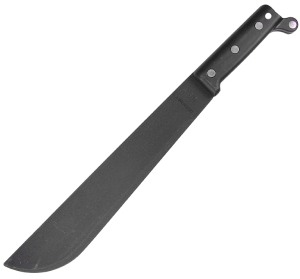
One of the tools I use at almost every dig is a machete. In hedgerows, nothing works faster to cut away multiflora rose, kudzu, wild grape, errant brambles, honeysuckle, wild cherry and poke berry. In the middle of a dig, a stray root can simply be loped off with a stroke of the machete. When dispatch time comes, a hard hit to the top of the skull with the dull back edge of the machete blade ends things pretty quickly.

A machete is not an axe. This tool is not designed to cut firewood or trees, but to hack through thickets of soft, fast-growing vegetation of the sort we generally find in hedgerows. No easily-transportable manual tool has ever beat a machete for this type of work.

Even an expensive machete is quite cheap, so get a decent one which should run you around $30-$40. You do not want a "cane knife", which looks like a machete but is too light, nor do you want or a K-Bar knife (too small and light), or any other of the other dizzying substitutes you might come across in a store or online knife shop.

I use an Ontario Machete, and have no complaints. One new style of machete I have seen comes with a saw edge along the back edge, which seems like a good idea if the soft steel of a machete will, in fact, hold a saw edge.

Some people prefer various odd types of machetes, like the kukri, but I prefer a simple straight blade which is easy to pack and useful in more situations than a kukri.

No machete should ever come with a pommel guard -- such a thing is real trouble in the brush. A machete is not a sword or a knife -- it is a machete. They are a perfected design, and you want the version that has stood the test of time.

Machetes are made of soft metal and are designed to be sharpened a lot. When cutting a lot of sugarcane or hard brush, they are sharpened once or twice a day.

Oddly, none of the machetes sold in the U.S. come with a sharp blade, and in fact getting one sharp the very first time takes some effort.

Do not use a grinder or belt sander to get a machete sharp -- there is very little chance you will get it right, and a very high chance you will permanently burn the blade.


What you need to sharpen a machete or shovel is called a "flat bastard" file. Put the machete blade in a vise, and draw the file across the edge of the blade at a 45 degree angle away from the center of the knife. Or do it the other way if you prefer -- put the file in a vice and draw the blade across it.

Putting the first edge on a store-bought machete will take time -- don't be in a hurry. When you have it right, be sure to oil the blade with a little motor oil.

When using a machete, always cut away from yourself. Always. Nothing will ruin your life faster than hacking your leg with a machete -- if you survive it at all.

A machete blade has a tendency to glance off thick vines and branches, which can be dangerous. The trick here is to not to try to cut straight across the vine with a single whack of the blade, but to hit the vine or branch with a scarfing blow, designed to cut along the stem in a kind of flat notch. The second whack will generally cut it through, with the blade in good control the entire time.

Your machete should have come with a scabbard of some type. Some are cloth, some hard plastic, some leather. Many of the old jungle machetes (many of which were made in Connecticut, believe it or not!) had light wood scabbards, but these are rarer now.

I keep my own machete sharp with a $1 D-handle knife sharpener bought at the local Dollar Store. The same sharpener helps keep an edge on my shovels, and can be bought at a kitchen supply store for about $10. Try the Dollar Store first -- why pay more?
.
.

Tuesday, November 7, 2006

Datura


The big green prickly seed pods are Datura


Datura is sometimes called Jimson Weed, Mad Apple, or Devil's Weed, but whatever you call in, it's a common enough plant on disturbed farm land. The picture above shows Datura growing on the edge of a field on Sunday.

Datura is a very powerful poison, and also one of the most powerful psychotropic plants found anywhere in the world. No one should ever experiment with this drug -- it makes 1500 mics of LSD look like a short beer, and it is not a "nice high" but a nightmare on two legs.

The following description describes the symptoms of Datura ingestion -- something once practiced by native American shammans, but now given a pass even by them:


Stimulation and/or anxiety.

Extreme nausea. Dilated pupils. Blurred or fixed-focus vision. Rapid heartbeat.

Extreme disorientation. Loss of memory. Loss of time. Delirium.

Profound sensitivity to light and noise. Seamless crossover into a variety of realistic dream states.

Extreme uncoordination, loss of body control, and vertigo. Extreme audio, visual, and tactile hallucinations.

Apparent astral travel to familiar places. Interaction with friends, relatives, and other random people who are not physically present.

Extreme drying and irritation of the mouth, throat, eyes, urinary tract, and other mucous membranes.

Potential for uncontrollably emotional or violent activity. Inability to recall anything -- even that you are under the effects of a drug -- for quite some time.

Tuesday, May 23, 2006

The Multiflora Rose Is In Bloom


When out digging the dogs, it is not uncommon to find a sette under a thick break of multiflora rose, with perhaps a few broken strands of barbed wire snaking along the ground right next to the hole.

In that little picture is a story.

Multiflora rose originated in Japan
and was imported to Europe around 1862 to serve as a root stock for "rambling" roses.

Rambling roses became a craze with the creation of "Turners Crimson Rambler" in 1893, and this craze lasted for about 30 years until the modern, repeat blooming, large-flowered climbing roses were created.

The first multiflora roses to "go native" in the U.S. were rambling roses that originate during the rose craze of the very early 20th Century. In truth, these feral roses were not much of a problem.

The problem started in the 1930s and extended into the early 1960s as the U.S. Department of Agriculture and various State highway departments promoted multiflora rose as a "cure-all" for many public and farm landscaping problems.

In truth, multiflora rose did seem to be a good solution for a lot of difficult areas. Multiflora was cheap, easy to propogate from cuttings, and was rampant with vigor. Long, arching and pliable canes with thorns were perfect for shielding car lights from oncoming traffic, discouraging humans from entering fields or crossing roadways, and keeping cattle out of riparian areas.

Rose roots seemed to thrive in a large variety of soils, tolerated both drought and wet reasonably well, and they did a commendable job of stablizing creek banks and slowing erosion on slopes. Rose hips were also eaten by a wide variety of song birds and animals, providing a needed food source in winter.

The U.S. Department of Agriculture and its various state analogues vigorously promoted multiflora rose as a low-cost alternative to barbed wire. Barbed wire had made its way East several generations earlier after first being established in the West.

Unlike western wire, which was typically strung from post to post, easten wire was often strung from existing trees around the edges of woods, creeks and fields. In time, these the trees grew and absorbed the wire into their trunk. Imbedded wire was difficult to remove and made the trees worthless as timber since wire and nails wrecked commerical saw blades and had the potential of turning a chainsaw into a lethal weapon.

Like so many good ideas, the promotion of multiflora rose has unintended consequences. A mature multiflora rose bush can put out half a million seeds a year, and these seeds are easily spread by birds and can live in the soil for 10 years or more.

Farmers found that getting rid of a rose hedge required riping it out with a bulldozer and then plowing and mowing the areas multiple times a year for several years in order to destroy the existing root and seed stock in the soil.

The good news with multiflora rose is that has truly been a boon to wildlife. Rose hips are consumed by robins, grouse, cedar wax wings, pheasants, wild turkeys, fox, chipmunks, white-tailed deer, possums, coyotes, black bears, beavers, rabbits and raccoons. Thick rose breaks provide shelter for deer and bear, as well as groundhogs, possums, fox, rabbits, and raccoons. Rose hedges along stream banks have worked to keep cattle and horses out of riparian areas, resulting in less erosion, cleaner water, and excellent denning sites for raccoons.

Next time you find yourself digging a hole in the middle of a multiflora rose bush with broken barbed wire snaking along the ground, remember that these stabbing obstacles are, in a very real sense, a significant player in the vigorous return of wildlife we see in in the Eastern U.S. today. Though they may be the enemy of the moment, they are the long-term friends of terrier work.