Wednesday, February 29, 2012
Baby
Tuesday, September 7, 2010
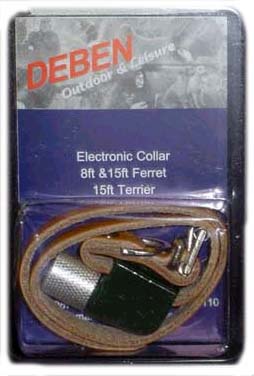
Deben Mark I Collars and Boxes for Sale
The good news, for those who want to get into the world of digging, is that five of the old collar and box sets have come on the market here in the USA.
The seller is Ray H. in New Jersey, who can can be contacted at FOXHUNTERDERRY@YAHOO.COM.
If you want a phone number, send me an email and I will forward that number to you.
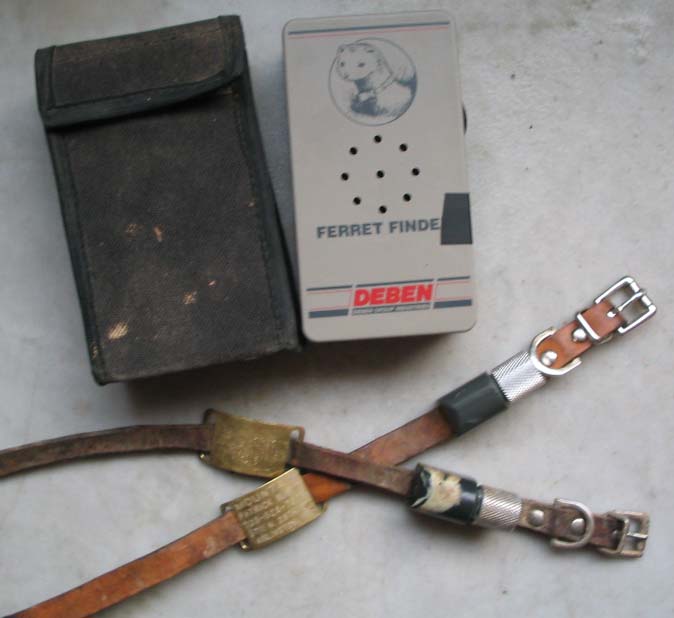
For those wondering, those are my old locator collars and box pictured below. Mine are a bit battered, but I have a spare box and a least two more collars beyond the two I use on my own dogs, so I am in good kit. More on how to use a locator collar -- and how to make the Mark I locator collars last forever --at this page on the Terrierman.com web site
.
Monday, May 24, 2010
The Best Great Sword Ad You Will See All Day
This is the best Great Sword promotional video you will see all day. This little beauty costs only $318 and it appears to be worth every dime.
Suggest your butcher buy one and put on a performance in his shop window; sure to boost business!
.
Sunday, April 18, 2010
Coffee and Provocation

A Little More Hexane in Your Veggie Burger?
Mother Jones magazine, notes that "In order to meet the demands of health-conscious consumers, manufacturers of soy-based fake meat like to make their products have as little fat as possible. The cheapest way to do this is by submerging soybeans in a bath of hexane to separate the oil from the protein." Hexane, of course, is an EPA-regulated neurotoxin, but despite that fact, the FDA does not test for it. Read the article.
This Is Why You Defend the Second Amendment:
The U.S. Constitution says nothing about guns. Not a thing. What it talks about is the "right to keep and bear arms." If you remove that right, the state can actually march in and take your pocket knife. Think that's crazy talk? It's not if you live in the U.K., where a disabled man who kept a Swiss Army knife in his car's glove box has just gotten a criminal record for possessing an offensive weapon. The knife was not just in his glove box, by the way -- it was in a pouch in his glovebox, along with a small flashlight, a first aid kit, and waterproof matches.
This Is Why You Defend the First Amendment:
The Associated Press reports that: "Sarah Palin spoke to a crowd of about 16,000 attending an evangelical Christian women's conference in Louisville Friday night....She asserted that America needs to get back to its Christian roots and rejected any notion that 'God should be separated from the state.'" Great. Just what we need to be: a theocracy like Iran, Afghanistan, Saudi Arabia, and the Vatican.
Tasering Sheep on Meth:
In a study of Taser safety, scientists got a bunch of sheep hopped up on meth and then zapped them with tasers to see how they did with that. Read all about it.
Native American Genius:
W.T. Wallington's Forgotten Technology web site shows techniques he has developed to show how the stones for Stonehenge and the Pyramids might have been hauled, rotated, and lifted into place using nothing more than simple physics. Check it out by clicking on the picture on the home page, and clicking through the links at the bottom of each subsequent page. Yes this stuff works! No space ships or Martians needed -- or massive ramps either from what I can gather.
Doug's Expanding Menagerie:
Doug is rehabbing a red-shoulderd hawk and starting an adventure in bees, the animal most likely to kill you. Madness I say!
Dominance in Pigeons:
Who is the alpha pigeon? Researchers are studying it with little GPS backpacks.
The Garden of Cosmic Speculation:
The Garden of Cosmic Speculation was created by Charles Jencks and Maggie Keswick in Dumfries, Scotland in 1989. It contains bizarre and mind-blowing geometric patterns. Check it out! This is a private garden and open to the public only one day a year, so these pics are probably your only opportunity.
Whatever Happened to Sealyhams?
Sealyham's are a breed that was sucked into the kennel club vortex almost upon creation. For a web site documenting that, see this interesting, if obscure, web site on show sealyham terriers in the 1920s, '30s and '40s, complete with a pictures of what the Westminster show looked like at Madison Square Garden back then, and a little note about the first head of the "professional handler's association." Hat tip to Paul H. for the link!
Nice Blog!
If anyone wants to see what a fun life in Western Colorado looks like (complete with great photos), see the Dirt and Dogs blog and check out "the hunter and the hunted" post for a little amusement. Also a few pictures of Arizona in here. Of course, Jamie O'Neal claims there is no Arizona. I think Trina might disagree!
Vitamin C for Canine Snake Bites?
I am quite happy that we do not have to worry, too much about venomous snakes in my area; we are a little too far north for water moccasins, copperheads are way over-rated, and rattlesnakes are rare all over and generally confine themselves to rocky shelves and outcrops in the mountains. That said, not everyone is so fortunate and Jonathan from South African passes on this tip about Vitamin C shots as a treatment for snake bites in dogs. Does it work? There are reports on the internets that it does, but I have to say I am skeptical. Snakes do not always envenomate when they bite, and there's a lot of mis-identification of snake species as well. Still, when nothing else is there to help, break out the Vitamin C. It cannot hurt!

.
Saturday, March 6, 2010
Are Useful Tools Ever Out of Date?

I got a letter from AARP the other day.
They wanted me to join. I am 50.
I wanted to scrawl on the envelope, NOT DEAD YET!
When I turn on the radio, the songs of my youth (such as Led Zeppelin and Grand Funk Railroad) are now on "the Oldies" station."
Oldies?
Perhaps.
Now to be clear I listen to new music -- a lot of it. And I will also venture that we have more great musicians alive right now than we have ever had in the history of the world.
But "new" does not always mean better. Sometimes it does, but not always. I am pretty sure the work of Little Wayne will be forgotten long before that of Mozart, Armstrong, Sinatra, and Springsteen.
Of course, a lot of times, the "NEW" is simply the OLD in a new wrapper.
The kids call this "sampling" which sounds so much better than plagiarism.
And, of course, it is not new is it?
When Leonard Bernstein pitched Westside Story, he pitched it short: "It's Romeo and Juliet with Puerto Ricans in New York."
When Steven Spielberg was trying to raise money for his first real movie, he said: "It's Moby Dick.... but with a shark."
When Francis Ford Coppola pitched "Apocalypse Now" he did not waste a lot of time: "It's Joseph Conrad's Heart of Darkness ... in Vietnam."
So what am I to make of all these folks claiming to be "new and improved" dog trainers? These are the folks ripping off 80-year old techniques which are derived from 150-year old techniques, which were lifted from stuff stolen from the folks who built the pyramids.
I am all for this "new" stuff. But I am not for tossing out the "old" stuff either. You see, it's all the same thing!
But of course this may come as new information to the fuzzy thinkers and instant experts.
Take the anonymous coward who showed up the other day to say he or she thought Cesar Millan's methods were "outdated."
Eh? What? What are his methods?
And what are his methods to do WHAT?
Does this person think Millan is training dogs? He is not.
Does this person think non-associative habituation is outdated? It's not.
Does this person think operant conditional extinction is outdated? It is not.
Does this person think a leash is outdated? It's not.
Does this person think exercise is outdated? It's not.
Does this person think consequences are outdated? They aren't.
Does this person think walking a dog is outdated? It's not.
Does this person think clarifying the point that dogs are not children is outdated? It's not.
Does this person think showing affection for dogs is outdated? It's not.
Does this person think the notion that a dog trainer has to be calm is outdated? It's not.
Does this person think the idea that a dog trainer has to send clear and well-timed signals is outdated? It's not.
So what is "the method" that is outdated? And what is that method being used for again?
This is a genuine question.
I hear people saying "Millan's methods are outdated" but no one seems to know what that means in the context of what he actually does, which is RE-habilitating dogs.
Instead, what I hear are anonymous cowards who are willing to "fence fighting" but stand as complete punks, ignorants or fools if that fence is removed.
And so they keep the fence up! No names. No email addresses.
When you tell me so little, you tell me so much!
Of course, along with the anonymous cowards, the zombies and the trolls, you have the parrots. These are the folks who repeat whatever they just heard on a board, or who regurgitate whatever they just read in a book, never once subjecting the idea to rationale thought, research, or field experience.
Parrots are the folks who write all-breed books and who read them and believe them.
They may squawk a lot, but their brains are the size of a shelled walnut, and they are incapable of original though or use of tools. Most spend their entire lives never leaving their cage.
And then there are the folks who actually do things. And guess what? The most successful of these use tools, both old and new, as they find them, and as they need them.
And so, in the world of working terriers we use tools and techniques straight out of the Middle Ages.
But we also use electronic locating collars in order to locate the dogs under ground. And we use plastic water bottles and, if the need arises, a veterinary staple gun and antibiotics.
Tools are not completely the same from one place to the next, either.
In the U.K., they do not use posthole diggers as the ground is a bit softer. When a UK terrierman comes over here, however, he figures out he may have a use for this "new" tool!
What? Not all geography is the same? True! But tell no one.
And not all dogs and dog problems are the same either.
But mum's the word. Tell no one.
As for my old tools, I try to keep them well-oiled.
A few years back I realized I could not scrunch down into a hole like I used to, and so now I go to the gym a couple of times a week just to keep things moving.
I have replaced a rivet or two in my shovel heads, I have replaced a few handles on my posthole diggers, I have patched a cracked locator box, swapped out some leather collars, replaced a badly frayed pack, and buried a dog or two.
But I still dig on my dogs the way it has been done for over four hundred years. I am not so vain as to think that because I invented a cheap game snare I invented digging on the dogs.
The world did not begin the day I was born!
.
Friday, July 24, 2009
Ames Pony Shovel
In looking for a source of extra-long rivets to repair a shovel head with, I discovered that an Ames Pony shovel (from AM Leonard) can now be bought from Amazon.com >> see hereThis is a very good American-made shovel from a company that has been making tools for longer than we have been a country.
This shovel is not cheap, but it is worth every penny.
.
Wednesday, July 1, 2009
Gentle on Dogs and Quarry
A smart digger learns to slip a spade between the dog and the quarry if it is at a stop end -- especially if it is a raccoon or a fox that cannot dig away. Why let the dog get injured when it has done its job, which is to locate, bolt, or bottle the animal in a stop end? The dog is valuable, and so too is the quarry.
Any fool can terminate quarry. There is no skill in killing. If it must be done (it is often a requirement for farm permissions when it comes to groundhogs), it should be done quickly with a gun or blow to the head.
Better yet is to let the animal go, especially if it is a fox or raccoon. If you hunt every weekend, it is too easy to bleed a farm white by killing off all the fox and raccoon in a matter of weeks.
If you must have a fox or raccoon on the mantle, buy a finished taxidermy piece -- it will be no more expensive, and you are guaranteed a good mount of a large specimen in prime coat.
Best of all, let your trophy be a picture. A shot down the hole is proof and memory enough of a dog that has done its job.
In the picture at top, the snare is set, with the digging bar placed vertically in the pipe to slow the fox down a bit and steer it into the snare.
A fox or raccoon can be snared around the neck, but a groundhog has no neck, and so at least one leg has to pass all the way through the loop before it is pulled tight. And, for the record, the little fellow at right was released unharmed.
Thursday, June 25, 2009
Undiggable Earths
This groundhog sette ran more than 6 feet deep through broken slates mixed with thick tree roots. This is a diggable earth, but one you do not want to tackle solo, as I was this day in the field. This is when you want a dog that will come out rather than force you to dig down to it.
If you dig very much, your dog will eventually enter a sette that, for one reason or another, is undiggable. Perhaps it is a fine-looking earth that, when shovel is put to soil, turns out to be a heap of roofing tin covered over with dirt -- or worse, a mound of steel-belted radial tires! I have had dogs enter settes that ran under huge pieces of broken iron sewage pipe that had been dumped into a ravine, as well as rock settes and massive hay bale stacks that were not going to be shifted without a backhoe.
Sometimes a sette is theoretically diggable, but you really would prefer not to. A 10-foot solo dig for a groundhog? Not if you can avoid it!
What do you do when your dog enters an earth that could only be dug if you were forced to chainsaw down the tree and prize out the roots?
Simple.
Stand back, far away, and sit down. Do not smoke, do not talk, and do not stand up. Do not sit near the sette -- you want to be so far back from the hole that the dog cannot hear you breathe or smell you. Do not shift your weight or bang your tools -- just sit and wait and watch the hole.
How long do you wait? That depends. Most dogs will come out between a half hour and an hour after they enter. What happens if they don't? You wait some more. Do not go back to the sette and do not call the dog.
Waiting is hard, especially if it's a green dog, or you are a green digger. There's a natural desire to do something -- to start digging, to call the dog, to shove a mirror and light down the hole, to walk around topside boxing for location, etc.
If you have really ascertained that the earth is undiggable, resist temptation.
Two or three hours may go by with the dog not coming out. The good news is that most dogs will exit on their own before this amount of time has passed. Be patient.
It is in these undiggable earths that small vocal dogs prove their worth, because these dogs are less likely to get stuck, are more likely to be able to turn around underground, and are less likely to shove dirt behind them that might "bottle them up" from behind.
If the dog is vocal, and you are quiet, you should be able to hear it bay when you are close to the sette (provided it does not have a mouth full of fur).
When the dog does appear, do not walk up to it, but instead turn your back, walk slowly away, and quietly call its name -- the dog will most likely follow. If it does not follow, and instead dives back into the hole, simply sit down and wait some more -- the dog will be out again, soon enough. Now you are simply in a waiting and training game.
An experienced dog will understand, in time, that you are a team and that if you are digging it has to hold ground, but if you are not digging for a long period of time it may be a signal to come out.
Dogs learn, provided we are consistent and give them lots of experience. It is on the experience end that most terrier owners fall down.
Monday, June 1, 2009
Machete Types, Use and Sharpening
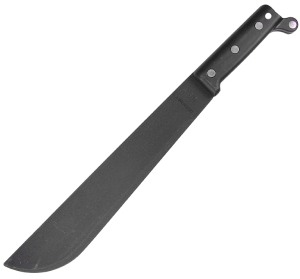
A machete is not an axe. This tool is not designed to cut firewood or trees, but to hack through thickets of soft, fast-growing vegetation of the sort we generally find in hedgerows. No easily-transportable manual tool has ever beat a machete for this type of work.
Even an expensive machete is quite cheap, so get a decent one which should run you around $30-$40. You do not want a "cane knife", which looks like a machete but is too light, nor do you want or a K-Bar knife (too small and light), or any other of the other dizzying substitutes you might come across in a store or online knife shop.
I use an Ontario Machete, and have no complaints. One new style of machete I have seen comes with a saw edge along the back edge, which seems like a good idea if the soft steel of a machete will, in fact, hold a saw edge.
Some people prefer various odd types of machetes, like the kukri, but I prefer a simple straight blade which is easy to pack and useful in more situations than a kukri.
No machete should ever come with a pommel guard -- such a thing is real trouble in the brush. A machete is not a sword or a knife -- it is a machete. They are a perfected design, and you want the version that has stood the test of time.
Machetes are made of soft metal and are designed to be sharpened a lot. When cutting a lot of sugarcane or hard brush, they are sharpened once or twice a day.
Oddly, none of the machetes sold in the U.S. come with a sharp blade, and in fact getting one sharp the very first time takes some effort.
Do not use a grinder or belt sander to get a machete sharp -- there is very little chance you will get it right, and a very high chance you will permanently burn the blade.
What you need to sharpen a machete or shovel is called a "flat bastard" file. Put the machete blade in a vise, and draw the file across the edge of the blade at a 45 degree angle away from the center of the knife. Or do it the other way if you prefer -- put the file in a vice and draw the blade across it.
Putting the first edge on a store-bought machete will take time -- don't be in a hurry. When you have it right, be sure to oil the blade with a little motor oil.
When using a machete, always cut away from yourself. Always. Nothing will ruin your life faster than hacking your leg with a machete -- if you survive it at all.
A machete blade has a tendency to glance off thick vines and branches, which can be dangerous. The trick here is to not to try to cut straight across the vine with a single whack of the blade, but to hit the vine or branch with a scarfing blow, designed to cut along the stem in a kind of flat notch. The second whack will generally cut it through, with the blade in good control the entire time.
Your machete should have come with a scabbard of some type. Some are cloth, some hard plastic, some leather. Many of the old jungle machetes (many of which were made in Connecticut, believe it or not!) had light wood scabbards, but these are rarer now.
I keep my own machete sharp with a $1 D-handle knife sharpener bought at the local Dollar Store. The same sharpener helps keep an edge on my shovels, and can be bought at a kitchen supply store for about $10. Try the Dollar Store first -- why pay more?
.
.
Tuesday, April 28, 2009
A Little Brain and a Little Brawn
Terrier work is not for fools, the unprepared, or the physically weak. Most of the time it is a simple things: dog in, dogs bays, quarry bolts or is dug to.
Most of the time.
There there are the other times: when the dog goes so deep it is off the Deben box and cannot be heard; when the explosive stench of skunk poison rises like smoke from the hole; when the dog refuses to shift out of a solid rock hole; when, after four feet of dirt, you hit running sand; when the dog is unable to turn around or exit due to a rock or root slipping behind it.
This is when tools matter.
In terrier work, the most important tool is between your ears. A lot of things that are written off as a "tragic accident," are, in fact, a predictable nightmare.
"The collar failed."
Yes it did. But did you spend time to really tape the collar, and do you know how to tape a collar? Did you enter a dog under a power line? Did you test the batteries before they were put in? Did you check to make sure the collar and receiver were working before letting the dog loose?
I have been guilty of all of these failures at one time or another (as have most diggers), but let us be straight; our failure is not an accident. It is sloth. It is stupidity. It is recklessness.
So many "accidents" occur when dogs are in the field without collars and the dog's owner is without tools. Again, I have been guilty of this transgression, but let it be clear that stupidity, sloth and foolishness on the part of humans is the chief culprit in what is too easily an unfolding tragedy. Failure to put a dog on a leash is not an "act of God," it is the non-action of a human.
Another invaluable tool, along with common sense and a basic knowledge of terrier work, is a certain level of physical strength. It is not politically correct to say this, but it is nonetheless true that women, on average, have half the upper body strengths of their male counterparts. This is not to say women cannot dig. Some women diggers are more capable than most men (including me). It is simply to say that all diggers, and women in particular, need to make an honest assessment of their physical abilities. It is one thing to think you can dig a hole five feet square, but it is quite another to do it when the time comes. It is a risky and marginal thing for a relatively fit man to work his dog solo, and it is not recommended for most women. Two heads are better than one most of the tine, and two bodies are better than one all of the time.
.
Tuesday, March 3, 2009
How to Use a Deben Locator
Simon Whitehead of Pakefield Ferrets has put together three videos for Deben, the makers of the Ferret Finder 3 which is, for all practical purposes, identical to the Long Range Terrier Finder when it comes to actual box opertion.
The Deben LRT is a pretty good locator, and the one I would probably be using if I were not using my "old school" Deben MKI. Nice work Simon!
- Related Link
** How to Use a Deben Box
** American Working Terriers. - basic instruction
.
Saturday, February 14, 2009
There Is No Skill to Killing

Say that to the gun-chewing vegan, and they will nod with vigor.
"Absolutely," they will say. "I'm against all killing."
"I'm not," I will say, and I then I will move in, a little too close for comfort, subtly invading their personal space and looking them in the eye.
"I'm damn good at it. I'm just saying there's no skill in it. The skill is in hunting."
And, of course, they have no idea what I am talking about.
Killing is like writing.
Anyone who has passed second grade can write. Writing is simply making block letters with a crayola.
A trained monkey can write. It's easy.
Research is hard. Thinking is hard. Developing a sense of place and time and the immediacy of now takes attention to detail. Developing a sense of craft takes discipline. Putting together a new synthesis takes knowledge. Fleshing out character requires an understanding of human failing. Fusing plot and voice requires an understanding of story and a sense of character and self. A sustained voice is suspiciously like work.
But writing is pretty damn easy.
Look at all all the people who write. The Internet is full of them, banging away on their keyboards without a moment's bit of research or thought, like monkeys looking for Shakespeare.
They are all writers.
By the same token, the boys running the line down at the Perdue chicken plant are certified killers, same as anyone who sprays bug spray on their garden.
Killing is not hunting. Killing is easy.
And yet, people who know nothing about hunting are more interested in the killing part than they are in any other part.
This is the part they want to talk about.
O.K.
But I wonder if, when they finally get a chance to meet a real writer, do they ask him how he makes the letter "A"??
Never mind.
People are fascinated in killing, and when it comes to terrier work, they are very confused about it too.
So let's get to the first point: The dogs do not do the killing. I do. And I am very good at it.
The job of the dogs is to locate, to push the critter to a stop end, to bolt it from the ground if possible.
The job of the dogs is to sort out rumor from fact and to read the complex tapestry of story that is written in urine, scat and saliva on twisted vine and moldy ground.
The job of the dogs is to find, and then when found, to go from room to room in the darkness, armed with nothing but a heroes heart.
And then, at the end of that dark hallway, their job is to hold, to push, to put in voice and perhaps teeth if voice alone will not do.
And yet, in all of the excitement, their job is also to never forget their mission.
The goal here, as Patton so famously said, is not to die for your country, but to get the other son-of-a-bitch to die for his.
A good working dog will not come away knackered very often, as he has learned the power of voice and the importance of discretion. He has learned his job. And his job is not to kill. That, he knows, is my job.
Of course, a lot of the young people today have never learned how to do proper terrier work, and that story is told on the wrecked faces of their dogs.
At the end of a dig, these young toughs are too timid to reach in and tail out a living animal, and they have no idea of how do deal with an animal that is teeth out and snapping.
And so they ask the dog to do what they are too cowardly to do themselves, and which they are too ignorant to know how to do any other way.
What's that? A shoelace can make a snare? Or better yet, you have one in your pack already made up because you read a practical book on working terriers rather than a book of fanciful stories danced up by a Brian Plummer wannabe?
Amazing! And what's that? The man with the book gives instruction on his web site for free? Where's the profit in that?
* * * * * *
So how do you kill the vegan asks? (They never ask how to hunt.)
"At the end of a dig there is too much chaos and movement, and excitable people with guns is a recipe for regret. I generally dispatch critters by hitting them on the top of the head with a blow from the blunt side of a machete."
What? The sharp side?
"No, the dull side. It's the blow that kills, same as if I slammed a paving brick into your head and staved in your frontal lobe. If I did that, you would be dead in an instant, and there would be no coming back for you. It's quite painless.
"I do not shoot things from a distance. When I kill it is up close, and is by hand, and it is very fast and quite assured.
"I tell you there is no skill to killing, and I am very good at it."
Friday, January 30, 2009
Terrierwork Weights and Measurements
My old $5 fish scale, bought some years back at some forgettable roadside superstore (only the best for me!) was found to be out of true weight a few weeks ago.
Apparently I have been bagging critters a few pounds heavier than I thought. Who knew?
I have gone digital now, and the new scale arrived last night. It will weigh things up to 110 pounds, and it has a very nice hook on one end, so things should be much easier.
I have never weighed my tool kit -- what I actually carry with me out into the field -- and so I took the opportunity to do so now, and it's about what I expected: the pack with shovel, tie outs, water bottles, machete, yoho trowel, snare, leashes, etc., weighs 30 pounds, the digging bar nine pounds, and the posthole digger a little over 12.
All in all, I am going into the field carrying over 50 pounds, which can feel like a quite a bit weight at the end of a long day in the hot sun and after a few digs on the dogs.
.
Tuesday, May 13, 2008
Good Leash Design With Low-Cost Materials
I too like Euro-leads, but I do not think I will ever shell out $42 for a leash -- I am simply too cheap, and too disorganized. And yes, I have lost leashes in the field while hunting, and done it more than once.
In my defense, I think terrier work may be a little more chaotic that bird-shooting -- we have hedgerows to machete, anywhere from two to four dogs to cope with, ten or more tools to keep up with (shovel, bar, machete, posthole digger, root saw, yoho trowel, den scraper, critter snare, two packs, dog tie-outs), the physical work of digging, live quarry that can take a finger off, and the mound of dirt that has been taken out of the hole, which has to go back into the hole. In the ballet of it all, it's easy to overlook a single leash tethered to a small tree 15 feet from the dig.
The good news is that a pretty nice 6-foot "Eurolead" leash can be had for $18 plus shipping. These are made by Hamilton, and are pretty-fair quality as I recall (my folks still use the one that I gave them some years back).
A couple of years ago, however, I decided to experiment, and I came up with a very simple $7 do-it-yourself leash that has worked well for me. And though my leashes are ugly, they are also useful, simple, and cheap.
As a consequence, if a visiting dog chews through one, or if I leave one dangling from a tree in the forest, or if they are ground into the dirt during a dig, I do not feel too bad about it
Here's how I make them:
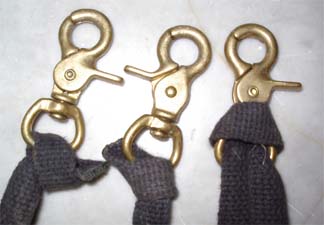
- Start with a 30-foot long black cotton training lead, and nine brass trigger snaps. If you prefer stainless or some another kind of snap, use that.
- Cut the lead into three nine-foot sections.
- Slip a brass clip into the bite in the middle (see far right, at picture below).
- Dip each of the slightly frayed ends of the cotton leash into a bit of black plasti-dip which is sold at most hardware stores for covering tool handles. The plasti-dip effectively seals the cotton ends so they do not unravel.
- When the ends are dry, use a single overhand hitch to tie a brass clip on to each end of the two leash ends (see the two clips on the left).
Believe it or not, that's all there is to it -- no real knots or sewing is needed.
The cotton is soft enough that it crushes on itself and holds well. I have never had a dog come off a leash (granted my dogs are small working terriers and not wolfhounds), and I can adjust the clip length any time I want.
The elegance here is not in the materials or the manufacturing, but in the simple design and its myriad uses in the field.
The finished leash should look very much like a brace couple with each side from the center clip approximately 4.5 feet long.
In fact, that's one way to use this leash -- to tie out two dogs at once at a dig, or to walk two dogs at once when the center clip is affixed to a belt or a rucksack's shoulder strap ring.
You can also affix the center clip to a low-hanging shrub or tree branch and tie out two dogs in the shade -- the branch will give some spring, and if you pick the right shrub, they cannot get entangled.
Perhaps the best way to use this leash is to simply take one side of the leash and hook it to the center strap, and then slip that over your shoulder and across your chest. The loose end, of course, is clipped to a dog (or dogs if a very short brace-couple is used there). Now you can walk hands-free, no matter how hard the dog lunges.
This same set up can be used to tie a dog to a fat tree, or to clip two dogs to a cyclone fence.
Put two of these leashes together, and you have a no-hands, over-the-shoulder leash with 4.5 feet of leash that you can affix to the middle section of the second leash which you used as a kind of long brace-hitch. Now you can walk two dogs hands-free, with the dogs free to roam as far as 10 feet in front of you. Or, if you prefer, you can hook the second leash to where the first leash is hooked at the shoulder, and now you can walk three dogs at once, hands-free.
Other than price, why do I think my do-it-yourself version is a little bit better than the off-the-shelf design commonly sold?
The short answer is length. A 9 foot-long leash is simply a lot more useful than a 6-foot long leash, especially if you are walking two dogs at once, or if you are looping a 4.5 foot section of the leash around your shoulder in order to walk one dog hands-free. In the field, I am more than willing to trade a little ugliness for a little utility.
Of course, these 9-foot leashes could be from leather by simply cutting down a really long long set of reins and putting in some rivets, or they could be made from nylon webbing. However, if I used either of these materials, cost would go up and loss and replacement of a leash would then be a bigger deal than I ever want it to be. So I race to the basement, sacrificing looks for utility, and the dogs do not really seem to mind.
. .
Sunday, May 11, 2008
Poison Ivy Prevention & Treatment
Poison Ivy is one of the burdens of American terrier work -- it's out there and you will get it if you work enough hedgerows.
Poison ivy, poison oak and poison sumac are all in the Rhus family of plants, and these plants produce more cases of contact dermatitis than all other substances combined. Plant-caused rashes can affect any part of the body, but commonly affect the forearms, face and back of the hands.
Poison ivy skin rashes are not contagious -- only the toxic oil of the plant (urushiol) causes the poison ivy reaction, and generally it has to be on your skin for an hour or more before it takes effect.
You can reduce or eliminate your chance of getting poison ivy in the field by wiping off your arms with soap and water if they have been dragging around in poison ivy during a dig. A very easy way to do this is with a packet of "handywipes" designed to clean off oils, such as Kimberly-Clark's Professional Heavy-Duty Hand Cleaning Wipes.
Tecnu is a special outdoor skin cleanser that removes Poison Oak and Ivy Oils from your skin. This product stops the irritant from spreading and can also decontaminate pets and tools. Small bottles are at many camping stores and pharmacies, such as Walgrens -- just apply with a small hankerchief.
Saturday, April 19, 2008
Aldo Leopold on Gadgets and Fox Hunting
Aldo Leopold
Aldo Leopoldwas one of the most important people in the history of U.S. conservation. A 1909 graduate of the Yale Forestry School, Leopold wrote first the book on Game Management (it is still in print and it is still used at a text book), and was the first person to predict that the widespread extirpation of wolves through poison and trapping would result in an explosion in the deer population that, in turn, would wipe out much of the understory of American forests. Most famous for his eco-philosophical journal A Sand County Almanac, about his Wisconsin farm, Leopold also explored the role of wilderness and hunting in American culture.
In an early essay entitled Wildlife in American Culture, Leopold noted that even in the era before World War II, "the gadgeter, otherwise known as the sporting-goods dealer," was dominating the sporting press and warping America's understanding of the outdoors.
The phenomenon is very easy to see today, with hunting and fishing magazines centered less on wildlife and wild places than on the Quad Bikes, scent sprays, lures, bait, and expensive guns, rods, and reels that we are told we will need before we even think about going into the woods.
This ethos has now expanded into the world of camping and hiking, where everything has to be rip-stop, multi-fuel, Goretex, and composite construction. Not only must everything be lighter weight, there must be more luxury and options than ever before. As Leopold noted in this 1940-era essay, describing the beginning of the modern ethos:
"Then came the gadgeteer, otherwise known as the sporting-goods dealer. He has draped the American outdoorsman with an infinity of contraptions, all offered as aids to self-reliance, hardihood, woodcraft, or marksmanship, but too often functioning as substitutes for them. Gadgets fill the pockets, they dangle from neck and belt. The overflow fills the auto trunk, and also the trailer. Each item of outdoor equipment grows lighter and often better, but the aggregate poundage becomes tonnage. The traffic in gadgets adds up to astronomical sums, which are soberly published as representing 'the economic value of wildlife.' But what of cultural values?"
The great thing about fox hunting and terrier work is that, with the exception of the locator collar, the equipment we use to today would need no explanation to Jaques Du Fouilloux (1560) or Sir Walter Scott (1810). Nothing much has changed, and very little has gone "high tech," in large part because the intervening variable -- the dog -- is immune to mechanical intervention.
At its core, the fox hunter is a primitive hunter and the dog is a primitive animal. As Leopold noted about mounted American fox hunting (which has never included killing the animal being chased):
"Fox-hunting with hounds, backwoods style, presents a dramatic instance of partial and perhaps harmless mechanized invasion. This is one of the purest of sports; it has real split-rail flavor; it has man-earth drama of the first water. The fox is deliberately left unshot, hence ethical restraint is also present. But we now follow the chase in Fords! The voice of Bugle-Anne mingles with the honk of the flivver! However, no one is likely to invent a mechanical foxhound, nor to screw a polychoke on the hound's nose. No one is likely to teach dog-training by phonograph, or by other painless shortcuts. I think the gadgeteer has reached the end of his tether in dogdom."
.
Saturday, December 15, 2007
Coffee and Provocation
Worst Messaging on Global Warming:An email from
The First Church of Global Warming:
The Daily Mail reports, without a hint of irony, that Pope Benedict XVI has "launched an attack on climate change prophets of doom, warning them that any solutions to global warming must be based on firm evidence and not on dubious ideology." The Mail goes on to note that the Pope says it is vital that the international community "base its policies on science rather than dogma." Ri-iiight. A lecture on science not dogma from the Pope? Thanks for sharing Benny!
Remind Me to Never Drink from a Glass in a Hotel Room:
I am hardly a finicky person, but this one makes me shudder just a little bit. And what about the sheets?
Live in Paris for Under $100,000:
The wife and I keep turning over the idea of selling out, simplifying, and settling down. Or as we like to put it: "Life is short, let's enjoy it." Towards that end, I spend a little time every week looking at "real-estate porn" just to see what's out there. My last great find was a huge lovely brick mansion with a lovely yard a spectacular inside (all designed by Walt Disney's father) in Missouri for about $270,000. This week, I found a place in Paris that had a pretty unbelievable price attached to it. Paris, eh? Now there's a place the Misses and I could kick back in. Might even sing a song about it.
Meanwhile the Rapacious Stalk the Earth:
The greedy bastards ruining this country know no boundaries or shame. Across America, more than 2 million people are expected to end up in foreclosure because of subprime mortgage shenanigans abetted in part by by Goldman Sachs, which simultaneously flogged subprime mortgages as great investments even as their hedge funds shorted them. The payoff for Goldman Sachs: over $19 billion in profits, and an average end-of-year bonus of $600,000 for each of their 30,000 employees.
Debasing the Currency:
Good news of sorts: strippers have finally found a use for $2 bills.
The
A cool little web site selling brass compasses, sextants, telescopes, pirate glasses, microscopes, etc. Check it out.
In the Market for a New Car?
It's that time of year for some folks. Lots to consider, but the Honda Element got top paws over at Dogcars.com.
Barney Cam 2007:
Since two of the current occupants of the WhiteHouse are terriers, I have kept rather close watch on the "Barney Cam" videos put out at Christmas time, and I have noted that bad things happen to those who appear in them. Anyone remember Gonzalez? Gone and under investigation. How about Harriet Miers? Gone and under investigation. This year the theme is "Our National Parks." You remember our National Parks -- the ones the Bush Administration has paid so little attention to up to now, and which have an $8 billion repair backlog that remains unaddressed. President Bush begins by telling Barney and Miss Beazely they can be Junior Park Rangers. Well, actually, that might be a problem. You see, dogs are actually prohibited from most National Parks. And another thing. Showing videos of a dog playing with a Christmas tree ornaments is not a great idea unless you get free veterinary surgery? Bush's dogs have free vet care? Oh then, never mind. Carry on!

.
Friday, December 7, 2007
How to Dig A Hole
If you think this is a silly topic, you don't dig much.
If you dig quite a bit, under a variety of conditions and with a variety of people, you know that most people aren't all that proficient at digging holes. Most people have shovels that are too small and too light weight, many people do not own a proper bar, and very little discussion is given to the different types of holes needed in different situations.
Some folks will box their dog at 2 feet and then begin digging a hole the size of a grave. More commonly an enthusiastic young dog owner will box a dog 5 feet down and reach for a posthole digger. Every tool has its place, and every dig is different, but holes deeper than four feet are fundamentally different from those that are three feet or less. >> To read more
.
Tuesday, June 19, 2007
Testing Out a New Field Pack
In 7 years it has never been washed, and so it has developed a rather pungent smell combining human sweat, dirt, dog, and old groundhog, raccoon and fox urine.
The smell of this pack may be an acquired taste, but it smells like the field to me, and I like it.
That said, there is a time to wash all things, and this pack's time had come. The pack also needed repair -- holes had developed in three spots, and I had lost one or two small items out of the bottom and begun to bag things inside the main compartment.
Enough of that; time to clean it, patch it and sew it up.
And I really meant to do that too.
Then, a couple of weeks ago Chris showed up with a brand new bow hunter's pack.
Nice.
Greg D. had recommended such a pack to me several years back, but I did not understand what made it better (or different) from a regular rucksack.
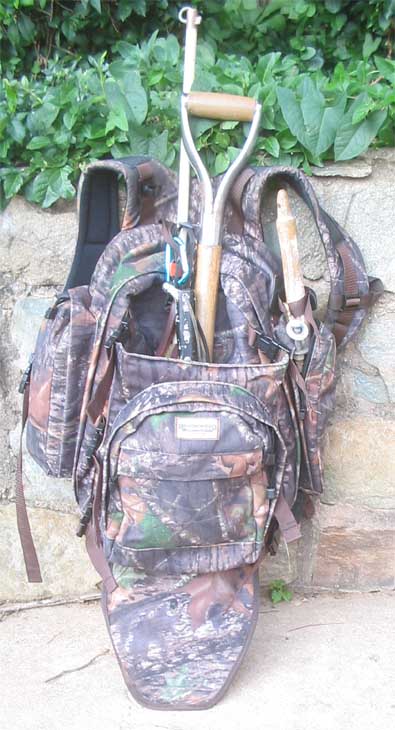
With the item in front of me, however, I saw its advantages right away -- it fit a shovel blade perfectly. Without wasting too much time, I ordered one off the Internet. What's the worst that could happen? That I wasted a little money? I've done that before!
The bag in question came from The Bag Depot and it's the Brockwood "Sniper" in a "Mossy Oak Breakup Pattern"
Yes, yes, now I own something in camo. I will try to get over it.
The pack itself is made of something described as "water-repellent suede-cloth" which is supposed to be a "super tuff material that resists burrs." No doubt all this is true, but I liked the plain old double-sewn army-green canvas of my old pack pretty well. This new stuff seems a bit heavier. That said, this new pack is "made in U.S.A. with Manufacturer Lifetime Guarantee." You can't beat that.
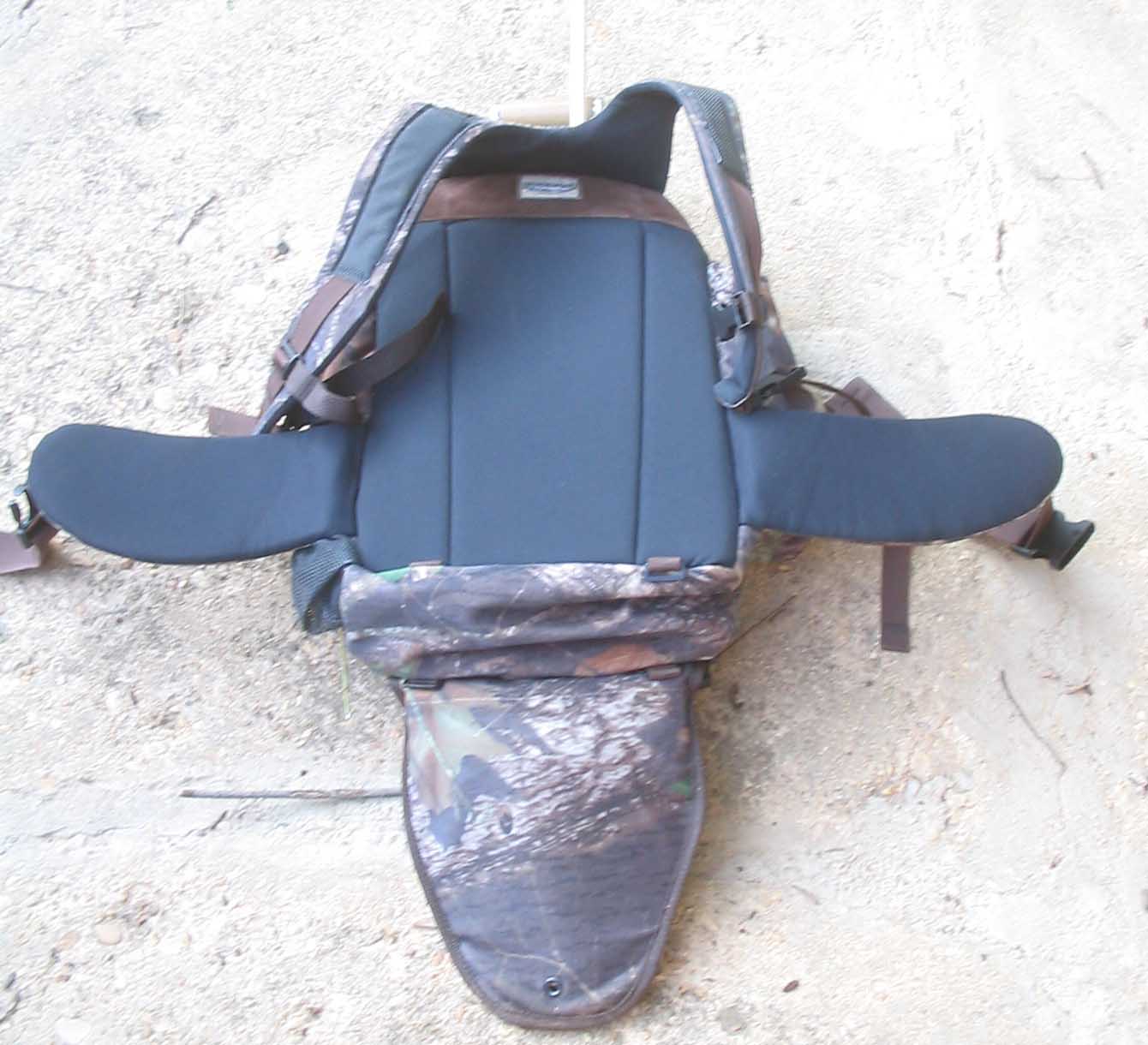
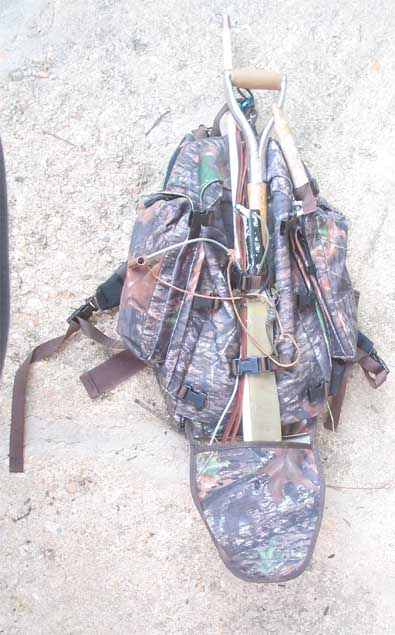
As you can see from the picture, the "Brookwood's Original Patented Bow/Rifle Backpack," has a fold-down pocket that fits a shovel blade like a glove (click on picture to enlarge).
Two center snap-straps run up the middle of the back, and these can be used to affix the shovel handle to the pack, as well as to hold (in my case) a machete, a snare pole, and a good leather leash. My long handled Yo-Ho trowel fits in the right side pocket, and several small eye-wash bottles slide into the left side pocket.
Segmented off within the main pack, up close to my back, is an area for a water bladder -- a very nice thing to have in the field.
The pack itself has both padded shoulder straps and a padded waist belt. There is also a "padded back with moisture-wicking fabric." Very fancy.
I was out on Sunday in extreme heat and it seems a pretty good pack. Though I have a strong emotional attachment to my old pack, this new one may be better. For one thing this new pack has a thick waist strap, and if you have spent a lot of time walking with weight in the woods, you know that alone can make a world of difference.
I used the pack this last weekend as shown. That said, there is also a large detachable pocked that can be strapped on the outside of pack to cover over the shovel and snare. I do not need this extra bit of room, but it occurs to me that it might be a very nice bit of camouflage for the folks in the U.K. who do not want to be seen in the field with a shovel. By simply slipping a small tubular camo-bag over the shovel handle, no one would know you had a shovel at all.
Useful for some, no doubt.
As for my old pack, it is nice and clean now, and repaired too. It will not be disappearing, but instead will take up the sport of fishing.
.
Wednesday, May 23, 2007
Blue Collar and Green All Over

The Start of Something New. Pictured left to right are Tom Buffenbarger, President of the International Association of Machinists and Aerospace Workers; Edward Sullivan of the Building & Construction Trades Department of the AFL-CIO, Matt Connolly of the Teddy Roosevelt Conservation Partnership; Rich Trumka, Secretary-Treasurer of the AFL-CIO (formerly with the United Mine Workers of America), Keith Kirchner of the United Steel Workers of America; Michael Sullivan of the Sheet Metal Workers International Association, Bill Hite of the United Association of Plumbers & Pipe Fitters, Donald Rollins of the Teddy Roosevelt Conservation Partnership, Jeff Zack of the International Association of Fire Fighters, Kinsey Robinson of the United Union of Roofers, Waterproofers, & Allied Workers, and Fred Myers of the Teddy Roosevelt Conservation Partnership.
I got a news release the other day that announced that:
"More than 3 million hunters and anglers in unions affiliated with the AFL-CIO today called on members of Congress to adequately fund key Farm Bill conservation programs and to include a measure that would allow states to establish or expand private land hunting and fishing access programs.
"In a joint letter signed by 17 unions, the unions urge Congress to follow the Farm Bill policy recommendations of the Theodore Roosevelt Conservation Partnership's Agriculture and Wildlife Working Group (AWWG)."
The unions are specifically joining with the Theodore Roosevelt Conservation Partnership to support the Open Fields part of the Farm Bill.
"In its current form, Open Fields would provide $20 million in federal funding for states to establish and expand private land 'walk-in' access programs for hunters and anglers. Such programs already exist in 20 states and have been extremely successful, opening up 26 million acres to sportsmen. They provide voluntary incentives to private landowners who open their property for public use, primarily for hunting. Remarkably cost-effective, these programs directly address declines in hunter and angler numbers felt across the U.S. in the last decade."
The partnership between the AFL-CIO member unions and the Teddy Roosevelt Conservation Partnership is a new development that sits under an umbrella called the "Union Sportsmen's Alliance (USA)".
Nice acronym, eh?
I applaud the AFL-CIO for going beyond the lunch pail.
Hunters and anglers are a powerful American tribe and therefore a potentially powerful way to frame a new message about working people that resonates across America.
If unions will defend and support hunting, hunters (who may or may not be union members) may give unions a new look and more support.
Besides, conservation is good for the economy.
Energy conservation means new jobs as buildings are retrofitted, while recycling means more trucks to move things to recycling centers. As America becomes more efficient in terms of energy, labor and materials, more jobs will stay in this country instead of going overseas. It's a win-win for everyone.
Of course at this very early point in its development, this hunter-union alliance is probably mostly window-dressing. That's OK. It's a sign that folks in the unions and in the hunting community are thinking outside the box. Lord knows, we need a little more that!
And for the record, I would not be caught dead in the field without my Ames Pony shovel -- union made (UAW, thank you very much) by one of the oldest tool makers in the United States.
As for my digging bar, it was hand-forged by a union steel worker. You can't get more union-made than that.
.jpg)