Showing posts with label amphibians and turtles. Show all posts

Saturday, July 15, 2006

Box Turtle Days


Last week Chris and I found a box turtle cruising down a row of recently mowed barley. He seemed no worse the wear for having had a combine just pass over him.

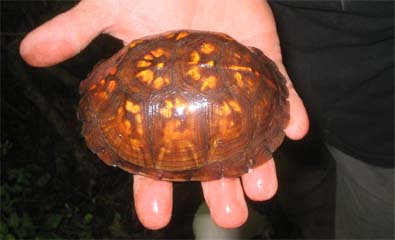
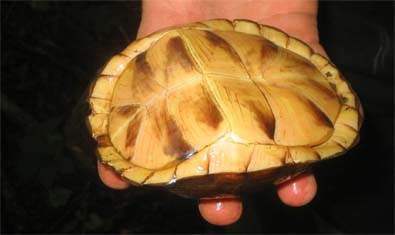
This week we found two small box turtles, the first in a thick hedge as we were looking for groundhog holes (picture of that turtle above and below) and another on a path by a creek after we had put the dogs up for the day (it was very hot!).

Eastern box turtle shell patterns are quite variable, and the one pictured above is called a "sunburst" pattern.

The second turtle, the one we found on the forest path, was very yellow and had lost a small part of his carapace at the front. He had the more traditional "crown" pattern.

For more on box turtles, and their steep decline across the Eastern United States, >> see here


Wednesday, May 31, 2006

Snapping Turtle in the Woods


More chins than chinatown. It's a sad thing to let yourself go like this.


This is a decent sized female snapping turtle Chris found in the woods while we were walking with the dogs. This turtle had come up an incredibly steep bank -- almost a cliff -- into the forest in order to lay her eggs. The rest of the year she lives in a flooded forest swamp at the base of the cliff. Male snapping turtles are larger than females -- the opposite of most other turtles.

Around here, snapping turles lay their eggs between May 15 and June 15, and the sex of the hatchlings is determined by the temperature of the nest.

My best guess is that this fellow weighed about 20 pounds -- they are very dense -- and was maybe 20 years old. This is a common snapping turtle of the type found all across the U.S. The infamous alligator snapping turtle is found farther south -- mostly in the southern end of the Misssippi watershed.

A common snapping turtle can easily get over 30 pounds and 60 pounders are rumored.

To give you an idea of how much the camera can lie, the picture above looks bigger than the turtle really is. In the picture below, Chris is holding the same turtle, which actually looks a little smaller than it actually was.


Sadly, we were still pretty clean a few hours later.

Tuesday, March 28, 2006

Frogs: Major Miracles in Small Spaces


Frogs and salamanders will soon awaken.
What amazing things these amphibians are!

Think about a frog for a minute. They start off with FINS and GILLS and sucking mouths. They are, for all practical purposes, a kind of primative fish. And then the weather gets warmer, and they go through this amazing transformation in the space of about two weeks -- the sucking mouth is transformed into a JAW with a huge tongue and tiny teeth ... the fins are transformed into some of the most powerful LEGS on the planet ... and the gills are transformed into air-breathing LUNGS and an air sac that would make a bag piper proud.

It's as likely as a carp turning into a wolf. And have no doubt that a large bull frog is a wolf -- they are a top end predator in any pond.

The picture below was sent to me last summer by my friends Larry and Linda Morrison, and shows a very large common bull frog in the Morrison's yard eating a living bird! The picture at top shows the same frog digesting the meal. Wow!


A very large common bull frog swallows a bird -- alive and whole.