Showing posts with label hibernation. Show all posts

Saturday, March 8, 2008

A Marmots' Swiss Paradise

An international Marmot museum and zoo? In Switzerland? And it's a tourist attraction??

Right.

Swear to God. And here's the best part: it's really well done!

Five species of marmots from Russia and from North America are visible in "huge parks" of 400 square meters, and tourists can observe the marmots underground by going down human-sized marmot holes themselves (actually large corrugated pipes with windows cut into their side.


The site is oriented to the south for maximum solar exposure and deeper dens are dug for winter hibernation. The marmots can be observed in their burrows thanks to special cameras, microphones and temperature sensors. No visible light is allowed in the burrows, so the marmots live in total obscurity and seeming privacy, as they would in the wild.


There are exhibits on threatened marmot species, marmot anatomy, marmot environment and habits, marmots and men, and hibernation, as well as others.

Fencing goes all the way down to bedrock where it is anchored, and it is electrocuted on top in order to keep out lynx and fox.

Click here to check out the web site.

This is the kind of thing two people might come up with after four hours of hard drinking at a bar, but the Swiss actually built the thing. What a wacky and wonderful world.
.

Monday, November 27, 2006

A Change of Season and Quarry


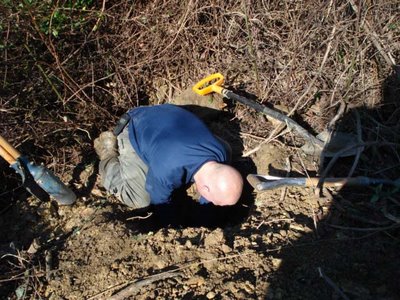
Chris peers into the hole.


On the drive out to the farms this morning, the truck thermometer said it was 33 degrees out, and the first frost of the season was evident on the grass. The temperature would climb at least 20 degrees today -- maybe 25 -- but the groundhog season was over, as groundhog hibernation is driven by light, not by temperature. This is true for bird migrations too -- an unseasonal period of warm weather in the Fall does not fool the birds.

Beginning with Thanksgiving and continuing to Christmas -- a period of about a month -- it's hit or miss with quarry, with a very high liklihood of getting hit by skunk, and a better than-average chance of finding possum and raccoon. After Christmas, the raccoon and skunk are generally hibernating (the male raccoon will begin moving around again in early February as they beging looking for mates), and groundhogs will very occassionally exit to defecate and then trundle back down to sleep for a few more weeks. Possum are active all year long, though they will lay up for long periods of really cold weather. After Christmas until the first of March it's fox season, with the peak in late January and running through February.

Chris and I met at the Flint Hill store. I had in mind pulling into a new parking spot close to a creek bed we could walk looking for game, but as I drove by I noticed two SUVs parked right where I wanted to pull in. Deer hunters. It turns out it's the first day of shotgun season. Oh goodie. How many first days of the season are there? First day of early black powder, first day of shot gun, first day of rifle, first day of bow, first day of regular black powder .... No worries -- off to another farm.

I turned around, and Chris followed me back up the road, and we pulled into a nice big place that has a nice creek and a small bog on it. It was going to be a nice clear day -- not too cold or windy -- and I had high hopes. Or should I say I had high hopes until I got out of the truck and walked 100 feet. The fields were soaked. Where did all this water come from? I did not remember too much rain from the week before, but it had clearly come down very hard here just 25 minutes up the road.

We hunted the dogs up the hedge, busting out a fair sized doe and a black-and-white feral cat which managed to get away with its life. We crossed above a boggy area and hunted down the top of a field where there were quite a few holes in a more-or-less dry hedge row. A large new push-pile has been bulldozed up, but nothing was home.

We crossed down the field to a creek bottom and began walking up the high side of the creek. Mountain gave voice for a second, and the dogs and I followed into the hedge, but nothing could be found, and Mountain trotted up from behind us as if she had bolted something into the field. Whatever it was, it was lost now.

We continued down the hedgerow on the high bank above the creek. In the distance I could hear guns blasting away. There was a large metal tree stand -- the type large enough to hold four hunters and a propane grill -- overlooking this field. No one was in it, but I still found myself routinely looking up the hill to make sure I was not being scoped in on.

At the end of the hedge, we crossed over the creek and begn walking up the hill to another long hedge about 100 yards above the water, but Mountain was nowhere to be found. We waited a bit, and I whistled, but after another minute it was pretty clear Mountain had found.

I crossed back over the creek and began boxing some likely settes, but she was not in them. Chris crossed over too and walked up the hill towards the big deer stand but did not find anything. He then crossed back over the creek and began walking down the high hedge where we had been headed, while I continued to call and box a few more possible settes. Chris whistled and said he had found her -- he was walking down the field and pointing to the same hedge I was in, but about halfway back down the course we had just come up. He could hear herfrom up on top, but the acoustics were such that even though I was closer, I could hear nothing.

I gathered up my tools, and Chris did the same, and we headed over to see what Mountain had in the ground. I doubted it was a groundhog -- it would have dug away by now. Probably a possum, maybe a coon. Or a cat. Too warm for fox yet.

Mountain was on the other side of the creek, and we waded over to find her in the middle of a very old and thick multiflora rose jumble. Time to break out the machetes.

This sette had about five eyes, and a quick boxing showed Mountain about three feet down in a mess of old roots and brambles. We hacked away at the vegetation, and then worked with machete and saw on the thick roots twising along the ground. After we had it cleared it out pretty well, I reboxed to locate the dog, found Mountain to be exactly where she had been before, and we began to dig.

This was not a particularly hard dig, but we did pull out some big rocks -- one the size of my upper torso, and the other the size of a small turkey. At one point Mountain came out -- she had been underground working this critter for about an hour, and whatever it was could not go anywhere or dig away.

With Mountain out, Pearl slid in and bayed it up nicely -- a nice deep voice. Mountain, hearing Pearl give voice, turned back around and pushed her way back in down another hole. She winkled past Pearl somehow, and Pearl came out. Pearl's a very young and inexperienced dog yet, but I am very pleased with how readily she is entering and working. This is only her third dig.

Pearl had riled up the critter in the hole, and Mountain was winding it up a little more, and by now, from the sound in the pipe, I was pretty sure we had a raccoon.

At about two and a half feet down we hit dry dirt, and I was pretty sure the dog was only ahout 6 inches deeper. Chris scraped the loose dirt out of the hole, and I carefuly barred and broke through into the den only 6 or 7 inches below. Excellent. Time for the posthole digger.

This last six inches was very dry and seemed to be made up of mostly degraded rock, but the posthole digger is a tough instrument, and it punched through in short order.

We pulled Mountain and tied up the dogs while we opened up the hole to see what we had. Chris dropped Moxie in hole, and she shot up the pipe and engaged -- there was small a roar in the hole and now I was sure it was either a coon or a very loud possum. Moxie has a habit of going for a head grab, but this time she was working in the dark, and I told Chris to let her work it a bit as I doubted she was going to be so brave and foolish wihtout light. After a while, we pulled Moxie, and she seemed to be no worse for the wear. A little dark tunnel work is all Moxie needs. She's a great little dog.

Chris went to tie Moxie up, and I looked in the hole to see the top of a raccoon head poking out. Hello!
The raccoon took one look at my ugly face, turned around, and pushed in as deep as it could. I postholed the pipe a bit to cut away the overhang, and I could see the raccoon's tail now. After a brief pause to see if she would relax, turn around, and bolt out on her own, we brought Mountain back over, and she turned the raccoon in short order.

With the coon turned around, we pulled Mountain and I got a snare over the coon and pulled it tight. We had decided to take picture and let this one go, but as the cable tightened up the coon pulled backwards very quickly and the cable came down on top of its head rather than over its neck. Not good. I tightened up the cable, but the raccoon squirmed free and then bolted. I told Chris to release Mountain, and he did. After a second or two of confusion (What do you mean it's not in the hole?) Mountain was off down the bank, through the water, and up the other creek bank. We let off the other dogs, and they too took to the water. A commotion with a lot of barking and snarling told me Mountain had caught the coon in a brushy jumble on the other side, and I leaped over to sort it you, which was done in short order. This was a female raccoon with an enormous posterior and she weighed 16 pounds.

We tied up the dogs, repaired the sette, and took a few pictures of the raccoon before heading back to work along the hedge. The dogs located nothing more on this farm, and we headed off to Nick's to see if we could find something there.

At Nicks the dogs had a nice run around before we headed over to a high bank above a creek. This is a fairly bad area, as a lot of rubbish has been tipped down this bank -- old pieces of plywood, bits of metal farm equipment, spoiled straw bales, spoiled soybeans, some old rugs, part of a small outbuilding -- but it is riddled with groundhog holes and is a likely spot for possums. We did not go fast through this section -- there were a lot of holes, and it would take the dogs a bit of time to find them.

Mountain was ahead of us down the creek, when Moxie showed interest in a hole. I downed tools and descended the embankment and pulled a few leaves out of the hole and encouraged Moxie to give it another sniff. In she went. Excellent. Chris came down the bank, and I tied up Pearl, and broke out the shovel. Chris was at the hole when he suddenly said, "Oh sh--; it's a skunk." We both began moving very quickly now. Chris began locating and it was not good news. Due to the steepness of the bank, the dog was about 6 feet down. The good news was that the ground was very soft -- wash down loam from the fields above. The diggin would not be hard, but it would not be quick either.

Chris started opening up the entrance hole and calling for Moxie, while I began to dig a hole from the top. I did not think she was as deep as the box said -- or at least I hoped she wasn't.

There was no sound coming from the hole. Minutes went by, and both Chris and I got a very bad feeling. Chris and I switched positions, with him digging on top and me clearing out dirt from the side hole. Suddenly I saw movement -- a white dog coming out. What the hell? It was Mountain. She must have gone to earth here without either of us seeing her. I could have sworn she was up the bank.

Mountain was out now, and she was reeking of skunk but seemed entirely fine from the experience. As I was tying her up, Chris called over -- "Here's Moxie". She had exited from another hole up on top -- a very small hole a few feet behind where Chris was digging. Lucky for us this sette had three or four eyes.

The dogs were fine -- Mountain got the heaviest part of the skunk blast, but Moxie was nailed as well. We gathered up the tools as the stench rolled out of the hole and down into the creek bed. It was pretty bad.

We crossed the creek on a plank bridge and headed up and over to the other side of the forested hill to hunt in the woods. We were not likely to find here, but that was OK -- the dogs needed a bit of time to let the stink drain off of them.

Chris busted a buck -- maybe four or six points -- and we bolted another three does while we were just on the other side of the steep hill that descended down to the Mononcacy River. There were several large brush piles here, but they were empty.

Later on, as we headed back to the cars, Mountain headed up into a field to check a large old sette. She went to ground and stayed, but she did not bay. I think she could smell the groundhog, but it was dug in for winter and it was not moving and there was no way to find it.

We headed back to the trucks where I had a brand-new bottle of Skunk Off (a seasonal precaution). I dosed Pearl first, even though she did not have much (if anything) on her, and then I washed Mountain with Herbal Essence shampoo to get off the dried black mud from the last hole of the day. Now that she was back to almost-white, I dosed her with Skunk Off and crated her.

Chris I worked over Moxie next, rubbing Skunk Off into her coat and paying as much attention as possible to her muzzle, front legs and chest where the spray was most likely to have been concentrated.

As we finished up with Moxie, a couple of deer hunters showed up for twilight shooting -- a father and son. The father looked stoned, and his shotgun had a scope which always looks like an odd fit to me, but is increasingly common. They asked about deer, and we told them that we had seen a few. As we pulled off the farm we stopped to talk to Nick, and Dave the farm manager who were repairing a bailer.

The dogs were a bit stinky, but otherwise this had been a fine day in the field with a bit more experience given to the two young dogs. All in all, not a bad day, but next time we may need to leave Mountain crated to give the young dogs a little more experience on their own.
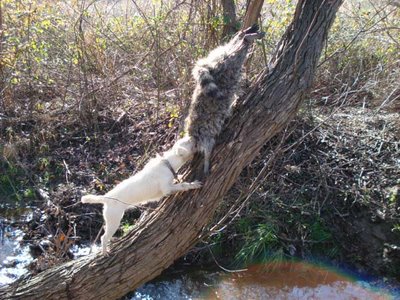


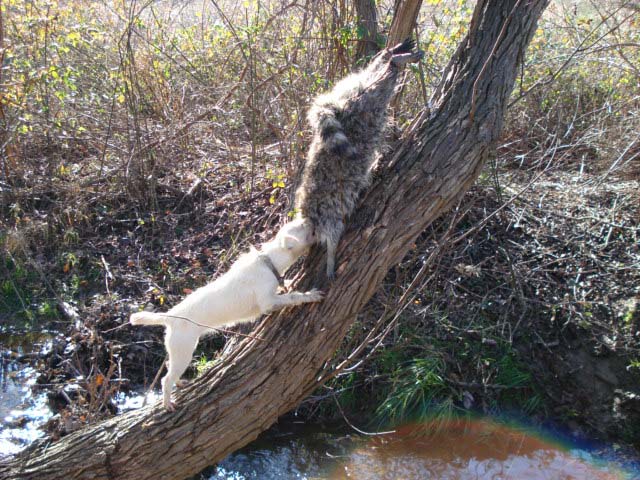
Pearl climbs a tree to grab a very dead raccoon. She got to work this one a little, as did Moxie.

Wednesday, September 6, 2006

Looking for Bird Flu in Alaska?


Sand Piper, Alaska


The Associated Press reports
that biologists are testing thousands of birds in Alaska, looking for any signs of Avian Flu.

Alaska? Sure -- Alaska. Huge numbers of bird nest in Alaska in the summer, from Peregrine Falcons and Snow Geese to Red Knots. Some of the birds that nest in Alaska are migrants from the tropical areas of Asia where Bird Flu has been somewhat prevalent.

For exanple, the Arctic Warbler nests in Alaska in the summer, and then flies across the Bering Straits, down the coast of Asia, passing through various countries including Korea, Thailand and Vietnam on the way to the Philippines where it spends the winters.

The Yellow Wagtail follows the same general migration path but nests throughout the region.

In theory, avian-flu infected birds could migrate from Asia to Alaska, and then transfer the disease to other birds that then migrated south into the heartland of North America and Latin American.

Bird are not alone in making vast migrations. If you follow migration patterns of animals, you will find that tuna, sharks, whales and turtles migrate vast disatnces North and South, East and West, and some species actually follow great circle migrations around the oceans on a seasonal basis.

Birds, of course fly great distances, and "American" birds migrate as far away as Tanzania, Australia, Tierra del Fuego, and Europe, with vast numbers going to Mexico, Central America, the Caribbean and northern South America.

Even some insects migrate vast distances. Right now Monarch butterflies are on their way south from Canada to their hibernation spot in the Oyamel Fir forests of Mexico.

In addition to monarch butterflies, some species of dragonflies also migrate south for the winter, soaring up into the jet stream to achieve incredible daily distances as they move to the Caribbean and Mexico.


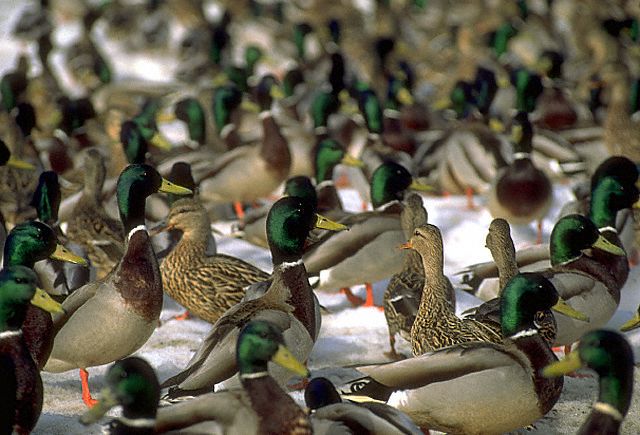
Mallards on snow, Alaska

Tuesday, March 21, 2006

Out on the Moors of Maryland


The moors of Maryland. All pictures by Chris J.


Chris J. and I went out on the Moors of Maryland yesterday -- large plowed-under corn fields with 30 mile-per-hour winds blowing cold in your lungs and heat off your body.

I had two coats in the car, but went out with a double shirt and a fleece vest and was -- for the most part -- OK as we were either moving or digging. That said, cold wind pulls the energy out of you fast!

At the first sette of the day Sailor managed to get the groundhog to crown out of the hole. The groundhog took one look at Chris, however, and decided he would try his luck underground again. That strategy worked, as he managed to dig himself in to the point that two dogs could not find him. Smart hog!

We headed down the field and checked a fox sette that was unused three weeks ago, but still open. Now it was filling in, and it was clear Mr. and Mrs. Fox had found a more likely spot to await the arrival of their kits. No worries -- too late for fox anyway.


Listening to Mountain in the hole. Sailor is staked out at left.


The dogs found again in a hedgerow next to a creek, and they were hard on the quarry when we arrived. Sailor got into the hole first, and Mountain was forced to patrol outside, checking bolt holes in the thick multifora rose brake.

Chris and I cleared out a small area, boxed for location, and began clearing soil when something bolted from a hole unseen under the multiflora. Mountain had been trying to get in at another side pipe, but at the sound of the bolt, she rushed down the creek bed in hot pursuit. She crossed the creek and began casting about for scent, and then entered a large mound of multiflora rose on the opposite creek bank.

Chris stayed with Sailor while I crossed the creek to see if Mountain had the critter bottled up. She did, and she was baying up a storm, so I called over Chris, telling him to leave Sailor -- she would come out in a minute. While Chris was crossing the creek, Sailor came out and they both crossed the creek to the opposite high bank.

Mountain had definitely found, and she was baying up a storm. The sette split off in a couple of directions, and whatever was inside was moving around pretty fast. We sunk a hole into the den pipe, and dropped a load of dirt between Mountain and the groundhog. Mountain exited, and we cleared the hole of loose dirt and put Sailor into the tight pipe. Sailor slid back up the pipe and began baying the critter again. Chris blocked off the far end of the pipe with dirt, and we began to box for location. I was barring for the den pipe when the groundhog broke though the loose backfill at the very end of the pipe. Mr. Groundhog got no more than three feet before Chris, fast as a boxer, dispatched it with a powerful shovel blow to the head.

"Hotel California -- you can check out, but you can never leave."
This was an average Spring groundhog -- maybe 8 or 9 pounds and a bit skinny from losing so much weight during hibernation. We backfilled the holes, pulled the multiflora rose hedge back over the scarred dirt of the dig, and headed back to the truck.


A small Spring groundhog. The dogs like them in all sizes!


The other side of the farm was across the road. We parked past the first hedgerow and headed down the creek. The wind was fierce, and though there were holes, most of the groundhogs were still hibernating.

During this part of the year, a groundhog will clean out its hole by pushing urine-soaked dirt to the exit. This dirt, in time, will be mounded over by the action of the groundhog's body moving across it.

Along with winter den cleaning, a groundhog will also be looking to find a mate at this time of year. Once this is accomplished, a groundhog will generally retreat underground, dam itself off from wind, rain and predators, and go back to sleep for a few more weeks until the grass is greener and the temperature is a little warmer.

During the next few weeks, a groundhog may exit from the hole only once every five or six days. As a consequence, an occupied hole may appear blank to a dog. It is during this period that the semi-somnolent female will go through her pregnancy, with an average of five to seven young born in mid-April or so, just as the goldenrod blooms.

In short, the beginning of the season can be a locating challenge -- a challenge never made easier by the fact that the dirt is generally quite soft with the winter melt, making it very easy for the groundhog to dig away.

The long hedge down the creek bank had been blank. I pointed out a little copse of woods in the middle of a corn field, and suggested to Chris we give it a try. I had walked this small woods once before and remembered there were some holes.

Man were there holes! One small area looked like a Prairie Dog town. Sailor found in a very tight hole and bayed it up, but she lost this groundhog a few minutes later when it dug away.

The dogs expressed little interest in the other holes, so we headed down the slope and across a field and to another hedge.

"Hey, where are the dogs?" They had been with us a second earlier, but now they were gone. We waited in the wind for a few minutes, and I whistled, but neither one of the dogs showed up. Clearly they had found.

Chris hiked back up the slope to the copse of woods, and quickly hello'd down to me that the dogs had found just inside the forest edge. I hiked back up the hill with the tools to find both dogs deep in a sette under an intertwined mass of thick tree roots

Mountain eventually came out, blacks with soil, but entered again. In the meantime Sailor lost the groundhog in the turns of root, rock and dirt. Sizing up the thickness of the deep roots, we decided to give this sette a pass for today. When Sailor came out of the pipe, we grabbed her before she could enter another section of the sette, and we quickly walked down the hill out of the woods. Mountain came out before we had gotten too far, and I whistled her back down the hill after us.

We crossed the creek to more holes on the other side, and hunted up the hedgerow past an old cache of cow skulls. This was an old dump for diseased dairy animals and horses. There had been an old fox sette on this high field last year, but it was not there now. We crossed the creek at the bottom of the hill, but on the other side we realized Mountain had not crossed with us.

We crossed back over the creek, and sure enough Mountain had found and was hard on her game. We cleared away the multiflora rose and dug down to her.

This was a shallow dig and we found Mountain latched on to the side of the groundhog and pulling hard. Mountain was not letting go, and there was no chance to dispatch as long as the dog was latched on.

We sunk a hole behind the groundhog, hoping to be able to tail it out. We got through on the backside of the groundhog, but could not quite see what part of the animal we were looking at. At about the same time as we broke through the pipe, Mountain shifted a bit and that was enough to allow the groundhog to bolt out of the side of the pipe where we had carved it away for a photo. Damn! The groundhog raced back to ground in another small part of the sette, but Mountain was hard on her heels. After a bit more digging, Mountain located again, and we soon dropped a shallow hole and dispatched it in short order.

Two down.


Mountain gets a good cheek grip.


We crossed back over the creek again, and found an enormous push-pile of broken farm machinery and wood that had, at some point, been a large shed and its contents of rusting equipment. Mountain and Sailor were inside this push-pile in a flash, and quickly bayed up a storm.

Huge trash-strewn dump piles are a problem; it is hard to locate a dog in one, and often impossible to move material to find the quarry.

I moved around on top of the pile and located both dogs baying very strongly under a palette covered with dirt, metal, plywood and old roofing. They were not deep, and the dogs were clearly on it.

Chris and I shoved some of the roofing material and twisted metal out of the way when we both caught the stench of skunk. It was pretty strong, but not overpowering. If this was a skunk, it was not a direct hit and deep . . . but the dogs were very close to the surface and seemed to have plenty of air. What was it? Of course it had to be a vixen ... and yet, it was pretty late for such a strong scent. Was this misery or opportunity? I waffled.

Chris peered into the back of the slotted hole and said he saw red fur. Excellent -- fox. No real worries with fox. Chris said he thought he might just be able to get hold of Sailor's tail -- maybe. I told him to grab her if he could, and he did. Sailor was now tied up and Mountain was mixing it up a bit deeper than we could quite reach.

The battle was on! There was a lot of movement inside the junk pile. I wanted Mountain out if we could get to her -- no reason to risk the fox going deep into this mess of metal, boards, I-beams and roofing.

Chris peered down the slot and managed to grab Mountain by the tail and drew her out. Mountain had taken a bite in the muzzle, and it was clearly a fox. No damage done, and we decided to call it a day. If this fox had very young kits in there, she could now raise them in peace.

We called it a day -- the dogs were beat and so were we. We had accounted for two groundhogs, and dug twice that many holes. The dogs had worked a fox, and neither side of that equation were too much worse for the sport.

That night the dogs slept like rocks and I got a little sleep too. As usual, the dogs bounded out of their crates the next morning, 'raring to go.

Easy dogs. Next Sunday will come soon enough
.


Ready for a bath and a little rest -- and whatever they can find next Sunday.

Tuesday, March 14, 2006

Nice Weather, Good Soil and Good Company


I went out Sunday with Chris J. who is new to terrier work but very sensibly studying up before committing to a dog that might otherwise be a 15-year mistake. We met at the infamous "Flint Hill Country Store" and then headed off to some public land for a scout. Mountain was with me, but I left her in the truck as her stitches from her hernia operation had just come out the day before, and she has yet to "hair over".

I could tell Chris was a bit skeptical of Sailor -- she's a little dog, and in truth she does not look like much. No matter. She always proves herself soon enough. Not all that is gold glitters, and in working dogs it often does not.

The land we head out on to is an old farm that the state bought up to use as a Wildlife Management Area (WMA). Some of the land is leased back to the farmers -- cover crops like corn and alfalfa have a symbiotic relationship to the deer and turkey that are hunted on the WMA. The farm is slowly being "re-wooded" by the silly people at "Global Releaf". More on that later. Suffice it to say that we found den pipes among the tree plantings at the edge of the fields, as I knew we would.

I had scounted this area for fox settes in January and even under the snow I could tell there were enough holes to make me happy. This old farm was thick with fox tracks, but though I looked with two good locating dogs, I never did find an occupied fox sette. In my defense, this was the warmest winter I can remember, and there were not more than two good cold foxing days on which to look.

The first week of March is a bit early in the groundhog season. As a consequence, the first six or seven holes were blanks, but we headed off to a bit of land next to a point of woods where I suspected we would find an occupied hole, and sure enough we did.

Sailor poked around a bit at the mouth of a promising sette, and then slid in and opened up. She had definitely found, but the ground was pretty soft and, after a few minutes, she lost it and then found it again.

This went on for a few minutes, and I let her work it out. Groundhogs in really soft ground can almost swim through the soil. This was not the real soft stuff you get after prolonged rains, but it was soft enough for the groundhog to wall itself off from the dog in short order, and it did so at every opportunity.

Chris got a pretty good idea of how tight these pipes are -- what looked like a very large hole at the top quickly narrowed down and took a hard turn at the bottom of a two-foot drop. A small dog clearly has its uses.

After a bit of poking around, Sailor seemed to have located, and we sunk a hole down to her, a little over four feet deep. By the time we got down to her, she was a little ahead of where we started, and we decided to come in behind the critter with a second hole, which we sunk in short order. After digging the second hole and cleaning it out, we let Sailor bay it up for a bit. This is the part of terrier work I like -- the dog's genetic code exploded, tail wagging, the quarry in the pipe, the digging mostly done, the dog clearly safe from skunk.

After a bit of listening to Sailor bay it up, we pulled her from the first hole and dropped her in the second hole, where she came up fast on the groundhog's butt. In short order the groundhog tried to bolt, and it was dispatched to Hog Heaven.

This was a nice dig on a very pleasant day, with excellent soil on land that I think will be quite productive. We weighed this groundhog who was three nickels shy of 13 pounds -- a nice weight considering this animal had probably lost at least 3 pounds in hibernation.

We had finished up the dig by 10:30 or so, and we scouted around a bit more before heading back to the truck, to try our luck on a nearby farm where I thought we might be able to raise a raccoon. Variety is the spice of life and always good.

That second dig will be a story for another day, as duties other than typing now call . . .


Monday, January 30, 2006

Groundhog Day In Congress and in Church


The roots of Groundhog Day go back to the Bible and perhaps even earlier. The Romans considered February [the name comes from februa, to purify] as "a time of cleansing in preparation for a fresh start" because the month comes halfway between December 21, the first day of winter in the Northern Hemisphere, and March 21 (the Spring or Vernal Equinox).

The connection to the Bible is that in Hebrew tradition mothers were required to purify their children in the temple 40 days after giving birth. Mary, mother of Jesus, purified Jesus on Feb. 2nd, 40 days after Jesus's birth, establishing the tradition of the "Feast of the Presentation."

The early Christians, working off of an earlier Roman tradition, associated February 2nd with the lighting of candles (i.e. "the bringing of new light") and established "Candlemas" as a Christian tradition.

A Candlemas rhyme was developed to mark the occassion of the turning of the seasons, and the rhyme suggested that Candlemas itself was a kind of weather predictor:

"If Candlemas be fair and bright,
Winter has another flight.
If Candlemas brings clouds and rain,
Winter will not come again."
Somewhere along the way the weather-predictive power of Candlemas came to be associated with badgers. No one is quite sure why, but it is probably due to pre-Christian Germanic traditon that associated the romantic roamings of this large weasel with the start of a slowly lengthening day.

In any case, when German and Dutch immigrants came to Eastern North America there were no badgers to be found, and so they transposed their badger tradition to the groundhog, which also burrowed in the ground and which also came out of hibernation at approximately the same period of time.

In 1887, Clymer H. Freas, city editor of the Punxsutawney Spirit Newspaper in Punxsutawney, Pennsylvania came up with the idea of a "Punxsutawney Groundhog Club" as a kind of boosterism for his ill-begotten city (the name Punxsutawney means "place of sand flies").

It was a crazy idea, but perseverence paid off. Over the course of several years, story and ritual were heaped up, and the Punxsutawney Groundhog Club stoked the flames of a myth, claiming that "Punxsutawney Phil" was a legendary groundhog that never died and could predict the weather for six weeks in advance.

In December of 2004, the 100-year-old civic boosterism of Clymer H. Freas came to its latest fruition when Congressman John Peterson (R-Pa.) managed to snake $100,000 in Federal funding out of Conggress for a "Punxsutawney Weather Discovery Center".

The "grand opening" of the Punxsutawney Weather Discovery Center will be Groundhog Day, 2006, but (you will be relieved to hear) it already has a home on the Web. Just >> Click here.

Wednesday, March 16, 2005

Four Groundhogs and Five Digs


I joined up with Beth and Jeff, who has a very good looking young dog from Beth's Kennel by the name of Dickens. It was an overcast day with a sharp wind and temperatures that ranged around 40 degrees but felt much colder on the hills.

Mountain found a groundhog in a hedgerow, and Jeff and I dug it out in short order while Millie worked another groundhog up the hedge that eventually managed to dig away in the very soft soil. Sailor found in a small pipe under a mass of dry sticks that was a bit like a beaver dam, and we dug down to this one in short order as well, with Mountain doing the final bit of extraction work.

Groundhogs number three and four were found in the same sette -- Sailor working away at one on one side of the pipe, and Millie working the other on the other side of the pipe. The two groundhogs ended up pushed up one behind the other in the pipe, with a dog on each end -- quick work and another shallow dig in soft earth, albeit with a net of finger-roots mixed in.

Millie had the fourth groundhog firmly by the seat of the pants, which was good luck as we weren't expecting it to be there!

All of the groundhogs we located were small -- one-year-olds that had lost a third of their body weight during hibernation.

At the end of the day, we watched a turkey vulture hunt low over the field, playing in the wind, its bright red head quite visible. Jeff guessed that it must be scenting one of the dead groundhogs we had left out for scavenging fox, and sure enough in the gloamin (and while we dug down six feet to extract Millie who was hard at work on the 5th critter of the day a bit farther up the field) we watched it settle down for its feast.

Everything is recycled, one way or another.

Millie was extracted from the pipe with the help of a snare (they work on dogs too!), and we finished repairing the den just as the last light faded into blackness.

All in all, an excellent day, and we left some in the ground to come back to another day. Nothing wrong with that.

The dogs were pretty tuckered out, the pups got an eyeful, and everyone had a few sore muscles at the end of the day. About as good as it gets.


Wednesday, March 9, 2005

Groundhog Hibernation


Groundhog hibernation is a truely amazing thing.

During the summer a woodchuck's heart rate is around 80 beats a minute, and it has a temperature of 98 degrees Fahrenheit.

In the winter, however, a groundhog's heartbeat drops to only 5 beats a minute, and its body temperature drops to just 38 degrees.

Wednesday, February 2, 2005

Happy Groundhog Day!


The roots of Groundhog Day go back to the Bible and perhaps even earlier. The Romans considered February [the name comes from februa, to purify] as "a time of cleansing in preparation for a fresh start" because the month comes halfway between December 21, the first day of winter in the Northern Hemisphere, and March 21 (the Spring or Vernal Equinox).


The connection to the Bible is that in Hebrew tradition mothers were required to purify their children in the temple 40 days after giving birth. Mary, mother of Jesus, purified Jesus on Feb. 2nd, 40 days after Jesus's birth, establishing the tradition of the "Feast of the Presentation."


The early Christians, working off of an earlier Roman tradition, associated February 2nd with the lighting of candles (i.e. "the bringing of new light") and established "Candlemas" as a Christian tradition.


A Candlemas rhyme was developed to mark the occassion of the turning of the seasons, and the rhyme suggested that Candlemas itself was a kind of weather predictor:


"If Candlemas be fair and bright,

Winter has another flight.

If Candlemas brings clouds and rain,

Winter will not come again."
Somewhere along the way the weather-predictive power of Candlemas came to be associated with badgers. No one is quite sure why, but it is probably due to pre-Christian Germanic traditon that associated the romantic roamings of this large weasel with the start of a slowly lengthening day.


In any case, when German and Dutch immigrants came to Eastern North America there were no badgers to be found, and so they transposed their badger tradition to the groundhog, which also burrowed in the ground and which also came out of hibernation at approximately the same period of time.


In 1887, Clymer H. Freas, city editor of the Punxsutawney Spirit Newspaper in Punxsutawney, Pennsylvania came up with the idea of a "Punxsutawney Groundhog Club" as a kind of boosterism for his ill-begotten city (the name Punxsutawney means "place of sand flies").


It was a crazy idea, but perseverence paid off. Over the course of several years, story and ritual were heaped up, and the Punxsutawney Groundhog Club stoked the flames of a myth, claiming that "Punxsutawney Phil" was a legendary groundhog that never died and could predict the weather for six weeks in advance.


In December of 2004, the 100-year-old civic boosterism of Clymer H. Freas came to its latest fruition when Congressman John Peterson (R-Pa.) managed to snake $100,000 in Federal funding out of Conggress for a "Punxsutawney Weather Discovery Center".


The "grand opening" of the Punxsutawney Weather Discovery Center will be Groundhog Day, 2006, but (you will be relieved to hear) it already has a home on the Web. Just >> Click here.