Showing posts with label germany. Show all posts

Saturday, August 28, 2010

Gorring's Raccoons


A repost from January 2006


The Monterey Herald reports on Germany's "Unwanted Raccoon Harvest":

California has had its revenge on Germany, the source of wild boars that were stocked to provide game for hunters and have since overrun the state, plowing up fields, gobbling plants and animals, and endangering endangered species.

Germany has raccoons. Lots of them, according to the Times of London. Some studies put the estimate at a million.

Times reporter Roger Boyes reported last week that "Vineyard owners across Germany are hiring bounty hunters to kill furry animals with a taste for grapes.

"Hunters are being hired to prevent a plague of raccoons with Nazi-era ancestry from munching their way through the German wine harvest."

The German wine-growing region of Kassel has become "the raccoon capital of Europe ever since Baron Sittich Von Berlerpsch released two of the animals into the wild in February 1934.

"The move was encouraged by Hermann Goering," he wrote, "the Nazi leader who, apart from being the head of Hitler's air force, was the chief forester of the Third Reich."

The first raccoons were brought from North America in the 19th century, Boyes reported, and their population grew by leaps and bounds when an Allied bomb hit a raccoon farm in 1945, scattering the animals.

Wednesday, May 12, 2010

Artificial Earths Go Pre-Fab


This post is a repost from this blog, circa March 2005.

Some folks in Germany have developed a company that manufactures pre-fab artificial earths for fox.

The German design for these things suggests several possible motivations:

  1. A very serious shortage of natural dens for fox (not likely);

  2. A shortage of time to locate these natural dens by paying customers who want to work their over-large show dogs in a safe manner (very likely), and;

  3. A confusion between killing fox and hunting fox.


This last point is suggested by the photos on the site showing more than two dozen dead fox laid out one after another.

Even when found in dense numbers, fox need a certain amount of space in which to hunt, and the number of dead fox shown here suggests the stocking of fur farm fox so that people can shoot them as they exit a concrete pipe. If this is what is occuring, it is ugly business. One does not have to be an animal rights lunatic to think a fox deserves more respect than a skeet shooter's clay pigeon.

Let us not confuse confuse hunting with killing. Anyone can kill and it takes no skill. There is a reason Teddy Roosevelt embraced the concept of "fair chase," and there is a reason that the best fishermen in this country do catch-and-release.

Respect the land and the creatures on it, and we will never lose our right to hunt.

Take time to learn about the wildlife in your area and be ready to stand up and speak out for land conservation issues from forest protection to open fields legislation, from riparian protection to farm conservation tax easements.

Above all, keep the wild in wildlife and keep the hunt in hunting. If we allow bullying slob hunters to define us, we will lose a great deal of what we value.
.

Thursday, May 21, 2009

Danish Earthdog Setup


The above picture is of a Danish den dog trial set up. Similar setups are done in Ukraine, Sweden, Germany, Finland, and several other countries, but with somewhat different designs from location to location.

In this design, there is an incline in one section in the middle and a spot where the dog is in a pit below the quarry. To get to the quarry at that location, the dog has to leap up 60 cm on to the ledge next to the drum or "kessel" (pot). This section can be closed off for a simple trial.

The drum on the far right is rotated so that the "quarry" (a live fox or badger) can escape out a side door and run from down the tunnel to another drum (not shown) which is then rotated half way to put bars between the dog and the game.

The fox and badger are very relaxed about the whole thing (they've been doing it their whole lives and are lept as pets) and the dogs get to run around a bit and see if they have voice and whether they will stick to the job even in in non-contact situation. There is no digging and no actual contact between the dog and the fox or badger.

The den pipes are generally too big with these things to suit my taste (9" by 9" is common) and so bigger dogs are able to act as if they have the stuff even when some of them could not get down a real pipe.

That said, this is fun sport for folks without the desire or without the physical ability to take their dogs into the field to do real hunting.
.

Thursday, May 1, 2008

Whither All Those Trapped Raccoons?


Raccoon harvests have gone up and down with the price of pelts, fads (for coats and hats) and population densities. The peak raccoon harvest was about 5.2 million pelts a year for the years 1980-83, but pelt prices have plumeted since then, and during the first half of the 1990s, only 1 to 2 million raccoon were trapped a year.

Unlike fox and mink, raccoons are never farm raised, as it's simply not economical. Only about 200,000 raccoons a year are harvested in Canada, reflecting their much smaller populations (most are taken in Ontario).

The majority of raccoon pelts are exported to Europe, especially West Germany, where they are sheared and dyed and sold as imitation otter, mink or seal.

The colloquial name for the raccoon in Mexico is the "tejon solitaria" which means solitary badger. Columbus called them the "perro tejon" or badger-like dog.
.

Sunday, April 13, 2008

Fox Size Around the World


The above table is from Paolo Cavallini's paper entitled "Variation in the Body Size of the Red Fox," which was printed in the December 1995 edition of Ann. Zoological Fennici, in Helsinki, Finland.

Dr. Cavallini's paper includes data on the size of red fox from all over the world (Australia, Italy, Jordan, Spain, Switzerland, several states in the USA, several regions within Scotland, several regions within England, the Netherlands, Denmark, Norway, Wales, Ireland, and East Germany).

In all the countries and regions listed, the number of fox measured was greater than 10 for each sex, while 300 were measured in Italy alone. In short, Dr. Cavallini's global data set totals well over 700 weighed fox.

What did Dr. Cavalini discover about fox weight? For one, he found that across the globe the average male (dog) fox weighs just 13.85 pounds, while the average vixen weighs just 11.60 pounds.

The heaviest fox came from a subsection of Scotland where the average adult dog fox weighed 16.09 pounds, while the heaviest average vixen from the same area weighed 13.7 pounds.

Dr. Cavallini provides detailed information about the 300 Italian foxes weighed and measured. The heaviest dog fox in this sample weighed 17.97 pounds, while the lightest vixen weighed 7.16 pounds, and the average fox weight was 12.01 pounds and the average chest size was 14.13 inches for males and 13.27 inches for females.

Dr. Cavallini's research concludes that "body size of the red fox may be variable even within a small area," but also suggests that the average red fox, wherever it is found in the world, is a much smaller animal than commonly believed, and that even in the regions with notably "big" fox, the average fox weighs only between 13.7 and 16 pounds.
.

Tuesday, November 27, 2007

Raccoon Biological History


The raccoon has had a tremendous reversal of fortune in the last 70 years both in terms of numbers and distribution.

By the late 1980s, the number of raccoons in the U.S. was estimated to be 15 to 20 times greater than the number that existed during the 1930s.

This reversal of fortune is partly due to the widespread regrowth of forests and revegetation of riparian areas, partly due to the rise of suburbia where they do so well, partly due to a decline in trapping and hunting, partly due to raccoons spreading out into new areas with the arrival of human-based food and denning structures (especially in the Plains states), and partly due to the stocking of raccoon in areas as far flung as California and Alaska (where islands were stocked with raccoons from Indiana).

Raccoons are not native to most of Canada, and in fact some tribes in northern Canada still do not have a name for the raccoon.

There are now raccoon populations in Germany (introduced in 1934) and they are spreading into France and the Netherlands. In 1936, raccoons were released into the former Soviet Union, and commercial trapping began in 1954. By 1964 the number had risen to over 40,000, but due to deep loose snow (which makes winter foraging very difficult) the raccoon seems to only thrive in the Caucus region and Byelorussia.

Most of a raccoon's diet is fruits, berries, nuts and seeds, and they strongly prefer to den near water (average distance 200-400 feet) which is why berry-rich and nut-rich hedgerows near water, corn and soy fields are the most likely location to find them.

In the spring, diet may be supplemented with birds eggs and hatchlings, and in the fall wounded wildlife may also be an important food source. In late fall acorns are important, and in the summer insects. Crustaceans are preferred all the time. Frogs are rarely eaten as they are hard to catch.

Raccoon population densities are extremely variable and depend almost entirely on food. Densities range from a low of 1-3 per square kilometer for North Dakota and Manitoba to 4-14 per square kilometer in Texas chaparral, to 15-20 in the tidewater and marshy areas of Virginia.

Numbers as high as 30 per square kilometer are reported in some swamps and waterfowl areas (where eggs, nestlings and wounded birds are important food supplements), and on the Swan Lake National Wildlife Refuge in Missouri (a marsh), 100 raccoons were removed from a 102 acre tract -- a density level of 250 per square kilometer.

Raccoon home ranges also depend on food density. A typical range is 100 to 250 acres, but they may be as small as five acres to as much as 12,000 acres depending on food availability. Male raccoons always have much larger ranges than females, and almost always leave the area they are born in.

Canine distemper and rabies appear to be the major population control agents for raccoons, with distemper capable of wiping out a raccoon population in an area.

The spread of rabies was greatly accelerated northward in the eastern U.S. in the 1970s due to several thousand raccoons from Florida being used to restock depleted hunting club lands in North Carolina, Virginia, and West Virginia.

Raccoons often move their young from tree dens to ground dens in the spring, when they are 45-65 days old, perhaps so they will not fall out, and perhaps to encourage them to start foraging on their own.

.

Sunday, May 27, 2007

Germany's Growing Raccoon Problem


Is this 75-pound pet the largest raccoon ever?


The article below is from yesterday's edition of The Washington Post
and covers a topic I have posted on before -- Germany's growing raccoon problem.

Raccoons are not the only non-native species increasing in numbers in Germany -- they also have a growing Raccoon-dog population (aka Tanuki).. The good news is that if you work terriers in certain parts of Germany, you now have four species you can dig on -- fox, badger, raccoon, and raccoon-dog.

The picture at the top of this page is unrelated to the article, and shows what Outdoor Life thinks is the largest raccoon ever -- a 75 pound pet raccoon once owned by Pennsylvania resident Deborah-Klitsch, and which died in 2004 after a remarkably long life (more than 13 years).

For those interested in the U.S. biological history of raccoons, I have written a little about that, as well as answered the question as to what is being done with all those raccoons that are trapped for pelts in the U.S. (no raccoons are fur-farm raised in the U.S.)


From Nazi Past, a Proliferating Pest
By Craig WhitlockWashington Post, May 26, 2007; Page A11


KASSEL, Germany -- In 1934, top Nazi party official Hermann Goering received a seemingly mundane request from the Reich Forestry Service. A fur farm near here was seeking permission to release a batch of exotic bushy-tailed critters into the wild to "enrich the local fauna" and give bored hunters something new to shoot at.

Goering approved the request and unwittingly uncorked an ecological disaster that is still spreading across Europe. The imported North American species, Procyon lotor, or the common raccoon, quickly took a liking to the forests of central Germany. Encountering no natural predators -- and with hunters increasingly called away by World War II -- the woodland creatures fruitfully multiplied and have stymied all attempts to prevent them from overtaking the Continent.

Today, as many as 1 million raccoons are estimated to live in Germany, and their numbers are steadily increasing. In 2005, hunters and speeding cars killed 10 times as many raccoons as a decade earlier, according to official statistics.

Raccoons have crawled across the border to infest each of Germany's neighbors and now range from the Baltic Sea to the Alps. Scientists say they have been spotted as far east as Chechnya. British tabloids have warned that it's only a matter of time until the "Nazi raccoons" cross the English Channel.

For the most part, the raccoons haven't disrupted the natural order of things in the forests, although some people blame them for reducing the number of songbirds by stealing eggs from their nests. Rather, the biggest impact has been on humans. Complaints are soaring about fearless raccoons that penetrate homes and destroy property, saddling owners with expensive repair bills and hard-to-dislodge pests.

The Germans call them Waschbaeren, or "wash bears," because they habitually wash their paws and douse their food in water. And no place in Germany has more of them than Kassel, a city of about 200,000 people in the central state of Hesse.

For the mask-faced mammals, it has plenty of leafy suburban back yards that border large tracts of public forests. The city lies less than 20 miles from the Nazi fur farm that is usually blamed for Germany's raccoon explosion -- wildlife biologists say the problem was aggravated by the release of raccoons from other farms that sustained bomb damage during World War II.

Five years ago, a family of raccoons scratched and munched their way into a house belonging to Ingrid and Dieter Hoffmann of Kassel. The brood settled into the Hoffmanns' chimney and -- despite efforts to smoke them out -- ruined their roof, which cost tens of thousands of dollars to fix. The Hoffmanns also spent about $1,300 to raccoon-proof their residence with electrified gutters and other countermeasures.

"The little ones look cute and have a pretty face," said Ingrid Hoffmann, 70, who like her husband is a retired orthodontist. "But their mother can bite your finger off."

Dieter Hoffmann wagged an accusing finger at a visitor: "We like the United States of America, but we do not like your Waschbaeren!"

Most Europeans are not used to sharing their habitat with wild animals. So while some Germans regard raccoons as a troublemaking alien species that deserves to die out, their neighbors across the backyard fence may see them instead as furry-faced novelties and toss them edible goodies.

"The city of Kassel is divided down the middle," said Theodor Arend, a forestry official based in nearby Wolfhagen, who keeps a stuffed raccoon mounted in his office. "One says, 'How cute, how nice,' so they give them raisins and bananas. The other side would like to shoot them to the moon."

Arend recalled a case involving an 80-year-old Kassel woman who allowed 50 raccoons to colonize her home. Authorities eventually declared a health hazard. "The smell was unbelievable, but the lady was very happy," he said.

Kassel officials have struggled for years to come up with an effective population-control strategy. In the mid-1990s, the city offered bounties to hunters in an effort to reduce the numbers, but the program backfired. Female raccoons had bigger litters to compensate for the losses, said Hartmut Bierwirth, who oversees city hunting licenses.

The challenge has been further clouded by ethical debates over animal rights vs. human rights.

For now, the city limits its efforts to handing out pamphlets urging residents to secure their garbage and compost heaps, two prime feeding areas. Those tormented by the varmints have two options: deal with the problem themselves or call a private trapper such as Frank Becker.

Becker owns a firewood dealership and lumberyard in Kassel but has developed a thriving side business in raccoon removal and prevention. He catches as many as 200 a year in his homemade wooden traps.

He loads the inside of the trap with sticky bread or something sweet and fastens it to a tripwire. As soon as the raccoon grabs the bait, the side doors slam shut. The trap doesn't harm the animals, but Becker finishes off the captured ones with a rifle shot to the head.

"No one else does it as professionally as I do," he boasted. "I always succeed, always. Raccoons in Germany don't really have any natural enemies -- except me."

Trapping is usually just a temporary fix, however; Becker said it's just a matter of time before more raccoons move into the neighborhood. As a result, he said, he concentrates on selling home-security systems that zap creatures seeking to force their way in.

For a man who has caught thousands of the animals, he's been tempted to eat a raccoon only once. "It's a very intensive taste, a wild animal taste," he said. "But there's just no demand for any part of them, basically." He did keep the pelt, though, and turned it into a coonskin cap.

Wednesday, August 30, 2006

Shitzhund Work at the AKC


A properly built dog has real drive and power.


In May the AKC decided there was money to be made in Schutzhund, and so they launched a program they are calling "Working Dog Sport."

Without a hint of irony or self-reflection, the AKC writes:


"In keeping with its long standing tradition and history AKC is now proposing the establishment of a 'Working Dog Sport' designed to demonstrate the development and advancement of the skills instincts and teamwork so necessary for use in defending the country and in reacting to threats and attacks against it."

Defending the country? If this country needs AKC dogs for protection, we might as well raise the white flag.

In fact, the Secret Service has abandoned American-bred German Shepherds entirely, moving to import Belgian Malinois from Holland, as the supply of American-bred dogs has been deemed too poor and inconsistent to stomach.

The Dog Scoop Blog thinks it knows why the AKC has moved to embrace Schutzhund work:


"Now, AKC's mutant versions of Dobermans and GSD's can get bite work titles too, in a comfortable, non-competitive environment, to prove the crippled softies really are solid, sound and all-around superior specimens."

If those sound like strong words, then you may be unaware of what the AKC show ring has done to the German Shepherd.

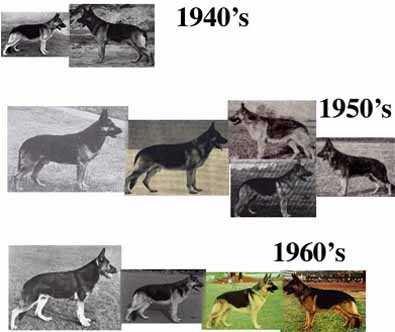
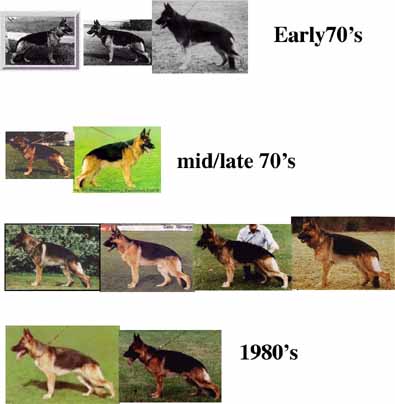
A pictorial history of the German Shepherd in America tells a powerful story in few words:


A core problem is that the AKC will register any dog regardless of health or working ability. German registration requires the sire and dam to have their hips x-rayed. and working titles are noted on the registration papers. Only German Shepherds that have passed a Schutzhund test or a herding test are allowed to have their pups registered.

Even in Germany, however, the division street between working dog and show dogs is wide, and I am told that true working German Shepherds are rarely crossed over show stock, no matter that the show dog has a Schutzhund title.

That is not surprising to me. You will almost never see a racing Greyhound, pulling dog or working border collie crossed with an AKC dog, and the same is true in the world of working terriers.

A core problem in the AKC is that the breed clubs are populated by people that have no idea of what their dogs are supposed to do.

That is not been changed by the weak performance trials that the AKC has cobbled together. These trials serve as little more than window dressing to help preserve the fantasy that a show dog can actually "do the job" if given a chance.

In fact, most of them cannot do the job, which is why the AKC has cobbled together "dumbed down" performance tests.

True working retrievers and pointers are being hunted for birds, not ribbons. True working terriers are going to earth in tight natural earths on live quarry that bites back, not sliding down smooth-sided wooden tunnels after caged rats.

"If you want to know if you have a working dog," notes one of my friends with battered boots, "you don't go to an earthdog trial, you go to a hedgerow. It's just not that hard to do."

No, it's not. But unfortunately, the dog cannot drive itself, and not every dog will do.


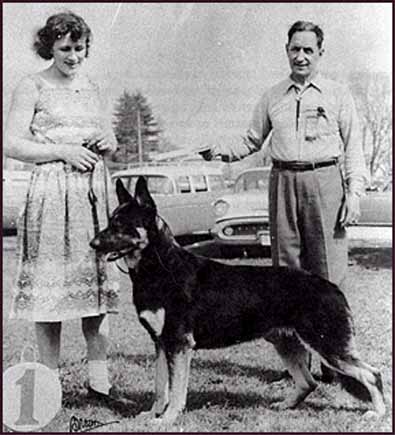
This is what a German Shepherd looked like in 1959, the year I was born. Note the straight back and relatively strong rear end.


This is a German Shepherd today. Note the roached back and the weak rear end devoid of true drive power.


Sunday, June 18, 2006

Meanwhile, Back in Slovakia ...


There is always a little variation, from place to place, in the world of terrier work. These pictures are from Matej in Slovakia. In the photo above, I believe he is shining a flashlight down the hole to see what is going on. This shot could be anywhere in the world.


And yet, it is always different, from one place to another, in one aspect or another.
Matej has three or four types of terriers, including a working bedlington. Here a terrier is used to locate and bust a russian boar out of dense brush. We don't have those where I hunt!


Get along little piggies! This little terrier is moving a lot of pig. You have to have a dog with brains and some discretion in a situation like this.


Matej uses a Mammut Barriovox transmitter/receiver for his locating box, and an Ortovox transmitter on the dog (an Ortovox transmitter is pictured on a Bedlington, above). He says the range is 40 meters (about 120 feet) in digital mode, and 80 meters (about 240 feet) in analog (accoustic only) mode. He got his rig on ebay and says it works great. Friends in Germany are using the same rig and also say it works great. I think this collar rig is too large for our very tight earths over here in the U.S., however -- compare the size to a cell phone, below. Thanks to Matej for the great pictures!


Tuesday, January 24, 2006

German Raccoon-Dog, Badger and Raccoon Hunting


Frank, badger and dachshunds.


Frank Joisten, from Germany, sent in some terrific pictures of his dachshunds
working everything from badger and raccoon-dog (Tankuki) to American raccoon and fox. One of my favorite pictures is below, showing not only his take this eventful day, but also some very well-disciplined dogs!


Dog, dog, badger, dog, badger, dog, dog.


Frank lives in the northeast corner of Germany, near the Polish border
, and is blessed with both badger and red fox, but also raccoon-dog, which were imported to the Ukraine from Korea and Japan, and which have now migrated into Finland, Poland and parts of Germany.


An amazing take of raccoon-dog!


American raccoon have also been imported to Germany.


Frank also has some American raccoon in his area -- a legacy of animals brought to Germany in the 1930s in the hope of expanding the domestic fur industry.


Digging to raccoon-dog (aka Tanukui)


Frank reports that his dachshunds have a chest of 35 cm.
The Germans are very precise about chest measurements, as they understand that for a dog to be a "gebrauchshund" (i.e. a "useful" hunting dog), it cannot be too big to fit into a tight den, nor can it be so nose-dead as to be unable to find in the field. Along with size and nose and gameness, a German working dachshund has to show that it is also not gun shy.

For those interested in the standard for the teckel or hunting dachshund, see >> http://www.teckelklub-berlin-brandenburg.de/usa/fci/fci.html

As the FCI standard posted at the web site of the Berlin Teckel Club makes clear, the ideal chest size of a working dachshund is just under 14 inches in circumference (35 cm). This 14 inch chest measurement is the same size cited as ideal for working terriers by Barry Jones in the UK (see http://www.terrierman.com/barryjones.htm and Ken James in the U.S. (see http://www.terrierman.com/hunting.htm ), and is about the size of the average red fox chest found the world over (see http://www.terrierman.com/foxsize.htm).

For those interested in working dachshunds in North America, see: http://www.teckelclub.org/hunting-with-dachs.htm


One of the great things about terrier work all over the world is that while it is a bit different all over, it is also quite a bit the same. The picture, above, could have been taken in the U.S., Germany, Finland, England, Canada or France -- the hunched over walk of a man with a locator box is the same all over!


Sunday, July 10, 2005

The Shrinking Globe


I just got a new shipment of button batteries in for the Deben collars -- 100 batteries for $15 which includes shipping from Hong Kong (via EBay).

That works out to just 15 cents per battery as compared to $2 to $2.30 a battery at Radio Shack or Home Depot.

It's an odd thing that you can have batteries sent from China that end up costing a small fraction of batteries purchased from just around the corner.

The world is becoming a smaller place. The locator collars now come from Switzerland or Germany as well as the UK, the antibiotics come from India or China, the button batteries from Hong Kong. The pictures I take in the field are from a camera made in Japan and are looked at by people in Denmark, Sweden, Canada and California. Field sport books can be located in used books shops across the world, from Australia to Maine, or ordered (new) from Wales. Money is converted and changes hands with the click of a computer mouse. A dog's pedigree can be examined on line, and pictures and even video exchanged. The dog itself can arrive on your doorstep with 24 hours.

Some things don't change much, however. The animals are still the same size, and they live the same seasonal lives they always have. The dogs required to do the job are the same as they ever were, and so too are the core tools of shovel and bar. If Jacques du Fouilloux or the Rev. John Russell were alive today, they would feel comfortable with the tools and the goal (though both might be surprised to learn there are no hunt servants around to do the actual job of digging!).

Thursday, June 9, 2005

German Ortovox Terrier Locator System

.

It turns out that using avalanche locators on working terriers is a bit "old hat" in Germany where the "Ortovox" transmitter (pictured above) has been used for some years and is available off-the-shelf and on the web if you know where to look (see "hundretter")


Ortovox Fox Dog Transitter and Receiver

"The Ortovox Earth Dog Transmitter is fastened on the dog's collar and sends a radio signal. The Orotvox Dog Receiver receives the signal. The shorter the distance between transmitter and receiver the louder the tone gets. With the rotary switch you can change the range and search area from 40m to 1m (43 yrds to 1 yard). Also, navigation is aided by three colored LED lights.


The compact Ortovox transmitter comes with a textile-collar into which the transmitter is tucked during earth work. Remeber, every minute counts should your dog get lost or stuck in the den of a fox or a burrow of a badger. With the D1 transmitter, a terrierman can safely and quickly locate his or her dog and rapidly dig it out. This way you spare your dog stress and unnecessary injury, and avoid possibly losing your precious companion. This light and robust transmitter is fastened at the dog's collar and it snuggles up close to the neck and therefore doesn't disturb the dog while it is working underground."


Click here >> To order from the German web site (The "box" used to pick up the Ortovox signal is pictured just below the collar).

Another place to order is >> here

The transmitter and box, combined, can be had for about 278 Euros or about $342 US. Please don't ask me about importing these things -- I'm sticking with my old Deben rigs for now.


.

Sunday, November 28, 2004

The True History of the German Hunt Terrier


The development of the German Hunt Terrier (Jagdterrier or Jagdt terrier or Jagd terrier) has to be put within a historical context that involves both a strong nationalistic sentiment and a desire to keep, create or recreate "pure German" breeds.

Between the two World Wars, game managers in Germany were focused on getting rid of "foreign" or introduced species, and bringing back now-extinct species that figured prominently in the mythology of the nation.

One of the pioneers of this peculiar quest was Lutz Heck, the curator of the Berlin Zoo, who went on to "back breed" primitive cattle and horses in order to "recreate" the extinct Auroch ( the kind of wild cattle seen in the cave paintings at Lascaux, France) and the Tarpan (a kind of primitive forest pony). Heck was also instrumental in the recreation of an extinct subspecies of zebra called the "Quagga".

Heck's interest in dogs was driven in part by his passion for hunting, and in part by a kind of strange and over-heated nationalism mixed with a desire to see what could be done with selective breeding. A social climber and decided brown-noser, Lutz Heck and his brother Heinz were men who courted power and counted among their friends both Adolph Hitler and Hermann Goring.

Even as pathological nationalism and a sick interest in genetic engineering were rising in Germany, terriers were also rising to the height of fashion in much of Europe and the United States. The Allied Terrier Show was taken over by Charles Crufts in 1886 and was the largest dog show in the world after World War I, while the first breed-specific dog publication anywhere was a magazine devoted to fox terriers. The Westminster Dog Show was begun in 1907, and the first winner was a fox terrier. A fox terrier won again in 1908, 1909, 1910, 1911, 1915, 1916, and 1917.

A fascination with terriers, fervent nationalism, and a propensity towards genetic engineering were braided together when Lutz Heck presented four black and tan fell terriers -- similar to what we now would call a Patterdale terrier -- to Carl Eric Gruenewald and Walter Zangenbert. Gruenewald was a "cynologist" (a self-styled dog man with an interest in genetics) and Zangenbert was a dedicated hunter with an interest in fox terriers.

It did not take much prodding on Heck's part to convince Gruenewald and Zangenbert that what the world needed was a true German Hunt Terrier to compete (and of course trump) the British and American fox terriers in the field.

Gruenewald and Zangenbert added to their team Chief Forester R. Fiess and Dr. Herbert Lackner, men with land for a kennel, and the financial means to support it over a decade-long quest..

An early problem was that the black and tan terriers selected as the core breeding stock and deemed "ideal hunters" based on color alone were, in fact, not all that great at hunting. As Gruenewald later wrote:


"We were glad to own fox terriers with the hunting color, and we hoped to use these four puppies successfully in breeding to establish a hunting fox terrier breed (jagdfoxterrier-stamm). From the viewpoint of hunting these four dogs were not bad, although they left much to desire. First we tried inbreeding, pairing brothers with sisters. But the results were not good. No wonder -- after all, the parents weren't real hunting dogs. The picture changed, though, when we bred our four 'originals' with our well-trained old hunting fox terriers. The beautiful dark color continued to be dominate. Dogs with a lot of the white color and spotted dogs were selected and eliminated from further breeding."


The breeding program for the Jagdterrier was German in every sense of the word: massive in scale and vicious in its selection criteria. At one point the men had 700 dogs in their kennels, and not a single dog was allowed to be placed outside of the kennel. Dogs that did not look the part, or which were deemed to be not of the quality desired, were shot. Early dogs were both smooth and rough coat, but the breeding program moved to get rid of smooth coats and the coat of the final product can best be described as "slape coated" -- a short, hard and wiry coat that sheds water and dirt while providing warmth in winter.

After only 10 years time the dogs were breeding more-or-less true, with a patterdale-like appearance, albeit with more red on the undercarriage.

The breeding program for the Jagdterrier was a bit confused as to the actual purpose of the dog. A great emphasis was put on the dog being multitalented -- able to go after fox and kill it underground, tackle a russian boar, retrieve birds, and scent track shot game. A small problem was that doing these tasks required a dog with different physiological characteristics!

A dog able to kill a fox underground will tend to be hard-mouthed, which is exactly the opposite of what you want in a retriever. At the same time a dog large enough to carry a bird through grass or tackle a russian boar will tend to be too big in the chest to easily go to ground in a natural fox den.

Never mind. After all, the rationale for the German Hunt Terrier was not that there was an unfilled need in the terrier world -- it was that there were no German terriers to put up as being "superiour" to those offered by the rest of the world.

The German Hunting Terrier Club (Deutscher Jagdterrier-Club) was founded in 1926, and the dog was warmly embraced in part because it was a trendy new breed, and in part because it fit well with the rising nationalistic sentiment within Germany at the time. It did not hurt at all that Lutz Heck was a darling of the Nazi regime and counted Hermann Goring among his closest friends.

In 1938 a German by the name of Max Thiel, Sr. bought his first Jagdterrier. Thiel hunted with this dog for only a few years before the start of World War II. During the war Thiel lost his dogs, but after the war he settled in Bavaria and purchased two female dogs, Asta and Naja.

In 1951 Thiel came to the U.S, bringing with him Naja. He soon sent for Asta, who was bred and shipped pregnant. In 1954, Armin Schwarz Sr., imported a "champion" sire named Axel, and a few more litters were promulgated. In March 1956, nine Jadgt terrier owners met in St. Louis, Missouri, and formed the Jagdterrier Club of America, with the expressed goal of getting the dog recognized by the American Kennel Club. In fact, the club did not prosper and eventually died out.

The Jadgt terrier did not take off in the U.S. for several reasons, not the least of which was that very few people hunted fox to ground. In addition, American hunters had excellent hunting dogs of their own. U.S. pit bull crosses may be the finest pig dogs in the world, while American-bred bird dogs are far superior to any terrier. Experienced raccoon and squirrel hunters were not about to give up their Treeing Walkers or Mountain Feists for some new- fangled dog no one could even pronounce.

In recent years, with the rise of interest in terrier work in the U.S., new lines of Jagdterriers have been imported, but the market for this dog seems to already be saturated. Pig hunters still prefer their pit bull crosses, bird hunters their pointers and retrievers, squirrel hunters their feists, and raccoon hunters their hounds.

Most working terriers in the U.S. are the same breeds found working in the U.K. and even Germany -- Jack Russell terriers, patterdales, dachshunds, and a few small lakelands and borders.

A small number of very small Jadgt terriers have found working homes in the U.S., but the breed standard calls for a 13- to 16-inch tall dog that weighs 16 to 22 pounds. This means that all but the smallest females are too big to work raccoon, possum and fox in the groundhog dens in which they are typically found here in the U.S.

With small Jack Russells from known working lines relatively easy to get, and patterdale terriers now flooding the market, the Jagd terrier is likely to remain an uncommon choice in the U.S.
.

Tuesday, September 28, 2004

Where in the World?

A bit of code on the main page of www.terrierman.com tells me a few general things about people visiting the web site: How many people are coming to the site, what search words they use, what the referring link was, and what country the visitor lives in.

This morning, most visitors came from the U.S. (not suprising), but the last 100 people also included people from: Canada, Sweden, Germany, the United Kingdom, Japan, New Zealand, Italy and Ireland.

Thanks to all who come to visit, and a special thanks to all who pass on the link and/or post it to other terrier, dog and hunting web sites.

Thursday, January 8, 2004

Virginia Hunting Statistics

For those that are interested, a good historical listing of Virginia trapping stastics is available at http://www.bobpickett.org/FurFileVA.htm, complete with red fox, Gray fox, possum, and raccoon trapping takes.


Note that in the last year that data is presenteed (2000), trappers officially took 30,000 fox (red and Gray) and over 83,000 raccoon.  Most fox is now ranched, and most raccoon is shipped to Germany where it is cut down and sold as "imitation mink".


Note that these trapping statistics do not have much to due with actual species populations in the state (other than to suggest they are healthy), as much as they do with the price of pelts.


A bit of regional wildife trivia: We SHOOT as many deer every year in the state of Virginia as actually reside in the state of Maryland.


The bobcat numbers for Virginia are impressive, as is the rapid growth in coyote numbers in recent years.


Bear are apparently doing very well.