Showing posts with label DDT. Show all posts

Friday, May 18, 2007

Coffee and Provocation

Immigration and Wildlife:
When Jimmy Carter went to China, he told Deng Xiaoping he wanted the Chinese to allow their political dissidents to leave. Taking a drag on his cigarette, Deng fixed a level look at President Carter. "Fine," he said. "How many million do you want?" The same question is now being debated on Capitol Hill, where our politicians are set to put in motion a plan that will inexorably lead to less access to hunting lands all across the United States as many scores of millions of additional people are added to our population over the next 50 years. Don't believe it? Read this old post which sets out the issues and the numbers. For how all this directly impacts hunting, read this little piece entitled "The Real Threat to Hunting (and Wildlife) in America."

Rachel Carson, Bald Eagles and Osprey:
Rachel Carson was a government public relations hack, and for that reason alone I have a soft spot for her. I am happy to report that The Washington Post has a very nice profile of her in today's paper which details, in some small way, her struggles with breast cancer at the end of her life. What most people don't know is that while DDT is bad for birds and other living things, it was not the reason for bald eagle and osprey decline in the U.S. For more on that topic, read this old post which comes complete with a few links to the Audubon data.

AKC Earthdog Events:
May 26-28 and June 2-3 there will be various Earthdog and Teckel trials at Village Green Farm Earthdog Center, Crosswicks, NJ (i.e. JoAnne Frier-Murza's place). Go to http://www.njbearthdogs.org/ to find details and a calendar of future events.

Thursday, December 14, 2006

You Gotta Break Some Eggs to Build a Movement


As we approach Christmas, I'm reminded that it's also time for the National Audubon Society's "Christmas Bird Count," which Audubon describes as "the oldest and largest citizen science event in the world."

What's fascinating about the Christmas bird count is that Audubon's own "citizen science" data does not support one of Audubon's core stories: that a decline in Bald Eagles and Oprey populations in the U.S. was due to DDT.

In fact, DDT did not kill off the Bald Eagle -- lead poisoning did, in the form of bullets shot from rifles.

The short story here is a common one in American wildlife: as guns became more accurate, cheaper and more powerful between 1850 and 1900, game laws did not keep up.

The result was a true wildlife massacre. We not only shot out all of the buffalo that once grazed on the East Coast, we also shot out all the passenger pigeons, Canada geese, beaver, elk, wolves, deer, mountain lions and -- yes -- eagles, osprey and large numbers of hawks as well.

Eagles, osprey and hawks were also decimated by the use of pole traps -- leghold traps set on the top of poles placed around fishing nets and barn yards. Nothing kills hawks and eagles faster, or more efficiently, than a pole trap.

Native Americans did their fair share of shooting of eagles too. It takes a lot of feathers to make a "war bonnet" for the tourist trade, and there was no shortage of demand for such things by museums, collectors, and wealthy tourist patrons.


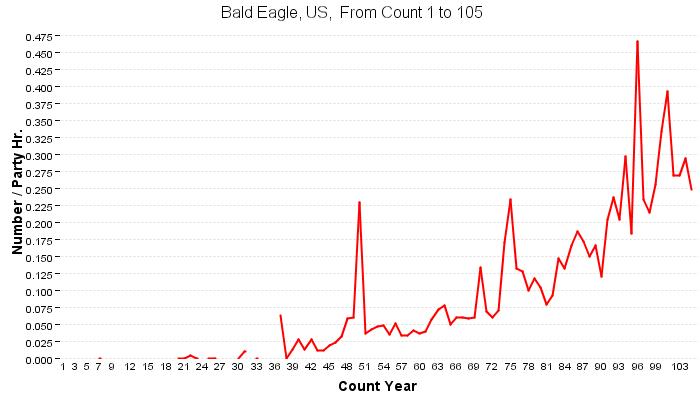
The graph above (click here to see full-sized graph) shows Bald Eagle populations as tracked by the National Audubon Society's Christmas Bird Count, which has tracked bird populations in the U.S. since 1900.

As you can see, by 1900 -- more than 40 years before DDT was invented -- Bald Eagle populations were vanishingly low. The same story is true for the Osprey -- another bird unlikely to be misidentified by a dedicated bird watcher participating in the National Audubon Society's Christmas Bird Count. As with Bald Eagles, Osprey were hammered by guns and pole traps, but large numbers were also killed when they collided with pound nets set in coastal fishing areas such as the Chesapeake Bay.

Ironically, Bald Eagle populations climbed between 1940 and 1970, when DDT was in full use in the U.S. The reason for this is fairly simple: the Bald Eagle Protection Act of 1940 made it illegal to shoot Bald Eagles. This protection was further expanded when the Endangered Species Act was passed in 1973.

Left to their own devices, and protected from unregulated shooting and trapping, Bald Eagle populations took flight and have now soared. Today, there are about about 8,00 nesting pairs of Bald Eagles in the Lower Forty-Eight, and the Bald Eagle is now now a candidate for de-listing from the Endangered Species Act.

Another American success story. Add that to the rostrum of success we have achieved through a marriage between hunters and conservationists: the return of the white tail deer, moose, elk, cougar, beaver, Canadian geese, wood ducks, and wolves.

For the record, and to be clear, I am NOT saying DDT did no harm to bird populations. Nor am I saying that DDT should be legalized. A ban on DDT was a good thing, and helped many bird populations rebound.

What I am saying is that DDT is routinely blamed for the decimation of two bird populations -- the Bald Eagle and the Osprey -- that it had little impact on. And what is most interesting is that the The National Audubon Society's own data tells this story, even though the National Audubon Society continues to obscure this story in its popular literature.

Is their evil intent here? Is it all a big conspiracy? Not exactly.

What happened was that the push to ban DDT in the late 1960s and early 1970s happened to coincide with the rise of computerized direct mail lists. Direct mail requires organizations to have recent victories, and the ban on DDT was a convenient example that could be trotted out by executives across the environmental movement. What was doubly delicious for direct mail copy writers was the opportunity to link the salvation of an icon -- the Bald Eagle -- with the organization's recent political success.

And it worked. In 1969, the National Audubon Society claimed a membership of 88,000, but just 10 years later its membership had risen to over 330,000, due in no small part to victories touted in a massive direct mail campaign.

Other environmental organizations quickly jumped on to the direct mail bandwagon. The Sierra Club, which had a membership of 33,000 in 1965, saw its own membership rise to over 113,000 by 1970, and top 200,000 by 1980.

Did Audubon and the Sierra Club do anything wrong by growing their membership using truncated and not--quite-complete stories? Not really.

Let's face it, you cannot squeeze all of the truth in this great world into a four page direct mail letter. And without that letter, not only would people not join movements, they would not become activated or motivated to learn more. The natural state of man, I am afraid to say, is prone before a television set.

The totality of what has come out of those direct mail campaigns is a true wonder -- massive amounts of land protection, cleaner air, cleaner water, the return of endangered species, and decreases in such once-common toxins as PCBs and lead.

When my grandfather was born, almost all the wildlife had been shot out, the air was black, and the rivers were dead.

Things were not too much better in 1970. It always shocks people when I tell them that we imported deer into parts of Virginia as late as 1965. Today, the "deer problem," in this state is that we have too many of them.

In fact, across the U.S. we have more of nearly every type of wildlife than we did 30 years ago, 50 years ago, 75 years ago, or 100 year ago. The National Rifle Association did not do that, Exxon did not do that, Boise Cascade did not do that, and the American Chemical Society did not do that. What did that were rank-and-file Americans organized and activated by massive direct mail campaign that began in the late 1960s and that continue to this day.

I am not a fan of the too-simple truths of direct mail, but I am not so naive that I do not think they have their place. So when people tell me that DDT wiped out the Bald Eagle, I tend to smile and nod.

Sometimes a simple fable is more powerful than a complicated truth.
____________

For anyone that wants to play with Christmas Bird Count data, see >> http://audubon2.org/birds/cbc/hr/table.html

Saturday, December 2, 2006

Condors and Species Lost


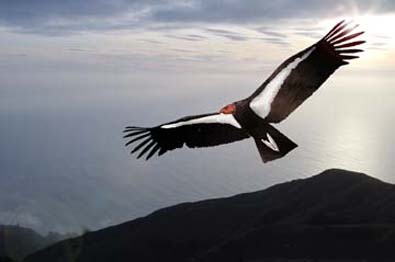
The North American condor's range was reduced to coastal California for reasons that had nothing to do with modern man.


A healthy email discussion yesterday about condors, lead shot and bullets, and the strengths, limits and pitfalls of environmental advocacy reminded me of an older post, appended below, from April of 2005, in which I suggest some caution is needed before the world swallows the extinction hyterics of some environmentalists (such as entomologist E.O. Wilson) who like to proclaim that we are now in the "era of mass extinctions."

I suggest one can be very concerned about extinction (I am), without tossing science and data overboard or engaging in out-and-out distortions about the data. Truth and data are not lesser values, and should not be abandoned by advocates looking to score cheap debating points.

In the case of condors, I am for doing whatever it is we can to ensure their survival and increase their numbers, including baning lead shot and bullets, if necessary (background article here on this controversy).

Having said that, let's acknowledge that this is a bird that was on the decline long before there were guns anywhere in the world.

During the time of mammoths, some 15,000 years ago, there were condors all over North America, but as the herds of these and other giant pre-Columbian animals declined and then slid into extinction, the condor's range was reduced to a narrow part of California (hence the name California Condor).

What few folks are willing to talk about, in a frank and unsentimental kind of way, is that the era of the condor was closing long before the Santa Maria left Spain. The reason for this is not too hard to explain: The condor is a huge, poorly conceived, "line of sight" meat scavenger. It was too specialized to make it.

And yes, God does make mistakes (the Whooping Crane, for example, is simply an "Edsel" Sandhill Crane) and He has plenty of "discontinued models". It is neither sacrilegious to say this, nor bad science: It is plain truth.

Not only is a condor a huge animal (a 9-foot 6-inch wingspan) that requires a lot of meat to keep it in the air, but it is also an animal that cannot kill that meat itself. The feet of a condor are closer in structure to those of a chicken than those of a hawk or eagle -- it cannot lift a rabbit, much less a lamb.

Unlike the turkey vulture, whose population numbers are huge and rising, the California Condor cannot smell rotting flesh from miles away. It is a pure line-of-sight scavenger. What this means is that if a condor does not see a large pile of dead flesh every couple of days for its entire life, it is going to die of starvation. The condor may have survived in coastal California only because of dead whales and seals washing up along the coast -- an easy-to-patrol carrion line.

Another factor in the demise of the condor, even before man showed up, is that it is a very poor and slow breeder, laying only one egg every other year, and not breeding at all until the age of 6 or 7. This is a bird that does not build a nest -- it needs caves and cliff ledges which, as a general rule, are in short supply.

Put it all together, and you have a very maladaptive kind of animal -- an animal whose internal biological problems were, and are, so serious that its range and numbers were shrinking long before the gun, the powerline, or DDT. Which is not to say guns, powerlines and DDT did not push things over the edge. They most assuredly did. Sadly, things on the edge are a little too easily tipped over in this over-fast, too-crowed and intensely-machined modern world.

In the end, the last pair of wild condors were caught and put in a captive breeding program with 20 others back in 1987. Since then, I am happy to report, the population of condors has grown from 22 to about 280, and there are now about 140 condors in the wild, and another 140 birds in captive breeding.

In addition to restocking condors in the shrinking wilds of California, where powerlines and windmills remain a very serious problem, the California Condor has also been restocked in Arizona.

All of this is good news, and it is about as good as it is ever going to get. There will never be large numbers of condors in America because this an animal adapted for a pre-Ice Age era that no longer exists. That said, poisoning from lead (the isotopes from shells has been traced into the dead birds themselves) has killed a large number of the condors released into the wild. If paying a few more dollars for shells will help reverse that phenomenon (while also spurring shel and bulletmakers to do more to develop new composite-type loads), I am all for that.


_ _ _ _ _ _ _ _ _ _ _ _ _ _ _ _ _ _ _ _ _ _ _ _ _ _ _ _ _ _ _ _
Reposted from the April 29, 2005 edition of this blog.
_ _ _ _ _ _ _ _ _ _ _ _ _ _ _ _ _ _ _ _ _ _ _ _ _ _ _ _ _ _ _ _

Thinking About Species Lost

The rediscovery of the Ivory-billed woodpecker in the hardwood swamps of Arkansas reminds me of how much we hear about wildlife species loss, but how rarely such species loss is quantified, defined, or given proper causation.

Whenever I hear about species loss, I naturally ask five key questions --and I often find the answers surprising.


1. Do the animals exist at all?

This may sound like an odd question, but it's a pretty important one because a lot of what is written about species extinction is totally unsupported by observed data.

Here's the scoop: Over the course of the last 400 years, only about 820 species of vascular plants and vertebrate animals are listed as having gone extinct by the IUCN Red List. In addition, the IUCN reports several species being "rediscovered" every year after having previously listed them as "lost".

Though the IUCN cannot report on what has not been discovered, we have clearly discovered most of the mammals, birds, fish, snakes, frogs, shrubs, vines, grasses and trees in the world. While new species of wildlife are being discovered every day, there is no evidence to support the notion that even 50 vertebrates and vascular plants are going extinct every year, much less the 20,000 number commonly cited (invertebrates and fungi are very difficult to push into extinction as any farmer can tell you).

As odd as it may sound, even physical evidence of the existence of a species does not necessarily mean that this species has ever existed. Here, I am specifically talking about birds, where it turns out some "extinct" species are based on single skins collected in the 19th or early 20th Century. The cone-billed tanager is a good example (to read more about the hunt for this "extinct species" read "The Ghost With Trembling Wings" by Scott Weidensaul).

The problem with birds is that they hybridize a lot, and bird species are not always very distinct from each other. Along with the cone-billed tanager, for example, there are several species of hummingbirds that we know of only due to single examples collected for the millenary trade. These
so-called "Bogotá Skins" (for their central shipping point out of South America to Europe) may in fact represent evidence of a new species of now extinct hummingbirds -- or they could simply represent hybrids of other hummingbirds. With about 10 percent of all bird species known to cross the "species barrier," it's hard to know.


2. Is the animal being described really a species?

In fact a lot of stories about species decline are NOT about the decline of a species, but about the decline of a SUB-species in a very specific area.

A sub-species is, by definition, NOT a species. In fact most subspecies are nothing more than slightly different colored animals that exhibit no other behavior differences and that freely breed with populations of other animals in their species (animals whose populations may in fact be quite large and growing).

Sub-species are an interesting thing. I have always found it ironic that many environmentalists place little value on the prolific creation of thousands of new subspecies of apples, potatoes, pigs, cattle, and chickens, but assign tremendous value to subspecies of cougars, lions and pronghorns (to give just three examples). In fact, mmany sub-species of wild animals are little more than political artifices designed to boost the careers or egos of the people naming them.

In some cases there is another less vanity-centered reason to name a subspecies -- you can "up list" an animal (and its habitat) for protection by simply singling it out. The Sonoran pronghorn appears to be an example -- an animal made "rare" despite the fact it appears to be little more than a light-colored variant of an animal that actually numbers in the million.


3. Was the species ever very common?

Some threatened and endangered species are animals that were always rare and not very successful to begin with. Take the Whooping Crane, for example. DNA analysis suggests Whoopers never numbered more than about 5,000 individuals. The 1850 population of the bird (when most of the American West was still unsettled and very wild) is estimated to have been just 1,500 individuals. There are now 500 Whoopers in the world, with about 350 of them in the wild. I am very glad the Whooper was pulled back from the edge of extinction, but the fact that the bird was never common or genetically successful is not an inconsequential part of its story (though it is rarely told).

The Florida Manatee is another animal that was probably never terribly common. The Manatee population of Florida before there were outboard motors is estimated to have been around 10,000 or so. By the 1980s, the manatee population had declined to about 800, but it has since risen to over 3,000.

Again, bringing the American manatee (Trichechus manatus) back from extirpation in the U.S. is excellent, but we should not expect the population to ever get really huge. Note that the American manatee also exists in many other Caribbean countries south to Brazil, but it is a rare animal there due to hunting by indigenous people .


4. What is the population of the species now?

I am always interested in both the percent decline or increase in a species and the total number of individuals that exist (and existed). For example, if I am told that 97% of all pronghorn antelope are gone, I am shocked. But if I am told that this 3 percent totals 1 million animals, I begin to feel a
little better. I begin to feel pretty good when I know that in Wyoming the pronghorn population is estimated to equal the human population of the states, and even better when I learn that the human population of Wyoming is actually declining.

The point here is that numbers are only meaningful within context. Do I wish there were more pronghorn in America? Sure! But one million pronghorn -- up from just 13,000 individuals at the Turn of the 20th Century -- is pretty good news and one we should be celebrating!


5. What has really caused the decline (or increase) of this species?

The death of any species is important, but I also want to know the circumstances of the decline or extinction. I consider the loss of the Passenger Pigeon and the Eskimo Curlew (there were once millions of these birds flying over vast areas of this continent) a much more significant tale than the loss of a species of flightless rail on a small island in the Pacific. One extinction signals the total loss of a once very common species that was successful over a very large area. The other signals the total loss of a very rare species that was NOT successful over a very large area. There are very different lessons to be learned from these very different stories.

Most people are surprised to learn that most extinctions are of the latter type (fairly unsuccessful species in very isolated locations) and not the former (fairly successul species in fairly common locations). They are further amazed to discover that habitat loss is a much rarer cause of species extinction than the introduction of rats, cats, goats and pigs -- or of indiscriminate hunting. If you go through the IUCN Redlist of extinct species, for example, you find zeros for most countries (no known endemic species pushed into extinction), but incredible numbers of extinctions for such tiny islands as Mauritius (41 extinct species), Réunion (16 extinct species), Saint Helena (29 extinct species), French Polynesia (67 extinct species), and the Cook Islands (15 extinct species). In fact, these little spots of land, along with Hawaii, account for about 200 of the 812 species pushed into extinction over the course of the last 400 years.

Is the loss of an "unsuccessful species" a bad thing? I think so. But it may not be quite as horrible or as unprecedented as it is commonly made out to be. In fact it may be part of the order of things. After all, instead of a living at a time when there is a "biodiversity bottleneck," as some texts would have you believe, we are actually living at a time of incredible genetic diverity. As the folks at the World Resources Institute note, "Global biological diversity is now close to its all time high. Floral diversity, for example, reached its highest level ever several tens of thousands of years ago. Similarly, the diversity of marine fauna has risen to a peak in the last few million years." In short, we live in a very bio-diverse time, and with diversity will come a lot of failure which is every bit as much a part of Darwin's evolutionary equation as success (if not more so).

It's also worth remembering that even as we are losing species, we are also gaining them -- new types of chickens, pigs, apples, corn, and trees. New hybrids of canaries, geese, ducks, pigeons, cattle, horses, falcons, eagles, dogs and cats. And we are doing it with wild birds too.

The last time I flipped through a Sibley's Audubon guide to birds, I counted one extinct species of parrot (the Carolina parakeet), but 27 new species of introduced parrots that are found in wild flocks in the U.S. (65 species have been encountered in Florida alone). In California and Florida these wild-flocking parrots are already creating new hybrids. Wild parrot colonies are not just found in warm climates by the way -- they are found near my home in suburban Virginia, and in downtown parks in Seattle and Chicago. One hundred and fifty years from now my great grandchildren may find hybridized variations of these same birds listed as entirely new "American" species of parrots (the Sibley guide already notes the presence of many Amazon hybrids in Florida and California).

Food for thought.

Monday, April 4, 2005

Return of the Bald Eagle


Bald Eagles near Wilson Bridge, Washington, D.C.

An article in today's paper notes that Bald Eagles in Homer, Alaska are known to attack white cats and small white dogs, such as Jack Russell's. Apparently, the eagles, which flock in large numbers on the outskirts of the town due to a nearby fish canning operation, think anything small and white and running around must be a rabbit and assume it is fair game.

Closer to home, it turns out that Rosalie Island, a small man-made spit of land at one end of Wilson Bridge outside of Washington, D.C is one of the best places in the lower-48 to spot Bald Eagles.

The reason for this appears to be the profuse amount of fish in the river, drawn to this particular spot by algae blooms and "nutrients" pumped into the river from the nearby Blue Plains Wastewater Treatment Plant. Despite the 200,000 cars that pass by the bridge daily, somewhere between 12 and 20 Bald Eagles call the Maryland side of the bridge home.

Bald Eagles have made a spectacular return in the last 30 years, and there are now more than 7,000 nesting pairs in the lower-48, with an additional 25,000 nesting pairs in Alaska, and even more in Canada.

Though DDT is often blamed as the sole cause of Bald Eagle decline, the truth is that the birds were nearly wiped out by shooting and leghold traps mounted on poles for "chicken hawks".

DDT did not arrive on the scene until after World War II, and was banned by 1972. Yet, a close look at the National Audubon Society's own Christmas Bird Count data shows that Bald Eagles were very rare as far back as 1900, and that their number rose (albeit slowly) during the years DDT was being sprayed in the U.S. The same is true for Osprey -- another bird hard to misidentify, but which was decimated both by shooting and by pole-net fishing weirs. It turns out that the decline of Ospreys had more to do with the large birds breaking their necks stooping on fish caught in pole-mounted weirs than it did with the rise of DDT.

This is not to say the DDT had no effect on bird populations (it most certainly did), simply that it was not the determinant variable in the decline (or rise) in Bald Eagle, Osprey, Peregrine Falcon and Golden Eagle populations, as is commonly believed (and reported by organizations such as Audubon).