Thursday, December 7, 2006

Joe Bowman's Patterdale


Joe Bowman, the Ullswater Huntsman, from Foxes, Foxhounds & Foxhunting
by Richard Clapham, published in 1923.


Most of the folks that write books on dogs would like their breeds to be ancient and have romantic and mysterious origins. Pick up any book on Jack Russell Terriers, for example, and Trump will be presented as the first white foxing terrier on earth -- never mind that the young John Russell selected it for looks alone and had no problem finding another white foxing terrier to mate with it.

The Border Terrier folks have wrapped the story of their dog completely around the axle in an attempt to give it an ancient origin. In fact this breed was created at about the same time as the Kennel Club was created, and it was pulled on to the Kennel Club roles as quickly as could be.

As for the Patterdale Terrier, quite a few people claim one person or another created the dog, and yet all seem quite confused as to the shape of the head. Where did that come from?

In fact it is no mystery, and the true story of the Patterdale is not too deeply buried or very old.

In 1873, the Patterdale and Matterdale hunts were combined to form the Ullswater Foxhounds. In 1879 Joe Bowman (just 22 years old) was made master of the Ullswater, a position he held (with a few short interruptions) until 1924, when he was replaced by Joe Wear who held the position for then next 47 years. Joe Bowman died in 1940 -- one of the most famous huntsmen of all time (there is even a song about him)

Joe Bowman was an early Border Terrier breeder, and he was also the first person to cross up a blue-black Border Terrier with a black and tan Fell Terrier (also called a working Lakeland) to create what he called a Patterdale Terrier.

In Jocelyn Lucas' book, Hunt and Working Terriers, a table at the back notes that the United Hunt preferred a "Lakeland, Patterdale, from J. Boroman's strain (Ullswater kennels)."

In fact, "J. Boroman" is a typo, and the real man was Joe Bowman.


From Appendix II of Jocelyn Lucas' Hunt and Working Terriers (1931).


Lucas published his book in 1931, and the information in it was collected between 1925 and 1930. The Patterdale Terrier was clearly a type (if not a widely used type) by the 1920s, and it centered on the Ullswater Hunt and Joe Bowman.

With that knowledge, it was not too difficult a thing (but not too easy either!) to lay a hand on Foxes, Foxhounds & Foxhuning by Richard Clapham, published in 1923. Here we find not only a good picture of Joe Bowman (see top), but the picture reproduced below with caption. Click on the picture for a larger image.


"One of the 'Patterdale' breed."
Click on the picture for a larger version.

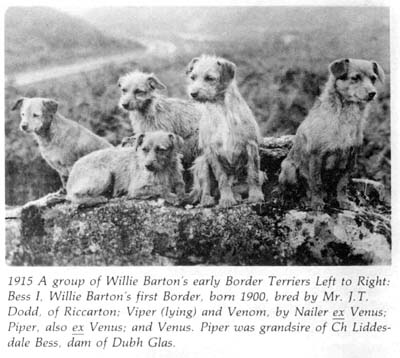
Now we can see that the Patterdale name goes back to at least the Nineteen-teens, a period just before the Border Terrier (which, like the Patterdale, started out as little more than what we would call today a Fell terrier today) was pulled into the show ring. To see what Border Terriers looked like in 1915, click here.

At about the time that Joe Bowman was fading out of the dog breeding business, in the 1930s, a young Cyril Breay was stepping up. Breay, like Bowman, had been a Border Terrier breeder.

In the early 1930s Breay met Frank Buck, when Buck rescued one of Breay's dogs that had gotten stuck in a deep rock cleft and Buck -- an expert at dynamite -- had blasted it free.

Bucks own line of dogs at the time were descended from Ullswater terriers kept by Joe Bowman, and Breay and Buck soon became fast friends with Breay breeding black dogs from Frank Buck into his line, and Buck crossing tight Border Terrier coats into his. Over time, the dogs of the two men devolved to a type as lines were crossed and condensed.

Cyril Breay was always adamant that the Patterdale Terrier was not made by crossing in Bull Terrier, and he was not lying. The Patterdale head is no mystery to a border terrier owner - the same broad cranial outlines are evident in both breeds.

Brian Nuttal began breeding Patterdales in the late 1950s, and says that his dogs are very much like those his father kept in the 1930s. It would not surprise me a bit to find that Nuttal's father got his dogs from Bowman, or from intervening hands that had gotten their dogs from Bowman. What is clear is that the Patterdale Terrier was already a recognized type by the time Nuttal's father owned his dogs.

The fact that Joe Bowman started the Patterdale strain and named it takes nothing away from folks like Cyril Breay, Frank Buck and Brian Nuttal, all of whom did quite a lot to popularize the breed, maintain it as a working dog, and perhaps improve and stabilize its looks. It is an easy thing to name a new breed (it's done every day by puppy peddlers), but quite another to find a market and a following for the dogs based on their performance in the field.

I mention all of this (I have told the story before and it is in the book), because I found a rather interesting old obituary on the internet the other day. Note the byline. With some amusement I note that "Greystoke Castle" was (supposedly) the ancestral home of Tarzan:


September 1956
PATTERDALE - One of Ullswaterside’s oldest residents, Mrs. Esther Pattinson, Broadhow, Patterdale, died at the age of 85. Formerly Miss Bowman, Matterdale, she hailed from a noted hunting family — her uncle was the celebrated Joe Bowman, huntsman of the Ullswater foxhounds for 42 years, while her great-grandfather, Joe Dawson, was for many years huntsman of the one-time Matterdale foxhounds. Mrs. Pattinson was only 13 years of age when she was hired as a farm girl, later working at Lyulph’s Tower for Mr. James Wood, who was agent for Lady Mabel Howard, Greystoke Castle.


In the end, it turns out that Joe Bowman was born in Patterdale -- a perfectly good reason for him to give a nod to the spot. It was, no doubt, an added bonus that Patterdale was also the old name of the Hunt that was both his employer and his passion. Finally, it should be noted that Patterdale was also the town where Joseph Dawson Bowman died, at the age of 88.
.

Tuesday, December 5, 2006

Footprints from the Air


Falconer Rebecca O'Conner has a very nice piece in The Los Angeles Times' West magazine about the steady creep of sprawl and what it means for her and her falcons in Southern California. This is what sprawl means at its most personal and conflicted. For a previous piece from her, see "Good Writing, Good Reading."

For a longer book that also covers the creep of shopping centers on to hawking grounds, see Matthew Mullenix's book, In Season: A Louisiana Falconer's Journal.

A shout out to Querencia for bird-dogging me to all of this reading (and more) on a wide variety of subjects.

To carry forward the theme of population growth, sprawl and birds, I append, below, a short op-ed I ghosted for the CEO of the National Audubon Society a few years ago. Population growth continues to gut-shoot the planet, pushing people farther away from nature, while pushing nature closer to the abyss.

Nature bats last, however. Whether we are willing to acknowledge it or not, our time will come (as it does for all creatures).

As has been so famously said, perpetual growth is the ideology of the cancer cell. Sadly, unbridled human fecundity has become a cancer on the planet. All we can do now is pray for remission in the form of family planning.


.


Ventura County Star (California), April 20, 2003

Safeguarding wildlife: A wise investment

As you approach Los Angeles by air, you see less and less evidence of the hand of God, and more and more evidence of the footprint of man.

From the cabin of a 757 you can see where roads slice across desert ridges. Farm fields and irrigation ditches cut straight lines across the land. Housing tracts fan out like cards, until at last the streets of suburbia fall away to the grid lines of the city.

One hundred years ago, only the birds flew over the Simi Valley. At that time, the population of the state was less than 2 million. By 1950, the population had risen to 10 million. Since then, California's population has more than tripled.

As human numbers have soared in California, forests have fallen to farms, and farms have fallen to freeway. As human populations have exploded, habitats worldwide have been profoundly altered.

Just 300 miles northeast of Los Angeles lies Mono Lake, one of the largest natural lakes in California. Just 50 years ago, Mono Lake was home to nearly a million ducks. Today fewer than 20,000 dot its shores. The reason? Freshwater diversions for Los Angeles have reduced Mono Lake's volume by 40 percent over the last 50 years, thereby increasing the lake's salinity and reducing the plant and animal life it can support.

In Tanzania, the changing chemistry of Lake Natron threatens the only breeding ground of East Africa's lesser flamingos. In Central and South America, farms and roads have been burned and bulldozed into once pristine forests. The result: 50 percent of all migrant bird species that summer in the United States and winter in Central and South America, are now in decline.

What's killing them is fallout from the population explosion that has occurred over the last 50 years. While the developing world is hardly anxious to hear lectures about waste and consumption from a nation where families already own three television sets, these same people are -- literally -- dying for family planning.

The good news is that President Bush has said he is interested in increasing U.S. aid to poor countries by $5 billion over the next three years. The bad news is that Bush has yet to earmark any portion for contraceptive delivery to the developing world. He certainly ought to. The United Nations Children's Fund has observed that "Family planning could bring more benefits to more people at less cost than any other single technology now available to the human race."

Family planning would not only benefit human life -- it would benefit wildlife as well. By directing that a portion of this new aid money be spent on improved access to contraceptive services in the developing world, Bush could ensure that U.S. aid money was being spent wisely, while also working to improve human life and safeguard wildlife the world over. It's hard to imagine a wiser investment or one much easier for this president to make.

Monday, December 4, 2006

A Trifecta in the Field


Static pushes into a tight pipe.


Mike B. was down from Colorado, and he and his Jack Russell, Static, joined up with Chris and I for a little action on a farm up near Baltimore. It was 29 degrees when I started out in Arlington at about 7:00, but it climbed to about 50 degrees during the day. Pearl stayed home this outing -- she came into her first heat on Saturday.

The first "find" of the day was a raccoon, found by Mountain and Moxie. Moxie worked it well and with a lot of grit, while Mountain perched at a bolt hole. The coon bolted for an exit with Moxie hard on it's butt, but Mountain was at the exit and sorted it out pretty quickly, with a little dispatch help from Chris. Moxie worked this coon well and came out with only a small nick -- a nice outcome and good work from this young dog.


Mike with Moxie (Patterdale) and Mountain (Jack Russell), and Chris with raccoon.


We crossed the road to the other side of the farm and worked down a creek bed. Mountain went to ground in a really nice eight-eyed sette in a mound of soft earth, but she never opened up. Mountain stayed underground for a long time, and it was only after we left, came back, and then dug a bit that she finally came out at all. I leashed her up. There was clearly a groundhog down there, but it was down for the count and walled in behind dirt. There was going to be no finding it in a sette this large and complex. Nice try Mountain Girl.

As we moved up the creek bed, a red fox bolted out of the hedge and ran up the field. It's still too warm and too early in the season for fox to be denning. Give it a month. This farm holds fox -- Chris and I had located here last March, and I have dug a few here in years past. January and February will come soon enough.

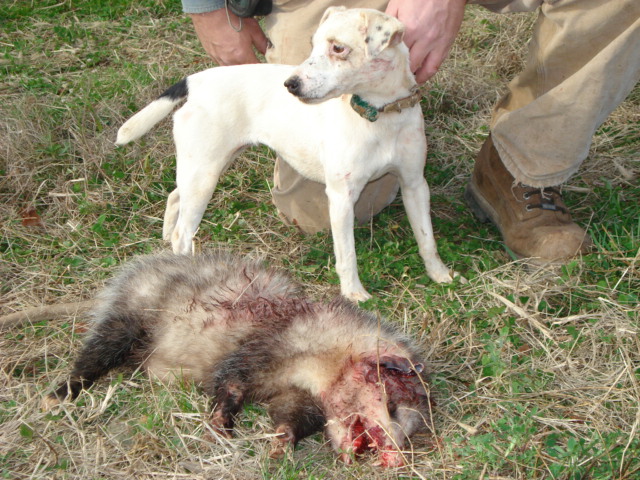
Mountain opened up in a hedge a little ways up, and when we reached her she was under a dry mound of sticks, with her tail wagging furiously in the hole. A bit of brush clearing, and a quick hole punched in the top of a shallow pipe, and we located a large male possum. Mountain pulled it out with the help of Static, and we terminated it. An 11.5 pounder -- not bad for a possum.


Mountain with possum.


We headed up the field, past five dead cows. This is a dairy, and diseased cows are generally shot and left to rot at the back of the farm, providing ready food for fox, possum, raccoon and coyote.


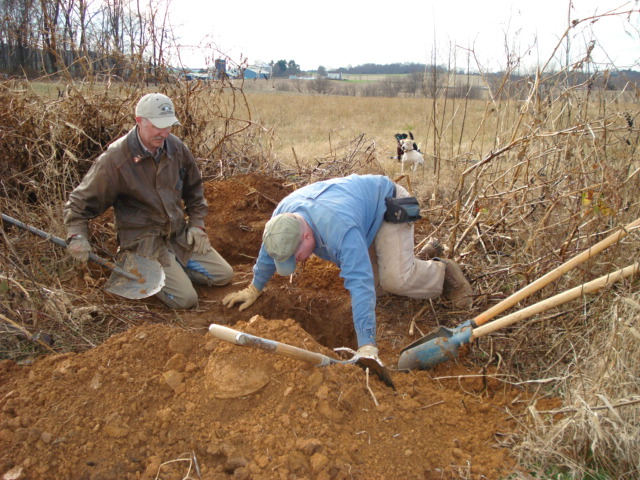
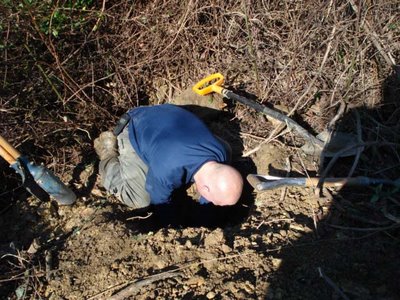
A little digging combined with a little watching of the dogs at work.


We decided to work a small copse of woods in the middle of field. This little patch is riddled with holes, but before we got to our destination, all three of the dogs opened up on a sette located in the middle of a jumble of old poke berries.

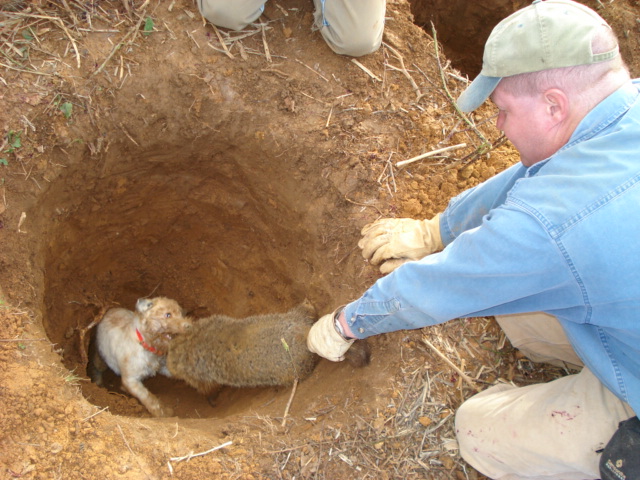
I tied up Mountain, and both Moxie and Static pinged on a small mouse hole at the bottom of a stopped pipe. Both dogs were too gung-ho for something not to be there, so we postholed past the blockage and found a den pipe. A bit more digging and locating, and we had a nice end-of-year groundhog. Yahoo -- a three-quarry day. Excellent!


Getting Static out of the hole was achived by pulling out the terminated groundhog.


Tired, we called it a day just in time for Mike to change clothes, wash off Static, and high-tail it to the airport for his flight back to Denver. My bet is that both Mike and the dog slept all the way back. It had been a fine day in the field with good company and three working dogs.

Is this a great country, or what?

Saturday, December 2, 2006

Condors and Species Lost


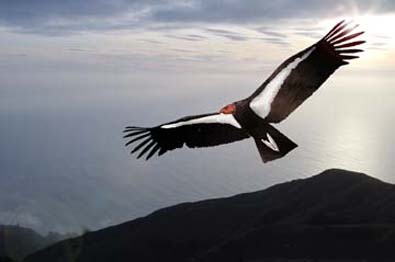
The North American condor's range was reduced to coastal California for reasons that had nothing to do with modern man.


A healthy email discussion yesterday about condors, lead shot and bullets, and the strengths, limits and pitfalls of environmental advocacy reminded me of an older post, appended below, from April of 2005, in which I suggest some caution is needed before the world swallows the extinction hyterics of some environmentalists (such as entomologist E.O. Wilson) who like to proclaim that we are now in the "era of mass extinctions."

I suggest one can be very concerned about extinction (I am), without tossing science and data overboard or engaging in out-and-out distortions about the data. Truth and data are not lesser values, and should not be abandoned by advocates looking to score cheap debating points.

In the case of condors, I am for doing whatever it is we can to ensure their survival and increase their numbers, including baning lead shot and bullets, if necessary (background article here on this controversy).

Having said that, let's acknowledge that this is a bird that was on the decline long before there were guns anywhere in the world.

During the time of mammoths, some 15,000 years ago, there were condors all over North America, but as the herds of these and other giant pre-Columbian animals declined and then slid into extinction, the condor's range was reduced to a narrow part of California (hence the name California Condor).

What few folks are willing to talk about, in a frank and unsentimental kind of way, is that the era of the condor was closing long before the Santa Maria left Spain. The reason for this is not too hard to explain: The condor is a huge, poorly conceived, "line of sight" meat scavenger. It was too specialized to make it.

And yes, God does make mistakes (the Whooping Crane, for example, is simply an "Edsel" Sandhill Crane) and He has plenty of "discontinued models". It is neither sacrilegious to say this, nor bad science: It is plain truth.

Not only is a condor a huge animal (a 9-foot 6-inch wingspan) that requires a lot of meat to keep it in the air, but it is also an animal that cannot kill that meat itself. The feet of a condor are closer in structure to those of a chicken than those of a hawk or eagle -- it cannot lift a rabbit, much less a lamb.

Unlike the turkey vulture, whose population numbers are huge and rising, the California Condor cannot smell rotting flesh from miles away. It is a pure line-of-sight scavenger. What this means is that if a condor does not see a large pile of dead flesh every couple of days for its entire life, it is going to die of starvation. The condor may have survived in coastal California only because of dead whales and seals washing up along the coast -- an easy-to-patrol carrion line.

Another factor in the demise of the condor, even before man showed up, is that it is a very poor and slow breeder, laying only one egg every other year, and not breeding at all until the age of 6 or 7. This is a bird that does not build a nest -- it needs caves and cliff ledges which, as a general rule, are in short supply.

Put it all together, and you have a very maladaptive kind of animal -- an animal whose internal biological problems were, and are, so serious that its range and numbers were shrinking long before the gun, the powerline, or DDT. Which is not to say guns, powerlines and DDT did not push things over the edge. They most assuredly did. Sadly, things on the edge are a little too easily tipped over in this over-fast, too-crowed and intensely-machined modern world.

In the end, the last pair of wild condors were caught and put in a captive breeding program with 20 others back in 1987. Since then, I am happy to report, the population of condors has grown from 22 to about 280, and there are now about 140 condors in the wild, and another 140 birds in captive breeding.

In addition to restocking condors in the shrinking wilds of California, where powerlines and windmills remain a very serious problem, the California Condor has also been restocked in Arizona.

All of this is good news, and it is about as good as it is ever going to get. There will never be large numbers of condors in America because this an animal adapted for a pre-Ice Age era that no longer exists. That said, poisoning from lead (the isotopes from shells has been traced into the dead birds themselves) has killed a large number of the condors released into the wild. If paying a few more dollars for shells will help reverse that phenomenon (while also spurring shel and bulletmakers to do more to develop new composite-type loads), I am all for that.


_ _ _ _ _ _ _ _ _ _ _ _ _ _ _ _ _ _ _ _ _ _ _ _ _ _ _ _ _ _ _ _
Reposted from the April 29, 2005 edition of this blog.
_ _ _ _ _ _ _ _ _ _ _ _ _ _ _ _ _ _ _ _ _ _ _ _ _ _ _ _ _ _ _ _

Thinking About Species Lost

The rediscovery of the Ivory-billed woodpecker in the hardwood swamps of Arkansas reminds me of how much we hear about wildlife species loss, but how rarely such species loss is quantified, defined, or given proper causation.

Whenever I hear about species loss, I naturally ask five key questions --and I often find the answers surprising.


1. Do the animals exist at all?

This may sound like an odd question, but it's a pretty important one because a lot of what is written about species extinction is totally unsupported by observed data.

Here's the scoop: Over the course of the last 400 years, only about 820 species of vascular plants and vertebrate animals are listed as having gone extinct by the IUCN Red List. In addition, the IUCN reports several species being "rediscovered" every year after having previously listed them as "lost".

Though the IUCN cannot report on what has not been discovered, we have clearly discovered most of the mammals, birds, fish, snakes, frogs, shrubs, vines, grasses and trees in the world. While new species of wildlife are being discovered every day, there is no evidence to support the notion that even 50 vertebrates and vascular plants are going extinct every year, much less the 20,000 number commonly cited (invertebrates and fungi are very difficult to push into extinction as any farmer can tell you).

As odd as it may sound, even physical evidence of the existence of a species does not necessarily mean that this species has ever existed. Here, I am specifically talking about birds, where it turns out some "extinct" species are based on single skins collected in the 19th or early 20th Century. The cone-billed tanager is a good example (to read more about the hunt for this "extinct species" read "The Ghost With Trembling Wings" by Scott Weidensaul).

The problem with birds is that they hybridize a lot, and bird species are not always very distinct from each other. Along with the cone-billed tanager, for example, there are several species of hummingbirds that we know of only due to single examples collected for the millenary trade. These
so-called "Bogotá Skins" (for their central shipping point out of South America to Europe) may in fact represent evidence of a new species of now extinct hummingbirds -- or they could simply represent hybrids of other hummingbirds. With about 10 percent of all bird species known to cross the "species barrier," it's hard to know.


2. Is the animal being described really a species?

In fact a lot of stories about species decline are NOT about the decline of a species, but about the decline of a SUB-species in a very specific area.

A sub-species is, by definition, NOT a species. In fact most subspecies are nothing more than slightly different colored animals that exhibit no other behavior differences and that freely breed with populations of other animals in their species (animals whose populations may in fact be quite large and growing).

Sub-species are an interesting thing. I have always found it ironic that many environmentalists place little value on the prolific creation of thousands of new subspecies of apples, potatoes, pigs, cattle, and chickens, but assign tremendous value to subspecies of cougars, lions and pronghorns (to give just three examples). In fact, mmany sub-species of wild animals are little more than political artifices designed to boost the careers or egos of the people naming them.

In some cases there is another less vanity-centered reason to name a subspecies -- you can "up list" an animal (and its habitat) for protection by simply singling it out. The Sonoran pronghorn appears to be an example -- an animal made "rare" despite the fact it appears to be little more than a light-colored variant of an animal that actually numbers in the million.


3. Was the species ever very common?

Some threatened and endangered species are animals that were always rare and not very successful to begin with. Take the Whooping Crane, for example. DNA analysis suggests Whoopers never numbered more than about 5,000 individuals. The 1850 population of the bird (when most of the American West was still unsettled and very wild) is estimated to have been just 1,500 individuals. There are now 500 Whoopers in the world, with about 350 of them in the wild. I am very glad the Whooper was pulled back from the edge of extinction, but the fact that the bird was never common or genetically successful is not an inconsequential part of its story (though it is rarely told).

The Florida Manatee is another animal that was probably never terribly common. The Manatee population of Florida before there were outboard motors is estimated to have been around 10,000 or so. By the 1980s, the manatee population had declined to about 800, but it has since risen to over 3,000.

Again, bringing the American manatee (Trichechus manatus) back from extirpation in the U.S. is excellent, but we should not expect the population to ever get really huge. Note that the American manatee also exists in many other Caribbean countries south to Brazil, but it is a rare animal there due to hunting by indigenous people .


4. What is the population of the species now?

I am always interested in both the percent decline or increase in a species and the total number of individuals that exist (and existed). For example, if I am told that 97% of all pronghorn antelope are gone, I am shocked. But if I am told that this 3 percent totals 1 million animals, I begin to feel a
little better. I begin to feel pretty good when I know that in Wyoming the pronghorn population is estimated to equal the human population of the states, and even better when I learn that the human population of Wyoming is actually declining.

The point here is that numbers are only meaningful within context. Do I wish there were more pronghorn in America? Sure! But one million pronghorn -- up from just 13,000 individuals at the Turn of the 20th Century -- is pretty good news and one we should be celebrating!


5. What has really caused the decline (or increase) of this species?

The death of any species is important, but I also want to know the circumstances of the decline or extinction. I consider the loss of the Passenger Pigeon and the Eskimo Curlew (there were once millions of these birds flying over vast areas of this continent) a much more significant tale than the loss of a species of flightless rail on a small island in the Pacific. One extinction signals the total loss of a once very common species that was successful over a very large area. The other signals the total loss of a very rare species that was NOT successful over a very large area. There are very different lessons to be learned from these very different stories.

Most people are surprised to learn that most extinctions are of the latter type (fairly unsuccessful species in very isolated locations) and not the former (fairly successul species in fairly common locations). They are further amazed to discover that habitat loss is a much rarer cause of species extinction than the introduction of rats, cats, goats and pigs -- or of indiscriminate hunting. If you go through the IUCN Redlist of extinct species, for example, you find zeros for most countries (no known endemic species pushed into extinction), but incredible numbers of extinctions for such tiny islands as Mauritius (41 extinct species), Réunion (16 extinct species), Saint Helena (29 extinct species), French Polynesia (67 extinct species), and the Cook Islands (15 extinct species). In fact, these little spots of land, along with Hawaii, account for about 200 of the 812 species pushed into extinction over the course of the last 400 years.

Is the loss of an "unsuccessful species" a bad thing? I think so. But it may not be quite as horrible or as unprecedented as it is commonly made out to be. In fact it may be part of the order of things. After all, instead of a living at a time when there is a "biodiversity bottleneck," as some texts would have you believe, we are actually living at a time of incredible genetic diverity. As the folks at the World Resources Institute note, "Global biological diversity is now close to its all time high. Floral diversity, for example, reached its highest level ever several tens of thousands of years ago. Similarly, the diversity of marine fauna has risen to a peak in the last few million years." In short, we live in a very bio-diverse time, and with diversity will come a lot of failure which is every bit as much a part of Darwin's evolutionary equation as success (if not more so).

It's also worth remembering that even as we are losing species, we are also gaining them -- new types of chickens, pigs, apples, corn, and trees. New hybrids of canaries, geese, ducks, pigeons, cattle, horses, falcons, eagles, dogs and cats. And we are doing it with wild birds too.

The last time I flipped through a Sibley's Audubon guide to birds, I counted one extinct species of parrot (the Carolina parakeet), but 27 new species of introduced parrots that are found in wild flocks in the U.S. (65 species have been encountered in Florida alone). In California and Florida these wild-flocking parrots are already creating new hybrids. Wild parrot colonies are not just found in warm climates by the way -- they are found near my home in suburban Virginia, and in downtown parks in Seattle and Chicago. One hundred and fifty years from now my great grandchildren may find hybridized variations of these same birds listed as entirely new "American" species of parrots (the Sibley guide already notes the presence of many Amazon hybrids in Florida and California).

Food for thought.

Thursday, November 30, 2006

PETA Taking Dogs from Shelters to Kill Them


I recently reported on PETA workers in Virginia picking up the dog warden's dog, taking its very expensive electronic tracking collar off of it, and trying to steal away with it down the road.

Now here's how that tale was maybe supposed to end ....

It seems that PETA workers in Virginia (where PETA is headquartered) have been routinely going down to North Carolina to pick up perfectly good dogs from the pound in order to kill them and dump their bodies in dumpsters.

Yeah, I know, I don't believe it either. So here's the link for you to read yourself. Knock yourself out.


Ahoskie police arrested the pair Wednesday night as they disposed of some bags into a dumpster. Police said the bags contained the bodies of 18 dogs; 13 other animals were found dead in a white panel van that’s registered to PETA.

Authorities said the animals were alive with the pair picked them up from animal shelters in Northampton and Bertie counties. The two were picking up animals to be brought back to PETA headquarters for euthanization, PETA president Ingrid Newkirk said Thursday.

Police have said that Cook and Hinkle said the dogs would be found good homes.

The arrests came after a month-long investigation where as many as 80 dead animals have been found in dumpsters on four consecutive Wednesday nights. Ahoskie Police Chief Troy Fitzhugh said, "It just gets to you after awhile."

A veterinarian told 13News that one of the animals he examined had been healthy and he couldn’t understand why it was killed.


And please hear this -- these are not some run-off lunatic kids doing stuff without supervision. This is PETA's core policy and plan -- to pick up dogs in shelters and kill them before they can be adopted.

"PETA has never made a secret of the fact that most of the animals picked up in North Carolina are euthanized," Newkirk said.

If there is a God, PETA workers will be going to very rough jails for very long stretches of time. Let's hope that Virginia and North Carolina judges are ready to send a message.

Wednesday, November 29, 2006

Whippet Good


Matt Mullenix and Rina the Whippet, with Rina's first brace of rabbits. The title to this post was stolen from an email from Matt -- a reference to an old Devo song.


One of the unplanned benefits of this blog is that I have met, online, some pretty cool people who, though they may hunt differently than I do, share the same three- and four-species trials, tribulations and thrills of making it all work in the field while hunting.

Along with the folks that hunt with ferrets are the long-doggers and, perhaps most interesting of all, the hawkers and falconers. This last group is, without a doubt, the most literate group of complex-primitive hunters.

The picture, above, is of Matthew Mullenix and his young whippet Rina. There was a hawk in this hunt, of course, but as Matt explains it (quoting Gregg Barrow, another online friend), "The first season belongs to the dog," and these rabbits are purely Rina's.

The first season, of course, refers to the dog's first season -- not the hawk's or the human's. Matt's well-written and insightful journal this season is more about Rina the whippet (at least so far) than his veteran hawk Smash.

It was on Matt's blog that I learned that his old bird, Charlie, is now in stud at the Coulson's down in Louisiana (Tom and Jennifer Coulson are Harris Hawk breeders, fliers and mentors par excellence) and that Charlie had sired the new Harris Hawk that digger and hawker Teddy Moritz is now flying in New Jersey. A small universe, eh? Teddy's new hawk nailed its first bunny back in mid-October -- a development I learned on Matt's blog.

Matt took a long hawking swing around America recently. To read a little about his visit at Steve Bodio's, see the Querencia blog where he and Reid Farmer also blog with Steve.

Steve Bodio and Reid Farmer are another pair of interesting writers I stumbled upon due to this blog -- the kind of people who write about Turkish pigeons (No Dear, not Turkish prisons, Turkish pigeons), and the commonalities found among petroglyphs across the world. Three voices and three interests make for a rich gumbo at Querencia -- with occassional dashes of good stuff from other bloggers, naturalists, hawkers and doggers to spice it all up.

OK, back to dogs -- specifically hawking dogs.

I observe that a very rich and diverse variety of canines are found in the hawking world, and that the choice of dog may have less to do with the hawk than with the countryside being hawked and the collateral game than can be had in non-hawking seasons.

Teddy Mortiz, for example, hawks under a small pack of long-coated miniature dachshunds -- dogs that are useful for busting rabbits out of the tight thick stands of multiflora rose that are found in the East, but which also do double dirt dog duty on groundhog, fox, raccoon and possum.

Steven Bodio, who lives on one of the high flat stretches of upland New Mexico, has a love affair with the type of Turkish long-dog know as a Tazi -- a function of the jack rabbits, coyotes, and vast open spaces he has in his neck of the woods.

Hawker Rebecca O'Connor recently acquired a nice red Brittany. Her first Brittany was so well acclimated it licked the Falcon on the face and the bird actually tolerated it. A small all-pupose bird dog, Brittany's do well in a wide variety of cover -- a good all-rounder for California.

In other parts of the country, Jack Russells and beagles are popular for busting bunnies out of brush, while down in Louisiana, Matt has a fondness for whippets which are good warm-weather dogs for swamp rabbits and cotton rats as well as for busting birds out of tall tropical grasses.

For more on the subject, see >> Rabbit Hawker's Dogs.


A young male Harris Hawk and a longhaired dachshund named Fitz (as in Fitz-in-dens) which has an 11 inch inch chest, both owned and hunted by Teddy Moritz. The young tiercel Harris has been doing the business on eastern cotton tails.

Monday, November 27, 2006

A Change of Season and Quarry


Chris peers into the hole.


On the drive out to the farms this morning, the truck thermometer said it was 33 degrees out, and the first frost of the season was evident on the grass. The temperature would climb at least 20 degrees today -- maybe 25 -- but the groundhog season was over, as groundhog hibernation is driven by light, not by temperature. This is true for bird migrations too -- an unseasonal period of warm weather in the Fall does not fool the birds.

Beginning with Thanksgiving and continuing to Christmas -- a period of about a month -- it's hit or miss with quarry, with a very high liklihood of getting hit by skunk, and a better than-average chance of finding possum and raccoon. After Christmas, the raccoon and skunk are generally hibernating (the male raccoon will begin moving around again in early February as they beging looking for mates), and groundhogs will very occassionally exit to defecate and then trundle back down to sleep for a few more weeks. Possum are active all year long, though they will lay up for long periods of really cold weather. After Christmas until the first of March it's fox season, with the peak in late January and running through February.

Chris and I met at the Flint Hill store. I had in mind pulling into a new parking spot close to a creek bed we could walk looking for game, but as I drove by I noticed two SUVs parked right where I wanted to pull in. Deer hunters. It turns out it's the first day of shotgun season. Oh goodie. How many first days of the season are there? First day of early black powder, first day of shot gun, first day of rifle, first day of bow, first day of regular black powder .... No worries -- off to another farm.

I turned around, and Chris followed me back up the road, and we pulled into a nice big place that has a nice creek and a small bog on it. It was going to be a nice clear day -- not too cold or windy -- and I had high hopes. Or should I say I had high hopes until I got out of the truck and walked 100 feet. The fields were soaked. Where did all this water come from? I did not remember too much rain from the week before, but it had clearly come down very hard here just 25 minutes up the road.

We hunted the dogs up the hedge, busting out a fair sized doe and a black-and-white feral cat which managed to get away with its life. We crossed above a boggy area and hunted down the top of a field where there were quite a few holes in a more-or-less dry hedge row. A large new push-pile has been bulldozed up, but nothing was home.

We crossed down the field to a creek bottom and began walking up the high side of the creek. Mountain gave voice for a second, and the dogs and I followed into the hedge, but nothing could be found, and Mountain trotted up from behind us as if she had bolted something into the field. Whatever it was, it was lost now.

We continued down the hedgerow on the high bank above the creek. In the distance I could hear guns blasting away. There was a large metal tree stand -- the type large enough to hold four hunters and a propane grill -- overlooking this field. No one was in it, but I still found myself routinely looking up the hill to make sure I was not being scoped in on.

At the end of the hedge, we crossed over the creek and begn walking up the hill to another long hedge about 100 yards above the water, but Mountain was nowhere to be found. We waited a bit, and I whistled, but after another minute it was pretty clear Mountain had found.

I crossed back over the creek and began boxing some likely settes, but she was not in them. Chris crossed over too and walked up the hill towards the big deer stand but did not find anything. He then crossed back over the creek and began walking down the high hedge where we had been headed, while I continued to call and box a few more possible settes. Chris whistled and said he had found her -- he was walking down the field and pointing to the same hedge I was in, but about halfway back down the course we had just come up. He could hear herfrom up on top, but the acoustics were such that even though I was closer, I could hear nothing.

I gathered up my tools, and Chris did the same, and we headed over to see what Mountain had in the ground. I doubted it was a groundhog -- it would have dug away by now. Probably a possum, maybe a coon. Or a cat. Too warm for fox yet.

Mountain was on the other side of the creek, and we waded over to find her in the middle of a very old and thick multiflora rose jumble. Time to break out the machetes.

This sette had about five eyes, and a quick boxing showed Mountain about three feet down in a mess of old roots and brambles. We hacked away at the vegetation, and then worked with machete and saw on the thick roots twising along the ground. After we had it cleared it out pretty well, I reboxed to locate the dog, found Mountain to be exactly where she had been before, and we began to dig.

This was not a particularly hard dig, but we did pull out some big rocks -- one the size of my upper torso, and the other the size of a small turkey. At one point Mountain came out -- she had been underground working this critter for about an hour, and whatever it was could not go anywhere or dig away.

With Mountain out, Pearl slid in and bayed it up nicely -- a nice deep voice. Mountain, hearing Pearl give voice, turned back around and pushed her way back in down another hole. She winkled past Pearl somehow, and Pearl came out. Pearl's a very young and inexperienced dog yet, but I am very pleased with how readily she is entering and working. This is only her third dig.

Pearl had riled up the critter in the hole, and Mountain was winding it up a little more, and by now, from the sound in the pipe, I was pretty sure we had a raccoon.

At about two and a half feet down we hit dry dirt, and I was pretty sure the dog was only ahout 6 inches deeper. Chris scraped the loose dirt out of the hole, and I carefuly barred and broke through into the den only 6 or 7 inches below. Excellent. Time for the posthole digger.

This last six inches was very dry and seemed to be made up of mostly degraded rock, but the posthole digger is a tough instrument, and it punched through in short order.

We pulled Mountain and tied up the dogs while we opened up the hole to see what we had. Chris dropped Moxie in hole, and she shot up the pipe and engaged -- there was small a roar in the hole and now I was sure it was either a coon or a very loud possum. Moxie has a habit of going for a head grab, but this time she was working in the dark, and I told Chris to let her work it a bit as I doubted she was going to be so brave and foolish wihtout light. After a while, we pulled Moxie, and she seemed to be no worse for the wear. A little dark tunnel work is all Moxie needs. She's a great little dog.

Chris went to tie Moxie up, and I looked in the hole to see the top of a raccoon head poking out. Hello!
The raccoon took one look at my ugly face, turned around, and pushed in as deep as it could. I postholed the pipe a bit to cut away the overhang, and I could see the raccoon's tail now. After a brief pause to see if she would relax, turn around, and bolt out on her own, we brought Mountain back over, and she turned the raccoon in short order.

With the coon turned around, we pulled Mountain and I got a snare over the coon and pulled it tight. We had decided to take picture and let this one go, but as the cable tightened up the coon pulled backwards very quickly and the cable came down on top of its head rather than over its neck. Not good. I tightened up the cable, but the raccoon squirmed free and then bolted. I told Chris to release Mountain, and he did. After a second or two of confusion (What do you mean it's not in the hole?) Mountain was off down the bank, through the water, and up the other creek bank. We let off the other dogs, and they too took to the water. A commotion with a lot of barking and snarling told me Mountain had caught the coon in a brushy jumble on the other side, and I leaped over to sort it you, which was done in short order. This was a female raccoon with an enormous posterior and she weighed 16 pounds.

We tied up the dogs, repaired the sette, and took a few pictures of the raccoon before heading back to work along the hedge. The dogs located nothing more on this farm, and we headed off to Nick's to see if we could find something there.

At Nicks the dogs had a nice run around before we headed over to a high bank above a creek. This is a fairly bad area, as a lot of rubbish has been tipped down this bank -- old pieces of plywood, bits of metal farm equipment, spoiled straw bales, spoiled soybeans, some old rugs, part of a small outbuilding -- but it is riddled with groundhog holes and is a likely spot for possums. We did not go fast through this section -- there were a lot of holes, and it would take the dogs a bit of time to find them.

Mountain was ahead of us down the creek, when Moxie showed interest in a hole. I downed tools and descended the embankment and pulled a few leaves out of the hole and encouraged Moxie to give it another sniff. In she went. Excellent. Chris came down the bank, and I tied up Pearl, and broke out the shovel. Chris was at the hole when he suddenly said, "Oh sh--; it's a skunk." We both began moving very quickly now. Chris began locating and it was not good news. Due to the steepness of the bank, the dog was about 6 feet down. The good news was that the ground was very soft -- wash down loam from the fields above. The diggin would not be hard, but it would not be quick either.

Chris started opening up the entrance hole and calling for Moxie, while I began to dig a hole from the top. I did not think she was as deep as the box said -- or at least I hoped she wasn't.

There was no sound coming from the hole. Minutes went by, and both Chris and I got a very bad feeling. Chris and I switched positions, with him digging on top and me clearing out dirt from the side hole. Suddenly I saw movement -- a white dog coming out. What the hell? It was Mountain. She must have gone to earth here without either of us seeing her. I could have sworn she was up the bank.

Mountain was out now, and she was reeking of skunk but seemed entirely fine from the experience. As I was tying her up, Chris called over -- "Here's Moxie". She had exited from another hole up on top -- a very small hole a few feet behind where Chris was digging. Lucky for us this sette had three or four eyes.

The dogs were fine -- Mountain got the heaviest part of the skunk blast, but Moxie was nailed as well. We gathered up the tools as the stench rolled out of the hole and down into the creek bed. It was pretty bad.

We crossed the creek on a plank bridge and headed up and over to the other side of the forested hill to hunt in the woods. We were not likely to find here, but that was OK -- the dogs needed a bit of time to let the stink drain off of them.

Chris busted a buck -- maybe four or six points -- and we bolted another three does while we were just on the other side of the steep hill that descended down to the Mononcacy River. There were several large brush piles here, but they were empty.

Later on, as we headed back to the cars, Mountain headed up into a field to check a large old sette. She went to ground and stayed, but she did not bay. I think she could smell the groundhog, but it was dug in for winter and it was not moving and there was no way to find it.

We headed back to the trucks where I had a brand-new bottle of Skunk Off (a seasonal precaution). I dosed Pearl first, even though she did not have much (if anything) on her, and then I washed Mountain with Herbal Essence shampoo to get off the dried black mud from the last hole of the day. Now that she was back to almost-white, I dosed her with Skunk Off and crated her.

Chris I worked over Moxie next, rubbing Skunk Off into her coat and paying as much attention as possible to her muzzle, front legs and chest where the spray was most likely to have been concentrated.

As we finished up with Moxie, a couple of deer hunters showed up for twilight shooting -- a father and son. The father looked stoned, and his shotgun had a scope which always looks like an odd fit to me, but is increasingly common. They asked about deer, and we told them that we had seen a few. As we pulled off the farm we stopped to talk to Nick, and Dave the farm manager who were repairing a bailer.

The dogs were a bit stinky, but otherwise this had been a fine day in the field with a bit more experience given to the two young dogs. All in all, not a bad day, but next time we may need to leave Mountain crated to give the young dogs a little more experience on their own.
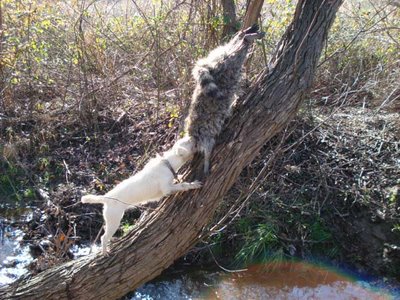


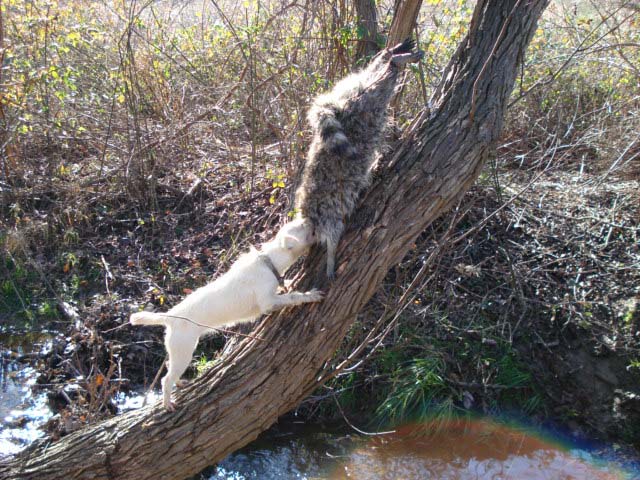
Pearl climbs a tree to grab a very dead raccoon. She got to work this one a little, as did Moxie.