The American foxhound is the state dog of Virginia and the Walker Coonhound is named after Dr. Thomas Walker who discovered the Cumblerand Gap and was the second person to import foxhounds to America. Walker was a resident of Albermarle County, Virginia.
Wednesday, March 11, 2009
Largest Litter of Dogs
The American foxhound is the state dog of Virginia and the Walker Coonhound is named after Dr. Thomas Walker who discovered the Cumblerand Gap and was the second person to import foxhounds to America. Walker was a resident of Albermarle County, Virginia.
Thursday, November 2, 2006
Danger for Dandies: Market Forces at Work

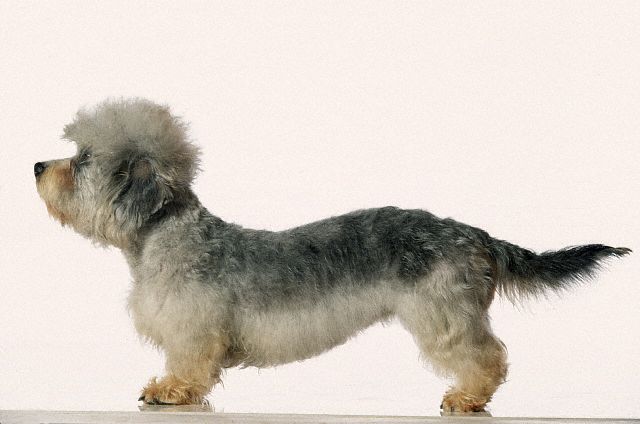
A Dandie Dinmont: Sway-backed, expensive, and now generally too big to go to ground.
In a shocking turn of events, it turns out that market forces work ... even in the world of dogs.
Two once-working terrier breeds (at least according to history) are now teetering on the edge of extinction.
The UK Kennel Club has officially designated the Dandie Dinmont a "vulnerable native breed" after it figured out that more giant pandas were born last year than Dandie Dinmonts. In the last three years, fewer than 100 Dandie Dinmonts were born in the UK - the lowest number since records began.
Hilary Cheyne, a committee member of the Caledonian Dandie Dinmont Terrier Club, says urgent action is required to reverse the decline. "These are difficult times for the Dandie Dinmont terrier," she said. "Although our breed is steeped in history, we need to tackle the breed's survival and revival in a modern and progressive way, which I believe we are doing."
Of course "urgent action" does not mean actually working the dog (that would not be very "modern and progressive," would it?).
No, the urgent action required is to -- wait for it -- hold a special show to encourage more people to own the breed and "raise awareness of its plight."
In short, the "urgent action" is going to be more rosettes, pets and puppy peddling.
Don't improve the product -- double the advertising budget. Talk about the hair of the dog that bit 'ya!
Only 33 Dandie puppies were registered with the UK Kennel Club in the first half of 2006. In the United States, only 51 Dandie Dinmont terriers were registered with the American Kennel Club during 2005.
Earlier this year, it was revealed that the Skye terrier, the dog immortalized in the story of Greyfriars Bobby, is also facing possible extinction, with only 30 born in Britain in the past 12 months.

A Skye Terrier: A dog for hair dressers and frustrated Barbie Doll collectors.
The Dandie Dinmont was named after a fictional character in Sir Walter Scott's 1815 novel Guy Mannering.
It appears the Dandie Dinmont was never very popular as a working dog (there is no record of it being much used by anyone, anywhere, ever).
Rawdon Lee, writing in 1893, describes the dog as:
"[P]perhaps the most crooked legged of any of our terriers; he is not an active dog, and is little use for work in a 'stone wall country,' nor is his 'crook' the slightest advantage in any way."
Rawdon Lee goes on to note that the best working dogs, even in his day, were not found in the Kennel Club:
"As a matter of fact, those [terriers] best adapted for hard work either with foxhounds or otterhounds are cross-bred, hardy dogs, specially trained for the purpose, although many of the 'pedigree' animals will do similar duty to the best of their ability, but their 'pedigree' and no doubt inbreeding to a certain extent, has made them constitutionally and generally weaker than their less blue-blooded cousins."
Yes indeed. Is it an accident that most American working terriers are found in a Club that prohibits high levels of inbreeding? I think not.
In America the Kennel Club (the largest in the world) is stumbling financially as the fog has lifted and dog owners have begun to realize that not only are AKC dogs not higher quality than other dogs (including so-called "mutts"), they are frequently lower quality due to long histories of inbreeding within a closed registry system.
As a result, the American people are beginning to turn to dogs registered in more open registries or planned hybrids.
Show ring snobs refer to planned hybrids as "designer dogs" under the mistaken belief that show ring dogs (with their cookie-cutter standards) are something else.
In fact, while most AKC breeds are bred by design for no higher purpose other than snobbery, some planned hybrids (such as the "labra-doodle") are being bred for a specific reason -- tractability, to avoid problems within a deeply inbred show ring gene pool, or to decrease shedding or improve coat quality.
The AKC response to people voting with their pocket books, of course, has NOT been to jettison the closed registry system which has resulted in sicker dogs that are more expensive to own -- it has been to strengthen it's long-term relationships with puppy mill operators and Pet Stores, and to enter into the crooked business of selling pet insurance and recommending veterinarians (is there a kickback to the AKC?), while working to require mandatory micro-chipping (the AKC sells the most popular brand).
In addition, the AKC continues to try to sweep non-AKC breeds into their folds in order to boost numbers -- dogs like the Jack Russell Terrier, the Border Collie, the Coton de Tulear, the Argentine Dogo, the Bluetick Coonhound, and Black and Tan Coonhound, the Catahoula Leopard Dog, the Cesky Terrier, the Dogue de Bordeaux, the Leonberger, the Plott Hound, the Tosa and the Treeing Walker Coonhound.
Can the Patterdale Terrier and the Fell Terrier be far behind? Only a fool cannot see it coming.
- Related Post:
** More on Dandie Dinmonts -- and a Small Challenge
.
Saturday, July 8, 2006
"That Dog Don't Hunt."
Note the working gun, the dead raccoons, and the focused dog. This is NOT the AKC way.
As the article below makes clear, the AKC now has its eye on bringing more coonhounds into the AKC, complete with a full retinue of "field trials".
The "field trials," of course, involve no guns (Heaven forbid!) and no animals will be killed (Good Lord, no!). Instead, raccoons will be placed in solid wire cages far up trees and towed across ponds on little styrofoam rafts.
This is hunting as boy scout competition (Campers, everyone will get a merit badge for this activity!), as opposed to what it is really supposed to be about -- a meditative contemplation of nature, a working demonstration of field craft, a partnership between dog and man, a test of some small physical abiltity of dog and human over a long day in cold, wind, heat, rain and sun.
These raccoon "field trials" are to raccoon hunting what go-to-ground trials are to real terrier work, and what clay pigeons are to bird hunting.
In short, they will have almost no relationship to the real thing at all.
What is the rationale for bringing more coonhound breeds into the AKC ? According to the article, below, the goal is to make sure coonhounds are "preserved" for the future.
But look at the numbers given in this article. How many non-AKC registered coon dogs are there in this country? And how many are in the AKC?
And how many dogs of any breed are in the AKC as compared to the number of unregistered coonhounds?
Hmmmm. You don't need to be a scent hound to smell the bullshit coming off this one.
The real deal, of course is that the AKC wants and needs dollars. Never muind the dogs. Plush offices on Madison Avenue are not cheap.
Before prospective coonhound hunters go down the AKC road, I would recommend they look and see how many AKC huskies are winning the Iditarod, how many AKC greyhounds are winning at the track, and how many AKC terriers they can find being dug to in the field.
Go into the field in duck, quail and pheasant season and ask the owners of the best working dogs how their four-legged companions are registered. Go to a working sheep farm and ask them if their working border collies are affiliated with the AKC
And then ask yourself this: Is this the road I want to go down?
Most serious owners of working dogs will tell you the same thing about the Kennel Club: "That dog don't hunt."
In the AKC, honest field work (i.e. real hunting) is always given the hind post, while progessive inbreeding within a closed registry is the norm. As a result, in its 130-year-history, the Kennel Club has never made a working dog; but it has ruined plenty of them.
And so it goes, once again. . . .
American Kennel Club Promotes Coonhound Initiative
By COKE ELLINGTON, Associated Press Writer, July 08,2006
The American Kennel Club is trying to make coonhounds couth.The nation's largest and most recognized dog registry is in the early stages of a major push to add coonhounds to its prestigious rolls, hoping both to increase its membership and to assure these sad-eyed symbols of country life stick around a while longer.
"We're interested in the registration of these dogs and their litters, but we're most interested in preserving these dogs for the future," said Steve Fielder, who moved to Raleigh in late 2004 to launch the club's coonhound initiative.
To meet its targets, the AKC has found itself negotiating with governments to assure there's ample hunting land for the dogs, setting up competitive hunts and working to enlist more of the estimated 1.2 million coonhounds in the nation.
It may seem like unlikely work for a club headquartered on swanky Madison Avenue in New York City and more closely tied to images of pouffy poodles than howling hounds, but Fielder insists it's right in line with the club's mission.
"The AKC wants to be all things canine," said Fielder, one of about 300 people at the AKC's operations center in Raleigh.
To help with its initiative, the AKC began offering free registration last year to coonhounds already enlisted with two other national clubs. The move resulted in about 10,000 registrations, up from about 500 the previous year. The club expects to have another 10,000 registered by the end of this year, pushing the total number of AKC registered coonhounds to 22,000.
Still, coonhounds make up a tiny part of the club's registry. Labrador retrievers were the most popular breed in 2005 with nearly 138,000 registered by the AKC. Almost 921,000 dogs were registered in all.
Registration costs just $15, but acceptance by the AKC is invaluable to breeders and others who need or want to prove their dogs have pure bloodlines.
For coonhounds, registering alsoopens the way for the dogs to compete in AKC-sanctioned hunts and competitions that offer titles, trophies and cash prizes of as much as $25,000. Just in July, the AKC is sponsoring about 70 coonhound competitions across the nation, including contests for youth, field trials, water races and night hunts.
Night hunts tie most closely to the tradition of the coonhound owners across the South who once led packs of dogs on late-night winter hunts, forcing the raccoons up trees where the hunters could get a clear shot at them. The raccoon hides fetched $20 to $30 each in the late 1970s, according to Perry Sumner, a biologist with the state Wildlife Resources Commission. With demand dwindling, a raccoon hide today is worth about $5, he said.
"Now the money is more in the hounds than in the coons," Sumner said.
A good coonhound can sell for $4,000 to $5,000, with some bringing up to $100,000, said David Gardin, the president of the North Carolina Coonhunters Association. Running the dogs has become more of an expensive hobby than a vocation, he said. Outfitting a hunter can cost up to $5,000, excluding the cost of the dogs, and the AKC doesn't allow guns or the taking of game during any of its events.
"It's more politically involved and it's more expensive," Gardin said.
The AKC first registered black and tan coonhounds - one of six coonhound breeds - in 1945, but during the past 60 years there had been little mingling between hound owners and the AKC. Coonhound owners were more likely to register with the Professional Kennel Club or the United Kennel Club and the AKC didn't seem to mind.
Coonhound handlers cared mostly how well a dog could tree a raccoon, while the AKC largely focused on the appearance of dogs.
Now, their interests seem to have merged.The AKC is expected to fully recognize Plott hounds sometime next year, while the treeing Walker, the American English, the bluetick are in the early stages of being fully recognized, perhaps by 2008.
"The coonhound has been kind of like a subculture in the world of dogs," Fielder said, "but with the AKC involved the spotlight is shining on the breeds."