Showing posts with label disaster. Show all posts

Tuesday, September 19, 2006

Lost and Not Found: Hurricane Katrina Jack Russell


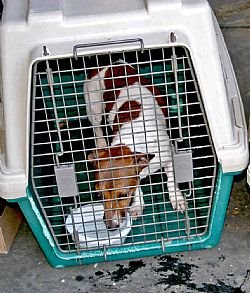
Max, a 7-year old brown and white Jack Russell Terrier, was one of the many dogs placed in local animal shelters during Hurricane Katrina, when fleeing residents were told they could not bring pets with them to hotels or to temporary housing facilities.

Max appears to have been one of the dogs airlifted from the Lamar Dixon Shelter in New Orleans on or about 09-10-05 and sent to California.

Unfortunately, Max was NOT supposed to be placed on a plane to California, and his records seem to have disappeared so there is no way to know where he has gone to.

Max's old owners are desperately looking for him, and are anxious to see him return home.

Max was 7 years old when he disappeared, and was an intact male, though he may now be neutured. He is white and brown with a brown face and ears with a thin line down the center of his face, and a patch of white on his upper left muzzle. He has half a brown saddle on his right shoulder, and a full brown saddle mid-back, and a large brown spot on his butt. His tail has been cropped as in the photo.

Please circulate a link to this page and/or pictures and a description to rescues, terrier lists, and pet owners as you see fit.

For more information and to contact the owner, see >> http://helpbringmaxhome.bravehost.com


Tuesday, February 21, 2006

Looking for Milo in New Orleans after Katrina


Jack Russell Terrier: smooth-coated; 6 years old; male, neutered; mostly white with a brown ring around the right eye and a small square brown patch on left ear; last wearing a red harness and a brown leather spiked collar.

He has a St. Bernard Parish booster tag and a Milo Carollo ID tag, with a phone number no longer in service.

Contact: Frank, Tara, Christina, and Gianni Carrollo: 504-881-7267, 901-874-2465, 901-872-0430, fax: 901-874-2568 or cell 504-376-5611 (Tennesee). You can also email Frank at Frank_carollo@yahoo.com.

Additional Information: Milo was left with friends at 3 Pamela Street, Arabi, LA 70001. He escaped the yard after the hurricane but before the flooding.

Listed on www.petfinder.com , ID #55615.

Wednesday, October 19, 2005

From Hurricanes Shelter to Deer Stand


Scores of thousands of trailers are being putchased by the U.S. Government to house victims of Hurricane Katrina.

What will be done with them in 18 months when they are no longer needed? Some will be shipped overseas, some will find use in the secondary market, some will be scrapped, and I am betting a few will end up like the one below -- the world's most luxurious deer stand.

America, what a country!

Sunday, September 18, 2005

The Dogs of Hurricane Katrina


Standard poodle in the debris and water.


Notice the two dogs to the right -- strangled and dead after jumping over the rail.


Wet and bedraggled with nothing to eat and no dry spot to rest.


Four large dogs on a wet car roof. No telling how long they have been there.


A matted terrier of some sort tries to find something to eat by licking the sharp metal edges of a can.


A young dog in oil-contaminated water. As desperate as it gets.


Unspeakable joy, unspeakable sorrows.


Flat bottomed boat from the DNR with dog crates on a rescue mission.


Hope has arrived for this dog. No telling where the owners are, however, and there are many more dogs than people with homes to care for them.

Wednesday, September 7, 2005

New Orleans Pet Rescue Gathers Steam


CTV.ca News Staff

With progress being made in evacuating people from New Orleans, some are turning their attention to other living creatures affected by the flooding: pets.

People left thousands of dogs, cats and other family pets behind in the rush to escape either Hurricane Katrina or the flooding that followed.

"We alone at the Humane Society of the United States, through our 1-800 number, logged 1,500 calls from people who lived in New Orleans and said they left their pets there," the Humane Society's Wayne Pacelle told Canada AM Tuesday.

"They simply misjudged how long they'd be gone. They left food for a couple of days, and now of course, people won't be able to enter for months."

Many of those animals sit forlornly on the rooftops of flooded homes, slowly starving to death as rescue boats ignore them, looking for people instead. Some have even tried swimming to boats, only to be rebuffed by the rescuers.

"A lot of these animals are pit bulls, rottweilers. We're not approaching the dogs if we can help it," says Jitm Metza, a U.S. Coast Guard searcher.

One fear is that after seven days in the hot sun, with no food, and drinking nothing but polluted water, the dogs might be dangerous.

On dry land, stray dogs have formed packs to scavenge the city for food.

Help for animals, however, is coming.

"There are hundreds of people on the ground now, who are trained in emergency animal rescue disaster response, just waiting to get into the areas hardest hit," Betsy Saul, president of Petfinder.com, told CNN on Monday.

It appears that pets were one reason why many people stayed behind in the flooded city. One man "refused to leave even at gunpoint when he was ordered to leave by the patrolmen in our boat," said CTV News Toronto's Paul Bliss.

"He said no because he had seven dogs that he want stay and take care of."

CTV's Jed Kahane met another couple who turned down a ride out to wait a few days and walk out of the flood zone with their dogs and other pets.

"They're dependent," Adrienne Price said, a snake around her neck. "This is my kid. These are my babies."

Many people who did evacuate were forced by authorities to abandon their pets before being whisked off to a different city or state.

Saul said there is information available at katrina.petfinder.com, "and certainly if they want to contact us directly ... we can get make sure they have the information they need to get to the (bus)."
The ASPCA (American Society for the Prevention of Cruelty to Animals) also has a searchable online database to help reunite pets with their owners. Volunteers who want to help can register on the society's website.

Several temporary animal shelters have been set up around southern Louisiana and Mississippi -- some next to shelters for human evacuees so people could visit their pets, she said.

Louisiana State University is providing shelter for hundreds of dogs and cats in an arena. One such shelter in Gonzalez, La. is taking pictures of every animal and uploading them to the Internet.

Besides pets, the flooding has damaged some of New Orleans' animal attractions.

The electricity failure meant no ability to pump oxygen into the water at the New Orleans aquarium, resulting in the deaths of about one-third of the 4,000 fish there.

At the zoo, 12 people are trying to take care of about 1,400 animals. After seeing what Hurricane Andrew did to Miami's zoo in 1992, the New Orleans facility upgraded its hurricane preparations, so losses there were minimal.

Russell Rescue & Hurricane Katrina

To find out what you can do to help terriers and terrier owners displaced by hurricane Katrina, see >> http://www.terrier.com/notices/katrina.php3

Friday, September 2, 2005

Time to Step Up


The area devastated by Hurrican Katrina is over 90,000 square miles -- as large as all of the United Kingom, including England, Scotland and Wales.

As I write this, scored of thousands of people are still trapped behind disease-infested water. They are hungry, scared, thirsty and sick. They have been failed by poverty, stupidity, hubris, and several generations of Government, of which the current administrations in Louisiana, Mississippi and Washington are but the latest cringing and pathetic incarnations.

I will stay out of the politics, and try to keep it to people and dogs.

People first. Please do what you can. Send money, and do not be tight about it.

After you have sent cash, send letters to your local newspapers asking for a public accounting of past, current, and ongoing government failure.

If you have friends or family in the area, now is the time to step up and offer a room, cash assistance, or the loan of a car.

If you have a free moment, take time to send emails to corporations asking them to step up to the plate by offering free or low-cost construction materials, a few days free lodging, diapers, medicine, clothes, soap, food, storage, free kennel sections for pets, free camping gear, etc. Something's got to give, and if it's not us, who is it going to be?

If you are overseas, now is the time to give back something to America. We will not ask for it, but by God you should step up and give it, as no country has ridden in more often to save the bacon of poor people in other countries than the U.S. A million of America's most impoverished are now homeless, jobless. They are simply wiped out.

For those of you in the Southern U.S. that have kennels with room to spare, a lot of people with dogs are now trapped in their cars or in hotels without good alternatives for their animals. Again, now is the time to step up.

Veterinary technicians or veterinarians who would like to volunteer in the disaster area can do so through the Louisiana State University School of Veterinary Medicine. To volunteer, contact Dr. David Senior, or by phone at 225-578-9551.

Here is more info from LSU's website:

Animal Evacuation and Recovery Plan for New Orleans
The Louisiana Society for the Prevention of Cruelty to Animals (LA/SPCA), the Louisiana Veterinary Medical Association (LVMA), the Louisiana Animal Control Association (LACA), and the LSU School of Veterinary Medicine (SVM) are managing animal evacuations and recovery plans for New Orleans pets and displaced animals.

Pets Traveling With Owners

** Lafayette: The LVMA is currently accepting pets at the Blackham Coliseum in Lafayette, LSU in Shreveport, the Monroe Civic Center for small animals and the Ike Hamilton Center for large animals in Monroe, the Farmer’s Market in Alexandria, and the LSU Agriculture Center/Parker Coliseum in Baton Rouge. Owners must be housed in a Red Cross shelter; owners are responsible for caring for their animals, including feeding and cleaning. Animals will be accepted 24 hours a day. Veterinarians will be on hand to handle any medical needs.

** Baton Rouge: While owners are responsible for the feeding and cleaning of their pets at the Parker Coliseum in Baton Rouge, the SVM, along with volunteers from the Baton Rouge Veterinary Medical Association, will provide veterinary care. If for some reason, an owner is unable to care for a pet sheltered in the Parker Coliseum (e.g., the owner is housed in a special needs shelter), SVM student volunteers will provide primary care, such as feeding and cleaning. The East Baton Rouge Animal Control Center will be taking stray animals. The Parker Coliseum will be staffed 24 hours a day by a supervising veterinarian and student volunteers from the School of Veterinary Medicine. Pets in the Coliseum will be given physical exams and Bordetella (kennel cough) vaccinations. If a pet requires medical attention and veterinary monitoring, it will be sent to the LSU School of Veterinary Medicine’s Veterinary Teaching Hospital.
.
DONATIONS
Financial donations are being accepted to fund the animals’ care through the Dr. Walter J. Ernst, Jr. Veterinary Memorial Foundation at the Louisiana Veterinary Medical Association at 1-800-524-2996. Make checks payable to the LVMA Dr. Walter J. Ernst Veterinary Memorial Foundation (write Disaster Relief Fund on the memo line) and send to the LVMA, 8550 United Plaza Blvd., Suite 1001, Baton Rouge, LA 70809. They will be able to use these funds quickly.

A regional donation center is being established. Needs include: large air kennels and metal cages, leashes, disposable bowls, canned cat and dog food, disposable litter pans, spray bleach, paper towels, sheets, towels, locks, hoses, bottled water, trash cans, trash bags, pooper scoopers, cat litter, extension cords, fans. The most urgent needs are kennels and monetary donations. For more information or to make donations of the materials listed above, please call the LSU School of Veterinary Medicine at 225-578-9900 (www.vetmed.lsu.edu) or the LVMA at 1-800-524-2996 (www.lvma.org).